



Abstract
Background
In coil packing for visceral artery aneurysms (VAAs), difficulties are sometimes associated with preserving the patency of the parent artery, particularly for wide-neck aneurysms. However, the double-microcatheter technique effectively prevents coil migration, while the triple-coaxial (triaxial) system is useful for reducing microcatheter kick-back.
Purpose
To assess the feasibility of combining these two techniques in coil packing for VAAs.
Material and Methods
Coil packing using the double-microcatheter technique and triaxial system was attempted for seven VAAs in six patients between August 2015 and January 2018. The technical success rate, packing density of aneurysms, complications related to the procedure, and occlusion status were evaluated. Technical success was defined as the completion of coil packing by immediate post-embolic angiography. The occlusion status was evaluated using time-resolved magnetic resonance angiography.
Results
There were three renal, three splenic, and one anterior superior pancreaticoduodenal aneurysms. The median size of VAAs was 13 mm (range = 8–21 mm), with five being classified as wide-neck aneurysms. The completion of coil packing was confirmed for all VAAs and the technical success rate was 100%. The median packing density was 28% (range = 22–40%). There were no complications related to the procedure. The median follow-up period was 14 months (range = 8–24 months). In six VAAs that were followed up, there were three complete occlusions, three neck remnants, and no body filling; re-treatment was not required in any patient.
Conclusion
The combination of the double-microcatheter technique and triaxial system is a feasible method of coil packing for VAAs.
Introduction
The incidence of visceral artery aneurysms (VAAs) has been increasing; they are now detected in approximately 0.09–2% of the general population due to the more frequent use of imaging modalities, such as computed tomography (CT) and magnetic resonance imaging (MRI) (1). The mortality of ruptured VAAs is reported to be in the range of 20–100% (1–3), justifying treatment for unruptured VAAs. Coil embolization is one option for the treatment of VAAs. Although advances have been achieved in many devices and techniques, difficulties are sometimes associated with performing coil embolization for VAAs, particularly wide-neck VAAs (1,2,4). Furthermore, recanalization may occur after coil embolization because of coil compaction and occasionally requires re-treatment (1–3). To prevent this, coil embolization needs to be performed with a high packing density (3). The double-microcatheter technique, which employs two microcatheters inserted through one guiding sheath, was previously shown to effectively prevent coil migration during the procedure and gives a high packing density for intracranial aneurysms (5–7). It has recently been applied to VAAs (8,9). However, even with this technique, microcatheter kick-back is a cause for concern. The triple-coaxial (triaxial) system, which consists of a small microcatheter, large microcatheter, and guiding catheter, is a useful technique for superselective coil embolization because it has been shown to prevent the kick-back of small microcatheters by providing good support from the large microcatheter (10,11). Therefore, we hypothesized that the triaxial system may be combined with the double-microcatheter technique. The purpose of the present study was to assess the feasibility of combining the two coil packing techniques for VAAs.
Material and Methods
This retrospective study was approved by the Institutional Review Board. Written informed consent for the procedure was obtained from all patients. Based on previous findings, the following indications for the treatment of VAAs at our hospital were employed (12–14). Symptomatic VAAs were considered to require treatment. The treatment threshold for the maximum diameter of asymptomatic VAAs was approximately 15–20 mm; VAAs with an increasing diameter during imaging follow-up and VAAs in women of childbearing age were indicative of treatment. Pancreaticoduodenal arcade aneurysms of any size were included due to the high risk of rupture. Splenic aneurysms with chronic liver disease were also considered for treatment. In the case of multiple VAAs, when one VAA required treatment, the others were also treated during the same session at the request of patients.
Between August 2015 and January 2018, 17 patients with 18 VAAs underwent coil embolization. An isolation technique with which an aneurysm may be trapped between coils placed in the parent artery distal and proximal to the aneurysm, thereby eliminating antegrade flow and the potential for retrograde flow to the aneurysm, was attempted for five VAAs in 5/17 patients. Based on the shape and location of the aneurysms, this technique was initially performed when coil packing was considered to be difficult and blood flow to the distal site of the VAAs appeared to be preserved due to collateral arteries. Thus, these five VAAs were excluded from the present study. Furthermore, six VAAs in six patients that were treated with coil packing using a balloon remodeling technique were excluded. In these cases, a balloon catheter was introduced via a different access route from that of coil packing to prevent the migration of coils to the parent artery, and it was inflated in front of the aneurysm neck during coil embolization and removed at the end of the procedure. As a result, for the remaining seven VAAs in six patients (three men, three women; median age = 68 years; age range = 40–83 years), coil packing using the double-microcatheter technique and triaxial system was attempted and evaluated in the present study.
The technical success rate, packing density of aneurysms, complications related to the procedure, and occlusion status were evaluated. Technical success was defined as the completion of coil packing by immediate post-embolic angiography. The occlusion status was evaluated using time-resolved magnetic resonance angiography (TR-MRA) and was classified into three categories according to the literature (15): complete occlusion; neck remnant; and body filling. The follow-up period was defined as the duration until the last hospital visit or death. All procedures were performed by a single operator (MS) who had 14 years of experience in diagnostic and interventional radiology with assistants (TG, KO, and KS).
Calculation of the packing density
The packing density was calculated using the formula: packing density = 100 × (total coil volume/aneurysm volume). Total coil volumes were calculated assuming a cylindrical coil shape using the formula: coil volume = π × (coil radius)2 × (coil length) for each coil. Aneurysm volumes were estimated assuming an ellipsoid shape using the formula: aneurysm volume = (4/3) × π × (length/2) × (width/2) × (height/2). The size of each aneurysm was measured in three planes (length, width, and height) using the pre-treatment multiplanar reconstruction of contrast-enhanced multidetector row CT images. Aneurysm heights were measured by the line that perpendicularly intersected the neck line of the parent artery. Regarding the dome diameter, length was defined as the maximum diameter of the line that perpendicularly intersected the height. Width was calculated based on the line that perpendicularly intersected the length. Height did not include the diameter of the parent artery at the aneurysm neck. The aneurysm size was defined as the greatest diameter. The dome-to-neck ratio was also calculated by dividing the dome width by the neck size, and wide-neck aneurysms were defined as having a dome-to-neck ratio <2.
Coil embolization technique
All procedures were performed under regional anesthesia. Six out of the seven procedures were approached via the femoral artery; the one remaining procedure was approached via the brachial artery because of the obstruction of the aorta due to Leriche syndrome. A 4.5-Fr. (Parent Plus; Medikit, Tokyo, Japan) or 5-Fr. guiding sheath (Destination; Terumo, Tokyo, Japan) was introduced and placed at the celiac artery for splenic and anterior superior pancreaticoduodenal aneurysms, and at the renal artery for renal aneurysms. A large microcatheter (2.8-Fr. microcatheter, Carry Leon High-flow; UTM, Toyohashi, Japan) and small microcatheter (2.0-Fr. no-taper microcatheter, Carry Leon Selective; UTM) were then introduced through the guiding sheath (double-microcatheter technique). Thereafter, another small microcatheter (2.0-Fr. no-taper microcatheter) was inserted through a large microcatheter (triaxial system). Coil packing was attempted using bare platinum electrically detachable coils (Target XL; Stryker, Fremont, CA, USA and DeltaMaxx; Codman, Raynham, MA, USA) from the two small microcatheters (Fig. 1). After the first two coils created a mesh, the aneurysm was densely packed with coils of a smaller diameter until the operator felt resistance and considered it unsafe to deploy more coils into the aneurysm. When the small microcatheters inserted directly from the guiding catheter sagged from kick-back due to the resistance of the existing coils, coil embolization was attempted from another small microcatheter inserted through the large microcatheter because the large microcatheter was able to support the small microcatheter and prevent kick-back.
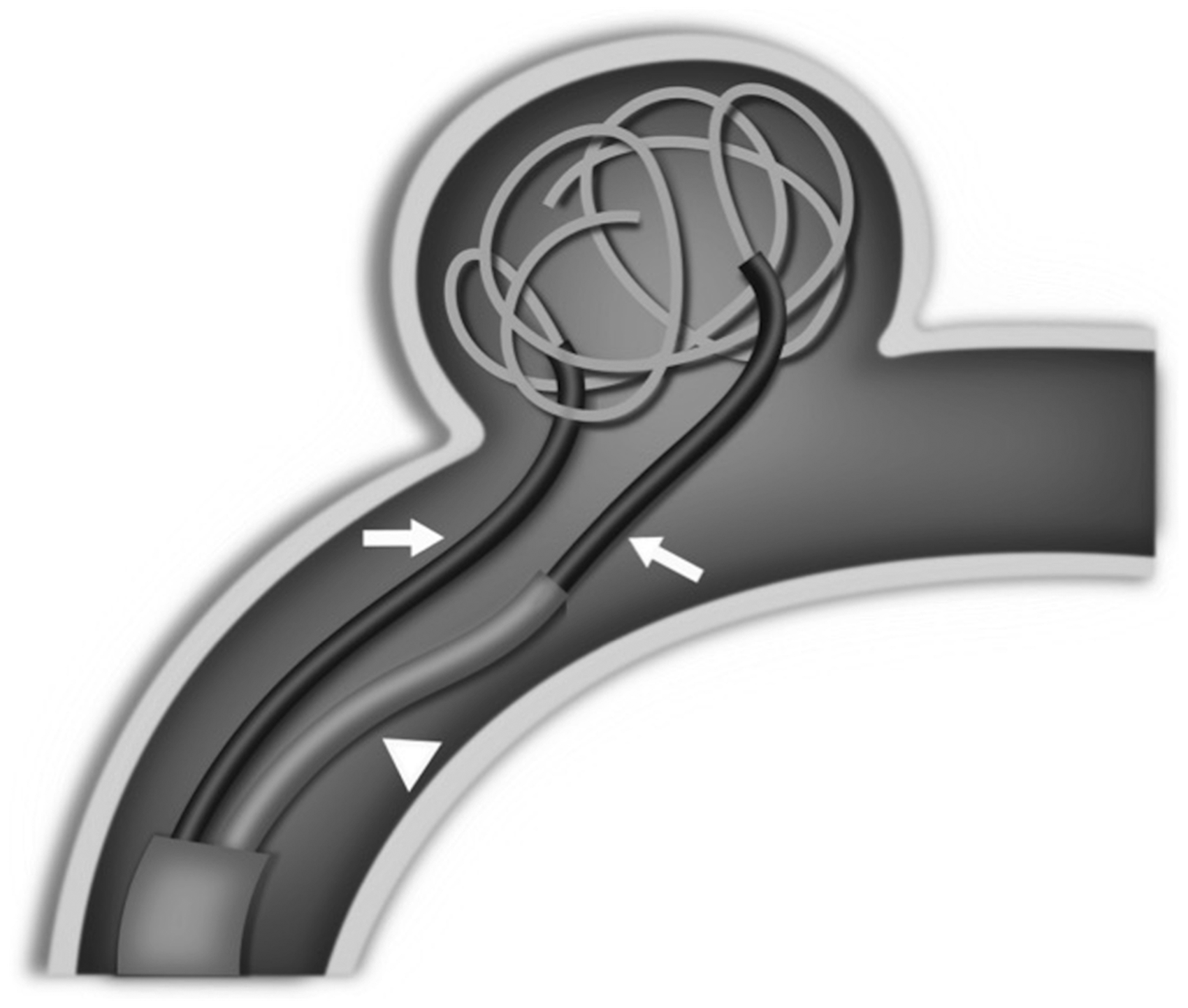
The double-microcatheter technique and triaxial system. Two small microcatheters (arrows) were placed in the VAA (double-microcatheter technique). One of the small microcatheters was supported by a large microcatheter (arrow head) (triaxial system) to prevent kick-back.
Follow-up examinations for the occlusion state
The occlusion status was evaluated with TR-MRA, and planned at three, six, and 12 months and every 12 months thereafter. Follow-up images were interpreted for recanalization by two radiologists (MS and TG, with 14 and seven years of experience in diagnostic and interventional radiology, respectively). Any discrepancies were resolved through consensus.
All TR-MRA was performed on a 1.5-T MR system (Achieva; Philips Healthcare, Best, The Netherlands) or 3.0-T system (Skyra; Siemens, Erlangen, Germany, Ingenia; Philips Healthcare). TR-MRA was acquired with a three-dimensional (3D) T1-weighted gradient-recalled echo sequence. The temporal resolution achieved was 1.7 s for Achieva and Ingenia, and 1.0 s for Skyra. Each acquisition slab was set to include the afferent/efferent artery and aneurysmal sac with portions of the aorta. Twenty-five consecutive 3D volume images were acquired immediately after the injection of contrast media (0.1 mmol/kg of Gd-chelate, Magnevist; Bayer HealthCare, Whippany, NJ, USA) at a flow rate of 3 mL/s, followed by a 30-mL saline flush during breath-holding. All source images from each frame were reconstructed with a maximum intensity projection algorithm.
Results
Details of VAAs and the results obtained were summarized in Table 1. All patients were asymptomatic, and all VAAs were saccular and unruptured. There were three splenic, three renal, and one anterior superior pancreaticoduodenal aneurysms. The median size of VAAs was 13 mm (range = 8–21 mm), five of which were classified as wide-neck aneurysms based on the dome-to-neck ratio. The completion of coil packing was confirmed for all VAAs; thus, the technical success rate was 100%. The median packing density was 28% (range = 22–40%). In all cases, there were no arteries sacrificed during the procedure. Furthermore, there were no complications related to the procedure. Although one patient with one VAA moved to another hospital and, thus, was not followed up, six VAAs in five patients were followed up. The median follow-up period was 14 months (range = 8–24 months). There were three complete occlusions, three neck remnants, and no body filling (Fig. 2), and re-treatment was not required in any patient.
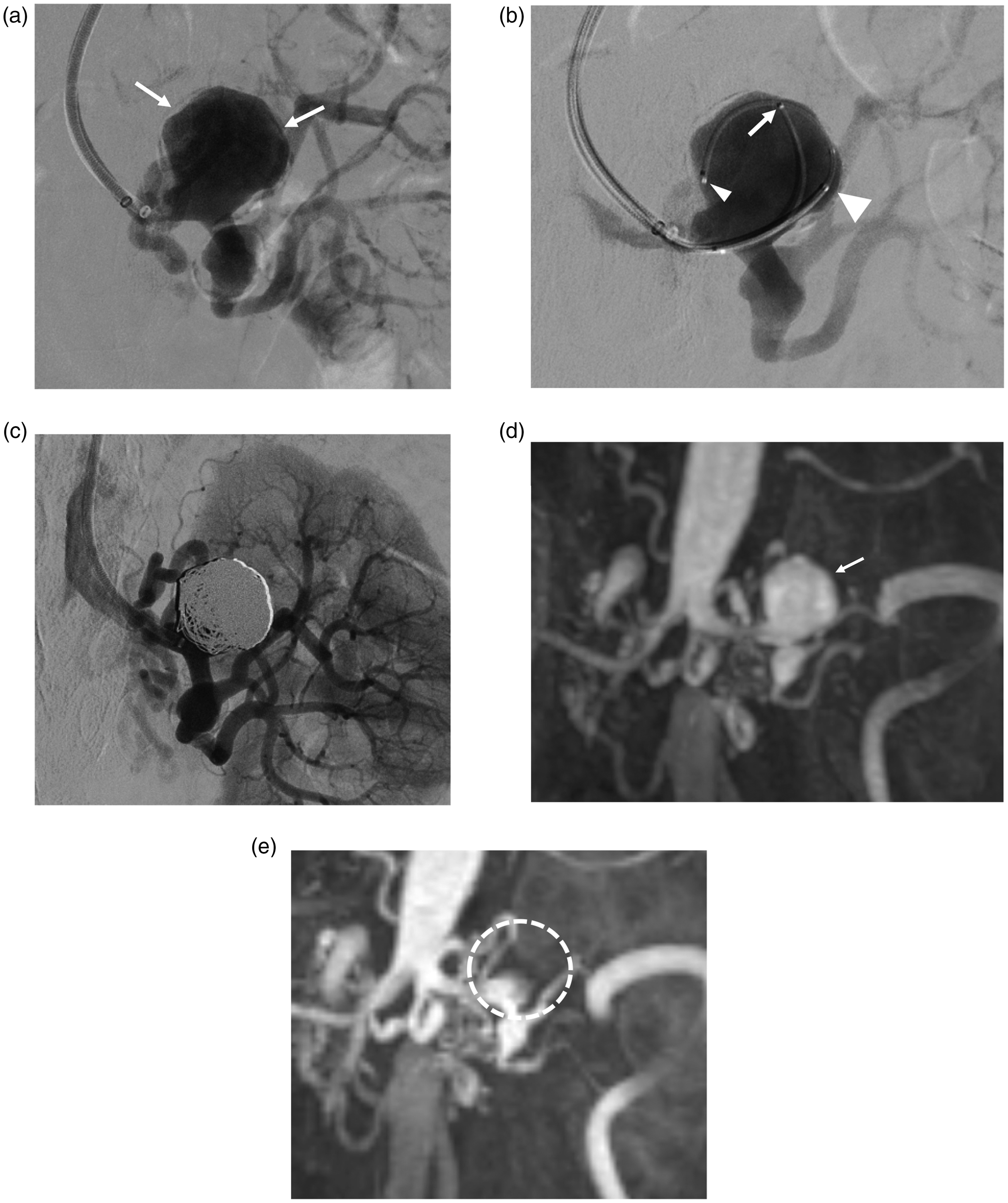
An 80-year-old woman with a left renal aneurysm underwent coil embolization using the combined double-microcatheter technique and triaxial system. This patient had obstruction of the aorta due to Leriche syndrome and left subclavian artery stenosis. Thus, the access route was limited to only the right upper-limb artery. (a) Angiography from a 5-Fr. guiding sheath placed at the left renal artery showed the aneurysm (arrows). (b) A large microcatheter (large arrow head) and small microcatheter (arrow) were introduced through the guiding sheath (double-microcatheter technique). Another small microcatheter (small arrow head) was then inserted through the large microcatheter (triaxial system). (c) Coil packing was attempted using bare platinum electrically detachable coils from the two small microcatheters until the operator felt resistance. When coil packing was finished, the packing density reached 22%. (d) TR-MRA before the procedure showed the left renal aneurysm (arrow). (e) In follow-up TR-MRA performed 24 months later, outcomes were evaluated as neck remnants not requiring re-treatment.
Details of VAAs and results.
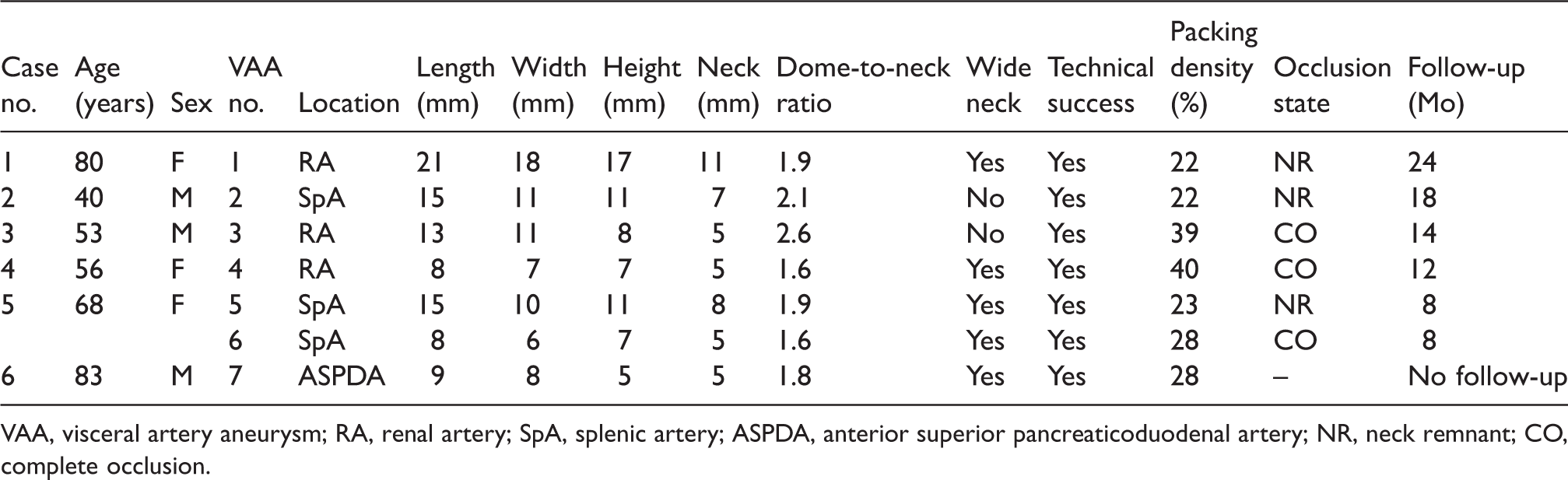
VAA, visceral artery aneurysm; RA, renal artery; SpA, splenic artery; ASPDA, anterior superior pancreaticoduodenal artery; NR, neck remnant; CO, complete occlusion.
Discussion
In the present study, all seven VAAs were treated successfully by combining the double-microcatheter technique and triaxial system with a relatively high packing density and good occlusion status. A recent study reported no recanalization in VAAs with a packing density of >24% (3), which is considered to be the threshold of the minimal packing density. In the present study, the median packing density was 28%, although 5/7 VAAs were wide-neck aneurysms. Thus, the combination of the double-microcatheter technique and triaxial system may increase the packing density.
The usefulness of the double-microcatheter technique, particularly for wide-neck intracranial aneurysms, has been demonstrated (16–19). An important issue when placing coils in wide-neck aneurysms is that even when the initial coil is successfully placed to make a frame, subsequent coils may displace the detached initial coil through the wide neck into the parent artery. A solution to overcome this issue is to place two coils into the aneurysm before detaching the coils. In this technique, coils simultaneously placed in the aneurysm cause the coils to intermingle with each other and remain within the aneurysm. An advantage of this technique is that the first coil remains retrievable if the second coil displaces the first. Thus, coil placement may be attempted repeatedly until a good frame is achieved. Furthermore, when coil locking or stretching occurs, coils and microcatheters may be easily retrieved together until coil detachment. Since a single guiding catheter is inserted, the removal of all devices is safe and easy. In this technique, difficulties may be associated with injecting contrast through the 4.5-Fr. or 5-Fr. guiding sheath because of the smaller internal space due to the use of two microcatheters, and the diagnostic quality of angiography may be compromised. Thus, when the quality of angiography is poor, another catheter may be required from another access route for diagnostic angiography.
Another concern during coil packing is microcatheter kick-back. If this occurs, it is difficult to place coils into the aneurysm. To prevent this, a guiding catheter needs to be advanced close to the aneurysm in order to provide good support to the microcatheters. However, with the double-microcatheter technique, the guiding catheter is relatively large, and, thus, it is challenging to advance it deeply. On the other hand, in the triaxial system, a large microcatheter may be advanced deeply and it provides good support to small microcatheters (10,11). At the end of coil packing, several coils are present in the aneurysm and may resist the microcatheter, thereby causing microcatheter kick-back. Under these conditions, when coils are advanced from the small microcatheter through the large microcatheter (triaxial side), coils may be placed into the aneurysm without kick-back. Theoretically, it is possible to insert two large microcatheters into the 5-Fr. guiding catheter, making both microcatheters into the triaxial system. However, the inside of the guiding catheter is narrow, which may interfere with the two microcatheters and disturb their manipulation. Thus, we made the triaxial system on one side only. Since good results were achieved, we considered this to be sufficient.
The balloon remodeling technique is useful for preventing the protrusion of coils into the parent artery in VAAs (4,20). Furthermore, stent-assisted coil placement was shown to be appropriate, particularly for wide-neck aneurysms (13,21). A stent is initially placed across the neck of the aneurysm, followed by the insertion of coils into the aneurysm sac through the interstices of the stent, which, in turn, constrains the coils within the sac. However, no stents are currently approved for stent-assisted coil placement for VAAs in Japan. Additional devices, such as another guiding sheath, balloon catheter, and stent, need to be used in these techniques, which increases the cost of and time needed for this procedure. However, our technique of combining the double-microcatheter technique and triple-coaxial system achieves good results without a balloon catheter or stent, which is an important advantage. On the other hand, new materials for the treatment of VAA, such as a stent graft (22) and multilayer stent (23), have recently been reported. Although they are not yet available in Japan, they are promising.
In the present study, a femoral artery access was selected because it represented an easy approach and was familiar to operators. However, a brachial or radial artery access may provide good stability for a guiding sheath in the celiac or superior mesenteric artery, particularly when the angles of these arteries are acute. Therefore, a brachial or radial artery access may improve the stability of guiding sheaths. Furthermore, the buddy wire technique and use of a neuro-interventional guiding catheter may be effective.
Our study has several limitations. The single-centered retrospective design was the key limitation. Furthermore, we estimated aneurysm volumes assuming an ellipsoid shape; however, this may be inaccurate, particularly for multilobulated and irregularly shape aneurysms. In addition, TR-MRA equipment and spatial and temporal resolutions varied among patients. Six out of the 7 VAAs were evaluated with TR-MRA only and were not confirmed by angiography. However, our group previously reported the usefulness of TR-MRA for the follow-up of VAAs and pulmonary arteriovenous malformations (24,25). Another limitation is that since this was not a comparative study, it currently remains unclear whether this method is superior.
In conclusion, the combination of the double-microcatheter technique and triaxial system may be a feasible coil packing method for VAAs.
Footnotes
Declaration of Conflicting Interests
The author(s) declared no potential conflicts of interest with respect to the research, authorship, and/or publication of this article.
Funding
The author(s) received no financial support for the research, authorship, and/or publication of this article.