



Abstract
Background
The characteristics of self-corrected publications have not been fully evaluated.
Purpose
To evaluate the annual number and characteristics of self-corrected publications in the imaging literature within the last 20 years.
Material and Methods
We searched MEDLINE (via PubMed) using the following keyword: (“Published Erratum” [Publication Type] OR “Corrected and Republished Article” [Publication Type]) in the imaging literature to identify all self-corrected publications in which initial versions of articles were published during 1999–2018. Extracted data included: date of publication of the original version; date of correction notification; the time interval between initial publication and correction; journal name; journal impact factor (IF); type of articles; number of authors; country of origin; and location of errors. Journals were divided into four quartiles (Q1–Q4) based on their IF.
Results
A total of 1071 self-corrected publications were identified, representing 0.30% of all papers published in the imaging literature. Trend analysis showed exponential growth of the number and rate of self-corrected publications during 1999–2018. The median (range) time interval from initial publication to correction was 120 days (0–7755 days). The rate of self-corrected publications in Q4 journals (0.17%) was significantly lower than those in Q1 (0.35%, P<0.0001), Q2 (0.26%, P=0.0007), and Q3 (0.30%, P<0.0001) journals. Additionally, 80.8% of self-corrected publications were original articles, 29.2% were from the USA, and 30.7% were corrected for author information (name, affiliation, and email address).
Conclusion
Self-corrected publications in the imaging literature have increased exponentially during 1999–2018 and author information was the most common location of error correction.
Introduction
Research is the primary source of knowledge in science, and publication of research findings serves as a key mechanism for dissemination of knowledge and establishes the basis for future research. It is thus important that scientific audiences have trust in the published literature and faith in the research (1). Research integrity relies on the implementation of ethical standards, professional methodology, good research conduct, and accurate documentation and reporting (2).
Corrections, or errata, are often published after the original version of an article but can be vital to scientists using information from the original version. Since the 1980s, the National Library of Medicine (NLM) has included errata fields in the MEDLINE database entries and serves correction information to readers (3). The development of online journals and hypertext linkages has allowed publishers to directly bring self-corrected publication to readers of the original version of article.
Errors in publication cause dissemination of erroneous data to readers, collaborators, and investigators, and most importantly, may increase risk of inadequate management for patients. In addition, correction of erroneous publication might take a great deal of time, effort, and money. Hence, it is worth analyzing the characteristics of self-corrected publications for the reduction of inadvertent errors in scientific publications. To the best of our knowledge, only a few studies (4–6) have been conducted to access the features of self-corrected publications. Therefore, the aim of the present study was to comprehensively evaluate the annual number and characteristics of self-corrected publications in the imaging literature over the last 20 years.
Material and Methods
The present study was a retrospective bibliometric analysis of a publicly available database and was exempt from institutional review board approval. A study investigator (JHH) performed the article search and data extraction.
Search strategy
The NLM MEDLINE database was searched through PubMed search platform (http://www.ncbi.nlm.nih.gov/pubmed/) on 10 June 2020 to identify all self-corrected publications in the imaging literature in which initial versions of articles were published between 1999 and 2018. Therefore, all included articles had a correctable period of at least 1.5 years.
First, MEDLINE was searched to identify the total number of publications in all biomedical journals and the total number of publications within imaging literature between 1 January 1999 and 31 December 2018. Second, MEDLINE was searched for all articles in which the initial PubMed entry for the article was indexed with a publication type of “Published Erratum” or “Corrected and Republished Article.” Finally, among the search results, those published in the imaging literature were selected for subsequent evaluation. The imaging literature was defined as all journals that were included in the “Radiology, Nuclear Medicine & Medical Imaging” category of the 2019 Journal Citation Reports (JCR) (Clarivate Analytics, Philadelphia, PA, USA). A total of 133 of 12,855 journals indexed by the 2019 edition of JCR were categorized as imaging literature.
The title and abstract (and full text if required) of each article were reviewed to ensure a self-corrected publication. In most (although not all) instances, these publications had one of the following words in the article title: “Correction OR Corrections,” “Erratum OR Errata,” “Addendum OR Addenda,” or “Corrigendum OR Corrigenda.” No restrictions were placed on the language or publication type for our study.
Data extraction
For all included self-corrected publications in the imaging literature, the correction notices were reviewed from MEDLINE. If information about a correction was not available or ambiguous from the MEDLINE database, we searched the journal’s website to obtain additional information. In addition, searches of MEDLINE or journal websites were performed to identify original versions of the self-corrected publications. The following information was obtained from each publication: (i) year, month, and day of publication of the original version; (ii) year, month, and day of correction notification; (iii) the time interval between initial publication and correction; (iv) journal name; (v) journal impact factor (IF); (vi) type of articles (original article, review, case report, or miscellaneous [pictorial essay, editorial, letter, technical note, quiz, educational material, book review, commentary, and news]); (vii) number of authors; (viii) country of origin; and (ix) location of error (author information [name, affiliation, and email address], authorship including the position of author, title, abstract, introduction, materials and methods, results, discussion, conclusion, references, acknowledgement, table, figure, or unknown or unclear [the location of error was not mentioned or not clearly stated]).
The time interval between publication and correction was calculated in days. If the date of publication or correction was expressed in months, a month was considered to be 30 days. Articles published and self-corrected in the same month were considered to have a time interval of 15 days. For our research, the corresponding author’s country was considered the country of origin of the publication because the corresponding author takes primary responsibility for communication with the journal during the manuscript submission, peer review, and publication process. If the corresponding author (or co-corresponding authors) has an affiliation with more than one country, the country of origin of a publication was determined based on the first author’s country. The journal IF was determined using the JCR 2019 edition. Journals were divided into four quartiles based on the journal IF: Q1 (n = 33); Q2 (n = 33); Q3 (n = 33); and Q4 (n = 34). Q1 is occupied by the top 25% of journals in the list; Q2 is occupied by journals in the 25%–50% group; Q3 is occupied by journals in the 50%–75% group; and Q4 is occupied by journals in the 75%–100% group.
Analyses
The data were downloaded into a spreadsheet for analysis using Microsoft Excel software (Microsoft Corp., Redmond, WA, USA). The chi-square test was used for comparison of self-correction rates between Q1, Q2, Q3, and Q4 journals. Linear regression analysis was used to explore the trends of the number and rate of self-corrected publications. Otherwise, the present study adopted a descriptive research approach through bibliometric analysis. Statistical analyses were performed by using SPSS software SPSS Statistical software (SPSS, version 20.0 for windows, IBM SPSS Inc, Chicago, IL, USA) and a P value < 0.05 was considered statistically significant.
Results
Between 1999 and 2018, a total of 362,819 articles were published in the 133 imaging-related journals. Of these, 1071 (0.30%) self-corrected publications were identified using the MEDLINE database. In comparison, 51,274 self-corrected publications were found in other journals in the same period, representing 0.32% of 15,921,658 publications (P < 0.01). Self-corrected publications were published in 106 journals, led by Medical Physics (n = 56), followed by Radiology and Neuroimage (n = 53 each), and European Radiology (n = 45). When the number and rate of self-corrected publications in the imaging literature was fitted over time in linear regression analysis, better fits were observed for exponential curves than for straight lines in both number (adjustment equation: y = 0.645e°.310x, R2 = 0.924 vs. y = 11.64x-23,321.69, R2 = 0.639) and rate (adjustment equation: y = 7E-05e°.252x, R2 = 0.875 vs. y = 0.00045x-0.905, R2 = 0.642) from 1999 to 2018 (Fig. 1). A total of 935 (87.3%) self-corrected publications were initially published between 2014 and 2018. When the journals were divided into four groups by their IF quartile (descending order), the rate of self-corrected publications in Q4 journals (0.17%) was significantly lower than those in Q1 journals (0.35%, P < 0.0001), Q2 (0.26%, P = 0.0007), and Q3 (0.30%, P < 0.0001) journals. The rate of self-corrected publications in Q1 journals (0.35%) was significantly higher than those in Q2 (0.26%, P = 0.0002) and Q4 (0.17%, P < 0.0001) journals (Table 1).
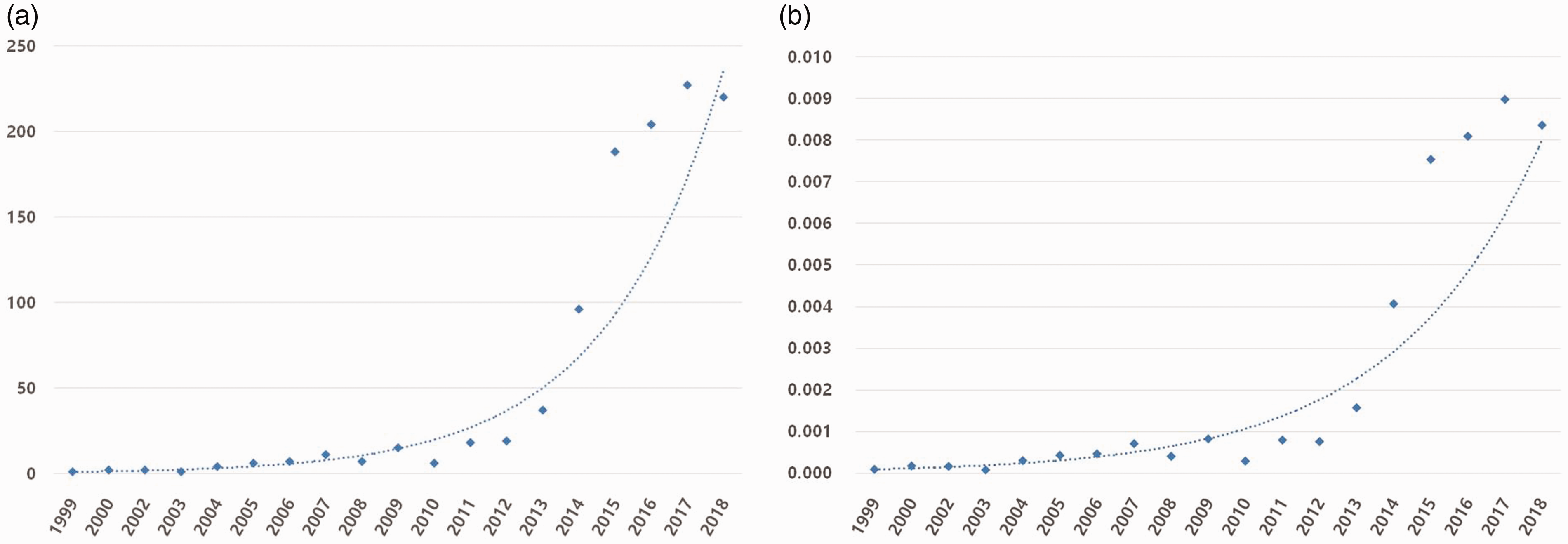
Growth curves of the number (a) and rate (b) of self-corrected publications in the imaging literature from 1999 to 2018. (a) Exponential adjustment: y = 0.645e°.310x (R2 = 0.924). Note: The data point for 2001 was excluded because of zero value. (b) Exponential adjustment: y = 7E-05e°.252x (R2 = 0.875). Note. The data point for 2001 was excluded because of zero value.
The number and rate of self-corrections according to JCR journal rank in the imaging literature between 1999 and 2018.

*Significantly higher than Q2 (P = 0.0002) and Q4 (P < 0.0001) journals.
†Significantly lower than Q1 (P < 0.0001), Q2 (P = 0.0007), and Q3 (P < 0.0001) journals.
JCR, Journal Citation Reports–Clarivate; JIF, journal impact factor.
Table 2 presents the characteristics of self-corrected publications in the imaging literature. The median time interval from initial publication to correction was 120 days (range = 0–7755 days). In 811 (75.7%) self-corrected publications, the correction took place in the first 12 months after the initial publication. The original articles (80.8%) represented the most frequent type of self-corrected publications, followed by review articles (11.1%). The median number of authors listed in each publication was 7 (range = 1–120). Most of the self-corrected publications had corresponding authors from the USA (313, 29.2%), distantly followed by Germany (113, 10.6%), Japan (57, 5.3%), Republic of Korea (52, 4.9%), Canada (51, 4.8%), United Kingdom and France (each with 49, 4.6%), China (46, 4.3%), and Italy (44, 4.1%). The most common location of error for correction was author information, which accounted for 30.7% of all corrections, followed by figures (17.8%), and tables (13.2%); 71 articles (6.6%) were self-corrected for at least two locations of errors. The location of error for the correction of 142 articles (13.3%) was not explained or unclear in the correction notice.
Characteristics of self-corrected publications in the imaging literature between 1999 and 2018.

Values are given as n (%) or median (range).
*Percentages do not add up to 100% because some articles have more than one location of error.
†The location of error was not mentioned or not clearly stated.
Discussion
The appropriate correction (or erratum) of error is an important part of the scientific process. NLM’s definition of an erratum is defined as significant errors in the text, abstract, or descriptive part of an article. It does not include small imprecisions or typographic errors of little consequence (3). These errors would be corrected if the indication of the change to the online record was made evident to the users in a subsequent issue of a journal. Corrections in the scientific literature are usually due to honest or inadvertent errors/mistakes, resulting from poor editing and proofreading. However, although an honest error was inadvertent and the underlying science is still reliable, its potential impact can be significant if inaccurate information forms the basis for subsequent research.
The main aim of the present study was to determine the number and rate of self-corrected publication in the imaging literature. Overall, the self-corrected publication was uncommon in the imaging literature (0.30%), occurring at a slightly lower frequency than for other MEDLINE indexed journals (0.32%). In 2016, Rosenkrantz reported an analysis of retracted publications within the imaging literature between 1983 and 2013, using the PubMed database with a similar method to that which we used for the data search. The rate of retracted publications from 122 imaging journals was 0.011% in that study (7), thus 0.30% of the correction rate in the present study was almost three times higher than the previously reported retraction rate.
The annual number of corrections in the imaging literature has increased exponentially during 1999 to 2018, as shown in Fig. 1. The number of corrections was markedly increased in the last five-year period (2014–2018) compared with 1999–2003 (935 and 6 corrections, respectively). This finding is in accordance with those of previous studies about chronological trends of retracted publications (7–9) that showed an increasing number of retractions in the past years. In recent decades, the combined effect of the “publish or perish” culture and financial support for health research may result in a growing number of scientific journals and published articles (10,11). However, our results demonstrated that the absolute number and the rate of corrections have increased as a whole. The increases in number and rate of corrections may be explained by increasing errors in the publication or raising the level of awareness and response of authors, readers, and journal editors. In addition, more corrections may be a reflex of advances in a publication system that can easily identify errors and correct publications. Further in-depth investigation of corrected publications is needed to evaluate this aspect.
The present study provides the first insights and characteristics of self-corrected publications in scientific literature. In the present study, the Q1 journals with higher IFs had a significantly higher correction rate than other groups. This finding can be explained by the fact that these prestigious journals usually have many audiences who can find honest errors in the article but also reflects a more positive attitude of high-quality journals for correction of previously published articles. More than 80% of self-corrected publications were original articles in the present study. This may be not only since original articles present the methods and results of authors’ research and usually include many tables and figures but also the dominant number of original articles in imaging literature. The mean number of authors listed in each publication was 7.7 between 1999 and 2018, comparable to the mean numbers of 6.2 in 2001–2003 and 7.1 in 2011–2013 of leading radiology journals (12). The majority (72.3%) of self-corrected publications were originated from nine countries, eight of them (except China) were also top-eight contributors of radiology articles published in Science Citation Index Expanded journals between 1986 and 2010 (13). A previous study (6) reported a similar result that strong association existed between the total number of publications across countries and duplicate and retracted publications.
Even if appropriately corrected at the time of discovery, self-corrected publications nonetheless might be potentially problematic. First, erroneous data or expression could be disseminated to readers, collaborators, and investigators. In the case that the correction is visible in the journal and clearly noted in bibliographic databases, it is not sure that all readers are alerted to the correction. Furthermore, an initial uncorrected publication may be cited as containing errors by other researchers unaware of the correction. A previous study indicated that citation of original invalidated publication occurred at a rate nearly the same as that of self-corrected publication for at least the first eight years after publication (5). This is particularly important in the medical field where erroneous data or expression from the uncorrected paper may have been incorporated into the management of patients (14). In addition, there might be a great deal of time, effort, and money spent on discovering errors and publishing the subsequent self-corrected version (15).
Such problems are of particular concern in weak linking and a lengthy delay between initial publication and correction. The notice, as well as the self-corrected publication, should be linked to the original version of publication. In addition, the correction notice should explicitly state the location of correction. In 2003, Poworoznek (4) reported that significant disparities were observed in linking original versions with self-corrected publications between journals. No links were observed between self-corrected publication and original versions in 17 of the 43 journals examined in that study. In contrast, all journals explored in the present study showed that self-corrected publications were accurately linked to the corresponding original versions in journals’ websites. However, the indication of the location of error was found to be inconsistent in some cases. There were 142 (13.3%) publications for which no exact location of error was provided in correction notice. Another consequence is that these corrections should be published as soon as possible to minimize harmful effects from erroneous publications. In the present study, the median time interval from initial publication to correction was four months, which was markedly shorter than the median of 2.0 years between publication and retraction in the imaging literature (7). In 260 (24.3%) self-corrected publications, however, the time interval from initial publication to correction was > 1 year.
Exponential trend growth of self-corrected publications may thus require greater efforts to reduce honest errors in scientific publications. First, the authors are responsible for preventing erroneous data and expression in their manuscript. All authors should pay attention to not only drafting or revising the article but also final approval of the version to be published (16). We expect that at least minor errors would be reduced by attentive final approval. Journal editors are responsible for maintaining the integrity of published articles in the manuscript editorial process before publication. In addition, journal editors should also provide accurate and comprehensive reporting on a correction. Finally, there is a need to raise awareness and training of researchers regarding the meaning and importance of self-corrected publication.
The present study had several limitations. First, the search was conducted with the MEDLINE database that offers the possibility to search for the self-corrected publications in a standardized way. A more exhaustive search using multiple databases may yield additional self-corrected publications and produce different results. Second, our study only included corrected publications published in journals in the category of “Radiology, Nuclear Medicine & Medical Imaging” according to the 2019 JCR. Thus, imaging-related journals that were not included in the JCR list were excluded from the analysis. Finally, our analysis included only self-corrected publications of honest errors in scientific manuscript. However, it is unclear how many of these errors remain undetected or uncorrected.
In conclusion, self-corrected publications in the imaging literature have been increased exponentially over the period 1999–2018 and author information was the most common location of error correction.
Footnotes
Declaration of conflicting interests
The author(s) declared no potential conflicts of interest with respect to the research, authorship, and/or publication of this article.
Funding
The author(s) received no financial support for the research, authorship, and/or publication of this article.
