



Abstract
Background
Bisphosphonate-associated stress fractures, atypical femur fractures (AFF), are a rare subgroup of femoral stress fractures. Their correct and early diagnosis is imperative for appropriate treatment.
Purpose
To investigate the sensitivity of written radiology reports to mention radiographic features of AFF, depending on the time period and academic level of the hospital.
Material and Methods
We used 171 patients, aged 55 years or older, who sustained an AFF between 2008 and 2010 (early period) identified through the Swedish National Patient Register and radiographic review and 104 patients identified through the Swedish Fracture Register between 2015 and 2018 (late period). Plain radiographs were extracted from 72 radiology departments in Sweden and individually re-reviewed and classified based on the American Society for Bone and Mineral Research case definition for AFF. Radiology reports were viewed for mentioning AFF or stress/insufficiency features (true positives). The number of true positives was compared with the number of false positives for both periods using non-parametric statistics and using the gold standard as reference.
Results
We obtained 98 of the possible 171 reports with 7% of true positives for the early period and 77 of the possible 104 reports with 27% true positives for the late period (P < 0.001). The level of improvement over time was independent of the academic level of the hospital.
Conclusion
Despite improvements over time, written radiology reports seldom mention AFF features. Clinicians, specifically orthopedic surgeons, are encouraged to contribute to a correct and early diagnosis to tailor treatment, while awaiting improvements in radiology reports.
Introduction
Atypical femur fractures (AFFs) are rare insufficiency type stress fractures of the femoral shaft with a strong association to bisphosphonate (BP) use (1), the most commonly used drugs in the treatment of osteoporosis. The relative risk of developing AFFs is approximately 55 times higher in bisphosphonate users compared to non-users (2). Related to the strong association between bisphosphonate use and AFF, the use of BPs to prevent osteoporotic fractures has decreased by >50% since 2005, leading to what has been referred to as a crisis in osteoporosis treatment (3).
However, with an annual incidence of 1.1–2.2 AFFs per 100,000 inhabitants (4), AFFs comprise only approximately 4% of all fractures of the femoral shaft and <0.25% of all femur fractures in Sweden. Since AFFs are rare, radiologists and treating orthopedic surgeons might see less than one AFF case every year thus possibly overlooking the specific fracture pattern in the abundance of other fractures of the femur (5,6). To increase awareness and diagnostic accuracy of AFFs, the American Society for Bone and Mineral Research (ASBMR) Task Force has published a case definition for AFFs using five major criteria (Table 1) (7). The radiological appearance of cortical stress fractures is the cornerstone of the ASBMR criteria reflected in two of the major criteria: transverse fracture line originating in the lateral cortex and a healing reaction around the fracture, i.e. focal cortical thickening due to callus formation (Fig. 1) (8). If utilized correctly the ASBMR criteria have a high sensitivity and specificity to discriminate AFF from other fracture types in the femur (9,10). However, a diagnostic challenge arises in patients with complete AFFs, where overlapping fracture fragments on plain radiographs can obscure the specific features of the stress fracture pattern. This issue is particularly problematic when no prior radiographs are available for comparison.
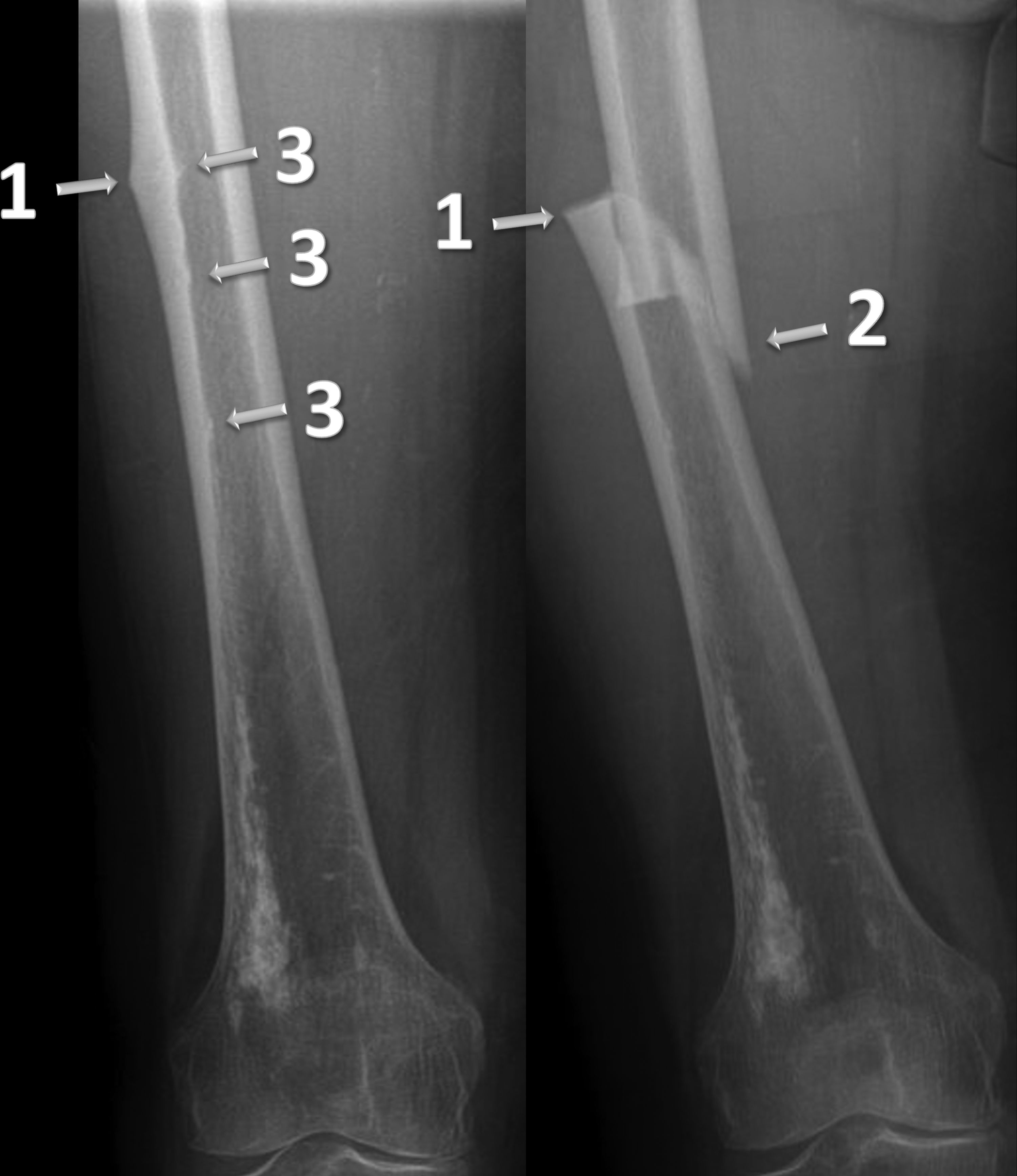
Radiographs of (a) an incomplete atypical femur fracture and progressing to (b) a complete atypical femur fracture. Indicated in the images are: focal cortical thickening at the fracture site with beaking/flaring (1); transverse orientation of the fracture line (insufficiency fracture part), with a medial spike in the displaced fracture (2); and multiple endosteal callus reactions (3).
ASBMR Task Force 2013 revised case definition of AFF.

*Excludes fractures of the femoral neck, intertrochanteric fractures with spiral subtrochanteric extension, periprosthetic fractures, and pathological fractures associated with primary or metastatic bone tumors and miscellaneous bone diseases (e.g. Paget’s disease, fibrous dysplasia).
AFF, atypical femur fracture; ASBMR, American Society for Bone and Mineral Research.
In AFFs, specifically, an early and correct diagnosis based on the first diagnostic radiographs is essential for the patient to receive adequate surgical treatment for fracture fixation (11) and to prompt cessation of BP treatment aiming to prevent the progression or development of an incomplete AFF on the contralateral side (7,12).
The aim of the present study was to increase awareness of AFFs by retrospectively reviewing two large historical cohorts of patients with AFFs. We investigated: (i) the sensitivity of mentioning AFFs in written radiology reports; and (ii) its differences over time by comparing reports from two nationwide cohorts with radiographically adjudicated AFF from two different time periods using our own expert adjudication as a gold standard. We hypothesized an improved sensitivity in the late period (2015–2018) compared to the early period (2008–2010), and that radiologists at academic teaching hospitals would have a higher likelihood of mentioning AFF features in written radiology reports.
Material and Methods
Ethics
The study was conducted in accordance with the Declaration of Helsinki and was approved by the local Ethical Review Board (DNR: 014/407-31 and 2017/1-149 32). The requirement for written informed consent was waived.
AFF cohorts
In a retrospective approach, written radiology reports from patient cohorts from two different time periods were acquired from all radiology departments in Sweden (Fig. 2).
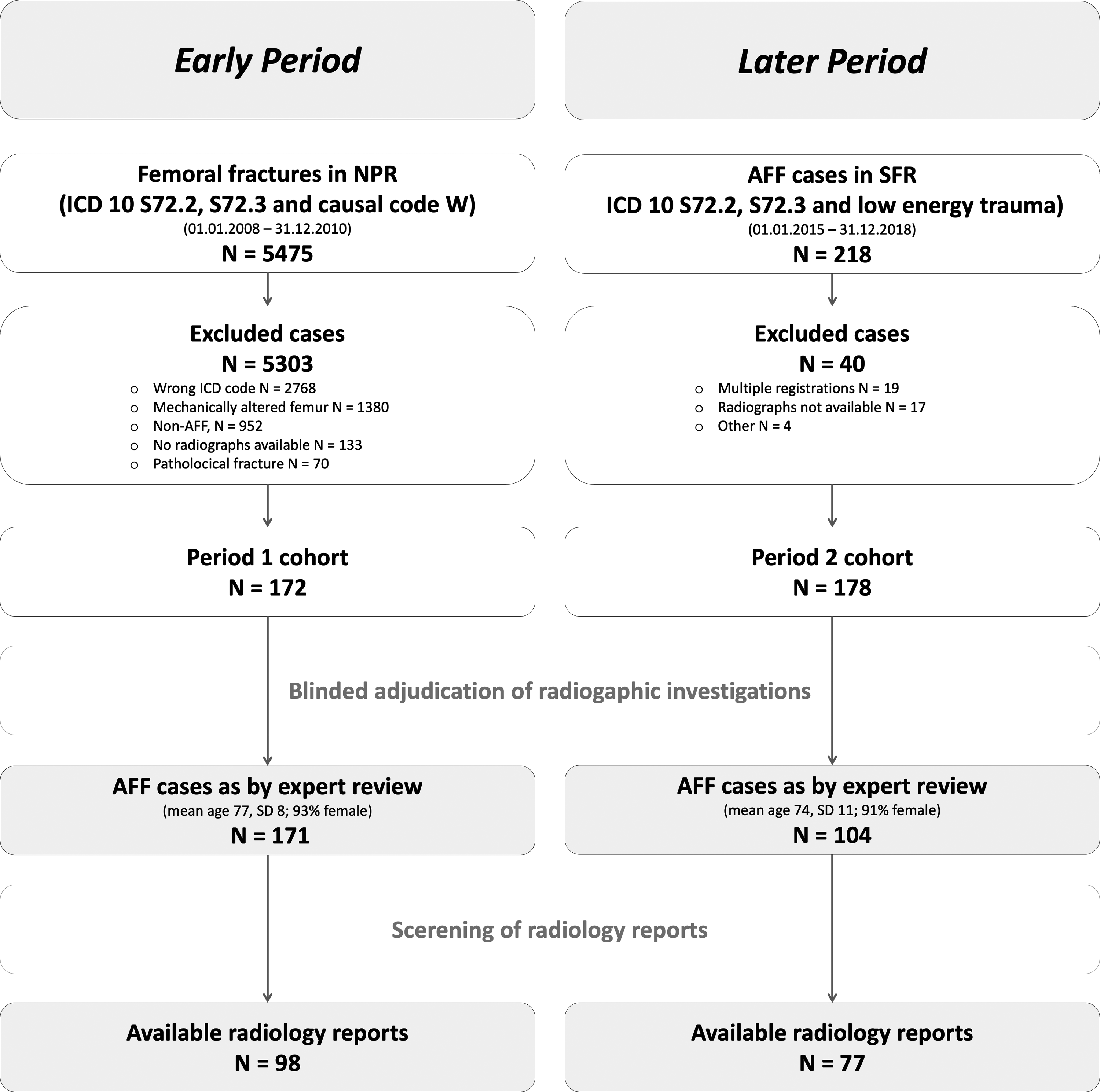
Flowchart showing the origins of and selection process for the two cohorts and the results of evaluating the written radiology reports. AFF, atypical femur fracture; NPR, Swedish National Patient Register; SFR, Swedish Fracture Register.
Early period (2008–2010)
The first period (early period) involved 5475 patients, aged 55 years or older, registered in the Swedish National Patient Register (13) as having a subtrochanteric or diaphyseal femur fracture (International Classification of Diseases 10 codes S72.2, S72.3 combined with causal code W for a low-energy trauma mechanism) during the period 2008–2010. Among these, we identified 171 patients with AFFs (gold standard classification) through blinded re-review of plain radiographs by expert reviewers (authors), applying the ASBMR major criteria (2,14). In our classification, the ASBMR major criteria of “transverse fracture line” and “focal periosteal thickening” were compulsory for a case definition of AFF (2,15).
Late period (2015–2018)
The second period (late period) involved 218 patients who were registered with AFFs in the Swedish Fracture Register (SFR), without any age restrictions, during the period 2015–2018. The SFR is a nationwide fracture register in which fractures are registered by treating physicians using a webpage with a personal login. During the process of registration of femoral shaft or subtrochanteric fractures, the user is asked to state whether the fracture accords with the ASBMR major criteria for AFF. Further information on the ASBMR criteria is presented in a written note and in a supplementary instructional video. Of the 218 patients who were registered as having AFF in the SFR, 40 were excluded due to multiple registrations of the same fracture (n = 19) or because we were not able to retrieve the relevant radiographs (n = 17). Four cases were excluded for not complying with the ASBMR case definition, e.g. pathologic fractures. The remaining 178 cases were re-reviewed by two expert reviewers of AFFs reviewing all the available radiographs independently and blinded for any background characteristics. After the individual assessments of the radiographs, unclear cases were resolved through consensus agreement (4), yielding a final gold standard classification of AFF in 104 patients. The remaining 74 patients were classified as normal femur fractures and were excluded. The ASBMR major criterion of low energy fracture was selected through search terms in the SFR, and of the remaining major criteria, “transverse fracture line” and “focal periosteal thickening,” were compulsory for a case definition of AFF (2,15).
Acquisition and assessment of written radiology reports
The final written radiology reports were retrieved either as printouts or digital copies for all AFFs according to the gold standard classification for both time periods. We screened all the reports for mentioning atypical femur fracture, AFF or stress fractures, or other indicators of stress fracture or ASBMR criteria. The findings were classified into three categories:
AFF: clear description or suggestion of AFF using any of the ASBMR major criteria. Stress fracture: description or suggestion of any of the well-established stress (insufficiency) fracture features. Non-AFF: no description or suggestion of AFF or stress (insufficiency) fracture features or ASBMR major criteria.
All the radiology reports were in the format of free prose and none was given as a structured report nor was any questionnaire used specifically asking for AFF or stress fracture (16).
Statistics
We used Pearson’s chi-square test (Jamovi ver.1.6.15.0 statistical software; jamovi.org) to compare the numbers of correctly identified AFF between the two time periods. Statistical significance was defined as a two-sided alpha of <0.05. To allow comparisons of fracture categories in the written radiology reports we considered the categories of AFF and stress fracture as true positives.
To minimize selection bias, we performed subgroup analyses of those counties for which all the written radiology reports were available in both time periods (Dalarna, Gävleborg, Gotland, Kalmar, Östergötland, Skåne, Uppsala, Värmland, and Västmanland).
We also compared differences stratified for the academic status of the hospital: university hospitals were defined as academic centers and the remaining hospitals as non-academic centers. We did not correct our analyses for multiple comparisons.
Results
AFF cohorts
Of the 171 AFF cases as defined by our adjudication for the early period, 98 radiology reports could be retrieved, and of the 104 AFF cases for the late period, 77 could be retrieved (Table 2). There was one incomplete fracture in the early period and 10 in the late period.
Distributions of the available radiology reports in relation to the patients’ characteristics.

Values are given as n (%) or mean ± SD.
The one patient with incomplete AFF in the early period was not identified in the radiology report compared to 7/10 patients in the later period.
From 9/21 participating Swedish counties, we were able to acquire all the radiology reports for both time periods. These nine counties contributed roughly 63% of all the acquired images (110/175 patients in the overall cohort). From the early period, 64 (65%) patients were included, and from the late period, 46 (60%) patients were included (Table 3).
AFF diagnostic accuracy levels for the radiology reports collected from academic and non-academic centers during the two time periods of the study.

Values are given as n (%).
*Reports that included a verbatim description/suggestion of an AFF.
Reports that included any description of an AFF or a stress fracture.
Fully completed radiology reports received in both periods from hospitals in Dalarna, Gävleborg, Gotland, Kalmar, Östergötland, Skåne, Uppsala, Värmland, and Västmanland.
AFF, atypical femur fracture.
Assessment of written radiology reports
Of the 98 radiology reports received for the early period, seven described findings of either AFF or stress fractures, compared to the 21/77 reports collected in the late period (P < 0.001) (Table 3). In the subgroup analysis of the counties that provided complete radiology reports for both time periods, 3/64 (4%) mentioned AFF features in the early period and 12/46 (26%) in the late period (P = 0.001) (Table 2). Both academic and non-academic hospitals showed a significant improvement in mentioning AFF features between the two time periods, 8% compared to 32% and 7% compared to 26%, respectively. However, there was no detectable difference in the reports between academic and non-academic centers at any of the two time points (P = 0.88) (Table 3).
Discussion
We found a significant improvement in the number of radiology reports correctly mentioning the radiographic features of AFF between the two time periods. However, this improvement emerged from unexpectedly low levels, and, in contrary to our hypothesis, we found no difference between the academic and non-academic hospitals.
Awareness of AFF as an adverse reaction to BP treatment among clinical specialties has led to intensive discussions on the risks and benefits of BP treatment, resulting in a distinct decrease in BP prescriptions in recent years (3). The field of radiology, though, seems less affected of this increased awareness of AFF and the ASBMR Task Force criteria (7) appear poorly applied in clinical practice (17). Reasons for this might be the limited awareness of the specific fracture pattern among radiologists and limited knowledge of the paradox of the situation in which drugs administered to prevent fragility fractures cause an insufficiency type of stress fracture (AFF). This limited awareness is reflected by the low number of publications on AFF in the radiology literature, as compared to the endocrinology, orthopedic, or basic science literature. We reviewed the literature using the terms “atypic* fem?r* fracture*” and found 1171 publications in MEDLINE. Of these 1171 papers, only 46 were published in scientific journals that can be categorized as pertaining directly to the field of radiology. Another explanation might be that the focus of reviewing radiologists in terms of AFF-specific features is misdirected by more obvious findings. In our series, the vast majority were complete fractures and much focus in the radiological reports was given to describe the degree of displacement and the number of fracture fragments. Such fracture details have a limited impact on the surgical decision-making compared to the distinction between a normal femur fracture and an AFF. In addition, the burden of an increasing number of images that need to be reviewed urgently imposed on physicians in the emergency care setting (18), including radiologist, might create a situation where the identification of specific fracture patterns cannot be prioritized (19).
Even if AFFs are rare, they comprise 10%–20% of all femoral shaft fractures (2) and approximately 4% of all fractures in the femur in the aged population. This low incidence might not be enough to ensure awareness or alertness in the clinical setting, underlining the need for automated alerting systems (6,17). Registers might offer one solution to this problem, although few healthcare systems have the necessary infrastructure or acceptance among physicians to use a register as a surveillance tool for rare fractures. However, the AFF detection rate was found to be much higher in such a register compared to reports from a database of adverse drug reactions (4). The Swedish Fracture Register does not use artificial intelligence (AI) but simply alerts the physician with the question “Is this an atypical femur fracture? Yes/No” when a femoral shaft fracture is reported. A structured radiologic report for the reporting of femoral shaft fractures that asks for features of AFF might have an equivalent effect on the radiologic assessment (16). The recognition of AFFs on radiographs is a matter of knowledge and alertness. Therefore, educational efforts should have great potential in improving diagnostic accuracy. However, such an educational improvement among radiologists would require a global effort. Another, perhaps more intriguing way for the future is to alert the radiologist of the possibility of AFF through deep learning tools in the clinical setting. Several studies have shown promising results of such AI tools even in the international context. One study from our group found a diagnostic accuracy of 91% when convolutional neural networks were used to discriminate normal femur fractures from AFFs (5). When using radiographs and register data in combination (4) or augmenting an AI with a manual attention box the diagnostic accuracy could be further improved (20). The challenges of using AI in the clinical situation lies in the discrimination of AFF from the many other conditions, such as implants from joint replacement or previous fracture surgery in the femur, requiring large datasets to train such an AI, and the certification process for clinical use (21).
A correct diagnosis is not only important for patient safety but also for medicolegal reasons. Not mentioning or providing incorrect diagnoses in radiology is not uncommon: in the USA, radiology is the specialty that is the sixth most frequent to attract malpractice claims, despite the fact that radiologists account for <5% of physicians in the US (22). Implementation of automated alerting systems might not only be cost-effective but could also contribute to an improved medicolegal situation for radiologists. Yet even the most-correct radiology report will not help if it is not read by the treating physicians. There are indications that orthopedic surgeons neglect to read radiology reports, particularly those that report on the findings from plain radiographs (23). This emphasizes the need for a combined effort from reporting radiologists, treating endocrinologists, primary care physicians, and orthopedic surgeons to achieve improved care for patients with AFF until AI tools are implemented (5).
The present study has some limitations. The two cohorts comprised patients with complete and incomplete AFFs and the numbers of these patients were unevenly distributed in the two cohorts. Out of 10 patients, seven were correctly identified in the later period, meaning that approximately 30% of patients (n = 21/77) that were correctly identified as AFF or stress fracture were incomplete. It seems that this uneven distribution explains much of the improvement between the two time periods. A possible explanation might be that incomplete AFFs are easier to identify on plain radiographs than complete fractures where overlapping of fracture fragments possibly obscure the distinct radiographic features of AFF and also might catch much of the attention in the clinical radiological assessment. Also, differences in the selection of cases between the cohorts might have led to a bias that we were not able to correct for.
A correct and timely identification of incomplete AFF might be even more important than that of complete AFFs. Incomplete AFFs can be treated with surgical fixation prophylactically and early detection would facilitate timely screening of the contralateral femur for AFFs and cessation of BP treatment. These measures could reduce the risk for progression of an incomplete fracture to a complete fracture, as well as the development of a contralateral AFF (11). Another limitation is that our results reflect the situation in Sweden and needs to be extrapolated to other countries and healthcare systems with care.
In conclusion, we encourage both radiologists and treating orthopedic surgeons to consider AFFs as a possible pathomechanism in subtrochanteric or diaphyseal fractures in patients at risk for this rare type of fracture.
Footnotes
Declaration of conflicting interests
The authors declared no potential conflicts of interest with respect to the research, authorship, and/or publication of this article.
Funding
The authors disclosed receipt of the following financial support for the research, authorship, and/or publication of this article: This work was supported by the Svenska Läkaresällskapet, Knut och Alice Wallenbergs Stiftelse, Centre for Research and Development, Region Gävleborg/Uppsala University, Gävle, Sweden, Region Östergötland, ALF Grants.
