



Abstract
Background
Repeated transarterial chemoembolization (TACE) may lead to treatment refractoriness, in which tumors fail to respond despite technically adequate procedures. However, evidence to guide optimal management strategies for patients with TACE-refractory hepatocellular carcinoma (HCC) remains limited.
Purpose
To assess the efficacy and safety of boosted transarterial radioembolization (TARE) in patients with TACE-refractory HCC.
Material and Methods
A total of 41 consecutive patients with TACE-refractory HCC underwent boosted TARE between November 2021 and December 2025. Tumor response, time to local tumor progression (TTLTP), time to progression (TTP), overall survival (OS), and adverse events were retrospectively analyzed.
Results
In total, 41 patients (36 men; mean age=66.1 ± 9.3 years) were evaluated. The median number of prior TACE sessions was 4 (range=2–11). Best index tumor response was complete response in 31 (75.6%) patients, partial response in 6 (14.6%), and stable disease in 3 (7.3%), yielding an objective response rate of 90.2%. Median TTLTP was not reached at the time of analysis. Median TTP was 6.5 months (95% confidence interval [CI]=3.1–8.8). Median OS was 31.8 months (95% CI=19.4–not reached). Among 25 patients with disease beyond the Milan criteria, 20 (80.0%) were successfully downstaged to within the Milan criteria, of whom seven subsequently underwent curative-intent surgery. Longer OS was observed in surgical patients compared with non-surgical patients (P = .048). Severe adverse events occurred in 4 (9.8%) patients. One patient died from sepsis after tumor rupture.
Conclusion
Boosted TARE may provide favorable local tumor control in selected patients with TACE-refractory HCC. Careful patient selection and dosimetry remain essential.
Introduction
Transarterial chemoembolization (TACE) is a standard treatment for patients with intermediate-stage hepatocellular carcinoma (HCC) according to the Barcelona Clinic Liver Cancer (BCLC) staging system and has been shown to improve overall patient survival.1–3 TACE induces tumor necrosis through a combination of ischemia and localized delivery of cytotoxic agents. However, achieving a sufficient tumor response after a single session is uncommon, and repeated procedures are often required. 4 Accordingly, clinical guidelines recommend performing at least two TACE sessions, with discontinuation in patients who fail to respond to treatment.5–7
Despite its therapeutic benefits, repeated TACE sessions can lead to treatment refractoriness, in which tumors fail to respond despite technically adequate procedures. The European Association for the Study of the Liver guidelines define TACE refractoriness as a lack of response after one or two consecutive sessions and recommend consideration of alternative treatments in patients with preserved liver function. 8 Although systemic therapy is indicated for advanced HCC characterized by vascular invasion and/or extrahepatic spread, evidence guiding the management of patients with TACE refractoriness restricted to intrahepatic progression remains limited. 7
Transarterial radioembolization (TARE) delivers high-energy beta radiation to tumors via intra-arterial administration of yttrium-90 (90Y)–labeled microspheres, inducing tumor apoptosis with minimal embolic effect. 9 TARE has demonstrated efficacy and safety as a first-line treatment in selected patients with HCC 10 ; however, its role as a second-line therapy in TACE-refractory disease remains unclear, especially as previous studies included small cohorts with suboptimal dosimetric assessment.11–15 Prior TACE may occlude small tumor-feeding arteries, potentially limiting microsphere delivery, and may also predispose patients to radiation-induced liver injury due to cumulative hepatic damage. 16 Therefore, the aim of the present study was to evaluate the efficacy and safety of boosted TARE in patients with TACE-refractory HCC, with particular focus on patients with intrahepatic target lesion TACE refractoriness.
Material and methods
Patients
This retrospective study was approved by the institutional review board of Asan Medical Center (reference no. 2025-1029). Due to the retrospective nature of the study, the requirement for informed consent was waived.
Patients who underwent TARE after prior TACE between November 2021 and December 2025 were screened for eligibility. Inclusion criteria required that patients had undergone at least two TACE sessions targeting the same lesion(s), with follow-up imaging demonstrating either a lack of objective response or local progression after each session. For the purpose of this study, TACE-refractory disease was defined as the absence of an objective response (complete or partial response) or the presence of local progression in the target lesion(s) on follow-up imaging performed after a minimum of two TACE sessions. Exclusion criteria were as follows: receipt of fewer than two TACE sessions before TARE; TARE performed for intrahepatic distant recurrence (i.e. previously untreated lesions); TARE performed for non-viable lesions after a favorable TACE response; non-HCC pathology (e.g. combined hepatocellular–cholangiocarcinoma or cholangiocarcinoma); or loss to follow-up.
Transarterial chemoembolization procedure
TACE was performed using selective or superselective catheterization of tumor-feeding arteries. Cisplatin (2 mg/kg) or doxorubicin (50 mg) was infused through a 1.7–2.4-Fr microcatheter (Progreat, Terumo, Japan; ASAHI Veloute and Tellus, Asahi, Japan), followed by up to 20 mL of a 1:1 emulsion of chemotherapeutic agent with lipiodol (Guerbet, Roissy, France). Embolization was then performed using calibrated gelatin sponge particles (Nexsphere, Next Biomedical, Republic of Korea; EGgel, Engain, Republic of Korea) until sufficient segmental arterial flow stasis was achieved. Patients were monitored overnight for possible post-embolization syndrome and other adverse events. Initial follow-up included laboratory examinations and computed tomography (CT) 1 month after TACE, followed by laboratory assessments and CT/magnetic resonance imaging (MRI) every 2–3 months. Repeat TACE was performed for residual or recurrent viable HCC detected on follow-up imaging.
Transarterial radioembolization procedure
TARE was performed using either glass (Therasphere; Boston Scientific, Marlborough, MA, USA) or resin microspheres (SIR-Sphere; Sirtex Medical Ltd., Sydney, NSW, Australia). Pre-treatment evaluation included hepatic arterial mapping with angiography and cone-beam computed tomography (CBCT), followed by technetium-99 m macroaggregated albumin imaging to determine the lung shunt fraction (LSF) and tumor-to-normal liver uptake ratio (TNR). Extrahepatic radiotracer uptake was carefully assessed, and any culprit vessels were coil-embolized to prevent non-target irradiation. The target lobe, segment, or subsegment was selected based on preprocedural imaging and tumor distribution. Treatment activity and absorbed dose were calculated using a multi-compartment partition model. For tumors with partial lipiodol uptake from prior TACE, only the viable portion was segmented for volume measurement, and TNR was calculated by comparing uptake in the viable tumor with adjacent normal liver. Treatment planning aimed to keep the lung dose below 25 Gy for resin and below 30 Gy for glass microspheres while maximizing tumor-absorbed dose. Boosted TARE was defined as a tumor dose above 205 Gy. 17 Dose distribution was assessed on the day of treatment using SPECT/CT through 2024 and positron emission tomography (PET)/CT starting in 2025. Follow-up imaging with contrast-enhanced CT or MRI was performed 1 month after treatment and every 3–6 months thereafter to evaluate tumor response and detect complications.
Response evaluation, outcomes, and assessment of toxicity
The largest tumor in each patient was designated as the index tumor, and its response was assessed using the modified Response Evaluation Criteria in Solid Tumors. 18 The objective response rate (ORR) was defined as the proportion of patients achieving complete response (CR) or partial response (PR), while the disease control rate (DCR) included patients achieving CR, PR, or stable disease (SD). Time to local tumor progression (TTLTP) was defined as the interval from treatment to the first occurrence of local tumor progression, with censoring at the time of surgery or liver transplantation. Time to progression (TTP) was defined as the time from treatment to the first radiologic evidence of disease progression, including local tumor progression, intrahepatic distant recurrence, or extrahepatic metastasis, and overall survival (OS) as the time from treatment to death from any cause. Successful downstaging was defined as conversion from tumor burden beyond the Milan criteria to within the Milan criteria after TARE, enabling eligibility for curative-intent surgery, including hepatic resection or liver transplantation. 19 Adverse events occurring within 90 days of TARE were identified through retrospective review of electronic medical records and graded according to Society of Interventional Radiology criteria as mild, moderate, severe, life-threatening, or fatal. 20 Laboratory values, including aspartate aminotransferase (AST), alanine aminotransferase (ALT), albumin, and bilirubin, were recorded at baseline and at 1 and 3 months after treatment. Survival data were censored as of 27 April 2026.
Statistical analysis
TTLTP, TTP, and OS were estimated using the Kaplan–Meier method. Variables with P < 0.10 in univariable analyses were included in a multivariable logistic regression model to identify independent predictors of CR and in a multivariable Cox regression model to identify independent predictors of OS. Final models were selected using backward stepwise elimination based on the Bayesian Information Criterion. Laboratory parameters at baseline and at 1- and 3-months after treatment were compared using the Wilcoxon signed-rank test. All statistical analyses were performed using R version 4.3.1 (R Foundation for Statistical Computing), and two-sided P values < .05 were considered statistically significant.
Results
Patient characteristics
The study included 41 consecutive patients (36 men; mean age = 66.1 ± 9.3 years) with TACE-refractory HCC who underwent boosted TARE (Figure 1). The median number of prior TACE sessions was 4 (range = 2–11). Hepatitis B virus infection was the predominant underlying etiology (63.4%). Most patients (78.0%) were classified as Child–Pugh class A, with a median Model for End-Stage Liver Disease score of 8 (range = 5–14). The mean maximum tumor diameter was 4.0 ± 2.3 cm. Overall, 25 patients (61.0%) had a single lesion, 14 (34.1%) had oligonodular disease (2–4 lesions), and two (4.9%) had ≥ 5 lesions. Most patients (82.9%) had unilobar tumor distribution. Portal vein invasion was present in 14 (34.1%) patients, and 1 (2.4%) had extrahepatic metastasis. Most patients (87.8%) had an Eastern Cooperative Oncology Group performance status of 0. Baseline characteristics are summarized in Table 1.

Flow diagram of the study population.
Baseline patient characteristics.
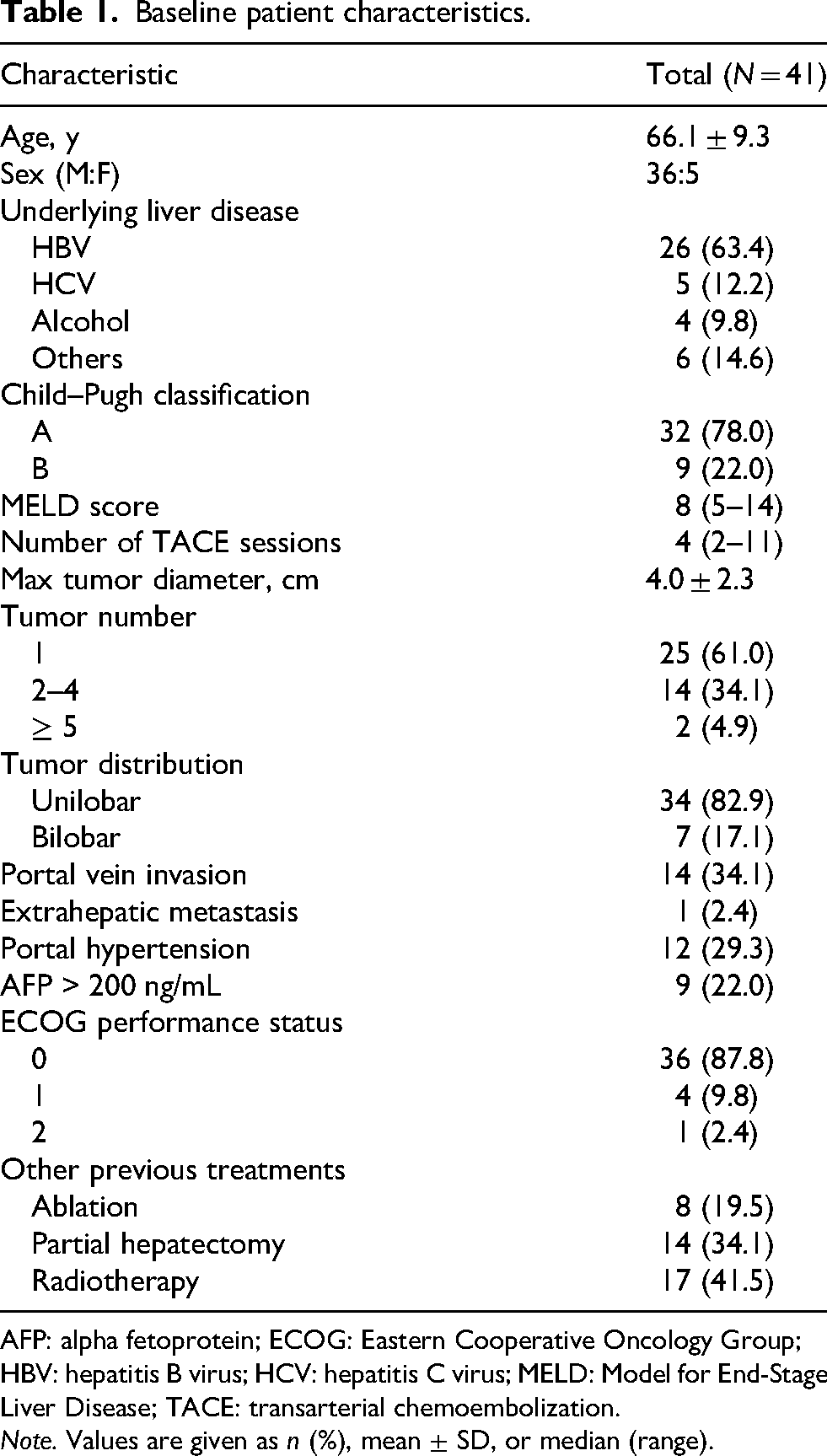
AFP: alpha fetoprotein; ECOG: Eastern Cooperative Oncology Group; HBV: hepatitis B virus; HCV: hepatitis C virus; MELD: Model for End-Stage Liver Disease; TACE: transarterial chemoembolization.
Note. Values are given as n (%), mean ± SD, or median (range).
Transarterial radioembolization treatment characteristics
The median total liver volume was 1143 mL (range = 612–1689 mL), with a median treated liver volume of 473 mL (range = 20–1014 mL) and a median tumor volume of 10 mL (range = 1–300 mL). The median future liver remnant (FLR) was 61.0% (range = 14.9%–98.4%); two patients had FLR < 30% (14.9% and 21.1%). The median TNR was 4.4 (range = 1.2–22.0) and the median LSF was 4.2% (range = 1.6%–19.6%). Resin microspheres were used in 30 (73.2%) patients and glass microspheres in 11 (26.8%). For resin microspheres, the median administered activity was 2 GBq (range = 0.1–6.0 GBq), with a median tumor-absorbed dose (TAD) of 644 Gy (range = 259–4083 Gy). Median absorbed doses to non-tumorous liver tissue and lung were 142 Gy (range = 28–722 Gy) and 3.5 Gy (range = 0.2–21.5 Gy), respectively. Three patients experienced severe arterial injury from prior TACE, resulting in premature vascular occlusion before complete activity delivery. For glass microspheres, the median administered activity was 2.9 GBq (range = 0.8–5.5 GBq), with a median TAD of 800 Gy (range = 248–2773 Gy). Median absorbed doses to non-tumorous liver tissue and lung were 238 Gy (range = 43–360 Gy) and 9.2 Gy (range = 1.8–27.5 Gy), respectively. Lobar treatment was the most frequently performed (n = 23, 56.1%), followed by segmental (n = 15, 36.6%) and subsegmental treatments (n = 3, 7.3%). TARE procedural characteristics are summarized in Table 2.
TARE procedure characteristics.
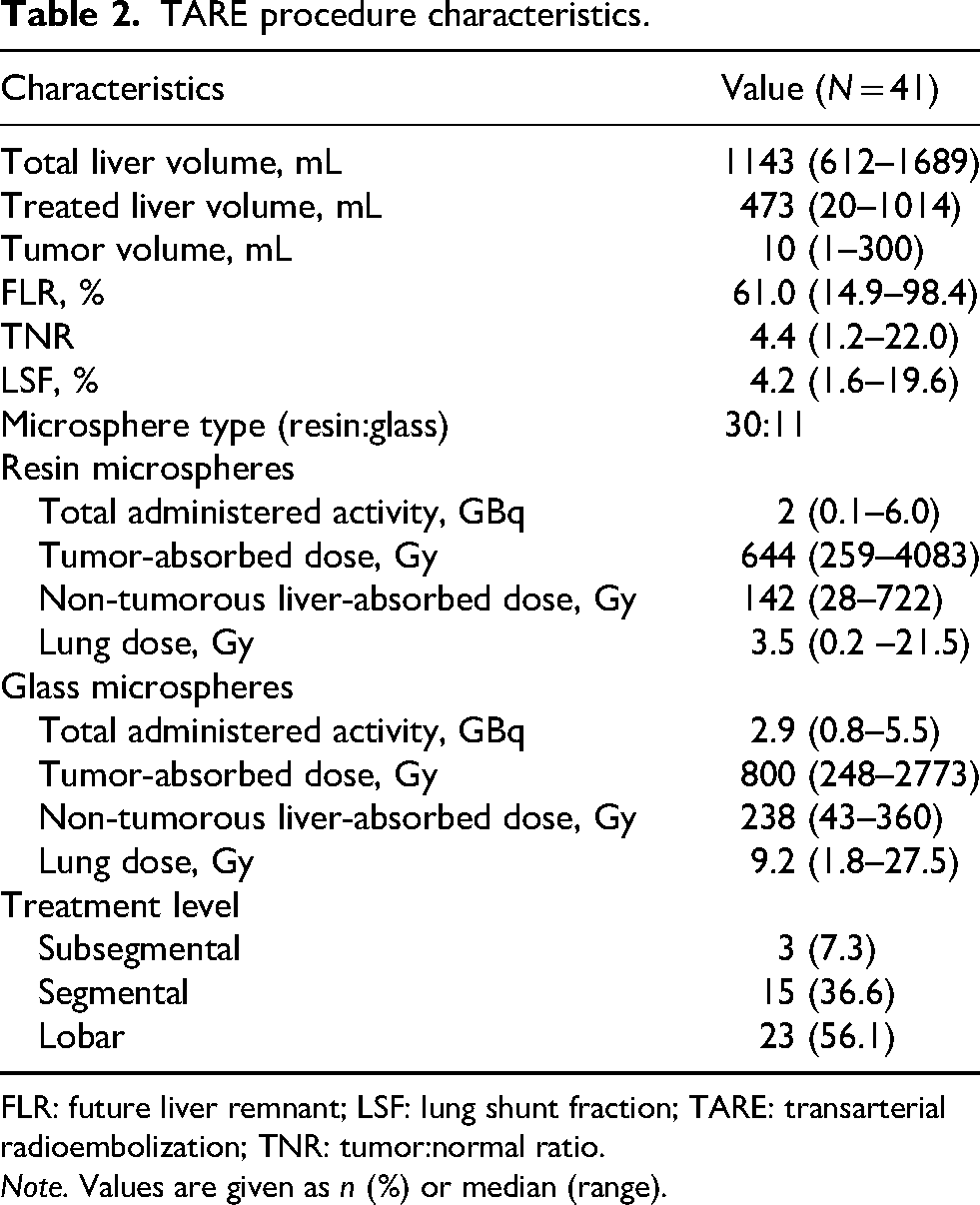
FLR: future liver remnant; LSF: lung shunt fraction; TARE: transarterial radioembolization; TNR: tumor:normal ratio.
Note. Values are given as n (%) or median (range).
Tumor response
Best responses of the index tumors were CR in 31 (75.6%) patients, PR in 6 (14.6%), SD in 3 (7.3%), and progressive disease (PD) in 1 (2.4%), yielding an ORR of 90.2% and a DCR of 97.6% (Figure 2). Among the three patients who experienced premature vascular occlusion due to severe arterial injury, two achieved CR and the remaining patient achieved SD. A total of 25 patients had disease beyond the Milan criteria. Among these, CR was achieved in 18 patients, PR in five, SD in one, and PD in one. Successful downstaging was achieved in 20/25 (80.0%) patients with disease initially beyond the Milan criteria, including all 18 patients who achieved CR and 2/5 patients who achieved PR. Of these 20 patients, 7 (35.0%) subsequently underwent curative-intent surgery, including hepatic resection (n = 3) and liver transplantation (n = 4). The remaining 13 patients did not proceed to surgery primarily due to interval disease progression (n = 8), patient comorbidities precluding surgery (n = 3), insufficient future liver remnant (n = 1), or unfavorable tumor anatomy (n = 1).

Imaging findings in a 73-year-old man with TACE–refractory HCC who subsequently underwent boosted TARE. (a) Contrast-enhanced CT at initial diagnosis showing a 5.3-cm HCC (white arrow) in liver segment 7/1. (b) Immediate post-TACE CT demonstrating compact lipiodol uptake (black arrow) without viable tumor. (c) Follow-up MRI scan after four TACE sessions showing recurrent tumor (blank arrows) adjacent to the lipiodol-laden lesion. (d) Mapping angiography demonstrating hypervascular tumor staining (blank arrows). (e) Tc-99m MAA SPECT showing corresponding tumor uptake. (f) Post-TARE SPECT/CT demonstrating intense tumor uptake (TheraSphere; tumor-absorbed dose, 774 Gy). (g) Follow-up MRI scan at 2 years showing no viable tumor (arrowhead).
Survival outcomes
During a median follow-up of 17.1 months (range = 2.3–53.4 months), LTP occurred in 16 (39.0%) patients. Median TTLTP was not reached at the time of analysis. LTP-free rates at 6, 12, and 24 months were 76.1%, 51.3%, and 51.3%, respectively (Figure 3). Disease progression occurred in 29 (70.7%) patients, with patterns including intrahepatic distant recurrence in 12 patients, LTP in nine, lung metastases in four, lymph node metastasis in three, and combined progression in one. Median TTP was 6.5 months (95% confidence interval [CI] = 3.1–8.8), with progression-free rates of 54.6%, 26.3%, 17.5%, and 17.5% at 6, 12, 24, and 36 months, respectively (Figure 4). A total of 16 (39.0%) patients died during follow-up. Median OS was 31.8 months (95% CI = 19.4–not reached), with OS rates of 84.9%, 63.4%, 35.3%, and 35.3% at 12, 24, 36, and 48 months, respectively (Figure 5). Among the seven patients who underwent curative-intent surgery after successful downstaging, longer OS was observed compared with the non-surgical group (median OS not reached vs. 24.8 months, 95% CI = 15.6–not reached; P = .048) (Figure 6).

Kaplan–Meier analysis of TTLTP. Median TTLTP was not reached at the time of analysis; LTP-free rates at 6, 12, and 24 months were 76.1%, 51.3%, and 51.3%, respectively.

Kaplan–Meier analysis of TTP. Median TTP was 6.5 months (95% CI = 3.1–8.8); Progression-free rates at 6, 12, 24, and 36 months were 54.6%, 26.3%, 17.5%, and 17.5%, respectively.

Kaplan–Meier analysis of OS. Median OS was 31.8 months (95% CI = 19.4–not reached); OS rates at 12, 24, 36, and 48 months were 84.9%, 63.4%, 35.3%, and 35.3%, respectively.

Kaplan–Meier analysis of OS stratified by secondary surgery status. Longer OS was observed in the surgical group compared with the non-surgical group (P = 0.048).
Adverse events
The most common mild adverse event was fever (n = 6, 14.6%), followed by abdominal pain (n = 3, 7.3%), nausea/vomiting (n = 2, 4.9%), ascites (n = 1, 2.4%), and jaundice (n = 1, 2.4%). Moderate adverse events included fever (n = 2, 4.9%), abdominal pain (n = 1, 2.4%), and nausea/vomiting (n = 1, 2.4%). Severe adverse events comprised fever (n = 1, 2.4%), gastric ulcer (n = 1, 2.4%), duodenobiliary fistula (n = 1, 2.4%), and post-procedural infection (n = 1, 2.4%).
The gastric ulcer developed despite prophylactic embolization of the right gastric artery using three microcoils. The duodenobiliary fistula occurred in a patient with five prior TACE sessions and stereotactic body radiation therapy (SBRT) who had pre-existing ischemic cholangiopathy (resin microspheres = 2 GBq; TAD = 567 Gy). One patient died 3.7 months after TARE from sepsis secondary to tumor rupture (resin microspheres = 2.5 GBq; TAD = 577 Gy). This event was considered to be associated with the subcapsular location of the tumor, in combination with the relatively high tumor dose delivered. All treatment-related adverse event grades are summarized in Table 3.
Summary of adverse events after TARE.
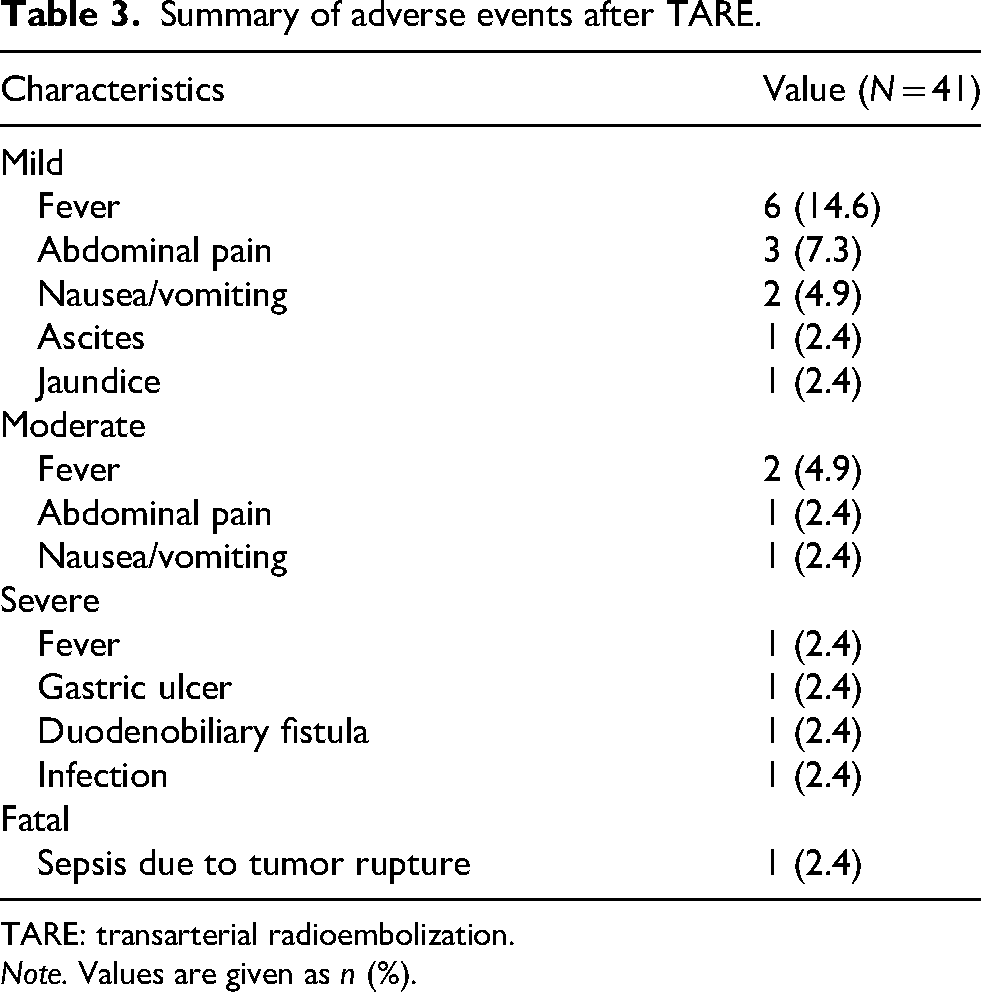
TARE: transarterial radioembolization.
Note. Values are given as n (%).
Compared with baseline, median ALT and albumin concentrations did not change significantly at 1 or 3 months after TARE. Median AST and bilirubin levels increased significantly at both time points (AST: P = .008 and P = .007; bilirubin: P < .001 at both), although these differences were not considered clinically significant (Supplementary Table 1).
Predictors of complete response and overall survival
No variables were significantly associated with non-CR on univariable logistic regression analysis; therefore, multivariable analysis was not performed (Table 4). In univariable Cox regression analysis for OS, ECOG performance status 1–2 and non-CR were associated with worse OS, while a greater number of prior TACE sessions showed a trend toward better OS (HR = 0.78, 95% CI = 0.59–1.03; P = .083). In multivariable analysis, ECOG performance status 1–2 (adjusted HR = 4.61, 95% CI = 1.20–17.74; P = .026) and non-CR (adjusted HR = 3.41, 95% CI = 1.17–9.90; P = .024) remained independent predictors of worse OS (Table 5).
Univariable logistic regression analyses of factors associated with tumor response (non-CR).
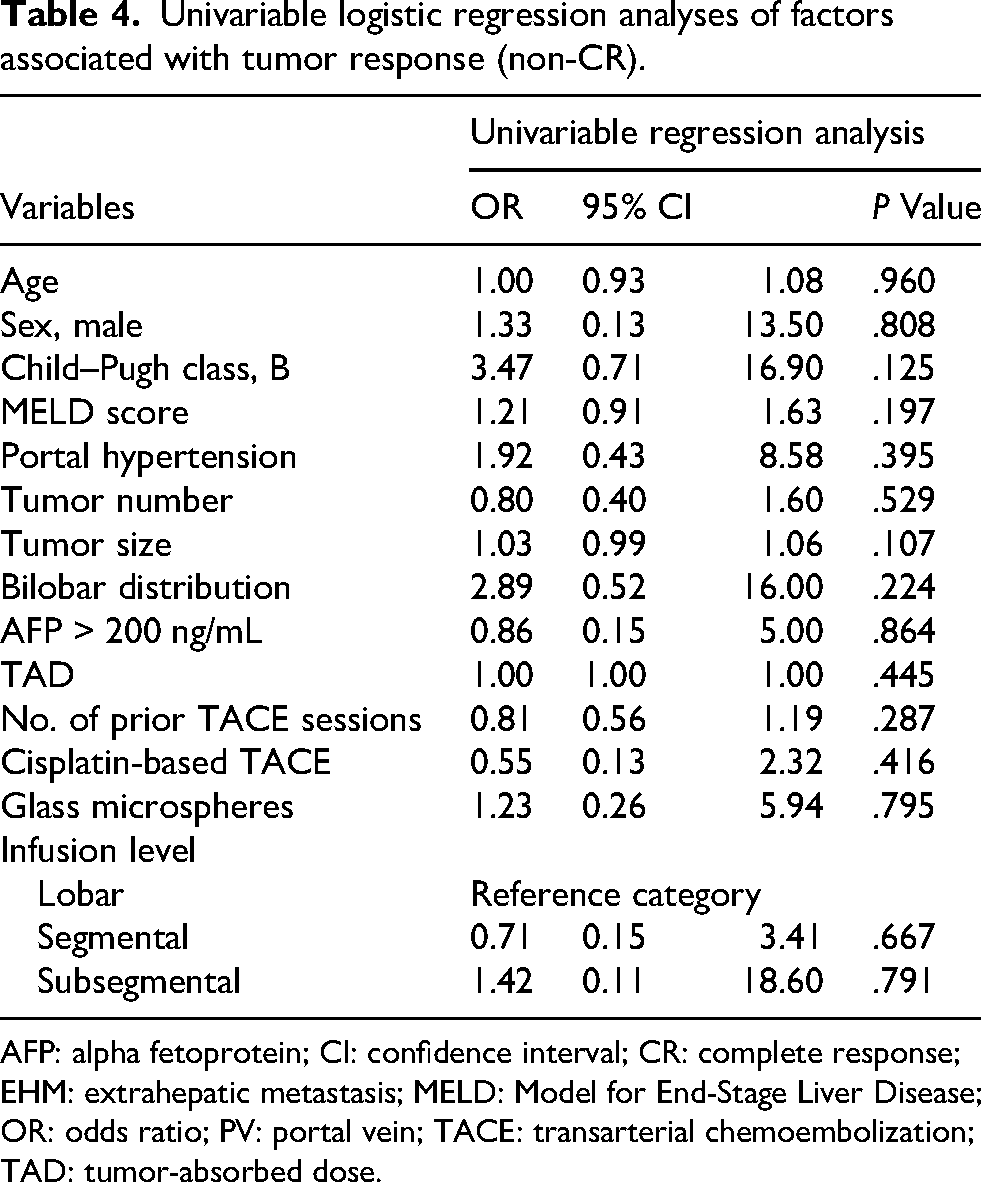
AFP: alpha fetoprotein; CI: confidence interval; CR: complete response; EHM: extrahepatic metastasis; MELD: Model for End-Stage Liver Disease; OR: odds ratio; PV: portal vein; TACE: transarterial chemoembolization; TAD: tumor-absorbed dose.
Univariable and multivariable Cox-proportional hazard model analyses of factors associated with overall survival.
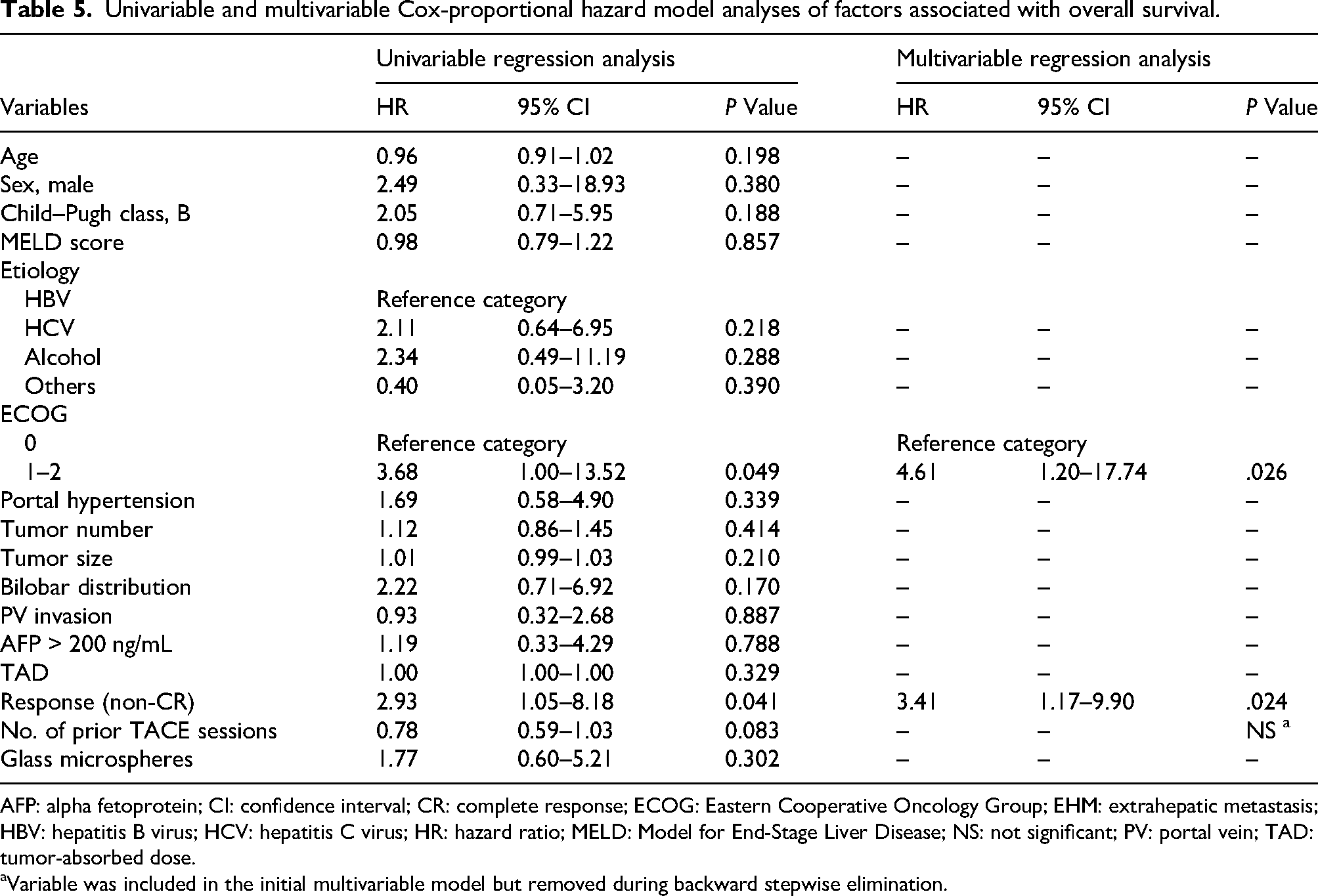
AFP: alpha fetoprotein; CI: confidence interval; CR: complete response; ECOG: Eastern Cooperative Oncology Group; EHM: extrahepatic metastasis; HBV: hepatitis B virus; HCV: hepatitis C virus; HR: hazard ratio; MELD: Model for End-Stage Liver Disease; NS: not significant; PV: portal vein; TAD: tumor-absorbed dose.
Variable was included in the initial multivariable model but removed during backward stepwise elimination.
Discussion
In this study, boosted-dose TARE achieved high tumor response rates in patients with TACE-refractory HCC, with 75.6% of patients attaining CR, 14.6% achieving PR, and an overall ORR of 90.2%. Median OS was 31.8 months, indicating favorable long-term outcomes despite prior treatment failure. These results likely reflect the distinct therapeutic mechanism of TARE compared with TACE. Conventional TACE induces tumor necrosis primarily through ischemia; however, Lipiodol may wash out rapidly or be cleared by Kupffer cells within 1 week. 21 Although drug-eluting bead (DEB)-TACE provides more consistent embolization, it does not deliver sustained cytotoxic exposure. In contrast, TARE achieves tumor control through direct internal radiation, and the boosted dosimetry applied in this study likely contributed to the observed high efficacy.
A prior retrospective study 15 evaluated boosted-dose 90Y radiation segmentectomy or lobectomy in 24 patients with HCC refractory to transarterial embolization (TAE) or TACE. That cohort included a higher proportion of patients previously treated with bland embolization (33.3%) and DEB-TACE (20.8%). Reported outcomes included CR in 52%, PR in 33%, and a median OS of 25.7 months. As in this study, these favorable results were attributed to boosted dosimetry. The superior efficacy observed in our cohort may be explained by differences in baseline characteristics and dosimetric parameters. Notably, fewer patients had BCLC stage C disease (44% vs. 71%), and the median TAD was higher (resin = 644 Gy; glass = 800 Gy vs. a perfused-territory dose of 346 Gy). In contrast, retrospective studies using standard TARE dosimetry for TACE-refractory HCC reported ORRs of only 37%–60%,11,13,14 underscoring the importance of personalized or boosted dosimetry to optimize treatment efficacy (Supplementary Table 2).
Deterioration of liver function after repeated TACE is well documented. Previous studies have shown that hepatic function deteriorates from Child–Pugh class A to B in 9%–14% of patients and from ALBI grade 1 to 2 in 18%–21% after each TACE session.22,23 As liver function is a key prognostic factor for subsequent systemic therapy, repeated TACE-associated deterioration may limit eligibility for or reduce the benefit of systemic treatments. 24 Therefore, preservation of liver function is a critical consideration when sequencing intra-arterial and systemic therapies. In line with current guidelines,6,8 a lack of objective response after two TACE sessions should prompt consideration of alternative treatment strategies rather than continued TACE. In patients with strictly defined intrahepatic TACE refractoriness, TARE may represent a potential alternative locoregional option. Although previous studies have shown that the number of prior TACE sessions does not predict hepatotoxicity after TARE 13 and that TARE yields comparable outcomes in TACE-pretreated and TACE-naïve patients, 25 cumulative treatment burden may still influence hepatic function in individual patients. This should be taken into account when interpreting our results.
Several retrospective studies have reported that switching to sorafenib at the onset of TACE refractoriness improves TTP (12.2–22.3 months vs. 6.1–7.7 months) and OS (24.7–25.4 months vs. 11.5–16.2 months) compared with continued TACE.26–28 However, these studies did not clearly distinguish intrahepatic TACE refractoriness due to incomplete response of previously treated lesions from refractoriness resulting from the development of new intrahepatic tumors. Therefore, the applicability of these findings to patients with strictly defined intrahepatic TACE refractoriness should be interpreted with caution. Beyond sorafenib, the contemporary systemic treatment landscape for HCC has evolved substantially. Several immunotherapy-based regimens have demonstrated improved OS compared with sorafenib or lenvatinib monotherapy in phase III trials including atezolizumab plus bevacizumab (IMbrave150), durvalumab plus tremelimumab (HIMALAYA), and nivolumab plus ipilimumab (CheckMate 9DW), with median OS in the range of approximately 19–24 months.29–31 Nevertheless, as with the sorafenib data discussed above, none of these trials specifically enrolled patients with strictly defined intrahepatic TACE refractoriness, and the extent to which their efficacy data apply to this population remains uncertain. In this context, boosted TARE represents a mechanistically distinct salvage strategy that may be particularly suited to patients with incomplete locoregional response. Furthermore, emerging preclinical and translational evidence suggests that high-dose intratumoral radiation may induce immunogenic cell death, raising the hypothesis that boosted TARE could synergize with immunotherapy-based regimens. 32 Although no studies have specifically evaluated immunotherapy in the strictly defined TACE-refractory population addressed in this study, future prospective comparisons of boosted TARE, systemic therapy, and their combination in this setting are warranted to establish an evidence-based treatment algorithm.
In this study, despite favorable tumor control, the rate of major complications (grade ≥ 3) was relatively high at 12.2% (n = 5/41). This may reflect the high radiation doses delivered, particularly with resin microspheres, for which the median TAD was 644 Gy (range = 259–4083 Gy). Notably, duodenobiliary fistula and tumor rupture occurred in patients receiving resin microspheres at TADs of 567 Gy and 577 Gy, respectively; although no universally accepted upper limit for TAD has been established in the literature, these doses may be considered relatively high, and toxicity in these cases was likely further compounded by proximity to biliary and bowel structures, subcapsular location and prior TACE-related tissue injury. These findings suggest that dose reduction, such as targeting TADs of approximately 300 Gy, may warrant consideration as a hypothesis requiring further prospective validation in patients at increased risk of complications, particularly when multiple risk factors co-exist. Collectively, these findings underscore the importance of careful dosimetric optimization to balance treatment efficacy and toxicity. 33
The present study has some limitations. First, its retrospective design may have introduced selection bias. Second, the relatively small sample size, the predominance of patients with preserved liver function and good performance status, and cohort heterogeneity may limit the generalizability of the findings. Furthermore, patients selected for TARE are likely to represent a relatively fitter subgroup. Third, the follow-up period was relatively short and may not fully capture long-term outcomes or delayed recurrences. Fourth, lead-time bias warrants consideration, particularly in patients subsequently downstaged to curative-intent surgery, where earlier detection of treatment response may have artificially prolonged the apparent OS. Fifth, given the single-arm design without a comparator group, direct comparisons with other treatment strategies were not feasible, and the observed outcomes should therefore be interpreted as preliminary and descriptive. Sixth, response assessment was performed by two independent reviewers with discrepancies resolved by consensus; however, potential inter-observer variability cannot be excluded, particularly in CT-assessed patients where confluent lipiodol deposits may obscure viable tumor. Although 24/41 (58.5%) patients were evaluated using MRI, the remaining CT-assessed patients may be subject to this limitation. Future prospective, controlled studies with centralized response assessment and longer follow-up, particularly those incorporating contemporary systemic therapies such as immunotherapy, are warranted to better define the comparative effectiveness of boosted TARE.
In conclusion, boosted TARE may provide favorable local tumor control in selected patients with TACE-refractory HCC. Careful patient selection and dosimetry remain essential.
Supplemental Material
sj-docx-1-acr-10.1177_02841851261468006 - Supplemental material for Efficacy and safety of boosted transarterial radioembolization in patients with chemoembolization-refractory hepatocellular carcinoma
Supplemental material, sj-docx-1-acr-10.1177_02841851261468006 for Efficacy and safety of boosted transarterial radioembolization in patients with chemoembolization-refractory hepatocellular carcinoma by Gun Ha Kim, Eunbyeol Ko, Jeongyeon Kim, Minyoung Oh, Changhwan Sung, Jin Hyoung Kim and Dong Il Gwon in Acta Radiologica
Footnotes

Ethical approval
IRB/ethics committee approval or waiver This retrospective study was approved by the institutional review board of Asan Medical Center (2025-1029), which waived the requirement for informed consent.
Funding
The authors received no financial support for the research, authorship, and/or publication of this article.
Declaration of conflicting interests
The authors declared no potential conflicts of interest with respect to the research, authorship, and/or publication of this article.
Supplemental material
Supplemental material is available online.
References
Supplementary Material
Please find the following supplemental material available below.
For Open Access articles published under a Creative Commons License, all supplemental material carries the same license as the article it is associated with.
For non-Open Access articles published, all supplemental material carries a non-exclusive license, and permission requests for re-use of supplemental material or any part of supplemental material shall be sent directly to the copyright owner as specified in the copyright notice associated with the article.
