




Abstract
Virtual cell is an emerging technology that integrates multiple disciplines, including biology, computer science, and artificial intelligence, to simulate cellular structures and functions. Compared with traditional methods, virtual cell technology offers a more holistic approach, enabling efficient simulation of cellular dynamics and prediction of biological phenomena. This technology holds significant potential in fields such as precision medicine, drug discovery, and synthetic biology. The development of virtual cells is driven by advancements in single-cell sequencing, subcellular imaging, and computational power, with platforms such as environment for cell simulation (E-Cell) and cell packing (CellPACK) enabling simulations across multiple biological scales. However, challenges remain, including data integration, model interpretability, and computational costs. Despite these challenges, virtual cell technology has made advances in drug development, disease research, and synthetic biology, offering a promising tool for personalized medicine and improving research accuracy. In the future, virtual cell technology is expected to find broader applications in cross-species simulations, quantum computing, and interdisciplinary collaborations.
Background
In recent years, with rapid advancements in fields such as biology, computer science, and artificial intelligence (AI), life sciences research is undergoing a shift from traditional reductionist approaches to more holistic and quantitative perspectives.1–3 The concept of virtual cell (VC), an emerging research tool, integrates multi-omics data, biophysical models, and machine learning algorithms to digitally simulate cellular structures and functions. This innovation overcomes the limitations of traditional experimental methods, showing immense potential across various domains of cell biology and medicine.4,5 Compared with traditional cell models, VC models not only significantly reduce experimental costs but also aid researchers by efficiently simulating and predicting potential biological phenomena and therapeutic outcomes prior to experimentation. 6 This technology bridges the knowledge gap between microscopic molecular mechanisms and macroscopic phenotypes and has been identified as a “disruptive technology for next-generation biomedical research.”
At its core, the VC reconstructs cellular dynamic behaviors through mathematical modeling (such as differential equations and stochastic processes) and computational simulations (such as finite element analysis and agent-based models). Its development has been driven by three major forces: single-cell sequencing technologies (e.g. single-cell RNA sequencing (scRNA-seq)), subcellular-resolution imaging techniques (such as cryo-electron tomography (cryo-ET)), and advancements in graphics processing unit (GPU) acceleration and cloud computing that make large-scale parallel simulations feasible.7–9 Collaborative efforts between biologists, computer scientists, and physicists have led to the creation of open-source platforms such as environment for cell simulation (E-Cell) and cell packing (CellPACK). These platforms facilitate dynamic simulations across multiple scales and levels, from molecular to cellular to tissue layers, thereby constructing a comprehensive and accurate representation of the cellular environment. 10 This capability not only positions VC technology as a supplement to experimental models but also paves the way for breakthroughs in fields such as precision medicine and drug discovery. This narrative review was guided by the Narrative Review Article Quality Assessment Scale (SANRA). 11
Despite the promising progress, the field of VC is currently facing a critical transition phase. Traditional mathematical models often struggle with the complexity of high-dimensional biological data, while emerging AI-driven approaches face challenges regarding interpretability and data scarcity. Therefore, the aim of this review was to provide a timely and comprehensive roadmap for this field. We critically examined how recent breakthroughs in AI and multi-omics are reshaping VC construction, moving beyond isolated pathway simulations toward holistic “digital twins.” Furthermore, we identified the urgent technical bottlenecks—ranging from multimodal data integration to computational costs—and discuss the ethical implications of these technologies. By outlining these challenges and future trends, this work aimed to guide researchers in bridging the gap between computational prediction and clinical reality.
Definition and historical development of VC models
A VC typically refers to a simulated cellular system constructed using computational biology and AI methods, integrated with experimental data and theoretical models. The goal is to replicate various biological functions and behaviors of a cell through a digital model, enabling the simulation of cellular dynamics and responses under different conditions.12–14
The research into VC technology dates back to the 1960s, with the advent of computational biology. Scientists began using mathematical models to describe biological processes, such as the Hodgkin–Huxley model (for neuronal electrical activity) and gene regulation dynamics models.15,16 However, early studies were limited by computational power and lack of data, restricting them to simulating isolated pathways rather than constructing complete cellular models. 17 During the period from the 1990s to 2000s, the development of the first VC platform (VC, 1999) and E-Cell project (2001) marked a breakthrough, making multiscale modeling possible. 18 The completion of the Human Genome Project and advances in high-throughput technologies further propelled the systematic modeling of metabolic networks and signaling pathways. In 2012, the release of the first whole-cell model (Mycoplasma genitalium) was a milestone, demonstrating the potential of VC technology in integrating molecular mechanisms. After 2010, the integration of single-cell sequencing and AI technologies took VC technology toward greater precision, supporting personalized modeling and applications in synthetic biology (such as the design of artificial minimal cells). 19
Currently, VC technologies are evolving toward digital twins and multi-organ modeling, while facing challenges associated with data integration, computational efficiency, and model interpretability. 20 In the future, their applications will expand to precision medicine, drug development, and synthetic life design, representing a core research paradigm in life sciences.
Key technologies and methods
As an interdisciplinary research field, VCs rely on a range of advanced technologies and methods. The general workflow for constructing and validating a VC model is illustrated in Figure 1. Current research in VC modeling primarily focuses on the following five key technological areas.

The general workflow for constructing and validating a virtual cell model.
Multiscale modeling techniques
Multiscale modeling serves as the foundational framework for VC research, aiming to integrate modeling approaches across different levels to achieve dynamic simulations from the molecular to the cellular, and even the tissue scale. These approaches include molecular dynamics, stochastic process models (such as the Gillespie algorithm), and finite element analysis. To accurately capture cellular dynamics, different mathematical strategies are employed based on the biological scale and data availability. Ordinary Differential Equations (ODEs) remain the standard for modeling metabolic networks and signaling pathways where the system is assumed to be well-mixed and deterministic. Platforms such as E-Cell utilize ODEs to efficiently simulate reaction kinetics over time. However, ODEs struggle to capture the stochastic nature of gene expression in single cells. To address this, Stochastic approaches (e.g. the Gillespie algorithm) are used to model discrete molecular events, which are critical when molecule counts are low and noise drives phenotypic divergence. Furthermore, for simulations requiring spatial resolution—such as intracellular transport or tissue organization—partial differential equations (PDEs) and agent-based models (ABMs) are preferred. ABMs, in particular, treat each cell or organelle as an autonomous agent with specific rules, making them ideal for studying emergent behaviors in multicellular environments, although at a higher computational cost. Recent breakthroughs, such as the whole cell model Version 2 (WholeCellV2) model, have made it possible to couple metabolic and gene regulatory networks.21–23 These advancements have ushered in a new paradigm for systematically understanding cellular functions and have facilitated comprehensive simulations from the molecular to the cellular level. For example, the National Institute of Health’s (NIH’s) WholeCellV2 project integrates over 1200 biochemical reactions, enabling the full-cycle simulation of Escherichia coli growth. 24
Data integration and model construction
With the rapid advancements in multi-omics technologies (such as scRNA-seq and spatial transcriptomics), VC technology now has access to high-resolution input data, which supports the precise construction of models. 25 Additionally, the use of knowledge graphs (such as KEGG, STRING) and open-source modeling platforms (such as virtual cell software platform (VCell) 7.0, CellCollective) has driven the standardization of VC model construction. However, data heterogeneity and model scalability remain key challenges, requiring the integration of different data types and ensuring the model’s applicability in diverse biological contexts. For instance, gene regulatory networks can be described using the graph theory models to represent interactions between genes, while metabolic pathways are modeled using metabolic network models. 26 Alon’s research on “network motifs” in gene regulatory networks identifies common structures in gene regulation. The use of the graph theory enables these motifs to effectively analysis and predict gene interactions.27,28 These studies provide the foundational theories and methods for modeling gene regulatory and metabolic networks, particularly in terms of how mathematical tools (such as differential equations and difference equations) can simulate molecular dynamics within cells. They highlight the potential of graph-theoretical modeling, network analysis, and mathematical equations in solving complex problems in systems biology.
Deep integration of AI
AI contributes to VC construction through a multi-stage pipeline. Initially, it enhances data fidelity via denoising and identifies key biological patterns through feature extraction from high-dimensional datasets. Subsequently, AI facilitates dynamic modeling by accelerating simulations through surrogate models and employing generative algorithms (e.g. variational autoencoders (VAEs) and diffusion models) to predict novel cellular phenotypes and perturbation responses. Beyond classical mathematical modeling, data-driven strategies are becoming essential for parameterizing and constructing VC models. Bayesian Inference frameworks provide a rigorous method for integrating prior biological knowledge with noisy experimental data. By calculating posterior distributions of model parameters, Bayesian methods allow VC technology to quantify uncertainty and robustness, which is critical when data is sparse. More recently, Deep Generative Models (e.g. VAEs and generative adversarial networks (GANs)) serve as powerful tools for “in silico” experimentation. Unlike mechanistic models that require defined rules, deep generative models learn the underlying data distribution of high-dimensional single-cell data (e.g. scRNA-seq), enabling the generation of realistic “virtual” cell states and the prediction of cellular responses to perturbations that were not experimentally observed. The rapid development of AI has significantly enhanced the efficiency and accuracy of VC modeling. Bayesian neural networks and graph neural networks have found widespread application in parameter optimization and cell phenotype prediction.29–32 Additionally, tools such as AlphaFold-VC have enabled seamless integration of protein structure predictions into VC modeling, providing strong support for simulating and predicting cellular behaviors. However, the lack of interpretability in AI models remains a critical issue that needs to be addressed. This limitation affects the transparency and operability of AI in biological research.33,34
High-performance computing technologies
High-performance computing technologies are crucial for enabling large-scale simulations of VCs. With the aid of advanced computing techniques such as GPU acceleration and quantum annealing, VC simulations can now handle larger datasets and more complex cellular systems. Distributed platforms such as European Brain Research Infrastructures (EBRAINS) are already capable of supporting real-time simulations of cell populations at the million-cell scale, providing powerful computational support for large-scale cellular behavior modeling.35,36 However, issues related to computational costs and energy consumption continue to limit the widespread adoption and application of these technologies.
Experimental validation and feedback mechanisms
Experimental validation techniques provide essential support for the reliability of VC models. 37 Through methods such as synthetic biology circuit validation and microfluidic chip coupling, VC models can continuously improve their accuracy within the “design-model-experiment” feedback loop. With advancements in dynamic monitoring technologies (such as light-sheet microscopy), the application of VC technology is no longer limited to theoretical simulations, but is increasingly transitioning into biomedical practice. This process allows VC models to more accurately reflect cellular behaviors in both physiological and pathological states.38–40 Detailed comparisons of these strategies are summarized in Table 1.
Comparison of key modeling strategies in VC construction.

VAE: variational autoencoder; GANs: generative adversarial network; ODE: ordinary differential equations; scRNA-seq: single-cell RNA sequencing; StochSS: stochastic simulation service; scGen: single-cell generative model; scVI: single-cell variational inference; PyMC: Python Markov Chain Monte Carlo; COPASI: complex pathway simulator; ABMs: agent-based models; E-cell: environment for cell simulation; VCell: virtual cell software platform; VC: virtual cell.
Data issues and challenges
As a cutting-edge field at the intersection of systems biology and computational biology, VC technology has made significant strides in modeling, simulation, and application. However, it still faces several challenges. First, the complexity of data integration and multimodal fusion remains a critical issue. VC modeling requires the integration of data from various omics layers, such as genomics, transcriptomics, proteomics, and metabolomics, along with high-dimensional data from techniques such as microscopy and scRNA-seq. These datasets often differ significantly in terms of spatial and temporal resolution, format, and noise levels, making it a challenge to effectively combine them to support cell model construction. Furthermore, most current data are static snapshots, lacking continuous time-series data, which hinders the accurate simulation of dynamic cellular behaviors, especially in processes such as the cell cycle and stress responses. Although spatial omics technologies, such as spatial transcriptomics and cryo-ET, can provide subcellular resolution data, their high costs and low throughput make large-scale applications difficult, thereby affecting the precision and scalability of VC models.41–44
Additionally, the technical bottleneck of multiscale modeling remains a significant challenge. VC models not only need to simulate multiscale interactions from the molecular to the cellular and even tissue levels but also require the effective coupling of physical laws across these scales. Computational models differ greatly across scales, and the lack of a unified theoretical framework makes precise coupling between these scales difficult. This is especially problematic during the simulation of cellular processes where many biological phenomena (such as gene regulation and signal transduction) exhibit highly nonlinear behavior and even small disturbances can lead to drastically different outcomes. Traditional mathematical models, such as differential equations, struggle to capture these nonlinear dynamics, further complicating the modeling process.45–47
VC models face significant challenges in terms of computational resources and algorithmic efficiency. Whole-cell simulations (such as WholeCellV2) involve millions of biochemical reactions, resulting in extremely high computational demands. Although GPU acceleration and high-performance computing platforms have partially alleviated this issue, these technologies still require vast computational resources and incur substantial costs. Specifically, the training process for AI models remains computationally intensive due to the requirement of massive datasets, although deep learning methods (such as graph neural networks and Transformers) have enhanced the predictive accuracy of VC models. This makes real-time model updates a challenge. Quantum computing is believed to hold potential for solving (nondeterministic polynomial time) NP-hard problems in molecular dynamics; however, it is still in the experimental stage and has yet to be applied in VC research.
Additionally, the interpretability and validation challenges of applying VC models remain critical issues that need to be addressed. Although AI-driven VC technologies (such as AlphaFold-VC) can accurately predict biological phenomena, the lack of transparent mechanistic explanations makes it difficult for biologists to fully trust these results, especially in clinical applications and drug development. This “black-box” issue limits the practical use of VC technology. The predictions made by these models also require experimental validation; however, the lengthy timelines and high costs of experiments complicate the formation of a “modeling-experiment” feedback loop. Moreover, there is currently a lack of standardized evaluation frameworks, making it difficult to uniformly assess the accuracy, robustness, and generalizability of VC models. This hampers the ability to compare and translate results across different research teams.
Finally, ethical and data security issues are also critical considerations in the application of VC technology. VC models, especially patient-specific ones, involve large amounts of sensitive genomic and clinical data, necessitating compliance and preventative measures to guard against data breaches. Moreover, as synthetic biology progresses, VC technology may be used to design artificial life forms or gene-editing systems. Although this presents tremendous potential for synthetic biology, it also carries risks of abuse, such as the creation of biological weapons or unnatural organisms, highlighting the need for appropriate ethical guidelines. Additionally, if the AI training data is biased (for instance, predominantly based on Western genomic data), it could lead to deviations in VC models used in personalized medicine, affecting their fairness and universal applicability.
Application scenarios
Drug development and precision medicine
VC technology plays a crucial role in drug development and precision medicine. Using AI-driven VC models, researchers can simulate the binding processes between drug molecules and cellular receptors, which allows them to predict potential drug targets and significantly shorten the drug discovery timeline. For example, a research team at Stanford University utilized VC models to screen for anti-cancer drugs, increasing the accuracy of drug screening by 40%. Recent advancements have further demonstrated the power of in silico approaches in pharmacology. For instance, computational methods are increasingly being applied to predict chemical toxicity and evaluate drug safety profiles.48,49 Furthermore, VC models are proving essential in understanding complex pharmacological responses and optimizing drug development pipelines.50,51 Furthermore, VC technology is also being applied in the formulation of personalized treatment plans. By constructing digital twin cells based on patient tumor samples, researchers can simulate responses to different drugs and optimize therapeutic strategies. The Chinese Academy of Medical Sciences has successfully implemented this technology in personalized treatment for breast cancer. Additionally, VC models can replace animal testing for toxicity assessments, predicting the toxicity of drugs on hepatocytes and cardiomyocytes, thereby reducing the failure rate of clinical trials.52–55 A comprehensive summary of representative VC models and their applications in varying biological contexts is provided in Table 2.
Summary of various virtual cell models and their applications.

E-cell: environment for cell simulation; CellPACK: cell packing; WholeCellV2: whole cell model Version 2; VCell: virtual cell software platform.
Research and modeling of disease mechanisms
VC technology had a wide range of applications in the study of disease mechanisms, particularly in cancer, neurodegenerative diseases, and infectious diseases. 54 For example, VC models can simulate the tumor microenvironment to investigate the interactions between tumor cells and immune cells, revealing mechanisms of tumor resistance. Massachusetts Institute of Technology’s (MIT’s) TumorSim platform has been utilized to study responses to programmed death-1 (PD-1) inhibitors. In terms of mechanistic resolution, recent studies have successfully employed computational modeling to reconstruct intricate cell signaling pathways and biological networks.56,57 These works highlight the growing capability of VC technology to capture the spatiotemporal dynamics of cellular processes. Additionally, VC models have been employed to simulate the aggregation process of tau proteins in Alzheimer’s disease, offering new insights for intervention strategies. In the realm of infectious diseases, VC models can accelerate vaccine design; notably, in the study of the infection mechanisms of the coronavirus disease 2019 (COVID-19) virus, VC models have demonstrated their potential in rapidly addressing global health crises.58,59 The geometric structure of the cell model is shown in Figure 2.
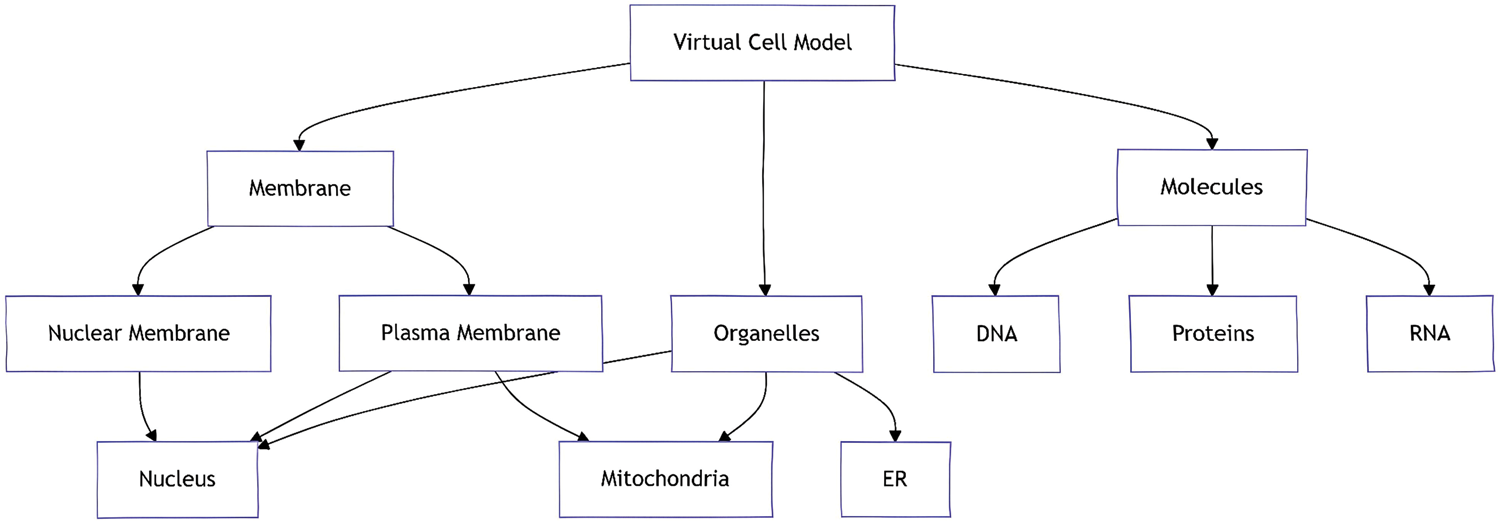
Geometric structure of the cell model.
Furthermore, VC technologies play a crucial role in elucidating the mechanisms of genetic integrity, specifically DNA damage and repair. Computational simulations offer a unique perspective to study biophysical events that are difficult to observe experimentally in real-time. For instance, recent studies have utilized advanced simulation frameworks (such as Monte Carlo methods) to model the induction of DNA damage and subsequent cellular responses under various stress conditions.60,61 These in silico approaches not only enhance our understanding of radiation biology but also assist in predicting cell survival probabilities, thereby supporting the optimization of therapeutic strategies.
Synthetic biology and design of artificial life
VC technology also plays a critical role in synthetic biology and the design of artificial life. For instance, in the study of minimal genome cells, VC models have guided the optimization of genetic circuits in artificial cells such as JCVI-syn3.0. Additionally, they have been utilized in metabolic engineering to optimize the metabolic pathways of microorganisms, such as Escherichia coli, thereby increasing the yield of biofuels.62,63 Additionally, whole-cell kinetic models have accurately predicted metabolic fluxes to optimize growth conditions in engineered bacteria. Spatially resolved simulations have revealed complex signaling dynamics, such as the precise gradients of proteins required for cell division. More recently, AI-driven VC models have successfully predicted drug response phenotypes, allowing researchers to forecast how cancer cells develop resistance to specific treatments before conducting physical experiments.
Fundamental biological research
VC technology is also crucial for fundamental biological research. Through VC models, researchers can simulate the cell cycle and predict key processes such as cell division and apoptosis. For example, yeast cell cycle models have been widely used to study the mechanisms of cell division and death. Furthermore, VC models can simulate the dynamic responses of cellular signaling pathways, such as the G protein-coupled receptor (GPCR) and wingless/integrated (Wnt) pathways, thereby elucidating their regulatory mechanisms.64,65
Education and research training
VC technology also plays a role in education and research training. For example, the “Metaverse Cell Culture Trainer” platform developed by Xihu University utilizes gamification to teach biology, providing a virtual laboratory experience that allows students to conduct experimental operations in a simulated environment.66,67
Recent research advances
Multimodal data integration and AI modeling
With the development of VC technology, data integration and AI modeling have become mainstream frameworks. Researchers have proposed models based on three key data pillars: prior knowledge, static structures, and dynamic states, known as the “3 + 1” approach introduced by Tiannan Guo’s team (three main modules plus closed-loop learning). By combining spatial omics with cryo-electron microscopy, researchers can achieve modeling of nanoscale cellular structures. For instance, the dynamic simulation of mitochondrial membrane proteins has become a research hotspot. Additionally, perturbation proteomics provides new avenues for acquiring dynamic data, and the integration of clustered regularly interspaced short palindromic repeat (CRISPR) screening with proteomics has advanced the application of VC technology in studies on cellular metabolism and drug targeting.10,68
Closed-loop active learning systems
In recent years, closed-loop active learning systems that integrate AI prediction, experimental validation, and model optimization have gained widespread application. For example, robotic laboratories such as Emerald Cloud Lab have incorporated VC systems to achieve automated prediction, validation, and optimization processes. The combination of DeepMind’s AlphaFold with VC technology has improved the accuracy of protein structure predictions, providing more reliable data support for signaling pathway simulations.69–72
From simple models to complex systems
The modeling of VCs has evolved from simple models, such as yeast, to more complex systems, including the establishment of human cancer cell models (e.g. HeLa cells). The development of VC technology also encompasses organ-level simulations; for instance, the “Virtual Heart” project (Stimulating Peripheral Activity to Relieve Conditions (SPARC) initiative) has been utilized in the study of arrhythmias, offering new insights for the treatment of complex diseases. 73
Ethical and standardization challenges
Beyond ethical considerations, the reproducibility of simulation results is a cornerstone for the credibility of VC research. Currently, the field faces a “reproducibility crisis” due to the complexity of multiscale models. To address this, the community must enforce stricter standardization protocols. First, model sharing is essential; researchers should deposit source codes and mathematical models in public repositories (e.g. GitHub or BioModels Database) rather than keeping them as proprietary assets. Second, adhering to standard exchange formats such as the Systems Biology Markup Language (SBML) or CellML ensures that models can be executed across different software platforms, enhancing code reusability. Finally, comprehensive metadata requirements—detailed documentation of parameter sources, initial conditions, and algorithmic assumptions—are critical. Adoption of the Findable, Accessible, Interoperable, and Reusable (FAIR) principles will transform VC models from isolated case studies into robust, verifiable community resources.
With the increasingly widespread application of VC technology, data privacy and ethical concerns have gradually come to the forefront. This is especially true for patient-specific models where compliance with regulations such as the general data protection regulation is an issue that needs to be urgently addressed. Furthermore, the challenge of AI interpretability poses significant obstacles for medical applications; black-box models may affect the reliability of clinical use. Therefore, integrating methods of causal inference remains an important direction for future research.
Regulatory considerations and model certification
As VC models progress toward clinical application, navigating regulatory frameworks becomes paramount. Regulatory agencies, such as the Food and Drug Administration (FDA) and European Medicines Agency (EMA), are increasingly focusing on Model-Informed Drug Development (MIDD). However, for a VC model to be certified as a medical device (Software as a Medical Device, SaMD), it must undergo rigorous Verification and Validation (V&V) to establish its specific context of use (CoU). Clear guidelines must be established to determine liability and safety standards before these models can be authorized for decision-making in patient care.
Future trends
With technological advances, VC technology is evolving toward greater maturity and precision. In the future, VC models will not only be able to simulate the cells of a single species but also perform accurate cross-species simulations, similar to those using “foundation models” in AI. This development will bring revolutionary breakthroughs in fundamental biology, medical research, and precision medicine, particularly in cross-species comparative studies, where VC technology will play a crucial role. The introduction of quantum computing will significantly enhance the computational capabilities of VC technology, addressing the computational bottlenecks associated with traditional methods and facilitating qualitative leaps in areas such as drug discovery, disease mechanism research, and precision medicine. Furthermore, global collaborative platforms (such as the EBRAINS and SPARC initiative) will promote data sharing and cooperative research and support the rapid development of VC technology and fostering interdisciplinary collaboration, which will further advance precision medicine and personalized treatment applications.74–76
Although we have endeavored to provide a comprehensive roadmap of the VC landscape, certain limitations of this review should be noted. First, given the exponential growth in the research on the intersection of AI and biology, we prioritized the discussion of data-driven and hybrid modeling approaches. Consequently, some classical, purely mechanistic mathematical models, which laid the foundation for this field, were discussed with less granularity. Second, our scope primarily focused on mammalian cells and their biomedical applications (such as cancer and drug screening), potentially underrepresenting advancements in microbial or plant VC models. Finally, the field of AI for science is evolving at an unprecedented pace; thus, the specific algorithms and tools highlighted in this work represent the state-of-the-art at the time of writing, which are subject to rapid iteration. Despite these constraints, we believe that this review captures the critical paradigm shift currently reshaping cellular modeling.
To realize the full potential of the VC technology, we envision three concrete milestones in the near future. First, the development of fully mechanistic AI-integrated whole-cell models. By combining the interpretability of mechanistic modeling with the predictive power of AI, these hybrid models will simulate complete cellular behaviors with unprecedented accuracy. Second, the establishment of patient-specific “digital twins.” These personalized VC models will integrate individual “omics” data to predict patient-specific responses to therapies, moving precision medicine from concept to reality. Third, the implementation of high-resolution subcellular digital reconstruction. This will enable granular visualization of drug–target interactions within specific organelles, significantly enhancing the efficiency of high-throughput drug screening and toxicological assessments.
As a highly interdisciplinary research topic, VC technology is gradually revealing its vast application potential. In the future, it will play an increasingly important role in precision medicine and personalized treatment by simulating individual cellular behaviors to tailor treatment plans for each patient. Moreover, deep collaborative efforts across disciplines supported by technological breakthroughs in computer science, life sciences, AI, and quantum physics, will drive the comprehensive development of VC technology, ultimately making a greater contribution to human health.
Footnotes
Acknowledgments
We acknowledge the use of the AI tool used for improving the language.
Author contributions
JML and HHZ planned the study. HHZ and WWZ drafted the manuscript. NL edited the draft. FXZ and GSS created the table and figures. All authors discussed the manuscript and approved the final version of the article for publication.
Data availability
Data sharing is not applicable to this article as no new data were created or analyzed in this study.
Declaration of conflicting interests
The authors declare that there are no conflicts of interest.
Ethical approval and informed consent statements
As this article is a review, there was no need for ethical approval or informed consent.
Funding
This work is supported by the “Kunlun Talent High end Innovation and Entrepreneurship Talent” project of Qinghai Province in China in 2024 and 2025 (for Dr. Yan Li and Guoshuang Shen).
