



Abstract
Introduction
Endurance and ultra-endurance running impose substantial physical and psychological demands, leading athletes to experience intense emotional states before, during, and after competitions. Accordingly, there is a paucity of evidence comparing mood profiles between endurance and ultra-endurance runners competing in trail and mountain events.
Objective
The aim of this study was to characterize the mood profile of endurance and ultra-endurance runners participating in La Misión Brasil 2024 and to analyze its relationship with sleep quality.
Methods
This prospective cross-sectional study included 193 runners, divided into an endurance group (n = 118; men = 75; women = 43) and an ultra-endurance group (n = 75; men = 60; women = 15), who participated in the same competition according to the proposed distances. La Misión Brasil is a trail running event with race distances ranging from 25 to 80 km and substantial elevation gain. One week prior to the competition, participants completed questionnaires assessing mood state, anxiety, psychological health, and sleep quality. Comparisons between groups (endurance group vs. ultra-endurance group) and sexes were performed using independent t-tests, Mann–Whitney tests, and generalized linear models, whereas associations were examined using Spearman's correlation.
Results
The results indicated higher vigor levels in the ultra-endurance group (p = 0.020) and greater overall fatigue in the endurance group (p = 0.027). Regarding sex differences, men exhibited higher vigor (p = 0.004), whereas women presented higher total mood disturbance and anxiety scores (trait anxiety and state anxiety; p < 0.05). Correlational analyses revealed that poorer sleep quality scores were moderately associated with higher total mood disturbance (r2 = 0.45) and anxiety levels (trait anxiety: r2 = 0.47; state anxiety: r2 = 0.48). Additionally, strong correlations were observed between negative mood states, total mood disturbance, and anxiety (r2 > 0.50).
Conclusions
Overall, endurance and ultra-endurance runners demonstrated a favorable mood profile; however, the psychological demands of these modalities are associated with relevant interactions between sleep, mood, and anxiety.
Introduction
Trail running events, comprising endurance races with distances shorter than 42.195 km and ultra-endurance races with distances longer than 42.195 km, have shown a substantial increase in participation in recent years. 1 From this perspective, and considering that this modality is practiced in natural environments where climatic variability, terrain characteristics, and elevation gain are fundamental features of the sport, 2 several authors have highlighted the need for a more comprehensive and holistic preparation process. 3 In addition to physical training, psychological preparation has also been shown to be essential for optimizing athletic performance. 4
Additionally, it should be considered that engaging in physical exercise in natural environments may exert a positive influence on athletes’ affective responses, such as increased calmness and euphoria and decreased fatigue and anxiety. 5 This effect is postulated to occur through the restorative qualities of natural settings, as contact with nature can facilitate recovery from psychophysiological stress and elicit positive emotional reactions. 6 Thus, in modalities such as trail and mountain running, the natural environment may act as a modulator of emotional responses. Particularly during prolonged exercise, athletes are expected to experience a range of affective states throughout the event, as the combination of physical overload and environmental enrichment may impact emotional regulation capacity and mood states despite the high physical and psychological demands involved. 7
Mood state can be defined as a set of relatively stable yet transient feelings influenced by exercise duration, 8 athletes’ behavioral patterns, 9 and the environments to which they are exposed. 10 Evidence suggests that prolonged exercise performed at moderate intensity may be associated with improvements in mood, characterized by increased vigor and reductions in negative states such as tension and anxiety, indicating adequate emotional adjustment to training and competitive demands.11,12 However, some findings demonstrate heterogeneous psychological responses among endurance and ultra-endurance athletes, as these athletes may present distinct psychological characteristics and potential vulnerabilities. 13 In contrast, high-intensity exercise performed under conditions of excessive training load or insufficient recovery may be associated with negative alterations in mood state, including increased irritability and reduced vigor. 14 Furthermore, mood fluctuations across different phases of competition (pre-, during, and post-event) may directly impact athletic performance.12,15
In addition to competition-related factors, other aspects that are often overlooked may also be associated with athletes’ emotional responses, including sporting experience and sleep.16,17 High-quality sleep, characterized by adequate duration, good continuity and efficiency, ease of sleep initiation and maintenance, and restorative function, is widely recognized as essential for the maintenance of cognitive processing, attentional functioning, and mood regulation. 18 Conversely, conditions that impair sleep quality or reduce sleep duration are associated with increased perceived exertion, diminished executive functions, and mood disturbances. 19 Compared with the general population, athletes frequently exhibit shorter sleep duration and poorer sleep quality due to training demands, competitive stress, anxiety, delayed-onset muscle soreness, dietary habits, and frequent travel. 20
However, there is a scarcity of studies that directly investigate the influence of sleep on mood state, 8 especially among trail and mountain runners, a population constantly exposed to environmental and physiological stressors. Evidence suggests that ultra-endurance athletes may experience increased confusion, tension, and fatigue during the pre-competition period, which tend to intensify throughout the event,21,22 whereas other studies have reported beneficial mood profiles in this population.11,12 Therefore, the existing literature presents heterogeneous results, and this lack of consensus limits the understanding of how psychophysiological factors interact in real competitive environments, highlighting the need for further research to better understand the interaction between mood and sleep in endurance and ultra-endurance sports. In this context, the present study seeks to examine the relationships between mood state, anxiety, and sleep in endurance and ultra-endurance runners in a real competitive setting, providing insights into psychological readiness in this population, which may assist coaches and athletes in developing interventions aimed at improving emotional regulation and performance. Accordingly, the objective of the present study was to characterize the mood state of endurance and ultra-endurance runners participating in La Misión Brasil 2024 and to analyze its relationship with sleep quality.
Methods
Study design
The present study was characterized as a prospective observational cross-sectional design conducted with endurance and ultra-endurance athletes participating in the trail and mountain running competition La Misión Brasil, held in 2024. The study was approved by the Research Ethics Committee of the Federal University of Viçosa (CAAE: 48570921.4.0000.5153; approval number 4.911.679) and was carried out in accordance with the ethical principles established in the Declaration of Helsinki, revised in 2024. All participants provided electronic informed consent prior to inclusion in the study, and all data were de-identified before analysis to ensure confidentiality and prevent individual identification.
Participants
A total of 229 athletes registered for the event were invited to participate in the study. Of these, 193 athletes completed all questionnaires and were included in the final analyses, whereas 36 participants were excluded due to incomplete responses. The final study sample consisted of 193 runners who completed the competition. Of these, 118 athletes were allocated to the endurance group (EG; competing in the 25 km and 35 km events; n = 118; men = 75; women = 43), whereas 75 athletes were assigned to the ultra-endurance group (UEG; participating in the 55 km and 80 km races; n = 75; men = 60; women = 15). Athletes registered to compete in La Misión Brasil 2024 in the 25, 35, 55, or 80 km distances were eligible to participate. Participants were recruited for convenience via email and text message after the race registration period. The study questionnaire and the electronic informed consent form were made available through an online platform. Participants who agreed to participate also authorized the researchers to access their official race performance data provided by the event organization.
Efforts were made to minimize potential sources of bias. Selection bias was reduced by inviting all registered athletes to participate in the study, considering the convenience sampling approach. Due to the observational design and the fixed number of participants in the event, no a priori sample size calculation was performed. Information bias was minimized through the use of validated psychometric instruments widely applied in the scientific literature. Additionally, data collection was conducted in the week preceding the competition, which helped minimize the influence of acute competition-related effects on participants’ responses. Standardized procedures were adopted to ensure consistency in data collection.
Procedures
Data collection was conducted during the La Misión Brasil competition, held between 15 and 18 August 2024, in the municipality of Passa Quatro, Minas Gerais, Brazil. Initially, contact was established with the event organizers, who authorized and supported the development of the present study. Following this authorization, the researchers were provided with a list containing the registered athletes’ email addresses, enabling contact with the study sample.
Subsequently, in the week preceding the competition (7 days pre-competition), a self-administered questionnaire was sent via email to all registered athletes. The questionnaire was designed to collect information for sample characterization and to assess pre-competition mood state, trait and state anxiety, and sleep quality. The first instrument administered was the Brunel Mood Scale (BRUMS), followed by the assessment of anxiety using the State–Trait Anxiety Inventory (STAI-T and STAI-S), and sleep quality using the Pittsburgh Sleep Quality Index (PSQI) global score. Anthropometric data, including body mass and height, were collected during the pre-race period using a portable digital scale and a reliable stadiometer. Additionally, official race performance data, including total race time, were obtained directly from the official event results provided by the race organization. Only official competition times were considered, without influence from individual global positioning system devices used by the participants.
All instruments are validated for the Portuguese language and were completed in the same order by all participants to ensure standardization of data collection. Mood state (BRUMS) and Subjective Exercise Experience Scale (SEES) were considered the primary outcomes, whereas anxiety (STAI) and sleep quality (PSQI) were treated as secondary outcomes. Race category (endurance vs. ultra-endurance) and sex were considered independent variables. Participation in the study was conditional upon electronically providing informed consent prior to completing the questionnaires. This study was conducted and reported in accordance with the Strengthening the Reporting of Observational Studies in Epidemiology (STROBE) guidelines for observational studies. 23
Mood state profile (BRUMS)
Mood state was assessed using the BRUMS, an instrument designed to measure transient mood alterations. The BRUMS was adapted from the Profile of Mood States (POMS) 24 and has been validated for the Portuguese language. 25 The scale consists of 24 items distributed across six domains: tension, depression, anger, vigor, fatigue, and confusion.
Participants indicated how they felt at the time of assessment using a 5-point Likert scale ranging from 0 to 4 (0 = “not at all” to 4 = “extremely”), with domain scores ranging from 0 to 16. Total Mood Disturbance was calculated by summing the negative mood domains and subtracting the vigor score, thereby representing overall mood state. Higher scores in the negative domains indicate greater emotional disturbance, whereas higher vigor scores combined with lower scores in the negative mood domains reflect better perceived vitality and positive mood, thereby characterizing a favorable mood profile.
SEES
The athletes’ well-being was assessed using the SEES, 26 adapted and validated for the Portuguese language by Albuquerque and Tróccoli. 27 The SEES consists of 12 items distributed across three dimensions: Positive Well-being, psychological distress, and fatigue, which represent different components of the affective state associated with exercise.
The items are answered using a 7-point Likert-type scale, in which 1 corresponds to “not at all,” 4 to “moderately,” and 7 to “very much,” according to the individual's perception at that moment. 28 Higher scores indicate higher levels of the construct assessed in each dimension, such that higher values in the Positive Well-being dimension reflect a better affective state, whereas higher values in the psychological distress and fatigue dimensions indicate greater impairment of well-being.
STAI-T and STAI-S
Trait and state anxiety were assessed using the STAI, 29 which has been validated for the Portuguese language. 30 This instrument allows the distinction between two components of anxiety: trait anxiety, related to relatively stable personality characteristics and assessed based on how individuals generally feel, and state anxiety, which reflects a transient emotional condition influenced by situational and contextual factors.
The STAI consists of 40 items, distributed across two independent subscales of 20 items each, with responses recorded on a 4-point Likert scale ranging from 1 to 4 (1 = “not at all” to 4 = “very much so”). Higher scores indicate greater perceived levels of anxiety in both the trait and state components. 31
PSQI
Subjective sleep quality was assessed using the PSQI, which has been validated for Portuguese. 32 The PSQI is a self-administered questionnaire consisting of 19 items organized into 10 questions that assess seven sleep components: subjective sleep quality, sleep latency, sleep duration, habitual sleep efficiency, sleep disturbances, use of sleep medication, and daytime dysfunction. The sum of the component scores yields a global PSQI score ranging from 0 to 21 points, with scores from 0 to 4 indicating good sleep quality, scores from 5 to 10 indicating poor sleep quality, and scores ≥11 suggesting sleep disorders.
Statistical analysis
Statistical analyses were performed using Jamovi® software (version 2.7.6; The Jamovi project, Sydney, Australia). Missing data were handled using a complete-case analysis approach. Only participants who fully completed all questionnaires were included in the analyses. Data were summarized using descriptive statistics and are presented as mean ± standard deviation. Normality of data distribution was assessed using the Shapiro–Wilk test, and all variables demonstrated normal distribution. Homogeneity of variances was evaluated using Levene's test. Comparisons between race categories and sexes were conducted using independent-samples t-tests for age, height, and body mass, whereas the Mann–Whitney U test was applied to body mass index (BMI) and race time. The remaining variables were analyzed using generalized linear models (GzLM), assuming a normal (Gaussian) distribution with an identity link function. Effect sizes were estimated using partial eta squared (ηp2).
Associations between PSQI, BRUMS, and STAI variables were examined using Spearman's rank correlation coefficient (r2), considering the asymmetric distribution observed in part of the variables. The magnitude of correlations was interpreted according to Cohen's 33 criteria, classified as small (r2 = 0.10–0.29), moderate (r2 = 0.30–0.49), and large (r2 ≥ 0.50). For all analyses, a significance level of 5% was adopted (p < 0.05). Correlation plots were generated using GraphPad Prism® software (version 8.0; GraphPad Software, San Diego, CA, USA).
Results
Descriptive anthropometric data and total race time of the participants are presented in Table 1. The results indicated that men exhibited significantly higher mean values for height (p < 0.001), body mass (p < 0.001), and BMI (p < 0.001) compared with women. Regarding comparisons between race groups, defined as endurance and ultra-endurance runners, total race time was significantly longer in the UEG (p < 0.001), whereas BMI was significantly higher in the EG (p = 0.002).
Sample characterization.
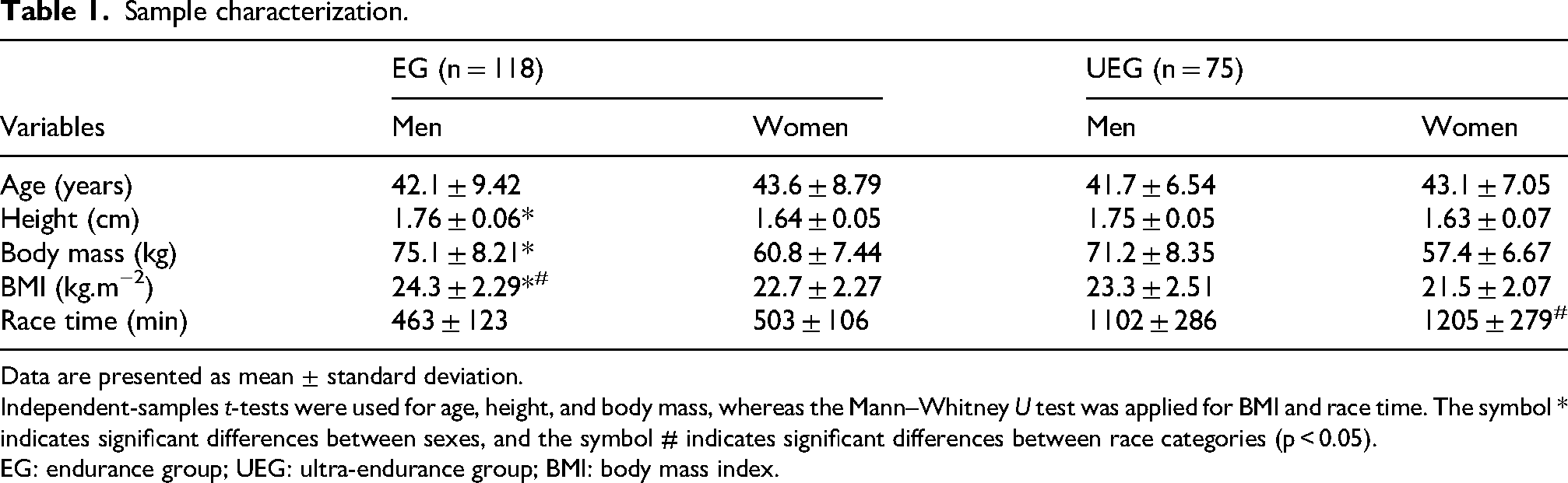
Data are presented as mean ± standard deviation.
Independent-samples t-tests were used for age, height, and body mass, whereas the Mann–Whitney U test was applied for BMI and race time. The symbol * indicates significant differences between sexes, and the symbol # indicates significant differences between race categories (p < 0.05).
EG: endurance group; UEG: ultra-endurance group; BMI: body mass index.
Table 2 presents the descriptive values of sleep quality, mood state, psychological health, anxiety, and fatigue indicators of participants in the endurance and ultra-endurance events, stratified by sex.
Questionnaires assessing sleep quality, mood state, psychological health, anxiety, and fatigue.

Data are presented as mean ± standard deviation.
Mood states represent the domains assessed by the BRUMS questionnaire.
EG: endurance group; UEG: ultra-endurance group; PSQI: Pittsburgh Sleep Quality Index; STAI-T: State–Trait Anxiety Inventory–Trait; STAI-S: State–Trait Anxiety Inventory–State; BRUMS: Brunel Mood Scale.
Comparative data from the GzLM across race categories and sexes are presented in Table 3. PSQI scores did not differ between categories or between sexes (p > 0.05), with very small effect sizes (ηp2 < 0.001). Regarding mood states, only vigor showed significantly higher scores in the UEG (β = 1.26; 95% confidence interval (CI) (0.19, 2.33); p = 0.002), although the effect size was small (ηp2 = 0.002). When sex effects were examined, men exhibited higher vigor scores (p = 0.003), whereas women presented higher tension (p = 0.009) and Total Mood Disturbance scores (p < 0.001), all with small effect sizes (ηp2 ≤ 0.006).
Generalized linear models (GzLM) examining the effects of race group and sex on sleep, mood, psychological health, anxiety, and fatigue indicators.

Results are presented as regression coefficients (β) with 95% CIs, p-values, and effect sizes (partial eta squared, ηp2). The reference group in the model was the endurance group for race classification and men for sex. * indicates statistically significant effects (p < 0.05) when comparing race categories (ultra-endurance vs. endurance). # indicates statistically significant effects (p < 0.05) when comparing sexes (men vs. women).
EG: endurance group; UEG: ultra-endurance group; PSQI: Pittsburgh Sleep Quality Index; STAI-T: State–Trait Anxiety Inventory–Trait; STAI-S: State–Trait Anxiety Inventory–State; CI: confidence interval; ηp2: partial eta squared.
For Positive Well-being and psychological distress scores, no significant differences were observed between EG and UEG or between sexes (p > 0.05). Regarding anxiety, both STAI-T and STAI-S scores were significantly higher in women (STAI-T: p = 0.006; STAI-S: p = 0.009), independent of race group, albeit with small effect sizes (ηp2 < 0.001). Finally, the fatigue score was significantly lower in the UEG (β = −1.94; 95% CI (−3.67, −0.21); p = 0.027), also with a small effect size (ηp2 < 0.001).
Spearman's correlation analysis (Figure 1) indicated that PSQI scores showed moderate associations with tension (r2 = 0.38; p < 0.001), depression (r2 = 0.32; p < 0.001), anger (r2 = 0.30; p < 0.001), fatigue (r2 = 0.36; p < 0.001), and Total Mood Disturbance (r2 = 0.45; p < 0.001), as well as a small association with confusion (r2 = 0.27; p < 0.001). A small and negative association was also observed between PSQI and vigor (r2 = −0.28; p < 0.001). Additionally, PSQI showed a moderate negative association with Positive Well-being (r2 = −0.32; p < 0.001), along with moderate positive associations with STAI-T (r2 = 0.47; p < 0.001) and STAI-S (r2 = 0.48; p < 0.001). Small associations were also identified between PSQI and psychological distress (r2 = 0.21; p = 0.004) and the fatigue score (r2 = 0.28; p < 0.001).
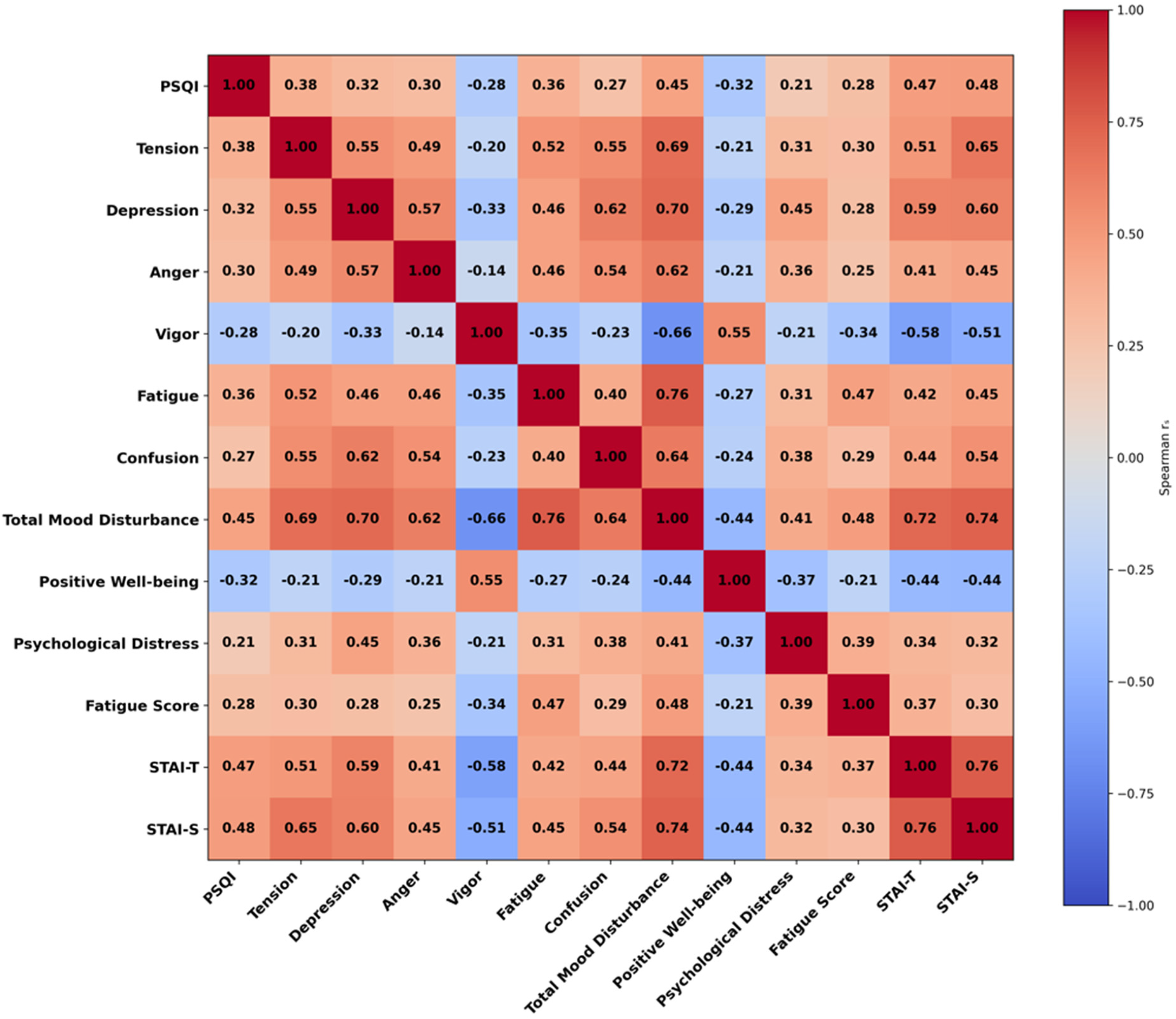
Heatmap of the Spearman correlation matrix among sleep quality, mood states, psychological health, anxiety, and fatigue.
In addition to the associations related to PSQI, strong correlations were observed among the remaining psychological variables. Notably, Total Mood Disturbance was strongly and positively associated with negative mood states—tension, depression, anger, fatigue, and confusion (r2 ranging from 0.62 to 0.76; p < 0.001)—and strongly and negatively associated with vigor (r2 = −0.66; p < 0.001). Strong interrelationships were also found among mood states, including depression and anger (r2 = 0.57) and tension and depression (r2 = 0.55).
Within the anxiety domain, a strong correlation was observed between STAI-T and STAI-S (r2 = 0.76; p < 0.001). Furthermore, depression showed strong correlations with both STAI-T and STAI-S (r2 = 0.60; p < 0.001), whereas tension was strongly associated with STAI-T (r2 = 0.51; p < 0.001) and STAI-S (r2 = 0.65; p < 0.001). Both STAI-T and STAI-S scores were strongly correlated with Total Mood Disturbance (STAI-T: r2 = 0.72; STAI-S: r2 = 0.74; p < 0.001). A strong association was also observed between STAI-S and confusion (r2 = 0.54; p < 0.001), along with strong negative associations between anxiety and vigor (STAI-T: r2 = −0.58; STAI-S: r2 = −0.51; p < 0.001).
Regarding psychological health, a strong positive association was observed between Positive Well-being and vigor (r2 = 0.55; p < 0.001), indicating that higher levels of positive psychological well-being are strongly associated with greater perceived energy and vitality.
Additionally, a Spearman's correlation analysis was conducted between race time and PSQI scores, mood state, anxiety, and psychological health. The results indicated no relevant associations, with correlation coefficients close to zero across all variables analyzed. Therefore, these data are not presented in detail in the main text and are reported only to demonstrate that race time was not associated with the psychological and sleep-related outcomes assessed.
Discussion
The present study aimed to characterize the mood state of endurance and ultra-endurance runners participating in La Misión Brasil 2024 and to analyze its relationship with sleep quality, based on the hypothesis that mood profiles would differ between the EG and UEG and that poorer sleep quality would be associated with less favorable mood profiles. Overall, the questionnaire results indicated that, regardless of race group, participants exhibited favorable responses in terms of mood, psychological health, anxiety, and fatigue, with scores generally indicating lower emotional disturbance and anxiety levels, together with adequate sleep quality. Taken together, the results support the study hypothesis, indicating that poorer sleep quality was associated with less favorable psychological responses, whereas specific differences were observed between endurance and ultra-endurance runners.
These findings are consistent with the existing literature, which demonstrates that even in the presence of high levels of mental fatigue and physical effort, characteristic of prolonged exercise, athletes may display a favorable mood profile.34,35 Moreover, previous studies suggest that success in long-duration events, conceptually defined by prolonged exposure to physical and psychological demands requiring sustained effort, is associated with specific psychological traits, such as greater self-sufficiency, higher intelligence, and lower levels of anger, fatigue, tension, and depression. 36 This psychological profile aligns with the favorable emotional functioning observed among the runners evaluated in the present study.
It is important to note that the variables assessed in the present study, including mood state, sleep, anxiety, and psychological health, represent self-reported psychological states and symptoms rather than clinically diagnosed mental disorders. Conditions such as depression, anxiety disorders, and sleep disorders require clinical evaluation and formal diagnosis. Accordingly, instruments such as the BRUMS, STAI, and PSQI allow the assessment of situational emotional states and perceived symptoms, which may be influenced by training load and environmental stressors but should not be interpreted as indicators of mental illness. 37 This distinction is particularly relevant in athletic populations, in which transient psychological fluctuations are common and do not necessarily reflect pathological conditions. 37
With regard to our results, another relevant aspect that may have contributed to the favorable mood profile observed is the natural environment in which trail and mountain running events are performed. Physical exercise conducted in natural settings has been associated with more positive affective responses, favoring the preservation of emotional traits and improvements in mood state. 6 These beneficial effects may occur, at least in part, through a shift in attentional focus, redirecting attention from internal cues often dominated by perceptions of fatigue and discomfort toward external environmental stimuli.38,39 Thus, even in the presence of elevated immunophysiological demands, which are potentially associated with negative mood alterations, competitions held in natural environments, such as trail and ultra-trail running, may facilitate mood restoration and emotional balance in athletes. 6 However, because environmental exposure and training characteristics were not directly assessed in the present study, these interpretations should be considered cautiously.
With respect to differences between race categories, the EG and the UEG exhibited largely similar characteristics, except for vigor and fatigue score. Athletes in the UEG demonstrated significantly higher vigor scores, whereas the EG presented higher levels of global fatigue. These findings may reflect differences in mood profile and emotional self-regulation strategies associated with chronic exposure to prolonged efforts, which are characteristic of ultra-endurance athletes. 13 Such adaptations may promote a greater perception of psychological energy and vitality, 40 thereby contributing to lower levels of global fatigue when compared with the EG. Similarly, Burgum and Smith 7 reported that ultra-endurance athletes exhibited higher vigor scores during the periods preceding an ultramarathon (1 week before and immediately prior to the race) compared with their own scores during the race. It is important to consider that differences in psychophysiological demands and adaptive responses may exist between endurance and ultra-endurance runners, potentially reflecting variations in global fatigue and other psychological responses. 41
Regarding sex differences, vigor was significantly higher in men, whereas women exhibited higher scores for tension, Total Mood Disturbance, and anxiety (STAI-T and STAI-S), indicating a more favorable overall mood profile among male athletes. Previous evidence indicates that women tend to report stronger motivations for running related to psychological health, whereas men are more performance-oriented, which may directly influence mood states in both sexes. 42 Consistently, McDowell et al. 43 reported higher scores for tension, fatigue, mood disturbance, and particularly trait anxiety (STAI-T; p < 0.05) in women compared with men, resulting in a substantially higher prevalence of anxiety among female athletes (26.9% vs. 3.7%). Similar findings were also reported by Correia and Rosado 44 across different sport modalities. The present results align with this body of evidence, suggesting a greater female predisposition to anxiety symptoms and negative affective states in competitive contexts, potentially related to psychosocial, hormonal, and stress-perception factors. 45
Although previous studies have suggested that more favorable mood states may be associated with improved athletic performance, 46 the present study did not observe relevant associations between sleep quality, mood state, anxiety, psychological health variables, and race time. In addition, potential confounding variables, such as sex, were not controlled in these analyses. Therefore, these relationships should be interpreted cautiously within the context of the present findings.
Regarding the associations between questionnaires, the analyses revealed important indicators of mood state. The strong correlations observed among negative mood states (tension, depression, and confusion), anxiety, and Total Mood Disturbance confirm the interdependence of these constructs in endurance and ultra-endurance athletes. Athletes engaged in prolonged and strenuous exercise and exposed to high physiological and psychological demands may be more vulnerable to changes in mental health. 47 These alterations are influenced by training and competitive pressures, which may facilitate the emergence of negative thoughts and emotions as a consequence of the sporting context in which athletes are embedded.1,36 According to Scheer et al., 1 in endurance and ultra-endurance runners, training and sport practice-related characteristics may be associated with a higher prevalence of mental health-related symptoms, such as anxiety. Conversely, the inverse association observed between vigor and negative mood states suggests that vitality may act as a protective factor against competitive stress, contributing to better mood adjustment in endurance athletes. 13
Finally, although no statistically significant differences were observed, PSQI scores tended to be higher among women in the EG and among men in the UEG. These findings should be interpreted cautiously, as the present study did not directly assess motivational or behavioral factors related to sleep quality during the pre-competition period. Poor sleep quality observed in endurance and ultra-endurance athletes may be influenced by multiple factors associated with the preparatory phase of competition, including anticipatory anxiety, pre-race routines, training demands, and psychological stress related to the event.1,47
Regarding PSQI-related associations, poorer sleep scores were moderately associated with higher levels of negative mood states, reinforcing the bidirectional relationship between sleep and mood regulation and strengthening the evidence supporting the study hypothesis. These findings corroborate evidence indicating that sleep plays a fundamental role in emotional regulation, such that poor sleep quality may intensify negative emotional responses and increase anxiety levels.18,48 Moreover, the correlations observed between PSQI and anxiety states (STAI-T and STAI-S) further reinforce that, beyond being a cornerstone of athletic performance, sleep can directly impact other relevant psychological domains. Consistently, Scheer et al. 1 reported a high prevalence of sleep problems (28.8%; women = 32.9% and men = 26.4%) and anxiety symptoms (13.5%; women = 16.2% and men = 11.9%) among endurance athletes, as well as a direct association between these variables. In addition, higher PSQI scores, indicative of poorer sleep quality, showed small to moderate inverse associations with vigor and Positive Well-being, highlighting the relevance of sleep for psychological vitality and overall mood state in athletes.
Finally, despite the recognized role of sleep quality as an important factor in predicting athletic performance and emotional regulation, no strong associations were observed between sleep variables and race performance in the present study. These findings suggest that performance in trail and ultra-endurance events may be influenced by multifactorial and potentially more qualitative aspects, including psychological adaptation, 38 pacing strategies, 49 environmental exposure, and previous experience in endurance competitions. 1
Several limitations should be considered when interpreting the present findings. First, the cross-sectional design of the study may limit causal inferences, as the assessments reflect responses from a single competition and a specific time point. In addition, the pre-competition period may involve substantial fluctuations in mood state, anxiety, and psychological health variables, which may have influenced the responses obtained, although this period was intentionally selected due to its relevance within the competitive context. The primary limitation lies in the reliance on self-reported instruments, which may be subject to response bias despite the robust validation of the questionnaires used. The absence of objective sleep measures, as well as the lack of detailed monitoring of training load, should also be acknowledged, particularly considering that the questionnaires were administered during the athletes’ preparatory phase. Finally, although the overall sample size was considerable, the smaller number of women in the UEG may limit sex-specific interpretations. Future studies incorporating objective sleep assessments and comprehensive training load monitoring, whereas directly evaluating mood-related outcomes and their relationship with sleep quality, are warranted to further elucidate these associations in trail and mountain runners.
Conclusion
This study showed that endurance and ultra-endurance runners generally exhibited a favorable mood profile, with higher vigor observed in the UEG and greater global fatigue in the EG, suggesting psychological adaptations associated with prolonged effort. Although the associations between sleep and mood were of small to moderate magnitude, the findings reinforce the central role of sleep in emotional functioning. The strong associations observed between negative mood states and psychological variables such as anxiety, psychological distress, and fatigue indicate that the demands of endurance and ultra-endurance modalities may influence athletes’ emotional states.
Furthermore, previous studies have suggested that exercise performed in natural environments may be associated with more favorable emotional responses. However, because environmental exposure and training context were not directly assessed in the present study, these interpretations should be considered cautiously. These findings nonetheless reinforce the importance of integrated monitoring of mood and sleep variables in endurance and ultra-endurance athletes.
Footnotes
Acknowledgments
The authors would like to thank the organizers of the La Misión Brasil 2024 event for their support and cooperation, as well as all athletes who voluntarily participated in this study.
ORCID iDs

Consent to participate
Electronic informed consent was obtained from all participants prior to their inclusion in the study.
Ethics approval and consent to participate
The study was approved by the Research Ethics Committee of the Federal University of Viçosa (CAAE: 48570921.4.0000.5153; approval number 4.911.679) and conducted in accordance with the Declaration of Helsinki. All participants provided written informed consent prior to participation.
Author contributions
Conceptualization, G.P.S., P.R.M. and H.S.S.; methodology, G.P.S., P.R.M., L.Q.G., J.P.M., A.C.P.K and H.S.S; original draft preparation, writing—review and editing, G.P.S., L.Q.G., V.S., J.P.M., M.L.S.B., B.K., A.C.P.K. and H.S.S.; data curation, G.P.S., V.S., B.K., A.C.P.K. and H.S.S.; visualization, G.P.S. and M.L.S.B.; funding acquisition, H.S.S.
Funding
This work was supported by the Fundação de Amparo à Pesquisa do Estado de Minas Gerais (FAPEMIG), Brazil, under grant number APQ-02146–22.
Declaration of conflicting interests
The authors declared no potential conflicts of interest with respect to the research, authorship, and/or publication of this article.
Data availability statement
The datasets generated and/or analyzed during the current study are available from the corresponding author upon reasonable request.