



Abstract
End-of-life care in oncology represents a complex and multidimensional challenge that requires ethical awareness, effective communication, and multidisciplinary collaboration. Drawing from the discussions and data presented during the 2025 AIOM Ethics Days, this paper highlights key aspects influencing the quality and humanity of end-of-life care. Significant gaps persist in clinicians’ knowledge and in the practical implementation of shared care planning, not solved by the dedicated Italian law approved in 2017 (n.219). Communication between oncologists and patients remains a critical factor in fostering informed decisions and emotional support. Awareness of prognosis and early integration of palliative care improve quality of life, yet these remain underutilized. Spiritual support and organizational innovation are increasingly recognized as essential components of comprehensive care. The findings highlight the importance of interprofessional dialogue, ethical reflection, and ongoing education to reduce overtreatment and professional distress. Fostering a culture of respect and shared responsibility is essential to uphold patients’ dignity throughout the end-of-life process.
Introduction
The management of end-of-life care in oncology was the focus of the event promoted by the Italian Association of Medical Oncology (AIOM) held in Lecce on September 19–20, 2025 (
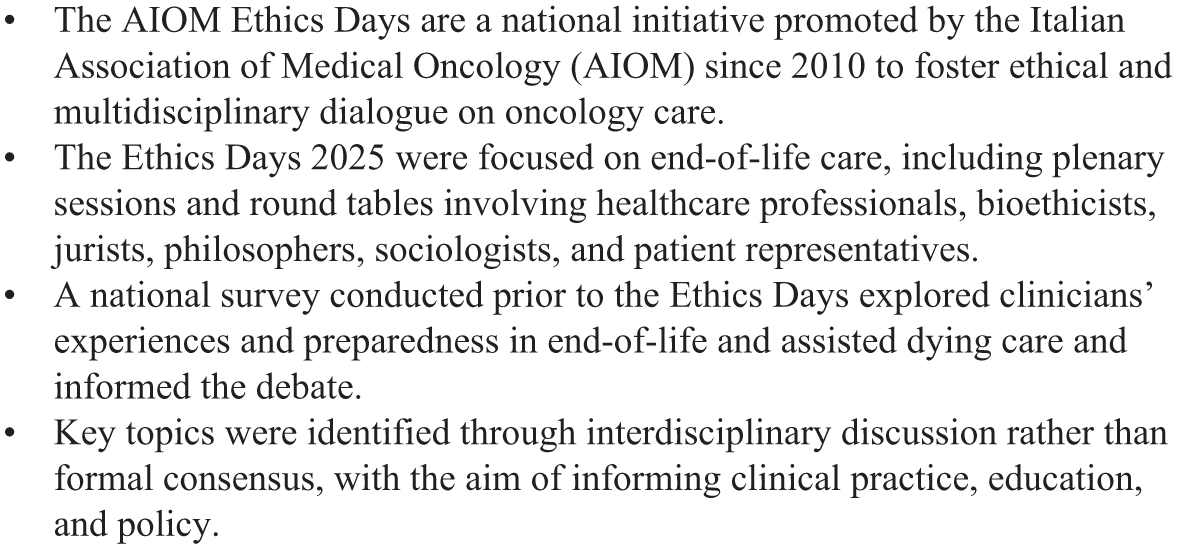
AIOM Ethics Days 2025 on End-of-Life Care
The essential aspects at the end of life: what oncologists need to know.
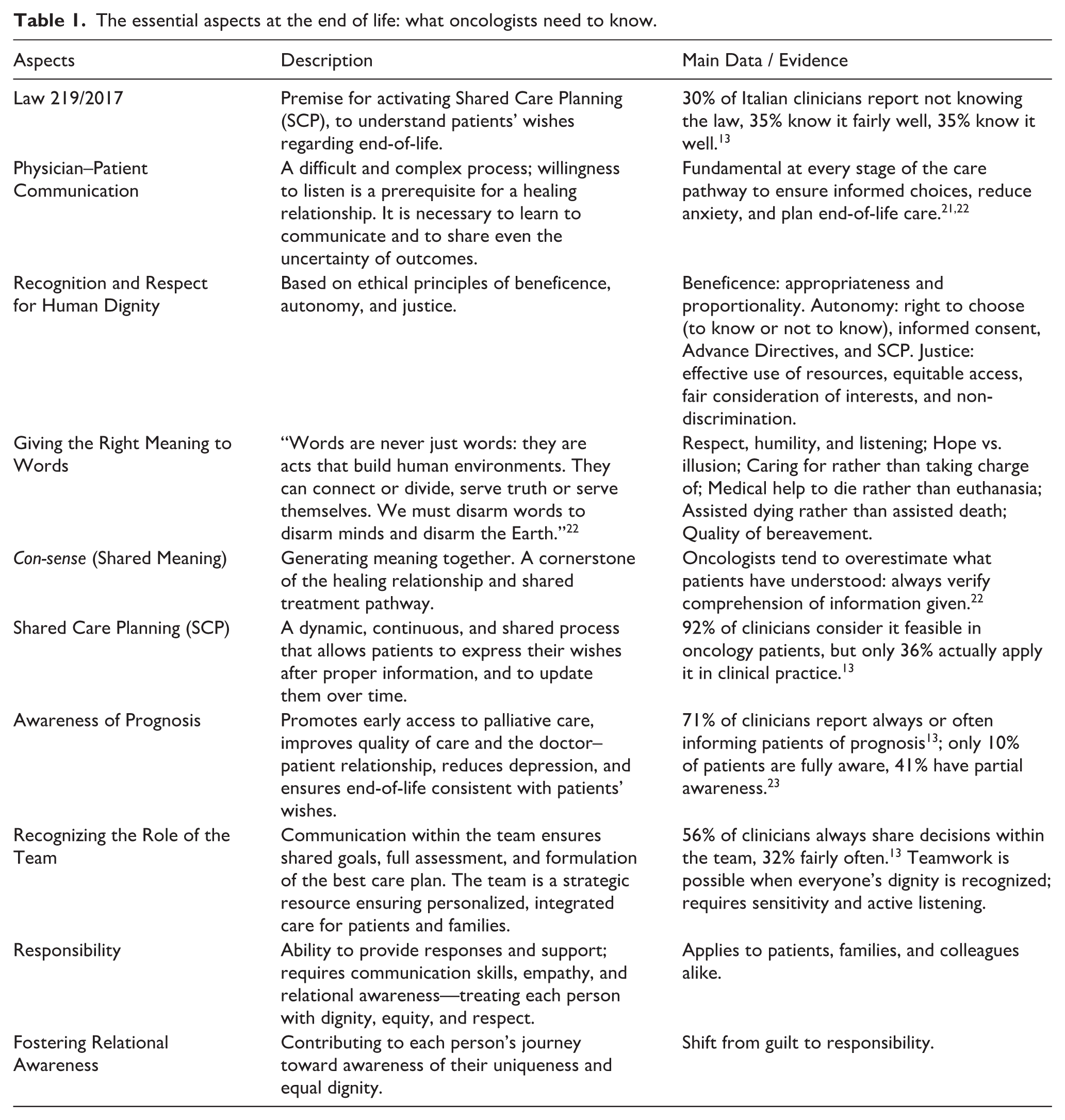
The essential aspects at the end of life: For care beyond illness.


Current state of the art and key challenges in end-of-life oncology care in Italy.
Insights from the 2025 AIOM Ethics Days and national survey
The 2025 AIOM Ethics Days were preceded by a survey promoted by AIOM with the participation of the Italian Society of Palliative Care (SICP), Italian Society of Anesthesia, Analgesia, Resuscitation and Intensive Care (SIAARTI), Italian Society of Psycho-Oncology (SIPO), Italian Society of Surgical Oncology (SICO), and the Italian Association of Radiotherapy and Clinical Oncology (AIRO), addressing end-of-life issues, conducted online from April to July 2025, and joined by 562 professionals (89% of whom were physicians). In addition to presenting the survey data, the sessions in Lecce provided an opportunity for interdisciplinary discussion of these complex and highly debated topics, involving philosophers, bioethicists, sociologists, legal experts, psychologists, spiritual caregivers, oncologists, palliative care specialists, anesthesiologists, nurses, family members, patients, patient organizations, and caregivers. Tables 1 and 2 present the main emerging issues discussed at the conference and related evidence, drawn partly from the survey and partly from the existing literature.
International and national regulatory frameworks
Internationally, EoLC is regulated according to different legislations. An overview of the current situation can be drawn from the Nuffield Trust report of August 2025. 5 Another recent international report by the OECD (Organization for Economic Co-operation and Development), operating in over 100 countries, aims to define better policies for better lives and identifies key issues in EoLC: 1) less than 40% of patients who need palliative care receive it; 2) care provided often does not align with patients’ wishes; 3) care quality is poor; 4) only about a quarter of patients establish advance care directives (ACDs); and 5) among elderly patients who die (50% in acute hospitals), only 10–25% receive adequate support for symptom relief and psychological support. 6 The report also highlights the lack of adequate financial resources allocated to EoLC (in OECD countries, hospital expenditures account for between 32% and 67% of EoLC costs), as well as insufficient scientific research in this field, both clinically and organizationally. Fewer than 30% of participating countries have a national research program in EoLC. This remains the case despite the well-documented benefits of early palliative care integration 7 and holistic end-of-life assistance (better quality of life, reduced costs due to decreased hospitalizations in acute care settings, reduced use of inappropriate drugs, and more appropriate care settings matching patient needs and wishes). 6 Results from some studies show that racial and ethnic minoritized populations with lung cancer experience more intensive EoLC than the white population. 8
In Italy, Law 219/2017 marked a fundamental legislative turning point, affirming the right to advance healthcare directives for all citizens and introducing the concept of Shared Care Planning (SCP) for patients with chronic and disabling illnesses. 9 In this framework, SCP should be understood not merely as informed consent to a single medical act, but as a broader and dynamic process that also includes Advance Care Planning as described in international literature. 10 Of note, this law does not address euthanasia or medically assisted suicide (MaS), but rather focuses on patient autonomy, decision-making processes, and the shared definition of care goals within the therapeutic relationship. 9 In this light, the uniqueness of SCP should be emphasized, as it amplifies the voices of patients and their needs in all settings, throughout their care journey, valuing the uniqueness of the person. Moreover, SCP underscores the creation of a shared project within a caring relationship, between those seeking help and those offering it (the expression “Communication time is care time” perfectly applies to this setting). This clarification allows a more accurate ethical interpretation of shared decision-making processes and facilitates their correct correlation with the principles introduced by Law 219/2017. 9 SCP requires a rethinking of innovative organizational models in health and social care services—flexible and responsive to the emerging challenges of a changing society. A distinct legal and ethical framework emerged with the Italian Constitutional Court ruling no. 242/2019, which addressed the issue of MaS by identifying specific and strictly defined conditions under which the punishment for assistance may be excluded, without constituting a comprehensive regulatory law. The ruling reaffirms the central role of access to palliative care and palliative sedation and has contributed to an ongoing public, ethical, and institutional debate regarding the need for a possible future legislative intervention on assisted dying in Italy. 11 Furthermore, patients must be informed about alternative solutions, especially access to palliative care and palliative sedation.1,7,8,12
Despite this, knowledge of Law 219 remains limited among both citizens and healthcare professionals, and its systematic application in daily clinical practice is rare. Available evidence shows that 34% of clinicians report feeling poorly or not at all prepared to assist dying patients, 39% consider themselves sufficiently prepared, and only 27% feel very confident in managing these complex situations. 13 These data highlight a relevant gap between the legal framework and everyday clinical practice, suggesting that legislation alone is insufficient to ensure appropriate EoLC. 13 In this context, scientific and professional associations could play a key role in promoting education, training, and ethical support, fostering shared competencies and increasing clinicians’ confidence when facing EoLC and medical assistance in dying scenarios. Experiences from a few Italian regions (Tuscany and Emilia-Romagna), as well as the much longer tradition in Switzerland that were presented at the AIOM conference, demonstrate that addressing requests for assisted dying from a healthcare perspective is complex but mandatory. Even the relevant terminology is not always shared, and the distinction between euthanasia (direct action by a physician to induce death at the patient’s request by administering lethal drugs) and MaS (the act of intentionally ending one’s own life by self-administering lethal drugs) is not universally understood. Difficulty still remains in reaching consensus about word usage and meaning. One consistent concept, however, is that the request for assisted dying aims to accelerate a process experienced by the person as gravely distressing, motivated by lack of hope and the search for meaning in life. This reflects not only intolerable suffering, but also a life perceived as intolerable. 5
The spiritual/psychological dimensions and the role of multidisciplinary teamwork
The spiritual, narrative, and psychological dimensions play a central role in EoLC, integrating with clinical and regulatory aspects to provide comprehensive support to patients, their families, and the entire care team.3,7 Spirituality, intended as a search for meaning, provides hope and helps patients find significance in life despite suffering, bringing attention back to fundamental values and the mystery of existence. 14 However, actual spiritual assistance remains scarce in oncology (ranging from 9% to 51% of patients), highlighting a significant gap between needs and organizational responses. 15
Testimonies from hospices presented at the AIOM ethics conference further underscored the fundamental importance of multidisciplinary teamwork, empathic listening, and psychological support - including for families and professionals - in helping patients process their journeys, preventing isolation, and reducing moral distress linked to ethical dilemmas or organizational constraints. 16 This distress can deeply affect healthcare workers, requiring targeted support strategies and lifelong training to ensure the well-being and cohesion of care teams, encourage open discussions, and normalize the topic of death. These elements are considered essential for fostering awareness, reducing uncertainty and emotional burdens, and promoting the dignity of individuals up to their final moments.1,4,17
All this requires healthcare professionals willing to take on the challenge, developing listening, communication, and communication-relational skills, fostering respect and shared decision-making within the team. 18 Sound moral judgment, the will to act beneficially, and the courage to stop when cancer treatments are no longer effective are equally crucial and necessary elements to prioritize dialogue, closeness, and palliative care while respecting and valuing persons. 8 Within this context, bioethics becomes a key to fostering reflection on the meaning and implications of suffering for patients and healthcare providers, and is a useful tool for imbuing this experience with meaning. 19
With regard to euthanasia, the percentage of Italian oncologists who declare themselves in favor has only slightly changed since 2007 (year of the previous AIOM survey). 20 Specifically, 14% of oncologist always declared themselves in favor, compared to 10.8% today; and “in favor in certain circumstances” 42% on 2007 versus 52.1% today.
Conclusions
The AIOM-promoted event on EoLC enabled an open and participatory interdisciplinary dialogue among the various scientific societies involved in patient care, highlighting the strong need for greater interaction among the diverse professionals for the benefit of patients, as well as to reduce the stress and care burden on healthcare professionals. All scientific societies involved must promote dialogue, discussion, training, support, and motivation among all stakeholders. It is also necessary to share a unified project among scientific societies to be more effective in institutional decision-making and to promote organizational models in social and health care more aligned with the emerging needs of a changing society. In this perspective, a crucial step forward could be the development of shared national pathways for EoLC, integrating hospital, territorial, and home-based services, with clearly defined roles and communication tools, to ensure continuity of care and equity of access across regions.
Footnotes
Declaration of conflicting interests
The authors declared no potential conflicts of interest with respect to the research, authorship, and/or publication of this article.
Funding
The authors received no financial support for the research, authorship, and/or publication of this article.
