




Abstract
The effect of art expertise on viewers’ processing of titled visual artwork was examined. The study extended the research of Leder, Carbon, and Ripsas by explicitly selecting art novices and art experts. The study was designed to test assumptions about how expertise modulates context in the form of titles for artworks. Viewers rated a set of abstract paintings for liking and understanding. The type of title accompanying the artwork (descriptive or elaborative) was manipulated. Viewers were allotted as much time as they wished to view each artwork. For judgments of liking, novices and experts both liked artworks with elaborative titles better, with overall rated liking similar for both groups. For judgments of understanding, type of title had no effect on ratings for both novices and experts. However, experts’ rated understanding was higher than novices, with experts making their decisions faster than novices. An analysis of viewers’ art expertise revealed that expertise was correlated with understanding, but not liking. Overall, the results suggest that both novices and experts integrate title with visual image in similar manner. However, expertise differentially affected liking and understanding. The results differ from those obtained by Leder et al. The differences between studies are discussed.
Visual art is always viewed within a context. With regard to art, context is a wide-ranging term that refers to the entire situation that is present when an art object is encountered by a person. Internally generated context comes from within a person, and consists of such factors as a person’s experience with art (Axelsson, 2007; Cupchik & Gebotys, 1990; Hekkert & Van Wieringen, 1996; Hekkert, Peper, & Van Wieringen, 1994; Leder, Gerger, Dressler, & Schabmann, 2012; Schmidt, McLaughlin, & Leighten, 1989; P. J. Silvia, 2013; Winston & Cupchik, 1992), their personality (Chamorro-Premuzic, Bruke, Hsu, & Swami, 2010), their purpose for viewing an artwork (Mastandrea, Bartoli, & Bove, 2009), and their state of mind (Bennington, Backos, Harrison, Reader, & Carolan, 2016). Externally generated context consists of environmental factors related to the artwork, such as the physical surroundings (e.g., an art gallery or a laboratory; see Brieber, Leder, & Nadal, 2015; Brieber, Nadal, Leder, & Rosenberg, 2014), information or labels attached to the artwork (Kirk, Skov, Hulme, Christensen, & Zeki, 2009), and the historical context that the artwork is embedded in (Bullot & Reber, 2013). These internal and external contexts have a substantial influence on appreciation of an artwork and on the viewer’s understanding of the meaning of an artwork.
Titles and Art
When considering visual art, one of the most commonly encountered forms of external context is a title. Visitors to an art gallery or an art museum often inspect a painting or an artistic photograph and then look for a printed card beside the artwork that displays the title of the piece. Reproductions of visual art in print media, electronic media, and social media often have titles that accompany the images. The title of an artwork has the potential for providing important contextual information that affects how viewers perceive the visual image. There is evidence that a title can alter the ease of processing of the artwork (Gerger & Leder, 2015) or provide additional insights about the artwork in terms of its meaning and Gestalt (Muth & Carbon, 2013). As Fisher (1984) points out, While titles are names, they are a good deal more than just names. They are not necessarily descriptions, although they can contain descriptive elements. They are names for a purpose, but not merely for the purpose of identification and designation, in spite of the important practical role which indexical names play in the designative process. The unique purpose of titling is hermeneutical: titles are names which function as guides to interpretation (p. 288).
In terms of the relationship between titles and visual art images, many laboratory studies have shown that the inclusion of titles with visual art affects the viewer’s liking for the artwork (Belke, Leder, Strobach, & Carbon, 2010; Gerger & Leder, 2015; Millis, 2001) and understanding of the artwork (Franklin, Becklen, & Doyle, 1993; Leder, Carbon, & Ripsas, 2006; Millis, 2001; Mullennix, Pilot, Steeves, & Burns, in press; Russell, 2003; Russell & Milne, 1997; Thömmes & Hübner, 2014). The effect that titles produce on the viewer depends on the type of title, whether the artist is familiar to the viewer, and the genre of visual art that is being judged (Gerger & Leder, 2015; Leder et al., 2006; Millis, 2001; Russell, 2003; Russell & Milne, 1997; Swami, 2013). Research has also shown that labels and explanatory information affect visitors’ impressions of art objects in museums (Bitgood & Henderson, 1993; Pekarik, 2004). There are some similarities in impression formation across the laboratory and the real world, as well as some differences (Pelowski, Forster, Tinio, Scholl, & Leder, 2017).
Studying how titles are combined with visual images during art appreciation can help provide insight into the perceptual/cognitive processes theorized to produce an aesthetic experience (Gerger & Leder, 2015; Leder et al., 2006; Mullennix et al., in press). In recent models of aesthetic processing, lower level and higher level cognitive processes are proposed as a part of various frameworks explaining how the cognitive system processes artworks (Graf & Landwehr, 2015; Leder & Nadal, 2014; Leder, Belke, Oeberst, & Augustin, 2004; Locher, Overbeeke, & Wensveen, 2010; Pelowski, Markey, Forster, Gerger, & Leder, 2017). The suggestion is that the cognitive processes employed during art appreciation are arranged in a serial/hierarchical manner, with bottom-up, relatively automatic processes engaged early in the processing sequence, and effortful, controlled processes employed later in the processing sequence (Leder et al., 2004). With this in mind, a few studies have examined the cognitive processes involved in viewing titled artworks by manipulating the type of title that is presented with the visual image. Leder et al. (2006) presented abstract paintings to viewers that were accompanied by descriptive or elaborative titles. Descriptive titles summarized elements of the paintings and were more straightforward, similar to what Levinson (1985) would call “reflective” titles. Elaborative titles provided a possible interpretation of the artwork, falling under Levinson’s definition of “interpretive” or “additive” titles. For liking judgments, they found that the type of title had little effect, regardless of how quickly or slowly the artworks were presented. Leder et al. explained this finding in terms of liking judgments being a product of affective information available at all levels of information processing. For judgments of understanding, ratings were higher for descriptive titles at a fast (1 s) presentation time for the artworks, but higher for elaborative titles at a longer (10 s) presentation time. Leder et al. concluded that higher ratings for descriptive titles at 1 s were because of the short presentation time allowing access only to early explicit classification processes (Leder et al., 2004), with descriptive titles affecting this level of cognitive processing. For the longer 10-s time, the assumption was the additional time allowed access to later cognitive mastering and evaluation processes (Leder et al., 2004) that handle interpretation and understanding, with enough time available to thoroughly process the elaborative titles and have them facilitate judgments of understanding.
A study by Mullennix et al. (in press) examined the effects of descriptive and elaborative titles on abstract paintings under varying conditions of image presentation times and cognitive load. Mullennix et al. explained their findings via a cognitive processing load framework. Under high-processing load situations (i.e., fast presentation time and high memory load), descriptive titles produced higher ratings of understanding. Under low-processing load situations (slow presentation time and low memory load), elaborative titles facilitated understanding. This suggestion is similar to Gerger and Leder’s (2015) idea that titles change impressions of artwork by facilitating mental “ease of processing,” alternatively conceptualized as facilitating processing fluency (Forster, Gerger, & Leder, 2015; Forster, Leder, & Ansorge, 2013). Studies that manipulate the semantic match of the title to the visual image also provide support for this idea (Belke et al., 2010; Gerger & Leder, 2015; Russell & Milne, 1997).
Art Expertise
We are just beginning to understand more about the cognitive processes that integrate the title with the visual image and how those processes fit into a cognitive model of art appreciation. In this study, the goal was to build upon this emerging research by examining how an additional contextual factor plays into the processing of titled artworks. This contextual factor is the viewer’s art experience and background. When one examines studies comparing naive viewers of art with art experts, one finds substantial differences in terms of how they view and process art. A few areas where differences have been observed are judgments of liking and understanding (Leder et al., 2006, 2012), emotional responses to art (Leder, Gerger, Brieber, & Schwarz, 2014), preference for complexity (Axelsson, 2007; Winston & Cupchik, 1992), perception of craftsmanship and quality of the artwork (Hekkert & Van Wieringen, 1996), one’s interest in art and appraisal of art (P. Silvia, 2006; P. J. Silvia, 2013), conceptual spaces possessed by the viewer (Augustin & Leder, 2006), and visual exploration patterns when looking at art (Nodine, Locher, & Kripinski, 1993). When considering cognitive models of aesthetic appreciation such as Leder et al. (2004), there exist hypotheses about the stage of processing affected by a viewer’s knowledge of art and their expertise level. In Leder et al.’s model, they suggest that knowledge and expertise affect explicit classification and cognitive mastering/evaluation stages of processing, alternatively described by others as perceiver-driven processes (Graf & Landwehr, 2015) or reflective processes (Belke, Leder, & Carbon, 2015). These later stages of processing are deliberate, can be verbalized, and are devoted to processing the meaning of the artwork and producing an understanding of the artwork (Leder et al., 2004). Thus, given the importance of expertise in models of cognitive processing in art, it seems important to explore in as many different domains as possible how expertise modulates the effects of context when viewing artworks. These findings could provide valuable information to further refine our ideas about the stages of processing affected by expertise.
The Present Study
In this study, the goal was to examine the role of art expertise in processing visual art accompanied by a verbal title. This was accomplished by examining how expertise affects liking and understanding judgments for artworks that have descriptive or elaborative titles. Leder et al. (2004) stated, “Expertise in art consists of information that supports cognitive processing. Therefore, investigations of aesthetic experience that explicitly measure art knowledge seem to be warranted in empirical studies” (p. 498). In this study, the processing of different types of titles and expertise were examined concurrently. This presented a unique opportunity to examine Leder et al.’s claims regarding expertise and the cognitive processing of art. Leder et al. suggested that top-down information in the form of expertise affects the processing of style-related information in an artwork and the degree to which the meaning of an artwork is mastered and understood. In terms of titles that accompany artworks, descriptive titles are believed to add little additional meaning to an artwork and most probably require little in the way of cognitive processing, while elaborative titles contribute significantly to the artwork in terms of meaning and understanding and presumably engage later, deep cognitive processing levels. If Leder et al.’s assumptions about expertise and cognitive processing are valid, one would expect to observe differences between art novices and art experts in terms of how they process artworks that have different classes of titles. One would expect that expertise should come into play less for descriptive titles and more for elaborative titles, with differences in judgments between artworks with descriptive and elaborative titles (especially when judgments of understanding are being made) observed when comparing novices with experts. Such a result would provide additional evidence to support Leder et al.’s idea that expertise affects deeper levels of cognitive processing related to cognitive mastery and understanding of artworks.
There is one study that examined titles and expertise together, that being the Leder et al. (2006) study discussed earlier. In Leder et al.’s Experiment 2, they examined expertise by dividing participants into two groups based on a median split of art knowledge scores. They found that art knowledge did not affect liking judgments. However, ratings of understanding were higher for those with more art knowledge, but only for artworks presented at moderate viewing times of 10 s. Art knowledge did not interact with the type of title (descriptive and elaborative). In terms of the effects of expertise, Leder et al. noted, Expertise and interest in art showed rather weak effects, presumably because the range of these variables was relatively small due to our sample consisting of art novices. The effects in Experiment 2b need to be studied further. Systematic variation using art experts might be useful for these investigations … (p. 192).
Given Leder et al.’s (2006) caveat on the weak effects observed for expertise, we believed that the manner in which they measured expertise may have been insufficient to demonstrate clear differences between art novices and art experts. Thus, we decided to extend their study in order to examine the role of expertise in a manner where clear differences between novices and experts could be examined. To accomplish this, we mirrored some aspects of Leder et al.’s methodology and modified others. In order to address the issue of art novices mentioned by Leder et al., we took steps to enroll participants into our study that possessed the necessary art-related background that distinguished them from naive viewers of art. We were also concerned that art knowledge alone may not adequately characterize art expertise. Thus, we used a survey that assessed five specific components of expertise: formal art-related coursework, frequency of exposure to art in museums/galleries, amount of time spent interacting with or creating art, creative achievement, and art knowledge/art history. The assessment of these five aspects of expertise allowed more precision in determining what aspects of expertise contribute to liking and understanding of titled visual art.
Similar to Leder et al. (2006) and Mullennix et al. (in press), we presented abstract artworks accompanied by descriptive or elaborative titles to participants. We chose abstract art because it is generally considered to be vague, somewhat ambiguous, and more amenable to having content-specific information provided in the form of titles act as a guide for interpretation of the artwork. As Swami (2013) noted, “Elaborate, content-specific information provides a better understanding of abstract artworks, which in turn results in better appreciation” (p. 293). Abstract art requires deeper elaboration and deeper cognitive processing. If differential effects of titles on the processing of art exist across novices and experts (two groups who ostensibly differ in how they utilize cognitive processes to make judgments about art), then using abstract art maximizes the possibility that these differences will be observed.
We assessed participants’ judgments of liking and understanding. Unlike Leder et al. (2006) and Mullennix et al. (in press), unlimited time was given to participants to view each artwork. This was done to emulate real-life situations where viewers take as much time as they wish inspecting a titled artwork they see in a gallery, museum, print, and electronic media. We were not interested in examining duration of presentation time and the resultant effects on processing.
For liking, we expected that novices’ ratings would not be affected by the type of title, following other research showing the absence of effects of title on liking for abstract art for naive viewers (Belke et al., 2010; Leder et al., 2006; Mullennix et al., in press). For experts, there were two possibilities. The first possibility was that (similar to novices) the type of title does not affect liking. This would suggest that liking judgments are handled by cognitive processes that do not utilize stored information related to expertise. The second possibility for experts was that higher ratings of liking would be observed for elaborative titles. In this scenario, one assumes that experts’ greater knowledge about abstract art (related to their expertise) is utilized and leads to greater hedonic pleasure from an elaborative title that contributes to the meaning and understanding of the abstract artwork. This would suggest that experts are utilizing different processes than novices for liking. If this result is found, one would also expect to find higher ratings of understanding for elaborative titles for experts as well.
For understanding, we predicted that novices would rate understanding higher for descriptive titles, similar to what Mullennix et al. (in press) observed. For experts, we predicted they would rate artworks with elaborative titles more highly. The rationale behind this prediction is that experts’ artistic background lends itself to understanding the conceptual linkage between title and image much better and in greater depth than novices with little experience. This would be consistent with the idea that art expertise affects later stages of cognitive processing as suggested by Leder et al. (2004).
In addition to obtaining rating data, response latency data to perform the rating judgments was also recorded. If art experts’ knowledge is used to facilitate judgments of understanding, perhaps these judgments would be made faster than novices. This result would provide additional evidence that expertise affects the processing of titled artworks.
Method
Participants
Two groups of participants were solicited. One group (art novices) consisted of 26 undergraduate students at the University of Pittsburgh at Johnstown (8 men and 18 women). The students were enrolled in an Introductory Psychology course at the university. The average age of participants in the novices group was 19.7 years (SD = 1.8), with age range from 18 to 25. These participants received $20 USD and course credit for participation. The novice participants were told that if they began the study and wished to stop and leave the experiment, they would still receive course credit (per American Psychological Association ethical guidelines) but would not receive payment. The second group (art experts) consisted of 26 people with artistic experience from the metropolitan area of Pittsburgh, PA, USA. The criteria specified for potential expert participants was (a) a significant grounding in formal art-related coursework (i.e., studio arts, art history, architecture), (b) an art-related degree, or (c) a track record and resume of professional experience or accomplishments as a visual artist. The art experts were solicited via advertisements posted in local art galleries and coffee shops, emails to undergraduate and graduate students and faculty in the Studio Arts and Art History programs at the University of Pittsburgh, and word of mouth via social media. The experts group consisted of 7 men and 19 women, average age 27.2 years (SD = 13.2), age range from 19 to 60. The experts were paid $50 USD for their participation (Note: In terms of motivational factors, we considered $20 and course credit for novices to be roughly equivalent to $50 for experts).
To ensure that the two groups differed in art expertise, all participants completed an art expertise survey. The survey included questions about artistic production and achievement (yes or no questions, loosely based upon the Creative Achievement Questionnaire from Carson, Peterson, & Higgins, 2005), questions about formal coursework related to art, the frequency with which an individual views and interacts with artworks, and the frequency with which an individual visited museums and art galleries (drawn from the art experience questionnaire used by Chatterjee, Widick, Sternschein, Smith, & Bromberger, 2010), and the Aesthetic Fluency Scale (Smith & Smith, 2006), which is an instrument designed to assess the amount of art knowledge and history that a person possesses. The Aesthetic Fluency scale is a 0 to 4 scale that consists of 10 questions, with 0 on the scale indicating I have never heard of this artist or term and 4 on the scale indicating I can talk intelligently about this artist or idea in art. The reason that we chose these particular scales was that they were based on previous published research and thus possessed some empirical validity. The art expertise survey is shown in Appendix A.
Materials
A total of 24 digitized color abstract paintings from lesser known contemporary artists accompanied by elaborative and descriptive titles used by Mullennix et al. (in press) were presented. The stimuli used by Mullennix et al. and in this study were based on stimuli from Leder et al. (2006). We wanted to use the same artwork stimuli and the same titles already shown by other researchers to produce measureable effects on liking and understanding. Because of difficulty in locating high-quality images of four of the artworks used by Leder et al., four of the paintings used by Mullennix et al. and in this study were different than Leder et al., but produced by the same artist in the same style. The titles used for those four artworks were identical to the original titles for the artworks from Leder et al. (2006) that were replaced. We did not collect any postexperiment data for the artworks to determine whether any of them were recognizable by participants. However, when some of the experts were asked later whether any of the artworks were familiar to them, none of them said they recognized them. Obviously this informal observation should be taken for what it is.
As described by Mullennix et al. (in press), all 24 stimuli were obtained from online sources from artists’ websites and online art galleries and depositories. The images were digitally processed using Photoshop to create images at a standardized 400 pixels in height with a resolution of 96 pixels per inch. Two versions of each artwork were created, one with a fictitious descriptive title and one with a fictitious elaborative title, with 44-point Times Roman font titles appearing above each artwork. Descriptive titles summarized the most important physical/surface aspects of the painting (e.g., “Curved Lines,” “Dots of Color”) and elaborative titles provided a possible conceptually based interpretation or explanation of the artwork (e.g., “Sabotage,” “Ice Dancing”). The original names of the paintings, the artists’ names, and the fictitious descriptive and elaborative titles for each are listed in Appendix B.
Design and Procedure
The study was conducted in one session. The novices were run individually on a laptop computer in one of the Pitt-Johnstown Psychology Laboratory quiet rooms. Because there were few expert artists in the Pitt-Johnstown community area, the artists were by necessity solicited from the Pittsburgh, PA, metropolitan area 75 miles away. Because of this practical constraint, and for the sake of convenience for participants, the experts were run individually on a laptop computer in a public quiet space in the Cathedral of Learning on the main campus of the University of Pittsburgh. Control of the experiment and data collection were performed using the E-Prime 2.0 software package (Schneider, Eschman, & Zuccolotto, 2002), with the same laptop used for all participants in both groups. The laptop screen was 15.6 inches with a screen resolution of 1,366 × 768 pixels. Participants were presented with a sequence of 24 titled images, with each image followed by two rating scales. A 1-to-7 rating scale for liking was presented first and a 1-to-7 scale for understanding was presented second on each trial. The sequential ordering of rating scales was not counterbalanced across participants, following the discussion by Gerger and Leder (2015) indicating that, in their study examining titles and fluency, sequential ordering did not affect their results (they used a liking scale followed by an interest scale on each trial). Participants were told to attend to both the title and the image on each trial. For liking, participants were instructed to rate each artwork in terms of how much they liked it. On the liking scale, 1 denoted Didn’t like the artwork and 7 denoted Liked the artwork—see Mullennix et al. (in press) for an explanation as to why these particular endpoints were chosen. For understanding, participants were instructed to rate each artwork in terms of the degree to which they understood the artist’s intent with regard to the meaning of the artwork. On the understanding scale, 1 denoted Didn’t understand the artwork and 7 denoted Understood the artwork. Participants pressed one of the number keys on the computer keyboard to indicate their responses on each trial.
Each artwork image was accompanied by a descriptive or elaborative title. For each artwork, half the participants received the image with a descriptive title and half received the image with an elaborative title (e.g., some participants received Abad’s “Feeling Something Inside” with the “Colorful Ornaments” title and some received the same artwork with the “Wanderlust” title). The assignment of artwork to title was also counterbalanced across participants by switching the titles across the two artworks from each artist (e.g., some participants received Abad’s “Feeling Something Inside” with the “Wanderlust” title and some received “It’s Time to Pop the Champagne” with the “Wanderlust” title). There was some variation in the number of words used for titles across conditions. To assess this, the number of words used for descriptive titles and elaborative titles were compared. An average of 3.2 words were used for descriptive titles and an average of 2.1 words were used for elaborative titles. This difference across title conditions was statistically significant, t(11) = 3.46, p < .01.
The experiment was self-paced. Participants were told that when the titled artwork appeared on screen, they could take as much time as they wanted to examine it before proceeding. When a key was pressed, the artwork screen disappeared and the liking scale appeared. When a response was made for liking, the liking scale was replaced on screen by the understanding scale. Participants’ responses were timed from when the scale appeared on the screen to the time that they registered a rating keypress. Note that participants’ viewing time was not tabulated while they inspected the artwork slide on screen. The program did not register a keypress until the rating scale appeared on screen, meaning that participants could not accidentally register their rating decision before pressing the button to remove the artwork and replace the artwork screen with the first scale.
After completion of the experiment, participants filled out a paper and pencil version of the survey questionnaire assessing art expertise.
Results
Differences Across Groups in Expertise
Comparison of Experts and Novices for Measures of Artistic Expertise.

Note: A series of independent sample t tests showed a significant difference across groups for each measure, p < .001. SD = standard deviation.
Rating Data
The rating data for the liking and understanding tasks and the response latencies to make the rating responses were combined over all artworks and analyzed. A series of correlational analyses were also conducted to assess the relationship between liking and understanding and to probe relationships between the five measures of artistic expertise and the rating data.
Two separate repeated measures analyses of variance (ANOVAs) were conducted on the liking and understanding rating data for the variables of group (novices or experts) and title (descriptive or elaborative). For liking, a significant effect of title was observed, F(1,50) = 15.89, p < .001, ηp2 = .24, with higher ratings of liking for artworks with elaborative titles. The effect of group was not significant (F < .2) and the interaction of title with group was not significant (F < .3). The liking rating data are shown in Figure 1(a).
(a) Average rating of liking (1–7 scale with Didn’t like the artwork to Liked the artwork as endpoints, respectively) for artworks with descriptive and elaborative titles across novice and expert groups. Error bars represent ± 1 SD error from the mean for each condition. (b) Average rating of understanding (1–7 scale with Didn’t understand the artwork to Understood the artwork, respectively) for artworks with descriptive and elaborative titles across novice and expert groups. Error bars represent ± 1 SD error from the mean for each condition.
For understanding, a significant effect of group was observed, F(1,50) = 11.34, p < .001, ηp2 = .18, with higher ratings of understanding for experts. The effect of title was not significant (F < .1) and the interaction of title with group was not significant (F < 2.2). The understanding rating data are shown in Figure 1(b).
Response Latency Data
Two separate repeated measures ANOVAs were conducted on the liking and understanding response latency data for the variables of group (novices or experts) and title (descriptive or elaborative). For liking, a significant effect of group was observed, F(1,50) = 6.18, p < .02, ηp2 = .11, with faster response latencies for experts. A significant effect of title was not observed, although there was a marginally significant trend for faster latencies to elaborative titles, F(1,50) = 3.57, p < .07, ηp2 = .07. A significant interaction of title with group was not observed (F < 1.5). The liking latency data are shown in Figure 2(a).
(a) Average response latencies for liking judgments for artworks with descriptive and elaborative titles across novice and expert groups. Error bars represent ± 1 SD error from the mean for each condition. (b) Average response latencies for understanding judgments for artworks with descriptive and elaborative titles across novice and expert groups. Error bars represent ± 1 SD error from the mean for each condition.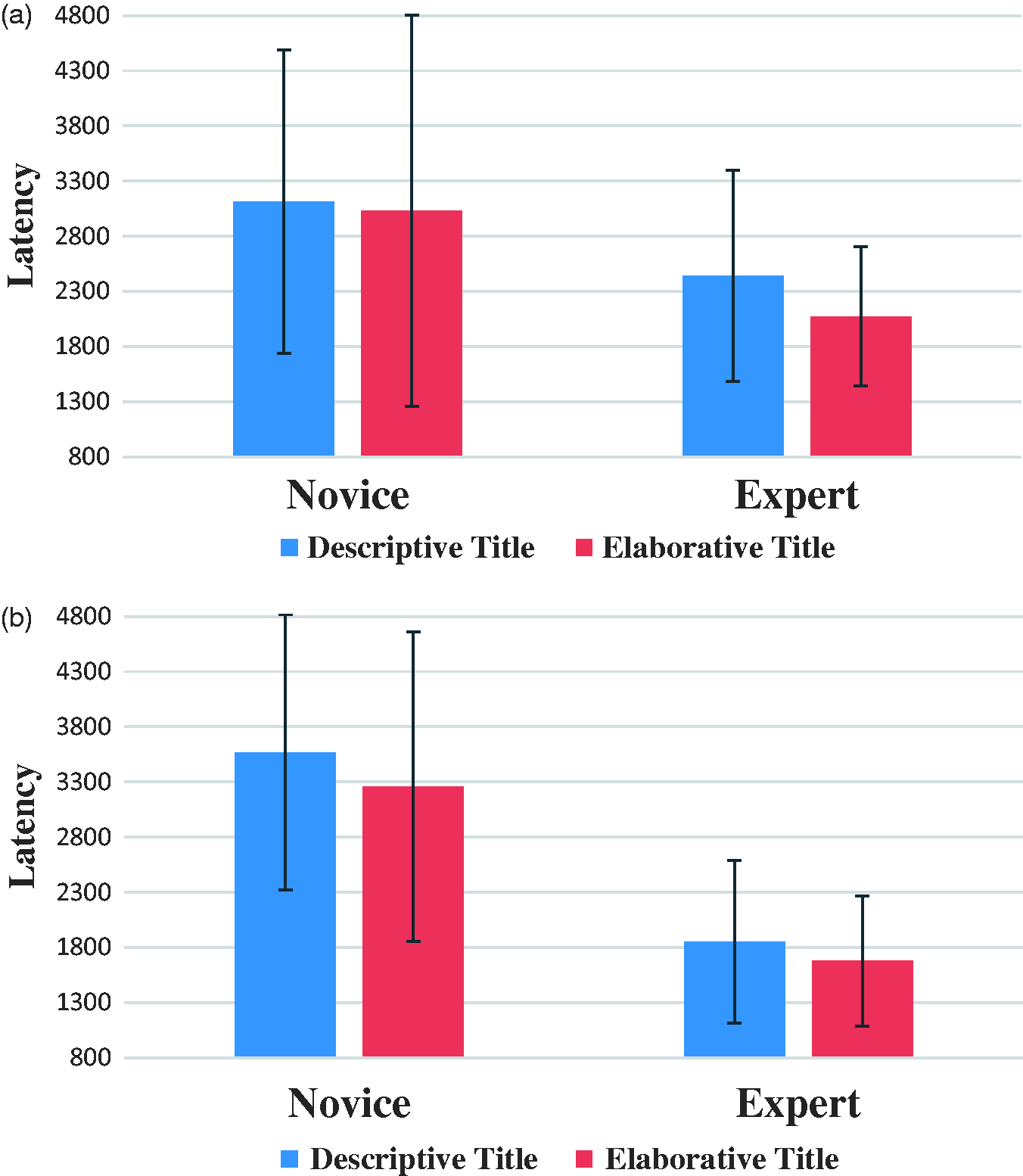
For understanding, a significant effect of group was observed, F(1,50) = 37.00, p < .001, ηp2 = .42, with faster response latencies for experts. A significant effect of title was also observed, F(1,50) = 5.14, p < .03, ηp2 = .09, with faster latencies for elaborative titles. A significant interaction of title with group was not observed (F < .39). The understanding latency data are shown in Figure 2(b).
Correlations of Rating Data and Response Latency Data
To assess whether ratings were related to response latency, for example, whether higher rating responses for liking or understanding were made more quickly, two Pearson product–moment correlation coefficients were computed between rating data and latency data for liking and understanding. The results showed a nonsignificant correlation of .10 (p = n.s.) for liking and a nonsignificant correlation of −.04 (p = n.s.) for understanding. Thus, the two dependent measures were not statistically related.
Correlations of Liking and Understanding
To ascertain whether ratings of liking and understanding were related, Pearson product–moment correlation coefficients were computed for liking and understanding ratings for novices and experts. For both groups, there was a significant positive correlation between liking and understanding, r = .44, p < .03, two tailed, and r = .66, p < .001, two tailed, for novices and experts, respectively. A similar set of correlations was conducted on the response latency data. For both groups, a significant positive correlation was observed for response latencies for judgments of liking and understanding, r = .75, p < .001, two tailed, and r = .58, p < .01, two tailed, for novices and experts, respectively. These analyses suggested that ratings of liking and understanding were linked together in some manner.
Relationship of Art Experience to Ratings of Liking and Understanding
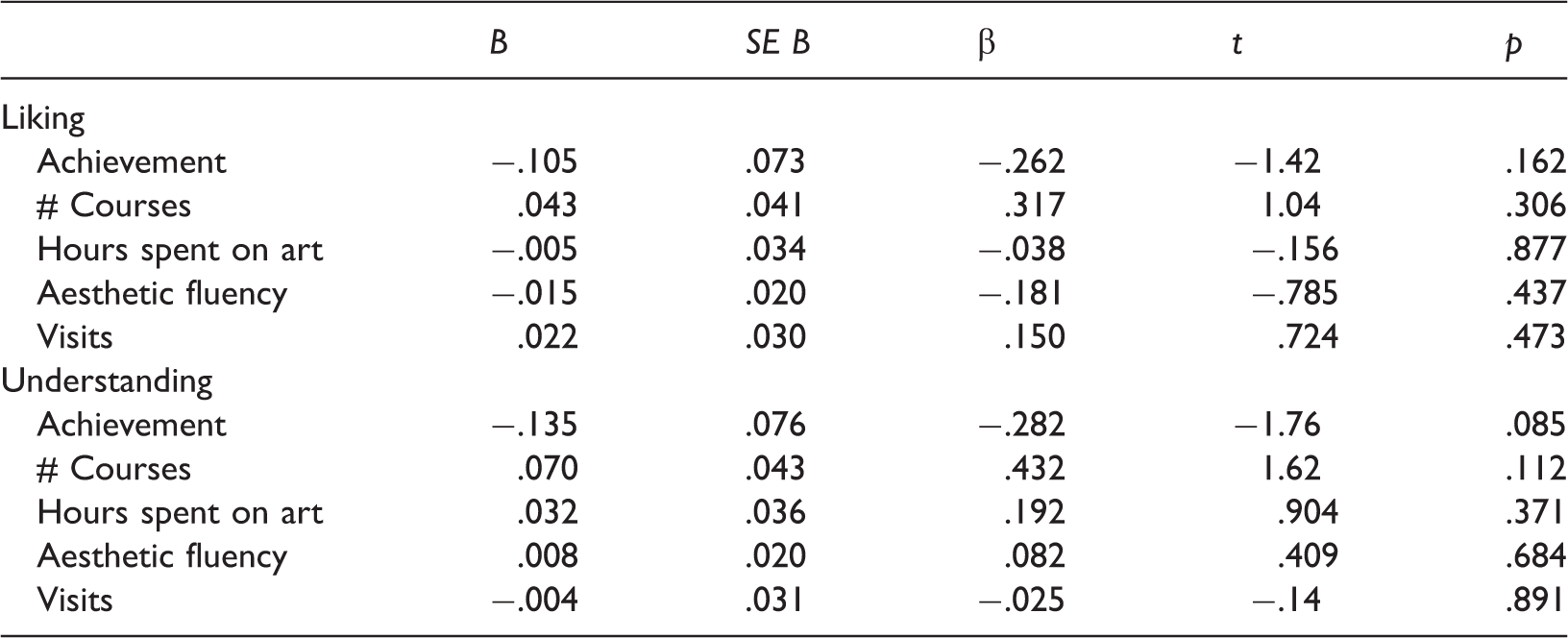
Multiple Regression Analysis for Measures of Expertise and Ratings of Liking and Understanding.
SE = standard error.
Finally, we mentioned earlier that elaborative titles were slightly shorter than descriptive titles (2.1 words vs. 3.2 words). One issue that arises is whether response latencies were faster for artworks with elaborative titles simply because the titles were read more quickly. We find this unlikely for two reasons. One, a significant effect of title on response latency was not observed, and, two, participants were given as much time as they needed before they proceeded from viewing the artwork to the rating scales, so time needed to read the title was probably not a factor.
Discussion
Overall, the results from this study were mixed in terms of support for the original predictions. There was no difference across groups in overall ratings of liking, suggesting that both novices and experts derived the same amount of hedonic pleasure from the abstract paintings. For liking judgments, artworks with elaborative titles were rated higher by both novices and experts, indicating that they preferred artworks with conceptual titles over artworks with straightforward, descriptive titles. On the surface, this finding is at odds with the absence of effects of title on liking observed for novices by Leder et al. (2006) and Mullennix et al. (in press). However, when closely inspecting the results from Leder et al.’s Experiment 2, one sees a slight nonsignificant trend toward higher liking for elaborative titles. And in Mullennix et al.’s study, a similar nonsignificant trend is evident under their “no cognitive load” conditions. Thus, similar trends are seen across studies. In terms of response latencies, experts performed their liking judgments faster than novices. It seems reasonable that art experts’ greater experience with art primed them to be able to quickly decide whether they liked an abstract artwork. For novices, the abstract art as a genre may have been relatively unfamiliar to them, requiring more time to make a decision.
For judgments of understanding, there was no effect of title for novices or experts. This is contrary to the prediction that novices would rate artworks with descriptive titles higher while experts would rate artworks with elaborative titles higher. This result was also contrary to Leder et al.’s (2006) finding that elaborative titles produced higher understanding at 10-s presentation times for novices and Mullennix et al.’s (in press) finding that descriptive titles produced higher ratings of understanding for novices. The analysis of response latencies for understanding showed that both novices and experts had faster latencies to artworks with elaborative titles.
The understanding data suggest that novices and experts use similar cognitive processes to understand titled artworks. However, there are two caveats to this conclusion. First, experts’ overall ratings of understanding were much higher than novices. This indicates that experts understood the conceptual basis behind the titled artworks better than the novices did, which presumably is related to art expertise. Second, experts’ understanding judgments were performed faster than novices. This suggests that experts’ greater familiarity and experience with art led to faster decision making about the conceptual meaning behind the artworks, compared with novices. Thus, when considering the issue of whether novices and experts use different cognitive processes to understand an abstract artwork, the issue is not settled. It appears that experts use their expertise in making judgments, but the manner in which the title is processed by both novices and experts for understanding seems similar.
There were significant positive correlations of liking with understanding for both groups. Although assigning directionality to correlations should be viewed cautiously, it seems reasonable to assume that a better grasp of the understanding of the artwork led to greater liking than vice versa. Regression analyses were conducted between the measures of expertise and judgments of liking and understanding. No significant relationship was observed for liking. However, a significant relationship of expertise with understanding was obtained. This provided further evidence that experts’ knowledge about art was used to help understand the meaning and conceptual intent of the artist for the artworks.
Overall, the picture that emerges from the present findings is one that shows some interesting, and somewhat unexpected, similarities between novices and experts in terms of how they process titled art. Overall, it appears that the manner in which a title is integrated with an artwork is similar for novices and experts. Effects (or absence of effects) of type of title for liking and understanding were similar for both novices and experts. However, there were also indications in the liking and understanding data that expertise did affect the processing of the artworks, with other differences observed between novices and experts.
In terms of comparison with Leder et al.’s (2006) study, this study expanded upon their work by enlisting a group of experts and by measuring expertise using a variety of measures. The only effect Leder et al. observed for expertise was higher ratings of understanding for experts at a 10-s presentation time. Similarly, we observed higher ratings of understanding for experts (who had unlimited time to view the artworks). However, we observed other differences between novices and experts: faster responses for experts for liking and understanding judgments and a significant statistical relationship between expertise and ratings of understanding. We believe that the manner in which we examined expertise allowed certain effects of expertise to emerge that may have been obscured in Leder et al.’s study. In addition, we allowed participants unlimited time to view the artwork before making their judgments. This is important. In Experiment 2 in Leder et al.’s study, they restricted the presentation time to 1 s and 10 s. This manipulation “stressed” processing in an unusual way, although allowing some insight into cognitive processing. In this study, we purposefully allowed unlimited time to view artworks for reasons of ecological validity, in that viewers of artworks in real-life situations usually take as much time as they want when inspecting visual art. It is quite likely that the processes engaged when viewers have plenty of time differ from the processes engaged when a viewer is under time constraints. This may also explain some of the differences between our results and Leder et al..
It should be noted, however, that viewing time for the artworks was not recorded. Based on our informal observations of participants, we would estimate that our participants’ viewing times were closer to Leder et al.’s (2006) 10-s viewing condition than their 1-s viewing condition. But this cannot be verified. It is possible that there are differences in cognitive processing occurring across novices and experts during the initial viewing of artworks as well as during the decision stages of processing. An analysis of viewing time together with response decision time would have helped to sort out the processing stages involved when perceiving and judging artworks and whether later stage cognitive mastery processes are only involved during viewing or whether they are also involved during the time that a judgment is being formulated. In a future study, this should be explored.
The underlying theoretical paradigm for this study is related to Leder et al.’s (2004) suggestion that expertise only affects later stages of cognitive processing. If one assumes that liking and preference judgments are performed via early-stage, relatively automatized processes (see Mullennix et al., 2013; Mullennix, Varmecky, Chan, Micky, & Polaski-Hoffman, 2016), then one might assume that novices and experts used early-level processes to perform the liking judgments, as their judgments were similar. However, this conclusion is complicated by the finding that artworks with elaborative titles were liked better by both groups and the finding that experts’ liking decisions were faster than novices. Given this, one must consider that liking judgments for novices and experts may simply reflect different aspects of the aesthetic experience for each, with each group’s judgments produced by different processes. If so, the stage of processing involved for each is difficult to define.
For understanding, experts’ ratings of understanding were higher than novices and were performed faster. Clearly, the experts called upon their background expertise when focusing on understanding the artworks, ostensibly engaging later stage processes as hypothesized by Leder et al. (2004). However, the absence of a title rating effect for both novices and experts and the finding that both novices and experts responded faster to elaborative titles seems incompatible with the idea that only experts relied on later stage processes. Although it seems counterintuitive, perhaps elaborative titles do not engage the same processes that expertise engages. Or, perhaps elaborative titles do not always engage later stage processes, perhaps this is “optional” given the contextual situation. So, when viewing Munch’s “The Scream,” perhaps both novices and experts integrate the title with the artwork in a way that does not require top-down processes that make use of artistic background and expertise. At any rate, the understanding data suggest that theoretical models proposing that later stage processes are affected by both expertise and the deeper processing required by elaborative titles need further clarification.
In terms of the response time data, it should be mentioned that it was possible that faster response times for experts were because of motivational factors unrelated to expertise. The length of time participants took to complete the experiment was tabulated, with the average time being 11.5 min for novices and 13.2 min for experts; this difference was statistically significant, t(50) = 2.93, p < .01. Thus, experts completed the experiment more quickly, although the 1.7-min difference is not large in magnitude. Were experts’ faster response times simply because of experts being motivated to complete the experiment more quickly than novices? It is possible. However, we have no good idea what these factors would be, and given the equivalent incentives across groups we view this as unlikely. Instead, we believe that expertise facilitated faster responses.
Finally, in this study we defined and measured expertise in a rigorous manner. There was some weak indication that creative achievement and the number of art-related courses taken were stronger indicators of expertise than number of visits to galleries/museums, number of hours spent on art, and aesthetic fluency. As aesthetic fluency is a measure of art knowledge, it is possible that some differences between this study and Leder et al. (2006) on expertise occurred because of differences in the way that expertise was defined. In future studies, if greater consistency across studies in stimuli, methods, and novice/expert groups is achieved, perhaps some of the inconsistencies across studies will disappear or be better explained. In addition, expertise needs to be examined in a manner free from other possible confounding variables. For example, in this study, the average age of novices was 19.7 years old and experts 27.2 years old. Although both groups were relatively young, some may argue that there were numerous educational and socioeconomic variables that differed across groups, and perhaps these variables factored into any differences observed. Certainly, there is evidence that these variables can form cultural profiles of people who prefer different forms of art experience (Hanquinet, 2013). Future research should attempt to tabulate these variables and ensure that they do not produce results that are mistaken for those attributed to art expertise.
Footnotes
Declaration of Conflicting Interests
The author(s) declared no potential conflict of interest with respect to the research, authorship, and/or publication of this article.
Funding
The author(s) disclosed receipt of the following financial support for the research, authorship, and/or publication of this article: Part of this study was crowdfunded using the Experiment.com platform.