




Abstract
Cosmetics alter social perceptions, and prior work suggests that cosmetic use may aid female intrasexual competition, making women appear more dominant to other women but more prestigious to other men. It is unclear whether these findings reflect general improvements in perceptions of traits related to women’s dominance or if they are specific to mating contexts only. Here, across two ethnicities, we examined effects of cosmetics used for a social night out on perceptions of women’s leadership ability, a trait that denotes competence/high status outside of mating contexts. Participants of African and Caucasian ethnicity judged faces for leadership ability where half of the trials differed in ethnicity (own- vs. other-ethnicity face pairs) and the subtlety of the color manipulation (50% vs. 100%). Regardless of the participant’s sex or ethnicity, makeup used for a social night out had a negative effect on perceptions of women’s leadership ability. Our findings suggest that, in prior work, women are afforded traits related to dominance, as makeup enhances perceptions of traits that are important for successful female mating competition but not other components of social dominance such as leadership.
Introduction
Cosmetics use has a long history (Ungar et al., 2002) and, as adornments, cosmetics may be part of the extended phenotype (Etcoff, Stock, Haley, Vickery, & House, 2011) and important in the study of gene-culture coevolution. Indeed, consistent with the proposed cultural importance of adornments to manipulate cues to reproductive fitness, preferences for purchasing such items strengthen when resources are scarce, in contrast to spending on other luxury consumer products (Hill, Rodeheffer, Griskevicius, Durante, & White, 2012). Sexual selection theories of human mate preferences suggest that attractiveness judgments reflect an underlying quality of the beholder (e.g., Gangestad & Scheyd, 2005; Little, Jones, & DeBruine, 2011). Consistent with this, natural and artificial changes to skin or lip coloration are associated with cues to mate quality such as health, youth, fertility, and attractiveness (Foo, Rhodes, & Simmons, 2017; Jones & Kramer, 2016; Jones, Sweda, Porcheron, & Russell, 2016; Stephen, Coetzee, Law Smith, & Perrett, 2009; Stephen & McKeegan, 2010; see also Henderson, Holzleitner, Talamas, & Perrett, 2016 for a review). Moreover, makeup alters the contrast between different facial features (Russell, 2009) and does so across different cultures (Jones, Russell, & Ward, 2015). These changes to contrast are negatively related to perceptions of age (Porcheron, Mauger, & Russell, 2013; Russell, Kramer, & Jones, 2017), even when assessed cross-culturally (Porcheron et al., 2017). In addition, facial contrast enhances judgments of both health (Russell et al., 2016) and attractiveness (Russell, 2003). Collectively, cosmetics and their effects on skin coloration are important in human mate choice.
Makeup application may also have corresponding effects on judgments that are important for successful resource competition (i.e., identifying traits related to dominance in others; Mileva, Jones, Russell, & Little, 2016). Complementing work on relationships between attractiveness and earnings (Hammermesh & Biddle, 1993), makeup use is related to tip earnings (Jacob et al., 2009) and, conversely, lack of makeup is associated with thin-slice judgments of having a low-status job (Nash, Fieldman, Hussey, Leveque, & Pineau, 2006). People appear to make implicit associations between makeup and status (Richetin, Croizet, & Huguet, 2004) and, in images of female models, makeup enhances perceptions of competence (Etcoff et al., 2011), complementing other work which suggests potential halo effects ascribed to women with makeup such as ‘organized’ (Graham & Jouhar, 1981), bright, and assertive (Osborn, 1996). While these findings suggest evidence for relationships between social dominance and makeup in women, no work to our knowledge has directly tested whether makeup enhances perceptions of leadership ability. In recent work, makeup enhances women’s attractiveness to other men and women but enhances perceptions of women’s dominance among female judges only, while enhancing perceptions of women’s prestige among male judges only (Mileva et al., 2016). Consistent with the importance of physical attractiveness in female intrasexual competition (reviewed in Vaillancourt, 2013), these sex differences in social attributions were driven by female jealousy of potential same-sex rivals for mates when they were wearing makeup (Mileva et al., 2016). Collectively, makeup use may be important for both mate choice and intrasexual competition.
The current study extends research on social responses to makeup. First, we test whether we observe similar sex differences in social responses to makeup when individuals are specifically asked to judge women with versus without makeup on their ability to lead others (one component of social dominance). Mileva and colleagues asked participants to rate faces on traits related to dominance without defining the traits (dominance and prestige) to participants. While this procedure is common in research on social judgments of faces, directly testing for effects of makeup on perceived leadership ability enables us to establish whether traits related to dominance that are conferred upon women with makeup generalize to aspects of dominance where competence and intelligence are valuable (i.e., leadership; Todorov, Mandisodza, Goren, & Hall, 2005; Todorov, Olivola, Dotsch, & Mende-Siedlecki, 2015). Alternately, we can clarify whether prior findings in this area reflect some other unidentified component of dominance, most likely the prestige freely conferred by men onto an attractive woman and, in turn, women’s gauge of other women’s effectiveness as competitors for mates (see Vaillancourt, 2013 for a review).
Second, we test whether Mileva et al.’s (2016) findings generalize across ethnicities. Research on responses to facial coloration suggests that judgments of own-race faces that are important for mate choice generalize to other-race faces when manipulated along the same color dimension (Stephen, Coetzee, & Perrett, 2011). However, group competition is salient in the evolution of leadership roles (Van Vugt, Hogan, & Kaiser, 2008; see also Choi & Bowles, 2007). Moreover, interactions between groups are more competitive than interactions between individuals (Wildschut, Pinter, Vevea, Insko, & Schopler, 2003) and cues to out-group membership can promote negative social evaluations of others (e.g., Blair, Judd, & Chapleau, 2004; see also Dotsch, Wigboldus, Langner, & van Knippenberg, 2008). Thus, we test whether leadership evaluations of women with makeup differ (i.e., are stronger or weaker) or are identical for ‘out-group’ faces (African or Caucasian) versus in-group (own ethnicity) faces.
Finally, we manipulate the subtlety of our color manipulation in order to test whether this alters evaluations of leadership ability. This extends Mileva and colleagues’ work, by taking into account evidence that women wear more makeup than is optimally attractive (Jones, Kramer, & Ward, 2014), and that quantity of makeup alters perceptions of traits that may be important in a good leader, such as likeability, trustworthiness, and competence (Etcoff et al., 2011). If, in general, makeup enhances perceived leadership ability, this would be consistent with prior work relating makeup to status (reviewed in Mileva et al., 2016). Alternately, if makeup weakens perceived leadership ability, we would extend prior work, which demonstrates that makeup enhances perceptions of traits related to dominance when competing for mates, by suggesting that these patterns of findings do not generalize to leadership roles where women compete for other resources.
Method
Participants
One hundred sixty-eight individuals (48 of whom were male, Mage = 23.25 years, standard deviation [SD] = 4.87 years: 29 Caucasian males, 47 Caucasian females, 19 males of African ethnicity, and 73 females of African ethnicity) who self-reported their ethnicity took part in the online face perception task hosted on surveymonkey.com. Participants of African ethnicity were primarily British and Irish participants of African descent. Responses from the same device were not permitted. Online and laboratory experiments on social judgments of faces produce equivalent results (e.g., Watkins, 2017; Wilson & Daly, 2004; see also Gosling, Vazire, Srivastava, & John, 2004 for a review). Our sample size exceeds 90% power to detect moderate effects (via follow-up paired t tests), both across the sample, within a given ethnicity (of rater) and within a given gender (of rater).
Face Stimuli
Caucasian prototype constituents
In a separate study run by the second author (a trained makeup artist), three young White British females (Mage = 18.57 years, SD = 0.11 years) were recruited to generate two prototype female faces representing the average color features of the same women before and after a makeover. Women were photographed using a Panasonic Lumix DMC-G3 in a standardized setup (constant lighting, soft box lighting, constant White backdrop and camera position). Women came to the laboratory without makeup and were asked to remove all adornments and to pose with a neutral expression with direct gaze and hair tied back from forehead. Participants had their photograph taken twice (i.e., before and after their makeover) in the same manner. During the makeover, the researcher used her professional judgment as a makeup artist to apply makeup that would be suitable for a social night out (sensu Mileva et al., 2016). Software was then used to average the color features of the three female faces, generating a before and after prototype of the same three women (i.e., two separate face prototypes). Images were standardized on pupil position, resized to 300 × 400 pixels, and were masked to remove hair and background cues to that only the face, neck, and ears were visible (see Figure 1).
The average color characteristics of women of Caucasian and African ethnicity before (a) and after (b) a makeover for a social night out. Transforming individual women without makeup (c) to generate a subtle (50%) makeup manipulation (d) and a 100% makeup manipulation (e).
In a pilot study, the two facial composites were rated by a separate panel of judges for attractiveness, with each participant indicating their preferred face in the pair and the extent to which they preferred their chosen face relative to the alternate face. Ratings were coded using the scale 0 to 3 (no makeup prototype: 0 = much more attractive, 1 = more attractive, 2 = somewhat more attractive, and 3 = slightly more attractive than makeup prototype) and 4 to 7 (makeup prototype: 4 = slightly more attractive, 5 = somewhat more attractive, 6 = more attractive, and 7 = much more attractive than no makeup prototype). Across participants, ratings of the facial composites (97 participants, 44 of whom were male: Mage = 26.81 years, SD = 7.85 years) revealed that the makeover enhanced attractiveness in the expected direction (Mattractiveness = 4.76, SEM = .17), t(96) = 7.40; p < .001, r = .35.
African prototype constituents
In a separate initial session run by the first author, three women of African ethnicity (Mage = 20 years, SD = 1.0 years) followed the same procedure as above except that they had their photograph taken before and after they self-applied makeup that they would be comfortable with wearing on a social night out. The women photographed here were a mixture of African women and Western women of African descent. These photographs were used to generate two face prototypes, representing the average color features of the same three women of African ethnicity before their makeover and, separately, after their makeover. Women were photographed under the same conditions as other women who provided their image for later manipulation in this study.
Manipulated faces
Individual face images were manipulated in color cues related to cosmetic use by manipulating a separate group of four Caucasian women’s faces (Mage = 21.58 years, SD = 2.29 years) and four African women’s faces (Mage = 21 years, SD = 0.82 years). The Caucasian women who provided images took part in a separate laboratory project unrelated to the current experiment; however, all participants were tested in the same laboratory under the same photographic conditions as the constituents of the prototypes. Image donors were recruited as a sample of convenience by the first author (women of African ethnicity) and second author (Caucasian women).
For the color manipulation, prototype-based image transformation was used (e.g., Perrett et al., 1998) to manipulate facial coloration only and generate two different versions of the same identity. Two different color transformations were applied for each identity, resulting in a (more subtle) 50% color manipulation and a 100% color manipulation of the same woman. All images were standardized on pupil position, resized to 300 × 400 pixels, and were masked to remove hair and background cues to that only the face, neck, and ears were visible (see Figure 1).
Procedure
Each participant completed a 16-trial face perception task where they judged 8 Caucasian face pairs and 8 African face pairs for leadership ability. Within these pairs, eight of the pairs consisted of a makeup-free woman versus a 50% color manipulation of that woman and the other eight pairs consisted of the same identities without makeup versus a 100% color manipulation of that woman. Trials were presented in a randomized order with labels “Image a” and “Image b” above left and right face, respectively. The side of the screen on which the face without makeup appeared was counterbalanced across trials. On each trial, participants were asked to indicate which face they judged to be the better leader and how much better they judged their chosen face to be relative to the other face in the pair.
Initial Processing of Data
Responses to the face perception task were coded:
0 to 3: Face without makeup judged much better (0), better (1), somewhat better (2), and slightly better (3) leader than the face with makeup.
4 to 7: Face with makeup judged slightly better (4), somewhat better (5), better (6), and much better (7) leader than the face without makeup.
Responses to our face perception task were averaged across trials, separately, for own-ethnicity trials and other-ethnicity trials and separately for 50% makeup trials and 100% makeup trials (i.e., to examine the within-subjects factors face ethnicity and makeup level). High scores on our task represent a stronger tendency to associate color cues related to makeup with leadership ability.
Results
A repeated-measures analysis of variance was conducted on the dependent variable perceived leadership ability, with the factors face ethnicity (own ethnicity and other ethnicity), makeup level (50% manipulation and 100% manipulation), and participant sex (male and female). This analysis revealed a main effect of makeup level, F(1,166) = 11.01; p = .001, np2 = .06, and no other significant effects or interactions (all F < 2.52; all p > .12). Paired t tests to interpret this effect revealed that the 100% color manipulation had a negative effect on perceived leadership ability (M = 3.24, SEM = .08) compared to the 50% color manipulation (M = 3.59, SEM = .06), t(167) = 4.04; p < .001, r = .31. Follow-up analyses confirmed that while the 100% color manipulation weakened perceived leadership ability at levels that differed from chance, absolute t(167) = 3.42; p = .001, r = .13, see Figure 2, the 50% color manipulation did not alter perceived leadership ability at levels that differed from chance (i.e., 3.5), absolute t(167) = 1.48; p = .14, r = .05.
Negative effects of makeup manipulation on perceived leadership ability, regardless of the sex or ethnicity of the judge (effect size r = .13).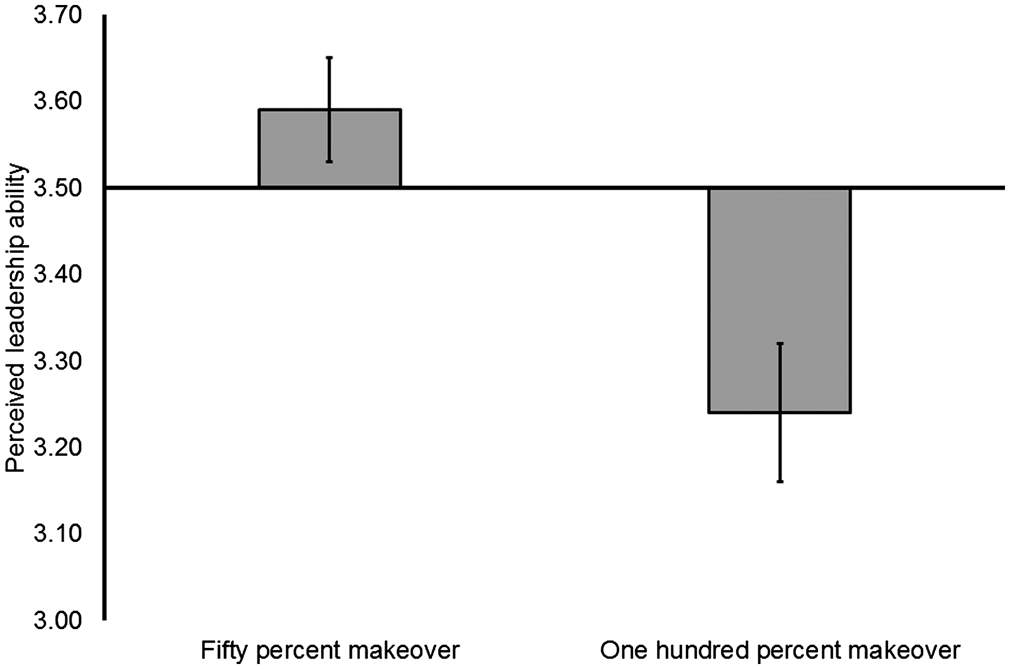
Discussion
Our findings extend recent research on social judgments of makeup (Mileva et al., 2016) by demonstrating that makeup has negative effects on perceptions of women’s leadership ability. Moreover, these findings were consistent across male and female judges, and when individuals judged both own-ethnicity and other-ethnicity faces manipulated in color cues to makeup. Of note, our color manipulation in African faces was generated by asking participants to self-apply makeup for a social night out (sensu Mileva et al., 2016), and the corresponding manipulation in Caucasian faces was generated by the application of makeup for a social night out from a trained makeup artist (the second author). Thus, our data also suggest that negative effects of makeup on perceived leadership ability are consistent regardless of the makeover process used to generate prototypes for manipulating individual face images. Our findings therefore complement prior work on perceptions of color cues in the face across ethnicities (e.g., Jones et al., 2015; Porcheron et al., 2017) by suggesting that color manipulations generalize across ethnicities when examining their corresponding effects on judgments important for mate choice and, in the current study, perceptions of leadership ability.
Our findings develop work by Mileva and colleagues (2016) as our data suggest that their prior work, where women were afforded traits related to dominance when wearing makeup, is likely due to makeup enhancing their perceived effectiveness as a competitor for a male mate (i.e., attractive women; Vaillancourt, 2013) rather than perceptions of their ability to lead others. Although prior work associates makeup with social dominance (see Mileva et al., 2016), positive effects of makeup may be specific to certain roles within an organization, such as in service industry roles where attractiveness to clientele may be more important for eliciting prosocial responses (e.g., from customers via tipping; Jacob et al., 2009). Indeed, prior work suggests that makeup may have negative effects on judgments of performance depending on whether the position under evaluation is a stereotypically female occupation (Cox & Glick, 1986). Our findings also complement recent work suggesting that traits derived from facial cues such as attractiveness may be valued more at lower- versus upper-level roles within an organization such as in retail (Fruhen, Watkins, & Jones, 2015). Competence (i.e., intelligence) is an important trait dimension in leadership (Todorov et al., 2005), and our data suggest that makeup use has a negative effect on judgments of leadership. Further work could use data-driven methods to establish the various routes toward female status and how traits related to female dominance relate to both their (natural) physical appearance and women’s desire to enhance or alter their appearance.
Although not significantly different from chance, our subtle color manipulation had a beneficial effect on perceived leadership ability relative to our 100% color manipulation. Thus, we provide preliminary evidence that a subtle enhancement in facial coloration via makeup may have positive effects on how women are evaluated within the business environment. This factor may account for differences between our data, where makeup weakens perceptions of leadership ability, and prior work, which demonstrates a possible link between makeup and social status, albeit across studies that use different stimuli and methods (Etcoff et al., 2011; Jacob et al., 2009; Nash et al., 2006; Richetin et al., 2004). For example, further work could extend Etcoff et al. (2011), who examined judgments of female models, by altering the intensity of makeup application to test for its effects on judgments of women on other trait dimensions. As identity has stronger effects on social perceptions of women’s faces than makeup application by those same women (Jones & Kramer, 2015), and attractive women benefit less from makeup than their less attractive peers do (Jones & Kramer, 2016), further work could also test for interactions between facial attractiveness and makeup application on perceptions of traits related to dominance. Such work may prove fruitful to test whether makeup application has stronger (positive or negative) effects on trait evaluations of women who are naturally more versus less attractive. The size of our stimulus set suggests that the broad generalizability of our findings to other individuals may be limited. However, effects of the intensity of our manipulation on judgments of leadership ability by the same raters (i.e., a repeated measures design), across the same identities and two different ethnicities, suggest that color cues denoting quantity of makeup influence social judgments of women on this particular dimension.
There are a few additional points for discussion in light of our study design and findings. Following prior methods (Mileva et al., 2016), women applied makeup for a social night out in order to test whether the effects found in prior work generalize to other components of social dominance such as leadership ability. Although prior work suggests that women self-apply more makeup than is optimally attractive (Jones et al., 2014) and our stronger color manipulation had greater negative effects on perceptions of leadership ability, further work could directly test whether self-application of makeup for different contexts (e.g., work vs. a social night out) has differential effects on perceptions of women when judging them as leaders versus other traits related to dominance that may be more applicable to mating contexts. This could be fruitful, in light of recent work, which suggests that women distinguish between enhancing appearance for mate choice versus making a professional impression in the workplace (Netchaeva & Rees, 2016).
Of note, our manipulation had negative effects on perceptions of leadership ability regardless of the ethnicity of the face under consideration, which runs counter to our theorizing that cues to out-group membership may moderate social judgments of faces on this trait dimension (i.e., stronger negative effects of makeup on perceptions of ‘out-group’ faces). This null finding may be accounted for, in part, simply by visual exposure to various ethnicities among our sample, which rendered ethnicity a weak cue to out-group membership. Our ideas could be tested further in ethnically homogenous samples, using arbitrary cues to group membership such as text-based labels, or by increasing the salience of between-group competition via experimental priming techniques.
Finally, the color manipulation in the current experiment involves color changes to large regions such as the lips or eyes but does not consider the role of other makeup such as foundation, which would influence perceptions of skin evenness. As color changes to regions such as the lips can have corresponding effects on judgments related to attractiveness (Guéguen, 2012; Stephen & McKeegan, 2010), our findings are still consistent with the proposal that color changes related to makeup have corresponding negative effects on a specific component of female social dominance (i.e., leadership). In addition, these effects are stronger when the corresponding manipulation is more apparent to the observer. Indeed, if other forms of makeup have corresponding effects on facial contrast and judgments of traits related to women’s attractiveness (e.g., Jones et al., 2015; Porcheron et al., 2017), our findings for effects of a color manipulation on specific facial regions may represent an underestimate of the true (negative) effect of makeup on perceptions of her leadership ability.
To conclude, our work presents new evidence that color cues related to makeup have negative effects on perceptions of women’s leadership ability and that these evaluations are consistent among male and female judges and when judging faces of Caucasian and African ethnicity.
Footnotes
Acknowledgements
The authors thank the donors who volunteered their time during our makeover sessions.
Authors’ Note
Data can be accessed on request from the corresponding author.
Declaration of Conflicting Interests
The author(s) declared no potential conflicts of interest with respect to the research, authorship, and/or publication of this article.
Funding
The author(s) received no financial support for the research, authorship, and/or publication of this article.