



Abstract
This study examined whether auditory pitch and loudness affect the perception of object’s weight. Two series experiments showed that the object with High-Pitch sound was perceived as being lighter than the object with Low-Pitch sound and that the perceived weight was not affected by loudness. Because auditory pitch has a relationship to the weight of an object while loudness has a relationship to the distance of a placed object, the perceived weight was affected by auditory pitch not loudness. Given these results, perhaps sound effects may make it easier to carry heavy luggage?
In our daily interaction with our environment, we are bombarded by many different sensory signals, which we combine into sensory information in order to navigate the world around us. This process, however, sometimes yields inaccurate perceptions.
Consider, for example, the size–weight illusion. This is a cross-modal phenomenon in which a smaller object is perceived as being heavier than a bigger object of the same mass. This perception is affected by visual information: Amazeen (2014) suggested that an object’s width and height influence its perceived weight. The color of an object also affects its perceived weight (e.g., Walker, Francis, & Walker, 2010).
Whether the size–weight perception is affected by nonvisual information remains less clear. Spence (2011) showed cross-modal associations between auditory pitch, loudness, and visual size, suggesting that auditory information, as well visual information, may affect an object’s perceived weight.
This study examined whether auditory pitch and loudness affect the perception of an object’s weight.
All weight stimuli in this experiment were made of paper boxes. We used a standard box (4 cm × 5.5 cm × 3 cm, 186 g) and two experimental boxes (Big-Box: 4 cm × 5.5 cm × 6 cm, 186 g and Small-Box: 2 cm × 5.5 cm × 3 cm, 186 g). The standard box was covered with yellow vinyl tape, and the experimental boxes were covered with black vinyl tape. Auditory stimulus was edited from the sound effect called “placing a small bottle.” Auditory stimulus consisted of five conditions: High-Pitch (864 kHz frequency and 72 dB at max volume), Low-Pitch (427 kHz frequency and 72 dB at max volume), Louder-Sound (688 kHz frequency and 77 dB at max volume), Quieter-Sound (688 kHz frequency and 68 dB at max volume), and No-Sound.
Twenty students (10 men and 10 women, age range 19–23 years) participated in this study.
Participants estimated the perceived heaviness of both experimental boxes, holding each box in their palm, with visual and auditory information. All boxes were placed in the palm of the participants’ dominant hand, and all auditory stimuli were emitted through a speaker (BOSE companion 2 series 2). An experimental box, with accompanying auditory stimulus, was placed in the participants’ dominant hand after the standard box, without accompanying sound, and participants were instructed to rate the perceived heaviness of each experimental box as if the rate of the standard box was 100 (the magnitude estimation). Each participant completed 40 trials in random order: 4 Trials per each condition (2 Weight Stimuli × 5 Auditory Stimulus). The data were the estimated heaviness of the experimental box versus the standard box.
Because this study can be separated into two series, loudness (Series A) and pitch (Series B), the average perceived weight was calculated under every condition in both series. Figure 1 shows the effect of loudness, and Figure 2 shows the effect of pitch. A two-way analysis of variance with sound and box as within-participant factors was conducted for each series. For the case of Series A, the main effect of box was significant, F(1, 19) = 56.32, p < .001,
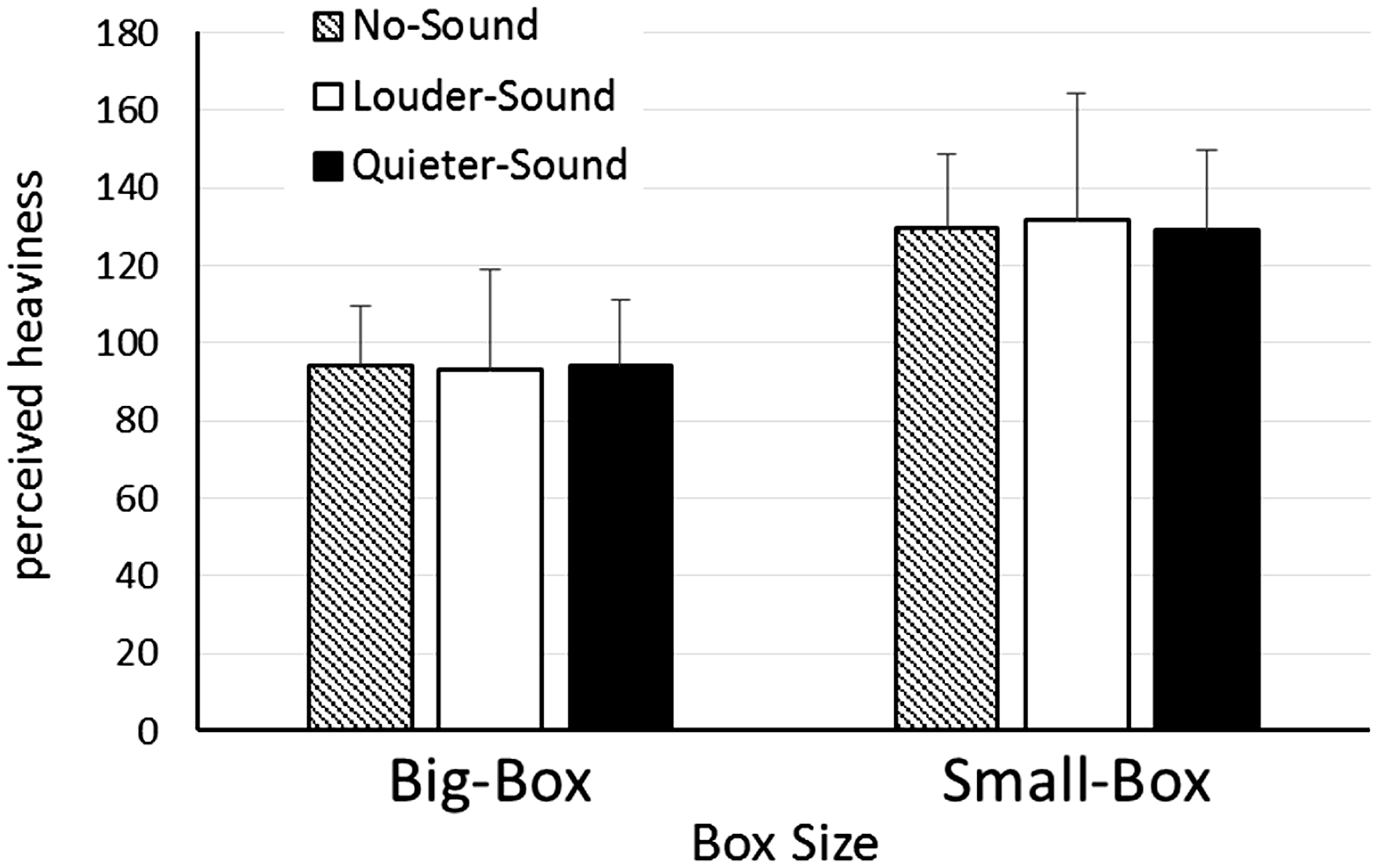
The effect of loudness on perceived heaviness (error bars represent standard deviation).
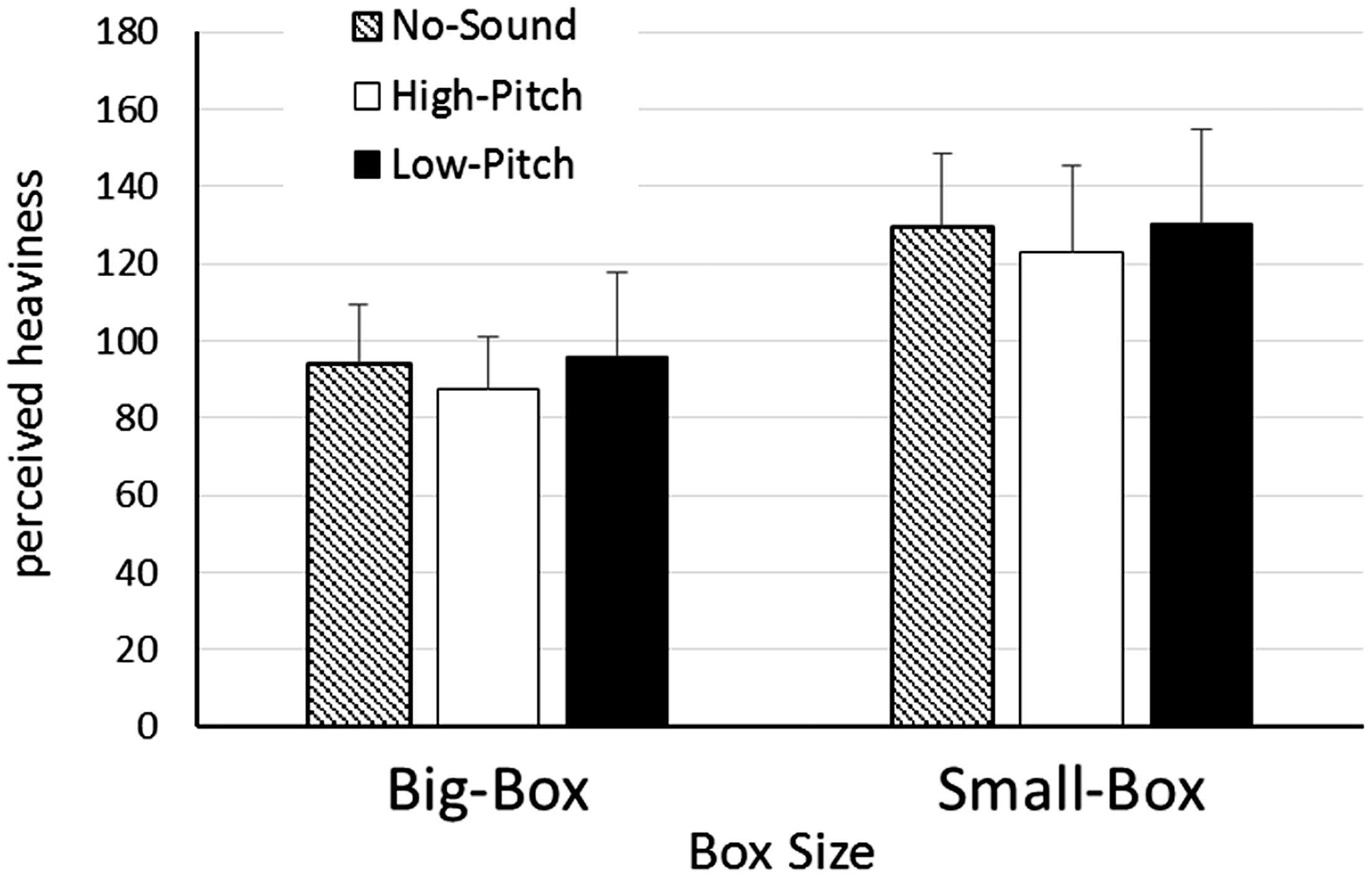
The effect of pitch on perceived heaviness (error bars represent standard deviation).
Auditory pitch has a relationship to the weight of an object. For example, a heavier object’s sound has a physically lower pitch than a lighter one when the objects are placed on a surface. On the other hand, loudness has a relationship to the distance of a placed object. An object appears to emit a quieter sound if it is placed down far away from the listener than if it is placed down close to the listener. This is the reason that loudness did not affect the perceived weight in this study.
Is the effect of sound a cognitive bias or a perceived effect? When participants in the preliminary experiment estimated the heaviness of a box with only auditory information (because they had closed their eyes), some participants did not notice that the experimental boxes were the same weight, and they reported that the box weight varied from sound to sound. Participants reported feeling different weights from different sounds. From these results, we suspect that the effect of sound is a perceived effect, but there remains a possibility of a cognitive bias. Further experiments will reveal whether the effect of sound is a cognitive bias based on weight–pitch association or a perceived effect.
This study could not conclude whether auditory pitch affects the perceived weight directly or indirectly through the intermediary of visual information. However, it is unlikely that auditory pitch indirectly affects perceived weight. Auditory loudness can affect the perception of visual size (Takeshima & Gyoba, 2010). If the perceived weight had been affected indirectly through the intermediary of visual information, the loudness would have affected the perceived weight in this study; but actually there was no effect on the perceived weight. Similarly, if auditory pitch affects perceived weight indirectly through intermediary visual information, the interaction between box and sound (pitch or loudness) in the analysis of variance would have been significant. But, in this study, the interaction was not significant. So, it is safe to say that auditory pitch affects perceived weight directly.
This study showed that the perceived weight of the objects is affected by both visual and auditory information. Given these results, perhaps sound effects may make it easier to carry heavy luggage?
Footnotes
Acknowledgement
The author wishes to thank the timely help given by Satoshi Sato in supporting these experiments.
Declaration of Conflicting Interests
The author(s) declared no potential conflicts of interest with respect to the research, authorship, and/or publication of this article.
Funding
The author(s) received no financial support for the research, authorship, and/or publication of this article.