




Abstract
In a simple experiment, we demonstrate that you don’t need to mindfully look at the eyes of your audience to be perceived as making eye contact during face-to-face conversation. Simply gazing somewhere around the face/head area will suffice. Or to borrow a term from Mareschal and colleagues, direct gaze will suffice. For those readers who experience anxiety when gazing specifically at another person’s eyes, or when being gazed at, we expect this is welcome news.
Maintaining strong eye contact is widely accepted to be an important communication skill in Western cultures (Bonaccio, O'Reilly, O'Sullivan, & Chiocchio, 2016; Hargie, 2010). After all, as the saying goes the eyes are the windows to the soul. If you aren’t willing to engage in soul-to-soul mutual eye contact, then you are at best lacking in confidence, and at worst, untrustworthy. The reverence devoted to eye contact is however not supported by the scientific evidence. It has been consistently shown that people have difficulty distinguishing precisely where a partner is looking when being looked at somewhere on the face, or just off the face. A bias exists to perceive ‘eye contact’ when it is not technically happening (Gamer & Hecht, 2007; Lord, 1974; Lord & Haith, 1974; Uono & Hietanen, 2015). In simple terms, frequently, our perception of eye contact is only an illusion. Remember during that romantic dinner when that magical moment occurred as your eyes locked and you felt so close with your partner? Well, your partner may have been staring at your mouth during that moment, and the mutual eye contact was all in your head. This might occur a lot more than you think, as recent research has uncovered that people engage in mouth gazing during conversation with higher frequency than you probably expect (Rogers, Speelman, Guidetti, & Longmuir, 2018).
Why isn’t this eye contact illusion more well-known? Is it some conspiracy led by extraverted corporate types who want to keep down their introverted competition? Instead, we suspect it might have more to do with how the prior research in this space has used highly controlled experimental methods that have not captured the attention of the public. Therefore, we conducted a simple study to show how powerful the eye contact illusion can be during natural conversation. One of us (O. G.) engaged in 4-minute getting acquainted conversations with 46 (Mage = 29 years, 48% females) university students, sitting approximately 1-m apart, while both O. G. and the participant wore Tobii eye tracking glasses. 1 For approximately half the conversations, O. G. behaved according to his normal gaze behaviour, looking at the eyes most of the time (N = 24 conversations, Mean = 77% of gaze directed at upper face), and for the other half gazed predominately at the mouth (N = 22 conversations, Mean = 73% of gaze directed at lower face), see Figure 1(a) to (c) (O. G. gaze at upper face significantly differed between groups, t(44) = 40.75, p < .001, d = 12.22). In both conditions, O. G. conversed in his natural manner to get acquainted with his partner. The only difference in his behaviour across conditions was his tendency to either focus mostly on the eyes or mouth when looking at the face of his partner. Across participants who came to the lab, O. G. simply changed his gaze style from one participant to the next.

In this figure, data from the group that O. G. gazed predominately at the eyes is shown on the left side of the dashed line, and data from the group that O. G. gazed predominately at the mouth is shown on the right side of the dashed line. Numbers on the x-axis of all charts refer to individual participants. These participants are matched across the charts (i.e., number 2 refers to the same participant across all charts). Example heat maps of O. G.’s gaze focus over a 4-minute getting acquainted conversation are provided for the (a) eyes group and (b) mouth group. A warmer colour equates to longer gaze duration during the conversation. (c) The proportion of O. G.’s gaze upon the upper face, lower face, and off-face during conversations with all participants. (d) The proportion of participant gaze upon O. G.’s upper face, lower face, and off-face. (e) Proportion of the conversation that comprised mutual face gaze (both people simultaneously looking upon each other’s face) and mutual eye contact (both people simultaneously looking at the upper face of each other). (f) Participant postconversation ratings regarding the extent they believed O. G. tried to make eye contact with them (scale: 0 = not at all, 1 = very rarely, 2 = rarely, 3 = sometimes, 4 = often, 5 = very often, and 6 = always) and their reported enjoyment of the conversation (scale: 0 = not at all, 1 = slightly, 2 = somewhat, 3 = moderately, 4 = very much, and 5 = extremely).
Overall, the participant gaze time at the upper face did not differ between groups, t(44) = 1.37, p = .18, d = 0.40. However, as can be seen in Figure 1(d), within each group, there is variability in participant preference for gazing at the upper versus lower face. Results replicate recent findings of Rogers et al. (2018) of the existence of an eye–mouth gaze continuum for gaze preference during natural face-to-face conversation. The level of mutual eye contact (measured in this study as mutual gaze at upper face region) was very low for the group O. G. gazed predominately at the mouth, compared to the group where O. G. looked predominately at the eyes (Mmouth = 3% vs. Meye 52%, t(44) = 19.69, p < .001, d = 5.93), see Figure 1(e). The amount of mutual face gaze did not significantly differ between groups (Mmouth = 64% vs. Meye = 60%, t(44) = 1.13, p = .26, d = 0.34), see Figure 1(e). After the conversation, participants rated how much eye contact they believed O. G. tried to make (on a 0–6 scale, never – always), and how much they enjoyed the conversation (on a 0–5 scale, not at all – extremely). The mouth group perceived the same amount of eye contact from O. G. (Mmouth = 4.78 vs. Meye = 4.96, t(44) = 0.84, p = .41, d = .24) and enjoyed conversation just as much as the eye group (Mmouth = 3.36 vs. Meye = 3.79, t(44) = 1.73, p = .09, d = .51), see Figure 1(f). Our results suggest that mouth group participants experienced the eye contact illusion. Results support assertions made by Rogers et al. (2018) that during natural conversation, the perception of eye contact is driven primarily by extent of mutual face gaze (or, direct gaze) rather than the extent of actual mutual eye contact.
To make sure our findings are not simply due to the Tobii glasses interfering with a person’s ability to detect gaze direction of their partner, we ran a follow-up study. Thirty-six pairs (Mage = 32 years, 54% females) of university students played an eye gaze guessing game, while wearing Tobii glasses. Participants alternated the role of gazer and guesser for 30 trials. A trial would begin with both participants looking down at the table, and then on the experimenter’s command both would look up at each other. The gazer would look at one of five locations for about 2 seconds (eye, mouth, nose, forehead, left ear, and right ear), both participants would look down again and the guesser would try to guess the location prior to the commencement of the next trial. Replicating prior research, it was found that overall accuracy (54%) was above chance level (25%), and participants were biased towards guessing ‘eyes’ when unsure (see Figure 2; Lord, 1974). This suggests that the glasses were not interfering with the participant’s ability to discern gaze focus in the prior study.
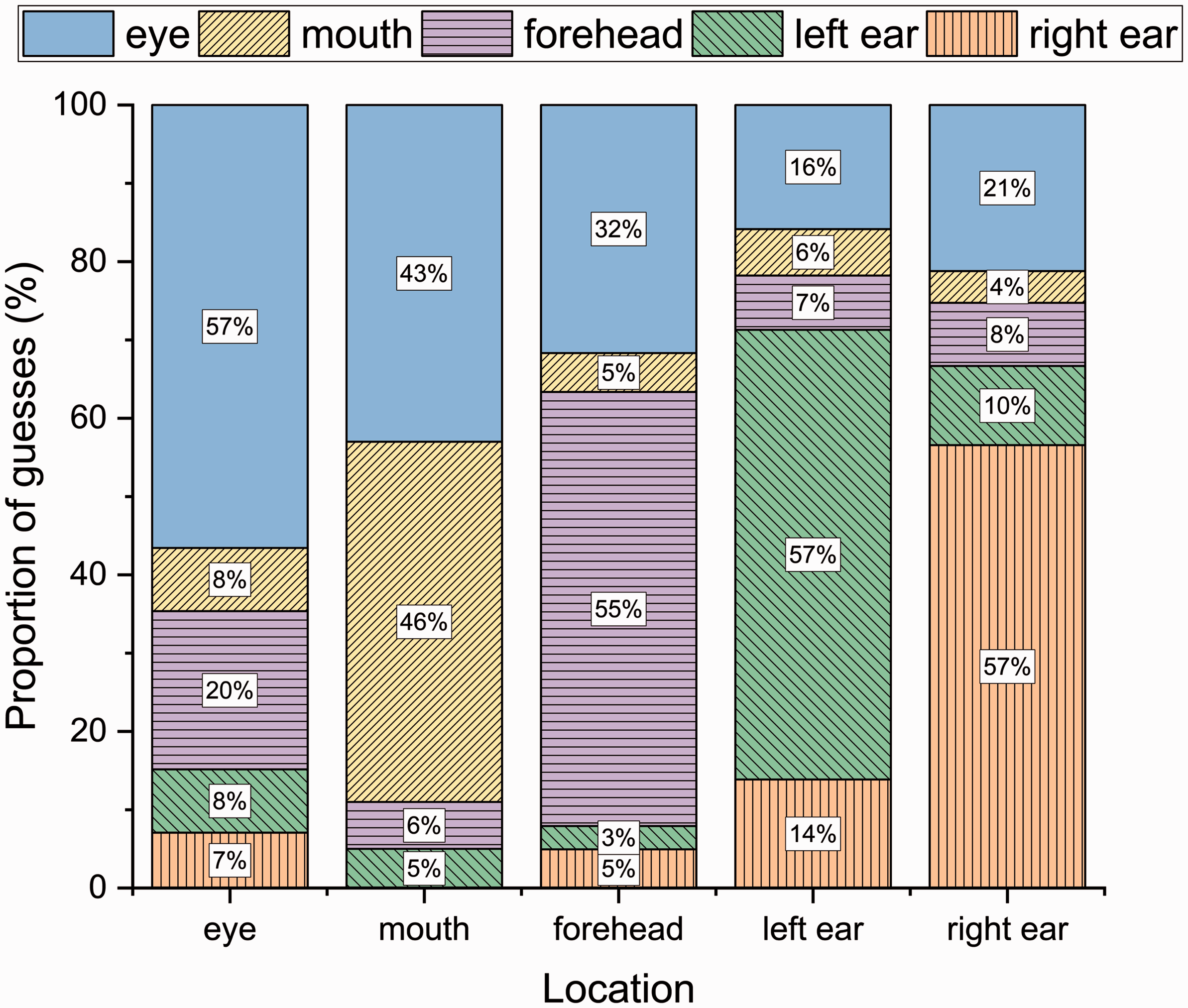
The proportion of guesser responses across each type of location they were gazed at, during the eye gaze guessing game. Note these statistics represent the combination of all participant responses.
Our results suggest that when specifically focused on trying to determine the gaze of one’s partner, people demonstrate some limited capacity to do it accurately. However, when not specifically attending to this, such as during a natural conversation, our research suggests that people are not very sensitive to the specific gaze focus of one’s partner upon one’s face. Instead, people generally perceive direct gaze towards their face as eye contact. In practical terms, the next time someone tells you to be a better communicator by making strong eye contact, you would be better off interpreting this as a recommendation to engage in strong levels of direct gaze (Mareschal et al., 2014). Don’t get hung up on seeking out the eyes of the audience, just look more generally at their face, and let the eye contact illusion experienced by your partner do the work for you.
Footnotes
Declaration of Conflicting Interests
The author(s) declared no potential conflicts of interest with respect to the research, authorship, and/or publication of this article.
Funding
The author(s) received no financial support for the research, authorship, and/or publication of this article.