



Abstract
The human egocentric perception of approaching objects and the related perceptual processes have been of interest to researchers for several decades. This article gives a literature review on numerous studies that investigated the phenomenon when an object approaches an observer (or the other way around) with the goal to single out factors that influence the perceptual process. A taxonomy of metrics is followed by a breakdown of different experimental measurement methods. Thereinafter, potential factors affecting the judgment of approaching objects are compiled and debated while divided into human factors (e.g., gender, age, and driving experience), compositional factors (e.g., approaching velocity, spatial distance, and observation time), and technical factors (e.g., field of view, stereoscopy, and display contrast). Experimental findings are collated, juxtaposed, and critically discussed. With virtual-reality devices having taken a tremendous developmental leap forward in the past few years, they have been able to gain ground in experimental research. Therefore, special attention in this article is also given to the perception of approaching objects in virtual environments and put in contrast to the perception in reality.
Keywords
Introduction
The automotive industry faces new challenges in the course of the vehicles’ automation process. The behavior of all surrounding traffic participants needs to be understood and implemented in the vehicles’ artificial intelligence. This also involves, for example, human perception and judgment of an approaching object, such as an oncoming automotive vehicle. While some researchers explored the neural basis on how an approaching object is processed by humans (Billington, Wilkie, Field, & Wann, 2010; Coull, Vidal, Goulon, Nazarian, & Craig, 2008; Field & Wann, 2005), factors and heuristics that may have an impact on how humans judge an oncoming object are also of profound interest to investigators. While these factors may be related to human individuality or the composition of the environment, the technological components of a virtual setup used for the assessment may also affect the judgment and corrupt the findings to a certain degree. Such virtual environments may be found, for example, in driving simulators or similar virtual-reality (VR) systems. Conquering the entertainment industry over the past few years, VR became an intensely growing field, with recent technological advances opening up new possibilities also for the research community. Investigators analyzing human behavior tap into utilization of VR setups due to their advantages in comparison with real-life experiments regarding participants’ safety, cost-efficiency, and reproducibility of investigated scenarios. However, VR setups initially require an unfortunately often omitted validation process analyzing the degree of similarity between participants’ perceptions and behavior within the virtual environment compared with scenarios in reality. Only then can conclusions be drawn based on data collected in a virtual environment, allowing a transfer of those findings to real environments.
The investigation of factors that influence impending collision judgments experienced its heyday back in the 1980s and 1990s after Lee (1976) had introduced his concept of tau. Nevertheless, this field is gaining much relevance again, for example, in the course of training artificial intelligence in vehicles. The article presented here strives to summarize past findings and to connect them to each other. Furthermore, the impact of virtual environments on the outcome of collision judgments is looked at and discussed critically.
Taxonomy of Metrics
The research community employs a variety of terms when investigating the remaining time between two objects approaching one another. Widespread terms are time-to-contact (e.g., Tresilian, 1991), time-to-passage (e.g., Kaiser & Mowafy, 1993), time-to-arrival (e.g., Schiff & Oldak, 1990), time-to-collision (e.g., Cavallo & Laurent, 1988), and time-to-coincidence (e.g., Groeger & Cavallo, 1991). The subtle distinction between these terms may lay in details:
whether the observer or the object or both of them are moving, whether the objects are on a collision course or passing each other, and whether the observer is perceiving the collision from an egocentric perspective or externally and uninvolved.
Hancock and Manser (1998) strived to organize the terminology and to create a formal taxonomy: An overview of different terms and their characteristics based on Hancock's and Manser's suggestion is given in Table 1.
Terminology and Characteristics of Metrics Used to Describe the Remaining Time Between Two Objects on an Approaching Course.

However, the usage of the terms among researchers can be somewhat confusing and inconsistent. Because of these small differences, which have no impact on the underlying concept, and the lack of a formal taxonomy, the terms are often used interchangeably in literature, even being treated as synonyms (see Bootsma & Oudejans, 1993; Parsonson, Isler, & Hansson, 1996; Schiff & Oldak, 1990; Tresilian, 1991). In addition to the terms listed in Table 1, Hancock and Manser (1998) also suggested the term time-to-go which is supposed to describe a stationary observer facing a moving object on a collision or bypass course. Due to its proximity to time-to-contact (TTC) regarding physical parameters, the use of two different terms appears obsolete. Consequently, the term time-to-go has never been able to establish itself within the framework of urban traffic research, even 20 years after Hancock and Manser introduced their taxonomy, and time-to-go has presumably not been employed again in this research field since Carel’s publication in 1961. Today, the term can be found in aircraft research describing an unrelated metric.
When investigating road-crossing scenarios from the perspective of a pedestrian who is facing approaching vehicles, TTC as a metric meets the required characteristics. Seen from the opposite side, in other words, from the view of the driver approaching the pedestrian, the corresponding metric is termed time-to-arrival (TTA). TTC and TTA can be determined from three-dimensional low-order information, or deduced solely from two-dimensional optical variables, such as looming. The low-order information method builds on the ratio of the oncoming object’s distance to the approaching velocity and is computed as follows:


Measurement Methods
Different study concepts have been introduced for the investigation of participants’ judgments of approaching objects, of which an overview is given in Figure 1. Generally, they can be divided into estimation tasks and discrimination tasks.

Overview of classical tasks evaluating participants’ impact time judgments.
Estimation tasks contain the subsets coincidence anticipation and interceptive action (Tresilian, 1995). The concept of coincidence anticipation requires participants to estimate the collision moment with an approaching object after the object has disappeared from sight by extrapolating the afore perceived motion and estimate the moment when the collision would have taken place, for example, by pressing a button at the respective moment (e.g., Cavallo & Laurent, 1988). The disappearance of the object from the observer’s sight can be due to an occlusion or a virtually induced vanishing. The interceptive action concept requires participants to react to a specific incident by performing a specific movement. The task can, for example, consist in catching an approaching object (e.g., van der Kamp, Savelsbergh, & Smeets, 1997) or avoiding the object in the last possible moment (e.g., Li & Laurent, 1995). Tasks that involve the estimation of absolute numerical values such as the temporal or spatial distance of an approaching vehicle make little sense due to the human innate limitations in making such judgments (see Hills, 1980).
Discrimination tasks use standardized psychophysical techniques aimed at measuring psychometric functions to determine, for example, just-noticeable differences (see Green & Swets, 1966). Those tasks usually require a pairwise comparison leading to determination of a discrimination threshold. Participants may face, for example, two approaching objects, either simultaneously or successively, and judge pairwise which of the two objects will arrive first (e.g., DeLucia, 1991). Regan and Hamstra (1993) used an uncommon discrimination task variant following the psychophysical procedure introduced by McKee (1981), in which the participant was asked to estimate whether a given stimulus was smaller or greater than the mean of the entire set of stimuli, that is, within group.
The within-group comparison remains a rare procedure, while coincidence anticipations, interceptive actions, and pairwise comparisons are the commonly encountered experimental methodologies in this field. When choosing an experimental design, it should be noted that estimation tasks and discrimination tasks look at different aspects: While an estimation task will investigate the perception of the approaching object relative to the observer, the discrimination task will determine the participant’s ability to detect changes or differences. Therefore, when investigating specific variables in an experiment, for example, the performance in a real environment versus a virtual one, the outcome may eventually depend on the chosen task type because the human estimation ability is cognitively dissociated from the human discrimination ability (see Seward, Ashmead, & Bodenheimer, 2007).
Supportive Depth Cues
When an observer is confronted with an approaching object, the perception of the object’s spatial distance and its rate of change are important heuristics. Therefore, it is of little surprise that depth cues and their availability to the observer affect the judgment of impending collisions. Over time, many different depth cues have been determined, investigated, and discussed regarding their availability and effectiveness over spatial distance. Although depth cues have just a supporting function when judging an approaching object, they were given their own section here in which the bases and different types are summarized. This shall sensitize researchers who investigate impending collision judgments—especially in virtual environments—as to which cues may affect the depth perception within a specific range and should therefore be provided to ensure the validity of the findings.
Cues that allow inference of three-dimensional depth information from a two-dimensional still image are termed pictorial depth cues, whereas other cues are categorized as nonpictorial depth cues and are related to motion, the oculomotor system, or stereoscopy. A further distinction can be made by dividing into depth cues that rely either on monocular information or require binocularity. An overview of different depth cues and their effective range, their classification into pictorial and nonpictorial depth cues, and whether they rely on monocular or binocular information is given in Figure 2, with data based on Cutting and Vishton (1995), Nagata (1989), and Renner, Velichkovsky, and Helmert (2013).

Overview of different depth cues and their approximate effective range.
Pictorial depth cues:
Occlusion: Objects that are closer visually overlap objects farther away, which allows observers to determine the relative but not absolute distance toward them. Relative size: When objects approach the observer, the object’s relative size increases on the retinal image. Thereby, the observer’s familiarity with the object’s size is of importance, but even when the object is unknown to the observer, smaller objects may appear relatively farther away (Sousa, Brenner, & Smeets, 2011; Sousa, Smeets, & Brenner, 2012). Relative density: With increasing distance, the relative retinal density of surface texture will increase. However, relative density is merely around the threshold that is considered effective for perceiving depth (Braunstein, 1976; Cutting & Vishton, 1995; Marr, 2010; K. A. Stevens, 1981). Height in visual field: Objects that have smaller angular distance to the horizon from the observer’s point of view, in other words, objects that are vertically closer to the horizon, appear to be farther away. Theoretically, on a flat surface, an object’s absolute distance can be extracted solely from its height in field, with the effective range lying beyond Aerial perspective: Objects at great distance have lower contrast and lower color saturation, usually involving a bluish cast, due to light scattering by the atmosphere. Aerial perspective is the only depth cue with increasing effectiveness over increasing distance, though the effective range will largely depend on the environmental and meteorological conditions (Cutting & Vishton, 1995; Nagata, 1989). Considering that objects at a great distance become indistinct and that the effective range of aerial perspective usually starts at no lower than a minimum of a few hundred meters, this depth cue is ineffective when judging approaching objects such as vehicles. Motion parallax: When an observer is moving, the apparent relative motion of stationary objects against the background gives the observer clues about the relative distance of those objects, with nearby stationary objects having a higher relative motion than those that are farther away. Mathematically, motion parallax can deliver absolute depth information (Ferris, 1972), though effectiveness declines rapidly with increasing distance and eventually becomes ineffective for distances beyond the action space (Cutting & Vishton, 1995). Also, effectiveness is further reduced when the respective objects are in the axis of the observer’s movement, which in application-oriented cases is usually the case, and not lateral to the motion axis. Accommodation: Kinesthetic sensations when contracting and relaxing ciliary muscles that are responsible for changing focal length deliver cues about the depth of the object on which the observer is focusing. However, accommodation is solely effective for distances less than Convergence: Due to binocularity, the two eyeballs are moved inward to create an intersecting focus point. The extraocular muscles that are responsible for this movement deliver kinesthetic sensations, similar to accommodation, and, consequently, cues about the depth of the focus point. Like accommodation, effectiveness is limited to about Binocular disparity: Due to horizontal separation of the eyes, the eyes perceive two slightly different images of the scene, which are eventually fused into one image. The slight differences between the two original images, however, allow subconscious extraction of depth information by triangulation. The effective range of binocular disparity varies strongly across literature, with investigators reporting different thresholds at which binocular disparity as a depth cue becomes ineffective: Some researchers suggest the cue’s effectiveness to be limited to the personal and action space (<30 m), while others claim an effectiveness of up to
Nonpictorial depth cues:
Additional depth cues that are also commonly mentioned in literature include texture gradients (e.g., Gibson, 1950), linear perspective (e.g., Kubovy, 1988), light and shading (e.g., Boring, 1942), kinetic depth (e.g., Wallach & O'Connell, 1953), kinetic occlusion (e.g., Kaplan, 1969), and gravity (e.g., Watson, Banks, von Hofsten, & Royden, 1992). These cues have been neglected in the list presented here, as they represent either some combination of several of the cues discussed earlier or are extremely ineffective in their psychological effect of revealing depth (Cavanagh & Leclerc, 1989; Cutting & Millard, 1984; Cutting & Vishton, 1995).
Factors Affecting Impending Collision Judgments
Human Factors
Over recent decades, numerous studies have been conducted on the perception of approaching objects. Participants across those studies all have in common that they have persistently underestimated the temporal distances to approaching objects, that is, TTC or TTA. A meta-analysis visualizes this underestimation effect in Figure 3 and attempts to quantify it, though without taking into account the numerous differing variables across the studies, in other words, ignoring the strongly differing experimental designs, the varying number of participants, and the varying number of assessed estimations (cf. Caird & Hancock, 1994; Cavallo & Laurent, 1988; Hancock & Manser, 1997; Horswill, Helman, Ardiles, & Wann, 2005; Mathieu, Bootsma, Berthelon, & Montagne, 2017; McLeod & Ross, 1983; Petzoldt, 2014; Recarte, Conchillo, & Nunes, 2005; Schiff & Oldak, 1990; Sidaway, Fairweather, Sekiya, & McNitt-Gray, 1996; Tharanathan & DeLucia, 2006). Experiments by Geri, Gray, and Grutzmacher (2010) and by Tharanathan and DeLucia (2006) have indicated that temporal distances were estimated lower when the observer was moving toward the stationary object, thus the TTA, than when the object was moving toward the stationary observer, thus the TTC. Nevertheless, due to the similarity of events, this meta-analysis takes both scenarios into account. An overview is shown in Table 2, indicating whether the experiments investigated
the TTC or the TTA, Experimental Characteristics of Studies Examined in the Meta-Analysis. Overview of Factors That May Affect the Human Perception of Oncoming Objects. conducted the study in a real environment, displayed a previously recorded video of a real traffic scenario, or used a simulated scenario.
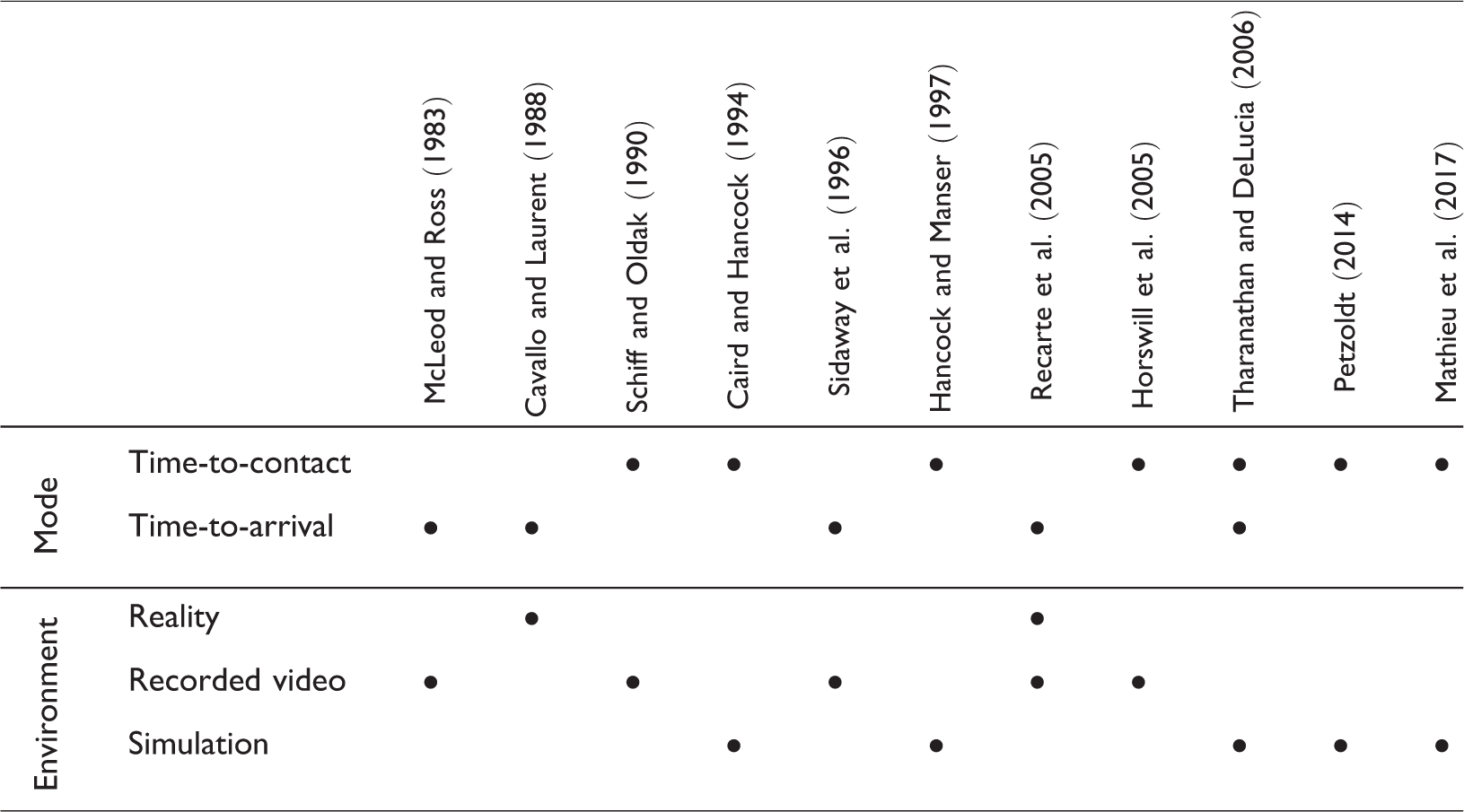

Please note that in order to facilitate the reading flow, the research overview in this section and also the sections hereinafter use the term TTC, referring eventually also to studies that investigated the TTA.

Meta-analysis of impending collision judgments from an egocentric perspective, across 11 different studies that have used contextual stimuli, in other words, realistic environments containing depth cues, plotted as estimations relative to the actual temporal distances, that is, TTCs and TTAs.
Despite the fact that all of the analyzed studies contained a lifelike environment, the designs of those experiments varied strongly and are thus difficult to compare. Nevertheless, this meta-analysis allows an approximate idea on how to globally grade the ratio of TTC estimation to the actual TTC. A linear regression (R2 =
When looking on gender as a between-subjects factor, significant differences were found, indicating lower TTC values for female than for male participants (see Caird & Hancock, 1994; Manser & Hancock, 1996; McLeod & Ross, 1983; Schiff & Oldak, 1990). A possible explanation may lie in women’s pursuit for greater safety margins (see Hills, 1980; Kadali & Vedagiri, 2012; Konečni, Ebbeson, & Konečni, 1976; Montgomery, Kusano, & Gabler, 2014; Parsonson et al., 1996) and thus an enhanced underestimation of the TTC, whereas the higher risk tolerance of men by implication leads to higher accuracy of the male TTC estimation. In addition, numerous experiments in the past have revealed that men tend to have fewer difficulties with regard to solving spatial tasks when compared with women: A meta-analysis by Voyer, Voyer, and Bryden (1995) reviewing 190 experiments with regard to spatial visualization, spatial perception, and mental rotation showed a significant gender difference with 112 of the experiments in favor of men and 3 experiments in favor of women, while no significant difference was observed in 75 of those experiments. Furthermore, men account for a larger share of traffic, resulting in increased driving experience (see Kirkham & Landauer, 1985; McGuckin & Fucci, 2018; Polus, Hocherman, & Efrat, 1988). In this light, it should be noted that an increased driving experience leads to a more accurate TTC estimate as a male-only study by Cavallo and Laurent (1988) has shown. Interestingly, Recarte et al. (2005) found no significant difference between the TTC estimations of men and women in their study with a sample of fairly young participants (
The participants’ age also appears to influence the accuracy of TTC estimations: Schiff, Oldak, and Shah (1992) observed that elder participants tend to underestimate the TTC to a greater extent than their younger comparison group. This effect was particularly noticeable when comparing female participants only. The differences between younger male and elder male subjects were less significant, which has a certain consistency with Matthews’ (1986) findings of attributing elder male drivers with an apparent overconfidence in traffic. A very similar age effect, as well as age × gender interaction, as reported by Schiff et al. (1992), was observed by Hancock and Manser (1997), and also Andersen and Enriquez (2006), as well as Dommes, Cavallo, and Oxley (2013), observed a strong deterioration of adults' TTC judgments with increasing age. Transferred to a practical application, age has been shown to affect road-crossing choices and may be partially related to difficulties of elderly people and children in judging approaching vehicles (see Barton & Schwebel, 2007; Connelly, Conaglen, Parsonson, & Isler, 1998; Demetre et al., 1992, 1993; Dommes & Cavallo, 2011, 2012; Dommes, Cavallo, Dubuisson, Tournier, & Vienne, 2014; Dommes et al., 2013, 2015; Dommes, Cavallo, Vienne, & Aillerie, 2012; Hills, 1980; Lee, Young, & McLaughlin, 1984; Lobjois & Cavallo, 2007, 2009; O'Neal et al., 2018; Oxley, Ihsen, Fildes, Charlton, & Day, 2005; Staplin, 1995; Young & Lee, 1987).
Physiological characteristics can also affect motion and depth perception: Banister and Blackburn (1931) measured interpupillary distances of 258 students and classified them according to their performance at ball games. The analysis of that data revealed a correlation between larger eye distance and higher performance at ball games. This was explained with the better stereoscopic vision that results from the wider distance between the eyes, increasing the effectiveness of depth cues inferred from binocular disparity and convergence (see the Supportive Depth Cues section). Indeed, binocular disparity as a contributing cue for judging motion-in-depth and speed-in-depth has been demonstrated to be effective in various experiments (González, Allison, Ono, & Vinnikov, 2010; Khuu, Lee, & Hayes, 2010).
Compositional Factors
Although some researchers (e.g., Caird & Hancock, 1994; Hancock & Manser, 1997; Sidaway et al., 1996) described that certain factors lead to a “greater accuracy” of the TTC estimation, it should be noted that due to the consistent underestimation discussed in the Human Factors section, compositional factors that lead to a higher estimation of the temporal distance also increase the accuracy by implication. Therefore, it is more appropriate to classify possible effects as increase/decrease of the relative estimation because some increasing factors may—with sufficient effect—lead to an exceedance of the actual TTC and by that lower accuracy itself again.
Todd (1981), as well as Kaiser and Mowafy (1993), showed that even when lacking spatial information, it is possible to estimate the TTC by solely relying on the perceived looming of objects. However, Todd (1981) also stated that sensitivity to observe accelerations under those conditions turned out to be extremely poor. There are many other factors and heuristics, for example, depth cues, that can influence a person’s perceptual process. Heuristics such as depth cues can support the perception and estimation process especially in case of restricted availability of invariants, such as looming, that may result from sensory or cognitive limitations, such as in case of low contrast (DeLucia, 2004). Various studies have sought to investigate the influence of depth cues on perception of approaching objects. Pictorial depth cues from occlusion, relative size, relative density, and height in visual field have proved to have a significant impact on TTC estimations (DeLucia, 2004; DeLucia, Kaiser, Bush, Meyer, & Sweet, 2003; Vincent & Regan, 1997). Depth information from the aerial perspective, which is effective at a great distance only, may be neglected though when setting up an experimental environment (see the Supportive Depth Cues section).
Special attention has been given to the relative size of an approaching object, with multiple studies suggesting that this cue can overrule perceived looming (
When looking on relative density of surface texture, Vincent and Regan (1997) noticed that a mismatching expansion of the approaching object’s surface texture opposed to looming, in other words the object’s outline expansion, affected TTC estimations significantly, even if the mismatching expansion error was held as low as 10%.
In addition to pictorial depth cues, the nonpictorial depth cue motion parallax was also found to be effective (DeLucia et al., 2003). Further nonpictorial depth cues are discussed in the Technical Factors section, as cues related to a shifting focal plane and binocularity are more of a technical challenge and not related to environmental composition.
Manser and Hancock (1996) investigated the influence of the trajectory angle of an approaching object and concluded that a larger angle (
Caird and Hancock (1994) investigated spatial distance as a variable and observed that a larger distance (
The chosen temporal distance itself also plays a role for the capacity to estimate the TTC of oncoming objects. Schiff and Detwiler (1979), who analyzed a variety of TTC estimations covering 2 s, 4 s, 6 s, 8 s, 10 s, and 16 s, concluded that there is little point in assessing TTC estimations above 10 s since participants do not seem capable of exploiting perceived information beyond that point. McLeod and Ross (1983), as well as Thomson (1983), deduced an even lower limit of about 8 s, up to which consistent estimations are to be expected. These suggested thresholds are not firm but rather approximate values beyond which estimation quality was observed to deteriorate rapidly. Furthermore, Schiff and Detwiler (1979) state that the observer’s critical perceptual-motor adjustments when facing an approaching object occur within the last 4 s prior to contact anyhow.
Studies that examined the effect of observation time on TTC estimations have achieved divided conclusions. While McLeod and Ross (1983), who compared observation times of 2s, 3 s, 4 s, 5 s, and 6 s, found no significant differences regarding estimation accuracy of the TTC, Manser and Hancock (1996) argued in their study that the duration of vehicle observation has an influence on TTC estimation. However, it should be noted that Manser’s and Hancock’s observation times—
Besides all those factors that rather depend on depth cues and parameters of the study design, environmental conditions such as the weather can also have an impact: Snowden, Stimpson, and Ruddle (1998), who compared self-perceived speed of drivers in clear, misty, and foggy conditions, noticed that subjects underestimated their speed significantly when visibility dropped. De Bellis, Schulte-Mecklenbeck, Brucks, Herrmann, and Hertwig (2018), as well as Gegenfurtner, Mayser, and Sharpe (1999), noted that a decreased environmental brightness may lead to an underestimation of driven speed.
Technical Factors
Because most of the studies investigating TTC estimations are carried out with some virtual device or screen, there are technical factors that may influence the perception and should therefore be considered.
The importance of a stereoscopic view for three-dimensional tasks has been already known for centuries, as the observation by Molyneux in 1690 shows: And as a conclusion to the whole shall only add one experiment that demonstrates we see with both eyes at once; and 'tis, that which is commonly known and practised in all tennis-courts, that the best player in the world hoodwinking one eye shall be beaten by the greatest bungler that ever handled a racket; unless he be used to the trick, and then by custom he gets an habit of using one eye only. (pp. 293–294)
For now, HMDs provide solely a reduced field of view (FOV), which can affect visual perception. Cavallo and Laurent (1988) compared participants’ impact time estimations when heading toward a stationary object while having a normal visual field and while having a reduced FOV limited to the foveal and parafoveal visual field of about
From a technological perspective, the brightness and contrast of the display may have an effect on the perception of velocities: Takeuchi and De Valois (2000) investigated the brightness as a factor when judging velocities of objects displayed on a screen and observed that a lower brightness may lead to a reduced capability of perceiving a differential between two different velocities. Anstis (2003), Blakemore and Snowden (1999), Stone and Thompson (1992), and Thompson (1982) manipulated the contrast of the visual display in their studies and showed that a reduced contrast typically evokes the perception of the object moving at a lower speed.
A large number of studies investigated TTC estimations by making the approaching object virtually vanish at a predefined moment, asking the participants to estimate at what moment the object would have made contact with them by extrapolating the aforeseen motion (see the Measurement Methods section). Because the event of a suddenly disappearing vehicle is not very lifelike, Hancock and Manser (1997) compared virtual scenarios in which the approaching vehicle either vanished “magically” into thin air or disappeared through occlusion by driving behind a bush. The results indicated that participants had significantly greater estimation accuracy in the case of occlusion compared with the vanishing mode.
Some researchers wondered about the influence of texture integrated into the simulation environment. López-Moliner, Brenner, and Smeets (2007) examined the effect of surface characteristics of an approaching object on the TTC estimation within a simplistic simulation and concluded that no significant differences could be observed, no matter whether the surface was textured or not. DeLucia et al. (2003) also argued that globally a richer visual texture of the object or the background surface do not influence TTC estimation performance. Li and Laurent (1995) confirmed with their experiment conducted in a real environment that an increased texture of an approaching ball did not influence the temporal distance, that is, TTC, at which the participant decided to dodge the ball. However, they observed a significant speed increase of the participant’s evasive movement when the ball held a texture compared with when the ball surface was left blank. Studies that observed influences of texture on TTC estimations involved intentional deficiencies in visual representation, such as a mismatching expansion of the surface texture opposed to the perceived looming of an approaching object (Vincent & Regan, 1997), or an insufficient contrast that could be compensated by the presence of a textured background (Blakemore & Snowden, 2000).
Discussion
Influencing Factors
In conclusion, a combination of many factors is incorporated into the judgment of TTCs. An overview of factors discussed throughout the Factors Affecting Impending Collision Judgments section is given in Table 3.
The research field related to the perception of oncoming objects was stimulated by Lee’s concept of optical flow and looming introduced in 1976 and the controversial hypothesis that human TTC estimations rely solely on this monocular cue. Studies that provide participants with solely two-dimensional information may conclude that TTC estimations are made uniquely based on them. However, it is a misconception to believe that other factors and stimuli—once available—do not weigh in. During the 1980s and 1990s, a wave of experiments followed, aiming at identifying factors that may or may not influence TTC judgments. Numerous factors connected to human individuality, study design, experimental environment, and technological aspects were successfully identified and can be partially linked to each other. However, with recent evolution in the technological field and also in regard to human factors, for example, women participating more in traffic than three decades ago, a new investigation of some of these factors may be of interest.
Substantial differences were observed regarding TTC estimations when the representation of the scenario was realistic and contextual compared with abstract experiments that involved simplistic environments. While the results of the realistic experiments varied fairly little with a consistent underestimation of about 75% of the actual TTC (see the Human Factors section), the simplistic studies covered average estimations ranging from 50% (e.g., Schiff & Detwiler, 1979) up to 200% (e.g., DeLucia et al., 2003) of the actual TTC. Although quality variation of virtual textures showed no influence on TTC estimations (see the Technical Factors section), the observation above indicates importance of an overall lifelike environment to achieve realistic results.
When investigating human perception and behavior, human factors will always play a role due to human individuality. Those factors may be invariant (such as gender), mutational (such as age or some physiological characteristics), or trainable (such as driving experience or risk tolerance). However, those factors are not always dissociated from each other: For example, driving experience and risk tolerance are entangled with both gender and age. However, since in the study reported by Recarte et al. (2005) no gender-specific differences could be observed when men and women had the same driving experience, one has to ask if gender can be considered as a factor at all and not merely as an indicator of driving experience and risk tolerance. In the light of the steady decrease in the gap between male and female driving experiences over recent decades (see McGuckin & Fucci, 2018), findings of numerous studies from the 1980s and 1990s may be outdated and a revaluation of gender-specific differences is encouraged.
Compositional factors may support (or also corrupt) the participants’ perception of their environment and as a result affect the given tasks. These factors may be related to the perception of dynamic changes (such as looming), the perception of depth (such as occlusion, relative size, relative density, height in visual field, and motion parallax), or simply to the experimental design (such as approaching angle, approaching velocity, spatial distance, temporal distance, and observation time). When the experiment is conducted outside in a real environment, changing light and weather conditions may also affect the experimental outcome. Compositional factors may interact and support one another and especially compensate for various deficient invariants and heuristics.
Human beings experience limitations when it comes to the extent of the temporal distances up to which reliable estimations can be expected. While Schiff and Detwiler (1979) noted a limitation of
There are technical factors that impede an experimental scenario within a virtual environment to be perceived identically as it would have been within a real environment. Examples are monoscopic displays instead of stereoscopic ones that involve binocular depth information, a static focal plane instead of a dynamic one, as well as a reduced FOV. Furthermore, some attention should be given to the technical settings of the visual display. Parallels can thereby be drawn between the observed effects of poor visual conditions in a real environment, for example, darkness or fog (see the Compositional Factors section), and those observed due to certain technical parameters of the visual display, for example, reduced brightness or contrast (see the Technical Factors section), that evoke the same perceptual mechanisms regarding TTC estimations.
Many of the different factors are strongly intertwined with each other. For example, the effect of a given FOV on TTC estimations may depend on participants’ driving experiences, same as the impact of an approaching object’s relative size or its velocity on TTC estimations will eventually depend on whether the display is monoscopic or stereoscopic.
In summary, the complexity and quantity of influencing factors warrant further research to determine in what way different factors interact with each other and what importance has to be attributed to each of them.
Comparison of Real and Virtual Environments
Between-studies comparison
Virtual environments as a tool represent a mixed bag for perceptual research: Even though they are a valuable tool to investigate scenarios that could not have been easily investigated otherwise, they also possess the potential to distort the collected data. Most of the studies discussed across the Factors Affecting Impending Collision Judgments section were conducted using some display system or VR device, without these setups having been validated against real environments. Researchers may observe the same effect over and over again when investigating a specific phenomenon, without taking into account that the effect may be related to the design of the experimental setup. The size-arrival effect, for example, with larger objects leading to lower TTC estimations (see the Compositional Factors section), was observed by Caird and Hancock (1994), DeLucia (1991, 1999), DeLucia and Warren (1994), Horswill et al. (2005), Kappé and Korteling (1995), Stewart et al. (1993), as well as Mathieu et al. (2017). Given these numerous experiments with varying study designs and parameters, one might believe this effect to be sufficiently documented. However, it should be noted that what all these experiments have in common is they all used some sort of display with one single focal plane in close proximity to the participant, providing solely monocular information. Van der Kamp et al. (1997) conducted an experiment in a real environment with a study design close to some of the ones mentioned earlier. However, because this experiment was conducted in a real environment and no screen was involved, binocular information was available to the participants and, furthermore, the focal plane was shifting with the approaching object. While the size-arrival effect was likewise observed when the participant’s view was artificially reduced to monocular vision, a binocular viewing condition abolished this effect, emphasizing the importance of stereoscopic vision delivering binocular depth cues for this kind of task. Results of experiments by DeLucia (2005), in which participants were exposed to monoscopic as well as stereoscopic displays, also strongly suggest that binocularity may abolish the size-arrival effect.
Contrary to Caird and Hancock (1994), Kappé and Korteling (1995), as well as Petzoldt (2014) who conducted their studies in a virtual environment using a monoscopic display, Cavallo and Laurent (1988) found no influence of velocity on impact time estimations in a real environment (see the Compositional Factors section). Even though Cavallo and Laurent were investigating TTA while the other three experiments studied TTC primarily—Kappé’s and Korteling’s study involved both TTC and TTA measures, although an interaction effect was not investigated—the difference can still presumably be traced to the technological characteristics of the setups: Under impoverished visual conditions, that is, reduced FOV or lacking binocularity, Cavallo and Laurent reproduced similar effects as those observed in the three studies that took place in a virtual environment.
Setups using displays for visualization of the experimental scenario often provide a reduced FOV that is in general significantly smaller than the human far peripheral vision can handle. The experiment conducted by Cavallo and Laurent (1988) in a real environment comparing normal viewing conditions to an artificially reduced FOV (
Within-studies comparison
Recarte et al. (2005) conducted an experiment in which participants were asked to estimate the impending collision from inside of a vehicle in a real environment as well as while sitting in front of a screen watching recorded footage of scenarios from the same point of view and perspective. They noted that estimations made in reality had a lower variance and also a higher correlation with the actual time than estimations based on the recorded videos, which was observed for all 16 different experimental conditions emerging from combinations of four different speeds (
One of the very few reported examples in which a VR setup for research and training purposes was actually subject to a validation study against reality was the experiment conducted by Schwebel, Gaines, and Severson (2008): They designed a moderately complex pedestrian simulator in which the participant stands on an artificial physical curb and faces the scenery of a two-lane bidirectional virtual street. The scenery, which contained cars approaching from both sides, was displayed on three monitors that were arranged in semicircular alignment toward the user. The participant was asked to initiate the street crossing by stepping off the curb whenever feeling safe to do so and with that, stepping onto a pressure plate. This triggered the scenery to morph from first-person view to third-person view, and the participant observed an avatar cross the street at a constant personalized speed that was measured beforehand and adjusted for each participant individually. Schwebel et al. conducted an experiment with 74 adults and 102 children that aimed at comparing the behavior in the simulator to real street crossings and ultimately validate the setup as a tool dedicated to train children toward a safe street crossing behavior. In the experiment, children were asked to perform three different types of tasks: initiating virtual road crossings within the described simulator setup, verbally indicating road crossings facing a real road (shout task), and indicating road crossings equally facing a real road but by doing the first two steps only (two-step task). Adults had a fourth one in addition to these three tasks, in which they actually crossed the real road at their own discretion.
Schwebel et al. (2008) argued that a construct validity was demonstrated through a significant correlation between the behavior in the real and the virtual environment as well as through developmental differences between adults and children observed in both environments. Correlations of parent-reported child temperament and the child’s crossing behavior revealed a convergent validity, while a face validity of the simulator was attested due to the participants’ self-reported perceptions of realism.
However, to conclude that the simulator is fully validated may be hasty, despite the numerous parallels shown between both environments. Although developmental differences, behavioral patterns, and a realistic impression of the virtual environment are all highly important factors in an overall validation of the setup, they do not provide quantitative information about the perceptual similarity between the real and the virtual environment. For this, Schwebel et al. analyzed two variables: for adults, the safety gap, that is, the TTC after the participant successfully crossed the street, and for children, the start delay, that is, the time elapsed between the last vehicle passing and the initiation of the crossing itself.
The generated safety gap may indeed give insight about the pedestrian’s perception of approaching vehicles. However, it must be noted that the experimental differences in the study design between the real and the virtual environment add additional variables and uncertainties: While in reality, participants were capable of adjusting their walking speed by continuously revaluating the approaching vehicle while crossing and thus speed up or slow down, the crossing speed in the simulator was rigid and visualized by an avatar without the user being capable of influencing the speed during the crossing process.
The start delay analyzed for the children, on the other hand, provides very little insight about their effective perception of approaching vehicles. This metric serves predominantly as a proxy measure of the cognitive processing time for judging the next approaching vehicle before initiating the crossing (Thomson et al., 2005). The importance of this metric is beyond question: Plumert, Kearney, and Cremer (2004) demonstrated that children show a riskier crossing behavior by having a greater start delay than adults, despite accepting the same gap in between two passing vehicles. Nevertheless, this metric cannot reveal how the pedestrian perceives and estimates the approaching vehicle’s distance and velocity.
Most important, it should be pointed out that the comparison of these two variables—safety gap and start delay—conducted by Schwebel et al. (2008), investigated the correlation between the real and the virtual environment. This means that a significant correlation between the two environments provides minimal information, giving insight solely into the similarity of the tendency in both environments. For example, in the case of a significant correlation, a participant with a shorter safety gap in the real environment will most likely also have a shorter safety gap in the virtual one; the significant correlation will not tell whether the values are identical nor even reveal the relativity to each other. Simulators that underwent such a validation process would allow solely nominal or ordinal measurement scales for research questions (see S. S. Stevens, 1946). For all of these reasons and despite the impressive extent of the study by Schwebel et al., it would be precipitate to declare an overall validity of the setup solely based on these observations.
David C. Schwebel (University of Alabama at Birmingham, USA) kindly provided the raw data collected in his study dating over a decade ago to the author of the work presented here to allow a more in-depth comparison between the road crossings using the VR setup and those observed in reality. The goal of the further analysis was to determine whether there are significant differences—despite the observed correlation—in the participants’ behaviors when crossing the road in reality and when simulating the crossing in that specific VR setup. Because only adult participants effectively crossed the road during the experiment and the sample of children skipped this task, the analysis was reduced to the adult sample. Two participants were excluded due to incomplete data, making the reanalyzed sample consist of 72 participants in total. In a first step, the scenario parameters in the real environment were compared with those in the virtual one: the density of the traffic and the participants’ road-crossing times. Although the virtual road-crossing scenario displayed a replicable number of cars per minute, the scenario in reality was somewhat difficult to control and was owed to the situational chance. Eventually, the virtual crossing scenario contained on average

Box-and-whisker plots visualize the distribution of participants’ road-crossing durations (left) and the traffic density the participants were confronted with during the experiment (right). Box-and-whisker plots structure: Values between the lower and upper quartile are represented by the box, while the whiskers identify estimations within 1.5 IQR of the lower and upper quartile. Outliers are plotted with lozenges. The horizontal line in the box portrays the median, and the small square shows the arithmetic mean value.
The participants’ average remaining time to the approaching car after crossing the road—that is, the safety gap measured as TTC—amounts to

Box-and-whisker plots visualize the distribution of the TTC at crossing initiation (left) and after crossing completion (right). For the structure of the box-and-whisker plots, see Figure 5.
Further attention was given to the start delay that turned out to be on average a bit higher in the virtual setting (

Box-and-whisker plots visualize the distribution of participants’ start delay (left) and the chosen gap size (right). For the structure of the box-and-whisker plots, see Figure 6.
Finally, the gap size chosen by the participants to cross in between two vehicles was compared: At the real road crossings, participants chose on average gap sizes between cars of
In conclusion, it must be noted that the VR setup, introduced and examined by Schwebel et al. in 2008, revealed, after all, some essential and highly significant differences compared with real-world behavior. Participants demonstrated a much riskier behavior in the virtual environment by choosing significantly smaller gap sizes and leaving significantly smaller safety gaps when crossing the road. This suggests that participants perceive and process approaching vehicles in virtual environments differently to those in real environments. Eventually, this can be due to a differing perception of the vehicles’ approachment in virtual environments or also due to experiencing a different safety feeling in virtual environments, not perceiving the virtual imminent threat in the same way as in real environments. In addition, the lower—partly negative—start delay at real road crossings suggests that participants act differently—some might say more efficiently—in their familiar environment.
This VR setup example demonstrates that even allegedly validated simulators may bear essential differences to real-world settings and points out that published results of experiments carried out with various VR setups that have not been thoroughly validated beforehand have to be handled with care. This does not require the discarding of published results but shall increase the researchers’ sensitivity when interpreting those findings. This shall also not question the use of VR setups for perceptual and behavioral experiments, as these setups come with tremendous advantages and open up whole new research possibilities (see Scarfe & Glennerster, 2015), but it shall emphasize the importance of the validation necessity for VR setups that are intended to be used in behavioral research. Thereby, the validation process shall be customized to the intended research or education purposes. The degree of similarity regarding perception and behavior between real and virtual environments will indicate which measurement scale may be applicable for research questions (see S. S. Stevens, 1946). So even with significant differences between both environments, a virtual environment with suitable arrangements may still be a valuable tool for behavioral research or be validly applied for educational purposes, for example, for evolving children’s cognitive skills in traffic environments (e.g., Demetre et al., 1993; Schwebel et al., 2008).
Footnotes
Acknowledgements
The author would like to express his gratitude to his colleague Georg N. Dyszak for his constant participation and meaningful discussions related to the work presented here. Furthermore, with this review building upon numerous extrinsic experiments, the author would like to thank the many researchers who took the time to enter fruitful discussions about their original work.
Declaration of Conflicting Interests
The author(s) declared no potential conflicts of interest with respect to the research, authorship, and/or publication of this article.
Funding
The author(s) disclosed receipt of the following financial support for the research, authorship, and/or publication of this article: This research was funded by the Fulbright Program and the Studienstiftung des Deutschen Volkes.
