



Abstract
When people choose between two items, they usually look at them alternately before deciding. The frequency and duration of contact are usually determined unconsciously. However, in a previous study, looking at one item for longer than the other increased participants’ preference for the former, but only when they had to move their eyes to look at each item. This result implies that eye movements not only gather information but are also closely related to decision-making. By analogy, this study examines the relation between hand movements and haptic preference. When participants touched two handkerchiefs in a pre-determined order before choosing the one they preferred, the likelihood of choosing the more frequently touched handkerchief was greater than chance. Bias in the choice was greater with increased difference in the frequency of touching between the two handkerchiefs. It was also greater when participants moved their arm to touch the handkerchiefs, compared with when a machine carried the handkerchiefs to their hand. These results indicate that both the reaching movement for touching and the frequency of touching affect the preference judgment using haptics.
Introduction
When people choose one from multiple items, they usually move their eyes to compare the items’ appearances. Eye movements are essential to bring the targets into focus on the retina to observe their detail. However, Shimojo, Simion, Shimojo, and Scheier (2003) show that eye movements are also related to preference formation. In their study, participants looked at two images alternately and selected one they preferred. The images were alternately presented at the left and the right of a screen, requiring participants to move their eyes from side to side to look at them. When one image was presented longer than the other, participants preferred that image more frequently than chance. People have been found to prefer items presented repeatedly, which is known as the mere-exposure effect (Bornstein, 1989; Zajonc, 1968). The bias in choosing an image observed by Shimojo et al. (2003) might be attributed to this effect. However, when the two images were presented alternately at the center of the screen, removing the need for participants to move their eyes to see both images, the bias was not found.
In typical studies of the mere-exposure effect, participants look at multiple images on a screen presented a pre-determined number of times before evaluating their preference for each image. During their exposure to the images, participants usually do not move their eyes. Therefore, Shimojo et al.’s (2003) observation of higher preference for images presented for longer when participants’ eyes moved (compared with no eye movement) seems a different phenomenon from the mere-exposure effect. In this study, we call the tendency to choose an item presented for longer or more frequently in two-alternative forced-choice tasks the liking effect.
Shimojo et al. (2003) also reported participants’ tendency to look at the image they would choose just before deciding in a two-alternative forced-choice task. This tendency has also been observed in many subsequent studies, which have discussed the relationship between eye movements and preference formation considering the liking effect (Glaholt & Reingold, 2009; Krajbich, Armel, & Rangel, 2010; Mitsuda & Glaholt, 2014; Nittono & Wada, 2009; Schotter, Berry, McKenzie, & Rayner, 2010).
This tendency for contact with an item a person will choose just before deciding has also been observed in auditory (Lindsen, Moonga, Shimojo, & Bhattacharya, 2011), odor (Mitsuda, 2015), and haptic preference tasks (Mitsuda & Yoshioka, 2015). Therefore, this tendency must be a general phenomenon regardless of sensory modalities.
Mitsuda and Yoshioka (2018) also recently found the liking effect in a haptic preference task. With participants asked to choose between handkerchiefs in a two-alternative forced-choice task, the liking effect manifested through the difference not in touch duration but in touch frequency: The likelihood of choosing the more frequently touched handkerchief was higher than chance. This finding suggests that the liking effect observed in visual preference tasks is a general phenomenon regardless of sensory modalities. To verify the liking effect in haptic preference, which only Mitsuda and Yoshioka (2018) have previously reported, this study examines the liking effect by the difference in touch frequency between two handkerchiefs, hypothesizing that the effect increases with a greater difference in the number of touches (Hypothesis 1).
In addition, by analogy with eye movement in visual tasks (Shimojo et al., 2003), this study hypothesizes that the liking effect in a haptic task will appear when participants actively move their hand to objects for evaluation, but not when participants do not move their hand (Hypothesis 2). To test this hypothesis, we adopt a two-alternative forced-choice task using handkerchiefs and compare the likelihood of choosing the more frequently touched item when participants moved their hand to the items (as in Mitsuda & Yoshioka, 2018) and when they did not. The hypothesis predicts that the liking effect will appear only in the former condition.
All three experiments in this study were approved by the university ethics review committee and conform with the Declaration of Helsinki; all participants provided written informed consent.
Experiment 1
Experiment 1 examined the liking effect in a two-alternative forced-choice task, comparing conditions in which one handkerchief was touched two and four times more than the other handkerchief. According to Hypothesis 1, the likelihood of choosing the more frequently touched handkerchief is expected to be greater in the latter condition.
Method
Participants
Sixteen students (4 women and 12 men; aged 20–23 years) participated in this experiment, for which they each received 500 Japanese yen. All the participants declared their right hand as dominant.
Stimuli
Thirty-two types of handkerchiefs with a different feeling of touch were purchased from several retailers. The materials of the handkerchiefs include cotton, silk, and chemical fibers, and some handkerchiefs were embroidered.
Participants touched two handkerchiefs positioned side-by-side and concealed from view, then selected the one they preferred based solely on the feeling of touch. In half of the trials (16), they touched two handkerchiefs with different feels of touch; in the other half (16), they touched two handkerchiefs that, unknown to them, were identical. These trials were mixed and presented in a randomized order. We followed Mitsuda and Yoshioka’s (2015, 2018) method of presenting two identical handkerchiefs to increase task difficulty and decrease the effect of variance due to individual preference. Their participants often reported different feels of touch for two identical handkerchiefs, showing that they did not notice the two being identical.
In the trials using two different handkerchiefs, eight pairs of handkerchiefs (totaling 16 different handkerchiefs) were used twice each, with their positions reversed to counterbalance the handkerchief types. In the trials using two identical handkerchiefs, 16 pairs of the handkerchiefs not used for the other trials were each presented once.
Apparatus
Participants seated on a chair touched handkerchiefs placed on a working plate (depth 30 cm, width 75 cm, height 2 cm) fixed to a linear actuator (SCLG6-020-800, Dyadic Systems Co., Ltd., Kanazawa, Japan). In Experiments 2 and 3, the linear actuator moved the working plate from side-to-side to switch the handkerchief, but in Experiment 1 the actuator did not move. A hand rest (depth 30 cm, width 10 cm, height 1 cm) was fixed at the center of the working plate, and two handkerchiefs were placed on both sides of the hand rest. Each participant’s arm was supported by a wheeled mounting (depth 13 cm, width 20 cm, height 12 cm) to decrease fatigue. Participants placed their aim inside a box (depth 30 cm, width 50 cm, height 37 cm) that hid the handkerchiefs from them. The movement of each participant’s hand was monitored by a position sensor (Patriot, Polhemus, Colchester, VT) at 60 Hz. A small receiver for the position sensor (depth 2 cm, width 2.5 cm, height 1.5 cm) was attached to the back of the hand used for touching. Figure 1(a) shows the experimental setup.
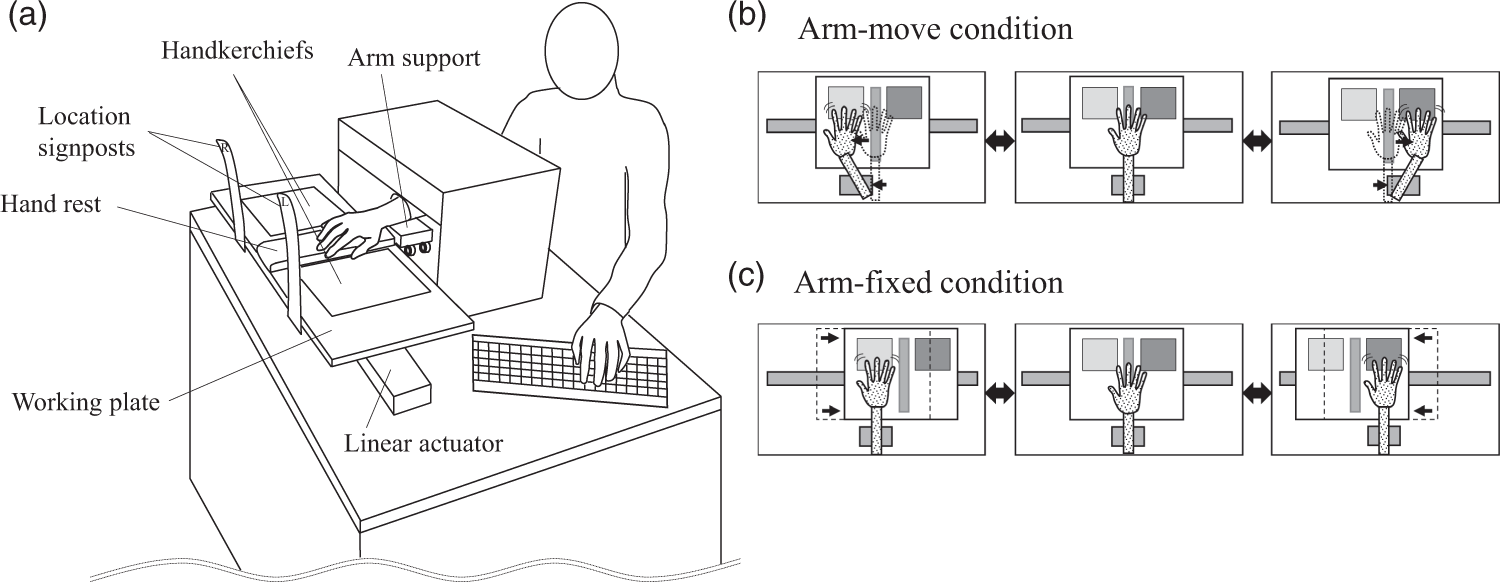
(a) Experimental setup for haptic preference judgment tasks using two handkerchiefs. (b) Hand movements in all arm-move condition trials. (c) Movement of handkerchiefs by linear actuator in all arm-fixed condition trials. Location signposts labeled “L” or “R” at the top, which participants could see above the box, were used only in Experiments 2 and 3. A monitor displaying the handkerchief for touching (i.e., “Left” or “Right”) was placed to the left side of the box in Experiments 2 and 3 (not shown in the figure).
Procedure
Every trial started with the participant placing their dominant hand on the hand rest. After a cue signal, each participant touched the two handkerchiefs in a pre-determined order and reported which they preferred by pressing the “Z” key for the left handkerchief and the “X” key for the right one using their non-dominant hand, after first returning their dominant hand to the hand rest. Participants were instructed to spread out their palm and stroke the handkerchiefs to sense their touch.
In the first condition, participants touched the right handkerchief for 4 seconds, the left handkerchief for 8 seconds, and then the right handkerchief again for 4 seconds. Participants returned their hand to the hand rest after each touch period and waited in that position for 1 second before the next touch period began. In this series of hand movements, participants touched the right handkerchief twice and the left handkerchief once, with a total touch duration of 8 seconds for each handkerchief.
In the second condition, participants touched the handkerchiefs as follows: right for 2 seconds, right again for 2 seconds, left for 8 seconds, right for 2 seconds, and right again for 2 seconds. As in the first condition, they waited for 1 second between each touch period with their hand on the hand rest and returned their hand there after the final touch period. In this series of hand movements, participants touched the right handkerchief four times and the left handkerchief once, with a total touch duration of 8 seconds for each handkerchief.
The cue for each hand movement was a beep sound created by a personal computer. When a participant moved their hand before the beep or did not reach the hand rest or designated handkerchief within 1 second of the beep, an alarm sounded and the participant repeated the same trial. Participants practiced the hand movements using dummy handkerchiefs before commencing recorded trials. The experiment took about 40 minutes in total for each participant.
Results and Discussion
When participants touched one handkerchief once and the other twice (i.e., Condition 1), the likelihood of choosing the latter was slightly higher than chance (M = .53, SEM = 0.02), although the bias was not significant, t(15) = 1.5, p = .15, dz = 0.38. When participants touched one handkerchief once and the other four times (i.e., Condition 2), the likelihood of choosing the latter was significantly greater than chance, M = .57, SEM = 0.02, t(15) = 3.2, p = .006, dz = 0.80.
A 2 × 2 repeated measures analysis of variance (ANOVA) crossing the handkerchief pair (i.e., two identical vs. two different) and the condition (i.e., difference in touch frequency between two handkerchiefs) detected a significant main effect of handkerchief pairs, F(1, 15) = 6.2, p = .025, ηp2 = .29. The liking effect for two identical handkerchiefs was greater than that for two different handkerchiefs in Condition 1 (M = .56 for identical; M = .50 for different) and Condition 2 (M = .60 for identical; M = .53 for different). The main effect of the condition was weak, F(1, 15) = 2.7, p = .12, ηp2 = .15, and there was no interaction between handkerchief pairs and the condition (F < .01).
The results in Experiment 1 verified that the liking effect previously found in visual tasks also appears in haptic tasks. Supporting Hypothesis 1, the bias toward choosing the more frequently touched handkerchiefs was greater for a larger difference in touch frequency between two handkerchiefs. However, the difference between Conditions 1 and 2 was not statistically significant, which might be due to the bias being smaller in this study than in Mitsuda and Yoshioka (2018). Their participants pinched handkerchiefs and touched them freely, whereas participants in our Experiment 1 just stroked the handkerchiefs. Consequently, differences in the feeling of touch might have been more difficult to sense than in Mitsuda and Yoshioka (2018). In Experiment 1, the bias for two identical handkerchiefs was greater than for two different handkerchiefs, for which a larger difference in the feel of touch was expected. Therefore, a smaller difference in the feel of touch when participants stroked the handkerchiefs compared with touching them freely would not decrease the liking effect. The difficulty of sensing might decrease participants’ confidence in their feel of touch and the resultant choice, potentially affecting their decision.
Experiment 2
In Experiment 2, the liking effect was compared between a condition where participants moved their arm to touch the handkerchiefs and a condition where their arm remained static and the linear actuator carried the handkerchiefs to their hand. Considering the small magnitude of the liking effect in Experiment 1, participants were allowed in Experiment 2 to pinch and touch the handkerchiefs freely, as in Mitsuda and Yoshioka (2018).
Method
Participants
The 16 participants in Experiment 1 also participated in Experiment 2, for which they received 1,000 Japanese yen. Experiment 2 was performed about 4 months after Experiment 1.
Stimuli
Thirty-two pairs of handkerchiefs from Experiment 1 were also used in Experiment 2.
Apparatus and procedure
The Experiment 1 apparatus was also used in Experiment 2. The position of the working plate, on which two handkerchiefs were placed in each trial, was controlled by a personal computer through the linear actuator. As in Experiment 1, participants reported their preferred handkerchief, based solely on touch, by pressing a key. Participants performed the haptic preference task in two conditions. In the arm-move condition, they moved their hand to touch each handkerchief as in Experiment 1; in the arm-fixed condition, the handkerchief to be touched was moved to lie directly underneath their hand by the linear actuator, so they did not move their arm at all during these trials. To enable participants to identify whether they were touching the left or right handkerchief in the arm-fixed trials, two location signposts labeled “L” or “R” at the top, which participants could see above the box, were fixed to the working plate (see Figure 1(a)). In addition, the handkerchief for touching (i.e., “Left” or “Right”) was displayed on a monitor placed to the left of the box. As in Experiment 1, a small position receiver was fixed on the back of the hand used for touching (i.e., dominant hand).
Eight participants first performed 32 trials in the arm-move condition, followed by another 32 trials in the arm-fixed condition. The other eight participants performed these two sets of trials in reverse order. The procedure in the arm-move condition was the same as in Experiment 1’s Condition 2 except that participants pinched and touched the handkerchiefs freely. In the arm-fixed condition, participants touched the handkerchiefs in the same order, for the same duration, and in the same manner (when stopped) as in the arm-move condition. Participants were asked to lift their hand to avoid touching the handkerchiefs while they were moving. The working plate, on which the handkerchiefs and hand rest were positioned, moved at a speed of 200 mm/sec and stayed at the destination for the determined duration (i.e., 1, 2, 4, or 8 seconds). The transit time was 1 second between a handkerchief and the hand rest, and 2 seconds between one handkerchief and the other. This experiment took about 60 minutes in total for each participant. Figure 1 shows the hand movements in the arm-move (b) and arm-fixed (b) conditions.
Results and Discussion
In the arm-move condition, the likelihood of choosing the more frequently touched handkerchiefs (referred to as the likelihood for readability in the following sentences) was significantly greater than chance, M = .63, t(15) = 5.0, p = .0002, dz = 1.3. The likelihood was greater than that in Experiment 1’s Condition 2 (M = .57), in which participants stroked the handkerchiefs, although without statistical significance, t(15) = 2.0, p = .065, dz = 0.50. In the arm-fixed condition, the likelihood was also significantly greater than chance, M = .56, t(15) = 2.6, p = .020, dz = 0.65, but was significantly smaller than that in the arm-move condition, t(15) = 2.4, p = .028, dz = 0.61.
Figure 2 shows the likelihoods by handkerchief pair (i.e., two identical vs. two different) and by condition (i.e., arm-move vs. arm-fixed). A 2 × 2 repeated measures ANOVA crossing the handkerchief pair and the condition detected a significant main effect of the condition, F(1, 15) = 6.0, p = .028, ηp2 = .28. However, the main effect of handkerchief pairs was not significant, F(1, 15) = 2.4, p = .15, ηp2 = .14, which differed from the result of Experiment 1. The interaction between handkerchief pairs and conditions was not significant (F < .01).

The likelihood of choosing the more frequently touched handkerchief by arm movement condition and by handkerchief pair in Experiment 2.
Supporting Hypothesis 2, the liking effect was greater when participants moved their arm than when they did not. This reinforces that the difference in the liking effect between active and passive sampling, as observed by Shimojo et al. (2003), is a general phenomenon regardless of sensory modalities. However, whereas Shimojo et al. (2003) found no liking effect when participants did not move their eyes, Experiment 2 found a significant liking effect when participants did not move their arm. In the arm-fixed trials, participants nonetheless moved their fingers to touch the handkerchiefs, which might produce a similar effect to that of arm movement.
Experiment 3
In Experiments 1 and 2, participants touched the right handkerchief more frequently in all trials, with the intention of avoiding confusion regarding hand movements. However, a difference in preference between left and right might have affected the results in Experiments 1 and 2, though Mitsuda and Yoshioka (2018) reported a significant liking effect in trials where handkerchief positions were counterbalanced. Experiment 3 examined this issue by alternating the position (left or right) of the handkerchief that participants touched more frequently in every trial.
Method
Participants
Sixteen men students (aged 21–23 years) who did not participate in Experiments 1 and 2 participated in Experiment 3, for which they received 1,000 Japanese yen. As in Experiments 1 and 2, all the participants declared their right hand as dominant.
Stimuli
Thirty-two pairs of handkerchiefs used in Experiments 1 and 2 were also used in Experiment 3.
Apparatus
Experiment 3 used the exact same apparatus as Experiments 1 and 2.
Procedure
Participants performed 32 trials in the arm-move condition and another 32 trials in the arm-fixed condition, as in Experiment 2. Procedures in both conditions were the same as in Experiment 2 except that the position (i.e., left or right) of the handkerchief that participants touched more frequently was reversed every trial. In other words, in half the trials, participants touched the right handkerchief first; in the other half, they touched the left handkerchief first. As in Experiments 1 and 2, participants touched two identical handkerchiefs in half the trials and two different handkerchiefs in the other half. In trials using two different handkerchiefs, the positions of the handkerchiefs and the handkerchief touched more frequently were counterbalanced. This experiment took about 60 minutes in total for each participant.
Results and Discussion
Consistent with the results in Experiment 2, the likelihood of choosing the more frequently touched handkerchiefs was significantly greater than chance in the arm-move condition, M = .65, t(15) = 4.2, p = .0007, dz = 1.1, and in the arm-fixed condition, M = .60, t(15) = 5.3, p < .0001, dz = 1.3. The likelihood was greater in the arm-move condition than in the arm-fixed condition, but not significantly, t(15) = 1.8, p = .098, dz = 0.44.
A 2 × 2 repeated measures ANOVA crossing the handkerchief pair (i.e., two identical vs. two different) and the condition (i.e., arm-move vs. arm-fixed) detected a significant main effect of handkerchief pairs, F(1, 15) = 9.4, p = .008, ηp2 = .39, inconsistently with Experiment 2. However, the main effect of conditions was weak, F(1, 15) = 3.6, p = .078, dz = 0.19, and there was no interaction between handkerchief pairs and conditions (F = 0.59).
The likelihood of choosing the more frequently touched handkerchiefs was significantly greater than chance for two identical handkerchiefs (M = .70 in the arm-move condition; M = .63 in the arm-fixed condition) and two different handkerchiefs (M = .61 in the arm-move condition; M = .57 in the arm-fixed condition), ps < .023. The likelihood was significantly greater for two identical handkerchiefs than for two different handkerchiefs—arm-move condition: t(15) = 2.4, p = .031, dz = 0.59; arm-fixed condition: t(15) = 2.5, p = .027, dz = 0.61. When participants touched two identical handkerchiefs, the liking effect was significantly greater in the arm-move condition than in the arm-fixed condition, t(15) = 2.9, p = .011, dz = 0.73. However, when participants touched two different handkerchiefs, the liking effect did not differ significantly between the conditions, t(15) = 0.89, p = .39, dz = 0.22.
Figure 3 shows the liking effects by the position of the more frequently touched handkerchiefs (i.e., left vs. right) and by condition (i.e., arm-move vs. arm-fixed), for all the trials (both identical and different handkerchief pairs). A 2 × 2 repeated measures ANOVA crossing the handkerchief position and the condition did not detect any significant main effect of handkerchief position, F(1, 15) = .66, p = .43, ηp2 = .042. A weak interaction between handkerchief position and condition was detected, but without statistical significance, F(1, 15) = 3.8, p = .07, ηp2 = .20. The liking effect in the arm-move condition was significantly greater when the more frequently touched handkerchiefs were placed on the right than when placed on the left—M = .69 for right placement; M = .61 for left placement; t(15) = 2.4, p = .029,dz = 0.60. By contrast, no significant effect of the handkerchief position was observed in the arm-fixed condition—M = .61 for right placement; M = .59 for left placement; t(15) = 0.39, p = .70, dz = 0.10.
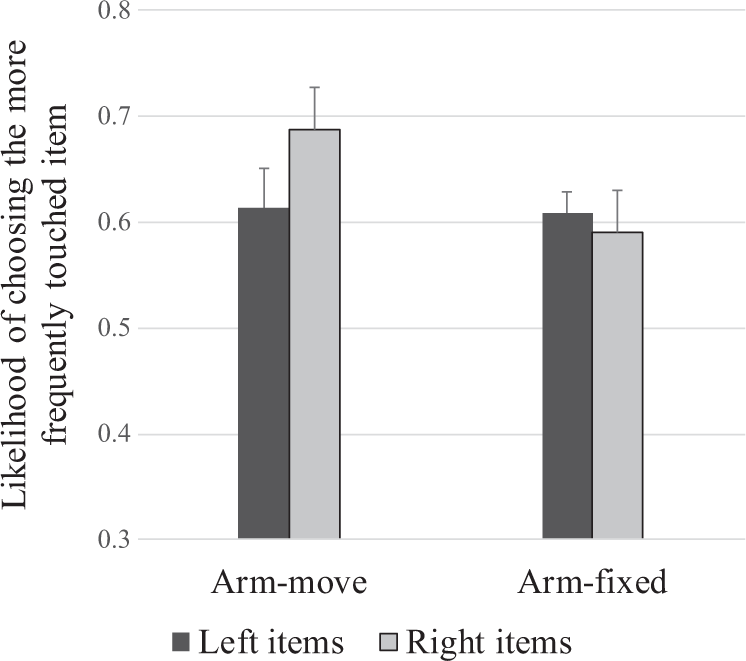
The likelihood of choosing the more frequently touched handkerchief by arm movement condition and by first-touched handkerchief position for all the trials (both identical and different handkerchief pairs) in Experiment 3.
The results of Experiment 3 verify that the bias of choosing the more frequently touched handkerchief exists regardless of handkerchief positions. Consistent with Experiment 2, the liking effect was greater when participants moved their arm than when they did not; however, the difference only appeared when participants touched the right handkerchief more frequently than the other.
General Discussion
This study examined two hypotheses. Hypothesis 1 was that the liking effect observed in visual preference tasks is a general phenomenon regardless of sensory modalities and so also exists in haptic preference tasks. The results of this study’s three experiments support this hypothesis, as participants tended to choose the more frequently touched handkerchiefs. Mitsuda and Yoshioka (2018) previously found bias in a preference judgment task but not in a smoothness judgment task. Therefore, the bias observed in this study must be attributed to preference-level difference.
In Experiment 1, a significant difference in touch frequency was not found to enhance the liking effect because the bias was small, which we attribute to handkerchiefs being touched differently (i.e., stroking) compared with Mitsuda and Yoshioka’s (2018) study (i.e., pinching and touching freely). However, when the latter way of touching handkerchiefs was adopted, the liking effects when participants touched one handkerchief four times and the other once (Experiment 2: M = .63; Experiment 3: M = .65) were greater than that when participants touched one handkerchief twice and the other once (M = .56) in Mitsuda and Yoshioka (2018). Therefore, a greater difference in touch frequency between the two handkerchiefs seems likely to enhance the liking effect, as in the mere-exposure effect (Bornstein, 1989; Zajonc, 1968).
One possible limitation of this study is that the serial order of touching handkerchiefs may have affected preference. Many studies have reported the serial order’s effect on choosing one from two or more items such as beverages, musical pieces, and landscapes (Biswas, Grewal, & Roggeveen, 2010; Carney & Banaji, 2012; Li & Epley, 2009; Mantonakis, Rodero, Lesschaeve, & Hastie, 2009; Pandelaere, Millet, & Van den Bergh, 2010). However, whether coming first or last has the greater effect has varied between different items. In addition, these studies presented each item only once in a series; no paper has examined the effect of serial order in the trial condition of presenting items repeatedly, as in this study. Mitsuda and Yoshioka (2018) found no bias in choosing a handkerchief when participants touched two handkerchiefs either once or twice each, suggesting that touching first or last did not affect preference. However, it is possible that the effects of touching first and last canceled each other because the first handkerchief and last handkerchief differed when participants touched them alternately at the same frequency. This issue should be examined in future studies. In any event, the effect of serial order on preference would not explain that arm movement and more frequent touching enhanced the liking effect in this study.
Hypothesis 2 was that the liking effect appears only when people actively touched objects, as in visual preference tasks. Contrary to its prediction, the results of Experiments 2 and 3 show that the liking effect also appeared when participants did not move their arm, instead touching handkerchiefs carried to their hand by a machine. However, the magnitude of the liking effect when participants moved their arm to touch the handkerchiefs was greater than that when their arm was static. In other words, the liking effect existed regardless of arm movement. At the same time, moving the arm to touch handkerchiefs only enhanced the magnitude of the liking effect when the right handkerchief was touched more frequently.
Shimojo et al. (2003) did not observe a significant liking effect when two images appeared on a screen alternately and participants did not need to move their eyes to see them. By contrast, this study did find the liking effect for the (passive) arm-fixed condition. This contradiction shows that the liking effect observed in haptics may have different source from that in vision. Therefore, further studies should explore the liking effect in visual preference and its relation to that in haptic preference.
This study observed a significant liking effect regardless of whether participants moved their arm to touch the handkerchiefs. Therefore, the mere-exposure effect, which has also previously been observed in haptics (Jakesch & Carbon, 2012), might induce the liking effect. The arm movement could increase attention to the handkerchief and the input of haptic sense to the brain, in turn enhancing the liking effect.
Another possible source of the liking effect observed in this study is the emergence of ownership from touching items (Peck & Shu, 2009). Previous studies have shown that touch increases preference for an object when considering a purchase (Grohmann, Spangenberg, & Sprott, 2007; McCabe, & Nowlis, 2003). In this study, the handkerchiefs were invisible, so participants could only choose by the feel of touch. This condition differs from that in the studies of ownership. However, this study’s participants were made aware before the trials of the object they would be touching, which might have made them consider the handkerchiefs as items for purchase, leading to the emergence of ownership. Accordingly, the greater liking effect in the arm-move condition may be due to arm movements inducing greater ownership.
Enhancement of the liking effect when participants moved their arm and touched the right handkerchief more frequently could be related to reachability. All the study’s participants reported that their right hand was dominant. Consequently, they touched the handkerchiefs in every trial with their right hand. The position of each seated participant relative to the apparatus meant that it was always easier for them to touch handkerchiefs on the right than those on the left. Bar-Hillel (2015) suggested that the item easiest to reach will be favored. Position effects in choosing an item have been extensively studied; although the results have been inconsistent between studies, reachability cannot be discounted as a possible explanation for the effect (see a review by Bar-Hillel, 2015, and the comment by Rodway, Schepman, & Thoma, 2016). Conversely, the unnatural behavior of touching the left handkerchief using the right hand might spoil the consciousness of the active movement (by causing participants to feel forced to touch the handkerchief), leading to a smaller liking effect or smaller ownership.
Heuristic decision-making is another possible cause of the effects observed in this study. People sometimes make decisions based on their metacognitive beliefs, such as the “center-stage heuristic” that important people sit in the middle (Raghubir & Valenzuela, 2006). In this study, similar metacognitive beliefs might have affected participants’ decisions when they had insufficient information to guide their judgment.
One limitation of this study is that the experimental results cannot determine whether the observed choosing bias was due to the liking or the disliking effect. The longer duration of a single touch could have increased aversion to those handkerchiefs. This issue should be examined in future studies.
Finally, this study found that different ways of touching objects affected preference. Experiments using other sensory modalities are required to check if the liking effect is a general phenomenon, as determining the influence of sampling behavior (such as hearing and smelling) on preference is essential for understanding the decision-making process. It would also be valuable to examine the liking effects in haptics with visual information—which may generate a multiplier effect—as people rarely select an item without looking at it in daily activity.
Footnotes
Declaration of Conflicting Interests
The author(s) declared no potential conflicts of interest with respect to the research, authorship, and/or publication of this article.
Funding
The author(s) received no financial support for the research, authorship, and/or publication of this article.