



Abstract
Recently, it has been proposed that solving addition and subtraction problems can evoke horizontal shifts of spatial attention. However, prior to this study, it remained unclear whether orienting shifts of spatial attention relied on actual arithmetic processes (i.e., the activated magnitude) or the semantic spatial association of the operator. In this study, spatial–arithmetic associations were explored through three experiments using an eye tracker, which attempted to investigate the mechanism of those associations. Experiment 1 replicated spatial–arithmetic associations in addition and subtraction problems. Experiments 2 and 3 selected zero as the operand to investigate whether these arithmetic problems could induce shifts of spatial attention. Experiment 2 indicated that addition and subtraction problems (zero as the second operand, i.e., 2 + 0) do not induce shifts of spatial attention. Experiment 3 showed that addition and subtraction arithmetic (zero as the first operand, i.e., 0 + 2) do facilitate rightward and leftward eye movement, respectively. This indicates that the operator alone does not induce horizontal eye movement. However, our findings support the idea that solving addition and subtraction problems is associated with horizontal shifts of spatial attention.
Introduction
Several studies have indicated that there is a clear association between numbers and space; that is to say, numbers are spatially mapped (Dehaene, Bossini, & Giraux, 1993; Fischer, Castel, Dodd, & Pratt, 2003; Fischer & Knops, 2014). Recent studies have indicated that the understanding of number–space associations can also be applied to elementary arithmetic (Fischer & Shaki, 2014a, 2014b; McCrink, Dehaene, & Dehaene-Lambertz, 2007). In one seminal study, McCrink et al. (2007) showed that participants tended to overestimate the results of addition problems and underestimate the results of subtraction problems (operational momentum effect), a phenomenon that has been confirmed through observation in other research (Jiang, Cooper, & Alibali, 2014; Knops, Viarouge, & Dehaene, 2009).
Recently, it has been reported that addition can induce rightward spatial bias, whereas subtraction can cause leftward spatial attention shifts (Li et al., 2018; Liu, Cai, Verguts, & Chen, 2017; Masson & Pesenti, 2014; Mathieu, Gourjon, Couderc, Thevenot, & Prado, 2016). Masson and Pesenti (2014) used the target detection paradigm to investigate whether addition and subtraction arithmetic can induce spatial attention shifts. They found that single-digit subtraction facilitated the detection of leftward targets, while multidigit addition caused rightward spatial attention shifts. However, their study was limited insofar as they required that participants only detect targets at 450 ms after solving addition and subtraction arithmetic. To identify the particular stages in which spatial–arithmetic association manifested, further studies began to focus on the time course of spatial attention shifts induced by addition and subtraction arithmetic (Li et al., 2018; Liu et al., 2017; Masson, Letesson, & Pesenti, 2017; Zhu, Luo, You, & Wang, 2018). Researchers found that rightward targets were more quickly detected than targets in the left visual field when solving addition problems. Conversely, subtraction problems facilitated the detection of leftward targets. Notably, this spatial–arithmetic association was robust at 300 ms after solving addition and subtraction problems. This result indicates that spatial–arithmetic associations could occur in earlier stages.
Evidence of the association between elementary arithmetic and space also stems from eye movement. A study using functional magnetic resonance imaging (fMRI) found that addition induced activation patterns in the parietal cortex, which overlapped with those activated by rightward eye movement (Knops, Thirion, Hubbard, Michel, & Dehaene, 2009). Hartmann, Mast, and Fischer (2015) required participants to solve arithmetic problems presented in auditory form. They found that compared with subtraction problems, gaze position shifted more upward while calculating addition problems. Masson et al. (2017) found that gaze position shifted rightward while solving addition problems. Furthermore, Zhu et al. (2018) observed that addition and subtraction problems could facilitate rightward and leftward eye movement, respectively. Binda, Morrone, and Bremmer (2012) found that participants underestimated the results of mental additions and subtractions before the execution of saccadic eye movements. They suggested that there existed a link between the preparation of action and the representation of abstract quantities.
Although many studies have provided evidences for spatial–arithmetic associations, the mechanism of spatial–arithmetic association was still a hot issue. Current theories give different explanations for spatial–arithmetic associations. Knops, Thirion, et al. (2009), for instance, posited that adding and subtracting numbers was similar to moving to the right or left of what they called the mental number line (MNL). The MNL is spatially oriented and the hypothesis suggests that numbers are internally mapped along the line. Some studies have demonstrated that solving addition and subtraction problems was associated with horizontal shifts of attention (Klein, Huber, Nuerk, & Moeller, 2014; Knops, Dehaene, Berteletti, & Zorzi, 2014; Masson et al., 2017; Mathieu et al., 2016). The neural computational model provides a potential explanation for the shifts of spatial attention in addition and subtraction arithmetic (Chen & Verguts, 2010). The basis function networks for spatial transformations correspond to multimodal parietal areas (such as the lateral intraparietal area or the ventral intraparietal area), which play a key role in numerical arithmetic, saccadic, and attentional control.
Moreover, some studies showed that the operator could elicit spatial representation. Pinhas, Shaki, and Fischer (2014) observed that a quicker response was evident when the plus sign was associated with the right response key and similarly quick when the minus sign was matched with the left response key. This study suggests that spatial bias related to elementary arithmetic might be due to a semantic association between operation sign and space. Based on this finding, it is apparent that people tend to map the plus operator onto the right side and the minus operator onto the left side. This hypothesis has been confirmed by further research (Masson & Pesenti, 2014; Mathieu et al., 2018). Mathieu et al. (2018) used fMRI to test whether the neural mechanisms for space contributed to the processing of operation signs. They found that the simple perception of a “+” sign could activate several brain regions that supported in the orientation of spatial attention. In addition, Masson and Pesenti (2014) found that arithmetic problems involving zero could induce spatial bias. When the second operand was zero, it resulted in no eye movement on the MNL. In this study, it was observed that spatial bias was induced by a zero problem, which supports a semantic association hypothesis. However, other research found no evidence for operation-dependent spatial bias when the second operand was zero (Mathieu et al., 2016; Pinhas & Fischer, 2008). Hence, it remains unclear whether the operator could induce spatial–arithmetic associations.
Further studies on spatial–arithmetic associations include McCrink and Wynn (2009) account of operational momentum, which they named the accepting more or less heuristic. Their theory posited that individuals tended to associate plus with more and minus with less in their daily lives. This mapping association gradually aligns to a spatial dimension (right and left). Based on this heuristic, if zero plus (or minus) a digit, the magnitude will be more (or less). A greater magnitude will map to the rightward space and a lesser magnitude will relate to the left space. The magnitude of solutions may, thus, influence spatial association. This heuristic also fits with the semantic association of the operator. In the case of one number plus (or minus) zero, the magnitude will not become more (or less). Through this idea, we can investigate whether the operator influences spatial bias. Therefore, we chose the zero as the operand to explore the nature of spatial–arithmetic associations.
From the earlier studies, the mechanism of spatial–arithmetic association continues to be unknown. To clarify this issue, it is necessary to explore whether spatial–arithmetic associations are rooted in movements along the MNL or if there are semantic associations with the operator. Second, some research used arithmetic problems involving zero to investigate the role of operator (Masson & Pesenti, 2014). However, this research concentrated on arithmetic problems wherein zero was the second operand. Whether arithmetic problems in which zero is the first operand can induce similar effect remains a knowledge gap. Hence, to further examine whether the operator was crucial for spatial–arithmetic associations, we would compare the results between arithmetic problems wherein zero was the second operand and arithmetic problems in which zero is the first operand.
To address these limitations, three experiments have been conducted in this study. Experiment 1 aimed to examine whether elementary addition and subtraction problems could trigger horizontal eye movement. Experiment 2 comprised two parts, aiming to investigate the mechanism of spatial–arithmetic associations. Both experiments were designed to investigate whether addition and subtraction problems with zero as the second operand (e.g., 2 + 0) could induce spatial attention shifts. Both experiments, thus, used zero as the second operand, but in Experiment 2A, the first operand was a positive number, while in Experiment 2B, the first operand was a negative number. Experiment 2B, therefore, extended the consideration further: Whether the negative sign of the first operand (e.g., −2 + 0) could induce spatial attention shifts. Experiment 3 further examined whether the operator was related with spatial–arithmetic associations when zero as the first operand (e.g., 0 + 2).
Experiment 1
We first explored if solving addition problems would facilitate rightward eye movement and if solving subtraction problems would facilitate leftward eye movement.
Method
Participants
A total of 26 undergraduate students (10 males, all right-handed) with an age range of 18 to 25 years (M = 20.35, SD = 2.04) were recruited. All participants were naïve to the purpose of this experiment and had normal or corrected-to-normal vision. Before the experiment, all participants signed written informed consent as required by the ethics committee at Shaanxi Normal University.
Material and Apparatus
There were 40 arithmetic problems, which comprised Arabic numerals from 1 to 99. The solutions to these addition arithmetic problems were the same as the subtraction problems (such as 1 + 2 = 3 and 5 − 2 = 3). We used an eye movement tracker, Eyelink II, with a refresh rate of 500 Hz to record participants’ eye movement. Participants sat at a distance of 60 cm from the screen, and a chin and forehead stabilizer were used to prevent head movement.
Procedure and Design
The sequence of an example trial is detailed as follows (see Figure 1). At the beginning of the experiment, a fixation dot was presented randomly in nine different locations on the screen. Participants were required to track the fixation dot to ensure that their eye movement was calibrated to the tracker. After finishing calibration and validation, a fixation dot was presented on the center of the screen for 500 ms. Thereafter, the first operand, operator, and second operand (Courier New 40-point font) appeared in the center of the screen successively for a duration of 400 ms each. Having seen the arithmetic problem, participants were asked to report the answer aloud. Then, a fixation dot with two lateral boxes was presented in the screen for a variable delay (150 ms, 300 ms, or 450 ms). Thereafter, the cues (presented in the shape of a star, 3.5° of visual angle) appeared for 1 second either to the right of the fixation dot or the left. Once the cues disappeared, participants were instructed to move their eyes to the leftward box or rightward box according to the location of the cues. Participants were required to practice the exercise in 10 trial runs before the official experiment began and there were 160 trials. The experiment lasted about 45 minutes.

An example of one trial showing the sequence of events and timing. The calibration, fixation, first operand, operator, and second operand were presented successively at the center of the screen. Then participants were asked to report the answer of the arithmetic problems as accurately as possible. After a variable delay (150 ms/300 ms/450 ms), participants moved their eyes to the corresponding box (left or right) according to the cues (the shape of a star).
Results
Trials in which there were errors in either the mental arithmetic task or the eye movement task were excluded from further analysis (6.03%). Furthermore, trials were excluded from further analysis if they met the following conditions: (a) in the eye movement task, trials in which the response times (RTs) were more than three standard deviations away from the mean; and (b) in the eye movement task, trials in which the vertical amplitude of the saccade were more than 3°.
Oral Report: RTs
We analyzed the RT and accuracy in varied delay conditions, respectively. A total of 0.53% of incorrect and extreme trials were excluded from the analysis in the 150 ms delay. A pairwise t test indicated no significant difference between mean RTs for addition and subtraction problems (addition: 449 ± 66 ms; subtraction: 459 ± 85 ms), t(25) = −0.75, p > .05, Cohen’s d = .147. In the 300 ms delay, 0.34% of error and extreme trials were excluded from the analysis. There was no significant difference between mean RTs for addition and subtraction problems (addition: 440 ± 66 ms; subtraction: 451 ± 81 ms), t(25) = −0.822, p > .05, Cohen’s d = .161. In the 450 ms delay, 0.56% of inaccurate trials were excluded from the analysis. Results indicated that there was no significant difference between mean RTs for addition and subtraction arithmetic problems (addition: 459 ± 71 ms; subtraction: 465 ± 79 ms), t(25) = −0.351, p > .05, Cohen’s d = .069.
Saccadic Latency
The mean saccadic latency of different delay conditions is presented in Table 1.
Mean Saccadic Latency (and SD) as a Function of Arithmetic, Eye Movement Orientation, and Delay in Experiment 1.

A 2 × 2 × 3 repeated measures analysis of variance (ANOVA) was first conducted with operation (addition or subtraction), eye movement orientation (left or right), and varied delay (150 ms, 300 ms, or 450 ms) as within-subject factors. Results indicate that there was a main effect of delay, F(2, 50) = 3.975, p < .05,
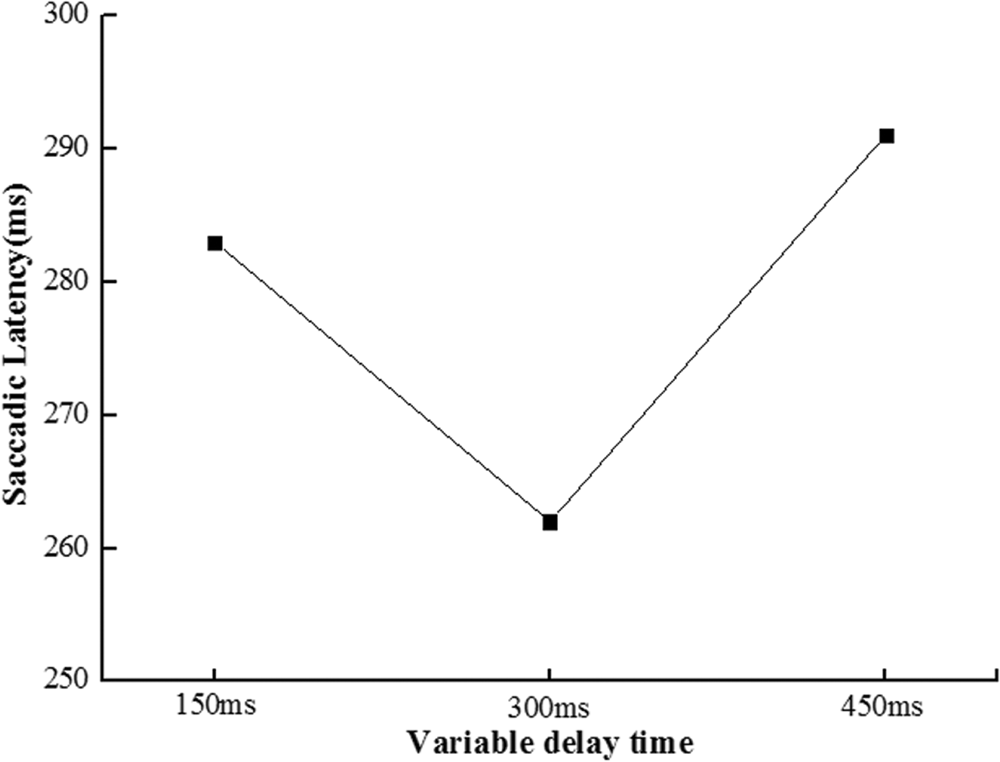
The mean saccadic latency in different delay conditions.
Further simple effect analysis was carried out in different delay conditions to reveal the time course of spatial–arithmetic association. In the 150 ms delay condition, the results showed that the main effect of operation was not significant, F(1, 25) = 0.061, p > .05,
In the 300 ms delay condition, the results reveal that the main effect of the operation was not significant, F(1, 25) = 0.78, p > .05,
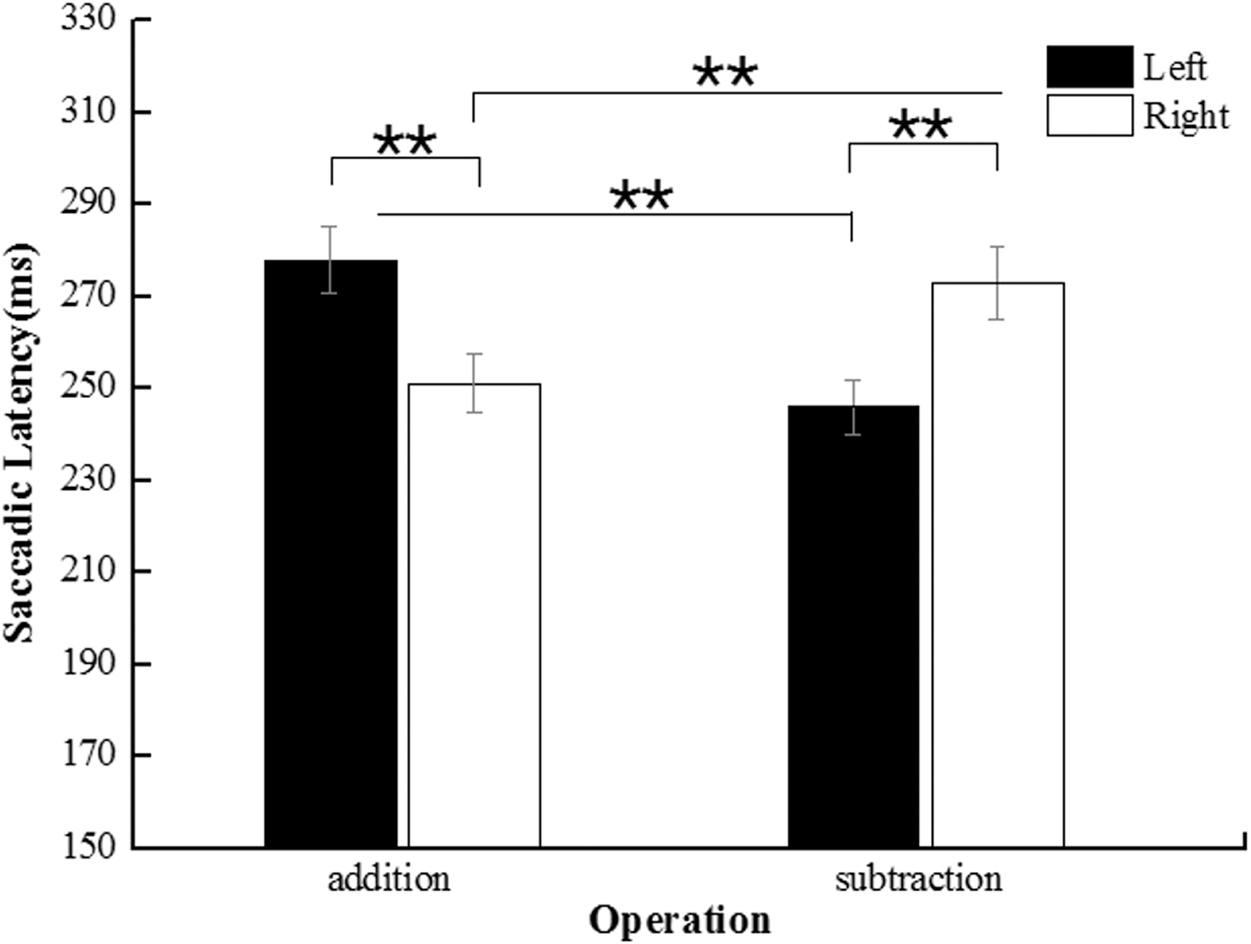
The interaction between operation and orientation in the 300 ms delay. **p < .01.
In the 450 ms delay condition, the results indicate that the main effect of operation was not significant, F(1, 25) = 7.981, p > . 05,
Experiment 2
Experiment 2 contains two experiments both of which aimed to investigate whether the semantic association between operator and space can initiate spatial attention shifts.
Experiment 2A
In this experiment, we investigated whether addition and subtraction problems with zero as the second operand (e.g., 2 + 0) could induce spatial attention shifts.
Method
Participants
A total of 26 undergraduate students (8 males, all right-handed) were recruited with an age range of 18 to 25 (M = 22.11, SD = 2.45). All participants were naïve to the purpose of this experiment and had normal or corrected-to-normal vision.
Material and Apparatus
There were 20 arithmetic problems, which comprised Arabic numerals from 0 to 9. In this experiment, we added a baseline task (e.g., 0 + 0 and 0 − 0) to explore whether the operator could cause a spatial attention shift.
Procedure and Design
The procedure was the same as that in Experiment 1. We used 2 (Operation: addition, subtraction) × 2 (Eye movement orientation: left, right) × 3 (Varied delay: 150 ms, 300 ms, 450 ms) as within-subject factors.
Results
We used the same exclusion criteria for data as in Experiment 1. Trials with errors in either mental arithmetic task or eye movement task were excluded from further analysis (5.36%). We first analyzed the data in the baseline task (0 + 0 or 0 − 0). The mean saccadic latency in different delay times is presented in Table 2.
Mean Saccadic Latency (and SD) as a Function of Arithmetic, Orientation, and Delay in the Baseline Task of Experiment 2A.

The Baseline Task
We conducted a repeated measures ANOVA on the mean saccadic latency with operation (addition or subtraction), eye movement orientation (left or right), and varied delay (150 ms, 300 ms, or 450 ms) as within-subject factors. Results revealed that the interaction among Operation × Eye movement orientation × Varied delay was not significant, F(2, 50) = 0.503, p > .05,
The Main Task
Following the aforementioned investigation, we analyzed the data in the main task (e.g., 2 + 0). The mean saccadic latency (and SD) as a function of operation, eye movement orientation, and variable delay is presented in Table 3.
Mean Saccadic Latency (and SD) as a Function of Arithmetic, Orientation, and Delay in the Main Task of Experiment 2A.

A 2 × 2 × 3 repeated measures ANOVA was conducted with operation (addition or subtraction), eye movement orientation (left or right) and varied delay (150 ms, 300 ms, or 450 ms) as within-subject factors. The main effect of the delay was marginally significant, F(2, 50) = 3.19, p = .05,
Experiment 2B
In this experiment, we chose a negative number as the first operand (e.g., −2 + 0) to explore whether the polarity of the sign could influence spatial–arithmetic associations.
Method
Participants
A total of 26 undergraduate students (8 males, all right-handed) were recruited with an age ranging from 18 to 25 (M = 22.11, SD = 2.45). All participants were naïve to the purpose of this experiment and had normal or corrected-to-normal vision.
Material and Apparatus
There were 18 arithmetic problems, which comprised Arabic numerals from −9 to 0. The solutions of the addition and subtraction problems were the same (−9 + 0 = −9 and −9 − 0 = −9).
Procedure and Design
The procedure was the same as that in Experiment 1. We used 2 (Operation: addition, subtraction) × 2 (Eye movement orientation: left, right) × 3 (Varied delay: 150 ms, 300 ms, 450 ms) as the within-subject factors.
Results
We used the same exclusion criteria for data as in Experiment 1. Here, 4.06% error and extreme trials were excluded from the analysis. The mean saccadic latency (and SD) as a function of arithmetic, eye movement orientation, and delay is presented in Table 4.
Mean Saccadic Latency (and SD) as a Function of Arithmetic, Eye Movement Orientation, and Delay in Experiment 2B.

First, a 2 (Operation: addition, subtraction) × 2 (Eye movement orientation: left, right) × 3 (Varied delay: 150 ms, 300 ms, 450 ms) repeated measures ANOVA was conducted. The main effect of the delay was marginally significant, F(2, 50) = 3.152, p = .051,
Experiment 3
In this experiment, we investigated whether addition and subtraction problems with zero as the first operand (e.g., 0 + 2) could induce spatial attention shifts.
Method
Participants
A total of 26 undergraduate students (8 males, all right-handed) were recruited with an age ranging from 18 to 25 (M = 21.69, SD = 2.20). All participants were naïve to the purpose of this experiment and had normal or corrected-to-normal vision.
Procedure and Design
There were 20 arithmetic problems, which comprised Arabic numerals from 0 to 9. Each problem repeated 4 times and 40 trials in total. The procedure of this experiment was similar to Experiment 1. We used a 2 (Operation: addition, subtraction) × 2 (Eye movement orientation: left, right) × 3 (Varied delay: 150 ms, 300 ms, 450 ms) within-subject design.
Results
Oral Report: RT
We analyzed the RT respectively in the varied delay conditions. When the varied delay was 150 ms, 0.39% of error and extreme trials were excluded from the analysis. A pairwise t test indicated no significant difference between the mean RTs for addition and subtraction problems (addition: 551 ± 92 ms; subtraction: 559 ± 101 ms), t(25) = −1.692, p > .05, Cohen’s d = .182. In the 300 ms delay condition, 0.36% of error and extreme trials were excluded from the analysis. There was no significant difference between the mean RTs for addition and subtraction problems (addition: 527 ± 89 ms; subtraction: 525 ± 94 ms), t(25) = 0.278, p > .05, Cohen’s d = .022. In the 450 ms delay condition, 0.46% of error trials were excluded from the analysis. The results showed no significant difference between the mean RTs for addition and subtraction arithmetic problems (addition: 579 ± 113 ms; subtraction: 590 ± 104 ms), t(25) = −1.008, p > .05, Cohen’s d = .223.
Saccadic Latency
We used the same exclusion criteria for data as in Experiment 1. The mean saccadic latency of different delay conditions is presented in Table 5.
Mean Saccadic Latency (and SD) as a Function of Arithmetic, Eye Movement Orientation, and Delay in Experiment 3.

First, a 2 (Operation: addition, subtraction) × 2 (Eye movement orientation: left, right) × 3 (Varied delay: 150 ms, 300 ms, 450 ms) repeated measures ANOVA was conducted. A main effect of delay was found, F(2, 50) = 6.255, p < .01,
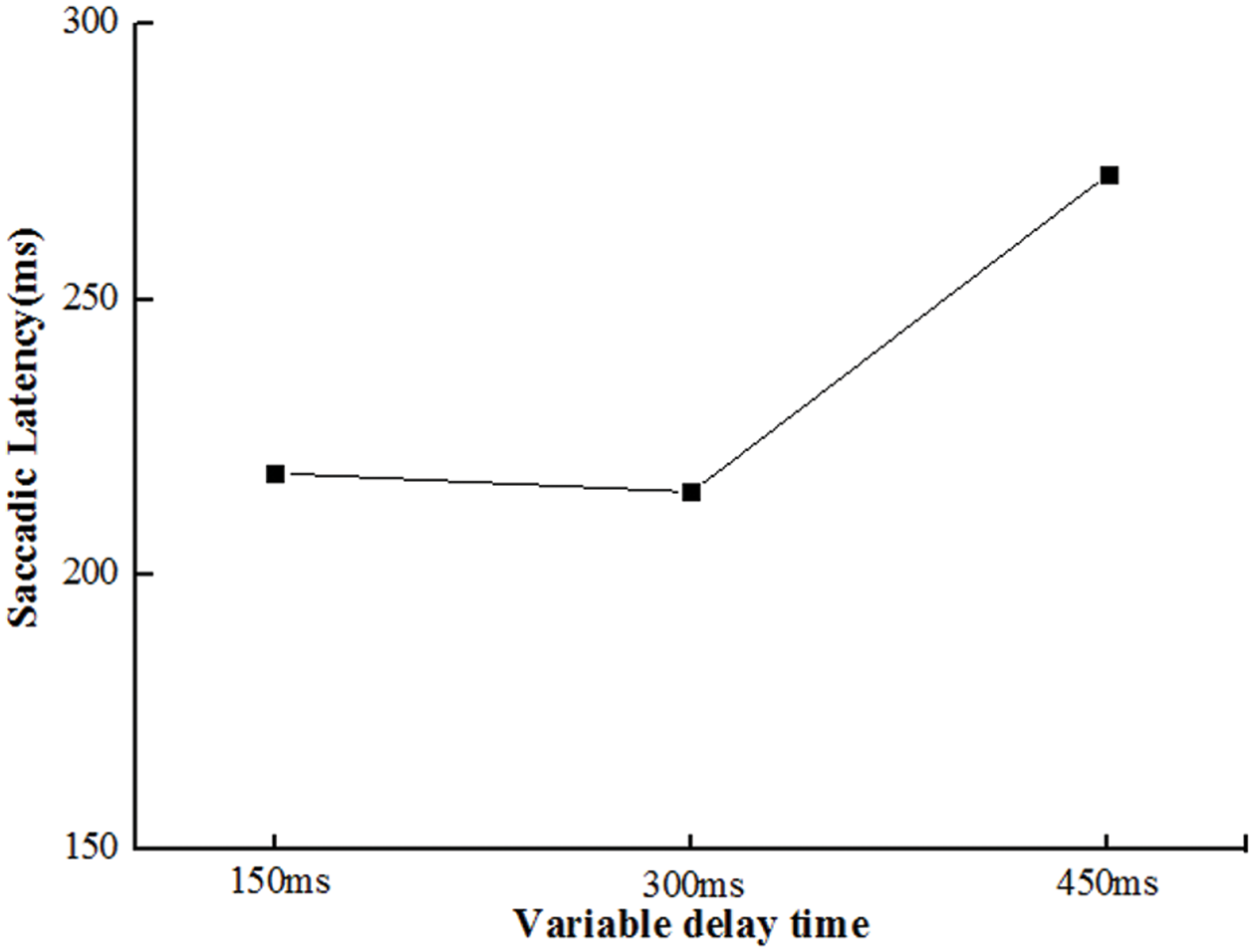
The mean saccadic latency in different variable delay conditions in Experiment 3.
Second, a simple effect analysis was carried out in different delay conditions to reveal the time course of spatial–arithmetic association. In the 150 ms delay condition, the results indicate that the main effect of operation was not significant, F(1, 25) = 0.112, p > .05,
In the 300 ms delay condition, the results show that the main effect of operation was not significant, F(1, 25) = 0.593, p > .05,
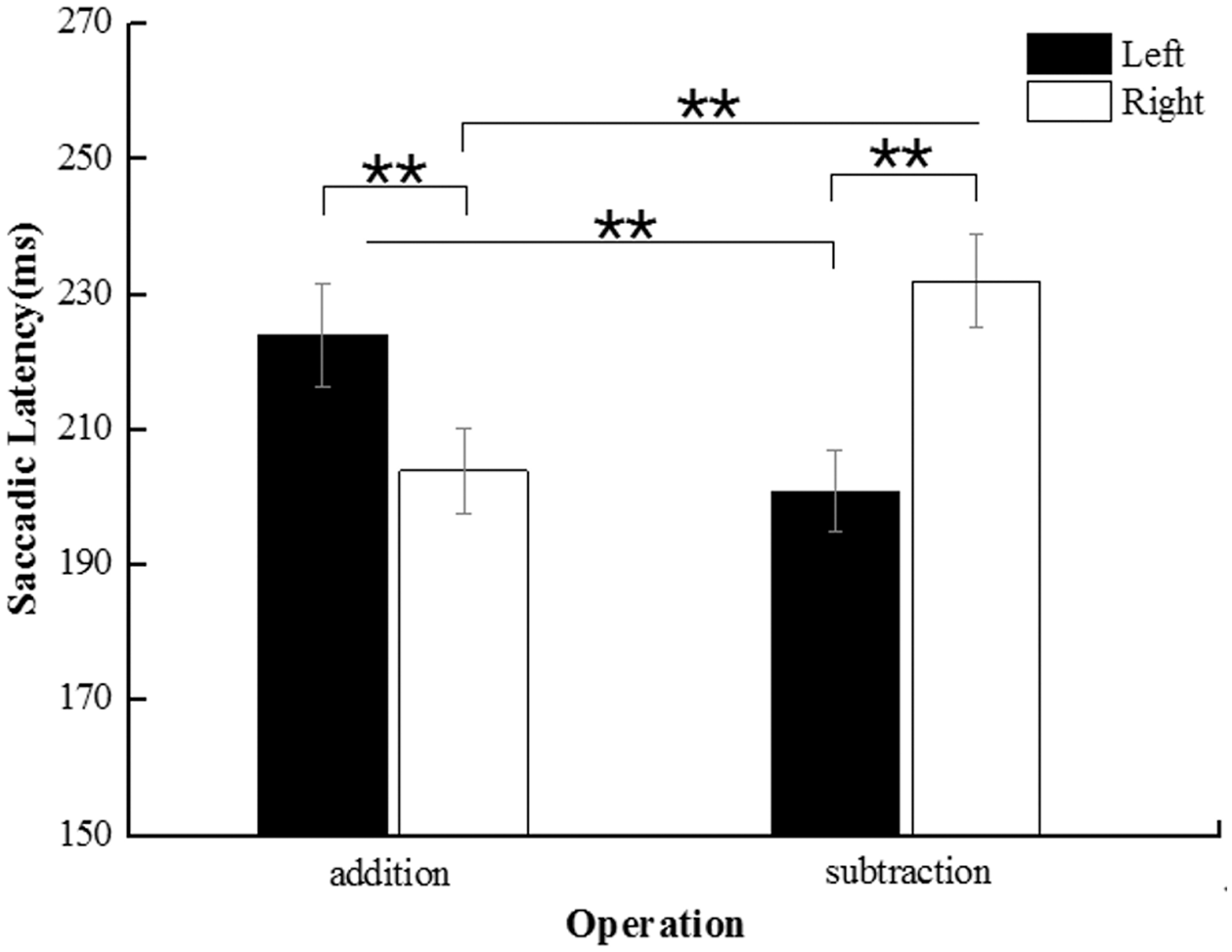
The mean saccadic latency as a function of operation (addition and subtraction) and orientation (left vs. right) with a 300 ms delay. **p < .01.
In the 450 ms delay condition, the main effect of operation was not significant, F(1, 25) = 0.033, p > .05,
Discussion
In this study, we investigated spatial–arithmetic associations through three experiments, each testing eye movement for different conditions of elementary arithmetic in relation to the semantics of the operator and operands and their values. Experiment 1 replicated spatial–arithmetic associations in addition and subtraction problems. Experiment 2 and Experiment 3 selected zero as the operand to investigate whether these arithmetic problems could induce shifts of spatial attention. The results indicated that solving addition problems facilitated rightward eye movement while solving subtraction problems accelerated leftward eye movement.
In agreement with previous studies, our findings demonstrate that addition and subtraction problems can facilitate horizontal shifts of spatial attention (Knops et al., 2014; Knops, Thirion, et al., 2009; Li et al., 2018; Liu et al., 2017; Masson et al., 2017; Mathieu et al., 2018). According to spatial attention shifts on the MNL hypothesis, when calculating arithmetic problems, people will shift spatial attention along the MNL to activate operands and outcomes. The spatial attention shifts in addition and subtraction arithmetic were consistent with the prediction of the neural network model, which indicated that the radial basis function networks for spatial transformations were recycled while solving addition and subtraction problems. The presence of spatial–arithmetic association resulted from interactions between different brain areas such as the lateral intraparietal area and the ventral intraparietal area, which play an important role in saccadic, attentional control, and numerical arithmetic (Chen & Verguts, 2010, 2012; Knops, Thirion, et al., 2009).
In Experiment 2, we did not find evidence of spatial–arithmetic association. The baseline task (e.g., 0 + 0) and main task (e.g., 2 + 0) did not facilitate horizontal eye movement. This suggests that a single operator (“+” or “−”) does not induce spatial bias. These results indicate that the semantic association between operator and space might not induce spatial–arithmetic mapping. Importantly, these results are inconsistent with previous studies. Pinhas et al. (2014), for instance, found that the “+” sign was associated with right space, while the “−” sign was related to the left space. However, in their study, the spatial association with the operation sign occurred only in the context of arithmetic: outside of an addition or subtraction problem, there was no operation sign-related spatial bias. In addition, Mathieu et al. (2018) observed that the spatial region was activated when perceiving “+” sign and other mathematical symbols (i.e., multiple sign) also could evoke spatial representations. From these studies, an operator classification task (i.e., classifying “+” and “−” with a right-hand or left-hand response) and an operator priming task (i.e., presenting the sign before calculating addition and subtraction) all emphasize the process of the operator. They found that operator processing was able to activate a spatial semantic association.
In Experiment 3, we observed that addition and subtraction problems, in which the first operand was zero (e.g., 0 + 2 or 0 − 2), could induce rightward and leftward eye movement, respectively. This result further supports the theory of spatial attention shifts in elementary arithmetic. In comparison, the operand and operator were the same in the addition condition (e.g., 2 + 0 in Experiment 2A, 0 + 2 in Experiment 3) and the subtraction condition (e.g., 2 − 0 in Experiment 2A, 0 − 2 in Experiment 3) in both Experiments 2 and 3. However, we found evidence of spatial–arithmetic association in Experiment 3 but not in Experiment 2. This different finding indicated that negative sign might cause spatial–arithmetic associations in Experiment 3. The solution of subtraction problems was different in Experiment 2A (i.e., 2 − 0 = 0) and Experiment 3 (0 − 2 = −2).
To further test whether a negative solution contributed to spatial–arithmetic associations and, thus, added subtraction problems where the solution was a negative value in Experiments 2 and 3 (e.g., 0 − 2 = −2). First, we did not find evidence of any horizontal eye movement in Experiment 2B (−2 + 0 or −2 − 0). This reveals that a single negative digit does not affect spatial–arithmetic associations. Second, many prior studies indicate that the spatial representation of negative digits is related with their absolute value, not with the polarity of the negative sign (Shaki & Petrusic, 2005; Zhang & You, 2012). This study further confirms that the negative sign does not facilitate spatial–arithmetic associations. Finally, previous research established that the most significant spatial bias was observed in the condition of a 450 ms delay when representing a single negative digit (Fischer, 2003; Kong, Zhao, You, & Zhang, 2012). In our study, however, although there were subtraction problems (e.g., 0 − 2 = −2) in which the solution was a negative value, in Experiment 3, the spatial bias was observed only in the condition of the 300 ms delay and not in the 450 ms delay. It is plausible that, in this period, spatial–arithmetic associations were irrelevant to negative solutions. Therefore, we can eliminate the influence of the operand value and arithmetic solutions.
Our findings reveal that addition and subtraction problems can facilitate horizontal eye movement, which is inconsistent with the results of the study by Hartmann et al. (2015). This inconsistency might be related to the mode of presentation. Hartmann et al. (2015) presented the stimulus in an auditory form, while visual presentation was used in this study. In addition, the operand and operator were presented successively in an auditory form in their experiment, which might strengthen the semantic processing of the operator; it would take up more cognitive resources to process the semantics of the operator but not the process of the calculation. Hence, auditory and visual presentation differences might influence spatial–arithmetic representations. Future studies should further investigate the mechanism of the difference between auditory and visual channels.
A possible limitation of this study was that we did not investigate whether the operand order could induce different spatial representations. In Experiments 2 and 3, we exchanged the location of the zero in the arithmetic problems (e.g., 2 + 0 or 0 + 2) but observed different results (Experiment 2: no evidence of spatial–arithmetic associations; Experiment 3: significant evidence of spatial–arithmetic associations). However, previous studies found that two independent representation systems exist between the a + b expression and the b + a expression (Shaki, Sery, & Fischer, 2014), while other studies indicate that they shared a common representation (Zhou, Zhao, Chen, & Zhou, 2012). Whether the order of the operands cause different spatial representation systems should be further explored in future research.
Conclusion
In summary, we investigated, for the first time, the association between arithmetic problems involving zero and space. We found that solving addition and subtraction problems can induce rightward and leftward eye movement, respectively. Our findings indicate that the presence of spatial–arithmetic associations is related to horizontal shifts of spatial attention.
Footnotes
Declaration of Conflicting Interests
The author(s) declared no potential conflicts of interest with respect to the research, authorship, and/or publication of this article.
Funding
The author(s) disclosed receipt of the following financial support for the research, authorship, and/or publication of this article: This research was supported by the “major project of medicine science and technology of PLA (AWS17J012)” awarded to Xuqun You.