




Abstract
An illusory exaggeration of the horizon moon’s visual angle (together with an apparently larger physical size) may account for its dramatic appearance.
When the panels of Figure 1 are viewed stereoscopically, they produce an appearance of two circles at different distances and physical sizes. But of far more interest, one of them also appears to be slightly larger than the other in the very special sense of appearing to occupy a slightly larger visual angle. That is to say, one of the circles not only appears to be physically more widespread out there but also seems to occupy a larger share of one’s subjective visual field. Moreover, this latter appearance, like the appearance of the two horizontal lines in the classic Ponzo-illusion pattern, violates what would seem to be a common sense truth: That the apparent visual angle of any object is dictated exclusively by the size of its retinal image.
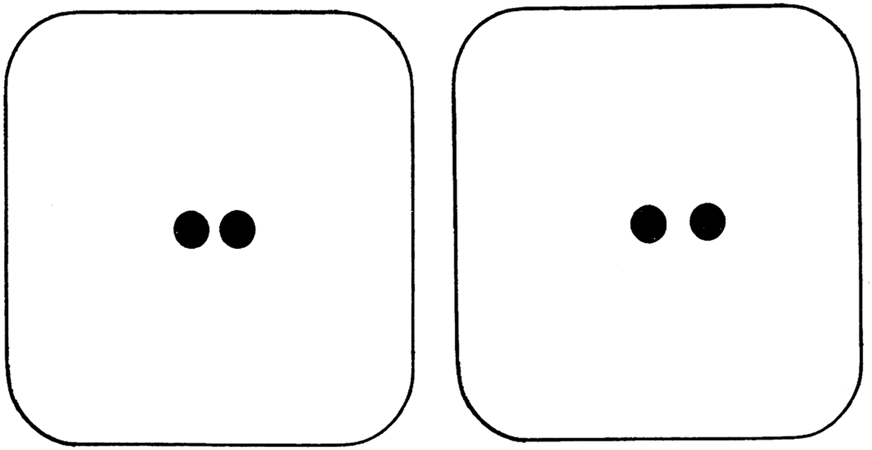
An illusion of depth, physical size, and of visual angle.
On the contrary, in the case of the Ponzo illusion, for example, the apparent visual angles of the two horizontal lines may be the end product of a multifactor process, one in which the pictorially more distant line is assigned a relatively larger physical size (Parks, 2013). But since that seemingly larger line appears to be at the same actual viewing distance as the other (i.e., on the same page), it also seems to subtend a larger visual angle. 1
Furthermore, the Ponzo illusion may be only one specific instance—and a fairly simple one—of a much broader principle: That the illusory difference in visual angles between any two identical and equidistant objects will be greater the more (a) any difference between the unconscious distances involved in size-scaling those two objects exceeds (b) the difference between their consciously experienced distances. So, for example, in the case of the Ponzo illusion, the latter value is an easily exceeded zero and the illusion readily occurs. In the case of Figure 1, the latter value is larger than zero (i.e., some depth is seen), but the illusion occurs, anyway, presumably because that value is exceeded by an even larger concomitant difference between the two unconscious distances (Figure 2). 2
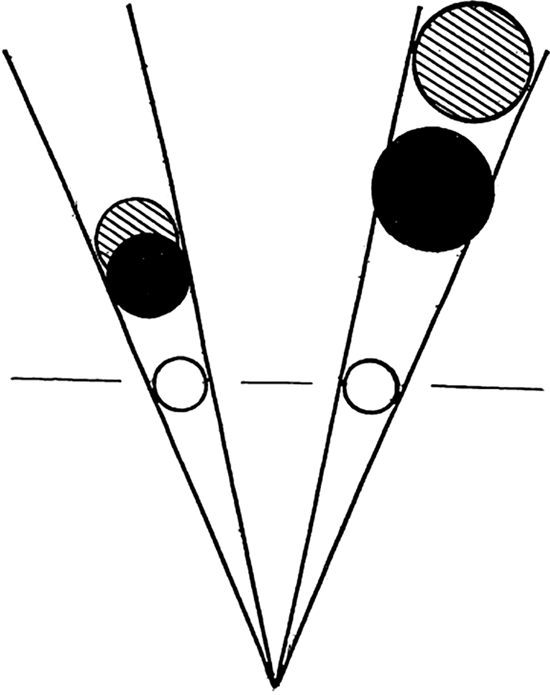
A diagrammatic representation of the optical geometrics that might be involved in viewing Figure 1 (showing, for simplicity, the situation for only one of the two eyes). Open circles represent the stimuli, hatched circles represent the unconscious results of size-scaling, and solid circles represent the final, consciously experienced, effects (not to scale).
But surely, the most dramatic potential consequence of this general principle stems from the possibility that it applies to the appearance of the moon. Specifically, as illustrated in Figure 3, the unconsciously registered distance to the horizon moon—the estimate that is used in its size-scaling—may (mistakenly) be far greater than that for an overhead moon, thus producing a greater apparent physical size. At the same time, however, that moon and overhead moons may consciously appear to be at more or less the same distance (Parks, 2001). As a result, the horizon moon’s apparent visual angle may greatly exceed that of a higher moon. And if so, a striking display: The impression that the newly risen moon not only has grown in itself, but that it also tends to fill the eye.3,4

The moon illusion. Open circles represent the moon, hatched circles represent the unconscious result of size-scaling at each elevation, and solid circles represent the final, consciously experienced, effect.
Footnotes
Declaration of Conflicting Interests
The author(s) declared no potential conflicts of interest with respect to the research, authorship, and/or publication of this article.
Funding
The author(s) received no financial support for the research, authorship, and/or publication of this article.