



Abstract
For over 2000 years, the pictorial line has been recognized as being fundamental to drawing and several other art forms. Yet pictorial lines present intriguing issues, three of which are considered here: lines very rarely exist in the natural world; there is no known part of the brain which “processes” lines; and, paradoxically, we often pay very little attention to the lines themselves, and they have even been viewed as “an imaginary idea”.
Keywords
So crucial is the drawn line to the way we depict the world around us and the world we imagine that it gave rise to the famous proverb attributed to the greatest of ancient Greek painters, Apelles, “Nulla dies sine linea,” “No day without a line” (Pliny the Elder, 1952). But what is a line? For Leonardo da Vinci “The line has in itself neither matter nor substance … ” (Leonardo da Vinci, 1883), whereas for the artist Paul Klee, who considered the subject in depth, the line was famously “a point that is set in motion” (see Hewish, 2015). Yet while acknowledging such philosophical attributes may have theoretical validity, and excluding multiple lines as components of hatching and similar techniques, the pictorial line as a utilitarian entity comprises an edge or an outline in a picture, serving to delineate as well as separate and enclose individual components, and as such is a fundamental feature of almost all graphic works.
This is self-evident in drawings—whether made by the young or the old, and by the least to the most skilled. Thus, lines and outlines feature in drawings made by children as they develop their drawing skills, just as they are seen in the most dazzling drawings of the creative masters. Furthermore, the line has featured throughout the history of mankind’s picture-making.
Separation of areas in a picture is not dependent solely upon the drawn line or outline and can be achieved by means of other modalities, for instance by contiguous areas having different colours, shading, or texture. But in contrast to three-dimensional sculpture, it is evident that the line attains supremacy in the creation of much two-dimensional art. Whether overtly depicted or achieved by these other modalities, however, the use of the line raises various important issues.
First, while at first sight this use of lines in drawings appears straightforward, lines are almost never normally seen around objects or in the natural world. Indeed, according to an unexpected source, Balzac, “Strictly speaking, drawing does not exist! … The line is the method by which man expresses the effect of light upon objects; but there are no lines in nature, where everything is rounded … ” (Balzac, 1899). Lines are thus wholly artificial constructs of the artist; they provide an essential graphic tool for the creation of a drawing, whether made for aesthetic or for technical purposes, and often form the templates from which a subsequent picture emerges, notably as in under-drawings. But what of lines which depict invisible and non-existent yet experienced features? Remarkably eloquent are the outlines of amputees’ non-existent limbs, with lines and outlines providing the only objective evidence of the phantom limb, whether those lines are created by the patient himself (Figure 1) or by an observer (Figure 2) (Schott, 2014). The lines and outlines here are thus a paradox: the precise depiction of something felt but invisible, and experienced but not simply a product of the imagination.

Patient’s Drawings of His Own Phantom Lower Limbs Experienced Following Complete Thoracic Spinal Cord Transection (Source: Avenarius & Gerstenbrand, 1967). Reprinted with permission from Springer Nature.
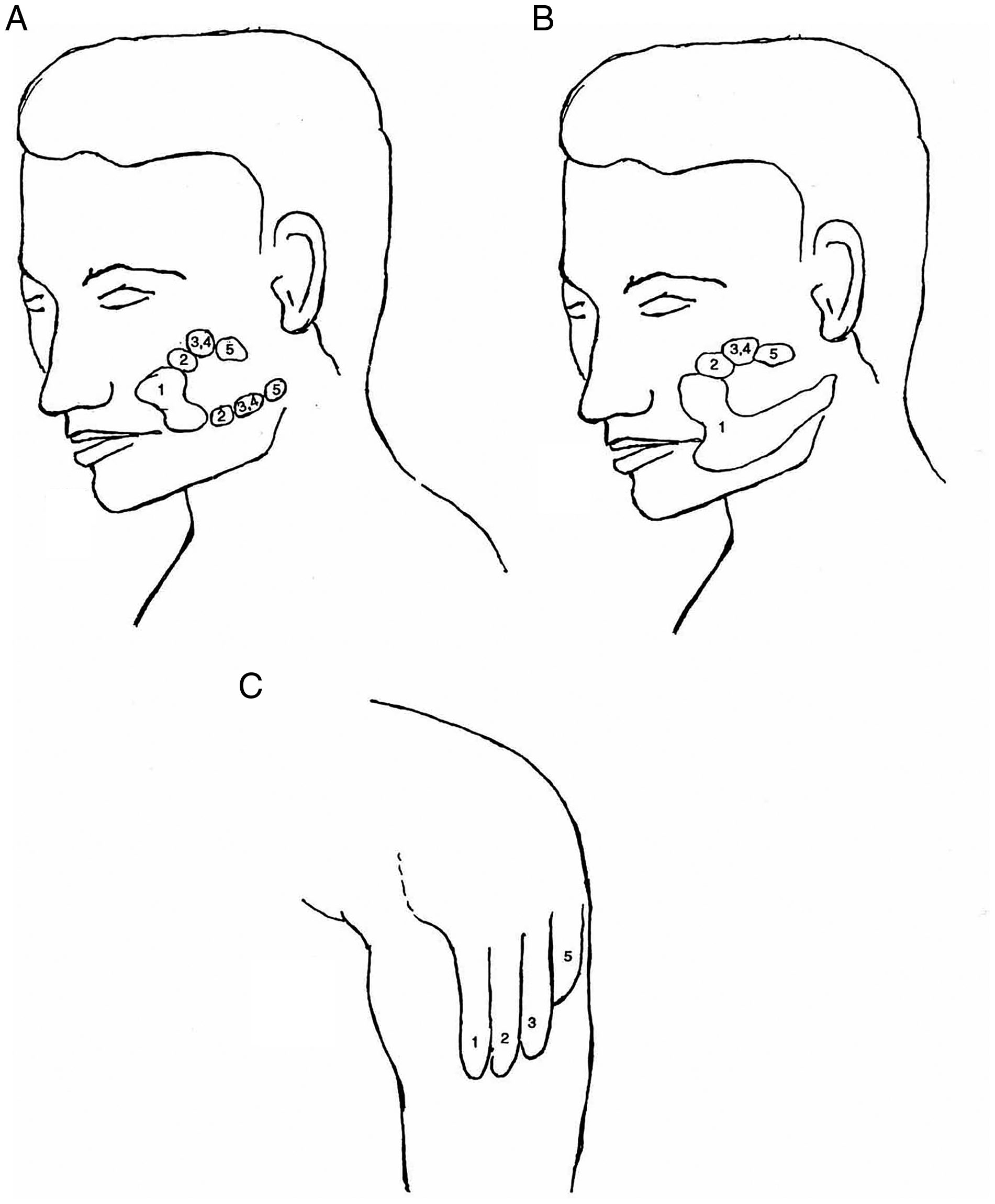
Drawing of Reference Fields in a Patient With a Phantom Left Arm Following Left Arm Amputation. The numbers refer to the digits of where the phantom fingers are felt (Source: Ramachandran & Hirstein, 1998). Reproduced with permission from Oxford University Press.
Second, there appears to be no part of the cerebral cortex which is primarily dedicated to the processing of lines. So how then is the line recognized? This question has been extensively studied and various possibilities discussed (see Sayim & Cavanagh, 2011). It is most unlikely that recognition of lines and hence line drawings is a culturally based acquisition; rather, much evidence points to the likelihood that the visual cortex “processes” lines in the same way that it “processes” edges. Neurons in the primary visual cortex respond to contours and hence edges, and not to uniform areas of an object, and the example of cortical responses to how the brain “sees” a cube demonstrates that “A set of lines that match the cube’s edges would trigger responses in the same pattern, indicating that, on a neural level, line representations are equivalent to the originals they depict” (Sayim & Cavanagh, 2011). Furthermore, functional magnetic resonance imaging experiments indicate that the visual cortex can decode different types of scenes as effectively in line drawings as in colour photographs (Walther et al., 2011). However, how the brain registers which edges are meaningful, in contrast to edges which, for example, relate to shadows and their edges, is unclear from the neuroscientific perspective, and tellingly Sayim and Cavanagh (2011) noted that “Artists appear to have access to a body of knowledge—what makes a characteristic contour—that scientists only dimly understand at present.”
A third issue is that on looking at a drawing, or at a painting on which visible lines are present, one is rarely conscious of the lines themselves. We see the object depicted by means of lines or within the outline, and the picture as a whole, but ignore the scaffolding on which the image is constructed: The line itself seems so fundamental a graphic tool as to be taken for granted and ignored, and so accepted as to be effectively unnoticed by the viewer.
And thus Leonardo da Vinci, challenging how we perceive and then record the world around us, may have been right in theory when he continued that the line “ … may rather be called an imaginary idea than a real object; and this being its nature it occupies no space” (Leonardo da Vinci, 1883) and is thus an illusion. Yet, in reality, without the line, there would be almost nothing in the way of drawing or indeed of much art, or architecture or design.
Footnotes
Declaration of Conflicting Interests
The author(s) declared no potential conflicts of interest with respect to the research, authorship, and/or publication of this article.
Funding
The author(s) received no financial support for the research, authorship, and/or publication of this article.
