



Abstract
This study investigated the relationships between personality and creativity in the perception of two different ambiguous visual illusions. Previous research has suggested that Industriousness and Openness/Intellect (as measured by the Big Five Aspects Scale) are both associated with individual differences in perceptual switching rates for binocular rivalry stimuli. Here, we examined whether these relationships generalise to the Necker Cube and the Spinning Dancer illusions. In the experimental phase of this study, participants viewed these ambiguous figures under both static and dynamic, as well as free-view and fixation, conditions. As predicted, perceptual switching rates were higher: (a) for the static Necker Cube than the Spinning Dancer, and (b) in free-view compared with fixation conditions. In the second phase of the study, personality type and divergent thinking were measured using the Big Five Aspects Scale and the Alternate Uses Task, respectively. Higher creativity/divergent thinking (as measured by the Alternate Uses Task) was found to predict greater switching rates for the static Necker Cube (but not the Spinning Dancer) under both free-view and fixation conditions. These findings suggest that there are differences in the perceptual processing of creative individuals.
Keywords
Introduction
Whilst our visual world is typically perceived to be stable and unambiguous, there are also some notable exceptions. For example, when we are presented with an ambiguous figure (such as the Rabbit–Duck figure), our conscious perception of this stimulus will often switch spontaneously from one possible interpretation to another (i.e., sometimes the Rabbit will be consciously perceived and other times the Duck—see Cao et al., 2018; Wang et al., 2013; Zhang et al., 2017). These perceptual switches occur, even though there is no change in the physical stimulus itself, due to the presence of competing visual evidence (Liu et al., 2012). Such visual illusions therefore challenge the assumption that our eyes are merely passive windows to the world. They also provide important insights into both how our brains actively organise external reality and the conscious and unconscious inferential processes that contribute to visual perception (Ghedini & Corporation, 2016).
Whilst all bistable illusions generate perceptual switches, switching rates appear to be different for each illusion. In the past, the types of visual stimuli used to investigate perceptual switches have varied markedly. Cao et al. (2018) addressed this issue by comparing perceptual switching rates across 11 different visual illusion stimuli. They identified three distinct clusters of visual illusions: (a) Cluster 1—which included the static Necker Cube, the Rolling Wheel, the Moving Plaid, the Face-Vase, as well as Binocular Rivalry illusions; (b) Cluster 2—which included the Spinning Dancer, the Rotating Cylinder, and the Lissajous-figure; and (c) Cluster 3—which included the Translating Diamond, Motion-Induced Blindness, and Biological Motion stimuli. Each of these clusters was distinguished by their different switching rates.
These perceptual switching rates do not, however, depend only on the type of illusion stimulus shown. Whilst they appear to be relatively stable within individuals, there is considerable variability in the switching rates across individuals for the same bistable/ambiguous stimulus (Cao et al., 2018; Wang et al., 2013). In light of Cao et al.’s (2018) findings, it would be beneficial to understand how inferential visual processing varies across individuals for different illusions/stimuli. This study will therefore examine individual differences in the perceptual switching rates for both the static Necker Cube (a Cluster 1 illusion type) and the Spinning Dancer (also known as the Silhouette illusion; a Cluster 2 illusion type).
Theoretical Accounts of Perceptual Switching
Bottom-up accounts of perceptual switching focus on the involuntary neural processes of passive adaptation, inhibition, and recovery (Kornmeier et al., 2009; Leopold & Logothetis, 1999). Different populations of neurons respond to different features in the visual field (e.g., some may fire maximally for vertical lines and others for horizontal lines; Brascamp et al., 2018). When certain populations of neurons are activated, they often simultaneously inhibit neighbouring populations of neurons. However, as the activated neurons begin to fatigue, these inhibited neurons become progressively more active and eventually dominant (Kornmeier & Bach, 2012; Scocchia et al., 2014). According to bottom-up accounts, perceptual switches are due to competing neural circuits in early visual areas cycling through these processes of adaptation, inhibition, and recovery at different times (Brascamp et al., 2018). Consistent with such accounts: (a) Electroencephalogram (EEG) activity in the visual cortex appears to predict which of the two alternatives will be perceived before it reaches conscious awareness (Kornmeier & Bach, 2012; Sterzer et al., 2009); (b) functional magnetic resonance imaging research has shown that blood-oxygen-level changes in area V1 appear to predict perceptual switches during binocular rivalry (Wang et al., 2013); and (c) applying Transcranial magnetic stimulation (TMS) over V1 can induce perceptual switches (Kanai et al., 2010).
By contrast, top-down accounts argue that sensory information is to some degree ambiguous and incomplete and that perceptual switches are mediated by higher level processes like attention, bias, decision making, sociobiological relevance learning, and exploratory behaviour (Atmanspacher & Fach, 2005; Heenan & Troje, 2014; Kornmeier et al., 2009; Long & Toppino, 2004; Scocchia et al., 2014; Strüber & Stadler, 1999; Suzuki & Peterson, 2000). Whilst perceptual switches may be initiated spontaneously, they can be influenced by variables such as mood and instructions (Leopold & Logothetis, 1999; Suzuki & Peterson, 2000), meditation, (Scocchia et al., 2014), intention (Suzuki & Peterson, 2000; Toppino, 2003), attention, exploratory eye movements, gaze-related behaviour (Sterzer et al., 2009), anxiety and inhibition (Heenan & Troje, 2015), and the presentation of a sudden transient flash behind the figure (Kanai et al., 2005). Critically, studies have shown that perceptual switches are rare or absent when the observer is unaware that an alternative interpretation exists (Kornmeier & Bach, 2012; Rock, Gopnik, et al., 1994; Rock, Hall, et al., 1994; Rock & Mitchener, 1992). This is difficult to explain if one assumes that perceptual switches are completely driven by unconscious neuronal processing. Instead, it has been proposed that top-down control is responsible for organising and disambiguating the incoming sensory information.
Although perceptual switches can be modulated voluntarily, they cannot be prevented or supressed completely (Kornmeier & Bach, 2012; Kornmeier et al., 2009; Toppino, 2003). More recently, evidence has emerged that supports both bottom-up and top-down accounts. Researchers have proposed an integrative theory where incoming information from the senses (e.g., neuronal activation and inhibition) is influenced by top-down information (e.g., salience, beliefs and attention; Kornmeier & Bach, 2012; Toppino, 2003). This top-down information allows the constant stream of incoming sensory information to be evaluated more quickly and efficiently. Perception and qualia is hence a dynamic, inferential interaction between these systems and is unique to the individual (Ghedini & Corporation, 2016; Wang et al., 2013).
Explaining Individual Differences in Switching Rates
Researchers have examined the role that biological, cognitive, and personality factors play in the different experiences of bistable illusions observed across individuals. A number of biological factors have been linked to perceptual switching rates, including neurotransmitter activity, grey matter density, handedness, Gamma aminobutyric acid (GABA) and serotonin concentrations (Phillipson & Harris, 1984; Scocchia et al., 2014; Van Loon et al., 2013), and genetics (Jauk et al., 2015; Kanai et al., 2010). For example, lower switching rates have been observed amongst adults with autism (Kornmeier et al., 2017), anxious personality, bipolar disorder and schizophrenia—which has been hypothesised to be due to abnormal GABA, dopamine, and serotoninergic transmission in these individuals (Antinori, Smillie, et al., 2017; Freyberg et al., 2015; Nagamine et al., 2007) and for bipolar; “sticky” interhemispheric switching (Pettigrew & Miller, 1998, p. 2141). In addition, the perceptual bias (see earlier) appears to be weaker in adults with autism (Kornmeier et al., 2017).
Studies on bistable illusions and the visual system have also shown that our knowledge and expectations of the world influence our perception (Kersten & Yuille, 2003; Scocchia et al., 2014, p. 1). For example, humans demonstrate a “facing the viewer” bias when viewing depth-ambiguous stick figure walkers; theorised to be sociobiologically informed by a greater perceived threat for a human walking toward, rather than away, from the viewer (Heenan & Troje, 2014; Schouten et al., 2010). Take another example, where Troje and McAdam (2010) argued that humans have a “viewing from above” bias (due to them being more likely to look down on, as opposed to up at, objects in everyday life; Kornmeier et al., 2009; Liaci et al., 2018; Troje & McAdam, 2010) which was responsible for the Spinning Dancer being seen to rotate clockwise ∼66% of the time. Similarly, it has been reported that when viewing the static Necker Cube, the front side bottom percept (i.e., the “viewing from above” angle) is the preferred initial percept (Kornmeier & Bach, 2004; Kornmeier et al., 2009). However, research has also challenged the Necker Cube’s “Bistability,” arguing that there are instead infinite possible interpretations of the Cube; our strong expectations about the world are theorised to influence the two predominant interpretations (Kersten & Yuille, 2003). Observer attention and exploratory eye movements (Gale & Findlay, 1983; Jackson et al., 2008; Kornmeier & Bach, 2012; Wallace et al., 1976), as well as the emotion and the salience of the image features (Scocchia et al., 2014), can also impact perceptual switching rates, and could therefore also contribute to the observed differences in switching rates between individuals.
The majority of research exploring individual differences has focused on perceptual switches as potential clinical markers for mental health disorders. Comparatively little research has examined the generalisability of these clinical findings to the rest of the population. Earlier studies by Frederiksen and Guilford (1938) found no relationship between perceptual switches and the personality traits of Impulsivity and Extraversion/Introversion. Recently, Antinori, Smillie, et al. (2017) were interested in the relationship between personality and perceptual switches in a nonclinical sample. They found that individuals who scored highly in Industriousness (associated with high levels of self-discipline, productivity, and work ethic as measured by the Big Five Aspects Scale [BFAS]) reported lower switching rates for a binocular rivalry stimulus (significant relationships were not found with any of the other Big 5 traits). The authors speculated that there was an inverse relationship between Industriousness and cognitive disorganisation, which facilitated the loosening of conceptual boundaries, inclusive perception, and connection of distantly related thoughts (Fink et al., 2013). Whilst they reported null results for Openness/Intellect (associated with being open to experience, curious and imaginative, as measured by the BFAS), in another study Antinori, Carter, et al. (2017) found that individuals high in Openness/Intellect reported higher rates of mixed percepts when viewing binocular rivalry stimuli (i.e., a mix of the left and right eye views) and shorter mean percept durations. This finding was taken as evidence of low-level “inclusive perception” and neuronal instability that could be linked to higher order personality traits, such as cognitive flexibility and creativity (Antinori, Carter, et al., 2017, p. 21). It is not yet known if these findings generalise to other types of visual illusion or measures of creativity, and if the relationship between Openness/Intellect and perception is specific to mixed percepts, or perceptual switching in general.
Creativity, Cognitive Flexibility, and Perceptual Switching
The concept of creativity is often described as the act of creating something that is both novel (i.e., original, unexpected) and appropriate (i.e., useful, valuable, adaptive concerning task constraints; Dietrich, 2004; Takeuchi & Jung, 2019; Torrance, 1987). The construct of cognitive flexibility and the ability to overcome “functional fixedness” are fundamental characteristics of creative individuals, who are skilled in the ability to consider different perspectives and generate alternative solutions to problems (Laukkonen & Tangen, 2017; Schilling, 2005). Whilst openness/intellect and creativity are highly correlated (and often used interchangeably), only a handful of studies have investigated the link between measures of creativity, cognitive flexibility, and perceptual switching (B. O. Bergum & Bergum, 1979; J. E. Bergum & Bergum, 1979; Best et al., 2015; Chamberlain et al., 2018; W. Li et al., 2015). Klintman (1984) first reported a relationship between performance on the alternate use task (AUT) and perceptual switching rates for the static Necker Cube. Similarly, Wiseman et al. (2011) investigated the relationship between divergent thinking (as measured by the AUT) and self-reported “ease” of figure reversal with the Duck–Rabbit static bistable visual illusion. Both found a significant positive relationship between self-reported “ease” and scores on the AUT. Later, Doherty and Mair (2012) investigated the link between perceptual switching rates, viewing behaviour, creativity, and academic preference. They employed a pattern meaning task as a measure of creativity and examined switching rates for three different visual stimuli: (a) the static Necker Cube, (b) the Rabbit–Duck stimulus, and (c) the Face-Vase stimulus. They reported a positive relationship between performance on the pattern meaning task and switching rates for the static Necker Cube. This positive relationship between divergent thinking and perceptual switches for the Necker Cube was later reported by Best et al. (2015). More recently, Chamberlain et al. (2018) investigated the relationship between perceptual flexibility and artistic skill. Their findings demonstrated that visual arts students experienced more perceptual switches when viewing a bistable structure-from-motion illusion (in passive and switch instruction conditions) than nonvisual arts students.
Despite studies on this topic being rare, anecdotally, the Spinning Dancer illusion has achieved online popularity as a claimed test of creativity—with individuals being deemed to be more creative (“right-brained”) or more analytical (“left-brained”) depending on the direction they are biased to see the dancer as spinning. Whilst this is a largely discredited and simplistic understanding of how creativity presents neurologically, independent findings have associated creative ability with increased reconfiguration of dynamic functional connectivity states and cognitive flexibility (J. Li et al., 2017). Furthermore, creativity has been associated with increased dopaminergic activity, which previously has been found to influence perceptual switches (Zabelina et al., 2016). These findings suggest that cognitive flexibility and creative ideation/ability could be related to perceptual switching rates in bistable illusion stimuli. Testing this hypothesis (as we do here) would help us to answer the question “do creative people really see the world differently?”
The Current Study
This study was aimed at exploring the extent to which individual differences in personality and divergent thinking are related to differences in perceptual switching rates. The study had two main phases. Phase 1 consisted of a perceptual experiment which measured each participant’s perceptual switching rates to four different visual stimuli (i.e., static and dynamic versions of the Necker Cube and Spinning Dancer) under two different viewing conditions (Free-view and fixation). Then, in Phase 2, we obtained questionnaire and performance-based measures of their personality and divergent thinking.
Phase 1: Perceptual Experiment
In this experiment, we measured the perceptual switching rates for the Necker Cube and the Spinning Dancer (see Figure 1). The static Necker Cube is inherently ambiguous (e.g., based on the available luminance, contour, occlusion, border, texture, and depth cues in the stimulus), where perceptual switches occur when one assigns or reassigns a front and a back face to the perceived three-dimensional cube (Kornmeier & Bach, 2004). By contrast, the Spinning Dancer is composed of multiple cueing surfaces (head, face, hair legs, toes, hands, fingers, and even the shadow—Liu et al., 2012). Despite this, she can still be readily perceived to be spinning to the left or the right. Psychophysiological and behavioural research suggests that the perceptual experience of the Spinning Dancer involves strong “top-down” influences (Cao et al., 2018; Ghedini & Corporation, 2016; Troje & Westhoff, 2006). Eye-tracking studies also suggest that some areas of the dancer’s body act as “hot spots” for perceptual switches (Cao et al., 2018; Jackson et al., 2008). Differences in visual exploratory behaviour with the Spinning Dancer might also explain the individual differences in perceptual switching rates, as those individuals who engage in rapid visual exploration of the stimulus may be more likely to stumble onto these hot spots and experience a “switch” (Kornmeier & Bach, 2004).
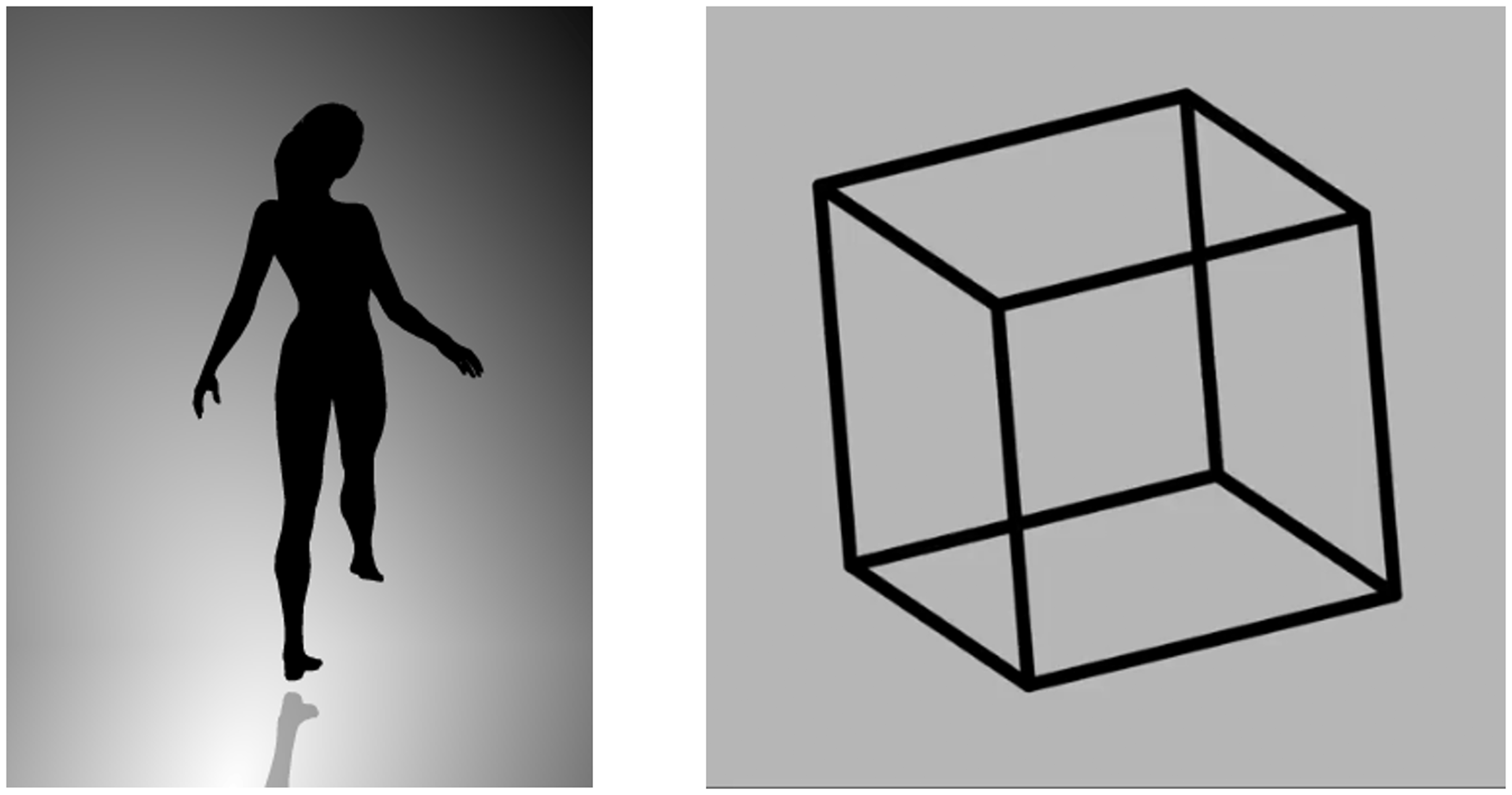
A single frame of the spinning Dancer and Necker Cube ambiguous figures.
In their traditional forms, the static Necker Cube produces 12.88 switches per minute on average (Nakatani & Van Leeuwen, 2005), whereas the Spinning Dancer averages 3.68 switches per minute (Troje & McAdam, 2010). We expected to find similar switching rates for these versions of the stimuli in this study. However, in this study, we also examined the switching rates to a dynamic version of the Necker Cube and a static version of the Spinning Dancer. The aim with these modified stimuli was to create a Necker Cube stimulus which was more similar to the Spinning Dancer (i.e., with structure from motion information), and a static version of the Spinning Dancer which would be more similar to the static Necker Cube.
All four of these visual illusion stimuli were examined under both free-view and fixation conditions. Higher perceptual switching rates are generally found under free-view conditions (i.e., when observer eye movements are allowed). However, eye-tracking studies have yet to identify predictable patterns between eye movements and switches (Einhauser et al., 2004, 2008; Kornmeier & Bach, 2004; Van Dam & Van Ee, 2006). Whilst eye movements may facilitate perceptual switches, they are not essential for them to occur and vary greatly between individuals (Jackson et al., 2008; Liu et al., 2012). It is, however, expected that individual differences in perceptual switching rates will be greater under free viewing conditions, where participants can engage in independent visual exploratory behaviour.
Phase 2: Creativity and Personality Assessment
The second phase of this study investigated proposed relationships between personality, creativity, and perceptual switching rates for the traditional versions of both visual illusion stimuli. Expanding on the recent work by Antinori, Carter, et al. (2017) and Antinori, Smillie, et al. (2017), our study examined whether these relationships generalise across (a) illusions belonging to two different clusters (as identified by Cao et al., 2018 and confirmed in Phase 1) and (b) both of the free-view and fixation conditions. This study used the personality variables of Openness/Intellect and Industriousness employed by Antinori, Carter, et al. (2017) and Antinori, Smillie, et al. (2017). Extending on the past research on the role of creativity, we also included the AUT, a commonly used, performance-based measure of creativity and divergent thinking. The AUT requires the participant to practice conceptual restructuring by imagining different uses, viewpoints, and constituent elements of a simple object. It thus appears conceptually similar to the perceptual restructuring needed to view multiple interpretations of an ambiguous figure/bistable illusion.
We hypothesise that individuals who are skilled divergent thinkers (as indexed by their performance on the AUT) will report more perceptual switches to both the static Necker Cube and the Spinning Dancer (Doherty & Mair, 2012; Laukkonen & Tangen, 2017; Wiseman et al., 2011). As Antinori, Carter, et al. (2017) have previously reported that Openness/Intellect influences the perception of binocular rivalry stimuli, we will examine whether this also alters the switching rates for the traditional versions of our illusion stimuli. We will also examine whether the previously reported negative relationship between Industriousness and switching rates for binocular rivalry stimuli generalises to our illusion stimuli as well. As these personality and creativity factors are expected to influence switching rates through the person’s exploratory visual behaviour, we predict that any relationships involving them will become nonsignificant when exploratory eye movements are minimised under the fixation conditions.
Methods
Participants
We recruited 82 female and 37 male participants (N = 119), including industry professionals as well as students from the University of Wollongong and the University of New South Wales (who received course credits). Participants ranged in age from 17 to 56 years (M = 23.21, standard error [SD] = 6.32). Participants indicated English as their first language and had normal or corrected-to-normal vision. This sample provided 80% power to detect an effect size of r ∼ .25, which is the average in personality psychology (Fraley & Marks, 2007). Note this sample size also either surpassed or matched the sample sizes used in the related past studies (e.g., Antinori, Carter, et al., 2017; Laukkonen & Tangen, 2017). The study was approved by both the University of Wollongong and University of New South Wales Human Research Ethics Committees.
Design
All participants in this study were exposed to the same conditions and measures. Personality trait type and divergent thinking were measured using the BFAS and the AUT, respectively. In the experimental phase of the study, participants were exposed to the different visual illusion stimuli and their perceptual switching rates for each stimulus condition were recorded. This experiment had a 2 (Viewing Type: Free-view or Fixation) by 2 (Motion Type: Static or Dynamic) by 2 (Illusion type: Necker Cube or Dancer) within-subjects design. The visual illusion stimuli were presented as either stationary or rotating about the vertical axis. Participants viewed the static and dynamic versions of these stimuli under both free-view viewing and fixation conditions. Each condition was repeated twice. On each trial, a single dependent variable was measured: The number of perceptual switches reported when viewing the illusion stimulus.
Apparatus and Materials
Participants completed the BFAS and AUT using the keyboard of an Apple MacBook computer, with their responses being recorded using Qualtrics. When viewing the illusion stimuli, participants were seated approximately 57 cm from the monitor of this computer. The Necker Cube stimuli subtended a visual area 7.6° high by 7.6° wide and the Dancer stimuli subtended a visual area 7.6° high by 5.02° wide. These stimuli were presented via custom MATLAB program (making use of Psychophysics Toolbox; Brainard, 1997; Pelli, 1997) and perceptual switches were recorded by the participant pressing keys on the computer’s keyboard.
The Big Five Aspects Scales
De Young et al. (2007) created a 100-item measure based on the Five Factor Model (McCrae & Costa, 1987). Each of the five personality factors (Extraversion, Agreeableness, Conscientiousness, Neuroticism, and Openness/Intellect) are assessed, in addition to their two second-level facets. Participants indicated their response to each item on a 5-point rating scale ranging from 1 (strongly disagree) through to 5 (strongly agree). Cronbach’s α for the total 100 items assessing trait domains and their components was α = .86. Individually, Cronbach’s α was .80 and .83 for the Openness/Intellect and Industriousness items, respectively. Only one subfactor of Conscientiousness (Industriousness) and the factor Openness/Intellect were included from the B FAS in our analyses as independent variables.
The Alternate Use Task
The AUT requires participants to generate as many uses as possible for three common objects (a paperclip, newspaper, and brick) over a fixed time of 3 minutes. Participants were instructed to think of as many novel and useful uses for these objects. They were informed that uses deemed to be expected (e.g., using a paperclip to hold paper together) or unrealistic (e.g., using a paperclip to fly to the moon) would not be eligible. Scoring was based on fluency: The total number of alternative uses listed per object. Two raters independently scored the task across participants with high reliability (interrater reliability was .86, intraclass correlation was .96).
Bistable Illusion Stimuli
Static and dynamic versions of the Necker Cube and Dancer stimuli were each presented continuously for 30 seconds. This time frame was chosen in line with similar studies (Wiseman et al., 2011). The dynamic Necker Cube contained 66 frames and completed 0.6 rotations over 1 second (obtained from https://michaelbach.de/ot/sze-Necker/). The Spinning Dancer contained 34 frames and completed 1 full rotation over 1 second (obtained from http://www.procreo.jp/labo/silhouette.swf). During static conditions, only a single frame of each stimulus was presented for the entire duration of each 30 second trial.
Procedure
After their initial briefing, participants completed both the BFAS and AUT online. They then moved onto the experimental component of the study. When viewing the visual illusion stimuli, participants were instructed to continuously report what they were experiencing via their key pressing behaviour. Each trial started by pressing the “S” key and lasted 30 seconds. During the trial, the “A” key was pressed if (a) the static Necker Cube appeared to have its top face forward or (b) if the static Dancer appeared to be facing forward or (c) the dynamic versions of these stimuli appeared to be spinning to the left (i.e., clockwise). By contrast, the “D” key was to be pressed if (a) the static Necker Cube appeared to have its lower face forward or (b) if the static Dancer appeared to have her back facing the participant or (c) the dynamic versions of these stimuli appeared to be spinning to the right (i.e., counter clockwise). Experimental testing began after participants had completed several practice trials. Participants each completed two free-view blocks and two fixation blocks. Each block consisted of four trials: one static and dynamic presentation of the Necker Cube and one static and dynamic presentation of the Dancer (the order of trial presentation was randomised.). Half of the participants experienced these blocks in the following order: fixation, free-view, fixation, and free-view. The remaining participants experienced these blocks in the opposite order. During the free-view trials, participants were told (a) to refrain from using any visual strategies (such as blinking, flickering eyes, and moving their head) and (b) that they were free to look wherever they like within the stimulus. During fixation trials, participants were instructed to fixate and follow either the bottom most corner of the Necker Cube or the outstretched toe of the Dancer.
Results
Effect of Illusion Type, Motion Type, and Viewing Type on Switching Rates
We conducted a within-subjects planned contrast analysis to investigate the effects of illusion type (Necker Cube vs. Dancer), motion type (Static vs. Dynamic), and viewing type (Free-view vs. Fixation) on the mean perceptual switching rates (see Figure 2). Overall, switching rates were found to be significantly higher: (a) for the Necker Cube, compared with the Dancer, illusion stimuli, F(1,118) = 271.740, p < .05; (b) for static, compared with dynamic, versions of these stimuli, F(1,118) = 53.139, p < .05; and (c) under free-view, compared with fixation, conditions F(1,118) = 162.372, p < .05.

Mean switches per minute for the two illusion types (Cube and Dancer) across the different movement type (Static and Dynamic) and viewing type (Free-View and Fixation) conditions. Error bars represent the standard error of the mean.

Relationship Between AUT Performance and the Number Switches per Minute for the Static Necker Cube (Free-View Condition). AUT = Alternate Uses Task.
According to Cao et al. (2018), the static Necker Cube and the Spinning Dancer belong to distinctly different illusion clusters. Consistent with these previous findings, free-viewing the static Necker Cube (M = 11.12 switches/minute, SD = 6.94 switches/minute) generated significantly higher rates of perceptual switching than free-viewing the Spinning Dancer (M = 1.33 switches/minute, SD = 1.64 switches/minute), t(1,119) = 14.61, p < .05. We also examined whether modifying our traditional (ambiguous/bistable) illusion stimuli, by adding or subtracting structure-from-motion information, rendered them more similar to stimuli in the other cluster. We conducted a correlational analysis to examine the relationships between total switches for the four different free-view conditions (see Table 1). We did find a significant positive correlation between the switching rates for the static Cube and the static Dancer. Follow-up t tests further examined the similarities/differences in their switching rates. However, contrary to the aforementioned proposal, we found that participants still reported: (a) significantly more switches for the static Necker Cube (M = 11.12, SD = 6.94) than for the static Dancer (M = 3.32, SD = 3.89), t(119) = 12.90, p < .001, d = 1.18, and (b) significantly fewer switches for the Spinning Dancer (M = 1.33, SD = 1.64) than for the dynamic Necker Cube (M = 7.71, SD = 7.28), t(119) = 9.52, p < .001, d = 0.8.
Spearman Rho’s Correlation Coefficients of Switch Rates Under Free-View Conditions.
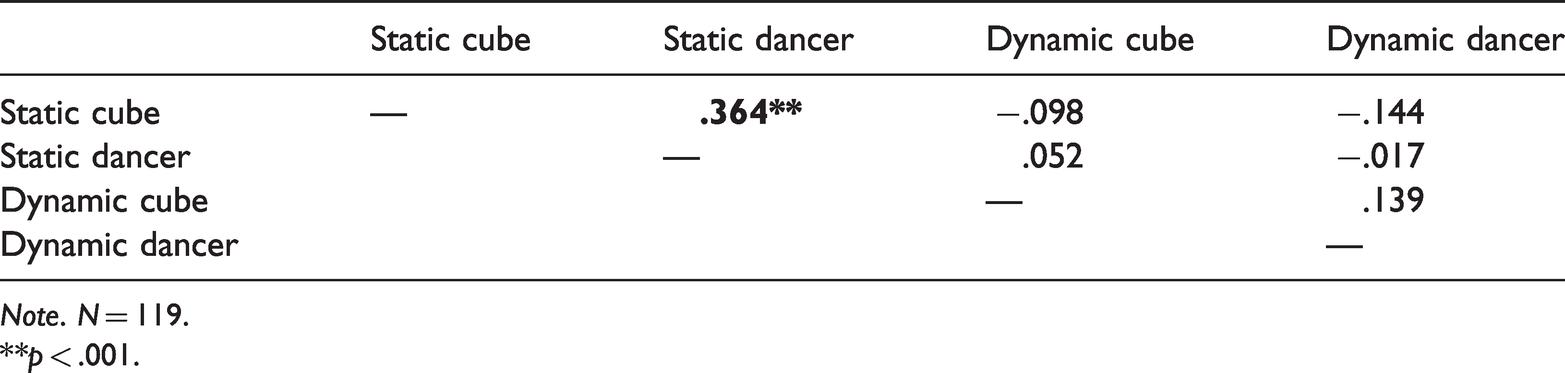
Note. N = 119.
**p < .001.
Spearman’s Rho Correlation Coefficients of the Static Cube Switch Rates Under Free-View Conditions.
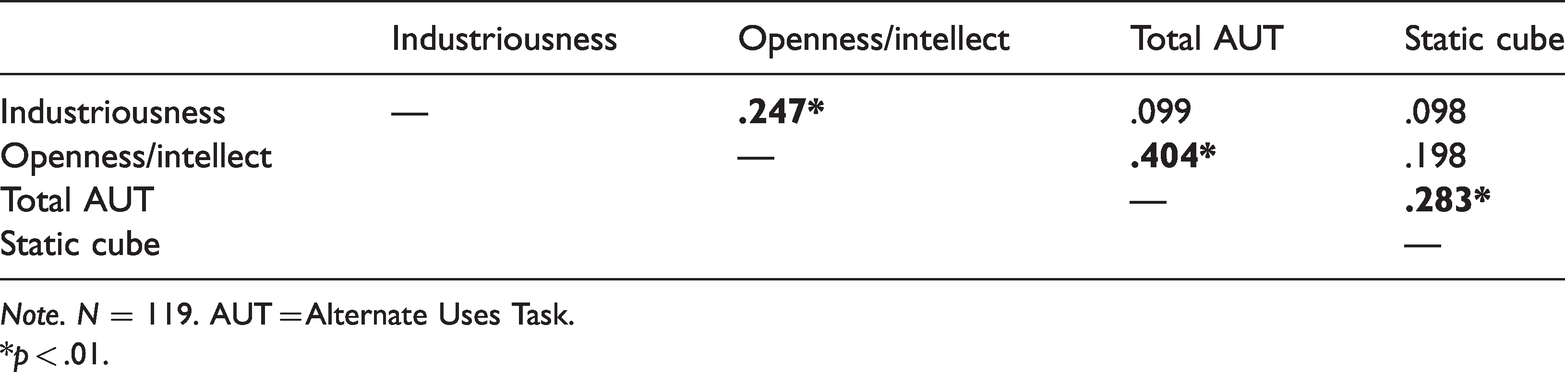
Note. N = 119. AUT = Alternate Uses Task.
*p < .01.
Under free-view conditions, the static Necker Cube and the Spinning Dancer displayed the greatest mean differences in their switching rates. Thus, in “AUT Performance, Industriousness, Openness/Intellect and Perceptual Switching Rates for the Static Necker Cube (Free-View)” and “AUT Performance, Industriousness, Openness/Intellect and Perceptual Switching Rates for the Spinning Dancer (Free-View)” sections, we will examine whether the switching rates for these two traditional illusion stimuli can be predicted by performance on the AUT, Industriousness or Openness/Intellect. We chose to focus initially on switching data for only free-view conditions in “AUT Performance, Industriousness, Openness/Intellect and Perceptual Switching Rates for the Static Necker Cube (Free-View)” and “AUT Performance, Industriousness, Openness/Intellect and Perceptual Switching Rates for the Spinning Dancer (Free-View)” sections (as bistable illusion stimuli are most often studied under these conditions and they are most akin to viewing in the real world).
AUT Performance, Industriousness, Openness/Intellect and Perceptual Switching Rates for the Static Necker Cube (Free-View)
We first tested the hypothesis that individual differences in the switching rates for the static Necker Cube would be significantly correlated with one or more of the following: (a) AUT performance, (b) Industriousness, and (c) Openness/Intellect (O/I). As the data were nonnormal, Spearman’s Rho correlations were used (note that significance levels were Bonferroni corrected as these were planned tests). The relationship between the Total AUT and the switching rates for the Static Cube was found to be significant (rs = .283, p = .002, two-tailed, N = 119; significance was based on corrected p critical of 0.01) (see Figure 3). However, neither of the personality measures were found to be significantly correlated with the switching rates for the static Necker Cube.
AUT Performance, Industriousness, Openness/Intellect and Perceptual Switching Rates for the Spinning Dancer (Free-View)
We next tested the hypothesis that individual differences in the switching rates for the Spinning Dancer would be correlated with one or more of the following: (a) AUT performance, (b) Industriousness; and (c) Openness/Intellect (O/I). As the data were nonnormal, Spearman’s Rho was used and all significance levels were Bonferroni corrected as these were planned tests. However, we did not find significant relationships between any of these factors and the switching rates for the Spinning Dancer (against a corrected p critical of.01).
Role of Eye Movements in These Individual Differences
It was hypothesised that any significant relationships would become nonsignificant when exploratory eye movements were controlled for during the fixation conditions. To assess this hypothesis, an additional Spearman’s Rho correlation was conducted. Contrary to our expectations, the relationship between AUT performance and switching rates for the static Necker Cube remained significant under fixation conditions, rs = .199, p = .03, two-tailed, N = 119 (see Figure 4).
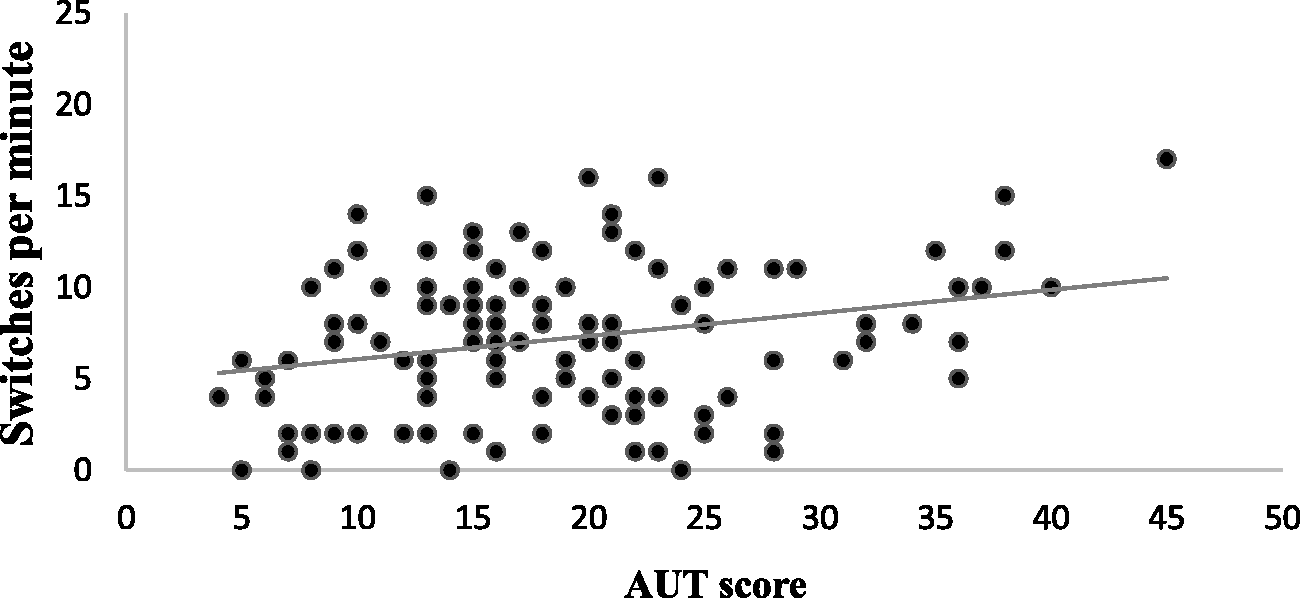
The relationship between performance on the AUT and the number switches per minute for the Static Necker Cube (Fixation Condition). AUT = Alternate Uses Task.
The Big Five and Perceptual Switching Rates for the Dancer and Cube (Free-View)
An exploratory analysis of the relationships between the Big 5 factor personality traits and the four different visual illusion stimuli (free-view), as well as the AUT, was conducted and shown in Table 3. As the data were nonnormal, Spearman’s Rho was used. The relationships between the Dynamic Dancer and Neuroticism (rs = .265, p = .004, two-tailed, N = 119) and the Dynamic Dancer and Openness/Intellect (rs = −.231, p = .012, two-tailed, N = 119) were both found to be significant (assuming an uncorrected p critical of .05). Furthermore, the relationship between the Static Cube and Extraversion (rs = .198, p = .031, two-tailed, N = 119) and Static Cube and Openness/Intellect (rs = .198, p = .031, two-tailed, N = 119) were also significant (assuming an uncorrected p critical of .05). As these analyses were exploratory (no correction was made for multiple comparisons), they would, however, need to be confirmed by subsequent studies. For more information, please refer to study data provided in Supplemental Material: Divergent Thinking Influences the Perception of Ambiguous Visual Illusions.
Spearman’s Rho Correlation Coefficients of the Spinning Dancer Switch Rates Under Free-View Conditions.
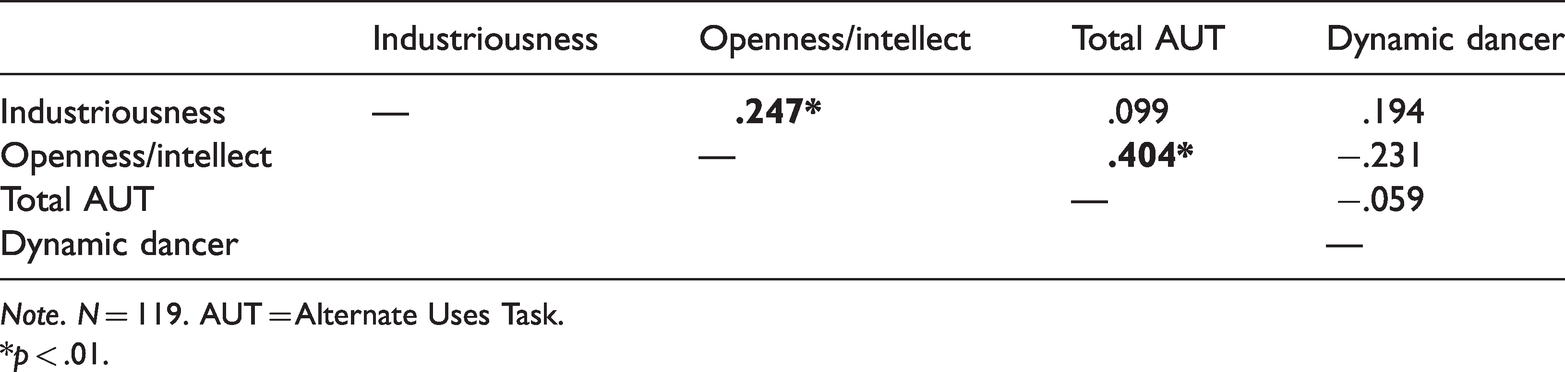
Note. N = 119. AUT = Alternate Uses Task.
*p < .01.
Spearman’s Rho Correlations Between Big Five factors, AUT, and Ambiguous Figure Reversals.
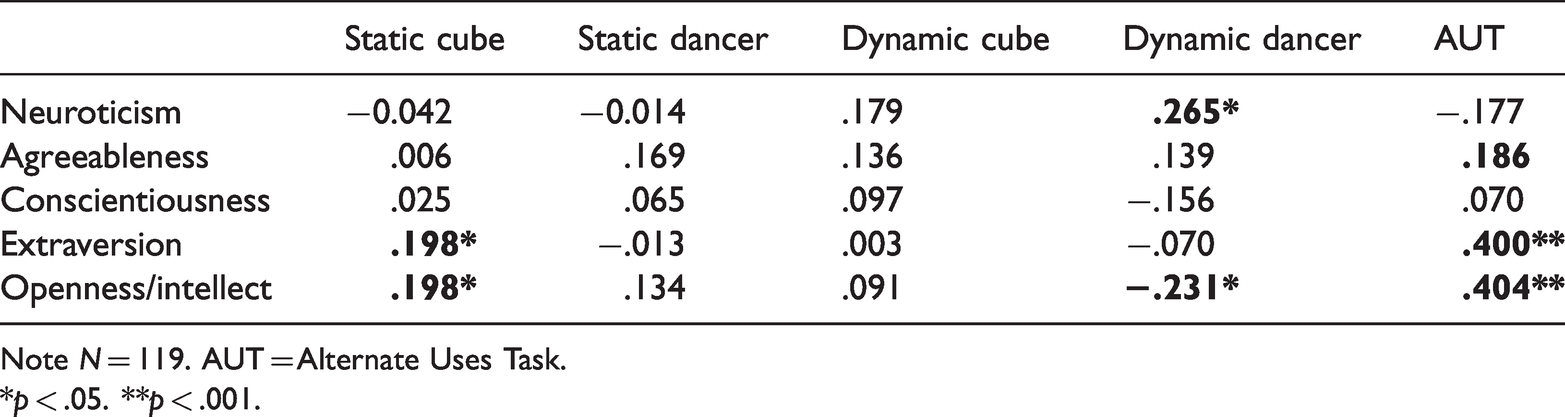
Note N = 119. AUT = Alternate Uses Task.
*p < .05. **p < .001.
Discussion
Despite decades of research, little is known about why there are such large individual differences in the experience of ambiguous visual figures. Progress has been slow because it has been challenging to compare the effects of different illusion stimuli that are visually so dissimilar. However, recent research by Cao et al. (2018) found that visual illusions fall into three distinct clusters based on their switching rates. The first phase of this study examined perceptual switching rates to different ambiguous visual illusions under both free-view and fixation conditions. Consistent with Cao et al. (2018), we found that the switching rates for the static Necker cube (a Cluster 1 illusion stimulus) and the Spinning Dancer (a Cluster 2 illusion stimulus) were very different. In fact, the Necker Cube was found to generate significantly more perceptual switches than the Dancer across all the conditions we tested (i.e., static and dynamic versions, free-view and fixation). Our switching rates for the Spinning Dancer were somewhat lower than those reported previously by Troje (2010; possibly because our trials lasted for 30 seconds as opposed to his 4 minutes). The Spinning Dancer and the dynamic Necker Cube were both found to produce lower switching rates than their static counterparts, suggesting they were less ambiguous than the static Dancer and the static Necker Cube (Bernal et al., 2014; Gilaie-Dotan et al., 2013; Hashimoto et al., 2006). However, when their structure-from-motion information was removed, this did not appear to result in categorical changes (e.g., the switching rates for the dynamic Necker Cube remained more similar to those for the static Necker Cube than for the Spinning Dancer). Finally, and as expected, the fixation conditions were also found to reduce the switching rates for our stimuli. Together, these findings echo Cao et al.’s (2018) conclusions that: (a) different bistable visual stimuli are unlikely to be controlled by a single mechanism; and (b) a person experiencing faster switching in response to one bistable illusion, may not necessarily experience faster switching for another bistable illusion. They are also consistent with past findings that the different ambiguous visual figures appear to employ different brain regions and mechanistic processes (Antinori, Carter, et al., 2017; Kanai et al., 2010; Wang et al., 2013).
The second phase of our study examined: (a) whether personality or creativity could explain individual differences in the switching rates for the static Necker cube and the Spinning Dancer and (assuming they did) (b) if these relationships persisted for fixation conditions. Contrary to findings from past studies on binocular rivalry stimuli, Industriousness did not significantly predict switching rates for the Spinning Dancer or the static Necker cube under either viewing condition. Contrary to predictions made based on Antinori, Carter, et al. (2017), Openness/Intellect was not found to predict the perceptual switching rates for any of the conditions tested. This suggests that relationships between Industriousness, Openness/Intellect, and perception may be specific to the experience of binocular rivalry and mixed percepts (Antinori, Smillie, et al., 2017). However, we did find significant positive correlations between performance on the AUT and switching rates for the static Necker Cube under both free-view and fixation conditions. These findings will be discussed in more detail later.
Perceptual Switching Rates and Personality Variables
Antinori, Smillie, et al. (2017) previously reported a significant positive relationship between Industriousness and mean percept duration during a binocular rivalry stimulus. As the static Necker Cube belongs to the same cluster as Antinori et al.’s binocular rivalry stimulus (according to Cao et al., 2018), we had expected this relationship to generalise to the Necker Cube as well. However, Industriousness was not found to significantly predict the switching rates for the traditional (static) version of this visual illusion. This null result suggests that (a) binocular rivalry and the static Necker Cube may be not as similar (in terms of their switching rates) as the Cao et al. study suggests or (b) the reported relationship between Industriousness and switching rates is either not robust or does not generalise to other visual illusion stimuli in the same cluster.
In an additional exploratory analysis of the role of personality variables in perceptual switches (which looked at all of the Big Five Factors), we found some evidence of relationships between (a) Extraversion and switches for the static Necker Cube (positive), (b) Openness/Intellect and switches for the static Necker Cube (positive), (c) Neuroticism and switches for the Dynamic Dancer (positive), and (d) Openness/Intellect and switches for the Dynamic Dancer (negative). However, caution should be taken when interpreting these results—as this exploratory analysis did not control for multiple comparisons, 1 and some of relationships appear to be different to the findings reported by previous studies (e.g., Antinori, Smillie & Carter, 2017; Frederiksen & Guilford, 1934). Thus, future studies, with greater power, would be required to confirm these relationships between perceptual switching rates and personality variables.
The Relationship Between Bistable Illusion Switch Rate and Divergent Thinking
We found that Klintman (1984) observed relationship between performance on the AUT and switching rates for the static Necker Cube not only replicated during our free-view conditions but also persisted during our fixation conditions. These results would seem to support previous claims (e.g., Doherty & Mair, 2012) that creativity is linked to faster perceptual restructuring. Studies have also shown that skilled divergent thinkers exhibit diminished executive control, a broader attentional field and increased exploratory eye behaviours (Beaty et al., 2016; Chamberlain et al., 2018; Ogawa et al., 2018; Walcher et al., 2017). So it is possible that in the fixation conditions of this study, these thinkers were less able to filter out information from other regions of the stimulus—explaining why the relationship between AUT performance and switching rates persisted when eye movements were minimised (Carson et al., 2003; Radel et al., 2015). Atmanspacher and Fach (2005) describe a basic feature of creativity to be the “aha” moment; a phenomena by which an idea or mental category is formed and reaches consciousness. Studying the moment when a bistable/ambiguous illusion stabilises into one interpretation might give us some insights into the creative aha moment (i.e., where a creative solution transfers into consciousness and suddenly reveals itself). This therefore needs to be explored in future studies.
Unexpectedly, AUT performance did not predict switching rates for the Spinning Dancer. Currently, there is no strong theoretical reason to explain why performance on the AUT was related to perceptions of the static Necker Cube but not of the Spinning Dancer. One possible explanation is that the static Spinning Dancer illusion was limited by a “floor effect,” whereby the rate of perceptual reversals was a priori very low; minimising individual differences. Another possible explanation might be that the Spinning Dancer was less ambiguous (had fewer visual cue conflicts) than the static Necker Cube (as is demonstrated by the Spinning Dancer generating fewer perceptual switches). This might have reduced the need for exploratory eye movements to “solve” the Spinning Dancer (relative to other more ambiguous static visual illusions; although it is noted that eye movements were not required for the relationship found with the Necker Cube). Under this framework, divergent thinkers may be deeply engaged by ambiguous conflict situations that are conceptualised as problems to be solved and less engaged by situations with reduced conflict (Laukkonen & Tangen, 2017). Whilst it is too early to make any definitive claims that this relationship is indicative of neural instability or any structural/functional differences in the visual regions (associated with static visual processing), it does provide promising headway for future research.
The (current and past) Necker Cube results suggest that there might similar processes driving both creative conceptual flexibility (as measured by divergent thinking tasks) and perceptual flexibility (as measured by perceptual switching rates). However, these studies have only investigated divergent thinking (exploring multiple answers and options). Another central component to creativity is convergent thinking (converging and selecting one, single answer), which is known to recruit different brain regions to divergent thinking (Arden et al., 2010; Boot et al., 2017). It is therefore suggested that future studies should include both divergent and convergent thinking measures to understand how they may individually relate to perceptual processing.
Tentative Theory for the Relationship Between AUT and Static Ambiguous Illusions
Whilst we cannot unequivocally pinpoint the shared mechanism binding AUT and static ambiguous illusions, we offer a tentative explanation (to be investigated in further research). A core component of creative cognition is the ability to flexibly combine remotely associated concepts in order to form novel and useful solutions. Mednick (1962) first proposed that this ability is reflected in the widespread activation of remotely associated concepts in semantic memory marked by a “flatter associative hierarchy.” Research suggests that individual differences in creative ability might be explained by variation in the structural hierarchy of object representations and fluid retrieval and activation of these disparate regions (Beaty et al., 2016; Friis-Olivarius et al., 2017). Recently, neuroimaging research has shown that creative individuals have strengthened white matter tracts (Takeuchi et al., 2010). These strengthened tracks may represent flatter associative hierarchies; activating distantly connected object specific regions and increasing connectivity across the primary visual cortex (V1; Genç, 2011; Song et al., 2013). If so, when viewing ambiguous figures/bistable illusions, it is speculated that creative individuals may have more widespread activation of early visual regions, in turn activating a wider array of object specific regions at a higher level, resulting in a wider variety of possible interpretations. This tentative explanation—that the relationship between perceptual switches and divergent thinking may be driven by early visual cortex connectivity—could be investigated with the use of functional magnetic resonance imaging and EEG (to see whether differences in neural activity for early visual regions underlie creative capacities).
Conclusions
Human capacity to generate novel and useful ideas has only recently begun to be decoded and understood at a neural level. However, the field of creative research has recently come under fire for being a “wild-goose chase,” unable to isolate brain processes and regions critical to creativity (Dietrich, 2019, p. 1). This study systematically investigated individual differences in perceptual switch rates across a range of bistable visual illusions and viewing conditions. Its results provide evidence that divergent thinking influences the perceptual processing of ambiguous visual stimuli. We do, however, note that different personality and creativity factors appeared to predict the perceptions of the Cluster 1 and Cluster 2 illusion stimuli we examined here—suggesting that such relationships, and mechanisms involved, are probably quite complex. When taken together with past findings, this study adds to the growing evidence that there are inherent differences in the perceptual processing of creative individuals (i.e., they may “see” the world somewhat differently from other people).
Supplemental Material
sj-pdf-1-pec-10.1177_03010066211000192 - Supplemental material for Divergent Thinking Influences the Perception of Ambiguous Visual Illusions
Supplemental material, sj-pdf-1-pec-10.1177_03010066211000192 for Divergent Thinking Influences the Perception of Ambiguous Visual Illusions by Annabel Blake and Stephen Palmisano in Perception
Footnotes
Declaration of Conflicting Interests
The author(s) declared no potential conflicts of interest with respect to the research, authorship, and/or publication of this article.
Funding
The author(s) received no financial support for the research, authorship, and/or publication of this article.

Supplemental Material
Supplemental material for this article is available online.
Note
References
Supplementary Material
Please find the following supplemental material available below.
For Open Access articles published under a Creative Commons License, all supplemental material carries the same license as the article it is associated with.
For non-Open Access articles published, all supplemental material carries a non-exclusive license, and permission requests for re-use of supplemental material or any part of supplemental material shall be sent directly to the copyright owner as specified in the copyright notice associated with the article.
