



Abstract
We focused on the inverse thermal sensation caused by the presence of both hot and cold stimuli, which we named hot–cold confusion. Some researchers have shown that when participants touch a thermal stimulus simultaneously with two opposite thermal stimuli on both sides, the outer temperatures dominate the center temperature; for example, a hot stimulus between two cold stimuli is perceived as cold. However, there has not been sufficient research on the effect of the center stimulus on the outer stimuli. In the current study, we placed a participant’s forearm on an alignment where hot and cold stimuli were alternately placed in three locations and found that the participants sometimes selected the inverse thermal sensation of the presented surface not only at the center but also at the outer locations. Namely, opposite thermal stimuli applied at multiple locations affected each other, and the participants sometimes perceived the hot stimulus at the outer location as cold even when the two of three stimuli were hot, and vice versa. In addition, using various alignments of thermal stimuli, we revealed a directional bias of the effect from the cold stimulus and a difference in strength according to its location on the forearm.
Researchers have reported a number of thermal illusions as occurring due to the gap between temperature sensitivity and the location of a stimulus (Bach et al., 2011; Green, 2002; Lindstedt et al., 2011; Oohara et al., 2010). Temperature sensitivity increases with spatial summation so that, for example, when heat is presented at multiple locations, it is perceived as warmer than the actual temperature (Stevens et al., 1974). Moreover, it is well known that people tend to have little ability for spatial discrimination regarding thermal sensations (Cain, 1973; Dimmick, 1915; Pritchard, 1931; Taus et al., 1975); most people have difficulty identifying the location, shape, and size of thermal stimuli and will subjectively perceive different temperatures from what they are objectively experiencing.
In this vein, Green (1977) described two thermal phenomena—referral and domination—that we discuss as follows. Referral was the phenomenon of perceiving the temperature of the center stimulus as being the same as that of the outer stimuli when the stimuli at two outer locations were hot or cold and the stimulus at the center was thermally neutral. This is known as thermal referral (Ho et al., 2010, 2011).
In Green’s (1977) study, the participants perceived the temperature of the stimulus at the center location to be hot even if it was cold if there were hot stimuli presented on both sides of it. He claimed that the participants experienced this phenomenon because the temperature produced by the outer stimuli dominated the experience of thermal sensations from the center spot. This phenomenon was called domination.
In both cases, Green (1977) recorded only the sensation perceived at the center to confirm that the outer stimuli affected the subjective temperature of the center. For thermal referral, investigators have reported an influence not only from the outer locations to the center but also from the center to the outer locations (Ho et al., 2011). For domination, although no research has focused on such influence from the center to the outers, there is a possibility that the center stimulus also affects the subjective temperature of the outer stimuli as observed in Ho et al.’s study about thermal referral. In this article, we focused on the direction of influence and investigated whether the inverse thermal sensation occurred only at the center location or also at the outer locations. Note that for this study, the inverse thermal sensation meant perceiving either hot when touching a cold surface or cold when touching a hot surface. For this purpose, we examined the following hypotheses, which led to two different predictions.
The domination hypothesis asserts that if the outer stimuli dominate the center stimulus as Green (1977) discussed, the participants would perceive an inverse thermal sensation only at the center. Researchers have shown that a quality that is common to a large number of stimuli has a stronger effect on perception than does a quality that is common to only a few stimuli (Zohary et al., 1996). The perceived information from presented stimuli tends to be averaged so that the effect of the majority is larger than that of the minority and the final sensation approaches the property of the majority. We predicted that participants would perceive hot when they touched a cold surface or cold when they touched hot only at the center location if a large number of stimuli create the thermal sensation of the center stimulus.
There is another possibility that the temperature of the stimulus that is smaller in number is perceived at the outer location by its effect on the outer stimuli. In this case, the temperature smaller in number is not dominated by the temperature larger in number, but they mutually affect each other. If this mutual-effect hypothesis is supported, the inverse thermal sensation would occur at the outer locations as well as the center. Watanabe et al. (2014) confirmed the thermal referral between a hot and a cold stimulus applied simultaneously to the wrist and the elbow, but they prepared one stimulus for each temperature. We tested the mutual-effect hypothesis with unequal numbers of stimuli for each temperature.
In this article, we investigated the best explanation for the relationship between the center and outer stimuli, domination or mutual effect. Based on Green (1977), in Experiment 1, we used hot and cold stimuli alternately applied to three locations on the forearm. While the participants in Green’s study touched the stimuli with their fingers, we tested on the forearm based on the study by Watanabe et al. (2014) because the size of our device for presenting the desired temperature was not suitable for the finger. By asking the participants about the thermal sensation at each of the locations, we evaluated our hypotheses. In addition, we analyzed their responses for the various combinations of thermal stimulus location other than those tested by Green (1977). In Experiment 2, we conducted a further investigation using additional combinations that included a thermally neutral stimulus.
Apparatus and Stimuli
In the experiments, the participants set the inside of their right forearm on three thermal stimuli points and then selected the thermal sensation for the stimulus at each location from prepared choices. We used three Peltier devices (size: 40 × 40 mm) and controller sets (VPE-20-5V, VICS Ltd. Tokyo, Japan) to maintain the correct temperatures (Figure 1). Each Peltier device was placed 60 mm apart in a row to apply temperature at the wrist, center, and elbow of the participant’s forearm. This interval was determined to be sufficiently larger than the threshold value (40 mm) of two-point discrimination in the forearm (Weinstein, 1968). Two pillows were used to keep the forearm stable.
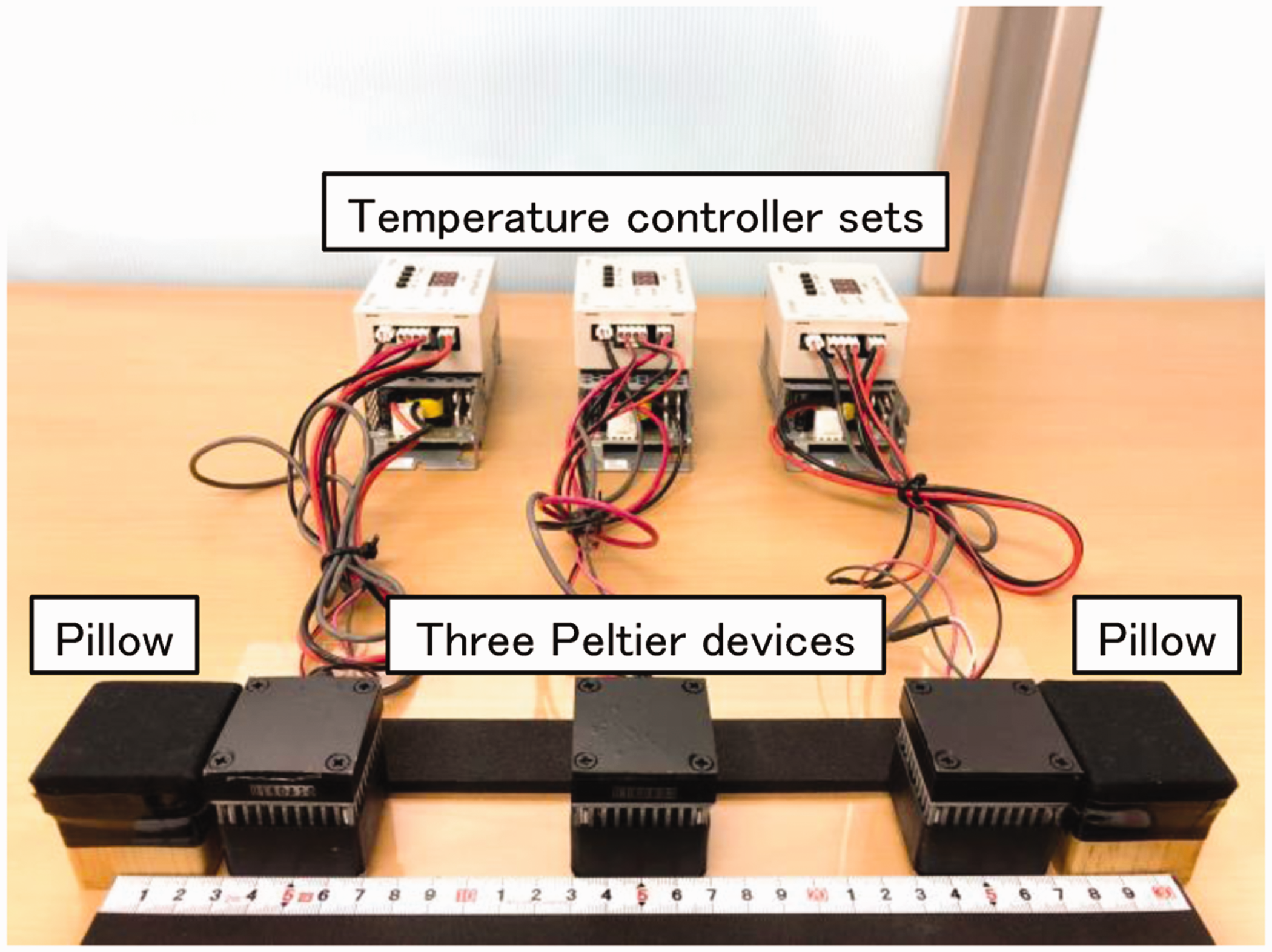
Experimental setup. The participant put the inside of his/her right forearm on the three Peltier devices and rested them on the two pillows. The controller sets were hidden.
Multiple researchers (LaMotte & Campbell, 1978; Tillman et al., 1995) have shown that pain occurs when the thermal stimulus reaches temperatures more than approximately 43°C (109.4°F) and below 15°C (59°F) depending on the body region and the stimulus used. We used 11°C (51.8°F) for the cold stimulus and 44°C (111.2°F) for the hot stimulus temperature. We set 32°C (89.6°F) as the neutral stimulus temperature in Experiment 2 based on the temperature range at which humans tend not to experience heat and cold, 30°C (86°F) and 36°C (96.8°F).
Experiment 1-a
We recorded the perceived thermal sensation of each stimulus at three locations on the forearm. We tested the hypothesis by presenting opposite thermal stimuli alternately. In addition, we investigated with other combinations that were not tested in Green’s (1977) study. We used eight combinations of the hot and cold stimuli, as shown in Table 1. The letters H and C indicate the hot and cold stimulus, respectively; they are listed from the wrist to the elbow and halfway between them. For example, HCH means that a hot stimulus was applied at the wrist, a cold stimulus was at the center location, and a hot stimulus was at the elbow.
Pattern of stimuli presented in Experiment 1.
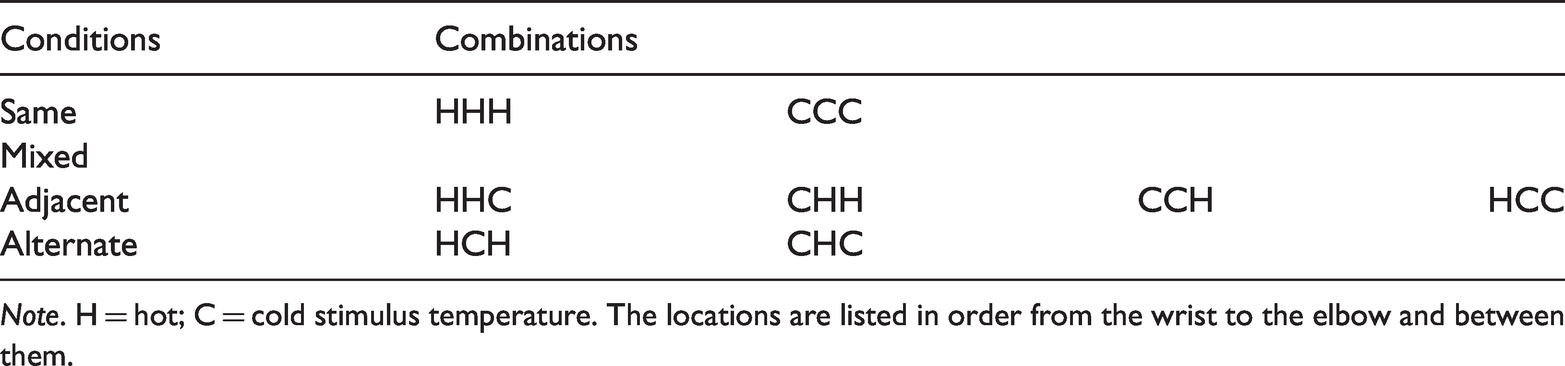
Note. H = hot; C = cold stimulus temperature. The locations are listed in order from the wrist to the elbow and between them.
The eight combinations were put into two conditions: (a) a same condition in which stimuli were all the same temperature (either hot or cold) and (b) a mixed condition in which stimuli of opposite temperatures were used. The combinations in the mixed condition were divided further into (a) the mixed-adjacent condition in which stimuli of the same temperature were presented in two of three adjacent locations and (b) the mixed-alternate condition in which the hot and cold stimuli were presented alternately as in Green’s (1977) study. By comparing the results of the mixed-adjacent and the mixed-alternate conditions, we were able to investigate the features of the combinations that induced inverse thermal sensations.
Methods
Participants
Fifteen males (Mage = 23.53 years, SD = 3.137) participated in Experiment 1. We confirmed that the participants were able to perceive the hot, cold, and neutral temperatures correctly. In addition, we confirmed that the participants did not experience any pain from the one thermal stimulus.
Procedure
The temperature of the experimental room was set to 25.0°C (77.0°F), although we allowed it to decrease or increase by 0.5°C (0.9°F): from 24.5°C to 25.5°C (from 76.1°F to 77.9°F). We obtained informed consent from each participant. The participants were asked to place their forearm on the apparatus in front of their body, as shown in Figure 2, on a cue from the experimenter. After 20 seconds, the participants were asked to lift their forearm up from the apparatus and select the temperature they perceived from hot, null (i.e., neither hot nor cold), or cold at each of the three locations. The order of the trials was randomized for each participant, and all participants experienced each combination once, yielding eight trials. We took a sufficient interval of more than 2 minutes between trials to diminish the effects of the previous trial. The participants were given careful instructions on the placement of their forearm, and they were given training trials before starting the actual experimental task.
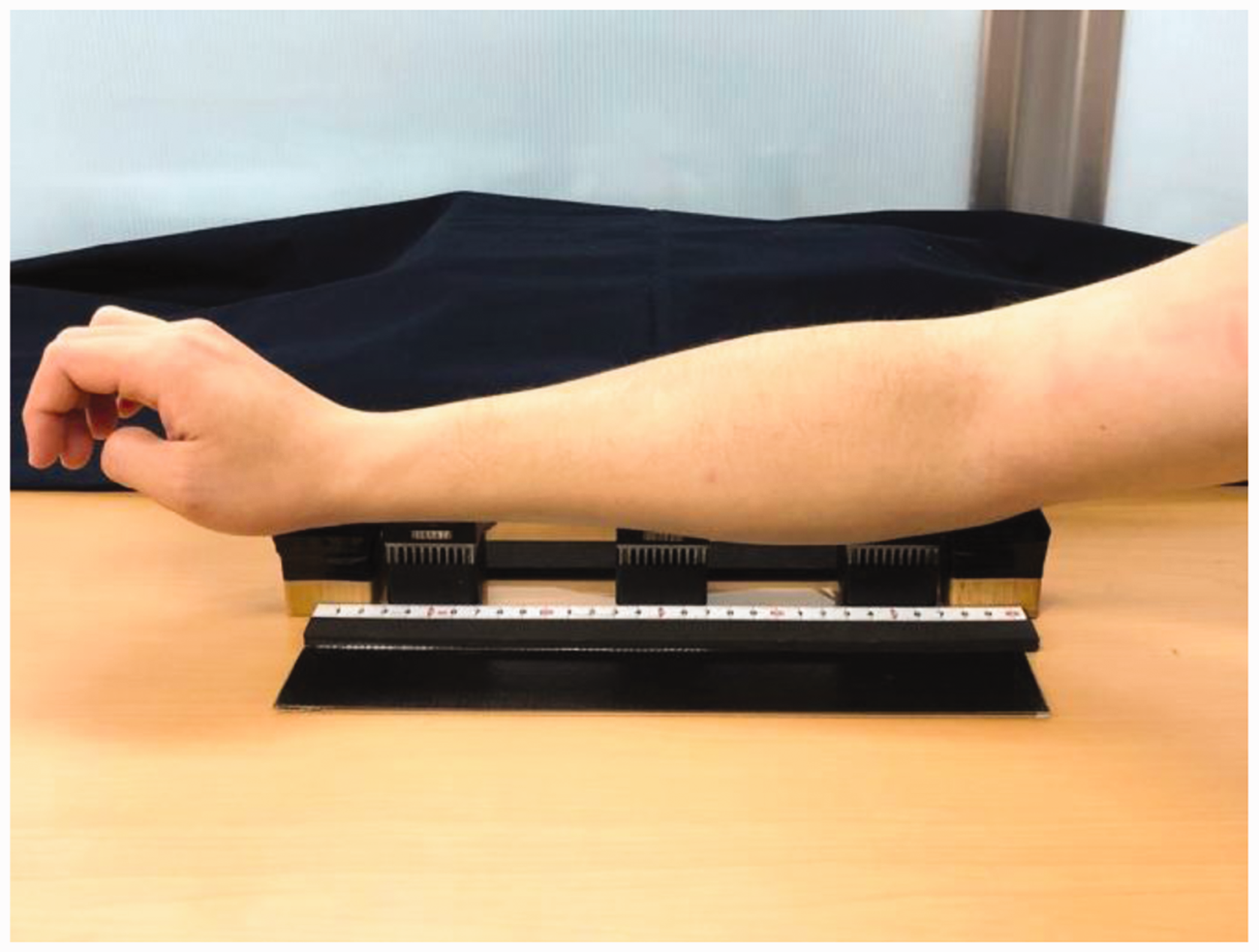
Experimental scene. After a cue from the experimenter, the participants place their forearm lightly on the apparatuses, simultaneously touching at the three locations shown.
Results and Discussion
To test which hypothesis was supported, we analyzed the participants’ responses in the mixed-alternate condition. First, we classified the trials where the participants did not report the inverse thermal sensation at all three locations as nowhere, meaning that they selected the correct temperature or null at all three locations. We classified the remaining trials into only-center or include-outers. We classified the trials in which the participants reported the inverse thermal sensation only at the center as only-center; in this category, the participants selected the correct temperature or null at the outer two locations. Regardless of the answer at the center location, we classified the trials in which the participants reported the inverse thermal sensation at one or both outer locations as include-outers. Figure 3 shows each ratio.
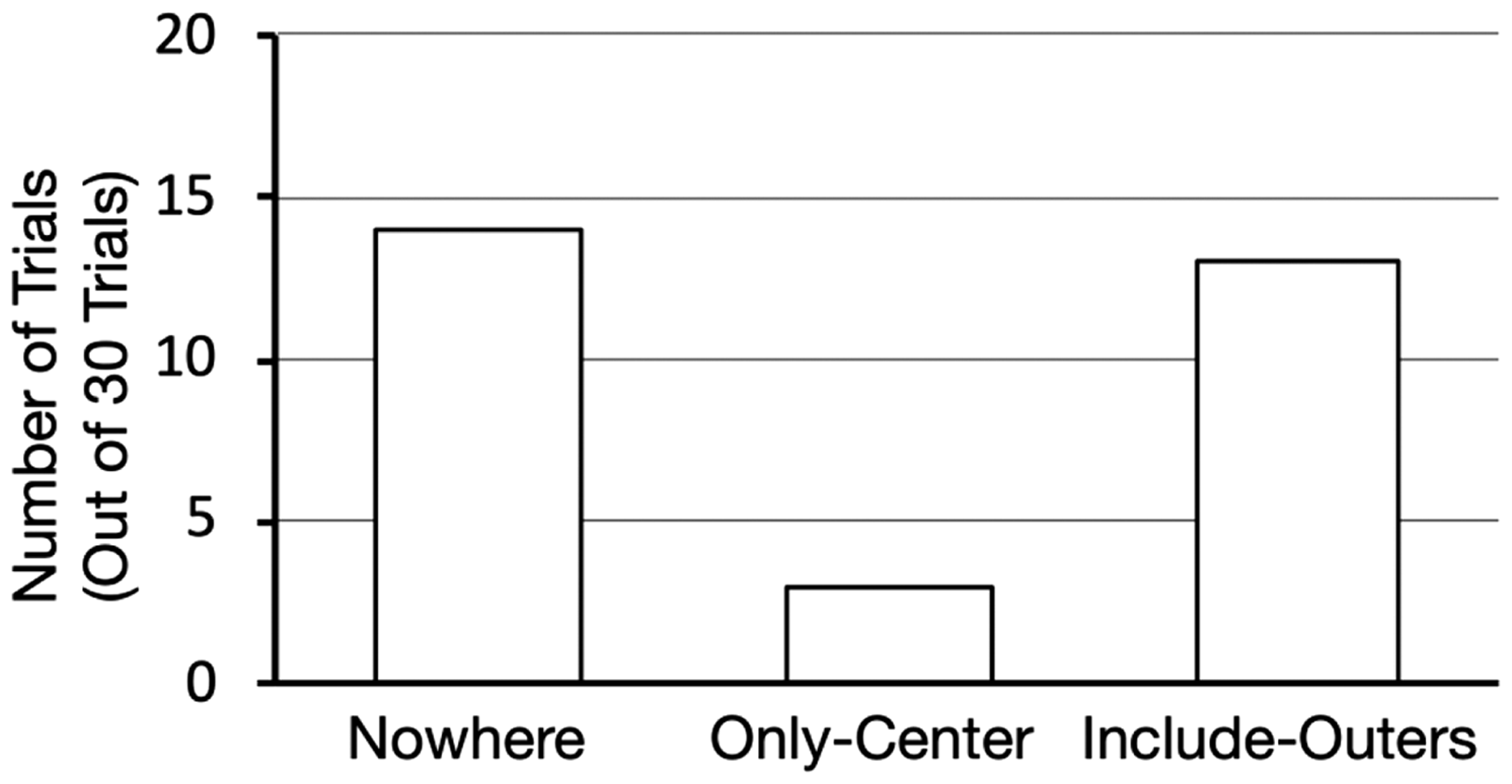
The number of trials classified in each category in the mixed-alternate condition of Experiment 1-a.
If the domination hypothesis is supported, the percentage of trials classified as only-center would be higher than those in the include-outers category. Conversely, if the mutual-effect hypothesis is supported, the percentage of trials classified as include-outers would be higher. The selection was biased significantly (χ2(2) = 7.400, p = .025). A multiple comparison test with the Holm method revealed that the percentage of trials classified into the only-center category was significantly lower than that of the include-outers category (p = .025) and that of the nowhere category (p = .023). There was no significant difference between the include-outers and the nowhere categories (p = .847).
The mutual-effect hypothesis was supported. The results of our experiment suggest that the participants subjectively perceived an inverse thermal sensation to what they were objectively experiencing because the hot and cold stimuli affected each other rather than the numerically superior stimuli dominating the perception of the center stimulus temperature.
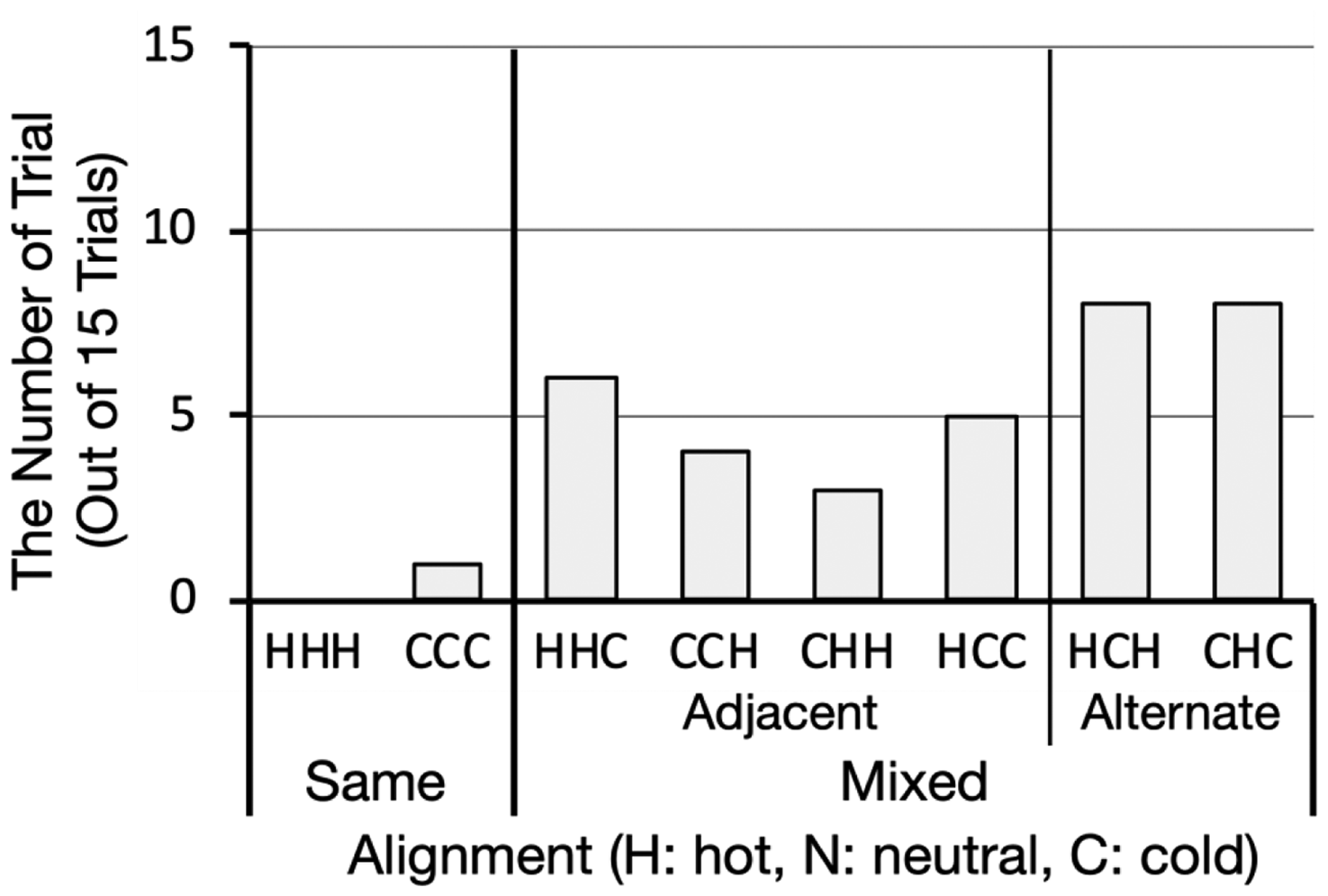
We also investigated other temperature combinations. The percentage of the trials in which the participants selected the inverse thermal choice in equal to or more than one location for each combination is indicated in Figure 4. It seldom occurred when the temperatures were the same at each location, and but it occurred in more than 20% of all combinations of the mixed condition. These results show that presenting both hot and cold stimuli is important for inducing the inverse thermal sensation.
The ratio of perception of the inverse thermal sensation for each combination in Experiment 1-a.
In addition, there was a tendency that the percentage of occurrence in the mixed-alternate condition was higher than in the mixed-adjacent condition. In both the combinations in the mixed-alternate condition, the participants perceived cold at least one location when the temperature of the stimulator was hot or perceived hot when the temperature was cold in more than 50% of trials. In the mixed-adjacent condition, the percentage ranged from 20 to 40%. These results indicate that accurate perception of temperature varied depending on the arrangement of the stimuli.
Experiment 1-b
To replicate and investigate the details of the results of Experiment 1-a, we conducted Experiment 1-b. We focused on the important two conditions, HCH and CHC, and asked participants to identify a temperature from a more detailed scale; we also asked them to report any feelings of pain and burning.
Methods
Participants
Fifteen males (Mage = 23.10 years, SD = 1.10) participated in Experiment 1-b. We confirmed that all participants satisfied the same requirements as those used in the screening test in Experiment 1-a.
Procedure
The procedure was identical except for the following three points. First, all participants experienced each condition three times. Second, after each experience, we asked the participants to select the perceived thermal sensation at each point from a 7-point scale: very cold, cold, slightly cold (cool), null, slightly hot (warm), hot, and very hot. Third, in addition to the thermal sensation, the participants reported whether they felt pain and burning at each point.
Results
To confirm the results of Experiment 1-a, we categorized each trial into only-center, include-outers, or nowhere with the same criterion as Experiment 1-a. As Figure 5 shows, the result was similar to that in Experiment 1-a. The ratio for each category was significantly biased in both the CHC (χ2(2) = 13.735, p < .001) and HCH (χ2(2) = 7.601, p = .020) conditions. The multiple comparisons with the Holm method revealed significantly fewer trials in the only-center category than among the nowhere category (p < .001) and the include-outers (p = .009) in the CHC condition. There was no significant difference between the nowhere category and the include-outers (p = .274). In the HCH condition, there were more trials in the include-outers category than that in the only-center category (p = .016), while the differences between other pairs did not reach significance (both p > .120). These results mean that thermal information from one (fewer) stimulus affected the perceived temperature of the other two (more) stimuli, which supports our mutual-effect hypothesis. In addition, the fact that in most of the trials (82.22%), the participants chose temperatures from both the cold category (i.e., very cold, cold, or slightly cold) and the hot category (i.e., very hot, hot, or slightly hot) also shows that the thermal information from one was not defeated by information from the other two.

Percentage of trials classified in each category in each condition of Experiment 1-b.
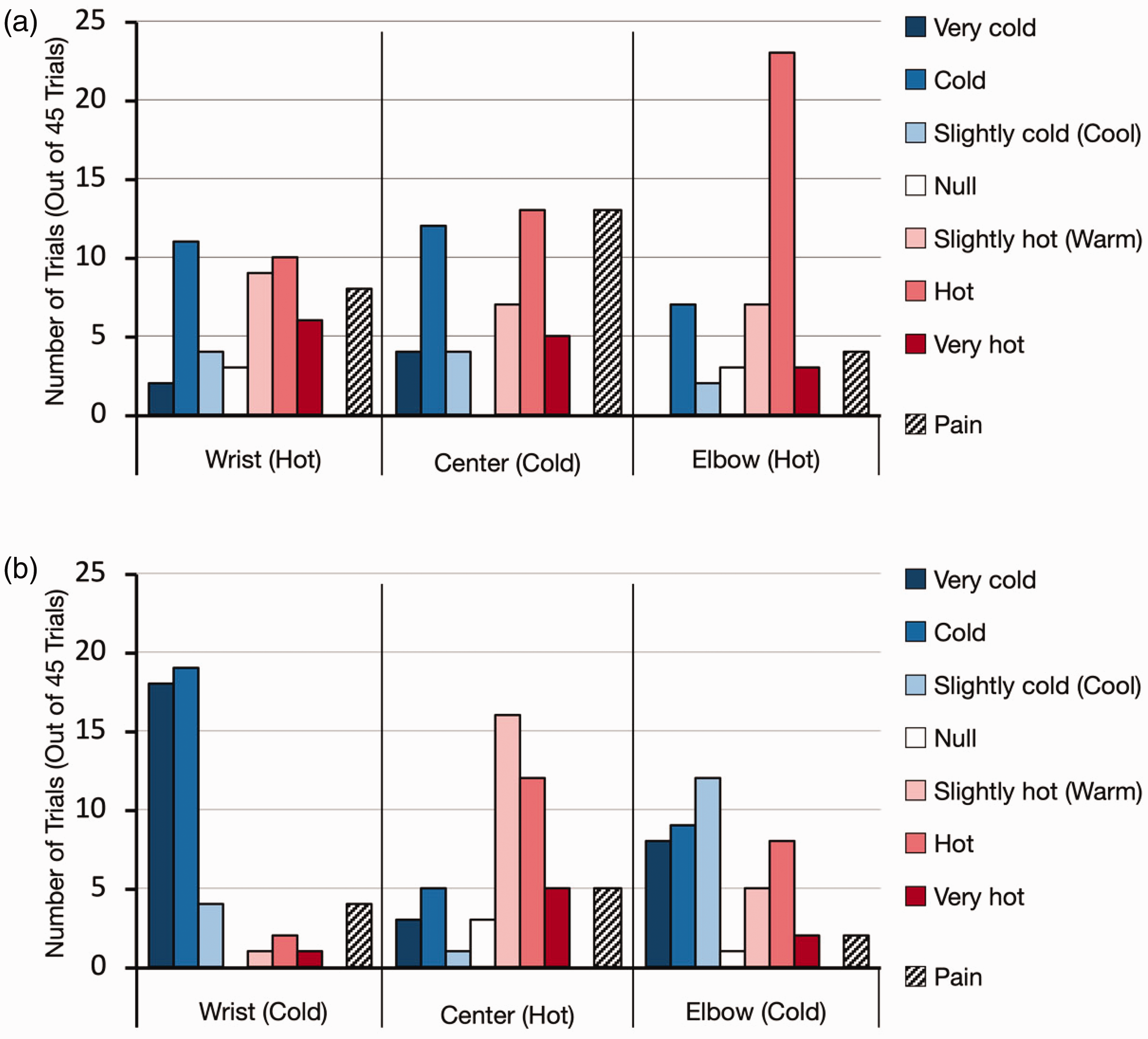
Figure 6 shows the details of the selection for each condition. The direction of the effect of the center stimulus was different according to whether it was hot or cold. When the center stimulus was hot, the participants selected the hot category at the elbow rather than at the wrist (p = .009), whereas when the center stimulus was cold, they tended to select the cold category at the wrist rather than at the elbow (p = .069). The cold stimulus at the center point was easily affected by the hot stimuli at both sides. They perceived the cold stimulus at the center as hot more frequently than they perceived the hot stimulus at the center as cold (p = .023).
The detailed results of the participants’ selection and pain sensation.
For pain perception, the participants felt pain in more trials in the HCH condition than in the CHC condition (p = . 032). In the HCH condition, they tended to feel pain at the location where they perceived the inverse thermal sensation frequently, although the difference among the three points was marginally significant (χ2(2) = 5.989, p = .050). We did not observe this tendency in the CHC condition where the participants rarely felt pain (three points compared with Fischer’s exact test p = .623).
Discussion
The results support the mutual-effect hypothesis again. The participants selected the temperature of the center stimulus at one of or both outer points. In addition, in most trials, the participants’ selection for three points included the choices in both hot and cold categories. The idea that the temperature larger in number dominated the perception of the temperature of the lower number of stimuli or that the temperature averaged across all stimuli was perceived could not explain our results.
The detailed analyses revealed different characteristics of each temperature. The participants selected the inverse thermal choice at the elbow point when the center stimulus was hot and at the wrist point when the center stimulus was cold. This result was consistent with Watanabe et al.’s (2014) conclusion that the hot sensation spread toward the center while the cold sensation spread toward the periphery.
Watanabe et al. (2014) also discussed that the spreading effect of cold sensation was weaker than that of hot sensation. However, the effects from the hot stimulus at the center point and the cold stimulus at the center point were not different: 15 inverse thermal selections for the CHC condition and 17 for the HCH condition. It might be because of the difference in the location of stimuli. We will discuss this point in Experiment 2.
In the HCH condition, pain occurrence had the same tendency as the tendency of the inverse thermal sensation but not in the CHC condition. There is a possibility that this phenomenon or an underlying mechanism relates to the thermal grill illusion or to heat pain. However, it is neither the crucial nor the only factor considering that pain did not always accompany the inverse thermal sensation. Watanabe et al. (2014) considered that perceiving the cold stimulus as hot caused heat pain, but in this study in contrast, the participants also felt pain when they perceived the hot stimulus as cold.
Experiment 2
In Experiment 2, we used additional combinations of thermal stimuli, and we further investigated situations where this phenomenon occurred. We presented 12 combinations of hot, cold, and neutral stimuli, which are summarized in Table 2. These combinations belonged to either (a) a same condition in which the two stimuli had the same temperature (either hot or cold) and one stimulus had the neutral temperature or (b) a mixed condition in which the three stimuli included a hot, a cold, and a neutral stimulus. By comparing the two conditions, we could further investigate the situations that induced the inverse thermal sensation and whether a temperature difference (i.e., neutral and either hot or cold) produced that sensation or two opposite temperatures (i.e., hot and cold) were needed.
Patterns of the presented stimulus in Experiment 2.

Note. H = hot; C = cold; N = normal temperatures. These characteristics are listed in order from the wrist to the center of the forearm to the elbow.
Methods
Participants
Ten men (Mage = 23.5 years, SD = 3.837) participated in Experiment 2. We confirmed that all participants satisfied the same requirements as those used in the screening test in Experiment 1.
Procedure
All participants experienced each combination three times. The experiment was conducted for two days: one trial for each combination on the first day and two trials for each combination on the second day. The order of the trials was randomized in each 12 trials for each participant. We asked the participants to select the sensation they perceived from five choices for each point: hot, warm, null, cool, or cold. They also answered whether they felt pain and/or burning other than the temperature. We used the same temperature for the hot and cold stimuli as those in Experiment 1 and used 32°C (89.6°F) for the neutral stimulus. Other procedures were identical to those in Experiment 1.
Results
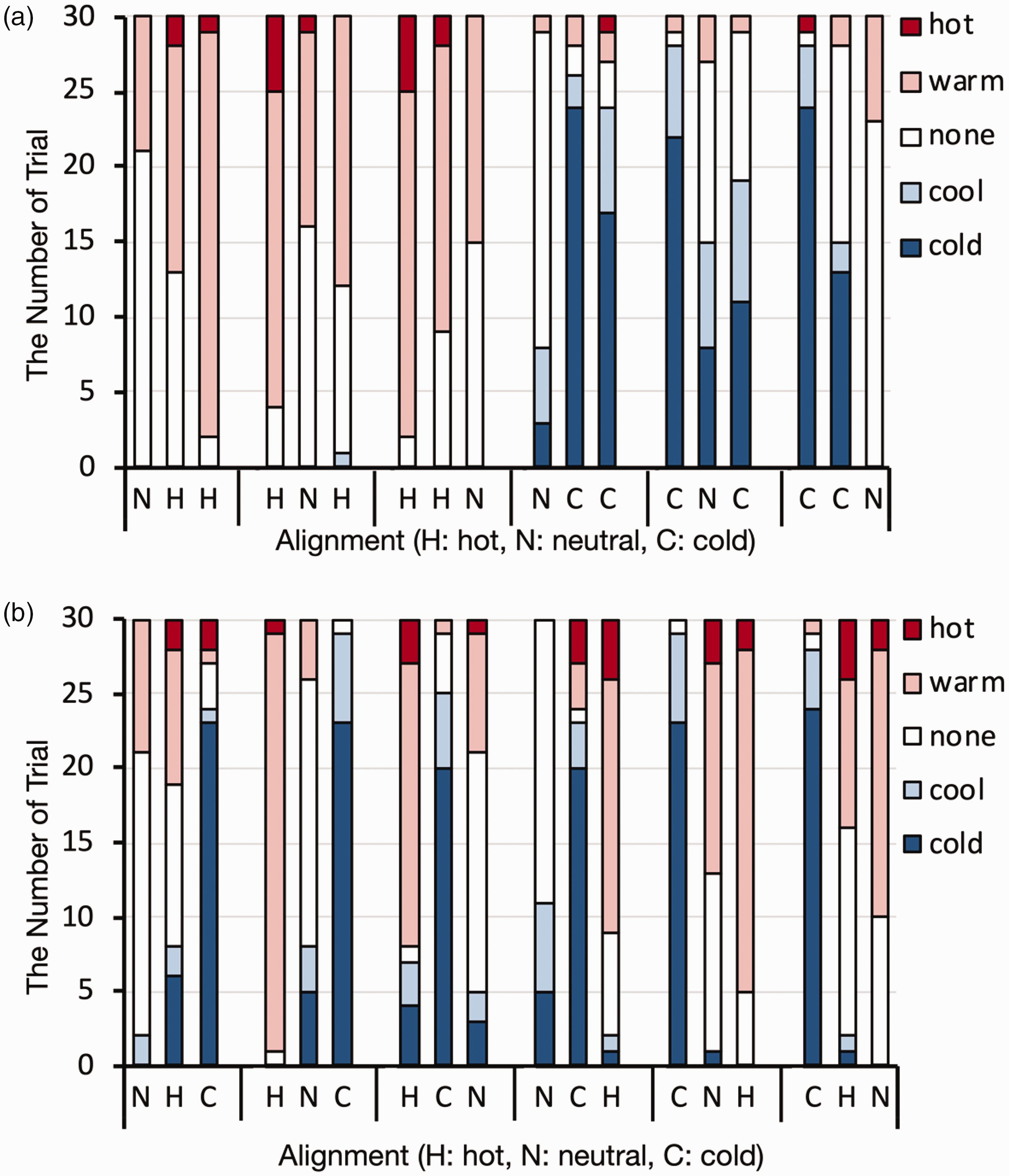
Figure 7 shows the number of trials where each choice was selected for each alignment. Each block on the x axis is one alignment of stimuli, and the first letter of the temperature of each stimulus is shown in order of wrist, center, and elbow from left to right. Figure 7A shows the results for the same condition, and Figure 7B shows those for the mixed condition.
The participants’ selections at each point for each combination.Note. Please refer to the online version of the article to view the figure in colour.
First, we compared the ratio of trials where the participants selected the inverse thermal choices to the presented temperature for more than or equal to one location for each alignment. We did not count the hot or cold sensation perceived at the location of the neutral stimulus. As Figure 8 shows, there were significantly more trials in the mixed condition than in the same condition (p = .006).

The number of trials where the inverse thermal sensation was observed.
For the same condition (Figure 7A), when the temperature of the two stimuli was hot, the participants always selected the correct temperature (hot or warm) or null except in one trial. In eight trials, they selected hot or warm where the cold stimulus was presented when the two stimuli were cold. The perceived sensation was relatively correct when there was only one temperature other than a neutral stimulus.
In contrast with the same condition, the participants often selected the inverse thermal choices in the mixed condition. The left three blocks of Figure 7B show the results of the alignment where the hot stimulus was placed at a more peripheral point than the cold one (i.e., HC) in the order that the point of the neutral stimulus was wrist, center, and elbow. The right three blocks are the results for when the cold stimulus was more peripheral than the hot one (i.e., CH) in the same order.
When the neutral stimulus was at the center (i.e., HNC and CNH), no participants selected the inverse thermal choices at either the wrist or the elbow points. Among the other four alignments, there were marginally significant differences in trials with the inverse thermal selection (χ2 (3) = 6.619, p = .085). As shown in Figure 8, the participants rarely made this incorrect selection in the CHN alignment; they did so in only 2 trials compared with 6 to 10 trials in the other three alignments.
The participants felt pain or burning sensation in very few trials, pain in 7 and a burning sensation in 8. They felt pain in one trial of the CNC alignment in the same condition and one trial of all alignments of the mixed condition other than the NHC alignment, but two in the HNC condition. The burning sensation was perceived in two trials in the CCN and CHN alignments and one trial each in the HHN, NHH, HCN, and NCH alignments. We observed no relationships between those trials and the perception of the inverse thermal sensation.
Next, we focused on the neutral stimulus. In the following analyses, we restricted the definition of a referral to only cases where the participants selected non-null choices for the neutral stimulus. The number of trials in which referral occurred did not differ significantly between the same and mixed conditions (p = .167). We often observed it when the center stimulus was neutral in the same condition, as shown in the previous studies. The temperature of the other two stimuli had a different influence on the referral occurrence.
When two hot stimuli were presented with the neutral one, referral occurred easily at the elbow point, although the percentages at the wrist and elbow did not significantly differ (p = .187); additionally, the participants judged correctly (warm and hot) at the farther point from the neutral stimuli. In the NHH alignment, the participants selected hot and warm more frequently at the elbow than at the center point (p = .002), and in the HHN alignment, they selected hot and warm more frequently at the wrist than at the center (p = .042).
We did not observe referral when the neutral stimulus was located at the elbow point with two cold stimuli; in this alignment, the neutral stimulus had the same effect as that with the hot stimuli. Namely, the participants correctly selected cold and cool more frequently at the wrist point than at the center (p < .001). However, if the neutral stimulus was at the wrist point, the participants perceived the cold stimulus at the center point as correctly as they perceived cold at the elbow (p = .731).
In the mixed conditions, the perceived temperature differed according to whether the neutral stimulus was placed at the wrist or the elbow. The participants tended to select the hot and warm more than the cold and cool for the neutral stimulus at the elbow point (p < .001), even if the next (center) stimulus was cold. In contrast, at the wrist point, the selection was not biased to either hot or cold (p = . 524), and it affected the temperature of the next (center) stimulus.
Finally, we analyzed the number of incorrect thermal sensations, that is, when the participants selected either cold or cool for the hot or neutral stimulus and either hot or warm for the cold or neutral stimulus. The incorrect sensation at the center point was not biased to either hot or cold (19 for cold and 28 for hot, p = .243). At the wrist point, the participants incorrectly selected the cold category in more trials than those in which they incorrectly selected the hot category (p = .072). In contrast, at the elbow point, the participants incorrectly selected the hot category in significantly more trials than those where they chose the cold category (p < .001).
Discussion
The results of Experiment 2 showed that the participants perceived inverse thermal sensation even when the alignment included the neutral stimulus, in particular when the alignment included both hot and cold stimuli. This inverse sensation did not occur when the neutral stimulus was placed at the center point, which means that stimuli of opposite temperatures placed next to each other caused the perception.
The results in the same condition clearly showed the cold sensation spreading toward the periphery as we discussed in Experiment 1. Along with that finding, all analyses indicated that the participants easily perceived cold at the point nearer to the wrist regardless of which stimulus was actually placed there. In contrast, in the alignments with two hot stimuli and one neutral stimulus had no such bias. The participants perceived hot sensation in the same strength at every point, and the hot sensation seemed to spread toward both directions in the same power.
These facts can explain the results in the other four alignments in the mixed condition. The participants robustly perceived cold at the wrist, and the cold sensation spread toward the periphery; that was reason why there was little occurrence of inverse thermal sensation in the CHN alignment. Considering the spreading direction of each temperature, the HC alignment was suitable for mutual effects. In the NCH condition, the cold stimulus at the center could be affected by the hot stimulus at the elbow point because the cold perception at the center was not as robust as that at the wrist.
General Discussion
In this study, we focused on inverse thermal sensation caused by the alignment of three stimuli, both hot and cold. In Experiments 1-a and 1-b, we tested the domination and mutual-effect hypotheses by applying two hot and one cold or two cold and one hot stimuli alternately at three different locations on the forearm (i.e., the HCH and CHC combinations). In Experiment 2, we investigated this sensation further by including a neutral temperature stimulus.
The result of Experiments 1-a and 1-b, in which the inverse thermal sensation occurred at one or both outer locations as well as at the center, supports the mutual-effect hypothesis in which hot and cold stimuli affect each other across the three locations. Green (1977) theorized that the perception of a different thermal sensation from what was actually used in the center was caused by the dominating effect of more outer stimuli, and he called this phenomenon “domination.” However, the domination hypothesis was not supported in the current experiments. Instead, we propose to call this phenomenon hot–cold confusion, wherein thermal stimuli, both hot and cold, are applied at multiple locations, and the participants perceived the inverse thermal sensation to the presented temperature at any of the three locations.
The results of the HCH and CHC combinations in Experiments 1-a and 1-b were different from the results predicted by Ho et al. (2011). Those authors presented a thermally neutral stimulus between two hot stimuli and observed that participants perceived a temperature at the center location to be higher than it actually was and temperatures at the outer two locations to be lower than the actual temperatures. It is likely that the perceived temperature was the average of the temperatures at each location. If the participants had perceived the average temperatures in this study, when the HCH combination was presented, the perceived sensation would have been hot at all of the locations, and the inverse thermal sensation could occur only at the center location. However, in Experiments 1-a and 1-b, hot–cold confusion occurred at not only the center but also at least one of the outer locations in both the HCH and CHC combinations.
This result can be explained by the different combinations of stimuli. Ho et al. (2011) gave their participants combinations of either hot and neutral or cold and neutral stimuli (i.e., HNH or CNC). For these combinations, the participants perceived only one thermal sensation that was summed and redistributed to three locations, and therefore, the participants perceived the average temperature across the three locations. Experiment 2 showed similar results. In the combinations in which we observed hot–cold confusion, we presented both hot and cold stimuli. Although participants perceived both, they could not correctly identify the locations of the hot and the cold stimulus. As a result, hot–cold confusion would have occurred.
The occurrence of the hot–cold confusion in our study was similar to the results reported by Watanabe et al. (2014). In their experiment, when hot and cold stimuli were presented at the wrist and elbow, some participants experienced hot–cold confusion, and our study extended their results to uneven numbers of stimuli for each temperature. In addition, our study showed different characteristics of hot and cold perception. As discussed in Experiment 2, the cold sensation spread toward the periphery and was perceived more robustly at the point nearer to the wrist, whereas participants perceived the hot sensation equally at every point, and it spread toward both directions. The results for Experiments 1-a and 1-b showed these characteristics. In the HCH condition, the center stimulus was perceived as hot because the hot sensation came from both sides. In the CHC condition, the cold sensation did not spread from the wrist, and the cold stimulus at the elbow had weak power because it was nearer to the center of the body; as a result, the participants tended to perceive hot at the center point. The characteristics of each temperature could explain why the hot–cold confusion occurred more often in some alignments than in others.
However, one limitation of our study is that it is unclear whether these characteristics could be observed anywhere on the body by placing stimuli from a nearer point to the center to a peripheral point or it was specific for the arm and what would happen if the stimuli were placed at points of the same distance from the center of the body as the points in previous studies where the participants touched the stimuli with their fingers. In one of his previous studies, Green (1978) found directional bias of warmth but not of cooling when participants touched the stimuli with two fingers. This finding suggests some importance of where the stimuli are presented in hot–cold confusion, but the matter needs further investigation.
The inverse thermal sensation was sometimes observed when the alignment included only cold stimuli or two cold stimuli and one neutral stimulus. We consider that there is a different mechanism for these cases from the mechanism for hot–cold confusion in the alignment with both hot and cold stimuli, paradoxical heat, a phenomenon whereby a cold stimulus is perceived as hot by cooling the skin (Greenspan et al., 1993; Hämäläinen et al., 1982; Susser et al., 1999). If the skin temperature decreased as the participants put their arms on the device, they would have perceived it as hot. In our experiments, inverse thermal sensation was perceived in only one trial (6.67%) in the CCC alignment of Experiment 1-a and in 8 trials (8.89%) in the two cold and one neutral stimuli alignments of Experiment 2. If the same underlying mechanism were operating, the inverse thermal sensation would have also been observed more in those alignments and when only the hot temperature was presented.
In some trials, participants reported both hot–cold confusion and pain or/and burning sensation at some of the same points. First, both were reported more frequently in the HCH condition than in the CHC condition, and second, both decreased by introducing the neutral stimulus. Third, in the HCH condition of Experiment 1-b, at the location where the confusion occurred frequently, the participants felt pain. These facts seem to indicate a relationship between the confusion and pain. Watanabe et al. (2014) discussed that thermal grill illusion or heat pain arose from perceiving the cold stimulus as hot.
However, some other aspects did not support this relationship. First, in the CHC condition of Experiment 1-b, the number of trials in which the participants reported hot–cold confusion at each point and in which they reported pain was not consistent. In addition, they reported pain or/and burning sensation in alignments where confusion did not occur in Experiment 2. Considering these results, hot–cold confusion could be one cause of thermal grill illusion and heat pain but not the only one, or the underlying mechanism of both phenomena overlap to some extent but not the identical.
The opposite directional effect was less likely that the thermal grill illusion had caused the hot–cold confusion. If this had been, the participants should have perceived the stimulus as hot at the location where they felt pain, but they did not. We need further study to investigate the relationships among hot–cold confusion, the thermal grill illusion, and other thermal illusions.
Footnotes
Acknowledgement
The authors are grateful to Tsubasa Fujimitsu who took a role of an experimenter in one experiment.
Declaration of Conflicting Interests
The author(s) declared no potential conflicts of interest with respect to the research, authorship, and/or publication of this article.
Funding
The author(s) received no financial support for the research, authorship, and/or publication of this article.
