




Abstract

The question posed in the title obviously depends on how you are prepared to understand “Perception.” A Google search lets you quickly compare various dictionary meanings. Here is the Merriam–Webster definition (https://www.merriam-webster.com/dictionary/perception):
a result of perceiving: a mental image:
awareness of the elements of environment through physical sensation (e.g. color perception) physical sensation interpreted in the light of experience
quick, acute, and intuitive cognition: a capacity for comprehension
I appreciate item 2, because consciousness implies sapience, whereas perception proper is sentience. Item 4 is clearly irrelevant to the present issue. So we need to consider only items 1 and 3. In item 3 the two subitems are not really different and they rely on the notion of “sensation,” which is an unfortunate concept framed by philosophers (Gassendi, 1658; Russell, 1912). So item 1 is what we primarily need to consider. The dictionary apparently differentiates between what has been called perception and apperception here (Descartes, 1649; Leibniz, 1714).
The item “a mental image:
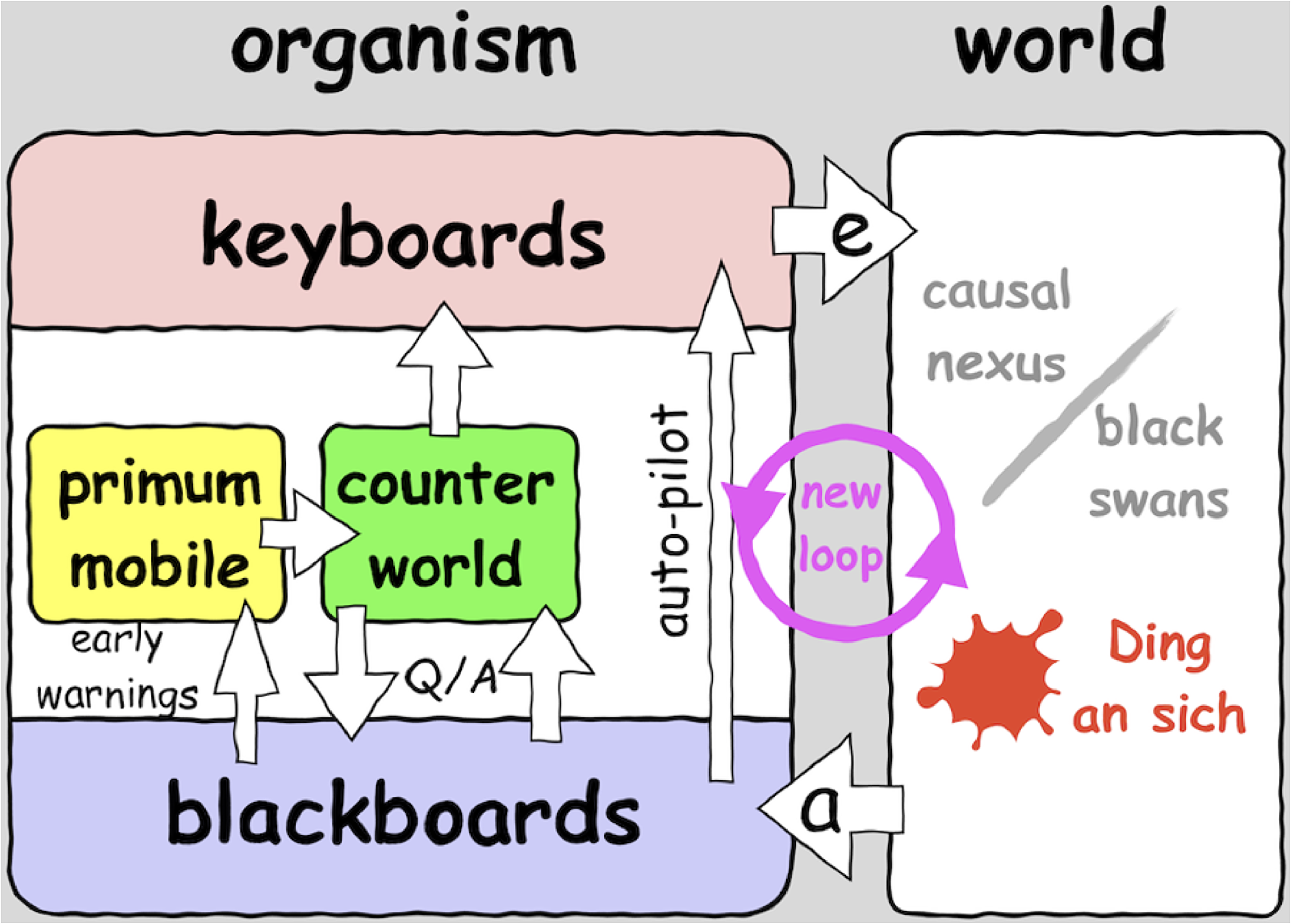
The “New Loop” (yes, there was an “old loop,” it would currently be called a “perception–action cycle”) drives the semiotic meaning making in Jakob von Uexküll’s thinking. The organism interacts with the world through efference (“
The hyletic data (to use that term for a moment) are as yet uninterpreted snap-shots that may at some time be promoted to something meaningful. Pre-Gestalts say. They are already distilled from the chaos (entirely meaningless) of body–world interactions by automatic neural filters. Perhaps that is the level of “sensations?” I don’t like that term, because it falsely suggests something already in awareness. Anything in awareness is by its nature meaningful. You cannot be aware of what you are not aware of.
Thinking in this framework I would differentiate between various levels that are often related to “perception.”
Somatic processes associated with interactions of the body and the world. (I reckon the brain to be part of the body.) These may be approached by physiological methods (invasive), or by way of psychophysical methods (non-invasive, or “dry” physiology). Neither of these has to do with perception as such. One studies “subjects” (living bodies) rather than “participants” (communicative agents). I would not list such methods under the head of “perception” proper. Methods of experimental phenomenology. Here one uses “participants” (including the scientist itself) rather than “subjects.” Such studies are by their very nature “subjective,” introspection being the key example. Thus they don’t count as “science” proper, because they fail to be “objective.” They can be both qualitative and/or quantitative Methods involving reflective, often discursive, conceptual thought. I would not list these under the head of “Perception” proper.
My personal experience with these levels is limited.
I have never been involved in neurophysiology, but I have done a lot of work in “hard” psychophysics. (A reviewer asked what I meant: “Hard psychophysics” is not about meaning or quality, it is really “dry physiology.”) I used to submit my results to the Journal of the Optical Society as many colleagues—mostly physicists—did in the 1960s and 1970s. I would distinguish that from “perception research.” It is a kind of ergonomics, perhaps.
I have never worked on the sapient levels either. It seems an apt level for much of psychology (Koenderink, 2019). There are plenty of journals and it seems right that these rarely focus singularly on perception. I would distinguish that from “perception research” too.
Since the 1990s I have done quite a bit of work on perception proper. My papers are usually ranked as “soft science” or “mere phenomenology.” I’m perfectly happy with that verdict. Sciences are not the only academic disciplines.
What is left is a mixture of items 1 and 3 of the dictionary meaning. Perception is a process of the psychogenesis of awareness that is meaningful because it relates the agent to its Umwelt—the World as it relates to the agent’s lifestyle (Gibson, 1966). The elements of perceptions belong to the Innenwelt (Uexküll, 1909) of the agents. That is to say, they reside in awareness. Mere reactive and habitual automatic actions are not accompanied by mental activity on the level of awareness. They are studied by the methods of dry physiology. (See Figure 1.) To probe the structure of the Innenwelt—and perception proper—one has to use methods of experimental phenomenology (Albertazzi, 2013).
This places the study of perception firmly in the realm of biology, especially ethology. Indeed, the terms Umwelt and Innenwelt derive from the work of Jakob von Uexküll (Uexküll, 1909, 1920), a biologist who did his major work in the first half of the 20th century. His methods are very much worth a close study. Focusing on the subspecies Homo sapiens sapiens has the advantage that the scientist is in immediate emphatic relation with the participant, whereas von Uexküll (who used mostly aquatic animals) routinely dealt with alien subjects.
Von Uexküll was a model scientist, which is why he was reckoned by the behaviorists as one of their own persuasion. That was not quite to the point though, because von Uexküll conceives of the psychogenesis of perception as an essentially semiotic process, both in animals and in humans.
Semiosis and meaning-making are at the core of perception. Much as I enjoy physics, I don’t feel there is any meaning to be found in the (physical) world. If I find any meaning in physics (I am a physicist) it is in myself. Meaning is not in the world, it is in agent–world relations. Thus the meaning of some given physical structure will be different for any creature. It depends upon the creature’s life world. It tends to be similar for members of a single species. This puts us (Homo sapiens sapiens) in a special position: we study ourselves.
Von Uexküll had the good sense to focus on simple aquatic animals. For such creatures, he could effectively act as an external observer, an All Seeing Eye. A scientific study of human perception requires that we step outside of our skin, so to speak. But who can step out of his or her’s skin? We all sadly lack God’s Eye (Koenderink, 2014). The study of human perception will necessarily be the work of humans.
A focused journal like
Footnotes
Declaration of Conflicting Interests
The author declared no potential conflicts of interest with respect to the research, authorship, and/or publication of this article.
Funding
The author received no financial support for the research, authorship, and/or publication of this article.
