



Abstract
Body odors convey information about the individuals, but the mechanisms are not fully understood yet. As far as human reproduction is concerned, molecules that are produced in sexually dimorphic amounts could be possible chemosignals. 3-hydroxy-3-methylhexanoic acid (HMHA) is one of them—more typical of men. Here, we investigated the possibility that the perception of gender and attractiveness in human faces could be implicitly influenced by this compound. Clearly feminine, ambiguous and clearly masculine faces were primed with an odor of HMHA, a control odor or air. Based on 100-ms face presentation, 40 raters had to identify the face's gender as quickly as possible and provide attractiveness evaluations. 3-hydroxy-3-methylhexanoic acid tended to be perceived as less pleasant and induced lower sniff duration in women compared with men. As to the effects of HMHA on face perception (vs. control conditions), we found that gender identification and the associated response time were unaffected by HMHA. Attractiveness of the faces, however, increased in presence of HMHA, but not in a sex-specific manner and only for unattractive faces with ambiguous gender. In sum, this study found no evidence in favor of a possible role of this sexually dimorphic compound in intrasexual competition nor in intersexual attraction.
Human secretions at the surface of the body are processed by skin bacteria, forming a complex mixture of volatile compounds: human body odor (Leyden et al., 1981). Natural body odor is thought to convey information about the individuals, such as their age (Mitro et al., 2012), sex (Doty et al., 1982), and physiological state such as the fertile phase of the menstrual cycle in women (Singh & Bronstad, 2001) or such as health status (Olsson et al., 2014). There is increasing evidence in favor of body odor involvement in different forms of chemical communication (Lübke & Pause, 2015; Stevenson, 2010) such as sexual attraction (e.g., Havlicek et al., 2005; Herz & Inzlicht, 2002; Rikowski & Grammer, 1999), mother–infant bonding (e.g., Doucet et al., 2012), and the communication of emotions (e.g., de Groot et al., 2015; Pause et al., 2010; Richard Ortegón et al., 2022). Yet relatively little is known about of the mechanisms of this human chemical communication: Its chemical bases are still largely unknown, for example. In this regard, disproportionate attention has been granted to androgen steroids from the axilla (see Wyatt, 2015 for the critical review) compared to other chemicals produced by the body. For some time, these compounds have been believed to act like sex pheromones. However, several studies suggest that their effects may not specifically relate to mate choice (Ferdenzi et al., 2016a; Hare et al., 2017; Hummer & McClintock, 2009). Androgen steroids represent only a small fraction of the hundreds of volatiles emitted by the human body, such as alcohols, carboxylic acids, ketones, aldehydes, esters, or hydrocarbons (Penn et al., 2007). It is likely that some of these compounds or groups of compounds may act as chemosignals in humans, but this possibility remains very poorly explored to date.
One possible characteristic of the chemosignals conveying information relevant to human reproduction and mate choice (such as sender's sex, reproductive state, physical attractiveness, or social status) is that they may be produced more by one sex (Darwin, 1871). In other modalities (faces, voices), sexually dimorphic traits predict mate preferences (intersexual attraction) and behaviors related to competition for mates (intrasexual competition) (Puts et al., 2012), which are two major aspects of sexual selection. The chemical composition of skin odors is not fully elucidated to date (Dormont et al., 2013) and there is debate as to how to sample and analyze them (Curran et al., 2006; Ferdenzi et al., 2020; Preti et al., 2006). Some differences between the sexes, however, have been reported (Gower et al., 1985; Penn et al., 2007; Troccaz et al., 2009). In particular, men and women differ in the ratio of two precursors secreted in the armpit, which are transformed by the skin microflora into odorous compounds giving each sex's sweat a particular perceptual characteristic: a more sulfurous onion-like odor in women's sweat through transformation of one precursor, and a more cheesy rancid odor in men's sweat through transformation of another precursor (Troccaz et al., 2009). The product of transformation of these precursors is a thiol 3-methyl-3-sulfanylhexan-1-ol (MSH) in women, and of a carboxylic acid 3-hydroxy-3-methylhexanoic acid (HMHA) in men. In this study, we only focused on the latter molecule HMHA. Men have the potential to produce more HMHA than women given (i) the quantitative differences of HMHA precursor found in sweat samples of both sexes (Troccaz et al., 2009) and (ii) the greater amount in men of Corynebacteria (Jackman & Noble, 1983) which are responsible for the formation of HMHA (Natsch et al., 2003). 3-hydroxy-3-methylhexanoic acid is a carboxylic acid considered as a major component of the human sweat odor in terms of relative abundance and perceptual quality (Natsch et al., 2006).
To test the possible function of the sexually dimorphic compound HMHA in mate preferences, we investigated in a previous study whether there were sex differences in how HMHA is perceived (Ferdenzi et al., 2019). In two different cultures (French and Malagasy), no sex differences in HMHA threshold detection were found with concentrations ranging from 400 ppm to 1.2 × 10⁻². Other perceptual variables including not only pleasantness and familiarity ratings but also verbal descriptions did not differ as well between male and female raters. The fact that HMHA intensity ratings were higher in the fertile (vs. nonfertile) phase of the menstrual cycle in female Malagasy receivers, which was not the case for a control floral odor, was however in line with a possible implication of this compound in mate preferences. Whether HMHA is relevant in the perception of a potential partner requires further explorations, with more implicit approaches testing for example how smelling this odor modulates actual perception of others and behavior toward them. In the present study, we focused on face perception.
The aim of this study was to test whether male and female raters would respond differently to HMHA in a perceptual task where an olfactory prime is preceding the presentation of a visual target (face) with varied gender levels (female, ambiguous, male), and where raters are asked to identify the face's gender as quickly as possible and to rate its attractiveness. We also investigated how HMHA itself is perceived in terms of pleasantness and masculinity, and how it is sampled by the human olfactomotor system (sniffing behavior). Sex differences in response to HMHA may provide useful indications about the possible role of this compound in sexual selection, either via intersexual or intrasexual processes. Indeed, on the one hand HMHA could be involved in intersexual attraction. In this case, women should rate faces—especially of males—as more attractive when primed with HMHA. Alternatively (or simultaneously), HMHA could be involved in intrasexual competition, in which case men should rate ambiguous faces more often as male faces when primed with HMHA. Sex differences are expected to be more likely at an implicit level (face processing after olfactory priming) than at an explicit level (direct odor evaluations, as in Ferdenzi et al., 2019), given the subattentive influence of smells on human behaviors (Sela & Sobel, 2010).
Method
Participants
This study involved 40 participants (20 men, 20 women; M ± SD = 22.7 ± 3.4 years of age; no sex difference in age: t38 = 0.42, p = .680), who declared that they were heterosexual, with normal olfaction, not regular smokers, and nonpregnant (women). The size of the sample was limited by resource constraints (time, budget, human resources). Also, because this research was exploratory, this sample size was deemed sufficient for generating preliminary insights. All participants were of European type. Men and women did not differ in relationship status (12 women out of 19 respondents and 10 men out of 20 were in a relationship; χ21 = 0.69, p = .408) or duration (women: 2.8 ± 2.3 years; men: 3.9 ± 3.6 years; U = 53.5, p = .692). Two thirds of the women (N = 13) were taking hormonal contraception; among those who were not (N = 7), 3 were estimated as being in the fertile phase of their menstrual cycle (Ferdenzi et al., 2009). Participants provided written informed consent prior to participation. They were tested individually, in French, and received monetary compensation for their participation. The study was conducted in accordance with the Declaration of Helsinki and approved by the Lyon Sud-Est II ethical review board.
Odorants
Three conditions were used: the target odor HMHA (1% v/v concentration, 1.0 l/min), a control odor diacetyl DIA (10.8%, 0.05 l/min), and clean air with no odor (AIR), diffused at an airflow of 1.5 l/min using a computer-controlled olfactometer that allows application of rectangular-shaped stimuli with time-controlled stimulus onset (Sezille et al., 2013). The concentration of HMHA was chosen to be clearly supraliminal, to allow for the use of a control condition where the odor is carefully chosen as a function of its perceived quality (see hereafter). We previously used 0.1% concentration for perceptual evaluations of HMHA in flasks (Ferdenzi et al. 2019) and increased it here to 1% to compensate for the loss of intensity due to the presentation through an olfactometer. 3-hydroxy-3-methylhexanoic acid was synthesized for the purpose of this study according to a procedure explained in Ferdenzi et al. (2019)'s Supplementary Material. Two milliliters solution (mineral oil alone from Sigma-Aldrich® for the AIR condition, or odors diluted in mineral oil) were absorbed on scentless polypropylene fabric (twice 1 × 6 cm; 3M®, Valley, NE, USA) placed in U-shaped Pyrex® tubes (VS technologies, France; volume: 10 mL; length: 50 mm; external diameter: 14 mm). A Teflon tube directed the gaseous stimuli (odorized air coming from the U-tubes + clean vector air) from the olfactometer to the participant's nose at about 3 cm below the nostrils. The control odor at concentration 10.8% was chosen because it was not perceived as a body odor but was similar to HMHA in terms of pleasantness and intensity (see details in Supplementary Material, Section 1).
Facial Stimuli
Pictures of real faces from the Geneva Faces and Voices Database (Ferdenzi et al., 2015a) were processed with Psychomorph software (Tiddeman et al., 2001) to obtain 36 composite faces corresponding to 4 different identities declined in a nine-level gender continuum from a clearly feminine (level 1) to a clearly masculine face (level 9). The four identities are the average of the five most and the five least attractive faces among male and female stimuli of the database. Attractive and unattractive stimuli were used to allow for the possibility that the effect of odors on attractiveness could have a ceiling or a floor effect depending the initial level of attractiveness of the face (e.g., it is possible that HMHA increases the attractiveness of unattractive faces, but not of faces that are already very attractive). The nine levels of masculinity/femininity were obtained by morphing these identities with a female template (average of the 15 most feminine female faces of the GEFAV) and a male template (average of the 15 most masculine male faces of the GEFAV). The requirements for the different levels of transformation were that 100% of the participants identify level 1 face as a woman and level 9 face as a man, and that levels 2 to 8 generate more uncertainty with a paroxysm of uncertainty at level 5 (ambiguous face identified 50% of the time as a man and 50% of the time as a woman, ideally). To best fit these requirements, a two-step online pilot study was conducted to adjust the degrees of transformation and obtain the final set of faces (see details in Supplementary Material, Section 2).
Procedure
Participants took part in a 1.5-h session, during which they were seated 50 cm far from a computer screen (distance kept constant by chin and forehead rests). They were equipped with noise cancelling headphones (Bose®) diffusing a white noise to prevent distraction by environmental and olfactometer noises. A nasal cannula positioned in both nostrils and connected to an airflow sensor (AWM720, Honeywell, France) allowed (i) to synchronize odor delivery with the participants’ respiration, and (ii) to record sniffing behavior. The sniffing signal was amplified and digitally recorded at 256 Hz using LabVIEW software®. Odorous stimuli were delivered through a Teflon tube placed 3 cm below the nostrils. Participants’ right hand was placed on a five-button response box. The experiment comprised 108 trials (36 faces × 3 odor conditions), divided in six blocks of 18 trials, each lasting ∼10 min with a few minutes break between blocks. Blocks were balanced in terms of facial attractiveness, identities, transformation levels and odor conditions. Presentation order of the trials within each block was random but identical for all participants, and presentation order of the blocks was pseudo-random (14 different preestablished presentation orders).
During the experiment, participants had to identify gender and evaluate attractiveness of the faces presented briefly and preceded by an odor prime or by clean air. Each trial started with a 500 ms fixation cross appearing in the middle of the screen. During the first expiration after the onset of the fixation cross, the olfactometer delivered an odorous stimulation (or clean air) for 3 s, a duration that ensured that the odor was sniffed at least once. Exactly 3.5 s after the participant started to inhale in presence of the odor (or clean air), a face was displayed for 100 ms. The sequence of a trial is illustrated in Figure 1. The task was deliberately devised as difficult (gender ambiguity, first impression only) to maximize the likelihood of an odor effect on participants’ responses. Participants had to decide as fast as possible whether this was the face of a man or a woman, using their index and middle finger on the response box (random allocation of each gender to either finger). Then, they had to rate the face's attractiveness from 1 (thumb: “not attractive at all”) to 5 (little finger: “very attractive”) without time constraint. The experiment was preceded by a training session with 8 faces and followed by perceptual evaluations of the three odor stimuli (AIR, followed by HMHA and DIA in a random order) presented in the same conditions as during the experiment. Participants used five-point scales to evaluate stimulus pleasantness (from −2: “very unpleasant” to +2: “very pleasant”), intensity and masculinity (from 1: “not at all” to 5: “very”). Ratings of familiarity, edibility, irritation, burning, cooling, and pain (1–5), as well as odor descriptions were also collected but are not analyzed here for the sake of concision.
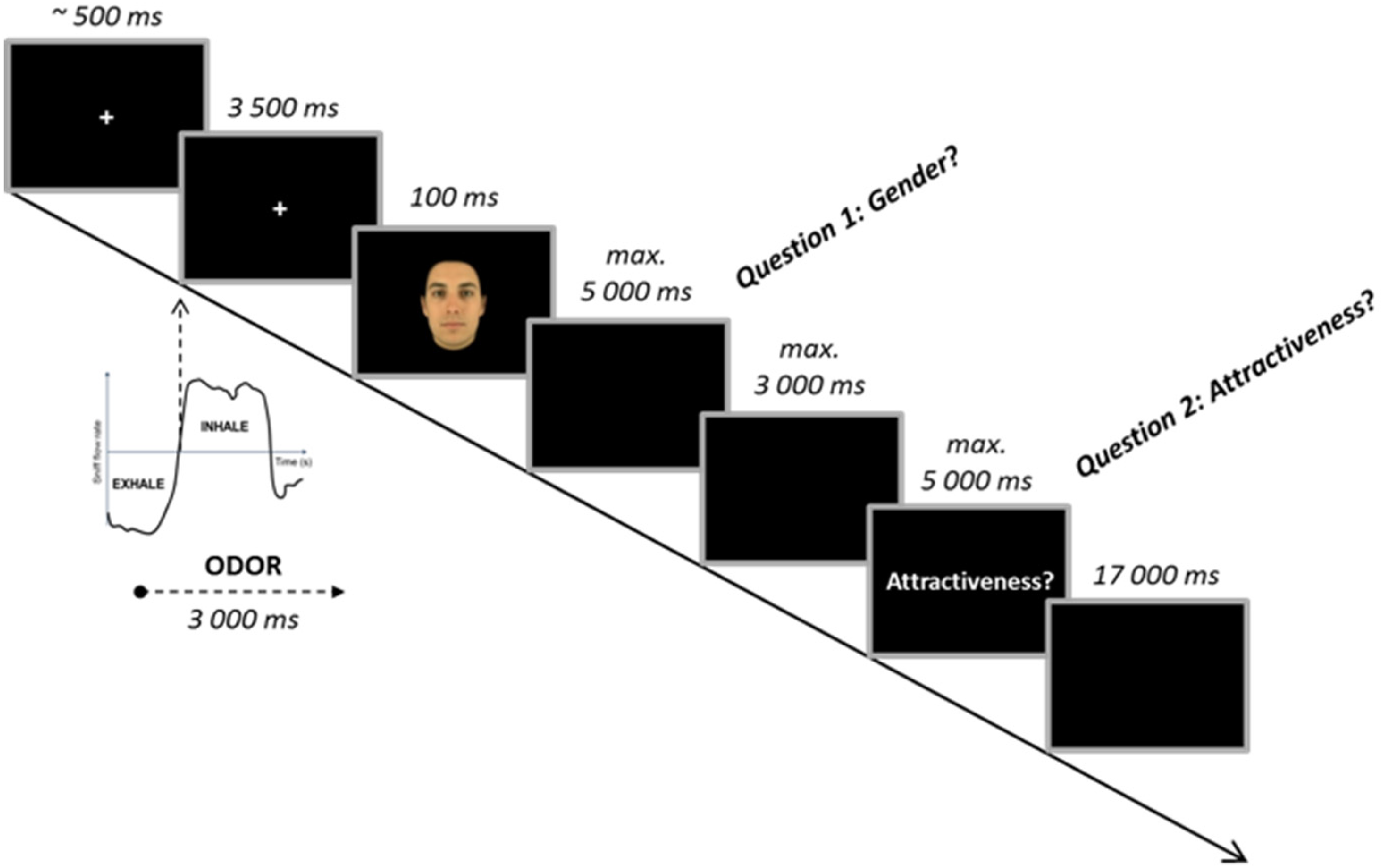
Sequence of the experiment for one trial, that is, one facial stimulus presented in one of three conditions (HMHA, DIA, or AIR). Participants had to determine the face's gender as fast as possible after face presentation (question not displayed on the screen), and then rate the attractiveness of the face (question displayed on the screen).
Data Analysis
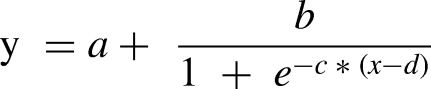
Variables. Each trial provided the following variables: attractiveness rating (1–5), gender identification (man = 1, woman = 0), gender identification response time RT, and sniff duration, namely the time between the inhalation starting point and the point where the flow returned to zero (for the first sniff after odor (or clean air) onset). Because the distributions of gender identification RT and sniff duration were heavily skewed, these variables were log-transformed. For gender identification, another variable was analyzed, based on the psychometric curves of gender identification responses, namely the frequency of “man” responses over the four facial identities for each of the nine levels of facial transformation (i.e., curves made of nine points that are the average of four responses). For each participant, the psychometric curve obtained in each condition (HMHA, DIA, and AIR) for each face identity (1–4) was fitted to a sigmoid model (using the curve_fit function from the Scipy Python library http://www.scipy.org) formalized as follows:
Missing values. Some trials were discarded as follows. For all variables, because we wanted to ensure that the participants had sniffed the odor during each analyzed trial, we removed trials where sniffs were too short (≤300 ms) and not detected or not analyzable; this also led to discard the responses of one participant (male) who had 42% unexploitable trials (data of 39 participants were therefore analyzed). In addition to these 181 discarded trials, three more were removed because of display problems for one face in one participant. In addition to this, (1) for attractiveness ratings, there were 15 missing responses; (2) for gender variables (gender identification, RT and IP), there were 11 missing responses and we discarded 27 inappropriate responses because they may indicate participant's distraction or fatigue (no key or unwanted key pressed on the response box for gender identification); (3) for gender identification RTs, we additionally removed outliers corresponding to values over three standard deviations from the participant's means. Overall, this represented 4.6%, 5.1%, 6.8%, 5.1%, and 4.3% of the 4320 trials removed for attractiveness, gender identification, gender identification RT, gender IP, and sniff duration, respectively.
Statistical analyses. Linear mixed models (LMMs) were conducted for each variable using the lmer and glmer (for the binary variable gender identification) functions of the lme4 package (Bates et al., 2015) of R (R Core Team, 2018). Fixed effects were Odor (HMHA, DIA, and AIR), Rater Gender (Man and Woman), Face Gender Level (FEM, AMB, and MASC, see details hereafter), and Face Attractiveness (Unattractive and Attractive). Note that the two latter factors were not included for gender IP (because they are not relevant due to the way this variable is calculated) nor for sniff duration (because we had no specific hypotheses regarding the possible modulation of this variable by the characteristics of the faces). Face Gender Levels were defined as feminine faces with morphing levels 1–3 (FEM), ambiguous faces with morphing levels 4–6 (AMB), and masculine faces with morphing levels 7–9 (MASC) (see Supplementary Material Section 5 for additional analyses conducted with Face Gender Level as a continuous variable using the nine levels of gender). As random effects, we introduced intercepts for subjects by face identity (1|subject:faceid): Likelihood Ratio Test model comparisons conducted to compare with the models using only (1|subject) showed that the former was better or equally good depending on the variables: we therefore decided to use (1|subject:faceid) in all the models for consistency purpose. Following the principle of parsimony, we used model comparison to determine whether interactions should be included or not. For example, for attractiveness, the model with the four-way interaction was not better than without, but the one with three-way interactions was better than the one with only two-way interactions, leading us to use the model with two- and three-way interactions. For models obtained with lmer, following Luke (2017) p-values were obtained using Kenward–Roger approximation in the ANOVA function of lmerTest package in R (Kuznetsova et al., 2017). For the model obtained with glmer, we used the “bobyqa” optimizer and set the number of model iterations to 100,000 to fit the model, and p-values of the effects were obtained using the ANOVA function. Uncorrected post hoc contrasts were performed using the multcomp function of the emmeans package in R (Lenth et al., 2018) and are reported in the results section with a significance level of 0.05. Odor ratings were analyzed with repeated measures ANOVAs with Rater Gender as between-subject factor and Odor as within-subject factor, followed by post hoc paired comparisons (t-tests). Finally, it must be mentioned here that three participants rated 0 for odor perceived intensity of HMHA (N = 1) or DIA (N = 2) at the end of the experiment. Consequently, analyses about face perception have been conducted both with and without these individuals, but as the conclusions remained the same in both cases, we chose to present only the results including all the participants (see Supplementary Materials Section 4 for the results without these individuals).
Results
Odor Ratings and Sniff Duration
Odor ratings. As expected, AIR was rated less intense than HMHA and DIA, while HMHA and DIA did not differ (repeated measures ANOVA: main effect of Odor F2,114 = 56.83, p < .0001, followed by post hoc pair comparisons; Figure 2(a)). Rater Gender and Odor × Rater Gender interaction were not significant for odor intensity (ps > .827). After keeping only HMHA and DIA in the analyses, we only found a marginal Odor × Rater Gender interaction for pleasantness ratings (F1,73 = 3.09, p = .083), due to the fact that women (but not men) rated HMHA as less pleasant than DIA and that gender differences occurred for HMHA only (women rated it as less pleasant than men; Figure 2(b)). There was no effect of Odor, Rater Gender and Odor × Rater Gender interaction for masculinity ratings (ps > .306; Figure 2(c)).
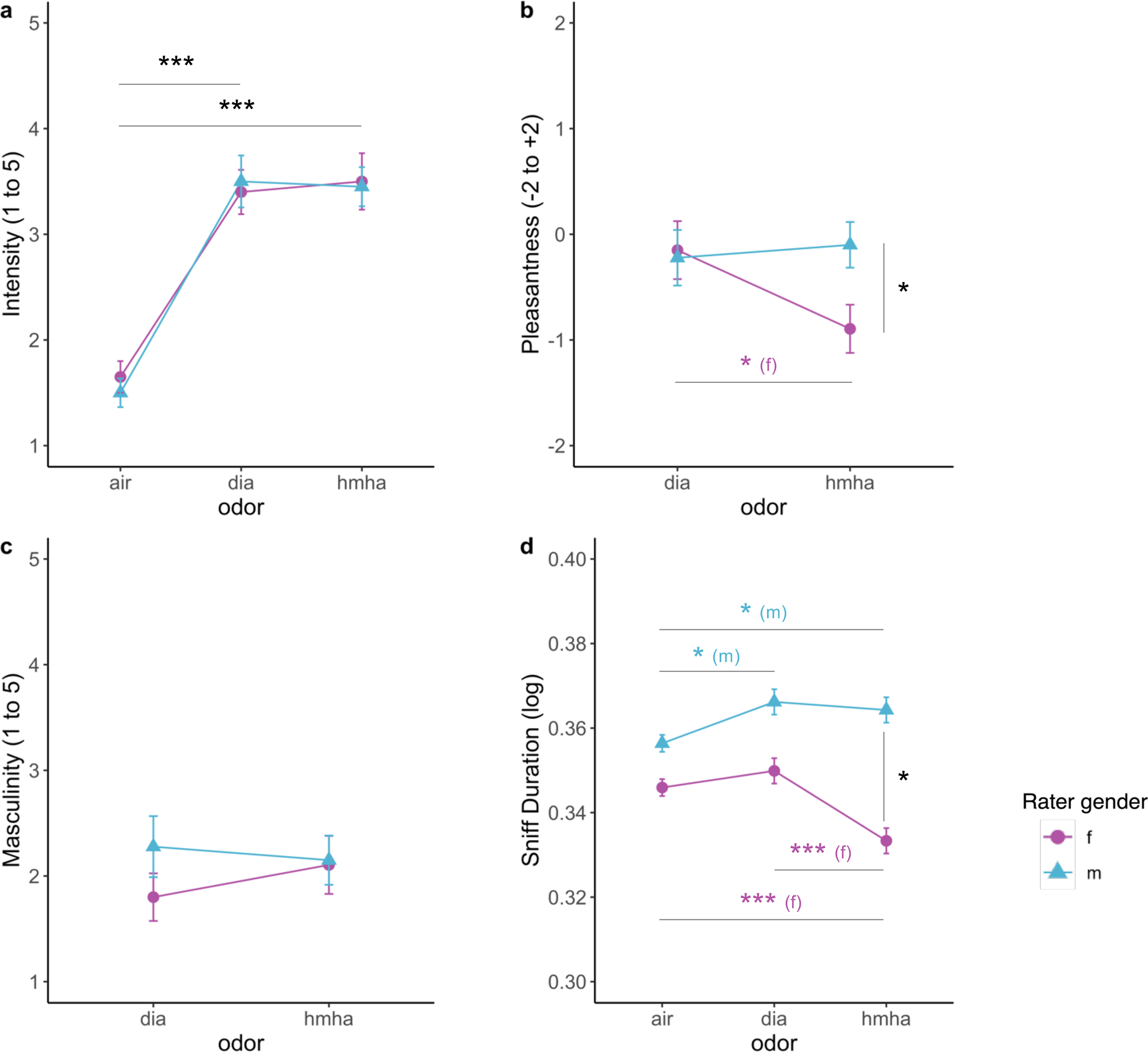
Intensity (a), pleasantness (b), masculinity (c), and ratings and sniff duration (d) in response to clean air and the odorants DIA and HMHA, as a function of rater gender (f: female; m: male) (mean ± SEM). Post hoc paired comparisons: *p < .05; ***p < .001.
Sniff duration. There was a significant effect of Odor (LMMs: F2,4093 = 7.84, p = .0004) and a significant Odor × Rater Gender interaction (F2,4093 = 10.25, p < .0001) (see full statistics in Table 1). Post hoc tests showed that men displayed shorter sniffs for AIR than for DIA or HMHA, that women displayed shorter sniffs for HMHA than for AIR or DIA, and that gender differences occurred for HMHA only (women had shorter sniffs than men; Figure 2(d)).
Sniff duration as a function of odor (HMHA, DIA, and AIR) and rater gender (man and woman).
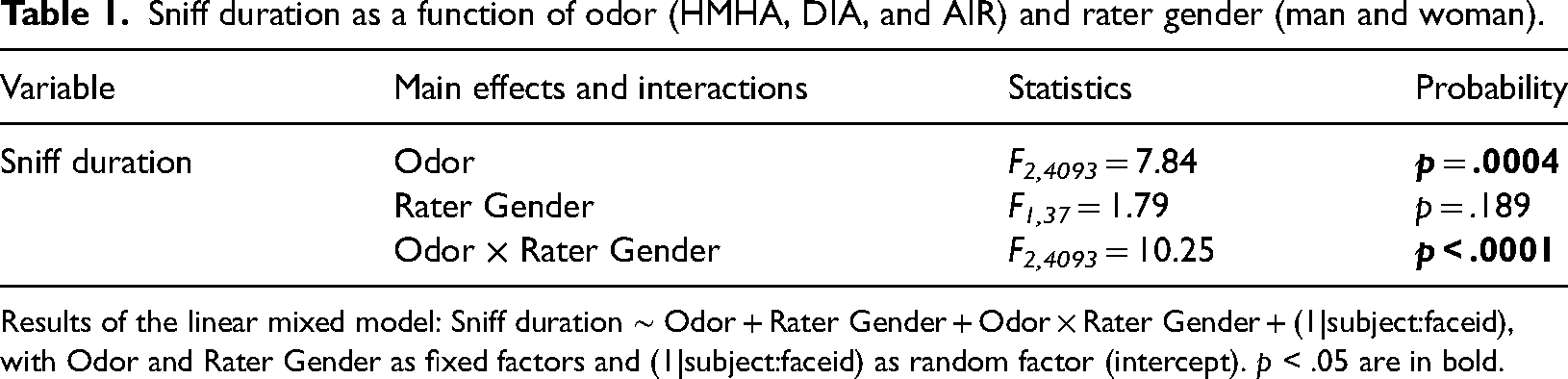
Results of the linear mixed model: Sniff duration ∼ Odor + Rater Gender + Odor × Rater Gender + (1|subject:faceid),
with Odor and Rater Gender as fixed factors and (1|subject:faceid) as random factor (intercept). p < .05 are in bold.
Face Ratings
The detailed results of the LMMs are shown in Tables 2 and 3, and descriptive statistics of all the variables are provided in Supplementary Material (Section 3).
Attractiveness ratings of faces as a function of odor (HMHA, DIA, and AIR), rater gender (man and woman), face gender level (FEM, AMB, and MASC), and face attractiveness (unattractive and attractive).
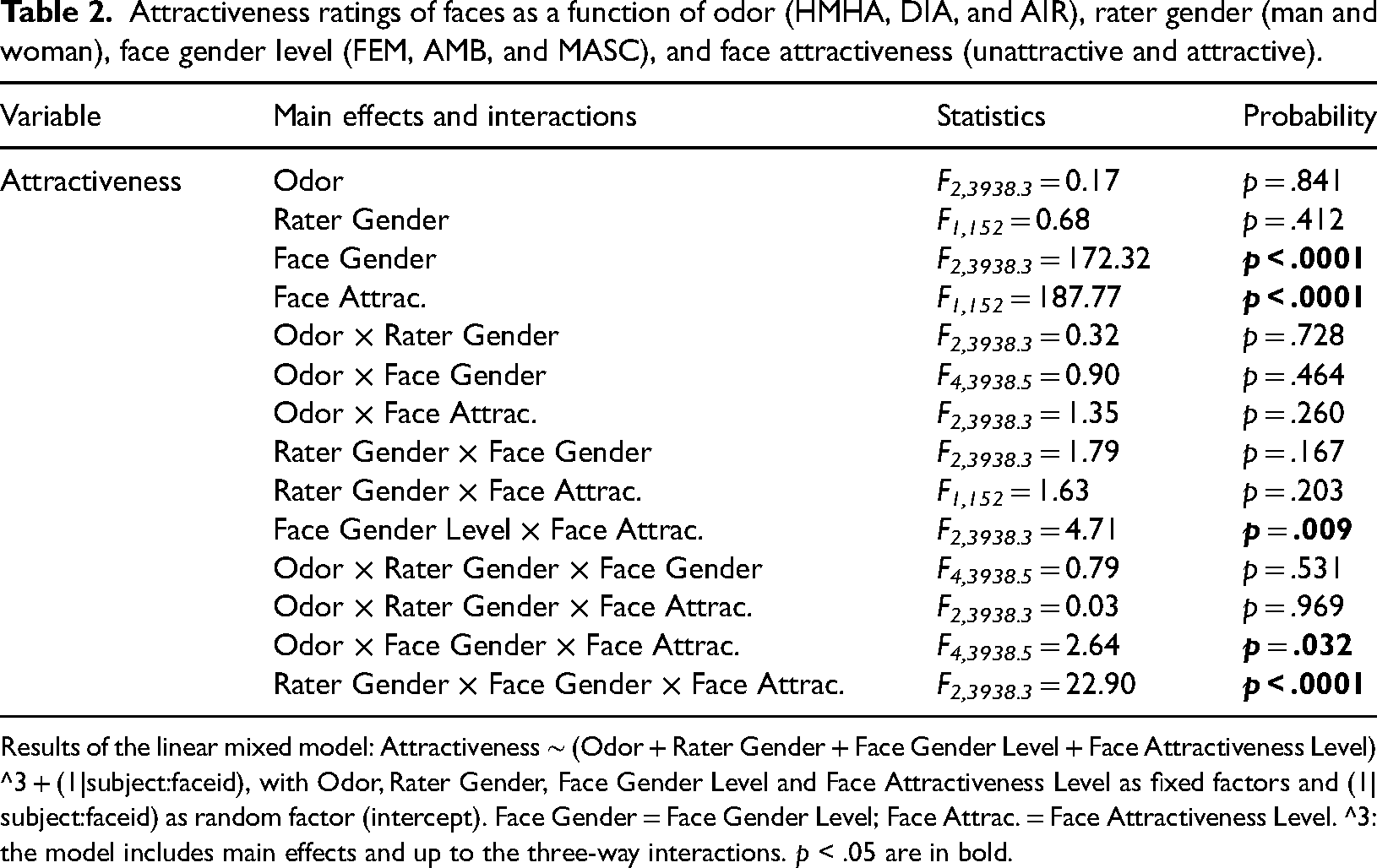
Results of the linear mixed model: Attractiveness ∼ (Odor + Rater Gender + Face Gender Level + Face Attractiveness Level)^3 + (1|subject:faceid), with Odor, Rater Gender, Face Gender Level and Face Attractiveness Level as fixed factors and (1|subject:faceid) as random factor (intercept). Face Gender = Face Gender Level; Face Attrac. = Face Attractiveness Level. ^3: the model includes main effects and up to the three-way interactions. p < .05 are in bold.
Attractiveness. The only significant effect involving the factor Odor was a three-way interaction Odor × Face Gender Level × Face Attractiveness Level (F2,3938.5 = 2.64, p = .032; Table 2). Post hoc tests revealed that this effect was due to higher attractiveness ratings of unattractive ambiguous faces when primed with HMHA compared to the control odor (p = .009) and, although the probability is just beyond the significance threshold, to air (p = .0506) (Figure 3(b)). In addition, there were significant main effects of Face Gender Level (p < .0001), Face Attractiveness Level (p < .0001), a significant interaction between these two factors (p = .009) and a significant three-way interaction between Rater Gender and these two factors (p < .0001). Post hoc analyses allowed to describe these differences in attractiveness as follows: (1) attractive > unattractive faces; (2) FEM > MASC > AMB faces for attractive faces and FEM > MASC = AMB for unattractive faces; (3) women find unattractive AMB and MASC faces significantly less attractive than men did (see also Supplementary Figure S8).
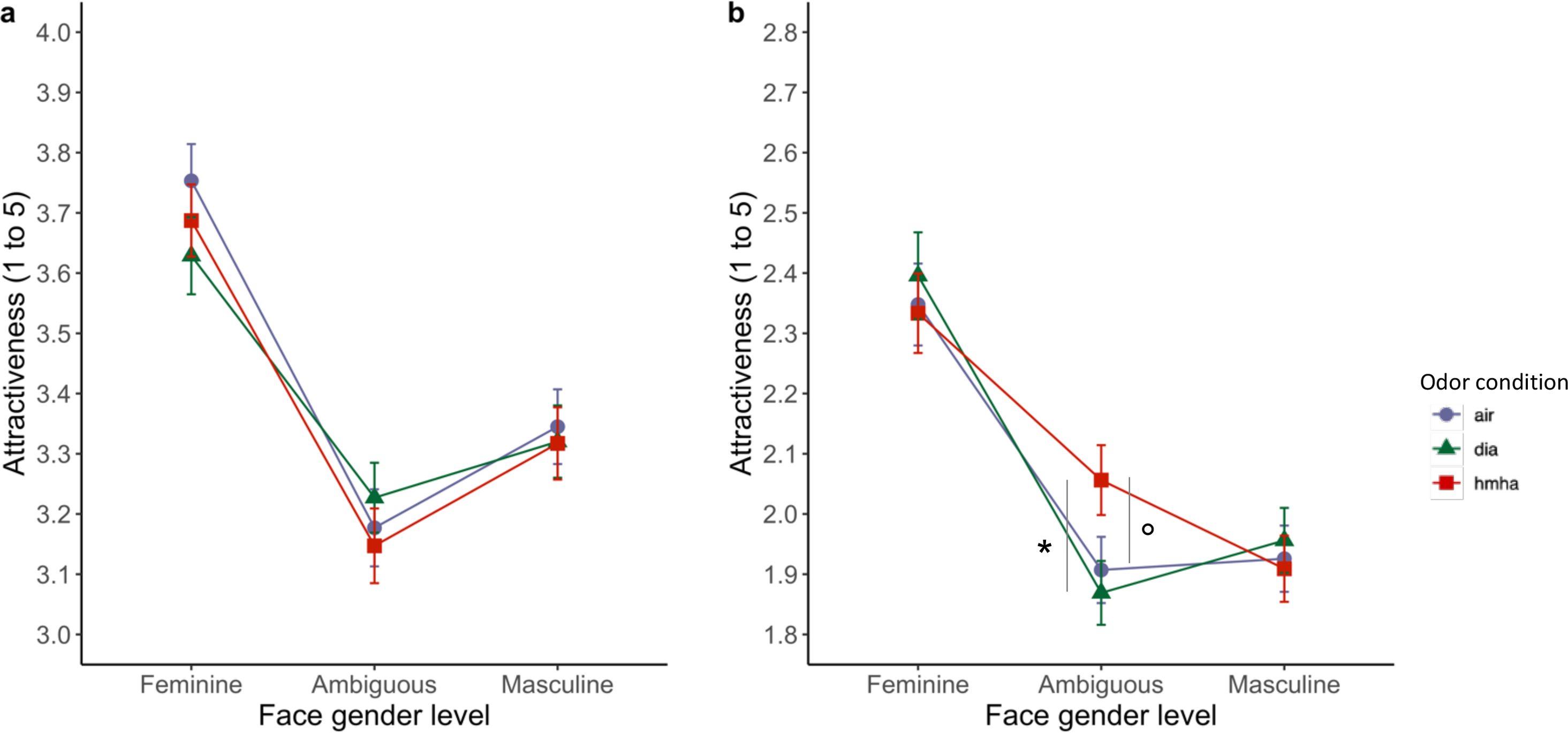
Effect of odor condition on attractiveness ratings of feminine, ambiguous and masculine faces for the subset of attractive faces (a) and of unattractive faces (b) (mean ± SEM). Post hoc paired comparisons: °p = .0506 (HMHA vs. AIR); *p < .05 (HMHA vs. DIA).
Gender identification. There were no main effect or interactions involving the factor Odor (see Table 3). The only significant effects were Rater Gender (χ21 = 7.52, p = .006, since women rated the faces more often as being male than men did), and Face Gender Level (χ22 = 1373.25, p < .0001), due to the expected frequency of male ratings: MASC > AMB > FEM.
Gender identification, gender identification response time (RT) and inflection point (IP) of the sigmoid curve of gender attributions to faces, as a function of odor (HMHA, DIA, and AIR), rater gender (man and woman), and—when applicable—face gender level (FEM, AMB, and MASC), and face attractiveness (unattractive and attractive).
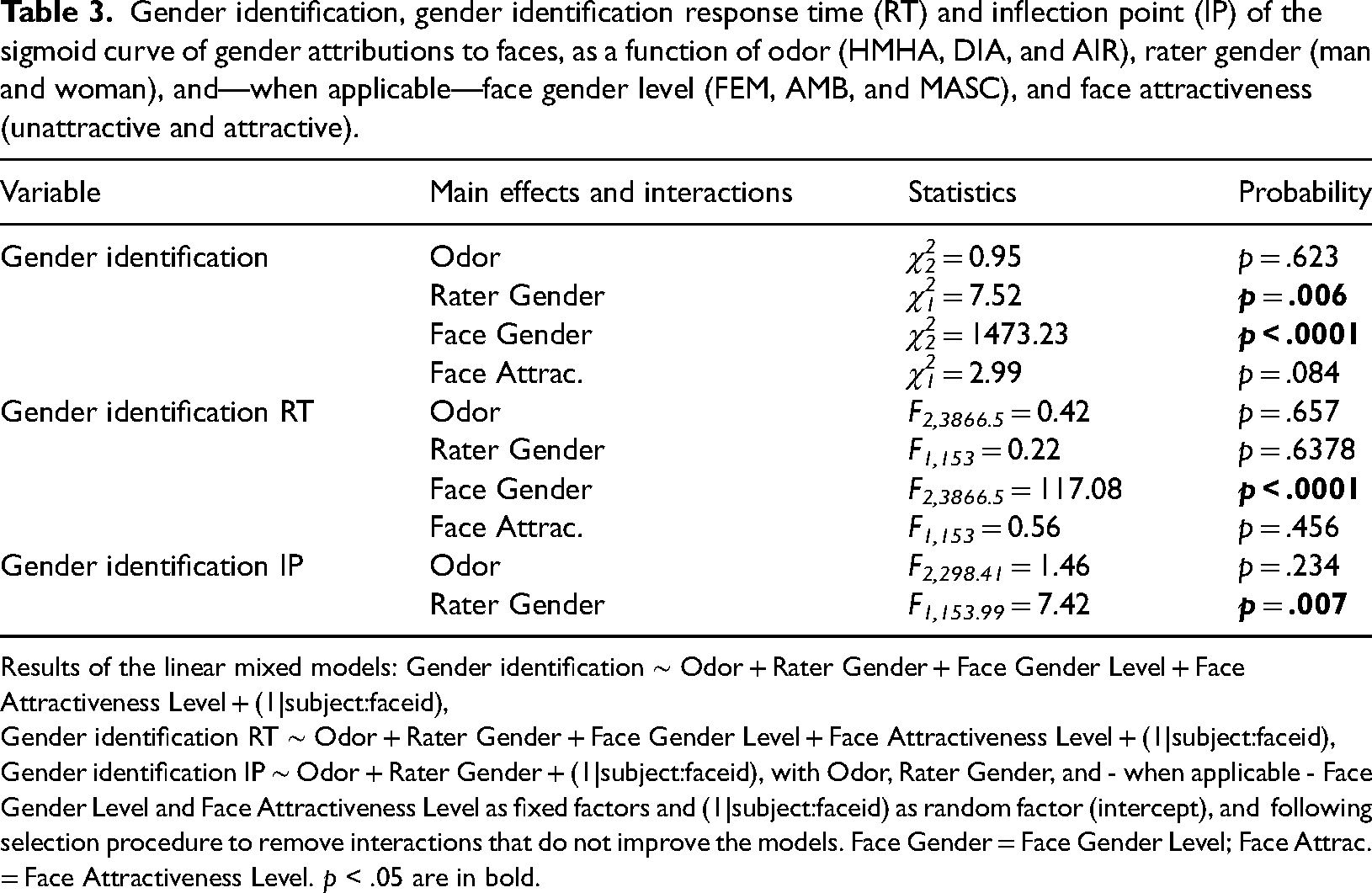
Results of the linear mixed models: Gender identification ∼ Odor + Rater Gender + Face Gender Level + Face Attractiveness Level + (1|subject:faceid),
Gender identification RT ∼ Odor + Rater Gender + Face Gender Level + Face Attractiveness Level + (1|subject:faceid),
Gender identification IP ∼ Odor + Rater Gender + (1|subject:faceid), with Odor, Rater Gender, and - when applicable - Face Gender Level and Face Attractiveness Level as fixed factors and (1|subject:faceid) as random factor (intercept), and following selection procedure to remove interactions that do not improve the models. Face Gender = Face Gender Level; Face Attrac. = Face Attractiveness Level. p < .05 are in bold.
Gender identification RT. There were no main effect or interactions involving the factor Odor (see Table 3). The only significant effect was an effect of Face Gender Level (F2,3866.5 = 117.08, p < .0001) caused by the expected longer time taken to attribute a gender to AMB faces (log-transformed RT: 3.04 ± 0.11 vs. 2.97 ± 0.11 for MASC and 2.98 ± 0.11 for FEM faces).
Gender IP. The inflexion point (IP) of the sigmoid curves modeling the face gender attributions along the feminine–masculine continuum did not vary according to Odor condition (see Table 3). There was only a main effect of Rater Gender (F1,153.99 = 7.42, p = .007), due to women's lower Gender IP (level 5.01 ± 0.12 on the 1-to-9 continuum vs. 5.48 ± 0.12 in men), indicating that they perceived more often the ambiguous faces (levels 4–6; see also Supplementary Figure S1) as being of males compared with men.
Discussion
Perception and behavioral effects of the acid fraction of human body odor remains poorly explored, compared to other families of compounds such as androstenes (in the field of face processing, see Damon et al., 2021). Here, we investigated whether HMHA, produced in larger proportions by men (Troccaz et al., 2009) could play a role in human interactions, either through intersexual processes (attraction) or intrasexual competition, which are two nonexclusive components of the sexual selection process. In particular, we tested whether HMHA (compared with a control odor or clean air) had implicit effects on gender perception and attractiveness ratings of female-to-male morphed faces, and whether there were sex differences.
Using olfactory priming where participants did not attend to the odor, we found no evidence in favor of an increased facial attractiveness or of a facilitated perception of masculinity in faces in presence of HMHA compared to the control conditions, in either male or female raters.
In the conditions of our study, the sexually dimorphic (male) body odor compound HMHA does not appear as a gender cue nor as a modulator of attractiveness, which refutes the hypothesis of an evolutionary role of HMHA in mate choice. Our face selection seemed to be however adapted to evidence such properties, if they existed. Indeed, we investigated varied levels of facial attractiveness (based on the large GEFAV database of faces designed for this purpose; Ferdenzi et al., 2015a). Also, we morphed faces to have stimuli with ambiguous gender, since visual ambiguity is a favorable condition for olfaction-vision interactions (see for instance the effect of body odor of fear on the perception of ambiguous facial expressions; Mujica-Parodi et al., 2009). Using other body odor compounds (androstenes), conflicting conclusions have been found regarding olfactory effects on face gender and attractiveness perception. While Kovács et al. (2004) found that androstenone increases perceived masculinity of faces, Ferdenzi et al. (2016a) did not report similar effects with a closely related compound androstadienone. As to attractiveness ratings of faces, they are higher in some studies (androstenol: Kirk-Smith et al., 1978; androstadienone: Ferdenzi et al., 2016a), but not in others (androstadienone: unaffected in Lundström & Olsson, 2005; and lower in Parma et al., 2012). Focusing on HMHA, another sexually dimorphic compound among the wide variety of compounds that constitute human body odor does not seem to provide more convincing arguments in favor of a role in attractiveness—at least using a face perception paradigm.
Some results of this study, not directly related to our main aim, deserve to be discussed here. First, women perceived HMHA as less pleasant than men did (while both groups did not differ for the control odor DIA). This is consistent with previous studies reporting women's stronger negative hedonic responses to odors of the axilla, of breath and of vaginal secretions (Doty et al., 1982, 1978, 1975; Stevenson & Repacholi, 2003), but also males’ desensitization to odors they are exposed to through their own body odors (Hummel et al., 2005). Olfactomotor measures were fully in line with the pleasantness ratings, since women also had shorter sniff durations than men in response to HMHA: indeed, sniff duration and odor pleasantness are usually negatively correlated (Ferdenzi et al., 2015b; Prescott et al., 2010). We cannot exclude that this sex difference in the perception of the odor could have reduced the hypothesized potential positive effect of facial attractiveness ratings of women. The fact that ratings of odor masculinity did not differ between HMHA and the control odor, or between female and male raters, could also explain why the expected effects of HMHA we not found in this study. Indeed, one mechanistic hypothesis of such effects (see de Groot et al., 2017) is that associations between the odor of HMHA and maleness develops in the recipient over lifetime. This was apparently not the case, at least based on the explicit conscious method we used to measure it (rating scale).
Second, women perceived the faces as overall more masculine, as indicated by gender identification responses and by the inflection point of the gender identification sigmoid curve. However, it is unlikely that this was a sex-specific effect of HMHA since it occurred in all the odor conditions, not only in the trials primed with HMHA. One can wonder whether seeing the experimenters faces (all females, CF, DP, or DL) before starting the experiment could have influenced differently men's and women's overall perception of masculinity. Indeed, aftereffects have been documented in the face perception literature and differences between male and female raters are described (for trustworthiness: Wincenciak et al., 2013).
Third, HMHA had a small effect on attractiveness rating that was independent of the gender of the rater, and that occurred in a very specific condition: when unattractive gender-ambiguous faces were presented. The fact that this effect was found with HMHA specifically, and on ambiguous faces only, finds an echo in the literature on odor-vision interactions. Indeed, it has repeatedly been shown that modulation by odors is particularly strong on ambiguous stimuli, and in a direction that is consistent with the odor content. For instance, fear body odors were found to facilitate the detection of relevant emotional expressions (fear or anger) in series of morphed faces involving faces with ambiguous expressions (de Groot et al., 2021; Mujica-Parodi et al., 2009; Rocha et al., 2018). It has also been shown that body odor (but not a control odor) facilitates the neural categorization of face-like objects that are both ambiguous and congruent (no such effect for faces, nor for other noncongruent objects: Rekow et al., 2022). As to why only unattractive faces, not attractive ones, are affected by the effect of HMHA, it can be speculated that there is more room for improvement for unattractive faces (rated < 2.5 on a 1-to-5 scale) than for attractive faces (rated between 3 and 4).
There were some limitations to the present study. First, we included women who purposely were representative of the population in terms of contraceptive use (high proportion of pill users; no selection on that criterion). Conducting this experiment with only spontaneously ovulating women, and a fortiori by comparing different phases of their menstrual cycle (follicular vs. luteal), may have provided different results. Indeed, although this is a debated subject (Gildersleeve et al., 2014a, 2014b; Harris et al., 2014; Wood et al., 2014; Wood & Carden, 2014), variations according to hormonal contraception and ovulatory cycle were found with regard to face and body odor perception (Ferdenzi et al., 2009; Jones et al., 2008; Parma et al., 2012; Roberts et al., 2008). The second limitation is the fact that odors were presented at supraliminal concentrations. In Ferdenzi et al. (2019), a prescreening led us to elaborate a threshold detection task with concentrations ranging from 1.2 × 10⁻² ppm to 400 ppm, and to use it for perceptual ratings at a concentration corresponding to one dilution step above the individual threshold. Here, we used this odorant at a much higher concentration (10,000 ppm), mostly to allow for comparison with a control odorant which was chosen based on perceptual ratings. However, the influence of (body) odors is likely to remain below the level of consciousness, without the odor being explicitly perceived (e.g., Richard Ortegón et al., 2022) and with possible disruption of the effect if the odor reaches conscious perception (Li et al., 2007). Additionally, whether the level of HMHA concentration used in the current study corresponds to the level naturally produced at the surface of the body is unknown, thus limiting the ecological validity of the approach (see discussion of this issue in Burke et al., 2012, and Damon et al., 2021). Third, the sample used in this study was rather small, which limits the generalizability and reliability of the conclusions. If future research is to be carried out on the effect of HMHA on social stimuli, it should involve larger samples to validate and extend the present findings.
To conclude, in this study we followed our idea expressed in Ferdenzi et al. (2016a; on the effect of androstadienone on the perception of social stimuli) that to better understand human chemical communication, it is necessary to enlarge the scope of investigated molecules. By choosing to focus on the male compound HMHA, we expected that, while very few evidence in favor of a role in mate choice were found with explicit testing (Ferdenzi et al., 2019), more convincing effects may be found using implicit effects on face ratings. This was however not the case. To investigate the impact of single molecules on human behavior in the future, it would be preferable to use physiological concentrations, that is, comparable to what is found in body odors, if possible (Wyatt, 2015). Also, body odorants’ presentation in mixtures corresponding to more realistic contexts should be favored, ideally (e.g., embedded in a body odor basis, constituted by either an artificial mixture of compounds or obtained by pooling samples from many donors). Testing the effect of body odorants in real (or closer to real) social interactions (Ferdenzi et al., 2016b), for example, using economic games (Huoviala & Rantala, 2013; Perrotta et al., 2016; Tognetti et al., 2022) would help increase the ecological validity of the research in this field. More generally, more research effort is needed to identify other behaviorally relevant chemical compounds (to date, body odor knowledge rests almost only upon malodor compounds and androstenes). Interdisciplinary research bringing together chemistry, experimental psychology, human evolution, and neuroscience are essential to increase our understanding of chemical communication in humans in the future.
Supplemental Material
sj-pdf-1-pec-10.1177_03010066231222473 - Supplemental material for Influence of the human body odor compound HMHA on face perception
Supplemental material, sj-pdf-1-pec-10.1177_03010066231222473 for Influence of the human body odor compound HMHA on face perception by Camille Ferdenzi, Arnaud Fournel, Nicolas Baldovini, Daphnée Poupon, Déborah Ligout, Marc Thévenet, Romain Bouet and Moustafa Bensafi in Perception
Footnotes
Acknowledgments
The authors wish to thank Christophe Bousquet for useful advice regarding the statistics.
Author contribution(s)
Declaration of Conflicting Interests
The author(s) declared no potential conflicts of interest with respect to the research, authorship, and/or publication of this article.
Funding
The author(s) disclosed receipt of the following financial support for the research, authorship, and/or publication of this article: Agence Nationale de la Recherche (grant number PDOC program, ATTRASENS project, to CF).
Data Availability
Data and program code that support the findings of this study are available from the corresponding author (CF) upon request.

Supplemental Material
Supplemental material for this article is available online.
References
Supplementary Material
Please find the following supplemental material available below.
For Open Access articles published under a Creative Commons License, all supplemental material carries the same license as the article it is associated with.
For non-Open Access articles published, all supplemental material carries a non-exclusive license, and permission requests for re-use of supplemental material or any part of supplemental material shall be sent directly to the copyright owner as specified in the copyright notice associated with the article.
