



Abstract

I was pleased but surprised to see a painting by Charles Sheeler (1883–1965) in the recent special exhibition Art for the Millions: American Culture and Politics in the 1930s at the Metropolitan Museum of Art in New York City. Pleased because Sheeler is one of my favorite artists from that period; surprised because Sheeler's paintings, typically of urban and industrial exteriors are devoid of people, while I figured that works in the exhibit would feature people. But there, in the very center of the middle of the three galleries on a red pedestal, was Sheeler's Americana (Sheeler, 1931; https://www.metmuseum.org/art/collection/search/486014).
Americana is a rare Sheeler interior. (He did paint the same room in his house shown in Americana from a different angle [Homer Sweet Home 1931], which does not include the multistable percept). Americana is desolate, like Sheeler's exteriors, with no people in the painting or other signs of recent life such as uneaten food. Further to this, the piece of paper on the table is blank. However, the backgammon game, still unfinished, makes it seem like the painting is depicting a moment in time—“frozen in time” as per the Metropolitan website description—a still life (Sheeler, 1931). The backgammon can't help but cause one to think of Caravaggio's The Cardsharps (1590–1594) (which also includes a backgammon board). Could Americana somehow be Sheeler's version of an Old Master painting?
The angle of the table is slanted, somewhat unusually. I agree with the description on the Metropolitan website, which suggests that this may have been painted from a top-view photograph Sheeler, an avid professional and recreational photographer, took of the room. The patterns on the carpets and pillows hauntingly portend and presage the random codes and bar codes of the war and its aftermath in the coming decades. Nevertheless, the focus of the painting definitely seems to be the floor tiling seen in the upper left.
The main part of the tiling shown in the painting consists of nine large squares arranged in a 3 × 3 array, each large square being made up of nine little squares. (A portion of the tiling is illustrated schematically in Figure 1. The nine large squares are labeled
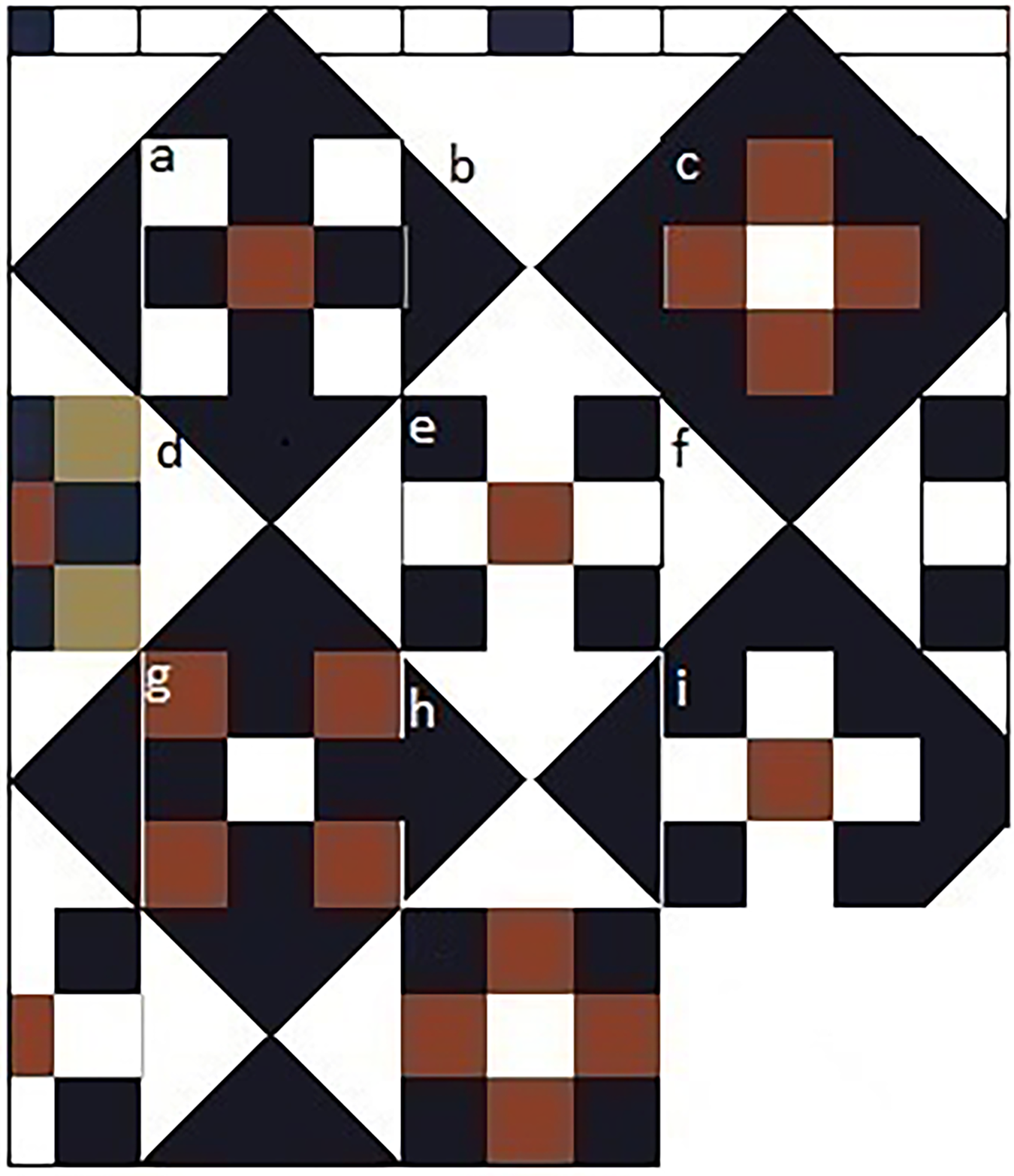
Schematic of the main part of the multistable tiling illusion. See text for discussion.
The perception of patterns of the nine large squares permits at least five multistable percepts: The main percept (I) upon first viewing is to see the nine squares in three columns (large squares
Formal study could demonstrate switching times and sequence for the different percepts. Interestingly, another painting at the Metropolitan in its Robert Lehman Collection The Annunciation (1480–1489) by Hans Memling (~1433-1440–1494) (https://www.metmuseum.org/art/collection/search/459055) has in the foreground a tiling, which may be a still novel bistable percept.
Footnotes

Author Contribution(s)
Declaration of Conflicting Interests
The author declared no potential conflicts of interest with respect to the research, authorship, and/or publication of this article.
Funding
The author received no financial support for the research, authorship, and/or publication of this article.