




Abstract

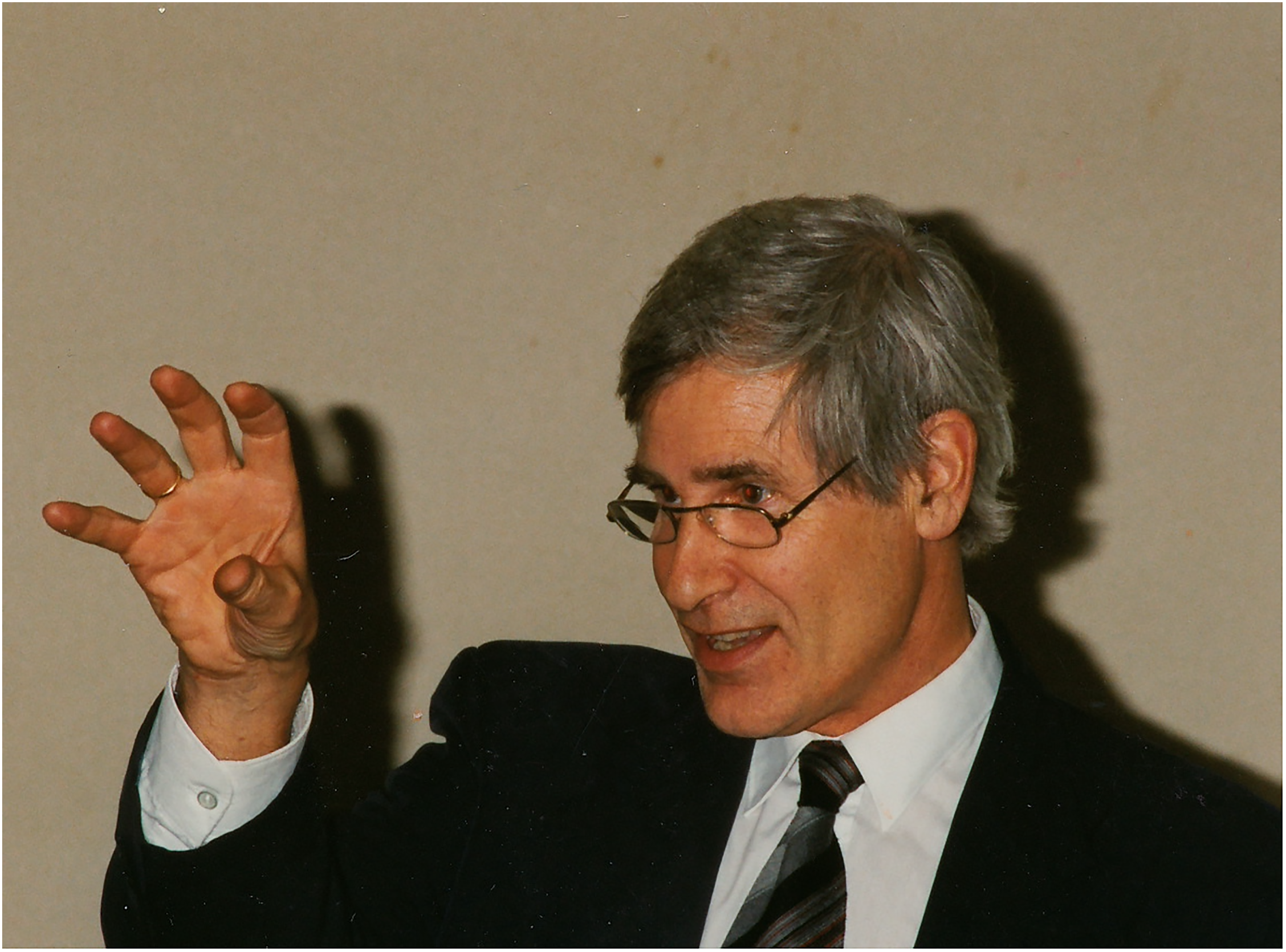
Willem Alexander Paul Frederik Lodewijk van de Grind or Wim as was known by his friends, died on 14 July 2024 after a short period of illness at the age of 88.
Wim was probably most well-known by the readers of our journal for his psychophysical work on the visual system, in particular his work on motion perception. But his interests were broader—much broader—probably because he understood the potential of modelling and modern recording techniques to find answers about the visual system. That was in part the result of his training, which was atypical for an electrical engineer interested in the visual system in the mid-sixties of the last century.
As an undergraduate student, he studied Electrical Engineering at Delft University of Technology. His initial interest was so-called switching technology in the world of electronics; full of relays, transistors, and diodes. While preparing to finish his studies, he read about new developments where scientists had built an electronic neuron. Fascinated by this innovation and its possible applications, he engineered a retina that modelled the neural responses to ON and OFF stimulation by light. It brought him the academic excitement he was looking for, yet it was impossible for him to pursue this topic at his alma mater. A professor at Delft University directed him to Professor Maarten Bouman at Utrecht University, which would change his life once again.
As a graduate student at Utrecht, he extended his work on the light-dependent dynamics of the retina. During that time he also spent 6 weeks in the lab of the famous cybernetician Warren Sturgis McCulloch at Massachusetts Institute of Technology. Wim's dissertation with the title “Retinal Machinery” was the thinnest thesis I have seen, it had 12 pages. It is good to know that in those days it was common to compile all the abstracts of one's already published papers, 6 in Wim's case, with an intro and outro as a dissertation. Wim's papers were published in the journal Kybernetik, later renamed Biological Cybernetics. He successfully defended his thesis in 1970 and was awarded a Cum Laude, which is the highest honour in the Netherlands.
As an engineer he lacked knowledge about the biological basis of the visual system, however, upon discovering its complexity, Wim's interest changed from “dead” engineered neurons to those based on “living” biological systems. This became his motto for the rest of his career. I remember a colleague graduate student whose PhD topic was to model motion detectors for looming (and vanishing) stimuli. At first sight not an easy job. A few months after he started, the graduate student, a mathematician by training, showed Wim his programmed model, and it clearly worked. “Excellent!” was Wim's reaction “and now build looming detectors based on known biological principles.” It took the grad student years to come even close.
In Bouman's lab, Wim met his friend and long-time collaborator Jan Koenderink and somewhat later Andrea (Ans) van Doorn. Together they investigated the motion perception system using a custom-built motion stimuli generator. At the time, video random access memory for regular computers could hold about 90 images, at 60 Hz this meant that the same stimulus would re-appear after 1.5 s, far from desirable for motion experiments. To deal with this issue, they designed and built their own random dot generator that had a wraparound time of 14 min at 100 Hz for 512 × 512 pixels in all cardinal directions. This was phenomenal and unheard of at the time. It was the foundation for several important papers on motion perception, which should have gained more attention. It even resulted in the late Werner Reichardt visiting the lab where “The Utrecht Troika” (as Wim, Jan, and Ans became known), showed Reichardt their simplified bi-local motion detector (as for example in Figure 1 in Sekuler et al., 1990, p. 206), to which Reichardt commented: “Call it whatever you want but not a Reichardt detector!”
After Wim received his PhD, he continued to work in Utrecht and later gained a position at the University of Amsterdam. In 1976, he was appointed full Professor at the Free University (Freie Universität) of Berlin, where his friend, the late Otto-Joachim Grüsser, also had his labs. He returned to Amsterdam in 1982, and in 1987 he joined his favourite University in Utrecht again. This time, he was appointed Professor of Comparative Physiology in the Faculty of Biological Sciences.
Until his retirement in 2001, he headed the Neuro-Ethology division, where he built a multi-disciplinary team and research lab with many graduate students and several members of staff. His love for neurophysiological measurements was omnipresent. He recorded from neurons in the retina and cortex of a cat, the electroreceptors of catfish, and used psychophysics to study binocular vision, structure from motion, movement and its aftereffects, of course, he tried to model the underlying structure and processes.
Wim successfully supervised many PhD students, several of whom are now Professors. All of Wim's graduate students hold fond memories of a caring supervisor, who instilled strengths of a multi-disciplinary approach to solving the mysteries of our brain and behaviour.
Wim was also a gifted teacher and very popular among the Utrecht undergraduate students, whom he lectured about “physics of life” and the physiology of perception and intelligence. These lectures formed the basis for two excellent books on intelligence. Wim's exceptional teaching qualities and passion for educating students were highlighted when he was named an honorary member of the Biology Student Society (Utrechtse Biologen Vereniging).
Wim held strong opinions on many topics and—truth be told—when convinced he was right, it would take a lot to change his mind. Hiro Ono (1984, see also Krol & Van de Grind, 1984) will remember the heated discussions about the double nail illusion and Brian Rogers’ adrenaline level will surely go up when thinking of the NATO conference in York Canada, where Wim tried to downplay the role of vertical disparities (see also Rogers & Bradshaw, 1993). Yet, heated debates are part of Dutch culture and can be entertaining. As some are aware, we Dutch are known to be direct, and Wim was no exception.
There were occasions when Wim clearly felt that he did not receive the recognition he deserved. I recall a discussion with Henk Spekreijse, at the time the editor-in-chief of the journal Vision Research, who would send Wim the most complicated manuscripts to review. That is, those manuscripts that all of us don't feel comfortable enough to give an expert opinion on. Wim often agreed to do these time-consuming reviews, but when he declined, Henk tried to convince him to reconsider, which made Wim ask Henk: “If you are so eager to hear my opinion, why didn't you ever ask me to become a member of your journal's editorial board?” As is true for most of us, some acknowledgement would have been appreciated.
Several of our older readers might remember that Utrecht and Cambridge were not the best scientific friends. Horace Barlow and Maarten Bouman had their moments and students generally side with their supervisors. At the European Conference on Visual Perception (ECVP) conference in 1992 in Pisa—my first—Wim used the business meeting to show his frustration about the number of invited speakers with a Cambridge connection (as had the organizers of that ECVP). Michael Morgan picked this up nicely and asked Wim to give an invited lecture at his ECVP in 1993 which was held in Edinburgh. Wim was honoured and of course, accepted the invitation. Later, he was more than just honoured when he was asked to give the prestigious Perception lecture at the ECVP in Groningen in 2000. He spent weeks preparing that lecture. I had the privilege to introduce him.
The early noughties were also the time Wim showed his justified anger with the obligatory retirement rules in the Netherlands. Possibly related, he was extending his already wide international network. For example, by successfully nominating Patricia Goldman-Rakic in 2000 for an honorary doctorate at Utrecht University. Patricia invited him to do research in her lab once retired. Luckily, Wim was able to continue to work close to his home. His successor was aware of Wim's wish to remain active in research and provided lab and office space. His existing network also assisted Wim's research and from 2003 to 2004 he was a visiting Professor at the University of Freiburg, on an invitation from Lothar Spillmann.
Sadly, Wim's plans dramatically changed when he suffered a cerebrovascular accident (stroke) in 2010 resulting in aphasia. This meant Wim had to renounce his love of writing, psychophysics, electrophysiology, and computational modelling. While this was an adjustment, Wim found joy in reading.
As mentioned, Wim's international network was extensive, which his students still profit from today. Many of his graduate students became post-docs around the world in the most prestigious labs, and Wim was extremely proud of his students and their careers, some of whom even continued to work alongside him. Wim's students were equally proud of having him as a supervisor which is the ultimate reflection of one's character. After 2010, communication with Wim became a little more difficult, nonetheless, he kept a special place in many hearts, mine included.
Wim is survived by Åse, the love of his life and devoted wife for more than 62 years, their children, and grandchildren, who miss him dearly.
Footnotes
Acknowledgements
I thank Ignace Hooge, Richard van Wezel, Jan Koenderink, Ans van Doorn, and my colleague editor-in-chief, Peter, Tim, Isabelle, and Pascal for their comments.
Declaration of Conflicting Interests
The author declared no potential conflicts of interest with respect to the research, authorship, and/or publication of this article.
Funding
The author received no financial support for the research, authorship, and/or publication of this article.
