




Abstract
Facial expressions play a crucial role in social communication, influencing judgments of trustworthiness and competence. While previous research has examined how face masks affect trust and competence in general populations, little is known about their impact on individuals with high autistic traits, who often rely more on the mouth region for social cue interpretation. The present study investigates the effects of face masks on perceptions of trustworthiness and competence as a function of high and low autistic traits. Results show that masked faces are generally perceived as more trustworthy and competent than unmasked faces. The effect of mask wearing on trustworthiness and competence ratings was not affected by autistic traits, suggesting that participants, regardless of their level of autistic traits, adjusted their judgements using available facial cues.
Introduction
Faces play a vital role in social communication, with most interactions relying on facial expressions to convey emotions and non-verbal cues. Face masks that cover the nose and mouth impede the recognition and interpretation of facial expressions (Barrick et al., 2021; Grundmann et al., 2021), thereby diminishing individuals’ ability to assess emotions in social contexts (Spitzer, 2020) and increasing the likelihood of misunderstandings (Carbon, 2020). Given that facial expressions are critical for evaluating intentions, focus and personality traits, their obstruction may adversely affect judgements of trustworthiness and competence—factors essential for effective social and professional integration (Hopfensitz & Mantilla, 2023; Todorov et al., 2009, 2015).
Trustworthiness and Competence
Trustworthiness plays a vital role in first impressions, shaping judgements of honesty, reliability and integrity. Facial cues, especially mouth visibility and expressions, are crucial for assessing trustworthiness (Bylianto & Chan, 2023). Dynamic signals such as smiles enhance perceived trustworthiness (Centorrino et al., 2015; Krumhuber et al., 2007; Schmidt et al., 2012). The face mask covers these cues, raising questions about masks’ impact on trust perceptions. Research shows mixed findings on masks and trustworthiness. Some studies suggest masks enhance perceived trustworthiness by demonstrating professionalism and responsibility (Fang & Kawakami, 2024; Oldmeadow & Gogan, 2024; Wang et al., 2024). Wang et al. (2024) found that in an investment game, face masks increased perceived trustworthiness for low-trustworthy faces by hiding negative trust cues, while reducing trustworthiness for high-trustworthy faces by blocking positive facial trust signals. Similarly, Fang and Kawakami (2024) found that faces wearing masks were consistently perceived as more trustworthy than unmasked faces. Conversely, Bylianto and Chan (2023) found that face masks significantly reduced perceptions of trustworthiness by obscuring critical facial cues, even though participants focused more on the eye region to compensate for the occluded lower face. By obscuring these cues, face masks disrupt emotion recognition but generally increase perceived trustworthiness, likely by reducing negative signals and bias (Guo et al., 2022; Oldmeadow & Koch, 2021).
Competence, involving judgements of capability and professionalism, depends on both dynamic and structural facial cues (Hopfensitz & Mantilla, 2023), with expressive signals such as smiles enhancing perceived competence (Min & Hu, 2022; Wang et al., 2017) and stable features like facial sexual dimorphism also contributing to competence judgements (Oh et al., 2019; Walker & Wänke, 2017; Wen et al., 2020). Some studies report no change as a function of face mask on competence perception (Guo et al., 2022; Oldmeadow & Koch, 2021), while others find increases (Stosic et al., 2024), likely moderated by expression, facial structure and observer characteristics (Grundmann et al., 2021; Kamatani et al., 2021; Marini et al., 2021). Masks may increase perceived competence by signalling professionalism and medical expertise (Fang & Kawakami, 2024; Klucarova, 2022). For example, masked individuals are often judged as more competent due to associations with health professionals, and similar effects are observed in service contexts where masks convey professionalism (Klucarova, 2022; Liang & Wu, 2022). Conversely, masks can reduce perceived competence by obscuring facial cues and impairing emotion recognition (Grahlow et al., 2022), making it harder to convey competence; this also hinders positive first impressions of competence and trustworthiness (Bennetts et al., 2022).
Autism
For individuals high in autistic traits, masks may amplify existing challenges in face perception (Pazhoohi et al., 2021). Autism is associated with difficulties in social interaction and communication, having intense interests, and engaging in repetitive behaviours (American Psychiatric Association, 2013). Individuals displaying the broad autism phenotype (BAP) exhibit elevated autistic traits and related challenges at sub-clinical levels, consistent with a dimensional view of autism as a spectrum in which traits are continuously distributed across the population rather than confined to categorical diagnoses (Bernier et al., 2012; De Groot & Van Strien, 2017; Morrison et al., 2018; Wheelwright et al., 2010).
Individuals with autism and those exhibiting the BAP have been found to gaze less at the eyes (Adolphs et al., 2008; Cuve et al., 2018; Moriuchi et al., 2017; Spezio et al., 2007; Wieckowski & White, 2017) and focus or rely more on the mouth for social interpretation (Adolphs et al., 2008; Fujioka et al., 2016; Klin et al., 2002; Spezio et al., 2007; Wieckowski & White, 2017). These different patterns of face exploration may explain the difficulties experienced by individuals with autism and those displaying the BAP in interpreting social cues or facial expressions (Cha & Kim, 2023; Uljarevic & Hamilton, 2013; Wieckowski & White, 2017). However, other studies have found no difference between neurotypicals and individuals with autism or those exhibiting the BAP in terms of fixations to the mouth (Hernandez et al., 2009) or the eyes (Sawyer et al., 2012), or their ability to recognise expressions (Jones et al., 2011; Soto-Icaza et al., 2022).
Current Study
The growing body of research on the impact of face masks on perceptions of trustworthiness and competence has primarily focused on specific contexts, such as professional or healthcare settings (Klucarova, 2022; Liang & Wu, 2022), or the general population (Grundmann et al., 2021), leaving a notable gap in exploring how mask usage might affect the social difficulties faced by individuals higher in autistic traits. This is particularly relevant for individuals higher in autistic traits, who show atypical face-scanning strategies (e.g., reduced eye fixation and greater reliance on the mouth). The current study aims to address this research gap by investigating the effect of face masks on perceptions of trustworthiness and competence as a function of autistic traits. Specifically, it seeks to determine whether the presence of face masks differentially affects the challenges faced by individuals higher in autistic traits, compared to those lower in autistic traits, in forming judgements of trustworthiness and competence. Moreover, stimulus sex and participant sex were included as factors, as prior research shows that both target and perceiver sex can systematically influence evaluations of trustworthiness and competence (Dong et al., 2018; Oh et al., 2019; Wen et al., 2020).
Methods
Participants
A total of 287 participants (83 men and 204 women), between the ages of 18 and 31 years (M = 20.29, SE = 2.04), were recruited from the University of British Columbia human subject pool. Participants were compensated with course credits for their time, and all participants provided informed consent prior to taking part in the study. Ethical approval was obtained from the Ethics Committee at the University of British Columbia before the recruitment process began. Data were collected in spring 2021.
Stimuli and Procedure
Images of 25 male and 25 female faces, which totals 50 faces were obtained from the FACES database (Ebner et al., 2010). The faces were aged between 19 and 31 years with a neutral expression. Another set of 50 stimuli of the same identities were created by superimposing a facial mask on the original images (Figure 1). Each set of stimuli which included masked and unmasked faces were randomised and presented in separate blocks. After consenting to participate in the study, participants answered socio-demographic questions. 1 Participants also completed an AQ-10 Autism Spectrum Quotient (AQ-10; Allison et al., 2012) questionnaire. Participants were asked to respond to 10 statements on a four-point scale from 1 (definitely agree) to 4 (definitely disagree). Following the scoring guidelines outlined by the developers of the AQ-10, individuals obtaining a total score of six or higher are recommended for referral for a comprehensive diagnostic evaluation for autism (Allison et al., 2012). Based on this criterion, participants were categorised into high scorers (N = 144, M = 7.00, SD = 1.06) and low scorers (N = 143, M = 3.98, SD = 0.96).
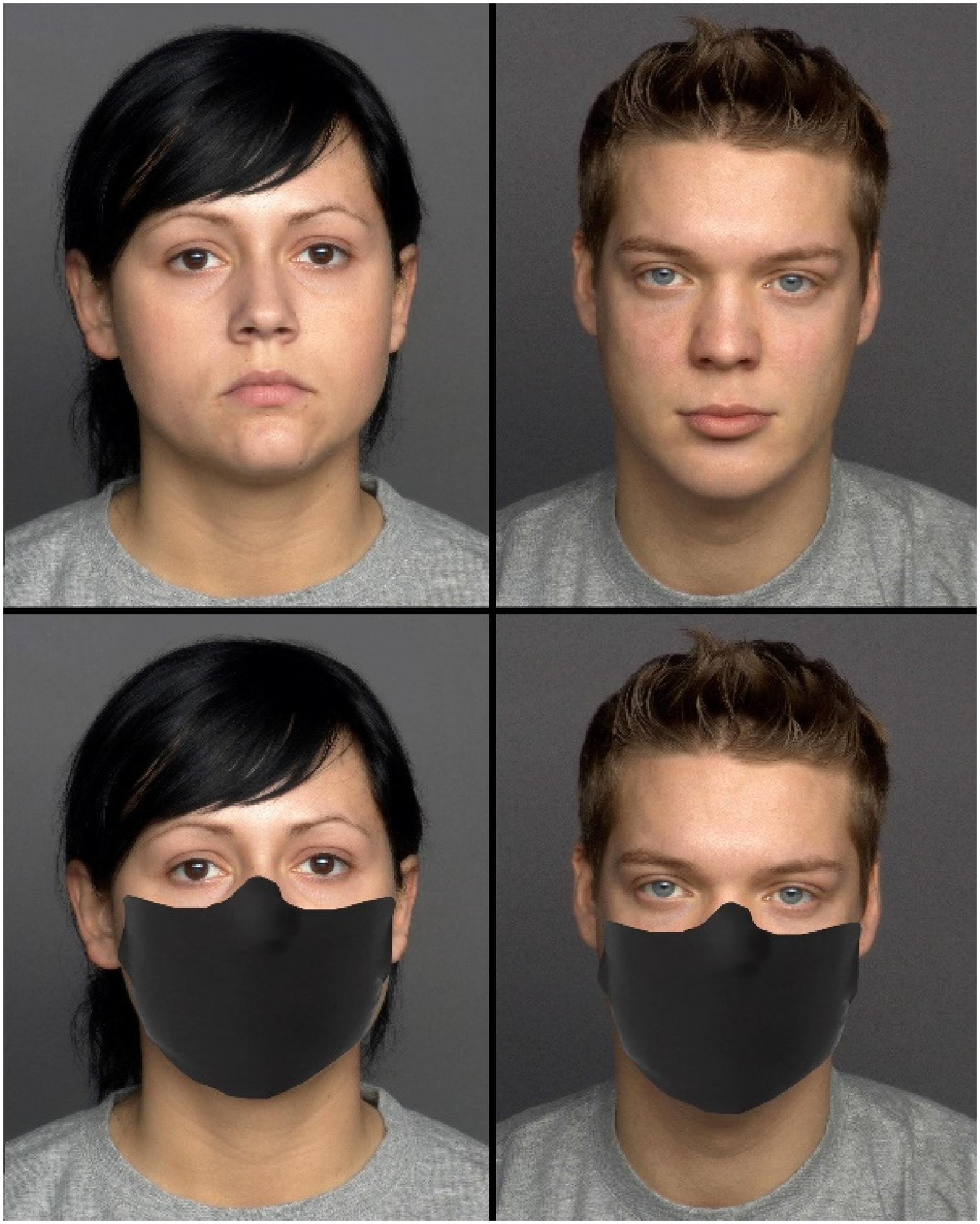
Examples of young female and male faces used.
This was a within-subjects experimental design and participants randomly observed either the block with facial masks first or the block with unmasked faces first. Participants were asked to respond to the questions ‘How trustworthy do you find this person?’ and ‘How competent do you find this person?’ on a seven-point scale from 1 (not at all) to 7 (very).
Results
Trustworthiness
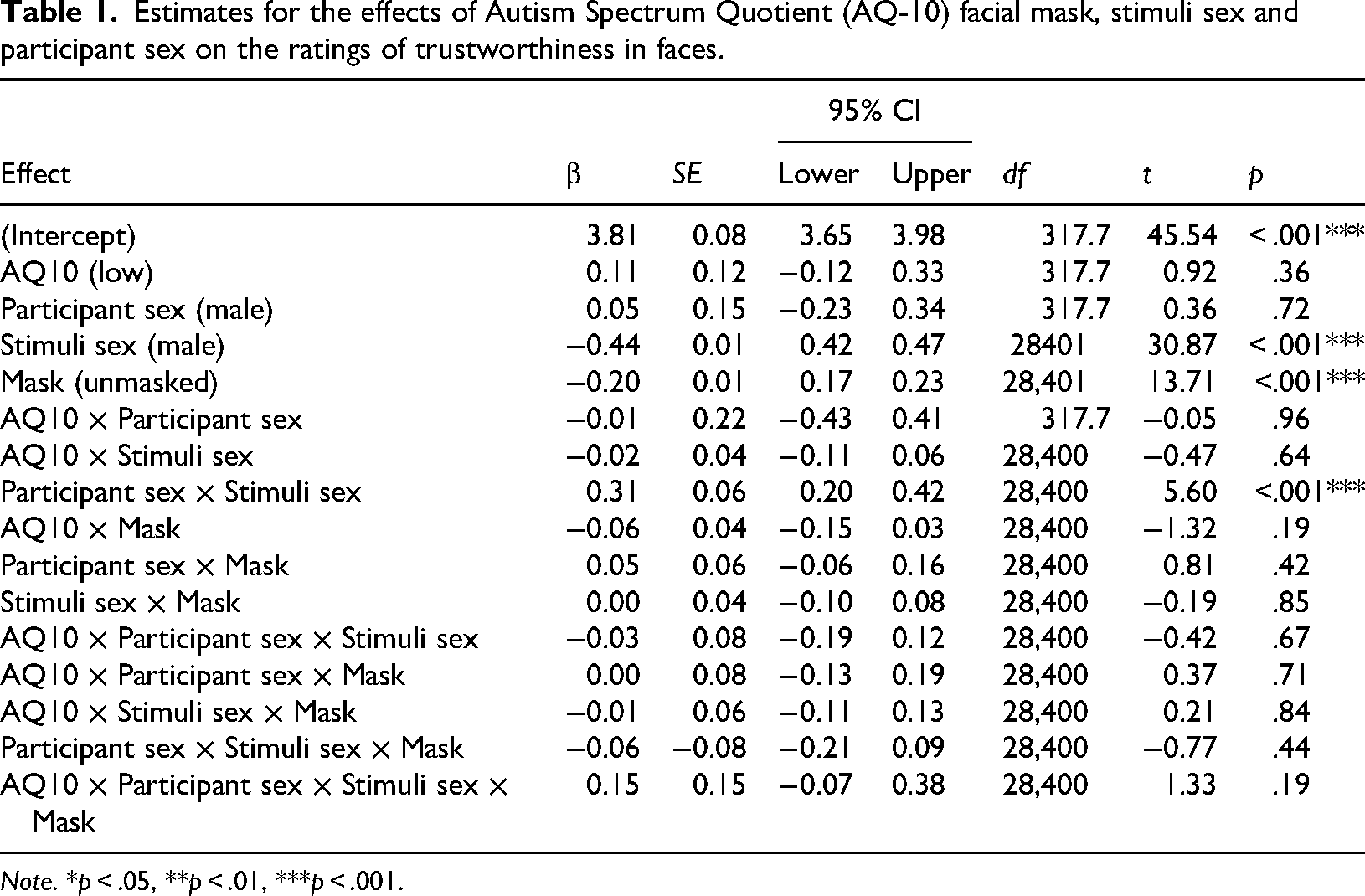
A linear mixed-effects model was conducted to examine the effects of AQ-10, participant sex (a between-participant variable), stimulus sex and mask condition (within-participant variables) on trustworthiness ratings, with participants as random factor to account for repeated measures. Variance components indicated substantial between-participant variability (σ2 = 0.63, SD = 0.79) relative to residual variance (σ2 = 1.21, SD = 1.10), corresponding to an intra-class correlation coefficient (ICC) of 0.34.
Results showed significant main effects for stimuli sex and mask condition (Table 1). Participants rated female faces (M = 3.79, SE = 0.05) as more trustworthy compared to male faces (M = 3.45, SE = 0.05). Also, participants rated masked faces (M = 3.67, SE = 0.05) as more trustworthy compared to unmasked faces (M = 3.47, SE = 0.05).
Estimates for the effects of Autism Spectrum Quotient (AQ-10) facial mask, stimuli sex and participant sex on the ratings of trustworthiness in faces.
Note. *p < .05, **p < .01, ***p < .001.
The Participant Sex × Stimuli Sex interaction was significant; female participants rated female faces (M = 3.75, SE = 0.06) as more trustworthy than male faces (M = 3.16, SE = 0.06, p < .001). Male participants also rated female faces (M = 3.83, SE = 0.09) as more trustworthy compared to male faces (M = 3.53, SE = 0.09, p < .001), but as reflected by the interaction, this difference was less pronounced for the male participants.
Competence
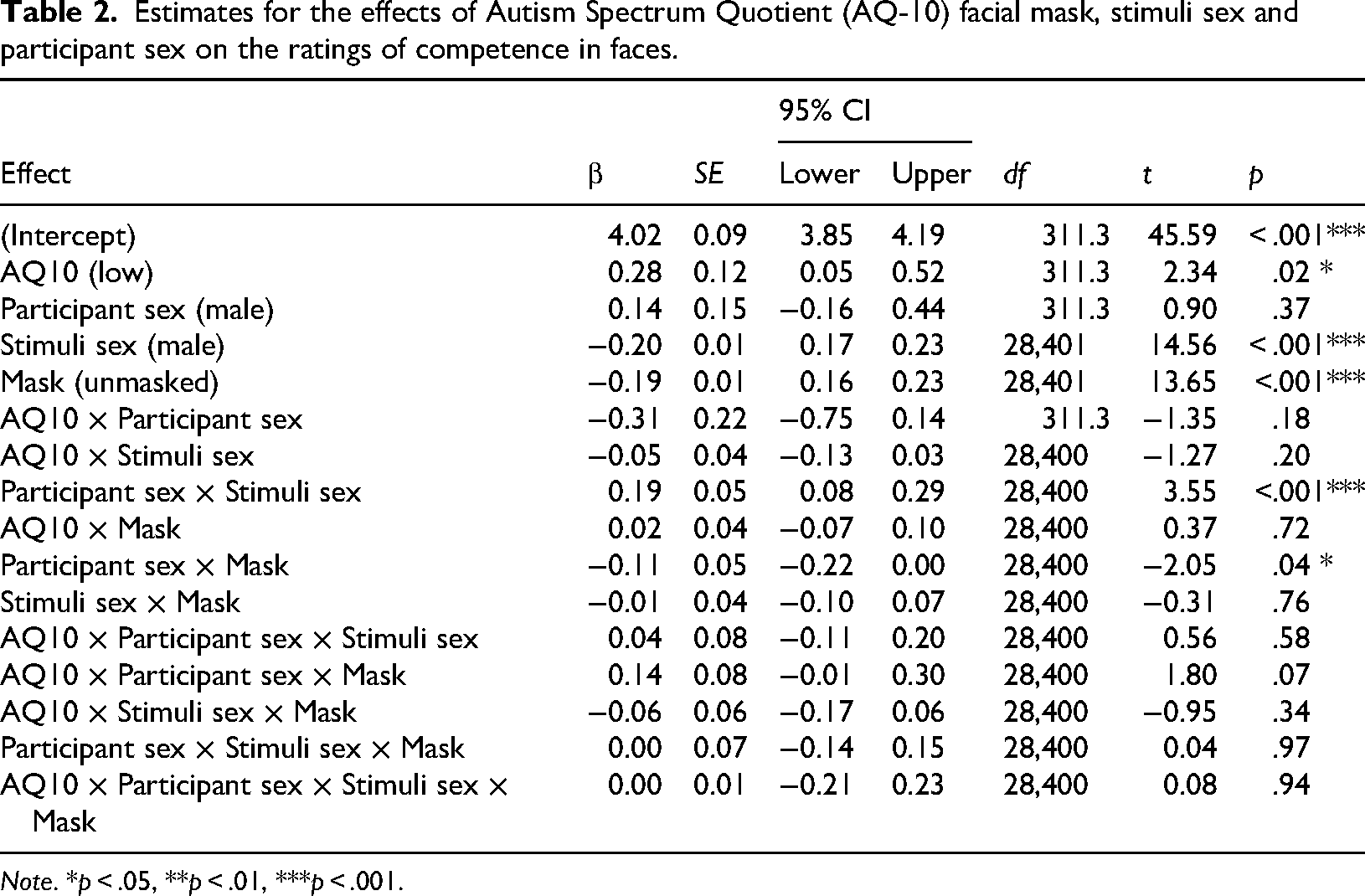
The same linear mixed model was conducted to investigate the effects of AQ-10, participant sex, stimuli sex and presence/absence of facial masks on the ratings of competence, with participants as a random effect. Participant-level variance (σ2 = 0.71, SD = 0.84) relative to residual variance (σ2 = 1.11, SD = 1.05) yielded an ICC of 0.39, indicating that a substantial proportion of variance in competence judgements was attributable to stable between-participant differences.
Results showed significant main effects for AQ-10, stimuli sex and mask condition (Table 2). Participants with low AQ-10 scores (M = 4.04, SE = 0.08) rated faces higher on competence than participants with high AQ-10 scores (M = 3.90, SE = 0.08). As for stimuli sex, participants rated female faces (M = 4.07, SE = 0.06) as more competent compared to male faces (M = 3.87, SE = 0.06). Results also revealed that participants rated masked faces (M = 4.06, SE = 0.06) as more competent compared to unmasked faces (M = 3.87, SE = 0.06).
Estimates for the effects of Autism Spectrum Quotient (AQ-10) facial mask, stimuli sex and participant sex on the ratings of competence in faces.
Note. *p < .05, **p < .01, ***p < .001.
Results from the analysis also showed significant Participant Sex × Stimuli Sex and Participant Sex × Mask two-way interactions. As for the Participant Sex × Stimuli Sex interaction, women rated female faces (M = 4.09, SE = 0.06) as more competent than male faces (M = 3.78, SE = 0.06, p < .001). Similarly, men rated female faces (M = 4.05, SE = 0.09) as more competent than male faces (M = 3.96, SE = 0.09, p < .001), though as reflected by the interaction, this difference was less marked for the male participants. As for the Participant Sex × Mask interaction, female participants rated masked faces (M = 4.02, SE = 0.06) as more competent than unmasked faces (M = 3.58, SE = 0.06, p < .001). Similarly, male participants also rated masked faces (M = 4.11, SE = 0.09) as more competent than unmasked faces (M = 3.90, SE = 0.09, p < .001), though again, as reflected by the interaction, for the male participants this difference was less severe.
Additional generalized linear mixed model analyses treating AQ-10 as a continuous predictor are reported in the Supplemental materials. These analyses produced the same substantive pattern of findings as the main categorical analyses: AQ-10 did not significantly interact with mask condition for either trustworthiness or competence ratings.
Discussion
The present study investigated the effects of face masks on perceptions of trustworthiness and competence, particularly in individuals with high autistic traits. Results indicated that masked faces were rated as more trustworthy than unmasked faces, supporting prior research suggesting that masks can enhance perceptions of trustworthiness by obscuring negative facial cues (Fang & Kawakami, 2024; Wang et al., 2024). This effect was observed regardless of participant sex or AQ-10 scores, suggesting a generalised pattern across individuals. Female faces were perceived as more trustworthy than male faces (especially by female participants), a pattern that aligns with previous literature on gender-based social perception biases (Buckingham et al., 2006). This gendered pattern of trust perception suggests that social expectations and biases may influence the way individuals evaluate trustworthiness, particularly in masked interactions.
Despite the significant effects observed, no significant interactions were found between autistic traits (AQ-10 scores) and mask condition in trustworthiness judgements. This suggests that the effect of face masks on trust perceptions was similar across individuals with both high and low autistic traits. While previous studies have highlighted that individuals with autistic traits rely more on the mouth for social cue interpretation (Adolphs et al., 2008; Fujioka et al., 2016), the present findings suggest that the obstruction of the lower face did not disproportionately impact their trustworthiness evaluations. Importantly, the literature on gaze allocation and eye avoidance in autism is mixed, and several factors may account for these inconsistencies. At the individual level, co-occurring alexithymia has been shown to better predict reduced attention to the eye region than autism itself, suggesting that variability in alexithymic traits across samples may underlie divergent findings (Cuve et al., 2021). At the methodological level, gaze patterns are highly sensitive to task demands, stimulus characteristics and analytic approaches, with evidence indicating that neither reduced eye gaze nor increased mouth reliance generalises across contexts (Guillon et al., 2014), and that effect sizes vary substantially depending on stimulus type and regions of interest (Frazier et al., 2017). Within this framework, the absence of an interaction in the present study may reflect the specific task structure and static stimuli employed, which may allow participants to flexibly rely on alternative cues such as the eye region—known to play a central role in trust judgements (Bylianto & Chan, 2023)—or to engage compensatory processing strategies. Similar to trustworthiness, our findings indicated that masked faces were rated as more competent than unmasked faces, aligning with prior studies showing that masks can enhance competence judgements due to their association with professionalism (Klucarova, 2022; Liang & Wu, 2022).
Moreover, participants with lower AQ-10 scores (i.e., those with fewer autistic traits) rated faces as more competent than those with higher AQ-10 scores. This suggests that individuals with higher autistic traits may differ in how they evaluate competence when facial cues are partially obscured, potentially reflecting differences in social evaluations (Pazhoohi et al., 2021). However, as with trustworthiness, no significant interactions were observed between AQ-10 scores and mask condition, indicating that the impact of face masks on competence judgements did not differ significantly between those with high and low autistic traits. Finally, given the number of predictors and interaction terms included, the study may have been underpowered to detect smaller or higher-order effects, and these findings should be interpreted with caution.
Implications and Future Directions
These findings hold important implications for understanding how individuals, including those with autistic traits, navigate social interactions in masked environments. The overall increase in positive evaluations of masked faces suggests that mask-wearing may play a role in shaping first impressions, particularly in professional and social settings. These findings have practical implications for workplace interactions, healthcare settings and other environments where trust and competence judgements are critical. However, given the reliance of individuals with autistic traits on mouth visibility for social cue processing, future research should explore whether prolonged mask use creates additional communication challenges for this population, particularly in nuanced social contexts.
Despite these contributions, the study has several limitations. First, the study primarily focused on young adult participants, limiting the generalisability of the findings to other age groups. Older adults, for example, may process masked faces differently due to age-related changes in face perception or varying levels of exposure to mask-wearing in different social contexts. Future research should explore whether these effects hold across diverse age groups and cultural backgrounds. Second, while the study assessed autistic traits using the AQ-10 within a non-clinical sample, it did not include individuals with a formal diagnosis of autism spectrum condition based on standard diagnostic criteria (e.g., The Diagnostic and Statistical Manual of Mental Disorders). Given that clinically diagnosed individuals may experience heightened difficulties in face perception, future research should examine how mask-wearing influences their real-world social interactions and whether specific coping strategies emerge in response. Moreover, the facial stimuli were randomly selected and not controlled or matched for perceived attractiveness, which may have influenced judgements of trustworthiness and competence. Future research would benefit from systematically controlling or measuring attractiveness.
Conclusion
In summary, the study highlights that face masks influence perceptions of trustworthiness and competence, with masked faces generally being rated more favourably. However, the impact of face masks on social judgements did not differ significantly based on AQ-10 scores. These findings contribute to a deeper understanding of how face masks shape social evaluations and offer insights into the broader implications of mask-wearing in professional and interpersonal settings, particularly for individuals with autistic traits.
Supplemental Material
sj-docx-1-pec-10.1177_03010066261456095 - Supplemental material for The effect of face masks on the perception of trustworthiness and competence in individuals with autistic traits
Supplemental material, sj-docx-1-pec-10.1177_03010066261456095 for The effect of face masks on the perception of trustworthiness and competence in individuals with autistic traits by Farid Pazhoohi, Maryam Rostami-Aghoui, Leilani Forby, Keina Aoki and Alan Kingstone in Perception
Footnotes

Ethical Considerations
The research was conducted in accordance with the Declaration of Helsinki as it pertains to research with human participants.
Consent to Participate
All participants consented to taking part in the study.
Author Contribution(s)
Funding
The authors received no financial support for the research, authorship, and/or publication of this article.
Declaration of Conflicting Interests
The authors declared no potential conflicts of interest with respect to the research, authorship, and/or publication of this article.
Data Availability Statement
Authors will share upon request.
Code Availability
Authors will share upon request.
Supplemental Material
Supplemental material for this article is available online.
Notes
References
Supplementary Material
Please find the following supplemental material available below.
For Open Access articles published under a Creative Commons License, all supplemental material carries the same license as the article it is associated with.
For non-Open Access articles published, all supplemental material carries a non-exclusive license, and permission requests for re-use of supplemental material or any part of supplemental material shall be sent directly to the copyright owner as specified in the copyright notice associated with the article.
