




Abstract
Introduction
Torque in orthodontics plays a significant role in final positioning of the teeth. This twisting force in wire helps in transferring the applied forces to bracket, which sometimes causes deformation of slot. This slot deformation can vary torque prescription and affect tooth position.
Aims and Objectives
To compare the deformation of slots of different bracket materials after torque application using finite element analysis.
Materials and Methods
A finite element model of maxillary central incisor with bracket slot 0.022 × 0.028 inch dimensions was constructed. The different bracket materials such as stainless steel (SS), ceramic, and titanium were used with rectangular SS archwire (0.019 × 0.025 inch). The slot deformation was obtained after various degrees of torque application at 5°, 10°, 15°, and 20°. This slot deformation was also seen at the top, middle, and bottom locations in the slot. All these models were then analyzed using the Ansys software.
Results
The results showed that there was a gradual increase in deformation of all the bracket slot walls from bottom to top locations. The bracket slot deformation for 20° twist was 0.78, 1.85, and 4.53mm (SS); 0.24, 0.70, and 2.50 mm (ceramic bracket), and 1.82, 2.85, and 4.83 mm (titanium brackets) in bottom, middle, and top slot wall locations, respectively.
Conclusion
Slot deformation was seen highest in titanium brackets and least in ceramic brackets. Further in the slot wall, the deformation was highest in top location as compared to middle and bottom locations.
Introduction
Torque plays a vital role in finishing phase of orthodontic fixed appliance therapy. It is a twisting or turning force that tends to cause rotation around an axis. Clinically, the moment of a rectangular archwire in the bracket slot represents the torque. This is also determined by slot wire play, bracket material, and the tooth inclination. 1
The torque in the incisors plays a key role for optimum interincisal angle, overjet, and posterior teeth occlusion. When the rectangular archwire contacts the wall of the bracket slot, there might be changes of slot wall deformation. This slot deformation is an important part in torque dissipation. Brackets of different materials such as stainless steel (SS), ceramic, and titanium will exhibit different responses to an applied torque. Depending on the material properties of a particular bracket and the amount of torque applied, elastic and plastic deformation of the bracket occurs. 2 The plastic deformation of the SS bracket was expected as SS is a more rigid metal than titanium and ceramic. 3 The ceramic bracket is often used in orthodontics due to its esthetic properties with greater hardness and resistance to stains. Since titanium has lower Young’s modulus than SS, the slot deformation of titanium brackets was greater than that of SS.2,3
Various experimental studies are done to predict the behavior of different bracket materials for applied torque. But these studies are unable to configure the accurate stress distribution and deformation in the slot of different bracket materials like SS, ceramic, and titanium brackets.
Finite element method uses various numerical equations to best possible quantify and evaluate the effect of torsional force applied to the teeth. So finite element method is the best method to accurately analyze the bracket slot wall deformation at different locations during torque application.4,5 Hence, the aims and objectives of the study were to compare the deformation of slots of different bracket materials after torque application using finite element analysis.
Materials and Methods
A conventional edgewise maxillary central incisor bracket with 0.022 × 0.028 inch slot was used in this study. Finite element models for three types of brackets were constructed. The bracket models used in the study were SS, ceramic, and titanium bracket. Stainless steel archwire with rectangular cross-section of 0.019 × 0.025 inch was used in all these models. The ceramic brackets used in this study were considered as ceramic alone and not reinforced with SS slot inserts. The slot deformation was evaluated after application of varying degrees of torque ranges from 5° to 20°as this is the torque limit commonly used in orthodontics.
The three-dimensional solid bracket model was constructed using SOLIDWORKS software. The bracket model was meshed with 6,162 isoparametric four-node solid elements and 11,997 nodes as shown in Figure 1. The meshed model was imported to finite element Ansys software. The material properties of the bracket were assigned to the model as shown in Table 1.
FEM Model of Maxillary Central Incisor.
Mechanical Properties of the Material Used in the Study.

Finite Element Analysis of Bracket
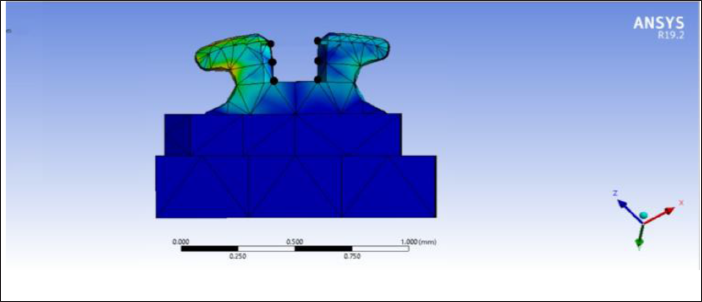
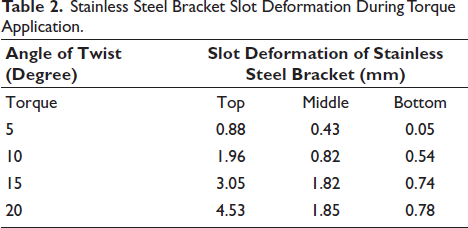
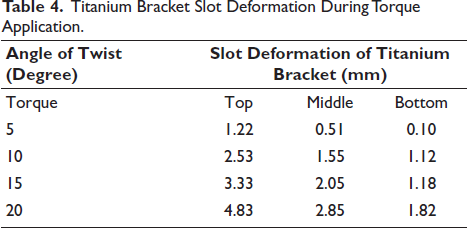
When a torqued archwire is inserted into the bracket slot, it is in contact with the bracket slot walls strongly at few locations. In this study, angle of twist ranged from 5° to 20°. All the nodes in the base of the bracket were completely arrested in all the degrees of freedom. The nodal displacements were measured at the top, middle, and bottom positions in the slot walls of all the bracket models as shown in Figure 2. The values obtained were tabulated as shown in Tables 2–4.
Bracket Slot Deformation Measured at Different Locations in the Slot (Marked as Cubes).
Stainless Steel Bracket Slot Deformation During Torque Application.
Ceramic Bracket Slot Deformation During Torque Application.

Titanium Bracket Slot Deformation During Torque Application.
Results
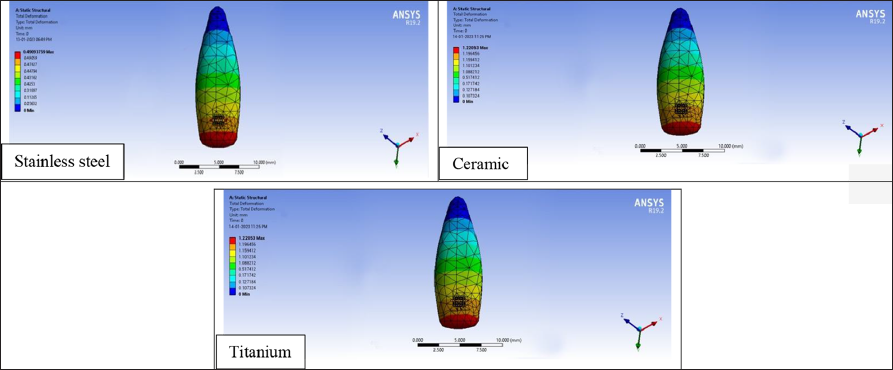
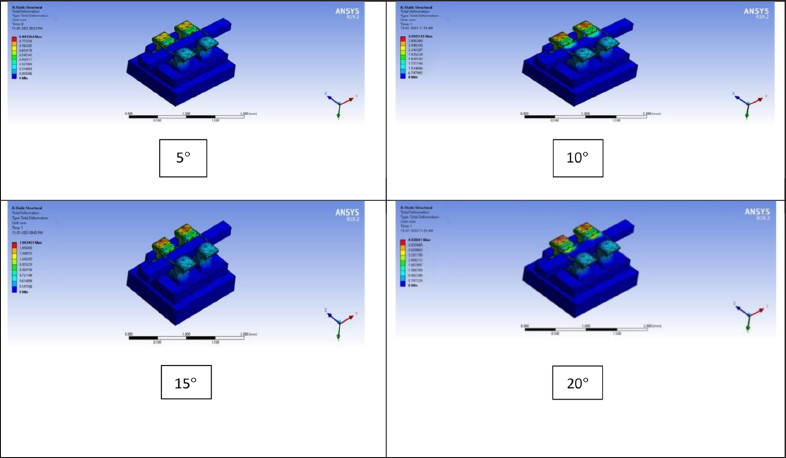
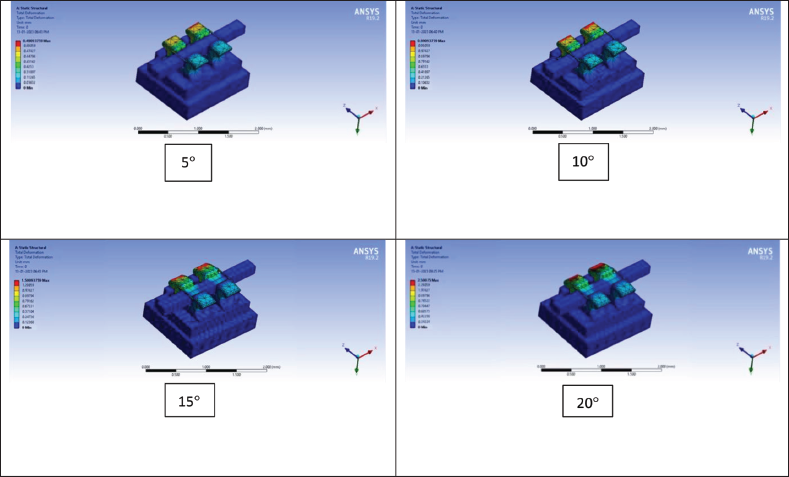
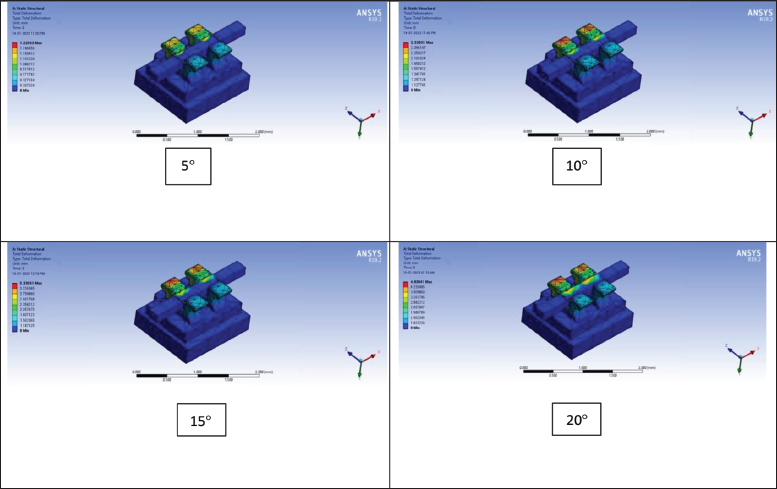
The results of the present study showed that there was a gradual uniform increase in deformation from 5 to 20 degree torque in all the models. The top location in the gingival slot wall showed maximum deformation compared with middle and bottom slot positions in SS, ceramic, and titanium bracket slots. In SS, the bracket slot deformation at bottom, middle, and top wall locations for 5° twist was 0.05, 0.43, and 0.88 mm, for 10° twist was 0.054, 0.82, and 1.96 mm, for 15° twist was 0.74, 1.82, and 3.05 mm, and for 20° twist was 0.78, 1.85, and 4.53mm, respectively, as shown in Table 2. Similarly, in ceramic, the bracket slot deformation at bottom, middle, and top wall locations for 5° twist was 0.03, 0.42, and 0.49 mm, for 10° twist was 0.10, 0.65, and 0.99 mm, for 15° twist was 0.12, 0.67, and 1.50 mm, and for 20° twist was 0.24, 0.70, and 2.50 mm, as shown in Table 3. Whereas, in titanium the bracket slot deformation at bottom, middle, and top wall locations for 5° twist was 0.10, 0.51, and 1.22 mm, for 10° twist was 1.12, 1.55, and 2.53 mm, for 15° twist was 1.18, 2.05, and 3.33 mm, and for 20° twist was 1.82, 2.85, and 4.83 mm, as shown in Table 4. The deformation of titanium bracket slot was more than the SS and ceramic bracket slot. The least deformation is seen in the ceramic bracket slot. The bracket deformation for 5°, 10°, 15°, and 20° twist is visually displayed in Figures 3–5 for SS, ceramic, and titanium materials, respectively.
Stainless Steel Bracket Slot Deformation During Torque Application.
Ceramic Bracket Slot Deformation During Torque Application.
Titanium Bracket Slot Deformation During Torque Application.
Discussion
Torquing in orthodontics is done for root positioning by ligating the twisted archwire in the slot. This twisted archwire evert forces on the bracket slot wall which has the tendency to deform the slot wall apart from moving the tooth. Therefore, the present study was done to evaluate and compare the slot deformation in different types of bracket materials. As different bracket materials have different mechanical properties, so the torque applied is expected to be varied in different materials. The present study included torque in the range 5°–20° as this is the commonly used clinical range.
The results of the present study showed that the deformation of the slot increases as the torque increases from 5° to 20°, as shown in Tables 2–4. This might be because as the angle of the twist increases, more contact forces on the slot wall lead to deformation of the slot. These results were in accordance with the study done by Melenka et al 8 who reported that the large torque applied to the archwire results in deformation of the bracket slot.
Further, on evaluation, it was found that the maximum deformation was seen in the top location of the slot wall as compared to the middle and bottom locations in all the models as shown in Tables 2–4. This could be explained on the basis of the fact that the bottom position of the slot wall is closer to the base of the bracket which is fixed and resists the contact forces significantly. This was in accordance with the study done by Magesh et al 9 who also reported that there is a gradual increase in the deformation of the slot walls from bottom to top locations.
Moreover, the results of the present study showed that the elastic deformation of the bracket slot was seen more in titanium bracket as compared to the SS and ceramic bracket slot, as shown in Tables 2–4. This could be explained on the basis of Young’s modulus of the material. The Young’s modulus of titanium (1,14,000 MPa) is lower than the SS (2,00,000 MPa) and ceramic (3,80,000 MPa). Higher the Young’s modulus, more stiffer the material; thus, harder to stretch and less slot deformation occurs. But when the Young’s modulus is lower, the material will be deformed more as more binding of archwire in the bracket. This binding effect with various materials could be explained on the basis of Young’s modulus. So, therefore, the deformation of the bracket slot was seen more in titanium. This was in accordance with Harikrishnan et al, Magesh et al, and Archambault et al as they reported that the slot deformation was highest in titanium bracket slot when compared to other brackets on the basis of Young’s Modulus.3,9,10
The results of the present study also showed that the slot wall deformation of the ceramic brackets was lesser than SS. This might be due to the fact that ceramic brackets have more Young’s modulus than SS, which leads to more rigidity of the ceramic brackets. This makes these brackets capable of withstanding higher torque values. These results were in accordance with Holt et al, Matsui et al, and Garrett et al.2,11,12
The binding effect of the SS wire in different types of brackets is based on the friction produced by the bracket.
Clinically, during torque application, there is tooth movement and thus dissipation of the applied force. It is difficult to assess the amount of time-related torque force in the bracket slot with the relevant tooth movement. It was not possible to incorporate this factor in our finite element analysis and thus, it is a limitation of this study.
Hence, the results of the present study showed that the titanium bracket slot deformation was greater than the SS and ceramic bracket slot and there was a gradual increase in the deformation of titanium, SS, and ceramic bracket slot walls from bottom to top locations. Therefore, it can be concluded that the deformation in the bracket slot is due to the torque force and the deformation varies according to the bracket materials and their mechanical properties such as Young’s modulus.
Conclusion
The following conclusions were drawn from the study:
There was a gradual increase in the deformation of titanium, SS, and ceramic bracket slot walls from bottom to top locations.
The titanium bracket slot deformation was greater than the SS and ceramic bracket slot.
The ceramic bracket slot showed the least deformation than titanium and SS bracket slot.
Footnotes
Declaration of Conflicting Interests
The authors declared no potential conflicts of interest with respect to the research, authorship and/or publication of this article.
Ethical Approval
The study was approved by institutional research ethical committee of Himachal Dental college, Sundernagar (Vide no. HDC/Ethical/ORTHO/2021/05).
Funding
The authors received no financial support for the research, authorship and/or publication of this article.
Informed Consent
Informed consent was taken before conducting the study.