



Abstract
Since the mid-2000s, Turkey has incorporated a soft power discourse into its foreign policy agenda and shifted its attention toward building up its soft power infrastructure. Up until 2013, Turkey was applauded as a regional powerhouse, an important player in the soft power arena, and a beacon of democracy and stability within an unstable region. However, the restrictions on free speech, media censorship, and the crackdown on the opposition have impacted Turkey’s current soft power ranking. While expanding its diplomatic network and public diplomacy apparatus to wield soft power, Turkey’s global reputation has seen a downward spiral. This article investigates the role that political leadership and political values play in determining Turkey’s soft power capacity. This article’s main contention is that while Turkey increases its global engagement and capacity to appeal non-Western audiences, its capacity to attract international audiences particularly in the West has diminished due to its democratic backsliding.
Introduction
The mid-2000s were marked by the ascendance of Turkey into global affairs as both a rising regional powerhouse and as an aspiring actor in the Middle East and the Balkans. Turkey, traditionally relying on hard power such as military operations in its region, has since shifted its attention to building up a soft power policy particularly in respect to its neighbors. Diplomacy replaced the once military operations or confrontations with neighbors such as Greece and Syria. Until 2013, the international community applauded Turkey as both an emerging regional powerhouse and an emerging actor in the arena of soft power, a beacon of budding democracy and stability in an unstable region. Nonetheless, restrictions on free speech, media censorship, and the crackdown against opposition have throttled Turkey’s capacity to attract international audiences, particularly those in the West.
The previous scholarship on Turkey’s soft power has highlighted Turkey’s democratization process that was underway until the elections in 2011 (Altunışık, 2008; Kalin, 2011; Kirişçi, 2009; Oğuzlu, 2007), which have justified the rise of Turkey as a role model in its region. However, there is a growing literature on the decline of Turkey’s soft power that started with the Gezi Park protests (Cerami, 2013; Kirişçi, 2016, 2018; Tol & Baskan, 2018). This article expands the discussion on Turkey’s soft power by looking at Turkey’s soft power potential, situating this potential within contemporary soft power debates and taking account of Turkey’s soft power assets. Furthermore, it offers a discussion on the relevance of democratic credentials on soft power, providing a background for the suggested decline in Turkey’s soft power.
To this end, this article examines Turkey’s current soft power capacity and attributes by providing an analysis of its soft power resources in the 2002–2017 period, the Adalet ve Kalkınma Partisi (AKP) era during which soft power became a popular term in the foreign policy lexicon. It also sheds light into Turkey’s soft power resources from the dimension of culture, values, and politics. 1 In doing so, it investigates the role that Turkey’s political leadership, government, and political values play in determining its soft power capacity.
The first section offers a discussion on power and situates the soft power debate within international relations. The second section outlines the methodology of this article. It will then turn to the analysis of the soft power in Turkey’s foreign policy. This section will look at the ways in which Turkey’s political elite interprets soft power and the context in which soft power is presented in scholarly debate. Finally, the last section will examine Turkey’s soft power assets by providing an account of its resources that fall under culture, political values, and foreign policies.
Debating Power and Soft Power
Power is an elusive, contested, and difficult to measure concept (Nye, 2011b). Boulding (1989) defines power as the ability to get what one wants. Power, although different than force, entails a component of threat power (the power to destroy), economic power (the power to produce/exchange), and integrative power (the power to create relations; Boulding, 1989).
Power has been an integral part of international relations since the early writings of Thucydides and Machiavelli, and its solid foundations were laid out in the realist school of thought. In the realm of international relations, power and politics are intertwined and the two cannot be separated from each other (Carr, 1941). Classical realist E. H. Carr argues that actors in international politics pay significant attention to power. States, as main actors in international politics, pursue power at the expense of one another (Mearsheimer, 2005). Furthermore, the foreign policy interests of states consist of preserving and accruing this power (Kuntz, 2010). Therefore, Carr (1941) argues that power is an essential part of politics and an indispensable part of governments.
Dahl (1957) defines power as the ability of one actor to influence the actions of another actor. Morgenthau (1954) suggests nine different elements of national power, and these include geography, natural resources, industrial capacity, military preparedness, population, national character, national morale, the quality of diplomacy, and the quality of government. Additionally, the elements of national character, national morale, the quality of diplomacy, and the quality of government are associated with intangible sources of power (Fan, 2008).
The three norms in international power that are military, economic, and power over opinion are essential capabilities to exert power (Carr, 1941; Nye, 2011b). All three norms of power are different but interconnected means to exert influence in international politics. The three norms of international power are conveyed through tangible and intangible resources, which are the raw materials or vehicles that underlie power relationships (Nye, 2011a). As such, scholars in the realist tradition define power by means of the material capabilities that states possess (Mearsheimer, 2001). For Mearsheimer (2001), these material capabilities are tangible assets that will eventually determine the military strength of a nation. Political scientist Kenneth Waltz (2010) similarly defines power as the capabilities that are comprised of the size of the population and territory, the number of resources, the economic capability, military strength, political stability, and competence of the country.
Along with this line of thought, in which power is defined in hard terms, Nye (2011a) also categorized the use of force, payment, and agenda as hard power. International prestige and reputation are the cornerstones of power that draw from hard power resources in the form of military and economic assets. Although prestige and reputation in the post–Cold War period have been overwhelmingly associated with soft power, hard power resources also greatly contribute to the international reputation of nations. Morgenthau’s (1954) definition of the policy of prestige asserts that the desire for prestige among nations represents an expression of power. Gilpin (1981) expresses similar points in regard to the role of prestige among states and the role it plays among political authority. Gilpin argues that …the hierarchy of prestige in an international system rests on economic and military power. Prestige is the reputation for power and military power in particular. Whereas power refers to the economic, military, and related capabilities of a state, prestige refers primarily to the perceptions of other states with respect to a state’s capacities and its ability and willingness to exercise its power. (p. 31)
In the post–Cold War age, foundations of power have been moving away from an emphasis on hard power and instead toward a reliance on persuasion by other means and therefore the intangibles of power (Nye, 1990). Power in the information age, together with the catalyzing force of liberal international order, has been equally utilized in noncoercive ways mainly in the developed North (Nye, 2004). Globalization, advances in communication technology, the end of the Cold War, and the shift in international power dynamics facilitated the emergence of the concept of soft power, coined by Nye (1990). An additional dimension of power that is essential for ensuring security and cooperation, soft power is getting others to want the outcomes that you want through culture, politics, and foreign policy rather than coercion and payments (Nye, 2004, 2008). Soft power achieves policy outcomes through attraction and because others also want the outcome that what you want (Keohane & Nye, 1998). It sets the agenda through influence and the ability to entice and attract (Nye, 2008).
Soft power resources are the assets that produce attraction (Nye, 2008). The three basic soft power resources—culture, politics, and foreign policy—“can translate into the behavior of attraction that can influence others towards favorable outcomes” (Nye, 2011b, p. 84). Nye (2004) further posits that a country should be able to establish emotional ties, such as attraction, with desired foreign audiences to assure policy objectives. Nye argues that “a country may obtain the outcomes it wants in world politics because other countries-are admiring its values, emulating its example, and aspiring to its level of prosperity and openness” (p. 5). According to Nye, soft power is a behavioral trigger that is led by attraction and example. Correspondingly, soft power is a referent power that is based on identification and attraction (Fan, 2008).
Credibility and reputation are the cornerstones of soft power (Keohane & Nye, 1998). A nation’s attractiveness relies on the legitimacy and credibility of its intangible assets (Nye, 2008). In other words, a nation’s soft power depends on the credibility of the government and its actions (Nye, 2011b). In turn, desirability and credibility are built on a cluster of qualities that are derived from benignity, competence, and charisma (Nye, 2011b, p. 92). These qualities are either existent in a nation or are crafted to meet a strategy. Olins (2007), nation branding expert, argues that nations have historically tried to manage their reputations in an effort to create loyalties and gain influence in other countries. In an ever-interconnected world where image is more important than reality, the perceptions held by others are influenced by the actions of countries and the words of policy makers (Benoit, 1995). As a result, nations manage their reputations and compete for a favorable global image in order to advance their interests in the international arena (Wang, 2006).
In summary, soft power refers to the capacity of one country to indirectly influence the behavior of another country that results in behavioral change (Dowding, 2012). Although soft power is about behavioral change, there are different operational frameworks in achieving behavioral change. Communications scholar R. S. Zaharna (2007) posits two frames of analysis of soft power: wielding and creating soft power. In this respect, wielding soft power is exerting influence in a one directional way that serves the interests of nations with limited room for reciprocity. When nations wield soft power, they have the intention to change attitudes or behavior of a target audience. Creating soft power, on the other hand, is comparatively a two-way engagement that is more inclusive of diverse cultural perspectives and is more reciprocal in terms of message exchange. Creating soft power emerges from changing communication dynamics defined by the actors and their communication styles. These new dynamics are the diffusion of information, the emergence of culture as a component of international relations, and the new communication of actors and technologies. Hence, creating soft power rests on a network communication approach, which is reflective of nonstate sources such as nongovernmental organizations. The network paradigm does not deliver a message in efforts to wield soft power, but it ends with a cocreated message or story that creates soft power (Zaharna, 2007, 2010).
The concept of soft power, which in and of itself is a liberal construct, has drawn significant criticism from academic circles. These criticisms encompass the scope of the concept (Kearn, 2011), the lack of a systemic and rigorous analysis (Gallorotti, 2011), the linkage between hard and soft power (Kearn, 2011), and the role of hegemony in soft power (Fan, 2008). Furthermore, the concept became a buzzword that is often misused. For example, soft power is often interchangeably used with public diplomacy, which is the complex communication strategy in achieving soft power. The conflation of the two concepts causes further confusion of when to use the appropriate terms (Snow, 2009). Furthermore, soft power is also used as a justification for public diplomacy (Hayden, 2017). Discussions on soft power can stretch the concept to describe both soft power resources, as well as its impact. Resources that comprise culture, political values, and foreign policy carry the potential for a nation’s soft power. However, unless these resources are realized by a government as assets and converted into soft power, we cannot assume these resource constitute soft power (Fan, 2008; Treverton & Jones, 2005). In other words, the existence of soft power resources does not justify the existence of soft power. In addition to state-based soft power resources, various other nonstate actors such as leaders in civil society and celebrities have the potential to generate soft power (Fan, 2008). Nonetheless, there needs to be intentionality by the state, a clear blueprint on how to best utilize state and nonstate resources, to translate these nonstate actors into actual soft power assets.
Contrary to its nature as an analytical concept soft power is treated as a stand-alone theory. Furthermore, it is almost impossible to quantify soft power and determine how much soft power contributes to a nation’s global reputation. Thirdly, soft power is treated as an alternative to hard power when in reality they complement one another since, without resources and hard power, soft power on its own does not translate into substantial initiatives. For example, the practice of yoga has been historically ingrained in India’s traditions and became popular throughout the world in the twentieth century. Only with India’s economic development and implementation of yoga diplomacy into its foreign policy apparatus, India has been capitalizing on the widespread popularity of yoga (Jaishankar, 2018; Mazumdar, 2018). In other words, recognition of the soft power resources and the economic power to communicate these resources to foreign audiences are necessary to translate them into soft power assets. Fan (2008), who argues soft power is a cultural power, supports this idea by suggesting that a country’s policy plans and foreign policy cannot be separated from hard power. He further argues that foreign policy is, in fact, a manifestation of hard power, as a nation needs to invest money, thus hard power, to develop its sources into soft power. For example, although foreign aid—a form of hard power—is a theme in soft power analyses, it has been understudied and is not assumed to have a pivotal role in explaining soft power (Pamment, 2018). While the efforts of U.S. Agency for International Development has had significant role since the Cold War in expanding American soft power (Cull, 2008; Essex 2013), more recent debates around China’s foreign aid to African countries furthered the debate on the role of hard power elements in generating soft power (King, 2013).
Finally, the role of hegemony has not been well researched in soft power debates, even though after the Cold War, soft power was in vogue. Nonetheless, soft power at its core is a power strategy for a means-end in achieving favorable foreign policy outcomes. As a result, soft power is comprised of liberal values but is not a form of idealism or liberalism. In Nye’s (2007) words, soft power “…is simply a form of power, one way of getting desired outcomes” (p. 170). Soft power was also conceptualized in the Western discourse and pertained to U.S. foreign policy in the aims to claim U.S. hegemony as the bastion of the international order. In this respect, soft power is a reflection of Western, liberal values that embody liberal democracies in North America and Europe. In Nye’s original articulation, image, reputation, and attraction occur when a nation possesses democratic values that are defined by liberal democracy. Consequently, soft power inherently favors nations that are liberal democracies and omits other nations, though they may still enjoy relative attractiveness in developing countries. Existing indices examining soft power such as the Portland Soft Power Report and the Monocle Soft Power Report are reflective of the bias.
Fan (2008) and Thussu (2014) both criticize Nye’s soft power concept as ethnocentric. They argue that the condescending approach in defining and conceptualizing soft power assumes the superiority of American culture and disregards the potential soft power of non-Western nations. Scholars (Liu, 2018; Nye, 2018; C. Walker & Ludwig, 2017) are revisiting the original conceptualization of soft power as numerous illiberal democracies turn to soft power as a means to influence world politics. While the earlier iterations of soft power build on the values of liberal democracies, others such as China and Russia are offering an alternative where sustainable economic development is not dependent on democratization. Therefore, nations do not have a monopoly on soft power, and in fact, any country and culture can develop and wield soft power.
The pull effect of soft power depends on how a foreign audience perceives the nation’s qualities and whether finds these qualities appealing (Fan, 2008). In other words, the image and reputation of an illiberal democracy could easily be unfavorable in a liberal democracy, whereas the same country may have a favorable image in other parts of the world. In another words, a country may possess soft power in one country and not possess any credibility in another. To illustrate, China’s image in developing countries, mainly in Africa, where China delivers significant development aid and investment, is more favorable than in Western Europe and North America (Pew Research Center Survey, 2018). Likewise, Russia enjoys a certain pull in former Soviet nations (Velikaya, 2018). Both are the results of hard investments, in forms of development aid and military cooperation. Correspondingly, the recent surge in populism across the globe has been reshifting the focus to hard power, coercion, and inducements. The anti-immigration wave in Europe and the United States, the decline of multilateralism in American foreign policy, and the appeal of undemocratic yet militarily strong states such as China and Russia all play into the decline of the soft power discourse. Soft power, which is a by-product of the liberal world order and a reflection of globalization, is becoming less popular in everyday political discourse despite states’ continuous efforts in seeking recognition and recognition, reputation, and attraction are moving toward hard material resources. In other words, soft power has been losing its momentum in leaving the international political scene for hard power.
Soft and hard power are mutually inclusive and can only operate successfully if they are utilized as part of a broader strategy to boost influence. The idealistic approach to position soft power as the fundamental avenue to exert influence in the era of globalization fell short of the reality on the ground where security, economic prosperity, and technological advances are vital to global competition for power. In other words, softer forms of national attractiveness are still crucial in determining a nation’s global appeal; however, without the existence of hard power assets, soft power by itself will not render the desired results. For example, Portugal, Greece, and Argentina are among the global soft power nations; however, none of them have global influence as other soft power nations such as Japan and the Netherlands (Soft Power 30, 2018).
Furthermore, the increasing global appeal of the economic development of particularly the Chinese model of governance and wave of populism is undermining the existing definitions of soft power. As the critics of soft power argue, non-Western nations also have the ability to exert soft power, giving way to nontraditional interpretations of soft power (Jeanne, 2015; Keating & Kaczmarska, 2019; Wilson, 2015). Despite the decline in the traditional soft power rhetoric, the practice of soft power is still imperative to advance national interests regardless of the different ways soft power is executed.
Method
Soft power is very difficult to both measure and quantify. Therefore, evaluating the degree and impact of Turkey’s soft power is beyond the scope of this article. The real-time capacity to change behavior cannot be determined without properly assessing soft power resources as assets that could potentially create soft power. In order to account for Turkey’s soft power sources, this article analyzes the material resources of soft power.
This article assesses Turkey’s soft power resources by first looking at the ways in which soft power has been employed by Turkey’s political elite and its presence in the scholarly debate in respect to Turkish foreign policy. Then, it collects data from global indices and reports such as the Soft Power 30 and Global Humanitarian Assistance report during the 2002–2017 period in order to examine Turkey’s soft power assets. It looks at existing soft power databases such as the Monocle Soft Power Index, the Portland Soft Power Index, and the Good Country Index. Then, it looks at soft power from five dimensions that encompass a cluster of qualities such as benignity, competence, and charisma, which establish a nation’s desirability and credibility (Nye, 2011b). The variables that make up this cluster are then a nation’s human rights record, asylum applications, the quality of higher education institutions, the gross domestic product, the gender equality gap, religious and press freedoms, the hosting of international sporting events, Nobel prize winners, tourists, and tangible and intangible cultural heritage (Nye, 2004). This group of variables can, in turn, reinforce the desirability of a nation and at the same time generate its soft power. Nation brand expert Simon Anholt (2007) argues that culture, history, politics, personalities, institutions, and foreign and domestic policies are variables that are attractive to foreign audiences. The Institute for Government (IfG)-Monocle soft power dimensions expand Nye’s conceptualization and offer business/innovation and education as two additional dimensions. These additional variables are considered separately in this article.
To determine Turkey’s soft power potential and capacity in respect to politics, this article draws on the indicators regarding Turkey’s desirability in its government and political system. In this respect, data from the United Nations, the World Bank, the Prosperity Index, the Human Rights Index, and the Religious Freedom Index are used. As for cultural assets of soft power, this article assesses Turkey’s cultural desirability by collecting data from UNESCO (United Nations Educational, Scientific and Cultural Organization), Nobel Awards, international film and television awards, international sporting events and awards, and incoming tourists. It assesses the desirability of Turkey’s education by collecting data from Times Higher Education List and data on international student mobility. Regarding business/innovation, it assesses the desirability and openness of the business climate by collecting data from Organization for Economic Cooperation and Development (OECD) and World Bank. Finally, it assesses the desirability of Turkey’s foreign policy by looking at multilateral engagements, asylum applications, foreign aid, and the number of diplomatic representations, drawing on the publications of the Turkish Ministry of Foreign Affairs (MFA), the Ministry of Tourism, the Ministry of Education, and the Turkish Statistics Society.
The scope of this article covers the period between 2002 and 2017. There are also a number of limitations posed for this article. Most of the secondary data used in this study are prepared by Western institutions or international organizations. These international institutions are not immune to bias. Particularly, democracy rankings define democracy within the contours of Western liberal democracies and reflect an affinity with U.S. foreign policy (Bush, 2017; Giannone, 2010). The method employed to measure democracy is criticized by some authors for being flawed or biased (Bollen & Paxton, 2000; Steiner, 2016).
Another limitation for this study is the availability of data for all of the indicators for the 2002–2017 period. Data for certain years on several indicators are not available which makes it difficult to assess the full soft power capacity of Turkey. In what follows, this article combines Nye’s soft power pillars with the IfG-Monocle’s metrics to evaluate at Turkey’s soft power assets.
The Literature on Turkey’s Soft Power
The concept of soft power was first introduced to the higher echelons of Turkish politics during the mid-2000s, following a more assertive foreign policy agenda under the (AKP, Justice and Development Party). The entrance of soft power, first into the Turkish foreign policy lexicon, and then later into its popular discourse intersects Turkey’s activism and its reforms. Turkey’s foreign policy activism emerged in the Balkans and the Middle East, which are considered former Ottoman hinterland (Ongur, 2015). In turn, the soft power debates in Turkey were initially shaped by Turkey’s interest and activism in the Middle East and the Balkans (Altunışık, 2008; Baskovic, Reljic, & Vracic, 2015).
External and internal dynamics laid the groundwork for Turkey’s interest in the role of soft power in foreign policy formulations. An important external dynamic is the Western effort to brand and present Turkey as a role model for the broader Middle East. This understanding stems from Turkey’s secular, modern, and Western identity, which was reinforced by reforms that were encouraged by the European Union (EU) accession process. The West, particularly the Obama administration and its advisors in the United States, believed that Turkey anchored in the West with connections to the Middle East would have demonstrative ability to change the region and lead by example (Parris, 2009; J. Walker, 2010). In turn, efforts in presenting Turkey as a role model cultivated domestic discourse on Turkey’s soft power. Thus, discussions on Turkey’s soft power are interconnected to Europe’s and the United States’s need for security and to locating a moderate Muslim voice in the Middle East.
Although the aforementioned drives exist for the heightened discourse on Turkey’s soft power, there are a number of pivotal elements that exist to foster a similar debate in the domestic political sphere. To begin with, Turkey’s relative economic prosperity, which came at a time when the European Union and the United States were undergoing financial turbulence, became an influential force. Turkey’s relative economic progress has enabled it to invest in its foreign policy by emphasizing a softer approach to power, which was made possible as a result of its hard power resources. Turkey’s growing economy helped boost its diplomatic presence across Africa, and the expansion of Turkish Airlines’ air travel routes was instrumental in Turkey’s soft power approach (Özkan, 2010; Selçuk, 2013).
Second, soft power as a foreign policy concept in Turkey took form under Ahmet Davutoğlu’s strategic depth vision, a policy approach that draws from Turkey’s historical, geographical, and cultural ties to nearby states. 2 Within this framework, Turkey relies on its cultural affinity with the Balkans, the Middle East, and Central Asia, which the doctrine assumes is of mutual interest to Turkey and the aforementioned regions. Underlining Turkey’s cultural affiliations was a fundamental element in the Davutoğlu era foreign policy doctrine, in which Turkey sought better ties with the nations that were established in former Ottoman territories and then envisioned these ties as Turkey’s soft power. Furthermore, Turkey acted as a mediator in the Middle East given its close ties with Israel and a majority of the Arab states up until 2010 (Aras, 2009, 2014). Throughout the first decade of the ruling AKP government, Turkey exerted itself as a rising regional actor by pursuing a value-oriented foreign policy and engaging in dialogue with Somalia, Myanmar, and Syria (Panayırcı & İşeri, 2014). Consequently, Turkey under Davutoğlu emphasized desecuritization and a foreign policy approach where cultural affinity, attraction, and leading by example were cornerstones. Endeavors during the strategic depth and zero problems era underscored Turkey’s relations with its immediate region and aimed to make Turkey more appealing as a role model in the Middle East.
Third, the reform period during the mid-2000s, which was fostered as a result of Turkey’s EU (European Union) bid, served as a launching pad to set the groundwork for Turkey’s soft power discourse, which led to a substantial soft power resource. Democratizing reforms in Turkey included improving the rule of law, government transparency, religious freedoms, and minority rights.
These issues slowly began to see some reforms in the social and political sphere starting from mid-2000s. Several attempts on political reforms in regard to minority communities were important for Turkey’s democratization process (Öniş, 2013). These positive developments taking place within Turkey became the drivers for Turkey’s international communication. Consequently, state-sponsored publications, documentaries, exhibitions, concerts, and conferences highlighted this change. 3 Therefore, Turkey’s soft power and its public diplomacy at that time were a direct result of its democratic reforms as emphasized by Kalin (2011).
Fourth, Turkish foreign aid, such as its humanitarian and development aid, has been an integral component in Turkey’s soft power discourse. Turkey has a strong network of government and nongovernment actors that provide foreign aid, which in turn helps Turkey’s brand as a benevolent nation (Çevik, 2015). Turkey’s humanitarian and development aid have been integral to Turkey’s public diplomacy with its attempts to brand the country as a “donor state” and “benevolent country” (Bacık and Afacan, 2013; Çevik & Sevin, 2017). The politics and rhetoric of its humanitarian aid highlight the ways in which Turkey embraces the image of the Ottoman Empire as a benevolent Empire and its contemporary aid initiatives. This overarching narrative historically situates Ottoman Empire and Turkey as safe harbor for immigrants and carries that historical narrative to current day. For example, the notion of Turkey as a safe harbor takes credence from the Ottoman benevolence toward Sephardic Jews, Balkan migrations during the early 20th century and in the 1980s, as well as the Kurdish refugee influx from Iraq between 1988 and 1991. 4 The Syrian refugee crisis is a cornerstone of Turkey’s humanitarian aid, with its 21 refugee camps and over 3 million Syrian refugees, Turkey is demonstrating an open-door policy. The Syrian refugee crisis also serves as a functional and a communicative perspective. Turkey’s relief efforts are instrumental in communicating its benevolent nation brand and have thus become a soft power resource (Çevik & Sevin, 2017). In 2015, Turkey was ranked as the second most generous donor country, which was partially due to its US$3.2 billion donation toward Syria and Syrian refugees. In 2017, 98% of Turkey humanitarian expenditure was allocated for supporting Syrian refugees making Turkey the most generous donor based on volume (GHA, 2016, 2018).
The cumulative economic and political drivers of Turkey’s soft power discourse have prompted the establishment of institutions of public diplomacy in aims to build Turkey’s soft power infrastructure. These state institutions emphasize cultural and educational exchanges, particularly with regions of strategic importance to Turkey and Turkey’s diaspora. This is done in order to expand Turkey’s sphere of influence across former Ottoman territories. The Yunus Emre Cultural Institute (YEE) was established in 2007 to ensure cultural exchanges between Turks and citizens of other countries. As a partner in the Global Public Diplomacy Network, it aims to create soft power through various cultural activities across its global branches. Turkey also sought to establish better ties with its diaspora in recognizing the political power of diasporas in their host countries. As a result, the Directorate of Overseas Turks (YTB), Turkey’s diaspora agency, was established and assumes numerous programs in diaspora engagement. Moreover, Turkey recognized the importance of building on the cultural affinity and kinship with people living in former Ottoman territories.
Thus, the function of The Presidency of Religious Affairs (Diyanet) was expanded to include engagement with Muslims as part of its soft power strategy (Öztürk, 2017). Diyanet also serves as a platform to enforce Turkey’s patronage, especially onto the Balkans, and to impose a state ideology (Öztürk, 2016). The Maarif Foundation is Turkey’s official overseas educational foundation. The establishment of The Turkish Maarif Foundation aims to realize Turkey’s objective of curbing the influence of the Gülenist network in Africa and Central Asia. 5 The Maarif Foundation’s motto, “Our aim is to raise good willed people around the world,” overlaps with Turkey’s self-acclaimed role as a value-oriented, benevolent nation. 6
These multiple dynamics and institutions produce and reproduce Turkey’s soft power discourse. Moreover, they lay the groundwork for its soft power resources. These dynamics also serve as discursive elements in the same way that the Turkish political elite constructs the ideational outline of “new Turkey,” which is manifested in their publications. Although soft power as a discursive element has become a trend, it has often been misused. It is often mistakenly used to imply concepts such as powerful, popular, attractive, appreciated, appealing, and desirable. Moreover, soft power was introduced in Turkey without any substantial context, basis, or justification. In this regard, the pioneers of Turkey’s soft power debate have assumed that Turkey had soft power without providing substantial evidence for it. They misinterpreted culture, heritage, and history as soft power. A number of initial debates also reflect the authors’ mental imagination of Ottoman and Turkish history. Soft power and public diplomacy have been used interchangeably. The current soft power narrative assumes Turkey’s soft power resources, the instruments to wield that potential soft power, and the actors in converting resources into power as proof of Turkey’s soft power.
Kalin (2006), the former adviser of the then-Prime Minister Recep Tayyip Erdoğan, was one of the first public figures to introduce soft power to the Turkish foreign policy lexicon in a 2006 opinion editorial. In this editorial piece, Kalin, who later became the first director of the Office of Public Diplomacy and moved onto becoming the presidential spokesperson, posits that soft power rests on the credibility and attractiveness of a nation, as well as the mobilization of its nonmilitary resources. Kalin (2006) further suggests that Iran, Egypt, and Turkey are the only three nations in the Middle East that possess soft power due to their rich histories and their political and cultural experiences. He argues Turkey has soft power in its own unique way. This power stretches from the Balkans to Central Asia. Turkey’s soft power in these regions do not come from its military superiority but from its historical and cultural depth. The Ottoman Empire was present in the 500-year experience of a unified Muslim nation in the Balkans. The deep marks left by the Ottoman Empire is a reflection of its soft power (p. 1).
Oğuzlu (2007) argues that Turkey’s soft power potential increases as it moves away from an emphasis on security. Furthermore, he posits that the binary categorization of hard and soft power is flawed, adding that it misrepresents the dimensions and means of the power that is utilized. Kalin (2011), in his next attempt to explain Turkey’s interest in soft power, takes Oğuzlu’s desecuritization argument further and suggests that Turkey’s soft power comes from its strengths. To Kalin, these strengths are Turkey’s history, geography, cultural depth, economic strength, and democratic experience. Kalin further argues that soft power is rooted in a value-based definition of power, which explains how attractive and worthy a country is in others’ eyes. In Kalin’s writing democracy and vibrant civil society are presented as two pillars of Turkey’s soft power. Despite the attempt to clarify Turkey’s soft power, Kalin’s essay offers a vague outline and fails to deliver substantial evidence on whether these resources are converted into soft power. Earlier attempts at explaining soft power extrapolate Turkey’s cultural pull, particularly in the Middle East, and use this pull factor interchangeably with soft power. For example, Turkey’s use of nonmilitary tools in the Middle East, its political and economic reforms, and its eagerness to play a third-party role in the resolution of regional conflicts are explained as the Arab World’s admiration for Turkey. In turn, this admiration is justified as Turkey’s increasing soft power (Altunışık, 2008).
In many of these attempts to establish soft power as a conceptual approach, there remains confusion about its content and scope. Turkey’s soft power resources, the instruments to wield that potential soft power, and the actors in converting resources into power are altogether presented as Turkey’s soft power. Furthermore, the academic and public discussions on Turkey in regard to soft power assumes that Turkey’s soft power assets are translated into actual soft power, specifically in the Middle East and the Balkans. The aforementioned literature on Turkey also implies that Turkey developed its soft power assets under the AKP, giving credit to the consecutive AKP governments’ engagement with Turkey’s regional proximity. Under both premises, the public opinion in the Middle East and the Balkans regarding Turkey is generalized and Turkey’s relations with different factions within are oversimplified to represent their relations with AKP government.
Turkey’s Soft Power: An Illusion or Partial Reality?
There have been international efforts to quantify soft power since the concept became a buzzword. The New Persuaders by the IfG-Monocle is the first of these attempts to introduce a soft power ranking in 2010. The IfG-Monocle Index provides composite metrics that go beyond opinion polling. It also moves beyond Nye’s three pillars of soft power and instead expands the pillars into a set of five categories: business/innovation, culture, government, diplomacy, and education. Additionally, the index includes subjective criteria such as the reputation of embassies and diplomats, the appeal of soft power icons, the quality of national airlines, cultural output, cuisine, and international political leadership. According to the IfG-Monocle 2010 index, Turkey ranks 25th. This, based on the report, is linked to Turkey’s EU candidacy and ambitious reform agenda. Alongside of these domestic developments, the IfG-Monocle 2010 index also points out Turkey’s foreign policy approach to transform into a regional actor through the exercise of soft power. The following year, in 2011, Turkey moved up from 25th to 23rd. According to the report, Turkey’s approach to building international influence focused on improving two of the three pillars of soft power: political institutions and foreign policy conduct. The report emphasizes Turkey’s expanding diplomatic network, democratic institutions, and multilateral approach. In 2012, the IfG-Monocle 2010 index ranked Turkey as the 20th as a result of its cross-cultural appeal and smart positioning. The Portland Soft Power 30 builds on the IfG-Monocle index and includes international polling data and digital diplomacy data which uses 65 metrics. Turkey ranked 28th of 30 in 2015, barely making in the global soft power index but still outdoing many other emerging powers. However, due to its domestic and international crises, it fell out of the top 30 in 2016. Turkey returned to the Soft Power 30 in 2017, taking the 30th spot as a result of its high engagement score, refugee policy, development aid, and multilateral engagements. Nonetheless, Turkey still ranked at the bottom of the opinion poll as a result of negative perceptions about its domestic and international affairs. In 2018, Turkey once again dropped out of the Soft Power 30.
Benhaim and Öktem (2015) argue that Turkey’s soft power discourse parallels the rise and fall of Turkish foreign policy and thus has gone through comparable cycles. They suggest that with the decline of Turkey’s assertive foreign policy and declining international credibility of soft power discourse, which served the AKP’s political agenda, soft power became an irrelevant concept (Benhaim & Öktem, 2015). In fact, Davutoğlu’s departure from office in 2016 and the continuous crisis mode in Turkey resulted in a de-emphasis on soft power attraction. The decline in Turkey’s soft power discourse is interconnected to Turkey’s domestic turbulence. For example, following the parliamentary elections in 2015, the reforms, vis-à-vis minorities, lost momentum due to the rising nationalistic sentiments and security priorities took precedence. The Kurdish opening and reforms toward other groups came to a stall. The AKP’s fallout with the Gulenist network also exacerbated Turkey’s decline in its soft power discourse. In the earlier periods of the AKP governments, the Gülenist schools, their cultural organizations, and think tanks were major components of establishing Turkey’s international communication network and were considered an extension of Turkey’s soft power. Following the fallout, the Turkish state can be argued to have lost its access to various communities across the globe, particularly in Africa and the United States. 7
An additional angle that is often overlooked is the blurring lines between the image of the state of Turkey and the image of Turkey under president Erdoğan. Since his election as Turkey’s president in 2014, Turkey became synonymous with Erdoğan’s persona. The eradication of checks and balances as a result of Erdoğan’s ever-growing political power has been centralized in the presidential seat. In turn, Turkey’s global reputation is connected to Erdoğan’s global image. While his image could be favorable in parts of the world his rhetoric or ideology resonate with, in other parts of the world, his image could suffer as a result of the same reasons. In other words, President Erdoğan is a reference point for foreign audiences in their perception of Turkey. This overlap in the image of Turkey and Erdoğan can be a curse and a blessing at the same time. Given Erdoğan’s harsh rhetoric against the West, the Erdoğan era epitomizes disengagement from the soft power discourse, differing strikingly from the earlier stages of the Davutoğlu era.
Diplomatic Network
Turkey’s diplomatic network is an area in which it demonstrates strength. One of the most important assets in Turkey’s soft power capacity is the MFA, which oversees the promotion of Turkey’s interests abroad and the advocating Turkey’s policies. In 2002, Turkey had 163 diplomatic posts. By 2018, the number of diplomatic posts increased to 236 mainly as a result of significant expansion in Africa (Anadolu Ajansı, 2018; MFA, 2018).
The Lowry Institute Digital Diplomacy Index ranks Turkey as the eighth strongest diplomatic network in the world with 224 diplomatic posts in 2017 and sixth with 229 diplomatic posts in 2017. Within the OECD countries, Turkey has the fourth most expansive network of diplomatic missions (Lowry Institute, 2018). This vast diplomatic network allows Turkey to represent its interests abroad and be present in areas, which did not take precedence prior to Turkey’s more assertive foreign policy. The MFA was also ranked the 25th most expansive digital diplomacy network in the world in 2016 and dropped to the 37th in 2017 (Digital Diplomacy Review, 2016, 2017).
Another area within diplomacy that Turkey demonstrates high degree of connectivity is multilateral engagements. Turkey is involved in a number of multilateral initiatives raising its profile in international affairs (Falk & Farer, 2013). As a founding member of the United Nations (UN), Turkey increased its presence within the UN platforms in recent years (Parlar-Dal & Kurşun, 2018). Turkey is also one of the 20 founding members of OECD and a member of Organization for Security and Co-Operation in Europe that was established in 1975. Turkey’s membership to North Atlantic Treaty Organization (NATO) in 1952 has played a central role in Turkey’s security and increased its integration within the transatlantic community (MFA, 2018).
Furthermore, Turkey has been taking part in various regional initiatives such as MIKTA Partnership in which Turkey was the term chair in 2017. Turkey has also led initiatives such as the establishment of the D-8 and BLACKSEAFOR. With its observer status in the African Union and engagement in EU platforms, Turkey has been expanding its multilateral engagements (MFA, 2019).
In addition to its diplomatic capacity, the Turkish passport has visa-free and visa-at-border access to 111 countries. The Henley Passport Index in 2018 ranks Turkey the 49th most powerful passport, up from 46th in 2006 (Henley Passport Index). Although Turkey currently has visa-free access to 111 countries, 115 countries require a visa for Turkish citizens. The Passport Index, another ranking by Arton Capital that offers data on the power of passports, ranks Turkey the 29th most powerful with 108 visa-free access, 42nd most powerful in 2016, 44th most powerful in 2017, and 39th most powerful passport in 2018 with 72 visa-free access. Both passport indices point that Turkey has a greater amount of visa-free access to developing countries and less access to developed countries. Therefore, it will be fair to argue that the Turkish passport is powerful in Africa, Southeast Asia, and Balkans while it does not enjoy the same degree of power in Western countries.
Foreign Aid and Refugee Policies
In addition to the power of passports, foreign aid both in development and humanitarian forms are indicators of a country’s foreign policy. Turkish foreign aid such as its humanitarian and development aid have been an integral strategy in Turkey’s global communication efforts and its brand identity. Turkey has provided foreign aid to countries in dire need such as Somalia, Palestine, Myanmar, Haiti, and Ecuador among others. Turkey’s activism in Somalia is an integral part of its foreign aid efforts and has been communicated to domestic and foreign audiences. In 2014, with US$74.5 million, Somalia was the fourth largest recipient of Turkish aid after Syria, Tunisia, and Kyrgyzstan (KDK Website, 2018). Turkey is also the fourth largest donor to Somalia, following the United Kingdom, United States, and EU (Achilles, Sazak, Wheeler, & Woods, 2015). Aside from foreign aid, Turkey invests in Somalia’s education, transportation, agriculture, and health by bringing in Turkish Cooperation and Coordination Agency and Disaster and Emergency Management Authority (Wasuge, 2016). Turkey has opened its largest overseas military base in Somalia, further expanding its hard power capacity and presence in Somalia (Hussein & Coşkun, 2018). While aid to other parts of the world remains to be important, the Syrian refugee crisis is a cornerstone of Turkey’s foreign aid. In 2015, Turkey was ranked as the second most generous donor country, partially due to its US$3.2 billion donation toward Syria and Syrian asylum seekers (GHA Report, 2016). Turkey is currently hosting over 3 million registered Syrian asylum seekers at 19 refugee camps spread across ten cities (Amnesty International 2018; UNHCR, 2019).
Education and Scholarship
Education is another resource of soft power for countries seeking global influence. Nations that have high-quality teaching and research institutions attract more international students and therefore are a source of a country’s soft power. More importantly, quality education is one of the strongest drivers of economic growth. Therefore, K–12 testing is important in evaluating a country’s global standing in terms of the quality of its primary and secondary education. The Programme for International Student Assessment (PISA) testing is an OECD resource that provides such information. Although Turkey’s PISA scores in science, math, and reading have increased between 2003 and 2009, making improvement especially for students from underprivileged household, its current scores are still below the OECD average (World Bank, 2013). Despite the deficiency in K–12 education, Turkey has paid much attention to higher education since its independence. There are 206 universities in Turkey, with a significant number of them being established under the AKP governments. The number of universities increased from 76 in 2002 to 176 in 2014 and 206 in 2018 (Seçim Beyannamesi, 2015; YÖK, 2018). According to the Times Higher Education Index, the highest number of Turkish universities in the Times 500 Index has been six. Turkey’s best universities that have made to the Times Higher education top 500 list are Bilkent University, Middle East Technical University, Istanbul Technical University, Boğaziçi University, Koç University, Sabancı University, and Atılım University. The fact that none of the newer universities or campuses that are in more remote areas have made the list is indicative of the quality and credibility of these institutions. Therefore, the number of universities does not necessarily translate to soft power for Turkey. Nonetheless, Turkey has been investing in educational exchanges in aims to build lasting relations with students partciularly hailing from countries that Turkey seeks better relations with. As a result of YTB’s Turkey Scholarships and which was established in 2010 and Higher Educational Council (YÖK) Scholarships, Turkey has increased its international student mobility (Aras & Muhammed, 2018). The number of international students in 2011 was 31,118, while in 2017, it increased to 125,138. This upward trend in the number of international students represents a significant potential for Turkey’s soft power capacity. Furthermore, short-term programs such as YEE Turkish Summer School, ERASMUS, Mevlana Exchange Program, and Farabi Exchange Program serve as platforms to further Turkey’s soft power capacity in the area of education (Figure 1).
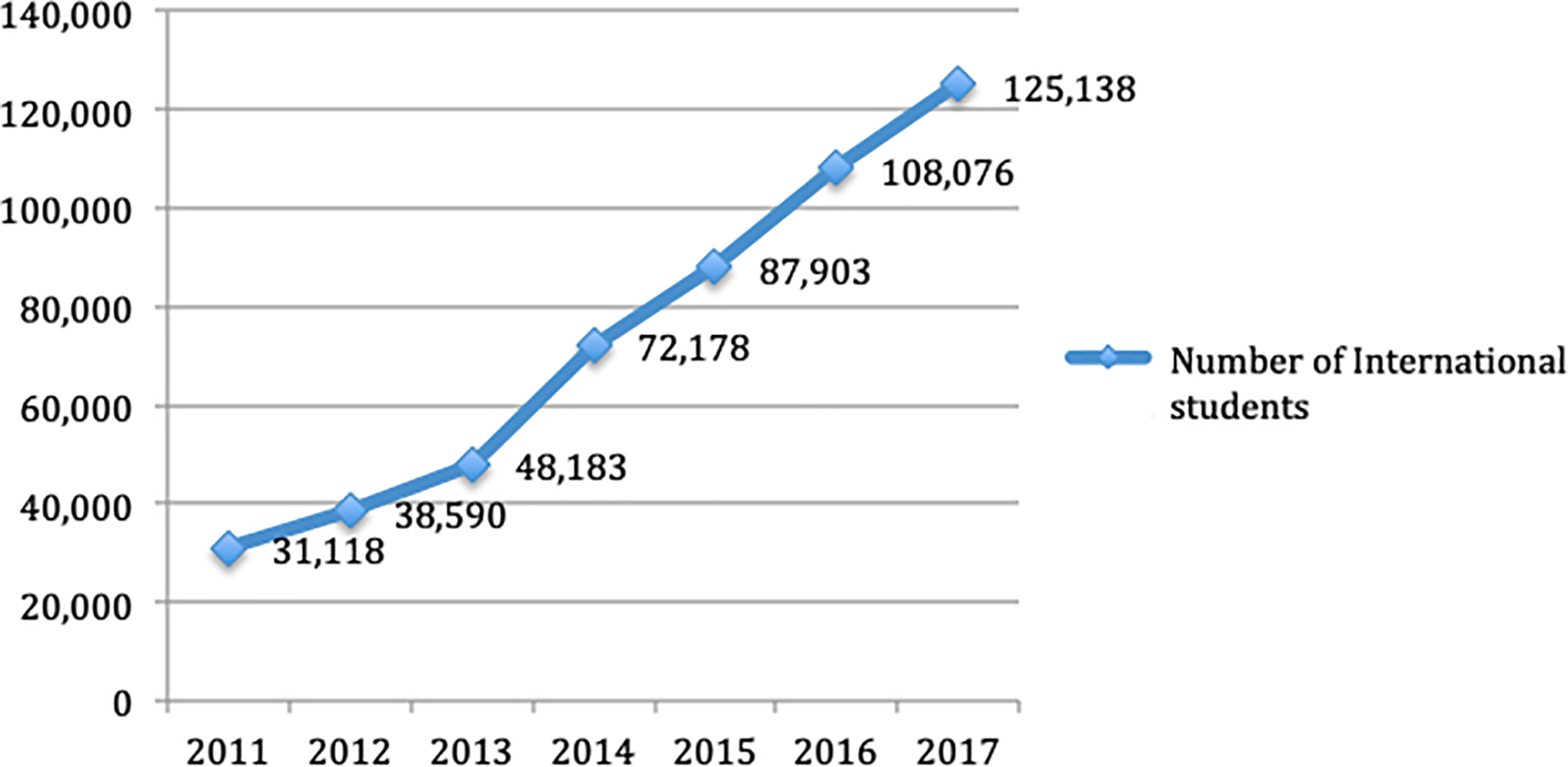
International students.
Business, Innovation, and Technology
A country’s track record in business and innovation is also central to soft power. Nations that allow creativity, critical thinking, and innovation are expected to thrive and provide a desirable environment for inspiration. Turkey has traditionally had a strong defense industry with a large budget for defense spending. The emphasis on defense industry allowed Turkey to become a prominent hard power in its region and NATO’s second largest military. In order to downscale its dependency of defense technology, Turkey has been investing in developing its defense technology. Its 2018 defense budget is over 10 billion dollars and part of that budget is allocated to developing its independent defense technology. Turkey seeks to maximize its local manufacturing capabilities by investing in research and development as well as technology transfer. Turkey’s local defense technology production has increased from 25% to 68% since 2003 (Export.Gov, 2018). In line with its growing independent defense industry, the number of Turkish patent applications has increased exponentially demonstrating an emphasis on research and development. There were 21, 205 applications in 2002, while in 2016 the applications were 10,499,692.
Internet usage has also increased since 2002 as the Internet technology became more accessible to masses. There were over 10 million broadband subscriptions in Turkey as of 2016. Although Turkey wants to put more effort into research and development, the environment in which entrepreneurs flourish is in rapid decline. Data collected from OECD indicate that Turkey has significantly become an unwelcoming environment for businesses. Within 3 years, its ranking has dropped from 54 to 77 and ease of doing business has also declined. An unfriendly or even hostile business environment demonstrates parallels to Turkey’s declining civil and political rights as well as whether it is considered safe for investment.
Culture
Culture as a soft power resource is a combination that stretches from a country’s historical appeal, cultural exports, celebrities, culinary traditions, its national airline, award winning films, and television series to its Nobel Prize winners. In this regard, culture is a dominant feature of Turkey’s soft power resources.
As the successor of many ancient Anatolian civilizations, Turkey is blessed with abundant historical artifacts. As of 2018, Turkey has 16 different cultural intangibles in the UNESCO Intangible Cultural Heritage List (2018). There are 18 properties listed as UNESCO World Heritage Sites and 77 properties listed under its tentative list (UNESCO World Heritage List, 2018). Natural parks and a country’s landscape are also important soft power assets that in turn generate more tourism and international recognition. The Denmark-based Blue Flag Programme, which recognizes best beaches, awarded 459 Turkish beaches for their excellence (The Blue Flag, 2018).
Turkey is home to 18 indigenous languages as well as 21 non-indigenous languages. Some of these languages including Aramaic, Ladino, and Western Armenian are under threat of becoming extinct (Ethnologue, 2018). While the existence of these languages point to the multiculturalism that dominated Anatolia, the waning of these diverse cultures has resulted in the current condition of these ethnic languages. Culinary traditions also serve as a benchmark in serving as soft power resources. Although Turkey has an extensive culinary tradition, it has not been able to develop a globally recognized Turkish cuisine. Therefore, Turkish cuisine despite its potential is not positioned to boost Turkey’s soft power. The exception to Turkey’s culinary soft power resource is the world famous restaurant chain Nusr-Et and its celebrity chef Nurset Gökçe who is known as Saltbae on social media.
Cinema films and television shows are also avenues in which nations compete to gain global recognition. For example, Bollywood and Mexican cinema are two important platforms in global entertainment (De La Mora, 2014; Thussu, 2013). Korean television dramas are similarly important cultural exports in enhancing Korean soft power and image (Kim, 2007). Although not receiving direct support from the state, a number of award winning directors and films have represented Turkey in international festivals. Nuri Bilge Ceylan and Semih Kaplanoğlu are two recent directors who have received awards at the Cannes Film Festival and Berlin International Film Festival. Additionally, Turkish television series has been generating significant attention across the globe. With millions of viewers in multiple continents, Turkish television content has become one of the leading exports in global content. In this regard, Turkish television series has the potential to contribute to Turkey’s soft power assets as cultural content emerging from Turkey. Whether or not drama series are utilized by the state of Turkey in favor of its soft power appeal is an understudied area.
In addition to substantial cultural features a country’s social capital, thus its citizens are an essential soft power resource. Nobel laureates, artists, celebrity figures, and intellectuals are a country’s soft power resource. Nobel laureate in literature Orhan Pamuk and Nobel laureate in chemistry Aziz Sancar are prominent international names of Turkish heritage. Turkey is also associated with numerous celebrity personalities that are recognized for their work. Award winning director Nuri Bilge Ceylan and Fatih Akın, world renowned pianist Fazıl Say, business executive Muhtar Kent, Turkish-American celebrity doctor Mehmet Oz, and entrepreneur and founder of Chobani brand Hamdi Ulukaya are a few of those figures. World-class football player Mesut Özil and NBA players Mehmet Okur, Hidayet Türkoğlu, and Cedi Osman all contribute to Turkey’s soft power capacity. On the other hand, another Turkish NBA player Enes Kanter, an affiliate of the Gülenist network, is countering the celebrity soft power potential by speaking up against the government of Turkey and President Erdoğan. Therefore, while celebrity personas can contribute to a country’s soft power potential, they can also undermine it. Likewise, intellectuals can boost or undermine Turkey’s soft power potential. A number of Turkish intellectuals live abroad and are established within their fields of studies such as academia and journalism. The decline of democracy in Turkey has resulted in an exodus of Turkish citizens particularly in these fields. Therefore, the recent wave of migration from Turkey to Europe and North America has more negative repercussions than serving the interest of Turkey’s soft power capacity.
Government and Politics
The way a country governs itself is another important dimension of soft power. Therefore, freedoms and democracy are key variables in building a nation’s soft power capacity. Freedom House and Reporters Without Borders provide the best available data. An analysis on Turkey’s freedom of the press indicates that on a scale of 0 (most free) to 100 (least free) Turkey’s rating dropped gradually from 48 to 71 in 2016 making it not free.
Comparatively, Freedom House also rates a country’s political and civil liberties. This figure determines the status of free (1.0–2.5), Partly Free (3.0–5.0), and Not Free (5.5–7.0). Freedom House ratings indicate Turkey’s downward trend from 2006 to 2018.
Similar to Freedom House, Reporters Without Borders ranks countries based on their press freedoms. Of 180 countries that were surveyed, Turkey shows a decline from 2002 to 2018 dropping from 100 to 157.
Furthermore, Freedom House ranking on Internet freedoms that surveys 65 countries also demonstrates Turkey is not free. In 2009, Turkey’s Internet freedom score was 42 with 0 being most free and 100 being least free. In 2017, it was 66 placing Turkey among the countries that are not free on the Internet. These rankings demonstrate the downward trend in Turkey’s freedoms and can be interpreted as a barrier toward building its soft power capacity. According to the aforementioned indices, countries that have more freedom are more appealing for foreign audiences. In this regard, given Turkey’s lack of freedoms, it can be argued that its pull affect has correspondingly declined (Figure 2).
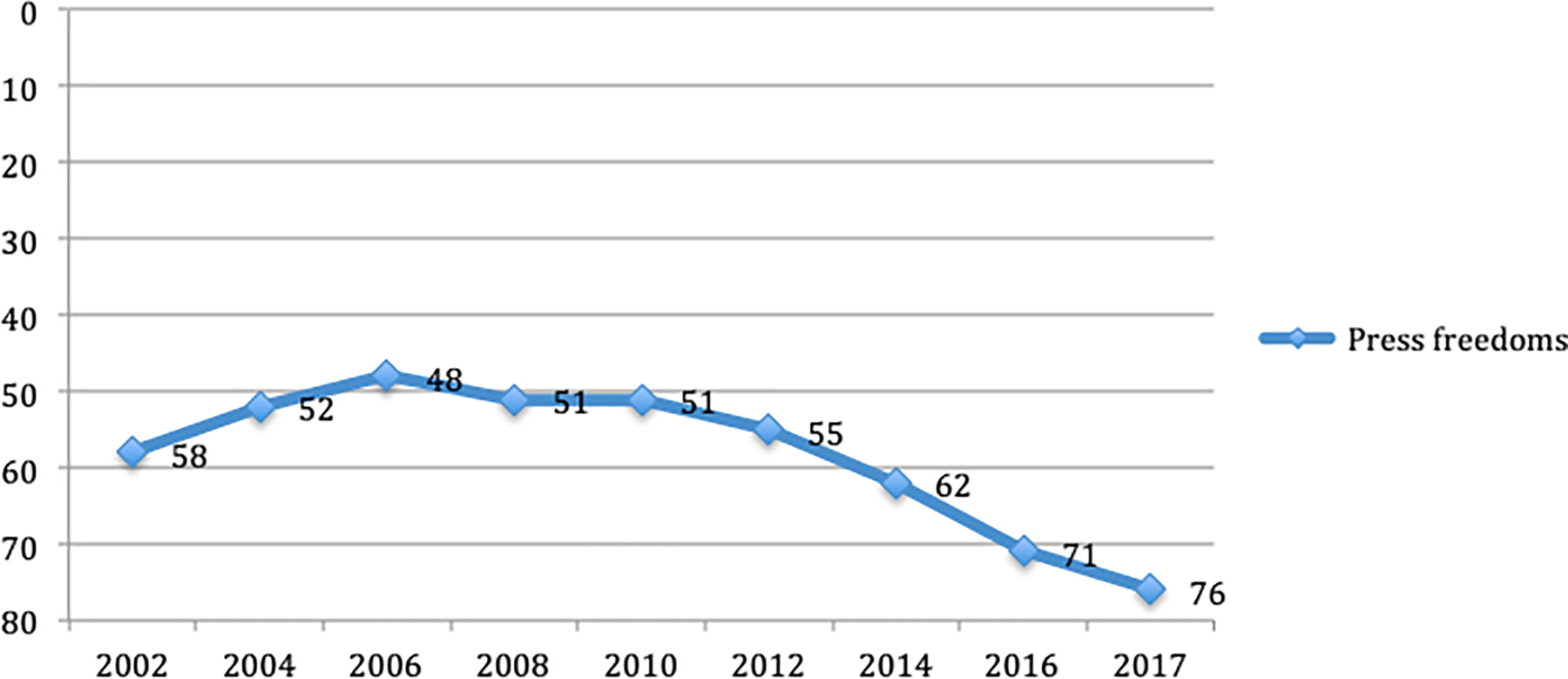
Freedom house press freedoms. Source. Turkish Higher Educational Council https://istatistik.yok.gov.tr.
Conclusion
As the dominant force that drives nations, power is a relative concept that is difficult to measure. Material resources such as military power, defense spending, and defense technology as quantifiable resources are easier to tie into the concept of international power. On the other hand, the power of attraction does not always invoke the same strong connection given its difficulty to measure and vague definition. Nevertheless, as Joseph Nye argues, in an information age, outcomes are not solely shaped by whose army wins but also by whose story wins (Nye, 2011a, 18). Thus, nations need to have and be able to share a compelling story to persuade audiences. Culture, history, politics, personalities, institutions, foreign, and domestic policies are values that are attractive to foreign audiences. Often times, nations have a set of values that are attractive to some foreign audiences, but they are not properly translated to power. In that case, soft power exists as a set of resources or assets but does not mean its translated to international power. Besides, there is an inherent bias with the concept of soft power. Soft power by definition is also a relative concept that is developed in the United States with a particular emphasis on sustaining American power. In other words, while the existing definition and scope of soft power is limited to liberal democracies, in reality, illiberal democracies or even authoritarian states do also have a certain degree of global appeal in audiences that do not uphold the same democratic standards as liberal democracies. Thus, the characteristic of the foreign audience does matter in determining the spectrum of soft power resources and their pull affect.
In this respect, Turkey is a noteworthy case study in examining the soft power capacity of developing countries. As an aspiring regional power that has often been criticized in the last decade for punching above its weight, Turkey has incorporated a soft power discourse in its foreign policy lexicon. Therefore, Turkey’s aim in expanding its sphere of influence by means other than hard power has been established both in the political and public discourse. The Davutoğlu era is the zenith of Turkey’s soft power discourse owing to external and internal factors that positioned Turkey as a rising role model in its region. Although Turkey has continuously expanded its groundwork in building its soft power capacity, Turkey’s slide into a hybrid democracy, in other words, its downslide in democratic freedoms, has had a negative impact on its reputation. In effect, the rise and fall of Turkey’s soft power discourse are both engrained in the Davutoğlu leadership. Hence, it was the Davutoğlu doctrine that paved the way for the soft power discourse, while it is the Erdoğan era that effectively put an indefinite pause on the discourse. In this regard, the direction and style of leadership is connected to Turkey’s soft power capacity.
Although providing a precise assessment of a country’s soft power assets is nearly impossible, this article offers an outline of Turkey’s most recognizable soft power assets. Within this context, the rise of Turkey’s soft power discourse is reflected in the first 8 years of consecutive AKP governments. The period of 2010–2013 is rather static, and Turkey’s track record in governance shows drastic decline after 2013, while in other indicators such as education, the number of international students is increasing. At the same time, Turkish drama series has gained popularity beyond the Middle East and became brand ambassadors for Turkey in Latin America. Furthermore, Turkish humanitarian and development aid by government and nongovernment actors have the capacity to attract audiences in Africa.
Turkey’s interest in the Balkans and Caucasus continues to grow together with educational, cultural, and trade programs developed to heighten Turkey’s soft power potential. Thus, Turkey’s soft power capacity is existent, but its reception will vary from one region to another. In other words, Turkey’s existing soft power capacity may be adequate to attract foreign audiences in the Global South or those in its cultural sphere, but its democratic backsliding stands in contradiction to the conceptual framework of soft power. Consequently, there is a contrasting outlook in respect to Turkey’s soft power capacity and the ways in which it is interpreted in various countries. More importantly, whether or not Turkey is able to translate its soft power resources into actual soft power requires further examination of public opinion. Nonetheless, this article demonstrates that Turkey’s soft power assets as a whole are underdeveloped to attract audiences in Western democracies. While Turkey’s cultural resources are abundant and can have broader appeal in Western democracies, they are not part of its foreign policy apparatus. On the other hand, while Turkey’s political values may not have the pull effect, regardless of its democratic shortcomings, developing countries could still find Turkey an example to emulate.
Footnotes
Acknowledgment
I would like to thank the three anonymous reviewers for sharing their comments and with that helping improve the quality of this article.
Declaration of Conflicting Interests
The author(s) declared no potential conflicts of interest with respect to the research, authorship, and/or publication of this article.
Funding
The author(s) received no financial support for the research, authorship, and/or publication of this article.
