



Abstract
The future of liberal democracy appears to be uncertain. This article develops a holistic approach to examine the prospects of liberal democracy by focusing on how three main regime types—that is, “established democratic regimes,” “hybrid regimes,” and “established authoritarian regimes”—interact with each other. We argue structural global political economy trends, which largely created the current authoritarian populist tide, remain strong despite signs of democratic renewal emerged with the recent new green Keynesian turn in established Western democracies, a more unified transatlantic response to the Russian invasion of Ukraine and growing political-economic fragility of key hybrid regimes ruled by authoritarian populist leaders. Also, the resilience of various types of autocracies which co-exist and reinforce one another through economic linkages and political coalitions should not be underestimated, especially demonstrative effects of the Russia–China partnership. Both democratic and authoritarian forms of capitalism face serious problems of income and wealth inequality, raising challenges over “performance legitimacy” in both regime types. In this context, the performance and political-economic orientation of hybrid regimes will have a crucial bearing on the fortunes of liberal democracy on a global scale.
Keywords
Introduction
Democracy is in crisis across the world. Today, 70% of the world population lives in autocratic countries and “the last 30 years of democratic advances are now eradicated” (V-Dem Institute, 2022, p. 12). It is a startling fact that “electoral autocracy” has become the dominant regime type. Some of the most pronounced authoritarian turns in recent years have been experienced in previously promising cases, such as Hungary, Poland, Turkey, Brazil, and India. We seem to have entered “a third wave of autocratization” (Lührman & Lindberg, 2019), which represents a sharp reversal of what Samuel Huntington (1991) has termed as the “third democratization wave,” a notable characteristic of the late 20th century.
The central question is whether we are likely to witness a reversal of this “third wave of autocratization” in the following years? After a surge in 2010s, some suggest that authoritarian right-wing populism is losing its appeal. The recent gains of social democracy in certain European countries such as Germany and Portugal as well as the new pink tide in Latin America involving the election of left-wing, progressive presidential figures in Chile, Peru, and Honduras are worth mentioning. The inability of the authoritarian populist leaders to solve major issues of our time, as the argument goes, has convinced citizens that they are not fit for office. The debate on the future of liberal democracy took a new turn with Russia’s unprovoked invasion of Ukraine on 24th February 2022. Some scholars suggested “the Russian invasion of Ukraine has given the world’s democrats a renewed sense of unity and purpose” and “the invasion is likely to put autocratic governments on the defensive” (Way, 2022).
We maintain in this article that an integrated perspective is needed to examine the prospects of liberal democracy in the age of uncertainty, anxiety, and insecurity. We therefore propose a holistic approach that would not only analyze the functioning of the individual components of the system—that is, “established democratic regimes,” “hybrid regimes,” and “established authoritarian regimes”—but also focus on how they interact with and influence each other in the global North and the global South. 1 This would enable us to identify some structural trends that are likely to shape the future of liberal democracy in a post-liberal international (dis)order. It would also help determine pathways to reform that would facilitate renewal of liberal democracy in the years to come.
The rest of the article proceeds as follows. The following section makes the case for a holistic approach to understand the growing tensions in contemporary politics. Section three analyzes the crisis of neoliberal globalization, which has exacerbated the anxieties and the insecurities of non-privileged masses in liberal democracies. Section four examines the challenge of authoritarian capitalism and explains why it has recently become more visible in global political economy. Section five delves into the dynamics of democratic backsliding and authoritarian consolidation in hybrid regimes. Based on the analysis of all three components of the system, and how they interact with each other, sections six and seven argue that the authoritarian tide represents a structural trend in global politics, which may not be easily reversible over a short space of time. The final section develops alternative scenarios on the future of liberal democracy, swinging between fragility and resilience.
The Need for a Holistic Approach
What makes the recent experience of democratic backsliding distinct from the previous patterns and therefore generates system-wide anxiety is that all three components of the global political system have been moving in a right-ward direction in the democracy-authoritarianism axis, though in different degrees of intensity. To start with, the appeal of democratic norms and representative function of political institutions have eroded in “established democratic regimes” (Levitsky & Way, 2020; Mounk, 2018; Öniş, 2017; Ziblatt & Levitsky, 2018). The most significant threat to liberal democracy in the West so far was posed by the election of Donald Trump in 2016. With the Trump phenomenon, the United States came close to replicating the authoritarian populist turn led by strongmen in the European periphery and many parts of the global South. The Trump phenomenon ended, at least for the moment, with the election of Joe Biden in November 2020. However, the legacy of Trumpism still lingers on and American society and politics continues to be highly polarized. Trump is likely to be nominated as the Republican candidate for the presidency and one cannot rule out the possibility that he might make a comeback in 2024, which would most certainly involve a major overhaul of the current agenda that Biden is trying to implement. Western Europe has been more fortunate in the sense that authoritarian populist leaders have presented a significant challenge but failed to generate the kind of landslide electoral success. Even though their ability to shape the tone for the political debate should not be underestimated, parties like Alternative for Germany (AfD) have remained at the margins of political power.
Whilst established Western democracies have been experiencing democratic recession, the most serious downward turn has occurred in the second category, “hybrid regimes.” One of the most dramatic and ironic shifts have taken place in the European periphery, where Poland and Hungary, having benefited from the European integration process with access to massive EU resources and funds, have witnessed significant democratic backsliding. Beyond the European periphery, striking examples include the so-called “democratic BRICS” like Brazil and India, which have become an integral part of the global right-wing authoritarian populist wave in recent years. Jair Bolsonaro in Brazil and Narendra Modi in India pushed these systemically important southern democracies into the realm of electoral autocracies, further undermining liberal democracy on a global scale.
Turning to our third category of “established authoritarian regimes,” these regimes have become increasingly repressive over time. China during Xi Jinping era, for instance, has become even more centralized and authoritarian, with significant expansion in the executive power of the top leadership. The expectations were high in early 2000s on the likelihood of political liberalization across the world. The idea of “convergence”—that is, “as countries embraced globalization, they would become more ‘responsible’ members of the liberal international order and would, over time, liberalize domestically” (Wright, 2017, p. 1) became popular in Western capitals. China, for instance, has become one of the principal winners of the post-Cold War international economic order. However, contrary to initial expectations, political liberalization did not occur. The consolidation of authoritarianism was not limited to the case of China though. In the Russian case, another systemically important country, after an unsuccessful attempt at political liberalization in the early 1990s, Vladimir Putin’s power has expanded steadily over the past two decades, leaving very little space for meaningful political opposition. McFaul (2018, p. 306) describes this process as “autocratic restoration” in Russia with “elections for the offices that matter are not competitive, with little uncertainty about the outcome on election nights. Only small pockets of independent media have survived.”
Examples of “authoritarian turn” in international politics abound. What is important for our purposes is that the three distinct regime types have interacted in such a way as to reinforce the patterns of democratic backsliding and further autocratization as a global phenomenon—a point we will elaborate in the following sections (for principal domains of interaction, see Figure 1). During the Cold War, there was an intense ideological competition between economically isolated political blocs, involving democratic forms of capitalism in the West and different forms of communism mainly represented by the Soviet Union and China. The new era, which some scholars frame as a “new Cold war,”
2
is quite distinct because dominant political economy paradigm today has become capitalism, organized at the global scale. The countries located in all three categories in terms of political regime types are firmly embedded in capitalist production and exchange structures. The current system, however, involves competition between different varieties of capitalism.
3
In the post-Cold War era, state-market relations in China and Russia have evolved in the direction of state capitalism, albeit in different forms.
4
Hence, global capitalism, in the early 21st century appears to be robust, yet the presumption that market economy would ultimately be associated with some sort of liberal democratic governance over time no longer holds true.
5
Indeed, there is a growing separation between capitalism and democracy, with the likely scenario that liberal democracy in the West would no longer be the dominant paradigm but would represent a part of the global political economy system—competing with highly authoritarian forms of capitalism in an “age of hybridity” in which different norms and values co-exist (Öniş & Kutlay, 2020b). A holistic approach to global democratic erosion in the age of hybridity. 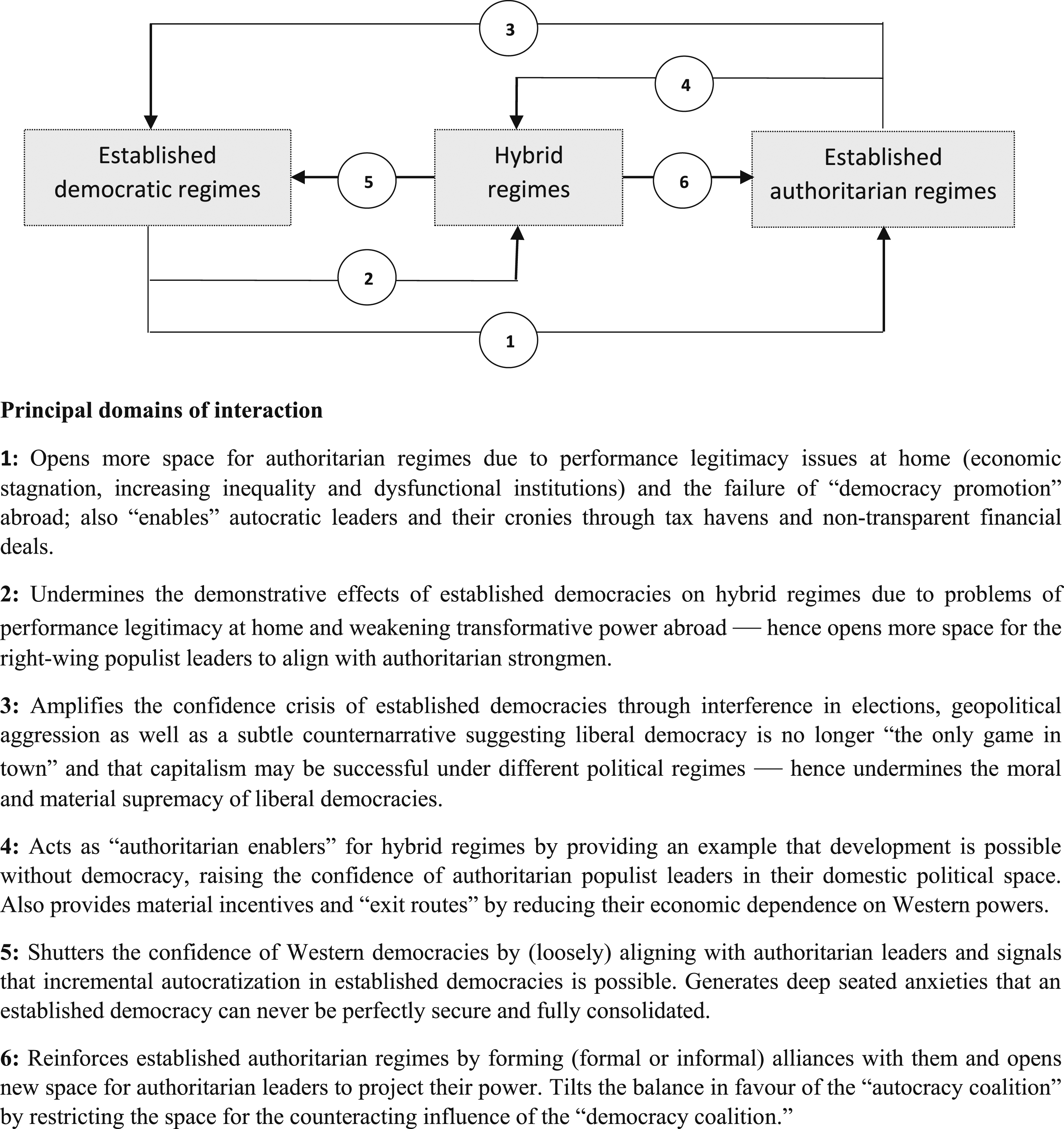
The mutual interaction of different regimes in a competitive but at the same time interdependent global capitalist system is fundamental to the discussion concerning the future of liberal democracy. The power of the Western actors is constrained by the retreat in their relative capacity and increasing contestation from non-Western global actors like China and Russia. Moreover, in the emerging hybrid international order (or in the “new Cold War” context), the challenge posed by China is way more substantial and harder to counter for the West compared to the challenge that Soviet Union posed during the original Cold War era. Whilst core democracies in the West have experienced a crisis of confidence—especially since global financial crisis of 2008, emerging powers like China presented themselves to the rest of the world as new models of successful development, with constant emphasis on order, stability, security, and effective decision making. Not surprisingly, many authoritarian populist leaders and the surrounding political-economic elites in hybrid regimes are influenced by this emerging form of competition between alternative forms of capitalism. The growing authoritarian turn in key hybrid regimes—in the European periphery and across much of the global South—has closely reflected this structural trend, where authoritarian capitalism is sharply deviating from the norms of liberal international order.
The Crisis of Neo-Liberal Globalization and Deepening Anxieties
How did we end up here? After the end of the Cold War and collapse of the USSR, United States became the only superpower in a “unipolar” international system. Francis Fukuyama’s (1989, p. 4) essay entitled “The End of History,” which suggested “the end point of mankind’s ideological evolution and the universalization of Western liberal democracy as the final form of human government,” captured the mood at the time. 6 The combination of free market capitalism and liberal democracy enjoyed an unrivalled ideational status, suggesting a natural path for the latecomers. This was also a period where the European Union (EU) exercised significant leverage over third countries as a transformative power. The EU during the 1990s and early 2000s enjoyed a dramatic process of deepening and widening, involving the formation of the Eurozone, along with the largest enlargement wave, leading to significant transformation in Central and Eastern Europe.
Western supremacy lasted until the global financial crisis of 2008. The extreme form of free market principles implemented under the rubric of neo-liberal globalization, also known as the “Washington Consensus,” (or its modified version the “Post-Washington Consensus”) whose implementation was facilitated by the absence of any serious alternative, was subjected to a blow with the onset of the global financial crisis of 2008. Clearly, this was not the first crisis of neo-liberal globalization. It, however, had a deep impact on Western capitalism. In retrospect, the global financial crisis shattered the confidence of the West. A decade after the global financial crisis, the world looked strikingly different than what it was back in early 2000s. The neo-liberal ideas were increasingly challenged by new forms of state capitalism emerging from the global South. China, following a path of incremental economic liberalization as opposed to most of the other developing countries adopting the Washington consensus norms, benefited from the opportunities that globalization provided through trade expansion and massive capital inflows (Öniş & Kutlay, 2020b, p. 126–129). As such, the idea that successful capitalist development could be achieved within an authoritarian political system gained visibility with the long-term growth performance of China (Figure 2(a) and (b)). Since early 2000s, China’s growing influence changed global political economy dynamics and popular perceptions on democracy-development nexus. For instance, “in 2001 […] over 80% of countries with data available had a larger volume of trade with America than China. By 2018, that figure was down to a little over 30%—with two-thirds of countries (128 out of 190) trading more with China than the United States” (Leng & Raja, 2019). a. China versus US GDP (per cent). 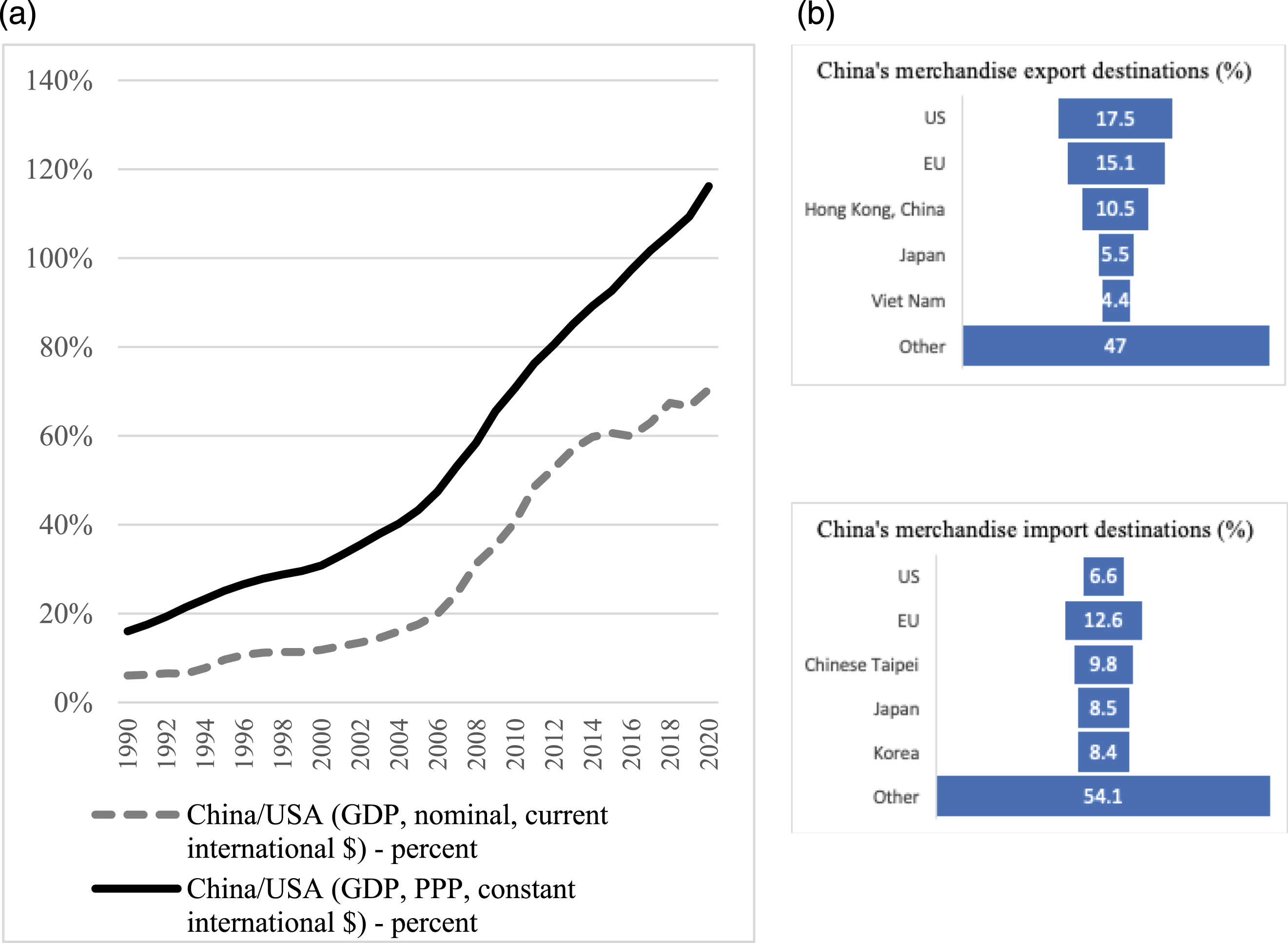
Neo-liberal globalization of the late 20th century had generated significant dislocations in Western political economies, notably in the United States. Over decades, the increasingly technocratic and complex nature of domestic governance led to a disconnection between governments and citizens. In effect, “as more and more areas of public policy have been walled off from the fray of democratic politics, the people’s ability to influence their government has been drastically curtailed” (Mounk, 2018, p. 101). The primary winners of neo-liberal globalization in the West were the upper income groups or the owners of large capital. Rising income inequality with steady deterioration in the relative positions of middle and working classes in Western democracies generated widespread economic dissatisfaction and political disillusionment. Figure 3(a) and (b) show that income inequality emerged as a much more pronounced problem in the United States where the scope of welfare state has been considerably more limited compared to the social market economies of core European countries.
7
In the United States, the share of the top 1% in total income doubled over the last four decades. Also, in 2020, top 1% of the population controls around 35% of total net wealth, whereas bottom 50% of American society takes just 2% of the overall wealth. Rising inequalities and the feeling of being “left behind” created insecurities especially among the working-class whose jobs disappeared through globalization, technological change, and broader “economic dislocations” (Rodrik, 2021; Guriev & Papaioannou, 2020, p. 19–36; Öniş & Kutlay, 2020a).
8
a. Top 1%, top 10%, bottom 50% in total pre-tax income—1980 versus 2020. 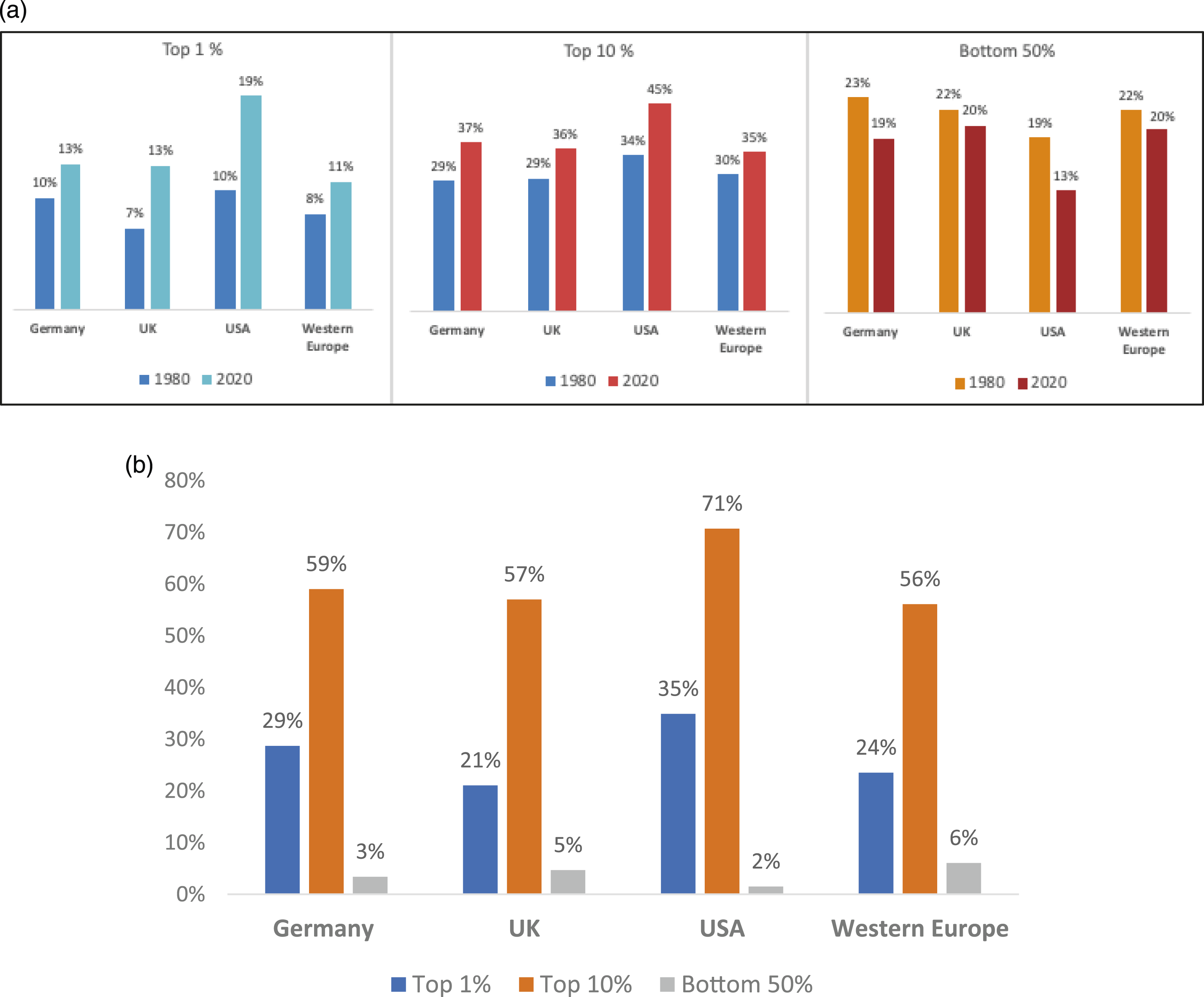
In this process, a serious populist backlash fed into a parallel crisis of liberal democracy. Populist leaders also effectively utilized identity-related cleavages to fill their sails by appealing to race, culture, and nativist sentiments (Inglehart & Norris, 2017). The Trump phenomenon in the United States was arguably the most striking example that shows how a dramatic political figure could exploit the underlying tensions and deepen polarization through politics of fear cemented with economic anxieties (Galston, 2017). Similar patterns emerged in Western Europe, where far-right parties appealed to losers of globalization through a discourse of exclusionary identity politics based on Islamophobia and anti-foreign sentiments, 9 which were aggravated by the large inflows of refugees following the collapse of state structures in the MENA region, state failure in Afghanistan, and the unfolding catastrophe in Syria with its dramatic human consequences.
The Challenge of Authoritarian Capitalism and Autocracy Coalition
The problems associated with neo-liberal globalization constitute just one side of the story. One needs to look beyond the West to comprehend the structural trend in global political economy that has lifted the boats of authoritarian movements. The phenomenal economic rise of China and the geopolitical aggression of Russia are among the most striking developments over the past two decades, which few could have anticipated in the immediate aftermath of the Cold War. China has become an integral part of the global capitalist system, although the Chinese ruling elites themselves are not fond of concepts like “state capitalism,” which they consider as Western constructs, preferring terms like “socialist market economy” instead. 10 China represents a protype example of an established autocracy. In the Russian case, there exist formal mechanisms of political competition. Yet, essentially, the regime provides very little room, if any, for political opposition. Despite the asymmetries in their economic dynamism and capabilities, where China clearly enjoys the upper hand as opposed to the lop-sided structure and stagnation of the Russian economy, with its heavy dependence on energy resources and military capabilities, the two systemically important countries have been collaborating on multiple levels on a global scale. Russia and China signed a lengthy joint statement in February 2022 stating that their friendship has “no limits” in a world “going through momentous changes, and humanity is entering a new era of rapid development and profound transformation.” 11 Admittedly, Russia’s invasion of Ukraine will constitute a stiff test of bilateral relations between these two global powers, yet it is ultimately unlikely to significantly undermine this relationship, as China’s leadership signaled since early days that they rejected joining sanctions against Russia devised by the Western actors.
In the emerging hybrid international order, there is a growing competition between Western democracies and authoritarian capitalism, not only in economic, military, and technological terms but also in terms of whose norms count in global politics. China and Russia are increasingly presenting to the rest of the world an alternative normative order based on principles of collective security and stability, rather than individual rights and political freedoms. The ways that the two countries have been undertaking “autocracy promotion” appear to be different but are ultimately complementary. Russia has been more overt in its interference in the domestic political processes of the Western countries (European Commission, 2019). In the Chinese case, the influence is exerted through more indirect avenues. China has been building economic ties through mega projects like the Belt and Road Initiative to support likeminded regimes in Central Asia, the Middle East, and in other parts of the world. As a result, many authoritarian leaders can access to alternative means of finance, reducing their dependence on the West (see Figure 1).
The nature of the contestation in the current era is therefore fundamentally different than the Cold War, which had involved a stiff ideological competition between two rival political economy camps. The ability of the Western alliance to emerge victorious from the “new Cold War” is likely to be more difficult. First, China constitutes a far more formidable rival than the Soviet Union ever was. Second, China and Russia are much more co-operative in the present juncture compared to their conflictual relationship during most of the original Cold War era. Third, China, despite significant competition in economic, technological, and geopolitical terms, constitute an integral part of an interdependent global capitalist order. We can no longer think of two entirely isolated systems in which defending democratic norms came with little economic costs for the West. In fact, Russia’s invasion of Ukraine and the scope of Western sanctions in response demonstrated how economic interdependence conditions policy options for both sides and paves a way for a more fragmented, fragile, and arguably controlled version of globalization.
What makes all more complicated is that the “peaceful rise of China” no longer holds. China has been experiencing a significant leap from its early cautious rise to become an assertive geopolitical actor with hegemonic ambitions. As the earlier confidence on the pacifying effect of economic interdependence withered away, the possibility of a great power conflict between China and the United States has become a growing concern for policymakers and experts. 12 The Chinese leadership has been more vocal in terms of promoting the virtues of its own political regime in dealing with major challenges of our time—such as economic development, poverty reduction, tackling pandemic, and climate change. A key element of the “Beijing consensus” as China rises to a position of a co-hegemonic power involves the construction of an alternative normative order where large-scale economic transformations can be accomplished in a stable but closed political order. According to this vision, the virtues of Western liberal democracy are framed as sources of weakness and fragmentation, undermining stability, security, and order, hence state power (Bloomberg News, 2021). This alternative conception has appeal to authoritarian leaders around the world, even though China may not be engaging in direct promotion of its authoritarian capitalism for the time being.
The Retreat of Democracy in the Global South
The more the pendulum swings in the direction of authoritarianism on a global scale, the more secure would Xi and Putin feel. By the same logic, if Western countries can recapture their appeal by effectively addressing the insecurities and anxieties of underprivileged citizens in liberal democracies, this will pose a major threat to existing regimes in China and Russia. History suggests liberal democracy is quite resilient in the long-term and has the capacity to renew itself more effectively than alternative regime types. In this context, “hybrid regimes” are critical in terms of the future of liberal democracy. One of the most dramatic and unexpected developments of the past decade has been the degree of democratic backsliding in several hybrid regimes. The most striking examples are Turkey under Recep Tayyip Erdoğan, Hungary under Viktor Orban, Brazil under Jair Bolsonaro, and India under Narendra Modi. It is ironic that these countries were moving in the direction of democratization just until a decade ago, although they had their greater share of democratic deficits compared with liberal democracies.
There is no doubt that national characteristics matter and countries involved in the process display some unique features. Yet certain common patterns exist in all cases as part of the structural trend sketched above. A dominant element of the new authoritarian populism involved the emergence of powerful leaders, who were able to use both economic growth and exclusionary identity politics as a means of building effective cross-class coalitions. The characteristic aspect here is that power is gained democratically and then has been used to bypass democratic norms and institutions incrementally. This points to a fundamental difference from the earlier waves of autocratization in the post-war era, where power was generally captured by military interventions, leading to the termination of the democratic process through sudden ruptures (Lührman & Lindberg, 2019). The present wave of autocratization instead takes place through a stage-by-stage process, whereby the autonomy of institutions like the judiciary, key layers of bureaucracy, and the media are undermined, leading to the gradual elimination of checks and balance mechanisms essential to the functioning of a liberal democratic order (Diamond, 2020, p. 39–40). Also, new business elites are supported to create a network of loyal economic actors and restrictions are placed on opposition parties and civil society organizations, which institutionally limit their ability to mount a serious challenge in the electoral process.
The global wave of right-wing populism, as manifested in the European periphery and the global South, may also constitute a backlash against neo-liberal globalization, with one fundamental difference. Authoritarian right-wing populist leaders like Erdoğan, Orban, or Modi are able to base their appeal to the emerging upper and middle classes (also see, Foa, 2021). The new economic elites have become the winners of autocratization process in their countries. The authoritarian populist leaders frequently communicate a “new developmentalist” discourse—or more active state intervention, influenced by the cases of Russia and China (Öniş & Kutlay, 2020b). It is not entirely clear how Russia’s influence would evolve following the invasion of Ukraine, yet Putin has represented a reference point for several of these leaders like Viktor Orban, with an admiration for Chinese style economic growth lurking in the background. What is also ironic and rather paradoxical is that authoritarian right-wing populist leaders are heavily nationalistic in outlook, yet they are part of a transnational wave. They tend to benefit from each other’s existence and availability of similar alternatives elsewhere tends to bolster their position in their domestic spheres (Miller-Idriss, 2019; Öniş & Kutlay, 2020a). To give a vivid example of transnational links between right-wing populist leaders, Hungarian leader Viktor Orban was the only high-level European figure to take part in Jair Bolsonaro’s inauguration as President of Brazil. In return, Bolsonaro visited Hungary to lend support to Orban in February 2022 prior to Hungary’s crucial elections in early April.
Sustained economic growth is critical to authoritarian populist leaders for two interrelated reasons. First, economic growth enables the successful incorporation of new elites (as opposed to the old elites) into their political project. Second, economic growth facilitates a certain degree of income redistribution and social policy, which allows them to satisfy the demands of middle- and lower-income groups (Öniş & Kutlay, 2020a, pp. 112-114). Redistribution and social policies become important instruments to create winning coalitions for these leaders. However, it would be naïve to suggest that authoritarian populist leaders will swiftly fall from grace because of economic failures. They effectively use identity-based insecurity of citizens, as complementary processes to bolster their political standing. Polarizing discourse and exclusive identity politics is part and parcel of their repertoire. Those actors have a vision of the dominant core in their respective societies, to which the rest of the society should conform. The precise ideological axis that dominant core relies on varies from one case to another. For Erdoğan, it is Sunni-Muslim nationalism; for Modi it is Hindu nationalism; for Orban it is the vision of a nativist Christian identity. What is common in all these ideologies is a vision of homogenous society build around dominant cultural core. The natural corollary of this is a rejection of pluralism and one of the key features of liberal democracy, namely, respect for diversity, opposition, and minority rights, under the disguise of “national security.” Economic factors are undoubtedly crucial to the durability of authoritarian populist leaders. What is important to emphasize here is that, given other considerations at work, it would take massive economic turmoil to remove authoritarian populist leaders from power as an outcome of a complex process.
Challenges to the Authoritarian Rule: Signs of Turning Tide?
Given recent developments in global politics, there is some room for qualified optimism in all components of the system. To start with, “systemic legitimacy” (commitment of broad segments of the public to the basic norms of a political regime) and “performance legitimacy” are important for the functioning and stability of all regimes. 13 The backlash experienced by Western democracies illustrated that performance legitimacy is important to established democratic regimes. Simply relying on the virtues of democratic governance is unlikely to prevent the decay of liberal democratic regimes. If citizens are not satisfied with their governments’ performance in key areas such as income distribution, access to public services, unemployment, migration control, urban violence, and education, they are likely to shift away from mainstream parties and turn to authoritarian populist leaders. The irony is that such leaders may capitalize on the grievances of ordinary voters and may be a powerful conduit in projecting their anxieties, yet they are highly unlikely to implement the kind of policies to deal with these underlying grievances once they are in office. For instance, Trump was elected to a significant extent by the votes of losers of globalization and middle class experiencing status anxiety. Once in office, however, his policies included attempts to dismantle the healthcare system instituted during the Obama era and engineer major tax cuts for the wealthy segments, which have contributed to a further deterioration rather than improvement in economic inequality.
Trump’s demise constitutes an important gain for liberal democracy. In the US context, the presidential term of Biden promises some changes in the right direction. At the domestic level, the implementation of $1.7 trillion “Build Back Better Plan” aimed to improve infrastructure and major social services, tackle climate change, and rebuild the middle class (The White House, 2021) can lead over time to revitalization in the US economy, both in terms of economic growth and redistribution, which in turn, is likely to enhance performance legitimacy. This will be instrumental in terms of not only reversing democratic erosion at home but also contributing to its role capabilities in an environment where established democracies are confronted with serious competition from various shades of autocratic alternatives. What we observe in both the US and Europe, a process clearly facilitated by the COVID-19 crisis, is a new green Keynesian turn. The original Keynesian revolution was a response to the onset of the Cold War and the imminent communist threat. The new Keynesian turn today may be conceived as a response to the “new Cold War” in the face of authoritarian capitalist challenge.
President Biden renewed the commitment of the US as a defender of liberal democracy. Indeed, Trump’s presidency had provided a major boost to authoritarian leaders, with many of them like Bolsonaro taking Trump as a role model and enjoying a greater degree of self-confidence in their domestic and external dealings with the assurance that a like-minded leader occupied the White House at a critical juncture. Biden’s election constituted a blow to such leaders. The fact that the US also renewing its commitments in key areas such as environment, global trade, and public health are significant developments. The revitalization of liberal democracy on a global scale is heavily dependent on the performance of established democracies. In that respect, the very recent developments in the US and the EU offer some promising signals for the future.
The COVID-19 crisis also seems to have made a big impact on hybrid regimes. In fact, cross-country evidence suggests that the most successful cases in dealing with the pandemic are either established democracies (such as Germany, South Korea, New Zealand) or established authoritarian systems (such as China, Singapore, Vietnam). These are countries with strong state capacity as well as effective leadership enjoying high degrees of public trust. 14 In contrast, some of the worst cases in dealing with the pandemic were to be found in countries governed by populist leaders. Brazil under Bolsonaro constitutes perhaps the most striking case of failure, both in terms of underestimating the seriousness of the pandemic itself and failure to undertake effective action. As a result, Brazil has experienced huge casualties. India under Modi constitutes yet another example of serious failure in dealing with the COVID-19 pandemic, undermining Modi’s popularity in comparison to pre-COVID-19.
It is possible to observe other signs of stress in several hybrid regimes. Most of them face significant problems in terms of performance legitimacy (Mounk, 2018; 2020). The Turkish case is a good example where the economy has been struggling with high rates of inflation, heavy youth unemployment, and successive currency crises—all raising serious question marks about the performance of the new hyper-presidential system. The major governance issue in such regimes is that popular leaders, as they are inclined to hollow out domestic institutions in their quest for direct appeal to people, undermine state capacity and trigger a multi-faceted crisis of governance. As a result, in countries like Turkey, Hungary, and Poland nationalist-populist leaders face serious opposition. The victory of opposition parties and the emergence of key opposition figures like Ekrem İmamoğlu and Gergely Karácsony in the local elections of Istanbul and Budapest, respectively, suggest that these regimes are vulnerable and likelihood of democratic restoration through elections in hybrid regimes constitutes a serious possibility. 15 For our purposes, the possibility of a reverse wave involving the demise and replacement of those leaders by the voters in elections will constitute a boost to liberal democracy across the world. The fact that Viktor Orban was able to emerge as the outright winner of the Hungarian general elections of April 2022 is not a good sign for the fortunes of liberal democracy in hybrid regimes, at least in the short run. In that context, the forthcoming elections in Brazil and Turkey are likely to prove a crucial turning point in the fortunes of hybrid regimes. Bolsonaro in Brazil is likely to lose the elections, considering his dramatic failures in handling the COVID-19 pandemic and the fact he faces stiff opposition with the return of the popular, former center-left president, Lula da Silva.
Finally, performance legitimacy is also crucial for consolidated authoritarian regimes. In the Chinese case, the regime enjoys a high degree of systemic legitimacy on part of the elites and the public at large who see the virtues of their system, as opposed to the alleged weakness and fragmentation of western democracies. Some scholars, however, suggest that the growing authoritarianism coupled with the personalization of the regime under Xi Jinping’s leadership may create backlash and open avenues for political change in the long run.
16
Also, growing income inequality in China along with economic slowdown is likely to create a challenge to the regime, which may again be a source of political instability in the medium term (Figure 4(a)). In the short-term, however, the regime seems secure and enjoys broad legitimacy. In the Russian context, Putin is likely to face with significant challenges following Russia’s unprovoked invasion of Ukraine. The massive sanctions imposed by the Western powers are likely to cause severe damage on Russian economy and lead to deprivation of Russian citizens. Given that Russia’s economic performance is much less impressive compared to that of China, the sanctions would further paralyze Russian economy and isolate Putin abroad. This would also transform Putin into a more repressive leader at home to ensure his political survival in a country where opposition was significantly oppressed before the war in Ukraine, as the poisoning and subsequent imprisonment of the key opposition figure, Alexei Navalny testified. a. Top 1%, top 10%, bottom 50% in total pre-tax income—1980 versus 2020. 
Democratic Renewal Versus Authoritarian Resilience
Are the recent developments a sign of reversal in the fortunes of authoritarian leaders? We suggest that caution is needed, and one should not be over-confident about the future of liberal democracy at least from a short to medium-term perspective. Although we have identified certain encouraging developments pointing toward change in a positive direction, structural trends, also summarized in Figure 1, are still in play to a significant degree. To start with, there are limits to democratic renewal even in established democracies. Several question marks hang in the air concerning the scope and longevity of the new Keynesian turn in Western democracies. Will Biden administration be able to implement its massive spending program to deal with the structural problems of the American economy? Will Democrats be able to iron out massive inequalities in the United States, which has been at the heart of widespread anxiety, collective insecurity, and resultant populist backlash? At the international level, will the United States be able to lead other liberal democracies to mount a strong challenge to various shades of authoritarianism?
Serious constraints may block effective implementation of Biden’s progressive agenda. At the domestic level, the desire to finance a large Keynesian spending spree may be confronted with backlash from powerful corporate interests not willing to pay for tax increases. Also, the legacy of Trump in American politics lingers on. The absence of any kind of genuine self-criticism within the Republican Party and a complete endorsement of the Trump phenomenon is certainly not a good sign for the future of American democracy. As the Biden administration focuses its attention on domestic restoration to put its own house in order, it faces a trade-off failing to generate sufficient resources for its international commitments. The chaotic withdrawal of the United States from Afghanistan in the summer of 2021, ending a 20-year presence in the country, created a sense of disappointment for those hoping for the United States to play a more constructive role in the international arena, without repeating the serious mistakes of the past. Biden’s “democracy summit” in December 2021 and the ambitious initiative to lead the democratic coalition simply by serving as examples will have limited effect in many parts of the world—such as Ukraine and Taiwan—if those countries feel they would have little protection against authoritarian great powers’ active use of military force.
Western democracies have faced a stiff test in this respect with Russia’s invasion of Ukraine in February 2022. Russia made a critical move by recognizing the two break-away regions in Ukraine, Donetsk and Lugansk, as independent states and then invaded the country in late February. Russia’s invasion of Ukraine has rapidly escalated the conflict between Moscow and the West. At the time of writing, the Western powers were in the process of mounting a significant reaction to Russian aggression by implementing a wide range of economic sanctions. Germany, rather unexpectedly, has taken an assertive stance by halting the certification of the Nord-Stream 2 gas pipeline project on an indefinite basis. This is quite a striking move given that Germany was previously criticized as being overly passive against Russian aggression. The US, UK, and the EU have also imposed sanctions on certain Russian institutions, state officials, and oligarchs close to Putin as well as removing certain Russian banks from the SWIFT messaging system. China, on the other hand, sided with Russia by abstaining on a UN Security Council resolution condemning Russia’s military move and stated that “against the backdrop of five successive rounds of Nato’s eastward expansion, Russia’s legitimate security aspirations should be given attention to and properly addressed” (White, Lin, & Mitchell, 2020). The outcome is highly uncertain and difficult to predict. The impact of the sanctions and their sustainability over time will have a crucial bearing on the resilience of the democracy coalition on a global scale. The best possible scenario for the West would be a progressive weakening and eventual demise of the Putin regime under the impact of unprecedented sanctions. Yet such an outcome appears to be highly unlikely in the short run especially in the presence of continued Chinese support.
In Western Europe, too, there are several question marks about revitalizing liberal democracy at home and abroad. Whilst the populist backlash appears to have been somewhat subdued in recent years, partly due to economic recovery and due to tighter control of migration and borders, it is by no means over. Another important question concerns the ability of the rule of law conditionality introduced as part of the COVID-19 recovery fund to discipline increasingly authoritarian member states like Hungary and Poland (Zalan, 2022). Whilst conditionality and blocking EU funds no doubt would put pressure on regimes like the Orban government in Hungary, the European Commission hesitated to discipline such regimes until now.
The ability of Western democracies and the EU to create a positive democratization impulse in authoritarian states are severely limited. There is no doubt that key segments of American and European societies care about the plight of the opposition movements in highly oppressive regimes and there is a genuine desire to help. The facts on the ground suggest, however, that there is little that Western democracies can do to contribute to the demise of highly centralized and repressive regimes. There are several examples validating this proposition. The EU could do more to prevent the imprisonment of Navalny, the key opposition leader in Russia. In Turkey, the leverage of the EU has virtually ended once membership process effectively collapsed and bilateral relations took a transactionalist turn (Kutlay & Öniş, 2021, p. 1098). In Belarus, the 2020–2021 popular protests against the long-standing leader Alexander Lukashenka presented a major challenge to the authoritarian regime. Yet, Lukashenka was able to crush protestors with the support of Putin and the EU could do little to alter authoritarian equilibrium in the country.
Such tendencies are certainly not confined to broader Europe. China has been severely criticized for its maltreatment of Uyghur minorities, with criticism coming predominantly from the West. Yet, this criticism had no impact on Chinese policies. China has also suppressed large-scale protests in Hong Kong. It is true that such protests received support from the West. Yet again, China was able to put an end to the democratic demands and placed Hong Kong firmly under the control of the Chinese state, a development, which Western democracies reacted to, but did little to reverse its slide into authoritarian control.
This brings us to a central dilemma. There are powerful economic interests that link Western democracies to both established and electoral authoritarian regimes. These economic interests, in turn, limit the ability of Western democracies to exert sustained pressure on non-democratic regimes. For instance, Merkel pushed ahead with the Nord-Stream 2 project with Russia, despite all the criticism concerning Russian opposition, a clear example of how economic interests dominated over human rights concerns. The rise of authoritarian populist leaders benefited from the Western finance. For instance, Orban consolidated its regime by accessing to massive EU funding. For long time, there was little criticism coming from the European political elite, as Hungary steadily drifted away from democracy over the course of the past decade (Kelemen, 2017). This suggests the battle between democratic and authoritarian regimes, which is becoming a central aspect of the so-called “new Cold War,” is not as straightforward as often portrayed because authoritarian leaders and their cronies have been “enabled” by the West during globalization period through investment deals, tax havens, and non-transparent financial transactions (Cooley, Heathershaw & Sharman, 2018).
Established authoritarian regimes are much more deeply entrenched and it would be unrealistic to expect significant democratic turns in such regimes in the foreseeable future. Hybrid regimes, in contrast, are more fragile and there is a significant possibility that political change may occur, given the strength of the opposition movements, through electoral processes. At the same time, we should not underestimate the resilience of such hybrid systems, given that they exercise disproportionate control over societies through their monopoly over media, the judicial system packed with supporters and repressive security apparatus. Given the fundamental asymmetry in the power resources available to incumbent parties/leaders on the one hand, and the opposition, on the other, it is by no means inevitable that the opposition will be able to turn the tables through conventional electoral process. We should also not underestimate the possibility that authoritarian populist leaders may not be willing to relinquish power by accepting “peaceful exit,” even if they lose elections. Trump not accepting the outcome of the US elections in November 2020 may be an indication of reactions that are likely to emerge in other cases. The forthcoming elections in Brazil will be a test case in this context, especially if Jair Bolsonaro fails to secure a majority.
Conclusion: Between Hope and Despair
The fate of liberal democracy appears to be uncertain. Signs of optimism are present with the recent new green Keynesian turn in established Western democracies. Signs of optimism can also be detected with reference to the fragility of key hybrid regimes. Such regimes have not been performing well in economic terms and face mounting opposition, which may lead to re-democratization through the ballot box. At the same time, the resilience of various types of autocracies which co-exist and reinforce one another through economic linkages and loose political coalitions should not be underestimated. Despite certain reversals, structural trends in global political economy, which largely created current tide in the first instance, are still strong.
This article proposed a holistic approach focusing on the interaction between three major political regime types, rather than analyzing each category on a separate basis. The democratic recession and the illiberal-authoritarian turn may be best understood by looking at the interaction of established democracies, established autocracies, and the hybrid regimes that fall in between. The weakening of liberal democratic regimes and the rise of authoritarian models of capitalism have tilted the balance in an authoritarian direction in several hybrid regimes. The rise of China with its close association with Russia has played a crucial role in this context. China with its dynamic economic system and its hegemonic ambitions under the Xi Jinping leadership poses itself as an alternative where development can occur through the market without necessarily needing liberal democracy. An increasingly self-confident China has been presenting its own model of development more actively in recent years. It has also been using the considerable resources at its disposal to reward countries having a favorable posture to China, whilst penlizing others critical of Chinese human rights violations. Countries with hybrid regimes benefit from access to Chinese and Russian resources, which also allow them a certain degree of independence in their domestic spheres, as they need to rely less on Western capital and associated conditionalities for democratic governance become irrelevant in the context of their domestic politics.
The ability of Western democracies to revitalize themselves by reforming domestic political and economic institutions as well as to act as a coherent front vis-à-vis non-democratic regimes is important. History suggests liberal democracy has better self-correction mechanisms and more capacity to reform itself in the face of domestic and external challenges. If liberal democracy is to (re)-emerge in non-democracies, this will be through domestic political processes of individual countries, with effective mobilization of opposition forces to challenge the fundamental shortcomings of those systems in areas such as high levels of corruption, heavy political repression, and widespread inequality. As a matter of fact, much-needed change in this direction will prove difficult but not impossible. The inherent fragility of the key hybrid regimes ruled by authoritarian populist leaders constitutes another field of struggle concerning the possibilities of reversing authoritarian tendencies on a global scale. Defeats of key populist leaders may lead to a process of democratic renewal in these countries, whilst victories on the part of such leaders may result in further consolidation of authoritarian regimes.
Footnotes
Acknowledgments
We gratefully acknowledge constructive comments and criticisms of the special issue editors Umut Can Adısönmez and Recep Onursal as well as two anonymous referees. We would like to thank Barış Çelik and H. Emrah Karaoğuz for their very helpful comments. We would also like to thank Gülşen Doğan, Özge Özkaya, Alperen Şen, and Yalkun Uluyol for their valuable assistance.
Declaration of Conflicting Interests
The author(s) declared no potential conflicts of interest with respect to the research, authorship, and/or publication of this article.
Funding
The author(s) received no financial support for the research, authorship, and/or publication of this article.
