



Abstract
While research has explored aspects of inter-arts collaboration at professional and primary level, there is little on inter-arts collaboration in the tertiary environment. This article explores aspects of the learning of tertiary music students undertaking a short-term collaborative inter-arts improvisation project with dance and theater peers, focusing on how and what learning occurs within the inter-arts collaborative improvisatory environment and the role of the individual in collaboration. Collaboration occurred most commonly through a homogeneous style within a complementary or co-equal approach. A rationale and structural elements, time, space and resources were important and learning occurred through different styles of dialogue – verbal, especially ‘cumulative’ in style, music and movement. The literature and the study’s findings noted several stages in the transformation of existing knowledge and of the individual through collaborative activities, and the majority of responses were in the first levels. This information could serve as a guide for teachers of tertiary collaborative inter-arts improvisation for the type of planning needed in relation to student levels, structure, time, project design, space and resources, and the learning likely to occur.
Keywords
Introduction
Collaboration for musicians may involve partnerships with other musicians at early childhood (St. John, 2006; Young, 2008), primary (Burland & Davidson, 2001; Gall & Breeze, 2008), primary and secondary (Burnard & Younker, 2008), and tertiary levels (Davidson & Smith, 1997); at primary level and professionally (Custodero, 2007) and professionally (John-Steiner, 2000). It may also involve working with non-musicians, including collaboration with other school disciplines (Lowe, 2002 – language, primary; Russell-Bowie, 2003 – other subjects, primary; Weymss, 2003 – literacy, secondary) and inter-arts collaboration (McCoy, 2000 – dance, primary, secondary and tertiary; Odam, 2001 – tertiary). At tertiary level collaboration can occur between music institutions (Temmerman, 2001); academics creating a musical play for pre-schoolers (Poston-Anderson & de Vries, 2000); in musicology presentations and the assessment of peers’ performance (Hunter, 2006); and professionally, the composer as collaborator (Hayden & Windsor, 2007; Hannan, 2006), piano duo collaborations (Blank & Davidson, 2007) and collaborative pairs or groups (artists, writers, composers) (Brooks, 1993; John-Steiner, 2000). While inter-arts collaborations at professional and primary level have been examined, there is little research on inter-arts collaboration in the tertiary environment. This article, therefore, extends previous knowledge by contributing to discussion on tertiary level inter-arts collaboration. The research explores the learning process of tertiary music students undertaking collaborative inter-arts improvisation with dance and theater peers seeking aspects in common with other levels but also new insights. The research questions ask:
How does the learning occur in the tertiary collaborative inter-arts improvisatory process?
What learning takes place in the tertiary collaborative inter-arts improvisatory process?
Improvisation is the creative medium but is not the primary focus of the article.
Literature review
How learning occurs within collaboration in inter-arts environments
In collaboration, ‘several individuals work together as a team to achieve creative ends … Cooperation, collaboration, occurs when [these individuals] … are interdependent, in that the movement of any one of them toward a goal they all seek increases chances the others will also reach it’ (Abra & Abra, 1999, p. 283). In the education environment, collaborative learning involves students working and learning together, and the outcome ‘should provide evidence of the nature of the collaborative endeavour’ (Hunter, 2006, p. 76). The nature of the endeavor and the outcome – that is, how and what learning occurs in the collaborative environment – are interdependent. How learning occurs depends, in part, on the style of collaboration adopted. Collaborations can be homogeneous or heterogeneous. When homogeneous, each collaborator performs roughly the same service, getting ‘to the point where you are not sure who wrote what’ (Leonard Bernstein quoted in Abra & Abra, 1999, p. 285). When collaboration is heterogeneous some opinions have priority over others ‘with extreme instances becoming virtual tyrannies’ (Abra & Abra, 1999, p. 285). These hierarchical relationships are concerned with power and dominance and can range from the leader as autocrat 1 to the acknowledged leader accepted by the other collaborating partners. 2
Within both collaborative styles several patterns of creative partnership are identified. Distributed collaboration is widespread and takes place in casual and organized contexts, with roles informal and voluntary. Groups may splinter or dissolve but from such informal connections, some lasting partnerships may be built (John-Steiner, 2000, pp. 197–198). Complementarity collaboration, the most widely practiced form, is characterized by a division of labor based on ‘complementary expertise, disciplinary knowledge, roles, and temperament’ (John-Steiner, 2000, p. 198). This co-equal, cognitive style has featured rarely between music and other school disciplines, and only in programs for gifted students where the arts were an equal partner, integrating the general curriculum with arts-specific contents, skills, expressions, and modes of thinking, addressing larger principles and issues (Bresler, 2002, p. 57). In family collaboration roles are flexible or may change over time and members can take over from each other while still using their complementarity (John-Steiner, 2000, pp. 200–201). Integrative collaboration requires a prolonged period of committed activity, and thrives on dialogue, risk taking and a shared vision to transform existing knowledge, thought styles or artistic approaches into new visions (John-Steiner, 2000, p. 203). Collaborative processes and outcomes can be reached over the short or long term, and can be intimate 3 or remote, 4 that is, from constant face-to-face communication to between virtual strangers who come together for a relatively brief duration.
Collaborative activity requires structure, time, space and self-reflection. A convincing rationale provides a structure and ‘learners themselves need access to that rationale’ (Mercer, 1995, p. 114). Sawyer’s (2006) three group creativity characteristics – improvisation, collaboration and emergence – occur within a background of structuring elements, first, through ‘scenarios that guide the overall improvisation …’ (p. 156) and, second, ‘formulaic speech’ (p. 156), whether actors’ lines or musical motifs, ‘shared conventions’ (p. 157) that allow communication within the group to take place. Examples include a music and a drama educator collaborating on a musical play for pre-schoolers who began by ‘establishing guidelines for the project immediately’ (Poston-Anderson & de Vries, 2000, p. 2); and two adult improvisers who ‘were clearly communicating within a common musical framework’ (Custodero, 2007, p. 92) in their collaborative improvisation. Children at primary level, however, may ‘step out of frame a lot’ (Sawyer, 1999, p. 200) because they are not skilled at ‘managing the collaborative unpredictability’ (p. 200). A temporal space within which early childhood children can ‘explore, discover and “play off” of others in interactive and complementary exchanges’ (St. John, 2006, p. 255) has been found to be important for musical collaboration. Time constraints can aid creativity or cause anxiety. For Burt Bacharach, time limitations ‘kept the adrenalin pumping’ (Rowland, 1996, p. 25) when song-writing with Elvis Costello by fax and voicemail. Time tension occurred in an orchestral collaboration between the Adelaide Symphony Orchestra, Australian indigenous creators, and the facilitating composer Chester Schultz, where ‘the ongoing conflicts in the process’ (Williams, 1998, p. 32) required the balancing of orchestral deadlines and expense with the composing team’s need for space to think.
Space as time and/or venue can become blurred. Bresler (2002) describes ‘transformative practice zones’ that provide ‘a space to share ideas, visions and commitments … where participants bring together their various areas of knowledge, experience, and beliefs’ (p. 71). They cannot be forced and are ‘characterized by open-endedness, providing spaces for exploration and discovery, rather than products of prescriptions’ (p. 73). ‘Reflection on practice is an essential part of professional life’ (Hayden & Windsor, 2007, p. 36) when musicians, in this case composers, who wish to collaborate with artists from other media have not received sufficient education to prepare them for the experience (p. 29), and whose predetermined discipline roles can hinder collaborative success (p. 39).
Learning from one another collaboratively can take place through talk and through the communicative medium associated with each art form. Collaborative activities, and here Gerlach (1994) is discussing discipline-specific learning, are demanding both socially and emotionally, and students are often required to ‘articulate their own points of view but also to listen to the views of others’ (p. 9). It is through talking among themselves that learning occurs. Teachers note how this expression of ideas and feelings in the arts can be undertaken openly and thoughtfully to facilitate students’ ability to imagine and consider ‘different vantage points’ (Bresler, 2002, p. 65) of an idea or problem and to work towards a solution. It can affect students’ ability to ‘focus their perception on items of experience, and sustain this focus over a period of time’ (p. 65) plus offer opportunities for students to take risks in their thinking as they explore new, uncharted learning arenas.
Different kinds of talk are identified as useful for ‘solving intellectual problems and advancing understanding’ (Mercer, 1995, p. 98) amongst peers in the classroom learning environment. There is talk ‘in which partners present ideas as clearly and explicitly as necessary for them to become shared and jointly evaluated’ (Mercer, 1995, p. 98). And there is ‘talk in which partners reason together – problems are jointly analysed, possible explanations are compared, joint decisions are reached’ (Mercer, 1995, p. 98). Three ways of ‘talking and thinking’ (Mercer, 1995, p. 104) are identified during this reasoning type of talk. ‘Cumulative talk’ or ‘articulation’ (Crook, 1996), in which ‘speakers build positively but uncritically on what the other has said … [constructing] a “common knowledge” by accumulation’ (Mercer, 1995, p. 104), involves requiring learners ‘to make their thinking public and explicit … for the benefit of joint activity’ (Crook, 1996, p. 133). Self-reflective processes arise ‘from the responsibility of justifying and declaring your own ideas to a collaborator’ (Crook, 1996, p. 134). One advantage is that ‘the talk of one participant serves to create for the other exemplars of strategic moves that comprise effective problem-solving’ (Crook, 1996, p. 134). ‘Disputational talk’ is characterized by ‘disagreement and individualized decision making’ (Mercer, 1995, p. 104). The benefit of articulating ideas does not come from ‘coordinated exchanges’ with partners but from the conflict that results from disagreements between peers ‘and their efforts to resolve them’ (Crook, 1996, p. 135). However, effective group work can occur without conflict being a necessary component. All piano duos in Blank & Davidson’s (2007) study realized that ‘resolving disagreements was of paramount importance in the success and survival of their partnership’ (p. 240) with talking ideas through and trying each other’s ideas as the main strategies. ‘Exploratory talk’ in which ‘partners engage critically but constructively with each other’s ideas … [whereby] knowledge is made more publicly accountable … [and] progress then emerges from the eventually joint agreement reached’ (Mercer, 1995, p. 104) is a form of ‘co-construction’ involving ‘strategies of sharing responsibility [which] serve to accelerate the participants’ joint construction of some worthwhile convergence – a common object of some sort’ (Crook, 1996, p. 137). This ‘task-directed-talk, affirmed through action’ (Burnard & Younker, 2008) occurred between both primary and secondary music students collaborating in groups of four through group composing and arranging activities.
Three examples of musical dialogue occur in improvisation and composing. An early childhood class was ‘scaffolding’ itself ‘through the dynamic exchange of improvised ideas and ‘flow’ [being] generated through the power of the musical interactions’ (St. John, 2006, p. 256), the scaffolding ensuring that the ‘the learning activity builds and expands on what the individual knows at the outset, and [allows] move[ment] to a new level of development’ (p. 242). A group of primary aged composers working collaboratively communicated through ‘choice of instrument, use of playing or talk to shape rules (e.g. of engagement, of the task) and division of labour … while negotiating tools and artifacts and establishing shared goals and musical values’ (Burnard & Younker, 2008, p. 71). Through sound, Meredith Monk (Duckworth, 1995) likens her vocal collaborative process with ensemble members to the way a choreographer works with bodies and dance: ‘I can have people try something and I can hear it. Then I can revise it, hear it, and then revise it again’ (p. 367).
Dialogue through movement occurred at the Guildhall School of Music and Drama, London, where classical musicians, in groups of eight, undertook T’ai Chi and Visualisation workshops to challenge the dualism of the roles of composer and performer by making each present as the other. The three aims involved: ‘developing holistic educational practice; expanding and crossing boundaries; empowering the musician’ (Davidson & Smith, 1997, p. 253). Inclusion of physical exercises in the workshops was not ‘a discrete domain emphasizing the exploration of physical being’ (Davidson & Smith, 1997, p. 261), but instead was found to relate intimately to, for example, aspects of musical performance. The important principle being that ‘although workshops emphasized the domain of the physical body, one could envisage work in other domains being equally appropriate and invigorating: e.g. painting, sculpture, or drama’ (Davidson & Smith, 1997, p. 262). Two children in a music-making nursery setting achieved collaborative communication together through ‘gestures, direction of gaze and eye contact, facial expression, bodily movement, posture and body alignment in relation to one another’ (Young, 2008, p. 3). Verbal communication emerged late in the session with minimal function (Young, 2008, p. 8). And upper primary students, composing in pairs through a software program, ‘often communicated through gesture (i.e. by moving in time to the music and pointing at the screen) or by gaze’ (Gall & Breeze, 2008, p. 34).
What learning occurs within arts collaboration
There is an interconnectedness and transformation of existing knowledge (John-Steiner, 2000) in the collaborations of arts practitioners and each collaborative approach offers different learning. Through collective improvisation activities, students in the classroom learn interactional skills, how to listen and respond appropriately, how to collaborate, how to communicate in social contexts as well as learning the ‘mechanics’ (Sawyer, 2006, p. 163) of their arts discipline. And through these collective improvisational activities, students ‘may learn a deeper musical understanding than they would from structured activities’ (Sawyer, 2006, p. 163). The classroom becomes a place where students are ‘socialized into musical communities of practice … [rather than] site[s] for the transmission of musical knowledge’ (Sawyer, 2006, p. 163). This socialization also occurs in the Javanese gamelan ensemble where there is a mixing of ‘social and musical issues … personal rivalry, intimate friendship, kinship … [which] may all affect musical processes and products’ (Brinner, 1995, p. 286); in a class of 11-year-old students working with group composition (Burland & Davidson, 2001, p. 53); and a class of 4–5 year olds manipulating and transforming teacher-presented music content where the collaborative peer interactions greatly influenced the ‘quality of experience’ (St. John, 2006, p. 256) both socially and musically.
For composer/performer Warren Burt (1998), collaboration itself provides a transformative place for taking ‘risks without fear; a place to try out ideas; a place to experiment’ (p. 5), making ‘me do things I wouldn’t otherwise do, aiding my quest for art activities that will help me change, grow and explore’ (p. 4). The term ‘collaborative circle’ (Farrell, 2001) describes the process of ‘a primary group of peers who share similar occupational goals and who, through long periods of dialogue and collaboration, negotiate a common vision that guides their work’ (p. 11). Creative collaborators learn from each other’s artistic styles, learn different modes of thought that create opportunities for expansion, and may make changes in temperament (Farrell, 2001, p. 189). Investigating creative collaborations between such individuals as Picasso and Braque, and Copland and Bernstein, John-Steiner (2000) finds that ‘humans come into being and mature in relation to others’ (p. 187) with parallels to Vygotsky’s concept of the zone of proximal development.
Collaboration is a cooperative activity where the individual can be transformed and this presents a challenge within a society where individual achievement of artists is rewarded. In order to collaborate across arts disciplines, we must overcome ‘the inertia that is discovered when one attempts to compel any art into combination’ (Hines, 1991, p. 8) and understand that collaboration requires ‘a shift of perception … from the individual against the community, to a framework where the individual becomes enhanced by interactions with the society’ (Bresler, 2002, p. 54). The role of the genius and the celebrity is celebrated in Western cultures and to collaborate is challenging ‘not least because it impinges on one’s solo notoriety’ (Geczy, 2002, p. 2). In collaboration others can get at one’s creative work and this brings fear that ‘the self will be diminished or lost’ (Fujiwara, 2000, p. 8). Collaboration in educational settings is also affected because of this ‘myth of individualism [which] underlies our perception of ourselves – both in terms of individual success and the fear of being constrained by society’ (Bresler, 2002, p. 54). Bresler finds this prevalence in music particularly surprising as music ensembles and their repertoire are, by their very nature, collaborative and this interconnected model is needed to bring the performed works of art to life.
From his own experience as a jazz pianist and studying collaborative work groups, musical and theater ensembles, Sawyer (2006) finds that in collaboration, ‘the creativity of a group cannot be associated with any one person. All members contribute and their interactional dynamics result in the performance’ (p. 148). He calls this ‘an emergent group phenomenon, [when] almost subconsciously [we] assume that there is a single leader or organizer’ (Sawyer, 2006, p. 154). Here ‘the whole is greater than the sum of the parts’’ (Sawyer, 2006, p. 148). Sawyer also describes ‘group flow[ 5 ] … [in which] everything seems to come naturally: the performers are in interactional synchrony’ (2006, p. 158). This is an emergent group property because it depends on interaction among performers and emerges from the process of this interaction.
Despite the time and energy given by staff and student participants, collaborations are not always successful (Bresler, 2002) and Reimer (1989) warns that ‘attempts to produce works using materials from more than one art are likely to be unsatisfying in education because of the extremely high levels of creative insight required to produce such works successfully’ (p. 232). This is even more likely to be the case if the music teacher is not keen to engage music students collaboratively. When a school is committed to arts integration involving all arts and academic subjects, ‘music teachers are typically the ones to resist collaboration’ (Bresler, 2002, p. 53). Bresler suggests three reasons for this resistance: (1) music is viewed primarily as a set of technical skills and formal concepts; (2) music education is focused on performance and acquisition of musical skills; (3) negative experience of music teachers with collaboration within the Subservient model (2002, pp. 58–59). For these reasons, she believes that ‘collaboration should revolve around relationships between teachers, not [be] centered on subject matter content’ (2002, p. 59). When teachers are willing to collaborative across disciplines, this facilitates and encourages students to take part in collaborations; teachers move away from reliance on set activities and narrower, discipline-specific skills towards a focus on larger projects, overarching themes, broad issues and questions; and they see themselves as a part of a larger interconnected whole instead of being isolated (Bresler, 2002, p. 63).
Method
Research site
Within discrete music, dance and theater degree programs at the University of Western Sydney, a rare opportunity arose for two days of improvisatory inter-arts collaboration between one class from each program. 6 The impetus grew from relationships between program staff (Bresler, 2002) who sought an opportunity to bring students from the three arts disciplines collaboratively together through improvisation for three reasons: to encourage music students to think beyond the usual physical parameters of music-making and explore using their bodies creatively; to encourage dance and theater students to explore the role of music and sound in their practice; and to challenge the three groups to transform and widen their experience of improvisation through inter-arts collaboration. Each discipline incorporates improvisation (both free and structured) within its own program, but collaborative improvisation rarely occurred between two disciplines and had never occurred between the three. Students were given the brief to develop an inter-arts collaborative improvisation of 10–15 minutes that was to be presented to peers. The two days, culminating in an event watched by peers and videoed for later viewing, plus access to outside or inside working spaces, provided structures for the collaboration to develop. A questionnaire and video offered students an opportunity to reflect on their process and outcomes (Hayden & Windsor, 2007). In terms of group size and aims, the project had aspects in common with the Guildhall workshops (Davidson & Smith, 1997); however, the improvisatory inter-arts combination offered a very different collaborative experience.
Participants
The music students (nine female, eight male) were third-year level, and the dance (16) and theater (20) students were first-year level. These different years, while not ideal in terms of similar academic maturity, were available for an event seldom accommodated by the university timetable. The music students play instruments associated with classical music and popular music and had been introduced to many different approaches to music improvisation during their program of study. Four staff members (one music – the author, one theater, two dance) took part in the collaborative event. Students were placed in ‘mixed’ groups of around 7–8 students, with as even a proportion as possible of dance, theater and music students per group.
The project began with exercises, led by the staff, designed to introduce all students to aspects of the other disciplines, warm them up socially and create a relaxing environment. The exercises included theater games, group dance/movement (for example, flocking) and sound exercises (for example, throwing sounds, vocal games). The student teams then situated themselves in different parts of the campus, some outside and some inside buildings, and began work on their improvisations while the staff moved from group to group offering advice and help. In the second half of the second day, each group presented their ‘event’, which had been built up through the improvisational process. These events were videoed so students could review their outcomes. Assessment of the project focused on (1) commitment to the improvisation team; (2) imaginative thinking and communication; and (3) the event.
Data collection
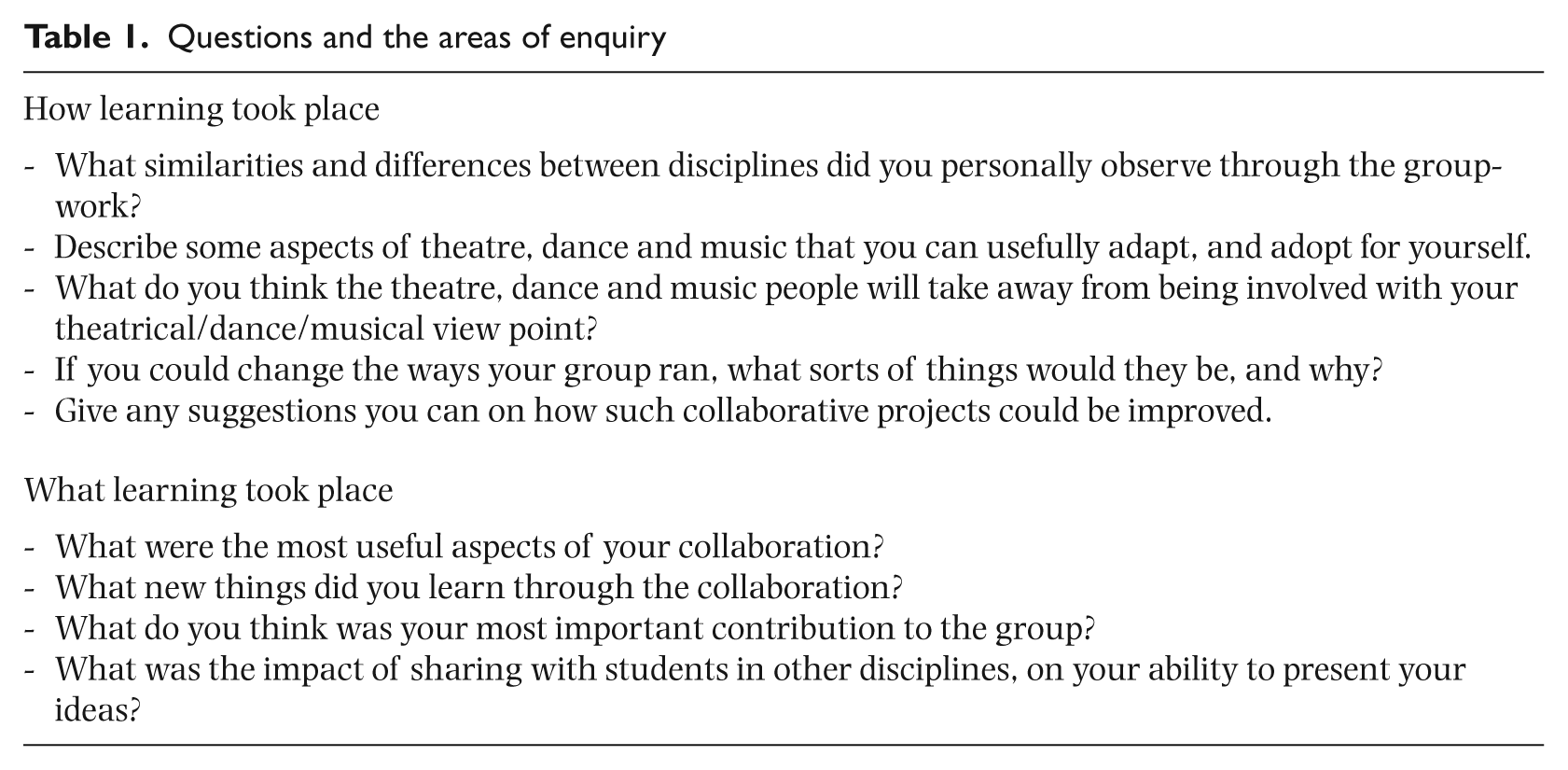
At the end of the two days all students were invited to complete a questionnaire and none declined the invitation. This article is an analysis of the music students’ responses. The nine questions (see Table 1) sought prevalence (Yin, 1994, p. 5), that is, what they experienced at the time, and were designed to encourage self-reflection through open-ended but focused responses about how and what learning took place, the role of the individual in the collaborative process, and to capture aspects of the type of communication taking place.
Questions and the areas of enquiry
Data analysis
Glaser’s ‘constant comparative method’ of analysis was adopted. Here statements are analysed and coded and then subsequent statements are compared ‘over and over again with codings and classifications that have already been made’ (Flick, 2002, p. 231). Ely, Vinz, Downing, and Anzul (1997) refer to this as a ‘recursive analytical process’ (p. 175) whereby the qualitative data is being interpreted and categorized in relation to the comments and findings of the researchers and artists discussed in the literature review and also new themes that emerge.
Results and discussion
How learning occurs in the tertiary collaborative inter-arts improvisatory process
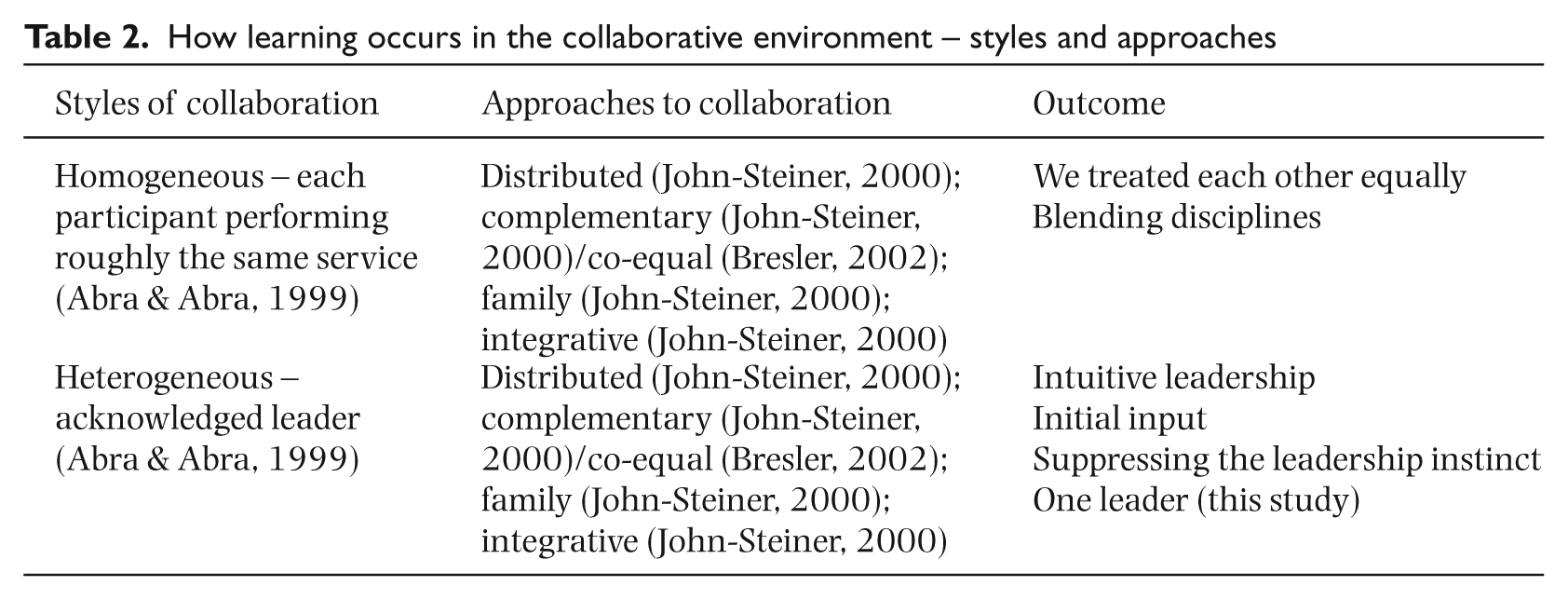
Learning for the music students occurred predominantly through a homogeneous style (Abra & Abra, 1999), within a complementary (John-Steiner, 2000) or co-equal (Bresler, 2002) approach, in which ‘no one was leader or took over, we treated each other equally’ (Student 9F 7 ), several noting that everyone worked as a team with other disciplines. For more than half of the students, the impact on their ability to present ideas, of sharing with students in other disciplines, illustrated this model as a positive environment moving students from being scared, to building confidence and feeling valued as part of the group through acceptance of ideas. The family collaboration model (John-Steiner, 2000) was the working environment for some groups in which students overlapped and blended their disciplines ‘body and soul’ (Student 16M), finding ‘it is great when you can’t tell them apart’ (Student 2F). A heterogeneous style (Abra & Abra, 1999) with an acknowledged leader was either recognized as being required, or adopted for the whole or part of the collaboration if there was group inertia. Three male students wrote of ‘taking the bull by the horns and making firm decisions at the point of disaster’ (Student 10M) thereby ‘bringing all … ideas to some sort of central focus toward performance (everyone else seemed unsure)’ (Student 15M). Different approaches to acknowledged leadership were raised including the need for ‘intuitive leadership [which] is often vital to a group’s success’ (Student 10M), or offering ‘more initial input … rather than sitting back and watching before making suggestions’ (Student 15M). The reverse was encountered with students wanting to make decisions ‘and do it how I imagined, but from the start I suppressed that way of thinking’ (Student 2F). In an approach similar to that of Meredith Monk, one student wrote of having ‘one leader/director that others listen to, give inputs and try’ (Student 16M). These comments indicate a readiness to take or accept a leadership role, if required, within either style of collaboration for the short or long term (see Table 2).
How learning occurs in the collaborative environment – styles and approaches
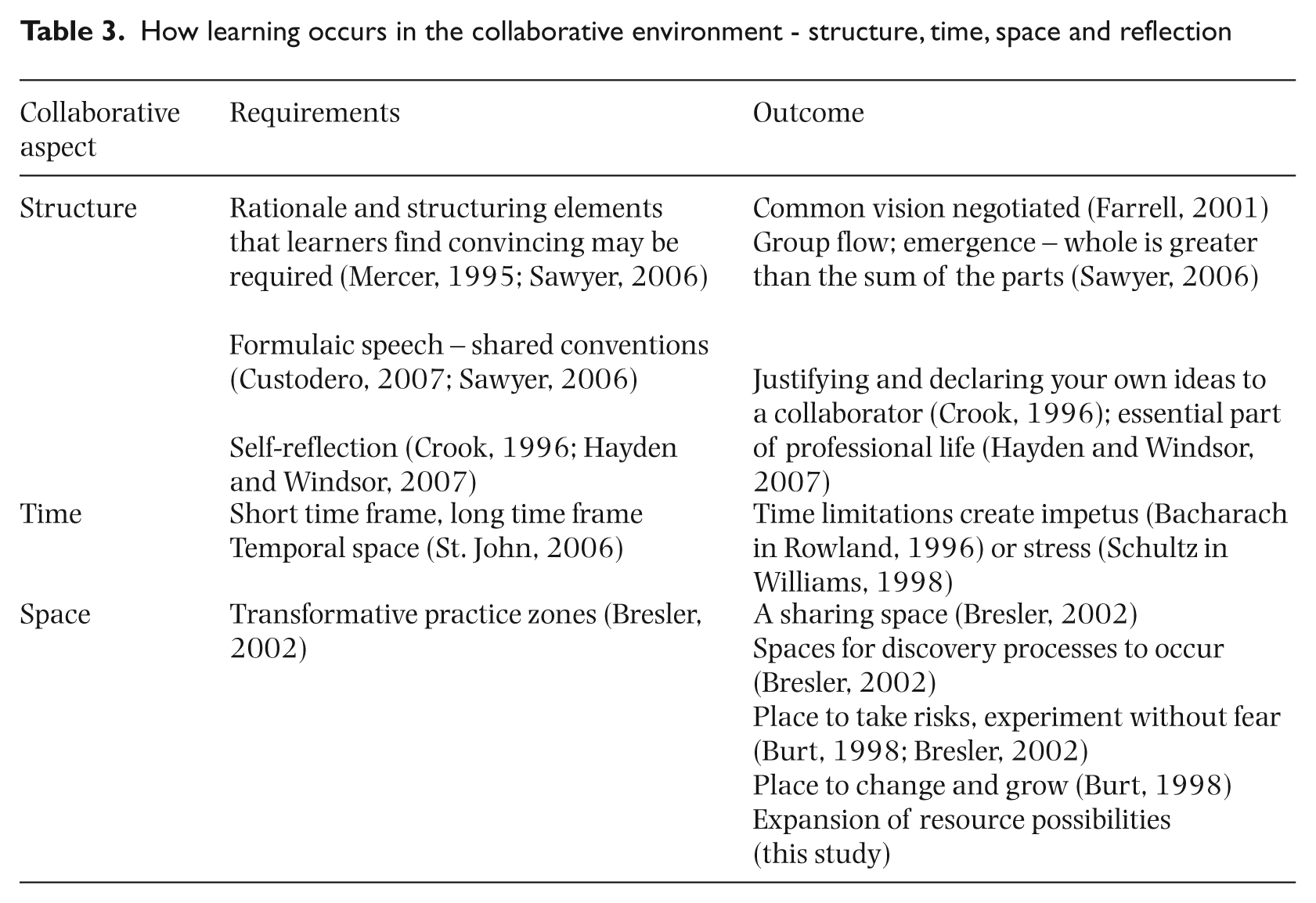
A rationale and structural elements were important to many (Mercer, 1995; Sawyer, 2006), but these could take several different forms. For some, this was leaving them ‘free to explore more’ (Student 3F) or for others, ‘actually following a certain idea through rather than starting one and coming up with one that’s totally different’ (Student 6F), in short, ‘grab one idea and JUST DO IT’ (Student 10M). Students recognized ‘that an idea, no matter how small, is something that can grow immensely, and it is the harnessing of this small idea that is the essence of true improv’ (Student 17M). Several students felt more group exercises would be of benefit ‘to improve and increase interactivity and concentration with each other’ (Student 4F), while others suggested ‘perhaps swapping groups’ (Student 10M).
It was acknowledged that time (St. John, 2006) needed to be used wisely as ‘working on an idea too much can make it stale’ (Student 10M). Comments indicate there needs to be a time balance between talk and action, with several students wanting ‘more doing, less talking’ (Student 5F) and ‘to start improvising immediately, so as to avoid intellectualizing TOO MUCH’ (Student 4F). A suitable space was required (Bresler, 2002; Burt, 1998; St. John, 2006). Other resources could include ‘more opportunity to use lights’ (Student 1F) and introduction of ‘music tech aspect [which] could be very exciting’ (Student 17M). The different university levels of the participants resulted in some of the third-year music students finding it ‘hard not to take charge …with 1st year dance and theatre students’ (Student 2F), not because of their lack of ability (see Table 3).
How learning occurs in the collaborative environment - structure, time, space and reflection
Within several styles of collaboration, learning occurred through different types of communication – spoken dialogue, musical and movement dialogue (see Table 4). Talk between group members was mainly cumulative (Mercer, 1995) in style. This allowed students to build positively but uncritically on what others had said, to construct a common knowledge by accumulation, offering ideas and hearing ideas of others, taking turns to express ideas and after listening to the ideas of others, then ‘discuss[ing] to find a best way’ (Student 16M). Articulation (Crook, 1996) was identified in self-reflective processes that arose as students justified and declared their ideas to fellow collaborators. For some groups conflict and resolution talk (Crook 1996; Mercer, 1995) was an important stage to work through as it allowed the individual to become part of a larger whole. There was evidence of disputational talk (Mercer, 1995) when ‘criticism was accepted by all’ (Student 8F), with dance and theater students seen as ‘more open to ideas and criticism’ (Student 11M). Through exploratory, co-constructive talk (Crook, 1996; Mercer, 1995), students were able to build common knowledge where ‘I think everything unfolded naturally and organically’ (Student 13M) with a balance in ‘how to listen more carefully, react to new ideas, act on impulse, use time wisely’ (Student 9F) and when peers ‘made me present ideas at levels that could be understood by all’ (Student 10M). Communication without talk was sought when a student ‘found it hard as I didn’t want to explain or define the experience or meaning – the interpretation was meant to be left for the audience’ (Student 2F).
How learning occurs in the collaborative environment - types of communication
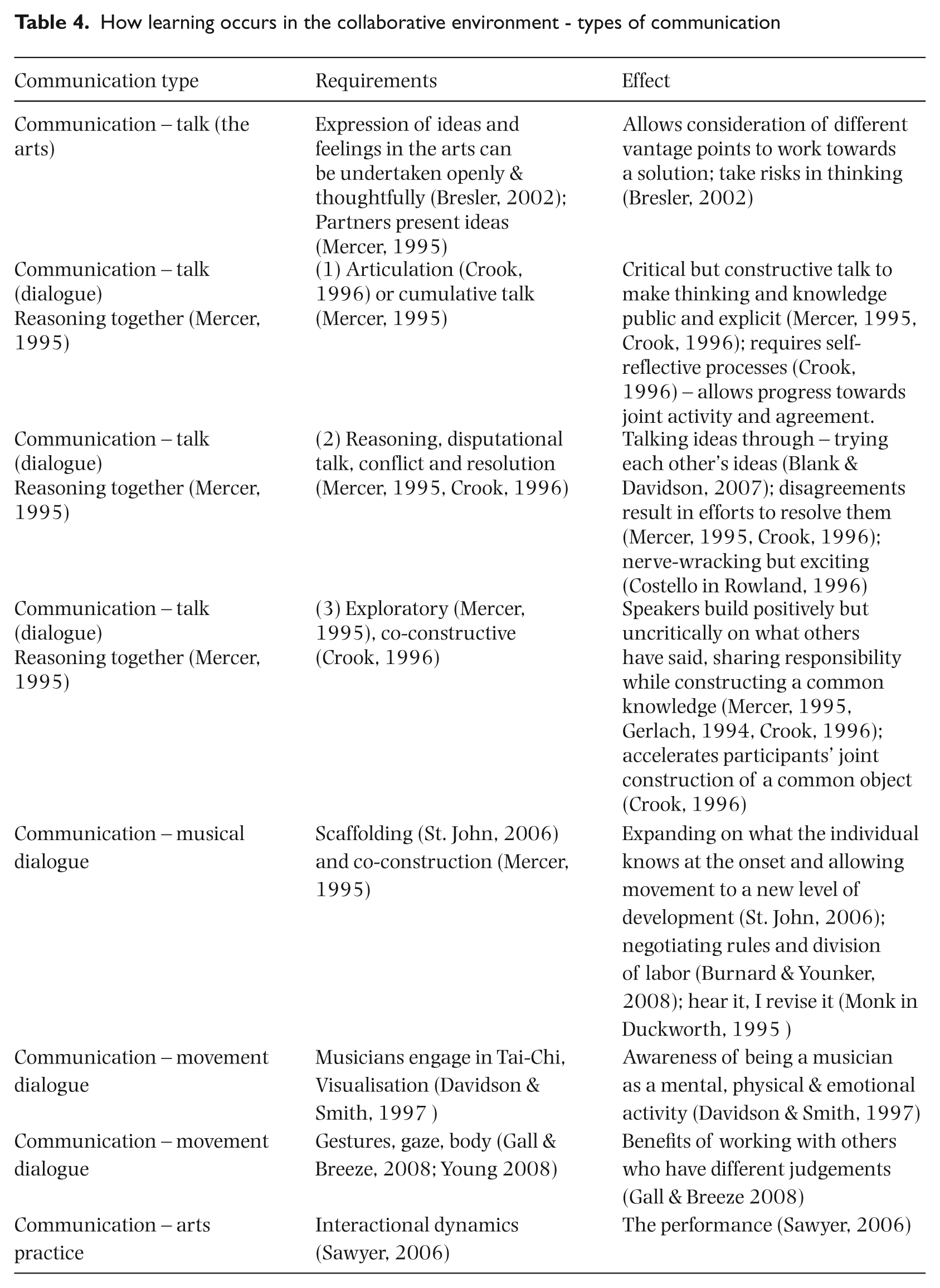
Music dialogue (Burnard & Younker, 2008; St. John, 2006) was especially evident in relation to the learning of theater and dance peers. Movement dialogue (Davidson & Smith, 1997) was evident in observations and experience of their own learning from the inherently physical activities of theater and dance students, and how through ‘movement and creating theatrical atmospheres [w]e all worked together to create the feel’ (Student 7F).
Learning that occurs in the tertiary collaborative inter-arts improvisatory process
The music students learnt about transforming their existing knowledge (John-Steiner, 2000) (see Table 5) through proximity to, and interactional dynamics (Sawyer, 2006) with, theater and dance collaborators. This was particularly so in relation to movement but also other aspects. While some musicians were initially reticent about engaging collaboratively with theater and dance peers (Bresler, 2002), a large number observed differences between the disciplines and also understood that they can learn from these. Students noted that ‘dance and theatre worked well and music was a separate group but this changed’ (Student 7F) while some felt that musicians ‘lag behind the other disciplines in terms of losing inhibitions with physical movement’ (Student 12M). They were torn between retaining individuality and being aware of the group collaborative process. One said ‘I brought the lights in!’ yet acknowledged ‘it was a
Transformation of existing knowledge and of the individual through inter-arts collaboration
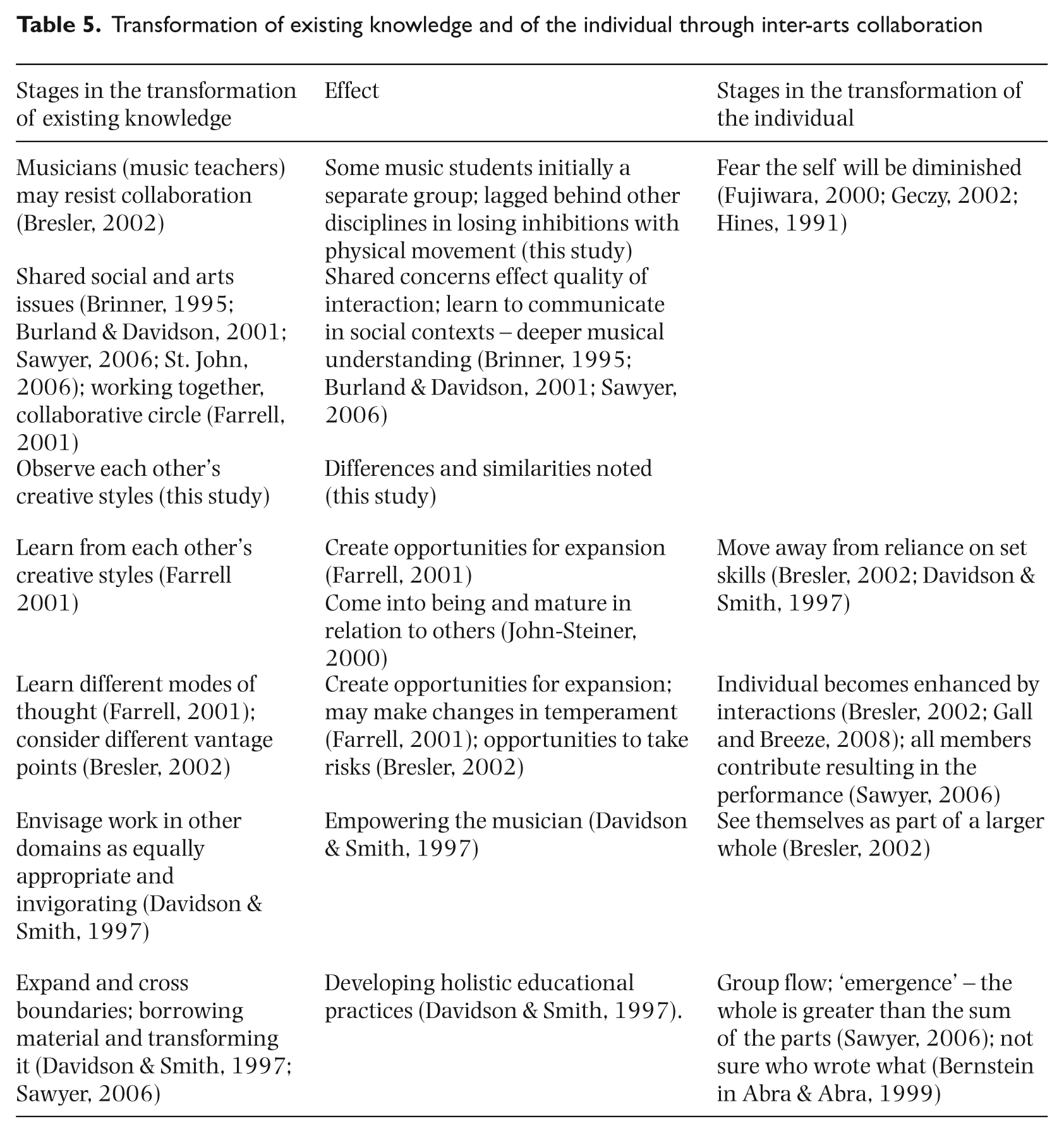
Once this was overcome, music students were able to usefully engage with aspects of dance and theater activities and several stages of this transformation of the individual and their existing knowledge, identified in the literature, were evident. These interactional dynamics may commence with socialization, observation of other creative styles and then an understanding that one can learn from these. Through sharing social and arts issues (Brinner, 1995; Burland & Davidson, 2001; St. John, 2006; Sawyer, 2006) students recognized the building of personal and social relationships, and how ‘relationships … developed at a quicker rate through collaboration’ (Student 16M). It was ‘new and challenging “to get happening” with a group you’ve only just met’ (Student 4F), and there was a need to ‘balance and juggle with their energy, attention and imagination – to understand and concentrate’ (Student 4F). Students ‘learnt to understand other people while working together’ (Student 14M).
Music students observed the creative style of their theater and dance peers as ‘being body aware and not afraid to interact physically. We music students were less inclined to do this’ (Student 7F). Dancers were observed to be ‘flexible’ (Student 16M) and ‘conventional’ (Student 6F) wanting play dialogue rather than improvisation ‘because they were used to structure and choreography’ (Student 17M). They were seen to be more quiet and reserved, ‘quite timid to begin with’ (Student 10M) and ‘unsure of how to contribute’ (Student 9F) perhaps ‘because they were first years’ (Student 3F). Theatre and music students ‘were very spiritual’ (Student 6F), with theater students ‘more willing to “get into it”’ (Student 9F), ‘to throw around many ideas’ (Student 15M) and be ‘very vocal and unashamed’ (Student 17M). Dance and theater students were seen as being ‘comfortable with movement’ (Student 12M) and ‘perceive visual aspects before aural concepts’ (Student 12M), whereas ‘musicians are not as body orientated as others (exceptions exist)’ (Student 16M). While theater and dance students ‘couldn’t get technical!!! [They] were more willing to explore rather than someone of the same discipline [and] accepted a wider variety’ (Student 16M). Music students noted how ‘other disciplines work very differently’ (Student 13M), each with ‘different perceptions of performance and different ideas of the expected outcome’ (Student 5F). For one, ‘it was really evident that music students had at times different approaches to improvisation and it was a challenge to try and understand and learn from the theater and dance students’ (Student 3F).
Several acknowledged they had learnt from each other’s creative styles and learnt different modes of thought (Farrell, 2001), had unlearnt what they had previously learnt, and saw different ways to improvise beyond the known music improvisation modes with and without an instrument. They acknowledged that the specifics of ‘movement, presentation, confidence with audience … help make a performance’ (Student 1F) and wrote of the need ‘to utilize your space; to choose to use sound, movement or image for a given event; to choose to have INTENT for an event’ (Student 4F) through ‘text ideas, movement [moving into] interaction with others, theatre sports [moving on to] playing around’ (Student 9F). More broadly, the ‘ideas and experiences by different group members’ (Student 9F) were acknowledged, and different vantage points were adopted when having to ‘unlearn what I’ve learnt – no limitation’ (Student 8F), specifically, the ‘theatrical aspect’ (Student 7F). They discovered ‘different perspectives of performance’ (Students 8F, 5F), paid ‘attention to others’ movements and … to [the] whole group’s movements/gestures’ (Student 15M), one wanting ‘to break out of my own discipline’ (Student 11M). Music students noted how ‘some [theater and dance peers] thought more of the sound world, others thought more visually. But everyone was interested in all realms’ (Student 1F). Dance and theater students were felt to have learnt from other’s creative styles (Farrell, 2001). While ‘obviously the different ways we all thought won’t change, … we are [at least] aware of other ideas and methods of improv’ (Student 6F). Some may embrace ‘another view or idea’ (Student 1F), recognizing ‘they will find some of [our ideas] different [from] theirs and they may like it’ (Student 14M). Several music students commented on how they feel their dance and theater peers will have ‘a greater understanding of musical possibilities’ (Student 12M), including ‘how to respond to music, how it can set a mood, change context, tempo, dynamics etc’ (Student 9F), and ‘(hopefully) a broader view of what music is’ (Student 13M) for future performances. There were also indications of individuals moving away from a reliance on set, known skills (Bresler 2002; Davidson & Smith, 1997) – ‘it was difficult at first because we all had so many different ideas, especially from the different departments’ (Student 3F).
For several, learning different modes of thought resulted in reaching for ideas outside their own experience of performance and ‘different ways to perform something’ (Student 6F). For music students who had previously improvised with musicians, there was a new understanding that ‘there is no ‘right’ way to improvise’ (Student 2F), that this was the ‘first time ‘true improvisation’ experienced, i.e. nothing prepared except for [the] theme’ (Student 3F), and of ‘learn[ing] other ways of improvising … not just with a musical instrument’ (Student 6F). Several music students thought the theater and dance students were learning different modes of thought (Farrell, 2001) and gaining ‘a different perspective of the meaning of their own artform through reinforcement from another genre’ (Student 15M) (Bresler, 2002). For some this was learning about musicians themselves – ‘that “those other people” aren’t as scary as they thought. Anything is possible and definitely a desire to do it again’ (Student 2F). One felt that dance and theater students had gained an ‘appreciation of the art of playing an instrument’ (Student 10M) and that theater and dance students will perhaps understand that ‘musicians can be just as movement based’ (Student 16M). With this came recognition of the individual becoming enhanced by interactions (Bresler, 2002, Gall & Breeze, 2008).
Some found this appropriate and invigorating (Davidson & Smith, 1997), especially through the inclusion of movement into a music student’s work. Here, shared conventions (Custodero, 2007; Sawyer, 2006) saw students gain ‘the ability to feel more comfortable with movement [which] will be useful in musical performance’ (Student 12M); of viewing ‘the movement and shamelessness about using the body as a beautiful thing’ (Student 13M), and of ‘being totally aware of my body in motion and stillness when performing’ (Student 10M). One valued the ‘opportunity to express myself in a more physical way’ (Student 10M). Others noted how ‘music – especially rhythm, is built upon a primal sense of movement that everyone has at least to some extent’ (Student 17M) and how ‘going right outside my artform into mainly movement based collaboration has given me more confidence in terms of body awareness in performance’ (Student 15M). Music students noted how theater and dance students have gained ‘more freedom in performance’ (Student 8F); that ‘our group have discovered their voices – the dancers especially and perhaps we have become more aware of the physical interaction’ (Student 7F). Recognizing how ‘the interpretation of each person should connect with others’ (Student 14M) indicated students were seeing themselves as part of a larger whole (Bresler, 2002).
Comments about ‘swap[ping] roles in disciplines to show our multi-talents’ (Student 16M) and being ‘more carefree with performance and tak[ing] more chances’ (Student 11M) indicate a stage where boundaries are crossed and risks are taken (Davidson & Smith, 1997). Music students learnt from the theater and dance disciplines that ‘some aspects could be incorporated into music performance such as visual work, … movement and text to create more interest in performance’ (Student 5F). Several felt the collaborative project offered theater and dance students the opportunity to expand and cross boundaries indicating how imaginative thinking can lead to discovery of one’s art. Their comments focused on the art form itself – ‘that art is a blend of all of these disciplines’ (Student 17M); ‘a different perspective of the meaning of their own artform through reinforcement from another genre’ (Student 15M) – and the collaborators themselves – ‘to realize that a title can “box” people in and that we all succeeded in un-boxing each other and have the desire to do it all again!’ (Student 4F). And there was some evidence of emergence or group flow (Sawyer, 2006) where ‘I couldn’t really say as the “ownership” of ideas was extremely muddled as we worked so well as a team’ (Student 2F).
Concluding comments
The literature offered a guiding framework (Sawyer, 2006) of issues likely to be present in the collaborative process in relation to how and what learning takes place. Collaborative learning occurred most commonly through a homogeneous style within a complementary or co-equal approach. Some students adopted a family approach and others a heterogeneous style with leadership taken if required. A rationale and structural elements took different forms and time, space, resources and self-reflection, through the questionnaire and articulation talk, were important. Learning occurred through different styles of dialogue – verbal, especially cumulative in style, music and movement. Several stages in the transformation of existing knowledge and of the individual in collaboration were suggested (see Table 5), which require time for collaborative progress and development to become new visions (John-Steiner, 2000). The results of this study placed the majority of responses of the tertiary music students in the first four of several stages likely to be encountered in the collaborative process, stages shared with largely pre-school, primary and professional collaborators. While one would, perhaps, expect the experiences of tertiary beginner inter-arts collaborative improvising students to be here, these stages were reached over a two-day period. The study noted that some music students initially functioned as a separate group, and lagged behind other disciplines in losing inhibitions with physical movement. It also noted an additional early stage in the transformation of existing knowledge – observation of other collaborators’ styles. This thoughtful observation of differences and similarities, before action could commence, may be especially important during inter-arts collaboration, where an understanding of the way other disciplines operate is a good starting base. Expansion of resource possibilities and their impact on improvisatory collaboration was a further finding.
Because the participants in this study were undertaking collaborative inter-arts improvisation between three arts disciplines for the first time, the literature and study findings also offer an opportunity for a speculative projection as to what would occur if the same tertiary students were given the opportunity to meet again for another, longer collaborative experience. This could include an integrative style of collaboration (John-Steiner, 2000) in which dialogue, risk taking, and shared and new visions would arise due to the prolonged period of committed activity; swifter movement through to disputational talk (Crook, 1996; Mercer, 1995) and to co-constructive talk (Crook, 1996; Mercer, 1995). More students could also become empowered and develop holistic educational practices by expanding and crossing boundaries, sharing, borrowing and transforming material (Davidson & Smith, 1997; Sawyer, 2006), encouraging the individual to see themselves as part of a larger whole (Bresler, 2002), resulting, perhaps, in not being sure of who wrote what.
Speculation aside, the results of the study offer teachers of tertiary collaborative inter-arts improvisation information about how and what learning could occur within a short-term project, and the type of planning needed in relation to student levels, time, project design, space and resources. The resulting collaboration may not be successful, but knowledge of aspects of the process likely to be encountered, from an article such as this, may serve as a starting guide. Working collaboratively, as artists are required by technological media (Geczy, 2002) such as films, videos, electronic games, in a world which is ‘interconnected and interdependent’ (Bresler, 2002, p. 54) offers opportunities for the individual to share his/her creative identity and develop creative growth. Collaboration is particularly relevant for schools and universities now.
Footnotes
Notes
Author biography
Diana Blom is Head of Music in the School of Communication Arts at the University of Western Sydney, Australia. Current research interests focus on tertiary performance (assessing group performance, collaboration, interpretation); student preferences for, and descriptions of, music; placement of melodic dissonance in the musical; and how arts practitioners working in academia view their practice as research. As a composer and performer (harpsichord and piano), she engages in practice-led research. Recent publications in several journals have resulted from several of these research interests, plus music scores and CDs. She is co-author, with Matthew Hindson and Damian Barbeler, of Music Composition Toolbox (Science Press), a text for composition.