




Abstract
Involuntary Musical Imagery (INMI) or “earworms” describes the experience whereby a tune comes into the mind and repeats without conscious control. The present article uses an inductive, generative, grounded theory-based qualitative analysis to classify reports of everyday INMI circumstances, and creates graphical models that determine their relative frequency within two population samples; listeners to the BBC radio station 6 Music and an online survey. Within the two models, four abstract categories were defined that described the characteristics of the circumstances surrounding the onset of INMI episodes; Music exposure, Memory triggers, Affective states, and Low attention states respectively. We also note the variety of musical media by which exposure to a tune results in an INMI episode and discuss the impact of musical engagement on INMI experiences. The findings of the present study are considered within a framework of involuntary retrieval theory from both the autobiographical and semantic memory literatures. In addition, the results highlight the potential facilitative effects of varying affective and attentional states on INMI episodes.
Keywords
Introduction
People spend a great deal of time engaged in internally-directed thought (Singer, 1966), but not all of this “internal mentation” (Andrews-Hanna, Reidler, Huang, & Buckner, 2010) is under conscious control. Involuntary, spontaneous cognitions are common, everyday experiences that occur against a backdrop of deliberate goal-directed mental processes (Christoff, Ream, & Gabrieli, 2004; Klinger & Cox, 1987). Musical imagery is associated with a unique form of spontaneous cognition: the anecdotal experience of having a tune stuck in the head. Involuntary musical imagery (INMI) is a ubiquitous experience, yet it is one that has so far received minimal attention from psychological research. However, thanks to the creativity of experimental designs that draw from both quantitative and qualitative traditions and the growth of large-scale internet-based data collection methods there is now a series of findings that outline the basic demographics of INMI including to whom it happens, how often it happens, and how long it persists (Bailes, 2007; Beaman & Williams, 2010; Brown, 2006; Halpern & Bartlett, 2011; Kellaris, 2001; Liikkanen, 2008, 2009). The scope of the present study was to build on this foundation of knowledge and to explore the next logical question of why INMI happens at any one point in time. The aim of the present study was to abstract and classify the contextual circumstances associated with the onset of INMI episodes, using qualitative methods in a large sample of individuals from the general population, in order to better understand both the personal and situational factors that facilitate INMI.
Musical imagery
Musical imagery is defined as the introspective persistence of a musical experience in the absence of direct sensory instigation of that experience (Intons-Peterson, 1992). Musical imagery can be purposefully generated for a variety of reasons; for example, imagery can be employed to mentally rehearse and recall tunes in order to reproduce them or make decisions about them, a facility that has been exploited by studies of musical memory (Brown, Martinez, Hodges, Fox, & Parsons, 2004; Gaab & Schlaug, 2003; Halpern & Zatorre, 1999; Koelsch et al., 2008; Levitin, 1994; Levitin & Cook, 1996; Vines, Schnider, & Schlaug, 2006). Musicians can also utilize imagery in order to aid their practice (Chaffin & Logan, 2006; Freymuth, 1999; Holmes, 2005; Wöllner & Williamon, 2007) and in some cases are able to generate musical imagery from score, an ability known as notational audiation (Brodsky, Henik, Rubinstein, & Zorman, 2003; Brodsky, Kessler, Rubinstein, Ginsborg, & Henik, 2008; Highben & Palmer, 2004).
Elegant designs have been used to probe the content of musical imagery. Quantitative and qualitative studies of inferential reports and behavioural studies of accuracy judgements have suggested that musical imagery can be both vivid and veridical in multiple musical dimensions such as pitch, rhythm, and, to a lesser extent, timbre (Bailes, 2006, 2007; Halpern, 1988; Halpern, Zatorre, Bouffard, & Johnson, 2004; Janata & Paroo, 2006). Neuroimaging experiments have reported evidence that the patterns of measurable brain activity are similar regardless of whether music is actually heard or is just being imagined (Halpern & Zatorre, 1999; Herholz, Lappe, Knief, & Pantev, 2008; Kleber, Birbaumer, Veit, Trevorrow, & Lotze, 2007; Kraemer, Macrae, Green, & Kelley, 2005; Meyer, Elmer, Baumann, & Jancke, 2007; Schurmann, Raij, Fujiki, & Hari, 2002; Zatorre & Halpern, 2005). The study of purposefully generated musical imagery has therefore contributed much to understanding the processes within auditory perceptual, memory and learning systems.
Involuntary musical imagery
A less well studied type of musical imagery is that of spontaneous or involuntary musical imagery (INMI: Liikkanen, 2008), a phenomenon also dubbed “brain worms,” “sticky music” (Sacks, 2007), “cognitive itch” (Kellaris, 2008) and “stuck song syndrome” (Levitin, 2006). All these terms describe the experience of a piece of music that comes unbidden into the mind and repeats outside of conscious control (Beaman & Williams, 2010). Anecdotally INMI is a common phenomenon that is most frequently described in the non-scientific literature as “earworms” (a direct translation for the German word Ohrwurm); however, peer-reviewed studies of INMI have only begun to emerge in the last five years, beginning with a detailed, introspective study of personal INMI. Brown (2006) noted the details of the musical dimensions within his own INMI episodes (pitch, rhythm and timbre variations) and commented extensively on the apparent veridical, perceptual nature of the experience. Such observations suggest parallels with consciously controlled musical imagery; however, conclusions from this study are constrained to the subjective observations of a single individual’s experiences.
Going beyond a strictly personal account of INMI, Bailes (2007) conducted an experience sampling study with 11 undergraduate and postgraduate music students that provided useful insights into INMI, although the study itself was focused on general musical imagery. Participants were contacted randomly over a period of seven days and asked to report their current experience of musical imagery. Many of these episodes could be classed as INMI, a supposition supported by the finding that the majority of reported imagery consisted of “repeated fragment[s]” (2007, p.562). A significantly high proportion of imagery was recognizable to the participants (89 vs. 18 unrecognizable tunes) denoting the important link between INMI and familiarity within long-term memory. Moreover, 58% of participants reported an association between hearing or performing music recently and later hearing it as imagery. But without being able to distinguish the INMI episodes from purposefully generated imagery there is a limit to the wider conclusions about INMI that can be drawn from this study.
The first large-scale empirical study of specifically involuntary music imagery (INMI) was an internet survey of 12,420 Finnish internet users conducted by Liikkanen (2008). The purpose of this study was to quantify the frequency of INMI and to classify the population demographics (age, gender, personality, and musical and linguistic competence) of those who experience frequent INMI episodes: 91.7% of people experienced INMI at least once a week, with 33.2% once a day and 26.1% several times a day. Familiar music dominated the reports, re-emphasizing a role for memory in INMI episodes, although 26% reported that the music they heard was “new.” Liikkanen (2008) also reported non-linear but significantly positive relationships between INMI frequency and musical education, and the use of portable music devices.
Three more recent studies have confirmed many of Liikkanen’s (2008) findings and have also suggested additional factors that may influence INMI experiences. In the first internet-based experimental induction of INMI, Liikkanen (2009) asked participants to complete written song lyrics, a variation of a standard method known as cued recall. They then completed a short filler task before being asked whether they had experienced any INMI relating to the cued recall procedure. On average, 58.35% of participants reported INMI from the cued songs, 15.75% reported INMI from other songs and 25.9% reported no INMI, a result that demonstrates the comparative ease with which INMI can be triggered by reading song lyrics. Liikkanen also counterbalanced the lyrics in the cued recall presentation and showed a significant recency effect relating to his induction paradigm. Beaman & Williams (2010) conducted a survey (N = 103) and diary study (N = 12) investigating the frequency and prevalence of INMI in a similar way to Liikkanen (2008), but with additional focus on the details of everyday patterns of INMI occurrence. They noted that 43.6% of participants reported repetition of the same few tunes, underlining the importance of familiarity in INMI experiences in everyday life. Finally, Wammes and Barušs (2009) sought to classify different dimensions of INMI by developing the Musical Imagery Questionnaire. They carried out factor analysis on reports from 67 volunteers and generated six dimensions, two of which relate to as yet unexplored aspects of INMI contexts: The first, “entertainment,” suggests INMI has a functional role to play in everyday life, as it is linked to personal preferences and often appears in situations where external stimulation is comparatively minimal. The second, “completeness,” implies in part that aspects of INMI can reflect current issues in an individual’s life.
Research questions and methodology
In summary, INMI episodes are a common, everyday experience for the majority of people (Liikkanen, 2008, 2009). Studies have so far documented patterns of INMI appearance within individuals (Brown, 2006) and across populations (Liikkanen 2008; Beaman & Williams, 2010) and demonstrated that memory appears to have a key role in the experience both through familiarity and recency effects (Bailes, 2007; Liikkanen, 2008, 2009). However, despite the growing number of findings that have shed light on the unique and prevalent nature of INMI episodes, no study has yet examined the contextual circumstances associated with the everyday occurrence of INMI. The present study therefore began with the following broad research question: What types of contextual circumstances facilitate the onset of an INMI episode?
The aim of the present study was to determine whether there are consistent patterns of everyday experience that are associated with the onset of an INMI episode in a large sample of individuals comprising mixed age, gender, and musical training and engagement backgrounds. Retrospective reports of INMI episodes were gathered via the internet, and an explorative, inductive paradigm was designed to isolate the contextual circumstances of each INMI episode. While there are methodological limitations to retrospective studies of experience, relying as they do on recall of an episode, such reporting methods have proved to be a valuable source of data on the experience of INMI (Bailes, 2007; Beaman & Williams, 2010; Liikkanen, 2008, 2009) and are currently the only real-world measure of INMI experiences that are conducive to large-scale study.
A grounded theory approach was selected for the data analysis of the participant reports. Grounded theory is a logical, linear process that is ideal for examining broad, qualitative research questions (Charmaz, 2008; Glaser & Strauss, 1967). Coding, the main method within the grounded theory approach, allows large amounts of textual data to be synthesized by an open and transparent method that is documented at every stage. By this process the researcher is able to summarize, categorize and abstract a small number of themes that describe a wide-range of experiences, culminating eventually in the emergence of a general empirically testable theory or series of theories regarding the initial research question, which are fundamentally grounded in the data. This makes grounded theory an ideal method for the present study; it provides an opportunity to classify the everyday contextual circumstances of the INMI experiences reported by hundreds of individuals and to generate testable theories as to the personal and situational factors that facilitate INMI occurrence.
Method
Data collection and participants
There were two separate stages of data collection, which in turn generated two corpora of INMI data. The first corpus (“6 Music”) was provided by listeners to the BBC radio station 6 Music. 6 Music run a feature on their morning breakfast show 1 where listeners can contact the presenter to describe their experiences of “earworms.” There is no standard script for the earworm feature, but the breakfast show presenter encourages listeners to contact him if they have a tune stuck in their head, and invites them to describe further details of the episode such as the circumstances under which it arose and how long it has been going on. These anonymous data, in the form of texts and emails, were provided by the BBC between June and August 2009 and February and August 2010. An additional point of data collection was a dedicated online short-form located on the 6 Music website (see Appendix 1) where individuals could briefly report the circumstances of their INMI episode. The data supplied directly from 6 Music (texts and emails) and the four questions from the 6 Music online short-form were treated in the same manner for the purposes of data analysis; the responses to the four online questions were collapsed into one paragraph and coded as one response. In total 2424 reports were received from the BBC and the resulting corpus (both emails and short-forms) contained the 333 reports where an individual provided information regarding the circumstances of the INMI episode.
The nature of the anonymous email and text message collection from 6 Music meant that no participant demographics were available. However, figures on general audience characteristics are available from Radio Joint Audience Research (RAJAR 2 ), which is the official body in charge of measuring radio audiences in the UK. According to RAJAR, the average 6 Music listener is 38 years old, with 54% of listeners aged between 25 and 44 years: 68% of 6 Music listeners are male and 78% fall within occupation social grades ABC1, 3 which includes the 55% of the population that work in managerial, professional, administrative and clerical roles.
The second corpus (“Survey”) came from an online questionnaire specifically designed for this research project (http://earwomery.com). The questionnaire sought basic demographic information (age, gender, level of education and musical experience; see Appendix 2) and included an optional request for information about a “recent earworm episode” (see Appendix 3). The survey was promoted through various outlets and by a variety of methods including live radio programmes and online features (including websites and blogs) across the BBC network, as well as radio networks in the USA and Australia, emails to university departments in the UK, USA, Europe and Australia, promotion across Facebook, Twitter and other social media sites, and through leafleting in London, York and Birmingham.
The online survey was completed by 1308 individuals between May and September 2010, of which 271 reports were analysed for the present study, where individuals had completed the “recent earworm” page and provided information about the circumstances of the INMI episode. Within the 271 participants, 117 were male and 152 were female (2 undisclosed), and the average age was 36.30 years (SD: 12.13, range: 16–70, mode: 28). In terms of education, 14 participants had completed secondary school, 51 had completed qualification post-secondary school, 112 had completed an undergraduate degree, and 94 had completed postgraduate education. In total, 238 (87.82%) people reported that they play or had played a musical instrument. The average age for starting to play an instrument was 8.98 years and the average length of time engaged in sustained musical activity was 11.20 years. Figure 1 shows the distribution of different categories of self-defined musicianship. Figures 2 and 3 relate only to those who identified themselves as musicians (from amateur to profession) and show, respectively, the amount of time individuals spent practising during their time of self-defined “sustained activity” and the amount of time currently spent practising an instrument (or voice).
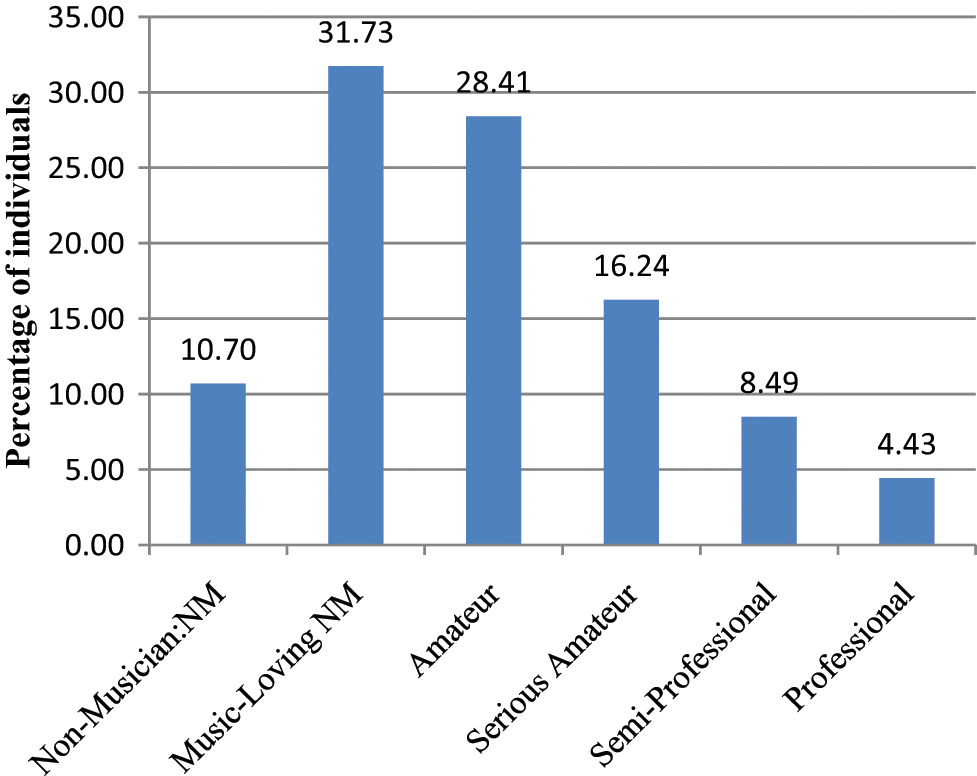
The percentage of individuals who self-defined themselves according to pre-defined categories of musicianship
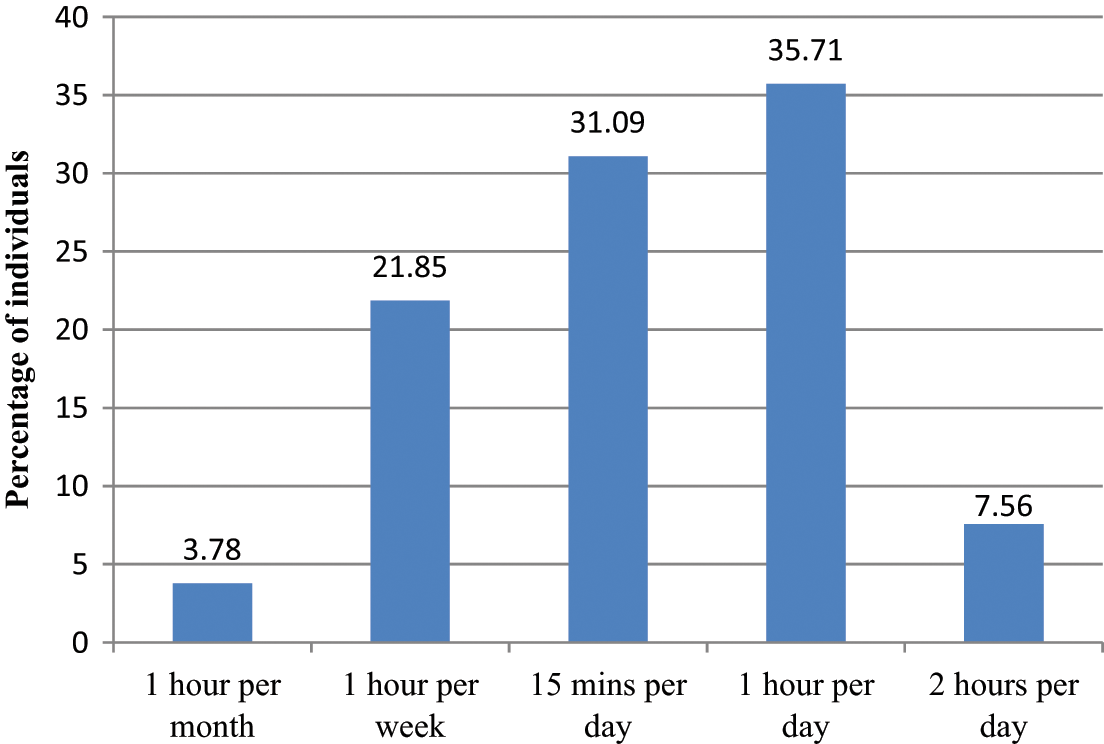
The percentage of individuals who practised their instruments during their time of “sustained activity,” grouped according to pre-defined periods of time

The percentage of individuals who are currently practising their instruments, grouped according to pre-defined periods of time
Data coding protocol
The 6 Music corpus was independently coded by two researchers, using NVivo 8 (QSR International) and a grounded theory approach based on descriptions by Payne (2007) and Charmaz (2008). The coding protocol comprised a four-stage inductive task, developed with the aim of generating themes to describe the circumstances surrounding the onset of an episode of INMI.
In the first stage, each researcher used line-by-line open coding to define the context within every INMI episode report. In the second stage, each researcher generated themes to “sort, synthesize and organize [the] large amounts of data” that resulted from the line-by-line coding (Charmaz, 2008, p. 92). This more focused stage allowed the researchers to frame their codes as specifically as possible; a “theme” was defined as an accurate description of the circumstances of an INMI episode, illustrated using as few words as possible. In the third stage the researchers compared their generated themes in order to ensure that subjectivity of coding was kept to a minimum. This stage resembled that of axial coding (Strauss & Corbin, 1990, 1998) as the researchers aimed to specify their themes explicitly and to determine the nature of the links between them. As part of the protocol, each researcher took turns in explaining and justifying their themes according to the original empirical data. Throughout this process, labels were agreed on and assigned to each theme. For example, the theme of “Sound association” was decided upon to encapsulate the terms “Song to song connection” and “Similarity to heard music,” which had been used independently by the two researchers in their coding. In the fourth stage, both researchers revisited the original data together and agreed on the application of these themes to the original coded reports. In the case of any disagreement between researchers during this final stage of re-coding, a third independent observer judged the disputed theme assignment. In total, 7 codes out of the 604 reports were resolved by the third party – all to the satisfaction of both researchers.
Theory development during all four stages of coding was promoted through individual and joint memo writing (preliminary analytic notes: see Charmaz, 2008) and through the construction of hierarchical draft models that emerged based on the coding experiences of the two researchers. In the draft hierarchical models several dominant and sub-dominant themes emerged, with consistent patterns of coding. For example, the dominant theme of “Association” was divisible into four discrete sub-dominant themes that related to different memory triggers for INMI, namely persons, situations, sounds and words. The analysis of the 6 Music corpus reached completion once the researchers had saturated the coding possibilities from the data, each INMI report was assigned to a theme, the themes themselves had been clearly defined and the relationships between the dominant themes and sub-dominant themes had been framed in a larger emerging model.
Next, the researchers replicated stage 1 of the coding protocol upon the second corpus (Survey). The purpose of analysing a second corpus of INMI reports was to determine whether the themes generated within the first corpus (6 Music) were valid within a sample of INMI reports gathered from a different population and using a different method. To this end, rather than blind coding the researchers first coded the Survey corpus line-by-line using the generated themes from the 6 Music corpus. If the researchers encountered a line that did not fit with the generated themes, a new code was created. The new codes were then reviewed by the researchers in a replication of stages 2 through 4 from the first corpus and were combined into two new themes termed “Rhythm” and “Mind wandering.” Upon agreement over definitions for the two new themes, the researchers ran a ‘double-check’ protocol through all the reports from both corpora to ensure that the two new themes of “Rhythm” and “Mind wandering” had not been overlooked in the first corpus.
During this final checking process, it emerged that many of the participants had reported a variety of music media by which they heard tunes that were later associated with INMI. Since there were consistent patterns of media experience within and across both corpora it was decided to code these reports within both corpora as sub-dominant themes relating to music exposure; these included public music, private music, radio, ring tones and video media.
Results
The 6 Music corpus contained 333 reports that resulted in 942 codes, while the Survey corpus contained 271 reports that resulted in 657 codes. The 6 Music corpus generated 24 themes and the Survey corpus contributed two additional themes. The models shown in Figures 4 and 5 summarize the circumstances associated with INMI episodes, illustrating the weight of each theme within the corpus (measured by the number of times it was coded), the hierarchical relationships across dominant and sub-dominant themes, and the number of occasions where different themes were coded together.
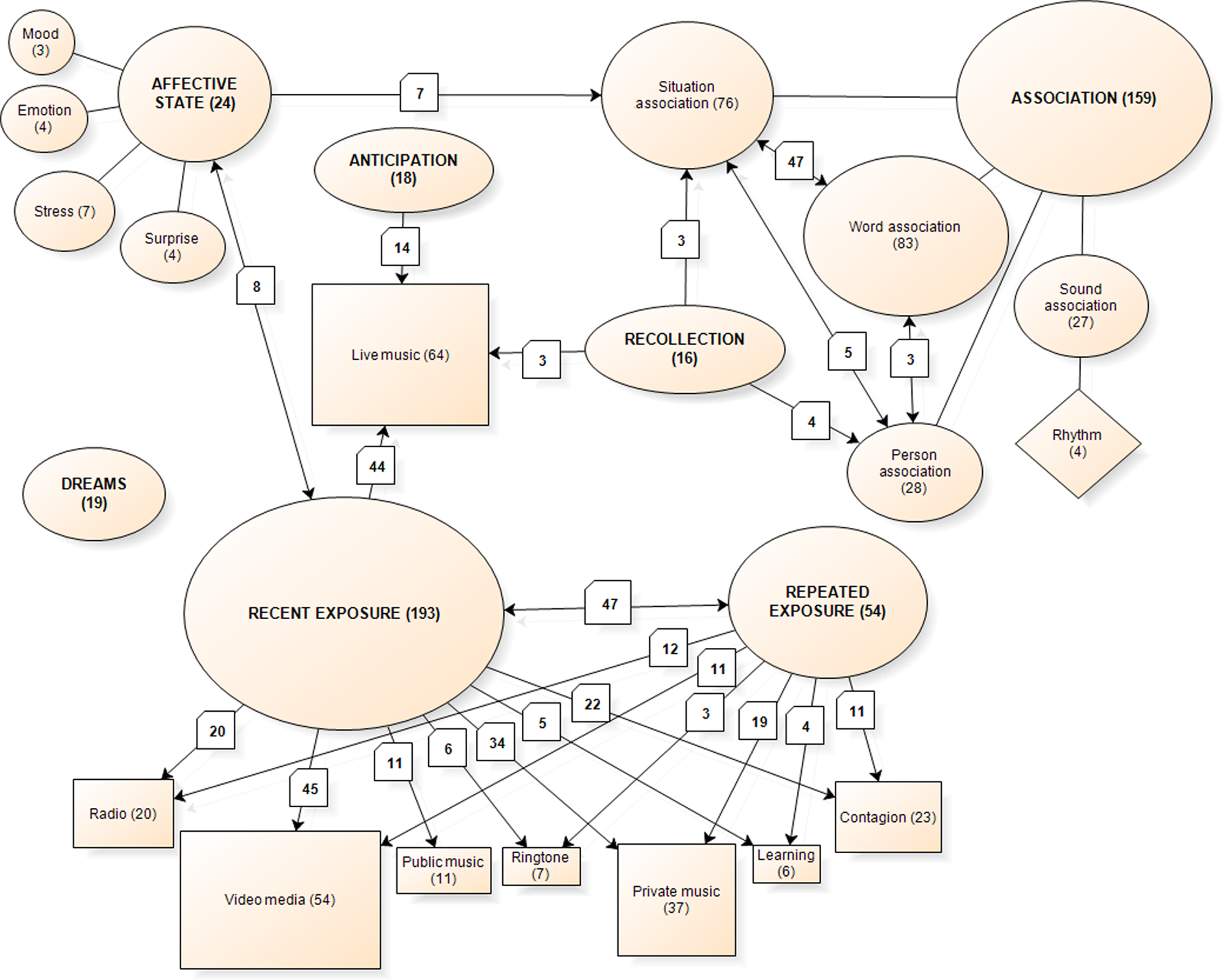
Illustrative model of the themes generated from analysis of the 6 Music corpus. Dominant themes are shown in capitalized bold. Media sub-dominant themes are illustrated with boxes and themes that emerged from analysis of the survey corpus are shown in diamonds. The numbers within all themes indicate the number of codes assigned and their size is designed to illustrate relative magnitude (not to scale). The numbers across coding links show the number of occasions when two themes were coded together. Coding links between dominant themes and sub-dominant themes are shown with double arrows while hierarchical links between dominant and sub-dominant themes are illustrated with directional arrows. Automatic associations between dominant and sub-dominant themes are indicated with straight lines (relevant to affective states and association types). Coding links are only shown if there were more than three occasions where two items in question were coded together
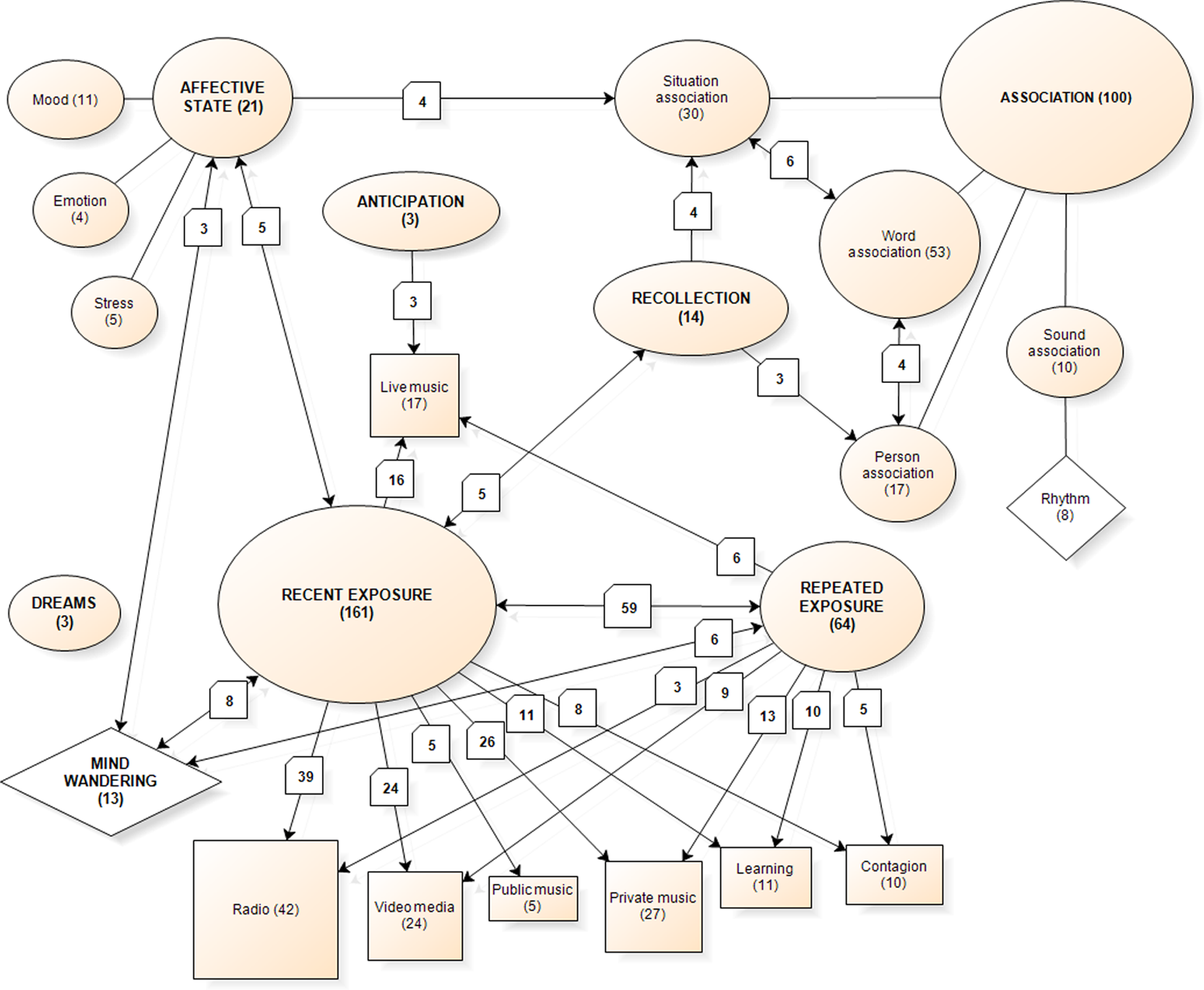
Illustrative model of the themes generated from analysis of the Survey corpus. Refer to Figure 4 for details. In addition: themes and coding links are only shown if there were more than three occasions where two items in question were coded together. Not shown in this corpus is theme “Performance” where an INMI experience was linked to a performance of music (this theme was coded twice)
Although there was a great deal of similarity in the coding across the two models, there were differences in the magnitude of some of the themes. In order to illustrate the differences between the two corpora we compared the percentage of time that each theme was coded as a function of the total number of codes (Table 1).
Comparison of the number of times each of the INMI themes were reported for both models (6 Music: N = 333, and Survey: N = 271). Calculation shown represents the number of times a theme was coded divided by the total number of codes in the corpus, converted to a percentage

Themes: Definitions and exemplars
The grounded theory analysis carried out on the INMI reports resulted in the emergence of eight dominant themes that describe the circumstances of INMI episodes (Recent, Repeated, Association, Recollection, Anticipation, Affective state, Dreams and Mind wandering 4 ), with many of these also being divisible into sub-dominant themes. The eight dominant themes were grouped into four abstract categories (Music exposure, Memory triggers, Affective states, and Low attention states 5 ), and these are listed below along with a description, a definition for each of the themes, and an example of a report that was coded under each theme. Sub-dominant themes are grouped with their original dominant theme apart from “Media” themes, which are presented in a separate later section.
Music exposure
The most frequently generated themes in both corpora related to hearing music that later occurred as INMI. This category was termed Music exposure and was divided into the two dominant themes of “Recent” and “Repeated.” These two themes were commonly coded together in reports but were found to be divisible in the analysis as two independent aspects of music exposure that participants associated with the onset of an episode of INMI.
My bloody earworm is that bloody George Harrison song you played yesterday. Woke at 4.30 this morning with it going round me head. PLEASE DON’T EVER PLAY IT AGAIN!! (6 Music)
“Duck tales” by Donald Duck and his nephews. It’s driving me mad; my 3 yr old has got the DVD on repeat. I know it’s not a proper song but it’s a proper ear worm. (6 Music)
Memory triggers
The second most frequent group of generated themes in both corpora related to memory activity. A crucial difference between the Music exposure codes and the Memory trigger codes was that in the latter participants did not report that they had recently heard the music that featured in their INMI episode. This category was divided into three themes, “Association,” “Recollection” and “Anticipation.”
Within the dominant theme of “Association” there were four sub-dominant themes that describe occasions where INMI was linked to seen or spoken language (“Word association”), the sight or mention of a specific individual (“Person association”), the context in which the respondent finds themselves (“Situational association”), or to hearing an auditory stimulus that was not the INMI tune, but that could include other music as well as environmental sounds and isolated rhythms (“Sound association”). The theme of “Recollection” marked occasions when participants experienced the onset of a related episode of INMI as a result of engaging in personal “mental time travel,” or episodic recall from their own life (autobiographical memory) (Tulving, 2002). The theme of “Anticipation” represented occasions where acts of spontaneous prospective memory, retrieving memory for an upcoming event, were connected to a tune that was later experienced as INMI.
Person – The INMI tune is linked to a sighting, mention of or thoughts about a person (including the song artist).
My earworm today is “This Charming Man” by The Smiths because every time I see David Cameron, that song just appears in my head, for some particular reason. (6 Music)
Situation – An individual reports that their situation or environment is a trigger for the music experienced in the INMI episode.
Anika Moa “Dreams in my head.” I listened to the song non-stop about 2 years ago just before I got together with my ex-boyfriend and I really liked him and now that I have similar feelings for a new person it has started coming into my head even though I haven’t listened to it in years. (Survey: Female, 22, Amateur musician)
Word – The title or lyrics within the INMI are linked to a word or series of words that the person either sees or hears. Items within this theme are also coded under
Michael Jackson PYT (Pretty Young Thing). On my journey, I read a number plate on a car that ended in the letters “EYC” which is NOTHING LIKE “PYT” but for some unknown reason, there it was – the song was in my head. (Survey: Female, 29, Music-loving non-musician) [Word and Situation] Today is the day I start to reassemble the book I was writing, having lost 10,000+ words when my Mac was stolen a couple of weeks ago – it’s a long, painful journey and so my earworm du jour is naturally “Paperback Writer.” (6 Music)
Sound – An individual hears a song that is similar to the INMI tune (either in form or by nature of being performed by the same artist) or an environmental sound that reminds them of the INMI.
A phone on a nearby desk at work sounds like the very beginning of “24 Hours to Tulsa” which gives me a permanent earworm. I’ve since moved desks so I’m not constantly haunted by Gene Pitney. (6 Music)
Includes “Rhythm” – An individual’s INMI episode is triggered by a heard or felt rhythm or beat that resembles that within the INMI tune.
Tinie Tempah “Pass out Chorus” … because I was banging my thumbs against the desk in the Tinie Tempah Pass out beat. (Survey: Male, 25, Non-musician)
Their earworm is: Tune “Portsmouth” What were they doing when they noticed it: First time I was a passenger in a car in Blackpool being driven along a particular road while the tune was playing on the car radio – about 1974. What triggered it: I get it every time I travel along the same road in Blackpool, seldom anywhere else. When it happens, it takes about 24 hours to disappear. (6 Music Short Forms)
Going to Hyde Park to see Pearl Jam on Friday- so excited that I might even bite through my leather restraints! My earworm is still “Alive” [by] Pearl Jam and has been for days. (6 Music)
Affective states
The third dominant theme to emerge from the grounded theory analysis related to different affective states being associated with the onset of an episode of INMI. This theme represents four sub-dominant themes that describe different ways in which feelings and subjective reactions are associated with INMI.
Prokofiev “Montagues and Capulets” opening theme I was writing an email about a distressing subject. I suspect the mood of the piece matched my mood at the time. (Survey: 29, Serious amateur musician)
My ear worm is “Nathan Jones” by Bananarama. I first caught it in 1989 during my GCSE chemistry exam and have been plagued by it in moments of extreme stress since, e.g. wedding, childbirth etc. (6 Music)
Emotion– An individual mentions that the onset of an emotional state precedes the onset of an INMI episode. An emotion state is defined by the presence of a clear trigger event, as opposed to a mood state where no cause need be identified (based on definition of mood and emotion by Ekman, 1999).
I just can’t stop thinking about MJ [Michael Jackson]. I just keep getting sadder! “Man in the Mirror” has been playing on my mind ever since I heard. (6 Music)
Having heard some Frank Turner at the petrol station on Sunday – somewhat to my surprise. The soft guitar has melted into my consciousness and regurgitated itself as an earworm. (6 Music)
Low attention states
The final dominant theme to emerge in the grounded theory analysis described reports whereby an episode of INMI occurred under, or was related to, circumstances where attentional demand was low.
My ear worm is “Mulder and Scully” by Catatonia. In fact I dreamt about running through woods and this was the sound track in my head. (6 Music)
K’naan “Waving Flag.” ‘So wave your flag, wave your flag …’ …in laboratory, doing repetitive task that I am familiar with enough to go “on autopilot.” (Survey: Female, 24, Amateur musician)
Music media and INMI
Within the dominant theme of “Music exposure” (“Recent” and “Repeated”), eight categories were identified and abstracted that describe the ways in which people hear music that is later experienced as INMI.
Private music – The INMI episode music has been heard in a private situation, such as in the car or at a birthday party.
I’ve got “ch-ch-ch-changes” by David Bowie as a repetitive ear worm, because it was the last song I heard before the battery on my IPod ran out on a very long and lonely cycle. (6 Music)
Public music – The INMI episode music has been heard in a public place, such as a restaurant, shop or gym (distinct from Live Music).
My earworm today is “Paint it Black,” thanks to my gym class which plays a well dodgy version of it. (6 Music)
Radio – The INMI episode music has been heard on the radio. Not classified as Public or Private music unless specified.
My earworm this morning is Jimi Hendrix’s “Purple Haze,” in my head since someone played it on Radio 2 Saturday afternoon. (6 Music)
Live music – The INMI episode music has been heard or will soon be heard in a live concert setting.
Brought about by the anticipation of seeing The National in Brighton tonight I have their “Mistaken for Strangers” on a permanent loop in my head. (6 Music)
Ring tones – The INMI episode music has been heard as a ringtone.
I managed to work during my “extra week” down in hotel reception and the driver for the hotel had on his mobile, “Ring of Fire” by the late great Johnny Cash. And can’t get it out my head! (6 Music)
Video media (TV/film/internet sites) – The INMI episode music has been heard through performances in the visual media.
Chopin “Prelude in C sharp minor, No.44” – Intro and as far through as I can get with memory. I was listening to it over and over on YouTube – Ivo Poglereich, and wishing to learn it on the piano. (Survey: Male, 31, Amateur musician)
Contagion – The INMI episode music has been heard due to another person humming, singing or playing the tune (distinct from Private music or Public music).
Guy behind me in the queue at Boots yesterday was humming Cream’s “Sunshine of your love.” I’ve been humming it ever since. (6 Music)
Learning – The INMI tune has been heard because the individual is trying to learn how to perform the music in question.
Travelling down to Norfolk this morning for a conference, spent way too much time learning new songs to show off with a guitar in the evening. Consequently have “Ih-Ah” by Devin Townsend wedged in my brain. (6 Music)
Themes and background variables
Post hoc analysis was carried out on the Survey corpus data in order to determine whether there were any relationships between INMI themes and the background participant variables of gender, age, education level, musical education (“yes” or “no”), self-defined musicality, and for musicians only, the number of years spent playing and the average amount of time spent practising an instrument during their period of “sustained activity,” and age of commencing practice. Only the INMI themes of “Recent exposure,” “Repeated exposure,” “Word association,” “Person association” and “Situation association” were included in the analysis; low numbers of codes within cells prevented analysis of the remaining themes. 6 Logistic regressions were carried out to determine relationships between the INMI themes and continuous background variables, while Pearson”s Chi square tests were utilized with the categorical variables. No significant relationships emerged in either analysis. Finally, continuous variables were also assigned to categories 7 for Chi square analysis, in order to determine whether relationships existed at this level of power: Age was categorized into five groups (16–24, 25–34, 35–44, 45–54 and 55–70 years), time spent playing an instrument into six groups (<5, 6–10, 11–15, 16–20, 21–30, >30 years), and age of commencement into four groups (categorized into four groups of <5, 6–10, 11–18, >18 years). As before, however, no relationships were found in this analysis.
Discussion
The aim of the present article was to use an inductive, generative grounded theory-based coding analysis in order to abstract and categorize the contextual circumstances of INMI episodes, and to determine their relative frequency in everyday life. The data presented in the two resulting models identify four key categories of themes that contextualize an INMI episode (Music exposure, Memory triggers, Affective states, and Low attention states) and denote a hierarchy of relative frequency between them. These themes will each be discussed individually, culminating in a summary of a grounded theory as to why INMI occurs at any one given point in everyday life.
Summary of themes
The majority of INMI reports in the present study were linked with recent and/or repeated exposure to music. This result supports previous studies that have highlighted the importance of familiarity and recency in INMI episodes, and therefore validate the crucial role of musical memory in these everyday experiences (Bailes, 2006, 2007; Beaman & Williams, 2010; Liikkanen, 2008, 2009), as well as the influence of increasing, readily available musical exposure in modern society (Sacks, 2007). Data from the present study also depict the role of different musical media in INMI episodes and therefore draw attention to the potential for different music listening habits to influence INMI experiences. Liikkanen (2008) reported that increased music listening and practice was related to increased frequency of INMI. The present study has built on this finding by documenting the multitude of different musical media that are associated with the onset of an episode of INMI in everyday life, including listening to the radio, attending music concerts, hearing ring tones, hearing other individuals humming or singing, and watching video media such as TV adverts, films, dedicated music channels and online music videos. Future studies that investigate the influence of music listening on INMI episodes should aim to investigate the full range of possible experiences in everyday life, including those that are not under an individual’s control.
Whilst the role of musical memory in INMI experiences seems now beyond doubt, the breadth of other themes reported in present study suggests caution should be exercised when estimating the potential importance of music familiarity in facilitating INMI occurrence. Beaman & Williams (2010) suggested that only over-learned tunes are available to be “replayed” as INMI, since in their survey “all [the tunes] were known to the participants” (p. 12). However, the present evidence indicates that whilst “Repeated exposure” is certainly a dominant theme within everyday INMI experiences, “over-learning” in the strict sense is not a prerequisite to an INMI episode. Evidence to support this conclusion comes from participants in the present study who describe INMI experiences that were triggered by limited exposure to a novel tune:
My earworm is quite a new song by Arial Park’s Haunted Graffiti called “Bright Lit Blue Sky.” I heard it for the first time last week and it’s been stuck in my head ever since. (6 Music)
Furthermore, if only over learned tunes are available to become INMI, it might also be expected that musicians would experience disproportionate INMI for their music, as they engage in many hours of physical and mental practice, including musical imagery, before a performance (Chaffin & Logan, 2006; Freymuth, 1999; Holmes, 2005; Wöllner & Williamon, 2007). Whilst we did receive reports that were coded as “Learning” in both corpora, this theme did not feature prominently despite a high proportion of participants in the Survey corpus being semi-professional or professional musicians. Indeed, congruent with the view that tunes need not be over learned to occur as INMI, Liikkanen (2008) reported a significant number of INMI experiences that were reported as “new music” by the participants. Therefore, while high levels of familiarity, or “over-learning,” might play an important role in some experiences of INMI, there are other potential factors that surround the circumstances of any one INMI episode that must be considered. Factors not included in the present study that are due further consideration are the features of the tunes themselves (Finkel, Jilka, Williamson, Stewart, & Müllensiefen, 2010) and the personality of the listener (Fry, 2010).
One factor that was seen to play a key role in the circumstances surrounding INMI episodes in the present study was Memory triggers. It was the second most prevalent generated theme with regards to INMI context and consisted of the dominant themes of “Association,” “Recollection” and “Anticipation.” A fundamental element of these themes, and all related sub-dominant themes, is that the individual did not report hearing the INMI tune in question but rather encountered a stimulus that triggered retrieval of the tune. With “Association,” the onset of a particular INMI episode related to the presence of a word or series of words, a person, a situation or a sound, and in both “Recollection” and “Anticipation” the INMI episode related to an incidence of “mental time travel” (Tulving, 2002), whereby an individual recalled either a retrospective or prospective episode from their own life (autobiographical memory) that was related to the INMI tune.
Evidence that underlies the importance of Memory triggers within INMI experiences comes from Liikkanen’s (2009) cued recall technique, which uses word primes (incomplete song lyrics) to trigger musical memories that later occur as INMI. However, this is a much more direct example of priming than the reports received in the present study where isolated words or phonologically similar letters were seen to spontaneously trigger INMI. There is also indirect evidence from Liikkanen (2009) for the role of sound association in INMI episodes, as a small number of participants reported experiencing INMI that was not directly related to the prime. The present study builds on this finding by documenting the types of sound association that can occur at the onset of INMI episodes in everyday life, including hearing music by the same artist, environmental sounds and rhythms from activities such as walking or finger tapping. Overall, the evidence from the present study indicates that spreading activation within non-musical autobiographical and semantic memory can result in INMI episodes, extending previous findings regarding the importance of musical memory to include non-musical memory triggers.
The remaining dominant themes from both models were grouped into two categories; the first was Affective states and the second was Low attention states (including “Dreams” and “Mind wandering”). Again, there are hints at the existence of these INMI themes in previous studies: Wammes and Barušs (2009) reported two related dimensions of INMI called “entertainment” and “completeness,” where an INMI experience appeared to have a “purposive” (p. 51) function for the individual. Items that loaded on these factors suggested that INMI can be entertaining when an individual is not occupied in a task, but tends to cease when there is a sudden need for concentration, and also that the content of the INMI episode can have relevance to the current issues in someone’s life. The results of the present study support these findings and extend them by showing that INMI is associated with periods of low attentional demand (defined as “Mind wandering”) and low alertness (waking from a dream), and that characteristics of INMI can reflect an individual’s mood and emotional state.
Theory development
It is important to place the results of the present grounded theory analysis of INMI within a wider theoretical context. The presence and frequency of circumstance themes regarding recent musical exposure and memory triggers invites interpretation within involuntary retrieval theory, which has not yet incorporated findings from INMI studies. Involuntary memory retrieval was identified by Ebbinghaus (1885/1964) as one of the three basic modes of remembering, along with voluntary and non-conscious (implicit) memory. Modern psychology has tended to group involuntary memory retrieval alongside implicit memory (Berntsen, 2010), but a small number of recent studies have described two independent forms of involuntary retrieval; involuntary autobiographical memory (IAM) and involuntary semantic memory (ISM). IAMs are defined as a sudden memory of a specific episode from the past (Bernsten, 2009) whereas ISMs are an involuntary occurrence of brief items from semantic knowledge (Kvavilashvili & Mandler, 2004), including autobiographical facts (Conway, 1987).
The results of the present study of INMI can be interpreted within an IAM/ISM framework in the following ways: “Recent” and “Repeated” exposure themes can be viewed as forms of IAM, because the individual in this case retrieves an episode where they heard the music in the past. The theme of “Anticipation” can be classified as part of prospective IAM, because a person in this case spontaneously retrieves a memory regarding a future event in their life (Ellis & Nimmo-Smith, 1993). Other Memory trigger themes can be broken down individually into forms of IAM and ISM experiences depending on whether the individual spontaneously retrieves an event from life that was associated with music as a result of an external cue (as was often the case with “Situation associations”) or whether retrieval results from spreading activation within semantic memory that was triggered by an external cue (as was often the case with “Word associations”). The “Recollection” theme does not fit within a strict definition of involuntary recall as the individual in this case is consciously attempting retrieval at the time, but instead represents the case whereby memories of music that are associated with an autobiographical episode are inadvertently triggered as a result of the voluntary recall attempt (Mace, 2006).
The present findings also outline the states of body and mind that facilitate INMI retrieval events, and in so doing reveal further similarities to both the IAM and ISM phenomena. Low or diffuse attention states have previously been identified as an important cognitive facilitator of IAM (Berntsen 1998; Berntsen & Jacobsen, 2008; Mace, 2006) and ISM (Kvavilashvili & Mandler, 2004), a finding that is supported by the present study with relation to INMI. There is additional evidence in the present data that emotion and mood congruence play a role in INMI, a finding that implicates a degree of processing similarity or overlap between the mechanisms underlying INMI and state-dependent memory retrieval (Buchanan, 2007; Eich, Kihlstrom, Bower, Forgas, & Niedenthal, 2000). Mood (but not emotion) has been shown to influence involuntary retrieval to a greater extent compared to voluntary retrieval (Berntsen & Hall, 2004), supporting a hypothesis that aspects of affective state have the potential to directly influence aspects of INMI retrieval.
Taken together, the present study’s findings suggest that INMI episodes represent a valuable phenomenon by which to further examine the nature of involuntary memory and to test a number of emergent hypotheses; these include testing the theory that retrieval through IAM and ISM results from independent cognitive and therefore potentially also underlying neurological processes (Kvavilashvili & Mandler, 2004), determining the effects of concurrent cognitive load on INMI retrieval patterns, thereby probing the role of working memory in the experience (Marsh & Hicks, 1998), and examining whether tunes that come unbidden to mind can be representative of an individual’s current affective state.
Overall, the predominance of external cues for INMI in the present study, in the form of music, words, sounds and visual stimuli, is in line with Morton’s (1990) theory that involuntary memories are most frequently released by specific, perceptual cues, as against internal thoughts that are independent of the external world (Singer, 1993). However, the findings do not rule out the possibility that INMI can also occur in the absence of a conscious cue. Many of the original reports gathered by BBC 6 Music and the online survey were not included in the corpora of the present study for the reason that the participant, by either a lack of knowledge or will, failed to report the circumstances of their INMI episode. One point to consider in this regard is that the lack of an identifiable cue for memory retrieval is reportedly more common in ISM than IAM (Kvavilashvili & Mandler, 2004). A potential hypothesis for future study would be that the majority of INMI that lacks notable circumstances or an identifiable “trigger” results from subconscious, spreading activation within semantic memory.
Caveats
The present grounded theory analysis has highlighted a number of themes that relate to the importance of musical engagement in INMI experiences, such as attendance at live music concerts, searching for music-related video media and the everyday use of private music, including MP3 devices. However, the self-selected data collection method could foreseeably bias the sample towards individuals with a particular interest in music. This is evidenced by the fact that the 6 Music corpus, by definition, includes listeners to a radio station, and over half the participants in the Survey corpus classified themselves at the level of amateur musicians or above. Therefore, the present study serves to illustrate the extent to which different music media engagement can be associated with INMI episodes, but presents no conclusions about the relative importance of different types of music engagement on INMI experiences. The findings of the present study suggest that the relationship between regular, everyday musical engagement and INMI is an important issue for future research to explore more directly (Liikkanen, 2008).
A final stipulation with the present data goes to drawing conclusions about the frequency of the identified INMI themes. It may appear that a theme such as “Learning,” referring to musical practice, is a minimal facilitator circumstance for INMI because of its low frequency count in the present data. This finding would appear to be at odds with the findings of Bailes (2007) and Liikkanen (2008), which both indicate that music practice is a common trigger for INMI episodes in trained musicians. However, the present study reports the frequency of single sample INMI reports provided by a large cohort of people, the majority of whom had little or no musical training; so the low number reports of some of the themes could simply reflect behaviours that are less frequent in everyday life within the general population, such as intensive music practice, as opposed to any measure of the relative facilitation effect for different circumstances surrounding INMI.
Conclusions
While musical imagery is a skill that many (especially musicians) can utilize to their advantage, INMI is an involuntary, spontaneous, cognitive intrusion that, while not necessarily unpleasant or worrying, can prove hard to control (Beaman & Williams, 2010). The present study has classified the breadth of circumstances associated with the onset of an INMI episode in everyday life and provided insights into the origins of this pervasive phenomenon, as well as an illustration of how these different contexts might interact. The conclusion to our grounded theory analysis is that the omnipresent existence of music in everyday life, both self-selected and uncontrolled, plays a key role in experiences of INMI (Beaman & Williams, 2010; Sacks, 2007) by facilitating the occurrence of musical IAM and ISM; however, the experience of INMI at any given time also depends on a complex interaction between an individual’s state of mind, as defined by their level of attention and affective state, as well as spreading activation processes within both autobiographical and semantic memory.
Footnotes
Appendix 1: Music short-form,available at http://www.bbc.co.uk/6music/shows/shaun-keaveny/form/earworms/
Appendix 2: Relevant demographics questions from the online survey – available at http://earwormery.com
We are part of the Music Mind and Brain (MMB) group from Goldsmiths, University of London and we are interested in finding out about the different types of music that people have in their heads. We want to ask you a few simple questions about your personality and musical background, and then we would like to know about the nature of the music in
Your participation is much appreciated! This survey should only take about 15 minutes; the green bar at the top of the page will indicate your progress. If you have any questions, please do not hesitate to email us:
By checking this you indicate that you understand that participation is voluntary and that you are free to withdraw at any time, without giving any reason, without your legal rights being affected.
If No, you may leave the rest of this section BLANK and move on to ‘Other musical activities’.
_______________________years
_______________________years
Appendix 3: The “Recent Earworm” section from the online survey
Now, we would like you to please tell us a bit about a very
If you don’t know or remember the lyrics, or the song does not contain lyrics, try to narrow down the part you heard for us by using words like “intro”, “verse”, “the 2 lines after the drum solo” or “chorus”.
(e.g. driving in the car, working in the office, walking to a meeting, eating a meal with a friend). Feel free to give as much detail as you can. You can tell us about more than one occasion if you like.
(e.g. ‘I heard it on the radio’, ‘Someone said a word from the song lyric which set it off’, ‘I have been learning to play this song on the guitar’). Feel free to give as much detail as you can. You can tell us about more than one occasion if you like.
Acknowledgements
This research was supported by a British Academy Research Grant to V.J.W and D.M (SG090316). We thank Mandi Goldberg for help in managing data and BBC 6 Music, in particular Paul Rodgers, Zoe Fletcher, Lisa Kenlock and Shaun Keaveny, for assistance with project promotion and data collection. Thanks also to the numerous radio stations and online forums who promoted the project, and to two anonymous reviewers and Lassi Liikkanen for helpful comments on earlier versions of the manuscript.
Notes
Author biographies
 .
.