



Abstract
The present research investigated how people judge the musical taste of others. In Study 1, participants were asked to judge the likely musical taste of 10 fictional individuals. Participants’ judgements of musical taste exhibited a common bias in keeping with stereotypes of musical taste; this bias was believed to stem from the use of the representativeness heuristic. Study 2 confirmed this, showing that an individual’s similarity to stereotypical music fans, rather than base-rate estimates of musical taste, was significantly related to predictions of their likely musical taste. This suggests that an individual’s relative similarity to stereotypical music fans might act as a heuristic ‘rule of thumb’ used by people to quickly and economically judge their likely musical taste.
Knowledge of someone’s musical taste has been shown to have direct consequences for how we judge and behave toward them. North and Hargreaves (1999), for example, demonstrated that preference for a particular musical style significantly influenced how participants judged an individual’s likely characteristics. In particular, people who like musical styles regarded as prestigious were likely to be judged more favourably than other music fans. Similarly, Zillmann and Bhatia (1989) found that the disclosure of musical taste significantly influenced how attractive potential romantic dates were perceived to be. On the basis of these findings, it is suggested that musical taste might play a significant role in how we perceive other people.
The most straightforward way to find out someone’s musical taste is, of course, to ask him or her. Rentfrow and Gosling’s (2006) study of topics raised during Internet discussions demonstrated that music preferences were the most popular conversation topic. This finding suggests that musical taste is likely to play an important part in getting to know someone, such that in the course of everyday conversation people may routinely solicit information about each other’s musical taste when they first meet. In real life, however, people may make judgements about an individual’s likely musical taste before even meeting them. These judgements of musical taste are expected to significantly influence how individuals perceive and behave towards each other. The present research investigated how people judge the likely musical taste of others.
Like any other judgement made under conditions of uncertainty, it is expected that judgements of musical taste will be made according to a relevant social schema, in this case stereotypes of musical taste. With this in mind, people’s stereotypes of musical taste are assumed to significantly bias how individuals judge the likely musical tastes of others, acting in a similar way to judgemental ‘heuristics’. Put simply, heuristics are cognitive ‘short-cuts’, or ‘rules of thumb’ used to reduce potentially-complex social judgements and decisions into increasingly simplistic evaluations. Heuristics enable individuals to make judgements quickly and economically; however, due to their insensitivity to statistical evidence or logical reasoning they are liable to lead to errors. Despite this, heuristics are regarded as effective cognitive strategies because of their continued use. Tversky and Kahneman (1974) identified a number of these key heuristic principles, including the ‘representativeness heuristic’.
The representativeness heuristic is used to judge whether a person or object is a likely member of a particular category (e.g., ‘is this person likely to be a criminal?’), where judgements of likelihood are based on an individual’s similarity to group stereotypes, rather than base-rate information concerning the actual probability of such events. To illustrate this, the representativeness heuristic explains, for example, why people sometimes misdiagnose themselves as having a rare and life-threatening disease. Individuals will often ignore the low statistical probability of having the disease, but focus instead on the fact that their symptoms are representative of the disease in question, and consider themselves more likely to be seriously ill. Kahneman and Tversky’s (1972, 1973) studies first demonstrated the use of the representativeness heuristic to assess the subjective probability of events, in which the application of heuristic rules were contrasted clearly with a normative (or Bayesian) model of judgement.
The present research is based on the proposal that the representativeness heuristic is used to judge the likely musical taste of others. As such, the likelihood of an individual holding a preference for a particular musical style (i.e., ‘is this person likely to be a heavy metal fan?’) should be evaluated according to their perceived similarity to stereotypical music fans rather than base-rate estimates of musical taste. The only previous study to investigate how people judge the musical taste of others was carried-out by Finnäs (1987), and is thought to provide indirect support for this idea.
Finnäs (1987) showed that, when asked to estimate the likely musical tastes of their classmates, school children tended to misjudge others’ preferences in keeping with broadly-shared stereotypes of musical taste. Participants consistently over-estimated their peers’ preference for loud, rock-orientated music, whilst underestimating their preference for quiet, classical music. This tendency is arguably the product of participants’ reliance upon the representativeness heuristic where an individual’s similarity to stereotypical music fans is thought to have significantly influenced how participants judged each other’s musical taste. Rock fans are stereotypically younger than classical music fans; because of this, participants’ fellow classmates were more likely perceived to be representative of typical rock music fans than typical classical music fans. For this reason, it is understandable that participants overestimated each other’s musical taste for rock music, and underestimated preference for classical music.
The present research investigated two questions based on the idea that individuals might use the representativeness heuristic to judge other peoples’ likely musical taste. First, if the representativeness heuristic is responsible for how people judge others’ musical taste, then participants’ judgements should exhibit a common bias in keeping with stereotypes of musical taste. Study 1 investigated whether or not this was the case. Second, if a stereotypic bias were to be found, judgements of musical taste should be based on the heuristic principle of perceived representativeness, rather than base-rate information. To test this, Study 2 investigated whether ratings of an individual’s similarity to stereotypical music fans were related more closely to predictions of their musical taste than base-rate estimates of musical taste.
Study 1: Do stereotypes of musical taste significantly bias judgements of other peoples’ musical taste?
Several recent studies have suggested that people share consensual stereotypes of musical taste (North & Hargreaves, 1999; Rentfrow & Gosling, 2007; Rentfrow, McDonald, & Oldmeadow, 2009). In each case, these studies showed that participants agreed on the psychological and social content of music-genre stereotypes, and that these stereotypes are largely distinct from one another. Moreover, the finding that participants from the United Kingdom share similar ideas about the content of music-genre stereotypes to those of American participants (Rentfrow et al., 2009) serves only to provide further evidence for the robust nature of these stereotypes. For this reason, it is reasonable to expect that, when asked to judge an individual’s likely musical taste, people’s judgements will exhibit a common stereotypic bias. This stereotypic bias would provide initial evidence to suggest that the representativeness heuristic might be used to judge other people’s likely musical taste.
Participants were given descriptions of 10 fictitious individuals that were based on previously-established stereotypes of musical taste (Lonsdale, 2009), and asked to guess the likely music style preference of each. The present research also investigated how the information presented to participants could influence the likelihood of employing stereotypical processing. It is well established that judgemental heuristics are more likely to be employed under conditions of greater uncertainty (see Kahneman, Slovic, & Tversky, 1982). The present study therefore manipulated the information given to participants about the 10 individuals to establish whether this influenced the extent to which their judgements exhibited a stereotypic bias.
Method
Participants
One hundred and fifty psychology undergraduate students (123 females, 27 males) participated in the study as part of their course requirement. Participants’ mean age was 19.22 years (SD = 1.37).
Design and procedure
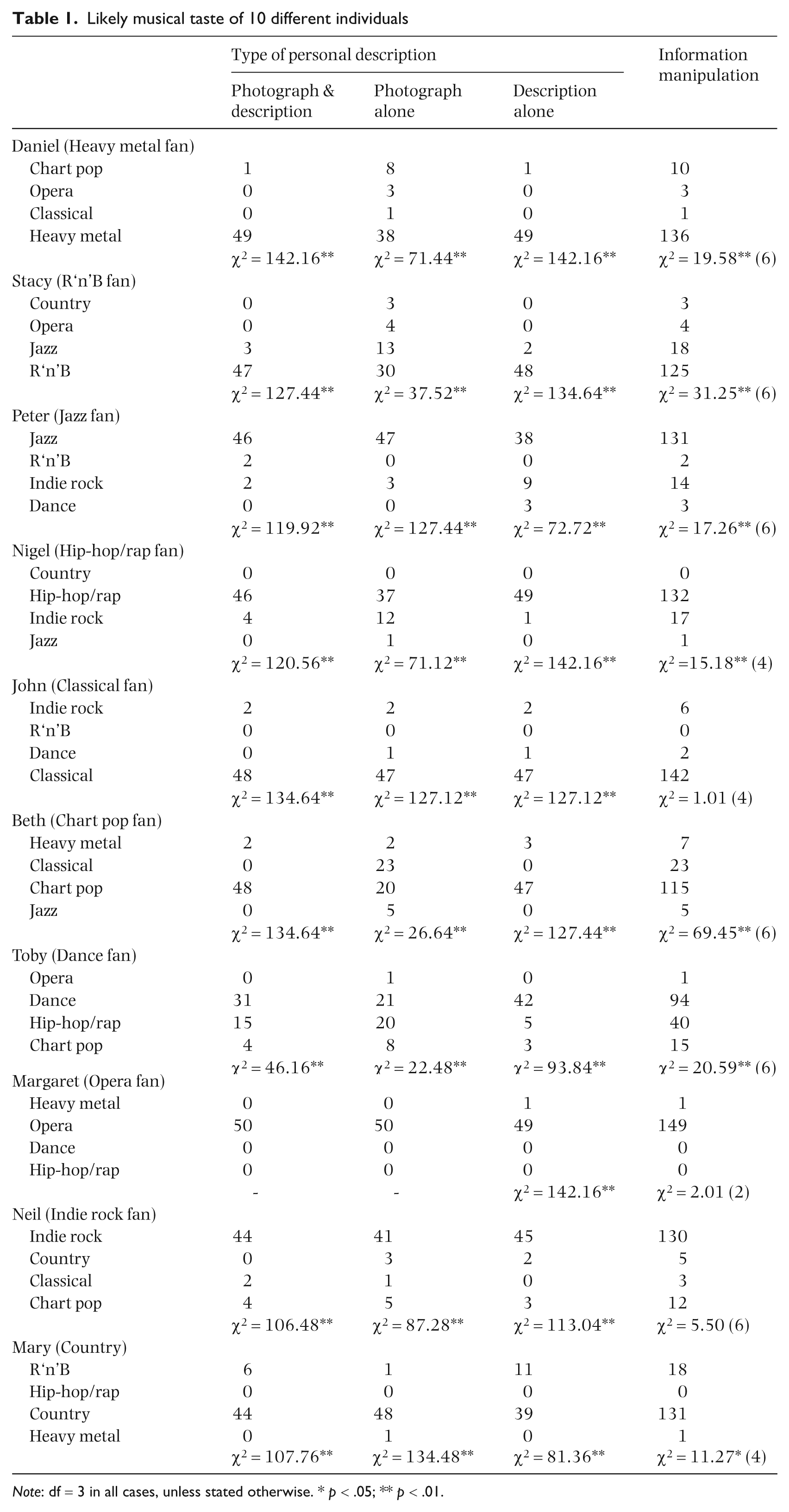
Participants completed a questionnaire that required them to identify the likely musical style preference of 10 fictional individuals. Each individual was described differently (see Appendix 1 for examples), according to characteristics stereotypically associated with fans of the 10 musical styles (see Table 1 for the musical styles used). These characteristics included, for example, age, income, religious and political beliefs, and were taken from Lonsdale’s (2009) study of stereotypes of musical taste. When asked to identify each individual’s favourite musical style, participants were provided with four options. Of the four options, one was the musical style used as the basis for the personal description and portrait photograph (i.e., the ‘correct’ response), whilst the other three remaining options were selected randomly from a list of the nine remaining musical styles. Participants were asked to identify one musical style for each of the 10 fictional individuals.
Likely musical taste of 10 different individuals
Note: df = 3 in all cases, unless stated otherwise. * p < .05; ** p < .01.
All participants followed this procedure in one of the three experimental conditions (n = 50), which manipulated the information given to participants about the 10 individuals. In condition 1, participants were given both a written personal description and a portrait photograph consistent with previously-established stereotypes of musical taste (see Lonsdale, 2009). In condition 2, participants were given the portrait photographs alone; whilst in condition 3, participants were given only the personal descriptions.
Results
Chi-squared analyses were performed to establish whether there was a significant bias in how participants identified the favourite musical style for each of the 10 fictitious individuals investigated. Chi-squared analyses were also used to determine whether the manipulation of the personal description had a significant effect upon how participants identify the likely musical taste of the 10 individuals. Table 1 provides a summary of these analyses for each of the 10 individuals investigated.
Table 1 showed that a significant proportion of participants identified a particular musical style as the likely favourite for each of the 10 fictional individuals investigated. For example, a significant proportion of participants (across all the experimental conditions) considered the favourite musical styles of Daniel and John were likely to be heavy metal and classical music respectively. In each case, participants’ judgements of musical taste corresponded with the stereotypes of musical taste used to construct their personal descriptions.
Further analyses showed that the manipulation of information given to participants had a significant effect on how they judged the likely musical taste of 7 of the 10 individuals. For 5 of the 10 target individuals, participants given portrait photographs alone made significantly less clear-cut judgements of musical taste, when compared to those given either photographs and personal descriptions or personal descriptions alone. For two of the target individuals (i.e., Peter and Mary), participants given personal descriptions alone made significantly less clear-cut judgements of musical taste, when compared to those given either photographs and personal descriptions or photographs alone.
Discussion
When asked to judge the likely musical tastes of 10 fictional individuals, a significant proportion of participants identified a particular musical style. In each case, the musical style selected corresponded with the stereotypes of musical taste used for the personal descriptions and photographs (see Lonsdale, 2009). This correspondence suggested that an individual’s similarity to stereotypical music fans might influence how people judge their musical taste. The stereotypic bias evident in participants’ judgements also supports the possibility that the representativeness heuristic is used to judge other people’s musical taste.
The study also investigated whether manipulating the information given to participants had a significant effect on how they judged the likely musical taste of the 10 fictitious individuals. In all three conditions, a significant proportion of participants judged each individual to have the same favourite musical style, exhibiting the same stereotypic bias. However, further analyses of the manipulation demonstrated that, for the most part, participants’ judgements of musical taste were significantly less clear-cut when given portrait photographs alone to judge the 10 individuals, than when given either personal descriptions and photographs or personal descriptions alone. These findings are likely to reflect the comparatively greater ambiguity associated with judgements based solely on an individual’s appearance relative to explicitly stereotypic, written descriptions.
The main limitation of the present study is that, when asked to judge the favourite musical style of each individual, participants were provided with only four different musical styles as options to indicate their response. This restricted participants’ range of responses and might have therefore inadvertently led them to give the stereotypic judgements observed. To improve on this, future investigations should include a greater number of musical styles and provide participants with the same options for each fictitious individual. Future research might also consider even using an open-ended question format, where participants would be asked to judge an individual’s musical taste without any options to restrict their response.
In addition to this, it cannot be ruled out that the participants’ own musical preferences might have influenced how they judged the likely musical preferences of the 10 fictitious targets. Specifically, it is possible that one’s own musical preference may have operated as an anchor leading to assimilation or contrast effects when judging the likely musical tastes of others. This possibility represents a potential avenue for future research. Furthermore, because of the disproportionate number of female participants sampled, we cannot also disregard the possibility that this somehow introduced a gender bias to our findings (although there is no evidence to expect this). Future studies might therefore look to investigate if men and women judge other people’s likely musical preference differently.
The findings of this first study suggest that people’s judgements of others’ likely musical taste show a significant bias in keeping with stereotypes of musical taste. This stereotypic bias was regarded to offer initial evidence for the idea that stereotypes of musical taste might function as judgemental ‘heuristics’, or cognitive ‘short-cuts’ used to quickly and economically judge the musical taste of others. Specifically, the stereotypic bias exhibited by participants’ judgements was presumed to have stemmed from their use of the representativeness heuristic to judge the musical taste of others. Study 2 investigated this idea, and tested whether perceived similarity to typical music fans, rather than base-rate information, is related to how people predict others’ likely musical taste.
Study 2: Judgements of musical taste and the representativeness heuristic
The representativeness heuristic refers to a cognitive bias where the likelihood of an event is judged according to its perceived similarity to typical group members. This is contrasted with a normative (or Bayesian) model of judgement, where the perceived likelihood of events is based on the consideration of an event’s relative frequency or probability according to statistical evidence. In this respect, perceived representativeness, like any other heuristic, reduces potentially-complex judgements and decisions into increasingly simplistic ‘rules of thumb’. In terms of social cognition, the representativeness heuristic is particularly useful when making quick judgements about people; and in particular when identifying likely group members (e.g., ‘is this person likely to be a doctor?’). The present study tested whether the representativeness heuristic is used to predict other peoples’ likely musical taste.
In Study 1, when asked to judge other people’s musical taste, participants’ judgements exhibited a common bias in keeping with each individual’s similarity to stereotypical music fans. This stereotypic bias may be the result of participants using the representativeness heuristic to judge the likely musical taste of others. Based on this assumption, the way in which people judge an individual’s likely musical taste (e.g., ‘is this person likely to be a reggae fan?’) should be based on their similarity to stereotypical music fans (i.e., ‘is this person like typical reggae fans?’). Moreover, any judgements of musical taste should be made irrespective of base-rate information concerning the relative frequency of different music fans (i.e., ‘how likely is this person to be a reggae fan given the number of reggae fans in the country?’). To test this idea, the present investigation used a research design very similar to that of Kahneman and Tversky’s (1973) pioneering study of intuitive prediction.
Kahneman and Tversky’s (1973) study provided perhaps the clearest demonstration of how the representativeness heuristic can significantly bias people’s judgements under uncertainty. The study was concerned with how participants predicted the subject that a fictitious graduate student (i.e., Tom W) was likely to study. Participants were split into three different groups: (1) the base-rate group; (2) the similarity group; and (3) the prediction group. In the base-rate group, participants were asked to give their best guesses about the percentage of students enrolled in each of the nine graduate courses. In the similarity group, participants were asked to rank the nine subjects in terms of how similar Tom W was to the typical graduate student of each academic subject. Participants in the prediction group were asked to rank the nine subjects in order of how likely Tom W was to study each subject. Kahneman and Tversky (1973) found that participants’ predictions were correlated strongly with mean similarity rankings rather than with base-rate estimates. This finding suggested that, regardless of the prior probability, participants judged Tom W’s likely subject by his similarity to typical graduate students. Similar findings were also expected when people are asked judge the likely musical taste of others.
If the representativeness heuristic is used to identify the likely musical tastes of others, an individual’s perceived similarity to typical music fans should correlate more closely with predictions of their likely musical taste than should base-rate estimates of musical taste. The present investigation tested this idea using a research design similar to Kahneman and Tversky’s (1973) study.
Method
Participants
One hundred and twenty-five undergraduate psychology students (98 females, 27 males) participated voluntarily. 1 Participants’ mean age was 19.84 years (SD = 3.29), and all were studying at a university in the East Midlands of the UK.
Design and procedure
Participants completed different questionnaires in one of five different groups (n = 25). In group 1, participants were asked to consider the distribution of music style preferences in the British population as a whole. Like Kahneman and Tversky (1973), participants were required to give specific percentage estimates to indicate the proportion of the population perceived to like each of the 10 music styles investigated. 2 Participants’ estimates were used to establish the perceived ‘base-rates’ of musical taste for each of the 10 musical styles.
Participants in the remaining four groups were given one of two fictional personal descriptions based on previously-established stereotypes of musical taste (Lonsdale, 2009). Participants in groups 2 and 3 were asked to judge the personal description of John, which was based on Lonsdale’s (2009) findings concerning the characteristics of stereotypical heavy metal fans:
John is a 23-year-old white man from a below average income household. At work, John is relatively disorganized, irresponsible and is slightly less intelligent than his colleagues. John tends to be somewhat self-centred and unfriendly to those outside his immediate friendship groups. In the past, John has shown evidence of drug abuse and is thought to be vulnerable to further ‘at-risk behaviours’ (e.g., suicide, unprotected sex, etc.). John is also an atheist.
Participants in groups 4 and 5 were asked to judge the personal description of Jerome, which was based on Lonsdale’s (2009) findings concerning the characteristics of stereotypical hip-hop/rap fans:
Jerome is a 19-year-old black man from a below average income household. Jerome is out-going, but relatively narrow-minded and hostile to those outside his family and immediate friendship groups. He is known to regularly participate in anti-social behaviour (e.g., street crime, violence, etc.) and abuse illegal drugs. Jerome is also a Christian.
Participants in groups 2 and 4 were asked to rank each of the 10 musical styles in order of how similar the individual described was to the typical fan of each music style. Similarity was ranked where 1 = ‘least similar to John/Jerome’ and 10 = ‘most similar to John/Jerome’. Participants in groups 3 and 5 were asked to rank each of the 10 musical styles in order of how likely it was that the individual described would be a fan of that musical style. The prediction of the described individual’s likely musical preference was ranked, so that 1 = ‘John/Jerome is least likely to be a fan of this style’, and 10 = ‘John/Jerome is most likely to be a fan of this style’. In each of these groups participants were instructed to rank each of the 10 musical styles differently, 3 and those who failed to do this correctly were not used as part of the study (n = 8). 4
Results
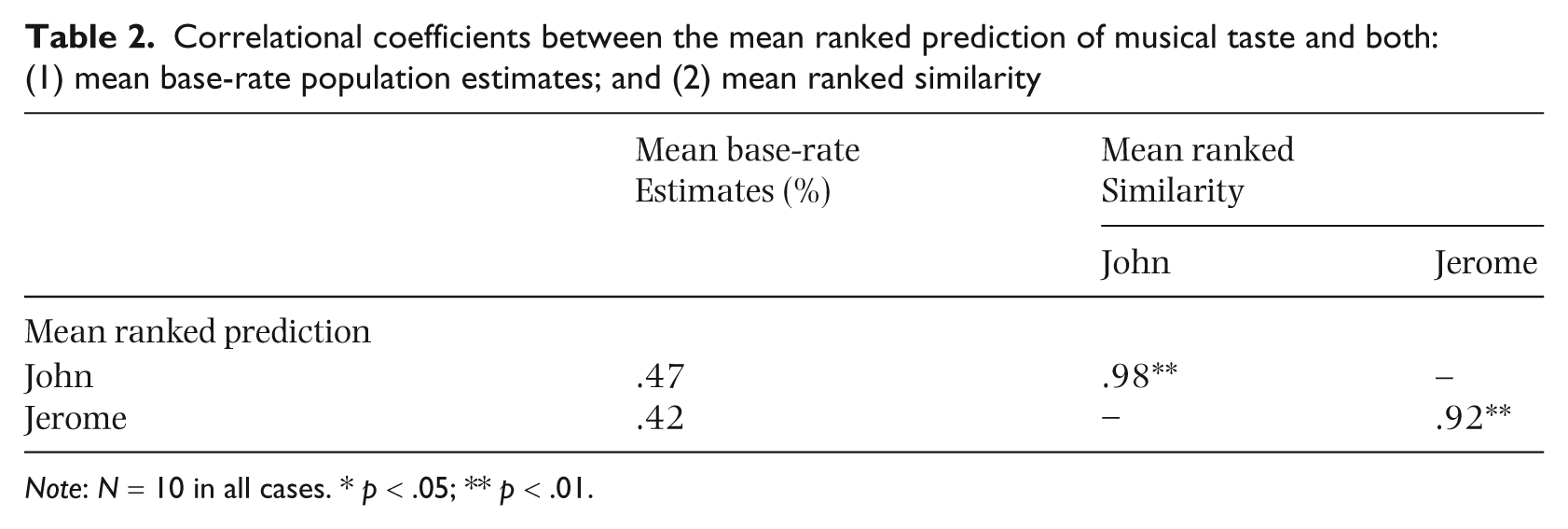
Spearman’s Rho correlational analyses were conducted to establish the relationships between the mean ranked predictions of musical taste with both mean base-rate estimates, and mean ranked similarity scores.
Table 2 shows that for both John and Jerome there was a strong significant positive correlation between their mean ranked similarity to stereotypical music fans and mean ranked predictions of their likely musical taste. Table 2 also shows that mean ranked predictions of musical taste were not significantly related to mean base-rate estimates regarding the perceived proportions of music style preferences in the British population.
Correlational coefficients between the mean ranked prediction of musical taste and both: (1) mean base-rate population estimates; and (2) mean ranked similarity
Note: N = 10 in all cases. * p < .05; ** p < .01.
Discussion
When asked to predict an individual’s likely musical taste, participants’ judgements correlated significantly with their perceived similarity to typical music fans. In contrast, no such correlation was evident between the same ranked predictions and base-rate estimates of musical taste considered typical of the British population. This suggests that simply because John was perceived to be similar to stereotypical heavy metal fans, and Jerome similar to stereotypical hip-hop/rap fans, they were each predicted more likely to like those musical styles, regardless of whether base-rate estimates suggested otherwise. On closer inspection, the extent to which rankings of perceived similarity and predicted musical tastes were correlated (i.e., r = .98 and .92) suggested that judging an individual as similar to stereotypical fans of a particular musical style might be psychologically very similar to judging their likely musical taste. These findings support the idea that the representative heuristic is used to judge the likely musical taste of others.
In this case, the representativeness heuristic is likely to have simplified how participants’ judged the musical taste of the two fictional individuals. The use of the representativeness heuristic meant that participants did not have to consider the actual likelihood that in a given population either John or Jerome was a fan of a particular musical style, which would be a complex and time-consuming process. Instead, participants had only to consider whether the individual was similar to stereotypical music fans. Although susceptible to errors, this heuristic strategy allows individuals to quickly and economically judge other peoples’ likely musical taste. This finding may also explain why, in Study 1, participants’ judgements of musical taste tended to exhibit a common bias in keeping with previously-established stereotypes of musical taste.
General discussion
The findings of this investigation support the idea that the representativeness heuristic is used to judge the likely musical taste of others. Study 1 showed that, when asked to judge the likely musical taste of 10 fictional individuals, participants’ judgements exhibited a common bias in keeping with each individual’s similarity to stereotypical music fans. This stereotypic bias was believed to stem from the use of the representativeness heuristic. Study 2 confirmed this idea, showing that an individual’s similarity to stereotypical music fans, rather than base-rate estimates of musical taste, was significantly related to predictions of their likely musical taste. This suggested that an individual’s relative similarity to stereotypical music fans might act as a heuristic ‘rule of thumb’ used by people to quickly and economically judge their likely musical taste.
Musical taste has been shown to play a significant role in how people are seen by others (e.g., North & Hargreaves, 1999; Zillmann & Bhatia, 1989). The way in which we judge an individual’s musical taste is therefore likely to have direct implications for how people perceive and behave toward them. Recent research has shown that people perceive and behave more favourably towards those perceived to share their musical taste than towards those who do not (e.g., Bakagiannis & Tarrant, 2006; Lonsdale & North, 2009). In this respect, musical taste has been argued to function as a social ‘badge’ (Frith, 1983; North & Hargreaves, 1999) of group membership, where those who share our musical tastes should be more likely to be considered in-group members. In view of this, the use of the representativeness heuristic to judge peoples’ likely musical taste is expected to have implications for intergroup behaviour. For example, individuals who closely resemble stereotypical fans of our favourite musical style, according to the present findings, are likely to be judged to share our musical taste. These individuals are therefore more likely to be considered in-group members, and subject to in-group favouritism, regardless of whether they actually share our musical taste. In this context, an individual’s similarity to stereotypes of musical taste is expected to significantly influence how people behave toward them, although further research is however needed to investigate this further.
In summary, the present findings support the idea that the representativeness heuristic is used to judge the likely musical taste of others. These findings suggest that an individual’s similarity to stereotypical music fans might act as a heuristic ‘rule of thumb’ used by people to quickly and economically judge their likely musical taste. Musical taste is thought to play a significant role in how people see others. Consequently, the use of the representative heuristic to judge an individual’s likely musical taste is expected to have direct implications for how people see and behave towards each other.