




Abstract
This study investigates children’s metarepresentational competence (MRC) with regard to listening to and making sense of simple sonic stimuli. Using diSessa’s (2002) seminal work on MRC in mathematics and sciences as background, it aims to assess the relative importance children attribute to several criteria for representational adequacy of graphical representations of sonic stimuli, as well as to investigate the impact of children’s age and music background on their valuations of the relative importance of these criteria. Four groups of children (8–9- and 11–12-year-olds with and without extra music education) were exposed to short and simple sonic fragments. For each fragment they received a set of pairs of representations from which they had to choose one from each pair. The representations were organized in pairs of opposites for two of the four representational criteria involved in the study (correctness, formality, transparency, and neatness). The findings revealed a development in children’s personal hierarchies of representational criteria with growing age and musical education towards the following ranking: (1) correctness; (2) neatness; (3) formality; and (4) transparency. Theoretical, methodological, and educational implications are discussed.
Keywords
Introduction
This study is part of a larger research project on children’s external representations of sounding music. Taking the available theoretical and empirical research on children’s musical representations as our starting point, we set up a series of empirical studies in an attempt to analyze children’s graphical notations as external representations of what they experienced while listening to simple sonic stimuli and more complex musical fragments. Besides an attempt to classify these notations, we also tried to assess the impact of several subject and task variables on these representations (Reybrouck, Verschaffel, & Lauwerier, 2009; Verschaffel, Reybrouck, Janssens, & Van Dooren, 2010a). In addition, we gradually started to become aware of the role of children’s metarepresentational competence in the construction of these external representations (Verschaffel, Reybrouck, Jans, & Van Dooren, 2010b).
Grounded in general theories of cognitive development (see Sutherland, 1992, for an overview), perceptual learning (Fahle & Poggio, 2002; Gibson, 1969; Goldstone, 1998; Werner, 1948; Werner & Kaplan, 1963) and symbol use, tool use, and modeling (diSessa, 2002; Gravemeijer, Lehrer, van Oers, & Verschaffel, 2002), on the one hand, and in empirical research on children’s invented graphical notations of sonic or music fragments (Bamberger, 1980, 1982, 1991, 2005; Barrett, 1997, 2001, 2002, 2005; Cohen, 1985; Davidson & Colley, 1987; Davidson & Scripp, 1988; Davidson, Scripp, & Welsh, 1988; Elkoshi, 2002; Fung & Gromko, 2001; Gromko, 1994; Hair, 1993–1994; Hargreaves, 1978, 1986; Kerchner, 2000; Smith, Cuddy, & Upitis, 1994; Upitis, 1987, 1990, 1993; Walker, 1981, 1983; Welch, 2006), on the other, the research on informal music notations has yielded insights into the wide variety of notations that children invent when confronted with sonic or music fragments as well as into the influence of several subject, task, and context variables on the nature and quality of these notations.
While being active in this latter line of empirical research (Reybrouck et al., 2009; Verschaffel et al., 2010a, 2010b), however, we gradually became aware of the potential relevance of the theoretical notion of ‘metarepresentational competence’ (MRC; diSessa, 2002) that was developed in the domain of symbol use, representational tool use, and modeling in general (Gravemeijer et al., 2002) but that – to the best of our knowledge – had not yet been used in the context of children’s notations of sound or music.
In a first study in which we applied this notion of MRC to the representation of sonic stimuli, and which will be briefly reported later, we confronted children of different age groups and with different levels of musical expertise in the context of a paper-and-pencil test, with several simple sonic stimuli with, for each of them, a pair of external representations that differed (only) with respect to one particular representational aspect (e.g., correctness, completeness, or formality of the representation). We asked the children to select the most appropriate representation for each of these sonic stimuli and to motivate their choice (Verschaffel et al., 2010b).
While this study yielded a number of interesting findings concerning the ways children handle these different representational criteria and the role of several subject and task features on their handling, it did not reveal any information about the relative position of these various representational criteria in their personal hierarchies. Therefore we set up a new study aimed at assessing children’s preferences among four representational criteria, namely correctness, neatness, formality, and transparency. Using a quasi-experimental design that was similar to the one used in the first study (Verschaffel et al., 2010b), children from different age groups and with different levels of musical experience listened to short sonic stimuli and were confronted with pairs of graphical representations that contrasted two of the four aforementioned representational criteria. They had to make a choice between the two alternatives and explain their choice. Their preferences were tested across age and musical training.
A first aim of the present study is to further explore the potential relevance of the theoretical notion of MRC, which was developed in the domain of (the psychology of) science education (diSessa, 2002; diSessa & Sherin, 2000), for research in the domain of children’s graphic representations of sonic stimuli as well as for music educational practice in general. Second, we want to contribute to theory and research on MRC in general by addressing an important but underrepresented metarepresentational issue, namely how people balance various representational criteria against each other. We propose a method for systematically investigating this issue, and report some first results obtained by means of this approach.
Theoretical and empirical background and research questions
In a seminal work on the role of representations in science learning, diSessa (2002, 2004; diSessa & Sherin, 2000) introduced the notion of ‘metarepresentational competence’ (MRC) to refer to the complex of abilities dealing with representational issues. The term was introduced: . . . to describe the full range of capabilities that students (and others) have concerning the construction and use of external representations. MRC includes the ability to select, produce and productively use representations but also the abilities to critique and modify representations and even to design completely new representations. The term ‘representational competence,’ used generically, should enfold this full range of activities involving representation. However, because of the historical and anomalously narrow focus on fixed and instructed representations, we add the prefix ‘meta’ to denote our more encompassing aims. We are interested in whatever students know about representation (= meta-representation) . . . (diSessa & Sherin, 2000, p. 386)
MRC, in this view, includes the ability to design a representation for a given natural, social, or cultural phenomenon such as the air circulation pattern in a hurricane, the functioning of a traffic light, or the acceleration of a car. MRC includes both the capacity to actually create adequate representations and to judge their adequacy for particular purposes (e.g., for better understanding the phenomenon oneself or for better explaining it to others), as well as understanding of how representations work or do not work (e.g., why people may have trouble in understanding or profiting from a given representation), etc. (diSessa, 2002).
According to diSessa research on MRC is not merely of intrinsic scientific interest but it has educational value as well in broadening the scope of current research on teaching and learning to deal with representations in school. This broadened scope includes aspects as design, critique, and explanation that have generally been neglected in common research about representations. As such, it is arguable to teach not only a few standard representational forms from domains like science or mathematics. It seems more fruitful, rather, to focus on the breadth of MRC, with the aim of ‘developing a true representational literacy’ (diSessa, 2002, p. 105). The major goal of diSessa’s work, therefore, has been to identify and characterize students’ competence in dealing with representations from an integrated cognitive and socio-cultural perspective. In his theoretical framework, two complementary central resources are distinguished: ‘constructive resources,’ which entail a set of ideas and strategies for generating new representations, and ‘critical abilities’ referring to the ability to judge the effectiveness of the results of such constructive effort and to re-design these results in order to ameliorate their shortcomings.
DiSessa and associates (2002; diSessa & Sherin, 2000) investigated MRC mainly in the context of rich and authentic whole-class activities with learners being invited to generate an external representation of authentic scientific phenomena and to comment on each others’ representational products. On the basis of qualitative methodologies (participatory) classroom observations during whole-class activities as well as individual interviews they analyzed these evaluative and reflective comments and proposed a classification scheme that consists of several categories, each comprising several subcategories (e.g., ‘use-centered’ criteria, such as ease of use; criteria of ‘epistemic fidelity,’ such as correctness and completeness; ‘formal’ criteria, such as conventionality and redundancy; and the ‘aesthetic’ criterion of beauty). Their analysis also yielded several findings about the metarepresentational competences of students (as compared to experts), the development of students’ use of different representational criteria with growing age and expertise, and the explicit versus implicit nature of these criteria (diSessa, 2002; see also Verschaffel et al., 2010b).
Inspired by this pioneering work in the domain of science, we recently set up a first study of children’s MRC in the domain of music 1 (Verschaffel et al., 2010b). As stated earlier, researchers have already developed theoretical models and conducted empirical studies about children’s notations of sonic and/or music fragments, revealing that children draw on a broad variety of invented representational forms to express certain aspects of the fragments they listened to, which can be considered as precursors to the development of the culturally agreed formal symbol system of the ‘adult’ music world. Besides attempts to classify this variety of notations, this research has yielded a great number of findings about the impact of various subject, task, and context variables on the nature and quality of these notations (see Aiello, 1994; Barrett, 2001, 2005; Elkoshi, 2002; Reybrouck et al., 2009; Verschaffel et al., 2010a, for an extensive overview).
As far as subject characteristics are concerned there is an influence of age and previous exposure to music, with notations becoming more detailed and reflective as children grow older (Barrett, 1997, 2001). The influence of task variables is documented, for instance, in studies comparing rhythmic structures as against melodic material (Upitis, 1987, 1990), or incomplete fragments as against complete compositions (Clarke & Krumhansl, 1990; Tan & Kelly, 2004). With respect to the influence of the context, finally, Auh (1997), for instance, reported that notations that are generated in the context of a composition task differ from those generated during a listening task. The notational strategies children rely on are thus affected by their developmental and educational level, the nature of the musical material, and the features of the task they perceive as being dominant.
To account for these findings authors have relied on notions coming from general theories of cognitive development, perceptual learning, and symbol use, tool use, and modeling. The finding, for instance, that children’s notations become gradually more sophisticated, with an increased concentration on musical elements (Barrett, 1997) and an increasing range of musical elements being represented (Barrett, 2001) has been related to changes in their general cognitive development (Gromko & Russell, 2002; Zimmerman, 1984). Other studies have stressed differences in children’s perceptual acuity as a result of learning and development (Campbell, 1991; Gooding & Standley, 2011), but little of these findings have been applied as yet to the domain of graphical notations. Differences in children’s notations, finally, have been analyzed also in terms of relationships between different representational systems, with an increase in more accurate symbol-meaning relationships as children grow older and an increased capacity to understand and express these relationships (Barrett, 2000; Upitis, 1992). In none of these analyses, however, the possible contributory role of MRC has been (explicitly) addressed. Therefore we set up a study (Verschaffel et al., 2010b) to explore the potential value of this construct with a view to broaden our theoretical understanding of (the development in) children’s notations of sonic and music fragments.
In that study (Verschaffel et al., 2010b), 138 children – third-graders (aged 8–9) and sixth-graders (aged 11–12) with and without extracurricular music education – were exposed, in the context of a whole-class test, to three short sonic fragments that were specially composed to accentuate, in each case, one salient sonic parameter, namely pitch, duration, or loudness. For each fragment we designed six pairs of contrastive notations that represented both a normatively more (+) and less appropriate (–) external representation according to one of the representational criteria that were selected by the researchers. These criteria were a subset from diSessa’s aforementioned framework, namely correctness, completeness, transparency, formality, redundancy, and beauty. The combination of the aforementioned sonic fragments and representational criteria resulted in a set of experimental items, each containing a pair of contrastive representations according to the specific representational criterion. For each pair the children had to choose the representation they considered to be the best. In addition, they were also invited to explain or motivate their choice.
Generally speaking our results corroborated diSessa’s (2002) findings. First, the quantitative analysis of the representational choices yielded evidence that the children were able to adequately use several representational criteria in their evaluation of the representations of sonic fragments. Second, this study also confirmed, to some extent, diSessa’s findings concerning the development in the kind of criteria that were adequately used by students. For instance, whereas the aesthetic criterion of beauty seemed to be used already early in children’s development, epistemic criteria like correctness and transparency seemed to arise only at a later stage. Third, there was also support for diSessa’s finding concerning the largely implicit nature of MRC; it was found that children’s relatively good performance on the test items – in the sense that they selected more normatively accurate than inaccurate representations – contrasted with their relative poor, unspecific, and unclear verbal explications of their choices.
At a more general level, our findings were also in line with research findings about children’s emerging semiotic capacity, the development towards more sophisticated and flexible use of signs and other kinds of representations with growing age and experience, and the gradual development of the ability to reflect upon these representations and how to use them in thinking and learning (for an overview, see Barrett, 1997, 2001, 2002; Gravemeijer et al., 2002; van Oers, 1997; Werner & Kaplan, 1963).
Our study, however, showed one important limitation, as it could not reveal the relative importance of the different representational criteria involved in the investigation. As all items involved a comparison of two representations that differed in only one representational criterion while all other representational dimensions were kept constant, the available results could not tell, for example, whether the aesthetic criterion of beauty is ranked higher in a child’s personal hierarchy than the epistemic criteria of correctness or transparency. In order to better understand the nature of MRC, however, it is crucial to also have a better view on children’s personal hierarchies of representational criteria. Though diSessa did not systematically analyze these hierarchies, he has argued for a context ‘in which different criteria must be balanced and traded off against one another’ (diSessa, 2002, p. 118). We do not know of any research that has tried to systematically address this issue.
So the present study is the first to investigate in a systematic, quasi-experimental way the important but underrepresented metarepresentational issue of how people balance various representational criteria against each other when engaged in a semiotic activity. Besides, this study aims at further elucidating the potential relevance of the notion of MRC which was developed in the domain of (the psychology of) science education (diSessa, 2002; diSessa & Sherin, 2000), for theory and research in the domain of children’s notations of sound and music.
To the best of our knowledge the notion of MRC has not yet been applied to (the psychology of) music education. Just as it has forwarded research on learning and instruction in subject-matter domains other than music (such as science and mathematics), its inclusion in music research may be helpful to better understand developmental and instructional processes that are related to children’s use of external representations in handling and learning about sound and music. To find, for instance, that young children should attach more value to one criterion (e.g., beauty as against formality or correctness) of a representation, may help to understand their difficulties in using certain kinds of notations or in creating and using new ones. It may also help to design appropriate intervention strategies for stimulating and helping children to evolve from their first invented notations to more advanced and culturally accepted ones. Likewise, insight into the way factors such as age and music education affect the growing development of children’s appreciation of the formality or transparency of a representation may inspire music educators in their design of appropriate instructional materials and interventions that are adapted to the knowledge and needs of the learners.
Method
Participants
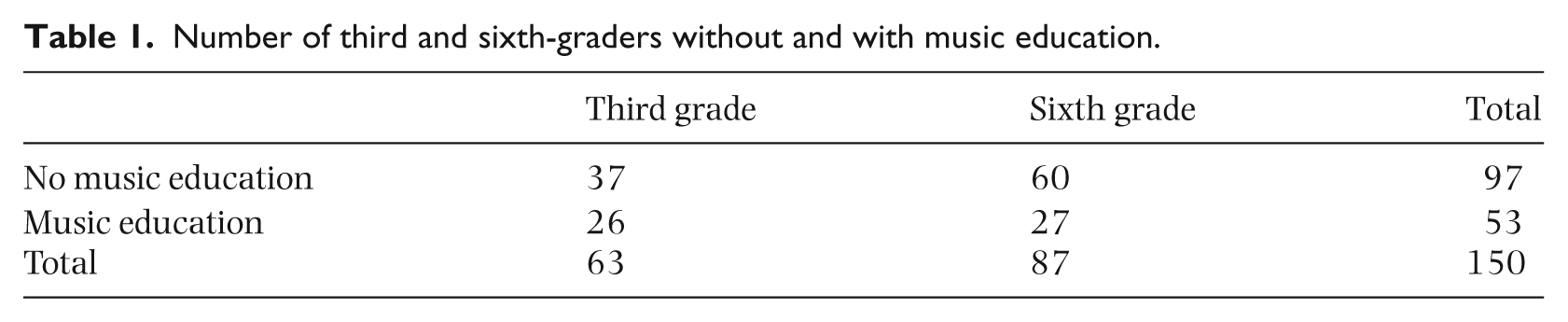
A total of 150 children recruited from three elementary schools and one music school from the same region participated in the study. They belonged to one of four groups, namely third-graders (aged 8–9) and sixth-graders (aged 11–12), with and without extracurricular music education. The children with extra music education had received additional instruction mostly in music schools or through private music lessons for a period of at least six months in which they learned the essentials of melodic sight-reading and solfege practice, together with musical instrument lessons. Those without extracurricular music education did not receive any systematic instruction in (Western) standard music notation, but may have been exposed accidentally to this system in elementary school or everyday life. Table 1 shows the distribution of the 150 children over the four groups.
Number of third and sixth-graders without and with music education.
Material
Each student received a test booklet consisting of 24 experimental items besides two practice items and eight buffer items. As in the previous study of Verschaffel et al. (2010b), each item consisted of two representations of the same sonic fragment from which the child had to choose the preferential one. The representations in the items varied with respect to four representational criteria that were selected from diSessa’s (2002) classification scheme, namely correctness, formality, transparency, and beauty. In what follows we first present the sonic fragments that were used in the present investigation, then describe the four representational criteria being selected for the study and, finally, provide a detailed description of the items and the way they were assembled to get distinct versions of the test.
Sonic fragments
We composed four short sonic fragments which varied only in terms of pitch. To keep the fragments as simple as possible, other sonic features such as rhythm, loudness, and timbre were kept constant within and between fragments. Each sound fragment consisted of eight pitches, grouped in two measures in common time (4/4), which were played with acoustic piano timbre (generated via the Macintosh software GarageBand). As shown in Figure 1, we further tried to make the four fragments equivalent in the sense that there was always one unison (same pitch) between two pitches, four seconds (one step up or down), and two thirds (two steps up or down) in each fragment. Moreover, we used whole steps only and built the respective pitch series by combining three notes (F, G, and A) written on the treble staff. Three of the generated fragments (series A, B, and C; see Figure 1) were used for the actual test while the fourth one (D) was used to familiarize the children with the material and the instructions during a short introduction and practice session at the beginning of the test (see ‘practice items’). The motivation for keeping the fragments short and simple was to maximize the chance that the children, even the younger and musically untrained ones, would be able to distinguish between a correct and an incorrect representation of the sonic fragment being heard (see Verschaffel et al., 2010b).
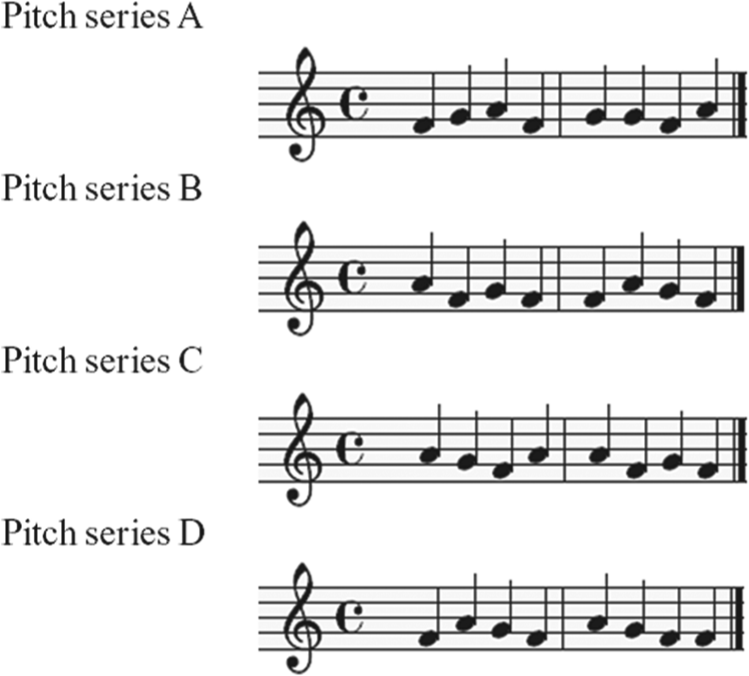
The four pitch series A to D.
Representational criteria
For each of the four selected criteria we distinguished between a positive (+) and a negative (–) variant.
Correctness: a representation is considered to be correct (+) when it accurately shows the articulation of the relevant sonic parameter (pitch in the present study) over time. If not, it is considered incorrect (–). The very simple nature of the fragments in combination with the manifestly erroneous nature of the incorrect representational variant make the distinction quite straightforward. Correctness is one of the criteria for ‘epistemic fidelity’ in diSessa’s (2002) framework. Previous research showed that it is an important developmental aspect in children’s spontaneous notations of sonic and music fragments (see, e.g., Reybrouck et al., 2009; Verschaffel et al., 2010a) as well as in their valuations of representations that are provided to them (diSessa, 2002; Verschaffel et al., 2010b).
Formality: a representation is considered to be formal (+) when it uses signs, symbols, rules, and/or conventions of the Western standard music notation. When no formal elements are used, the representation is considered as informal (–). This criterion is related to diSessa’s (2002) ‘conventionality’ criterion, but we restricted ‘formality’ to the narrow scope of standard notation, whereas diSessa’s definition of conventionality embraces also other kinds of (informal) representations that use conventions (e.g., ‘up is more’ or ‘left is earlier’). We made this restriction because previous studies revealed the importance of standard music notation in the development of children’s spontaneous representations of sonic or music fragments (see, e.g., Reybrouck et al., 2009; Verschaffel et al., 2010a) as well as in their valuations of given representations (Verschaffel et al., 2010b).
Transparency: when a representation contains an element that shows or suggests any systematic variation that does not refer to any corresponding variation in the sonic fragment that is to be represented, it is considered as misleading (–); when such misleading elements are missing, the representation is called transparent (+). This criterion is closely linked to correctness, except that correctness concerns the question whether the representation accurately shows the articulation of the relevant varying sonic parameter, whereas transparency addresses children’s capacity to notice whether there was some systematic variation in the given representation that did not correspond to any apprehensible change in the corresponding sonic material. This transparency criterion is closely related to the epistemic fidelity criterion ‘does the representation show what it “should” show?’ from diSessa’s (2002) framework.
Beauty: this criterion refers to the ‘aesthetic’ quality of the representation. The same representation, for example, can be made with or without attractive visual ornaments, or can be drawn neatly or sloppily. In diSessa’s (2002) framework, this criterion is called ‘aesthetic.’ In our previous study (Verschaffel et al., 2010b) we also applied a rather broad definition of beauty, but in the present study we decided to narrow it down to one particular aesthetic aspect, namely neatness (+ = neat; – = sloppy). In the literature on representations, beauty c.q. neatness is mentioned as a possible criterion, but it is mainly considered to be less essential than the epistemic criteria (diSessa, 2002).
Types of items
As stated earlier, all children received a test booklet consisting of 24 experimental items, preceded by two practice items and mixed with eight buffer items. This made a total of 34 items. As we wanted to assess the relative importance children would attribute to each representational criterion, each experimental item involved two criteria which were contrasted with each other. This yielded six possibilities for contrast: correctness-formality, correctness-transparency, correctness-neatness, formality-transparency, formality-neatness, and transparency-neatness.
For each of these six contrasts we composed four items, resulting in a total of 24 experimental items. These four items per contrast were created by always contrasting a representation that was positive for the first criterion (A) and negative for the second (B) with a representation that was negative for A and positive for B. The third and fourth criteria C and D varied over the four items for a given contrast, but were always kept constant within each item: in the first item criterion C and D were both positive in the two contrasting representations, in the second both negative, in the third item C was positive and D was negative, and in the fourth C was negative and D positive. Figure 2 illustrates these composition rules for one of the six contrasts, namely the contrast between correctness and formality.
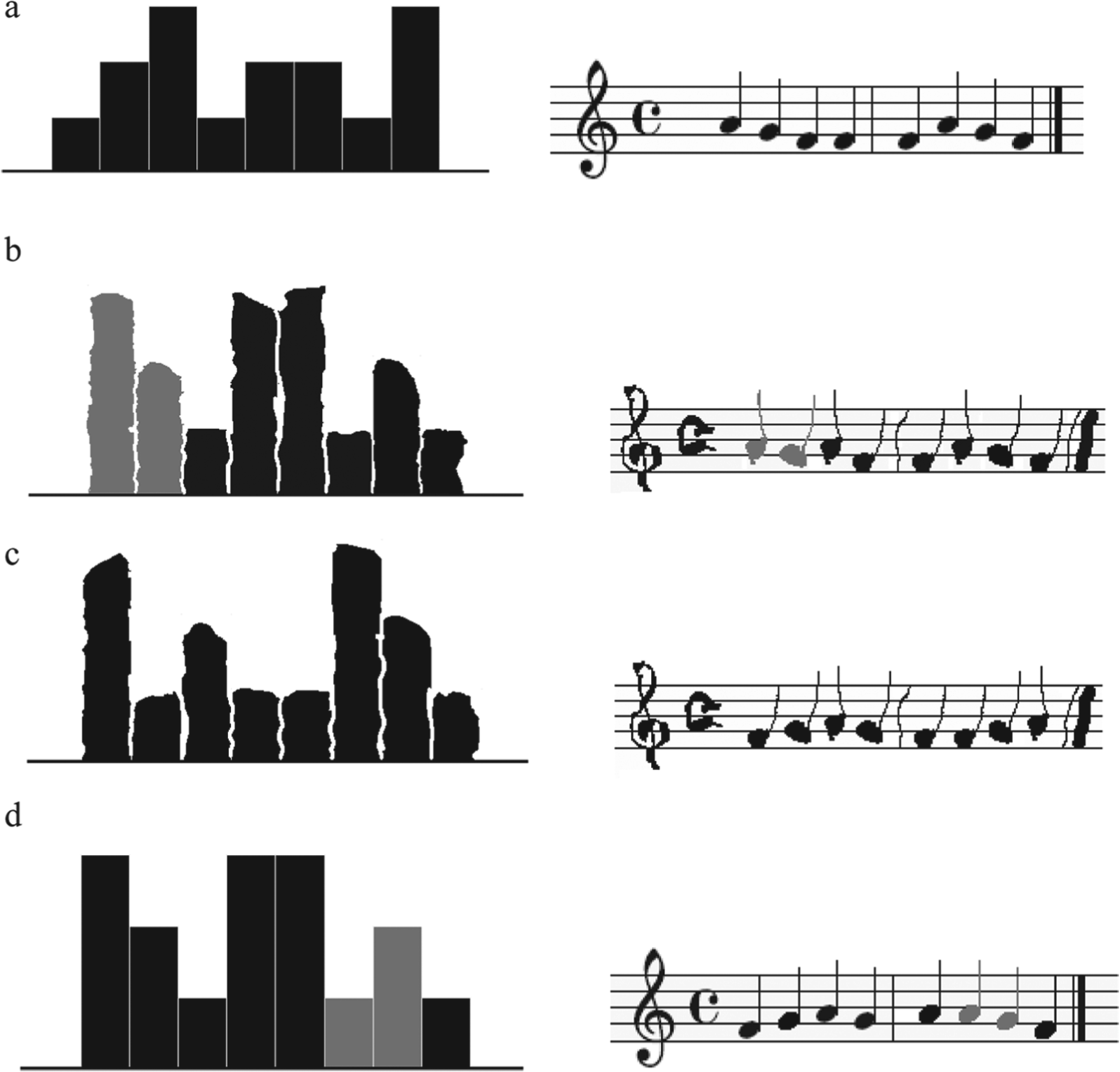
The four experimental items for the comparison between correctness and formality (relating, respectively, to pitch series A, C, B, and C).
In Figure 3 we give one illustration for the other five contrasts. We selected as examples the items with the positive variant for both of the criteria C and D that were not involved in the contrast.
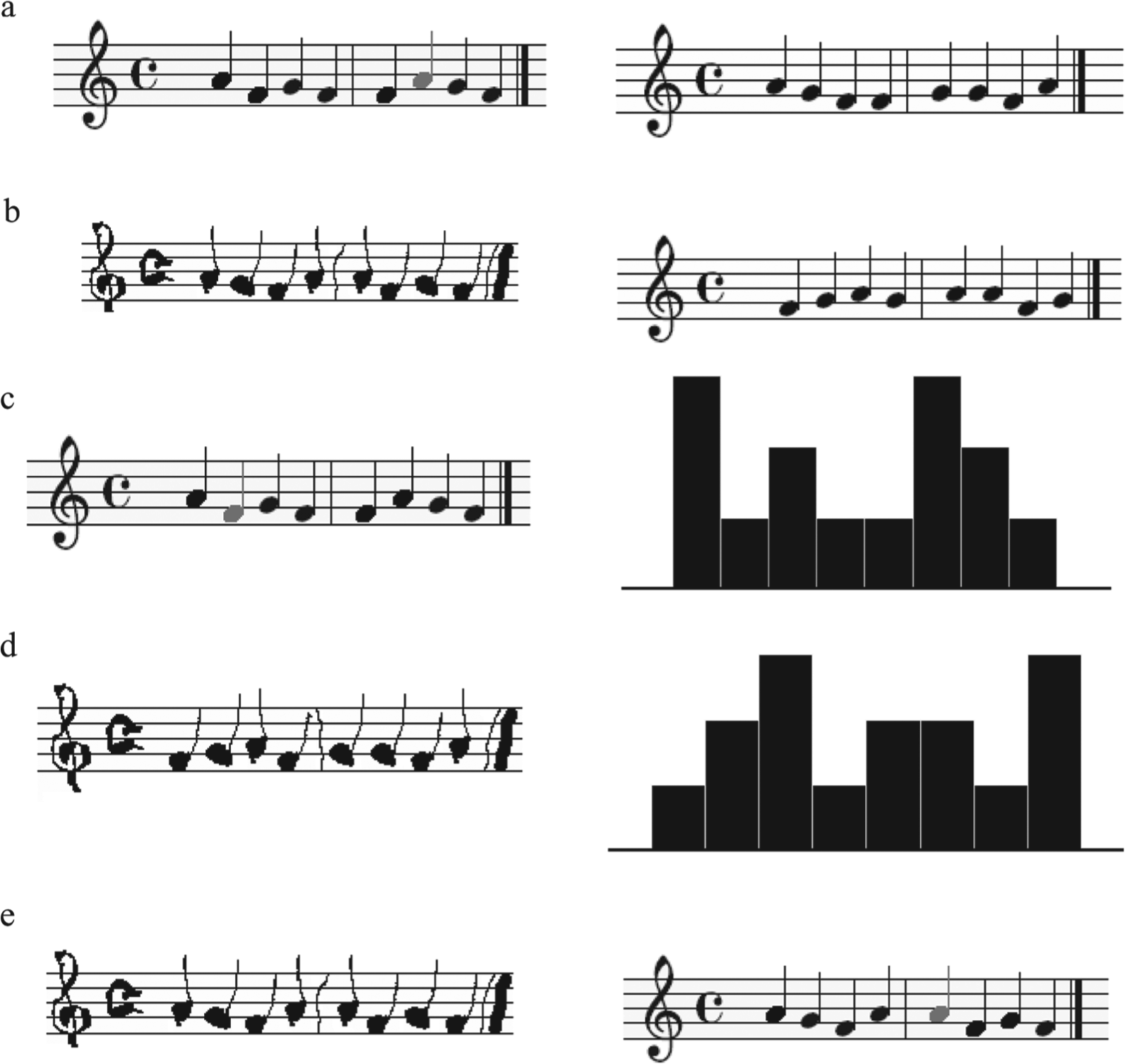
Examples of experimental items for the comparison between (a) correctness and transparency (pitch series B); (b) correctness and neatness (pitch series C); (c) formality and transparency (pitch series B; (d) formality and neatness (pitch series A); and (e) transparency and neatness (pitch series C).
The goal of the buffer items was to obscure for the participants the principles underlying the design of the 24 experimental items. Whereas the experimental items contrasted a positive operationalization of one criterion with a negative operationalization of another criterion (see earlier), for the buffer items we created, for each of the four representational criteria, items (similar to those in Verschaffel et al., 2010b) with the normatively positive operationalization of the criterion (e.g., correct) being contrasted with the negative one (e.g., incorrect) of this same criterion. The two buffer items for each criterion differed from each other with respect to the operationalization of the three other representational criteria that were kept constant for the two versions of each item. The first buffer item about correctness, for instance, compared a correct and an incorrect representation which were both formal, transparent, and neat (see Figure 4a), whereas the second one compared a correct and incorrect presentation which were both informal, transparent, and neat (see Figure 4b).
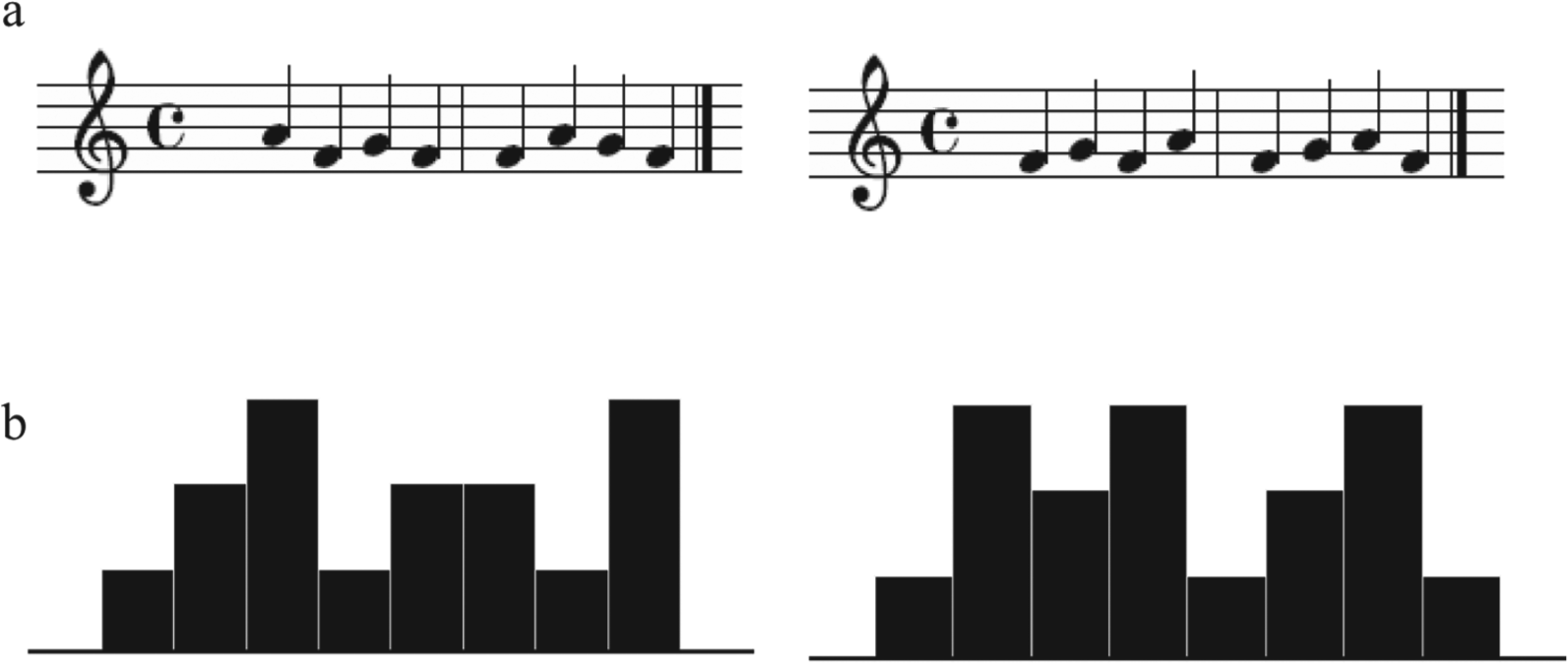
The two buffer items about correctness (pitch series B and A).
As already mentioned, we also constructed two practice items to make sure that all students would understand the test material and instructions. The first trial involved the choice between a complete and an incomplete (correct) representation of a given sonic fragment; the second contrasted two different representations of this same fragment, both correct and complete, but visualizing the pitch series either with a continuous line or with separate dots.
Test booklet
Pitch series A, B, and C (hereafter called fragment A, B, and C) were used for the actual test; series D was used only for the two practice items. The eight buffer items (i.e., two per criterion) were randomly distributed over the three fragments (series A, B, and C), with two or three buffer items per fragment and, likewise, the 24 items were randomly distributed over the same three fragments with eight items per fragment.
For practical reasons all experimental and buffer items belonging to the same sound fragment were put together in the booklet, but the order was mixed. To prevent possible order effects, a threefold randomization was realized. First, all six possible sequences of the three sonic fragments (A, B, and C) were used. Second, children sitting together on the same desk got different versions of the test booklet: the second version had, for each set of items belonging to a given sound fragment, the opposite order of the first one. Third, for each of these (6 × 2 =) 12 versions of the test booklet, we created an alternative version with the position of both representations in each single item being reversed (the representation at the left was put to the right and the representation at the right was put to the left) to exclude any possible effect of position preference. So, 6 × 2 × 2 = 24 different versions of the test were used.
Procedure
All children were tested in a whole-class setting. The session lasted for about one hour and the task administration was done by one of the authors. At the beginning of the session each child received a booklet consisting of a first page and 34 pages with one item on each page (two practice items, eight buffer items, and 24 experimental items). The first page asked for some personal information (i.e., name, date of birth, class or grade at school, kind and amount of formal music training outside of the elementary school). It was filled in collectively and children who had difficulties to answer particular questions got help from the researcher. The researcher, thereafter, explained the task and told the children what exactly she expected them to do. They should first listen to the practice fragments and solve them, to familiarize with the material and the task, and to make sure that everyone knew exactly what to do.
After this introduction the researcher asked the children to turn the page to the first practice item and played the D fragment several times (with intervals of about 10 seconds between each replay) on a standard portable CD player that was placed in front of the class at a loudness level that we judged adequate for all children to hear clearly. While the children were listening to that fragment they solved both practice items and the solutions were briefly discussed. Afterwards the actual test started. Each sound fragment (A, B, and C) was played repeatedly (with intervals of at least 10 seconds) during a time span of 12 minutes at most, during which the children completed the 10 to 11 items (eight experimental and two or three buffer items) belonging to that fragment. Typically a fragment was played about 20 times.
Analysis
We analyzed the hierarchy in children’s representational criteria by looking at their choices for the 24 experimental items. We applied the following scoring system: when a child preferred the representation with criterion A being positive and criterion B negative (e.g., the correct but informal representation in the item given in Figure 3a) rather than the alternative with criterion A being negative and criterion B positive (e.g., the incorrect but formal representation), we scored this choice with a 1 for criterion A (i.e., correctness) and 0 for criterion B (i.e., formality). When a child made the opposite choice and preferred the second representation, we scored that choice with a 0 for criterion A (i.e., correctness) and 1 for criterion B (i.e., formality).
To determine the overall ranking of the four representational criteria we used a generalized estimating equations (GEE) approach in SPSS version 16 (Liang & Zeger, 1986; Stokes, Davis, & Koch, 2000). The design of our study involved repeated binary responses in each of a series of individuals and, therefore, ignoring the correlations between the observations in each individual (as would happen in an ordinary logistic regression analysis) could lead to invalid inferences, while ‘GEE regression correctly adjusts for the correlations between repeated binary observations’ (Sheu, 2000, p. 269). Six additional GEE analyses were conducted for each of the six contrasts (correctness vs. formality, correctness vs. transparency, etc.), this time including age and music education as explanatory variables.
Research hypotheses and questions
Although there is a considerable body of research into the development of MRC in other curricular domains such as science and mathematics, and into the development of children’s external representations of sound and music (see earlier), there is no research that has directly addressed the development of MRC in relation to sound or music. The only exception is the study of Verschaffel et al. (2010b) that acted as the starting point for the present investigation. Given this lack of directly relevant theoretical and empirical findings, it was rather difficult to make predictions about the relative importance of the four representational criteria and the impact of the children’s age and musical background on their evaluations of these criteria. Only three predictions could reasonably be made: (1) children who are growing older will become epistemically more sophisticated (diSessa, 2002), resulting in a growing importance of the two epistemic criteria – correctness and transparency – in their personal hierarchies; (2) children who receive additional musical training will consider the criteria of correctness and formality of music representations to be more important than children without training (Bamberger, 1982; Davidson & Scripp, 1988; Upitis, 1987); (3) given diSessa’s (2002) findings concerning the decrease in importance of aesthetic criteria as students get more experienced with a certain domain, it is anticipated that, with growing age and musical experience, there will be a decrease in the relative importance attached to the neatness of the representations.
Results
Overall ranking of the four representational criteria
The GEE analysis revealed a significant main effect of criterion, Wald χ2(1) = 10.617, p = 0.001, indicating that representations meeting certain criteria were selected more often than representations meeting other criteria. This main effect will now be explained by means of pairwise comparisons. Table 2 provides the results on the experimental items for the whole group of children, from which the overall ranking can be deduced. We first explain how to read the data in the table, taking the first cell (i.e., C (69%) > F (31%)) as an example. When asked to choose four times between a correct but informal representation or an incorrect but formal one (see the method section), 69% of the choices were for the first alternative. So, based on these four experimental items, we can conclude that children obviously attributed more value to the correctness of a representation than to its formality (therefore: C > F).
Preferential representational criterion for all pairwise comparisons and all participants (percentages between brackets).

Note: C = correctness, F = formality, T = transparency, N = neatness; the > sign indicates that the first criterion was significantly preferred to the second one; the numbers between brackets refer to the frequency in percentages with which the criterion was preferred to the other one; the equals sign means that there was no significant difference in the preference for both criteria involved in the pairwise comparison.
In two of the three comparisons in which correctness was involved, this criterion was significantly favored over the other criterion, namely when contrasted with formality (as reported earlier) and with transparency (66% preferences for the correct but misleading representation vs. 34% for the incorrect but transparent one). In comparison with neatness there was no significant preference for one of the criteria (51% preferences for the correct but sloppy representation vs. 49% for the neat but incorrect one). In the remaining comparisons, neatness was significantly favored over the other representational criteria: 62% preferences for the neat but informal representation (versus only 38% for the reverse), and 70% preferences for the neat but misleading one (versus only 30% for the reverse). Finally, children showed no significant preference for one of the remaining criteria, namely formality or transparency (53% for formality vs. 47% for transparency). So the overall conclusion is that children in general had a significantly higher appreciation for correctness and neatness than for formality and transparency.
Results for impact of age and music education
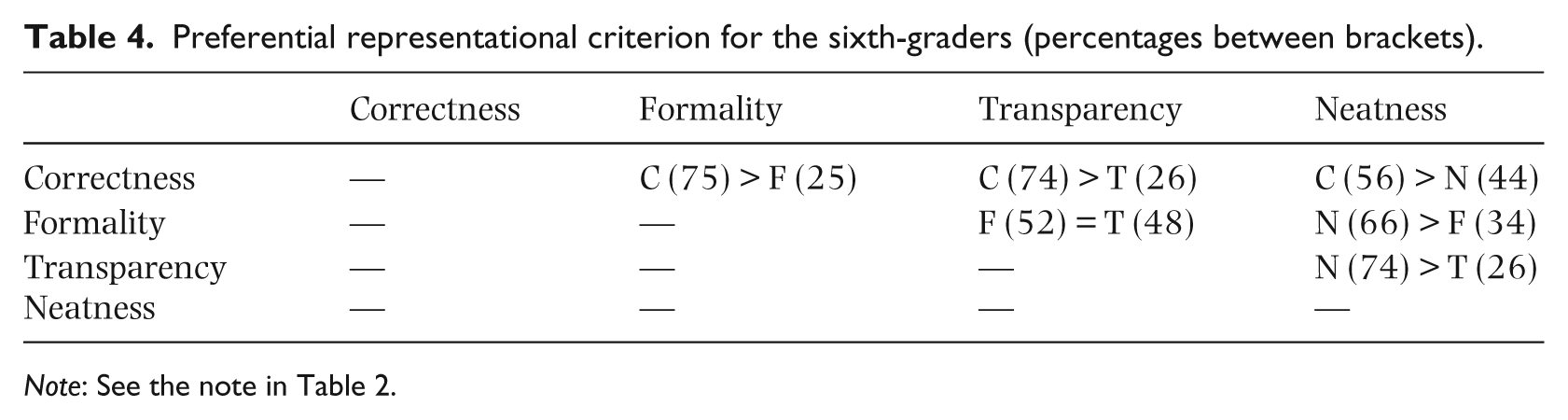
We now turn to the findings about the impact of the subject factors age and music education on (all) children’s preferential choices. The results for age are shown in Tables 3 and 4, with third-graders preferring only in 60% of the cases correctness to formality as against 75% for sixth-graders. There was a significant main effect of age, Wald χ2(1) = 10.617, p = 0.001, for this pairwise comparison.
Preferential representational criterion for the third-graders (percentages between brackets).

Note: See the note in Table 2.
Preferential representational criterion for the sixth-graders (percentages between brackets).
Note: See the note in Table 2.
Third-graders preferred correctness to transparency in only 54% of the cases, as against 74% for the sixth-graders, which was a significant difference, Wald χ2(1) = 18.845, p = 0.001. There also was a significant main effect of age, Wald χ2(1) = 10.648 p = 0.001, for the comparison between correctness and neatness. Third-graders preferred in 56% of the cases neatness to correctness whereas sixth-graders had a (reversed) preference for correctness over neatness in 56% of the cases.
There was no significant main effect of age for the contrast between formality and transparency, Wald χ2(1) = 0.177, p = 0.674. Neither age group showed a clear preference for one type of representation. We found a significant effect of age for the contrast between formality and neatness, Wald χ2(1) = 4.173, p = 0041: third-graders (45%) preferred the formal representations more often than the sixth-graders (34%). Finally, there was a significant main effect of age for the contrast between transparency and neatness, Wald χ2(1) = 6.929, p = 0008, revealing that third-graders (36%) preferred neat to transparent representations more often than sixth-graders (26%).
Some conclusions can be drawn from Tables 3 and 4. First, the general picture of the children’s ranking of the four representational criteria (as shown in Table 2) becomes more pronounced as they get older. For the third-graders there were two findings: (1) half of the pairwise comparisons yielded no significant differential preferences and the other half just reached significance (never exceeding 60% choices for one alternative); (2) neatness rather than correctness seemed to be the dominant criterion. The sixth-graders, on the contrary, clearly preferred correctness to the other criteria, even to neatness. They also clearly preferred neatness to the other two criteria, which did not significantly differ from each other in terms of preference.
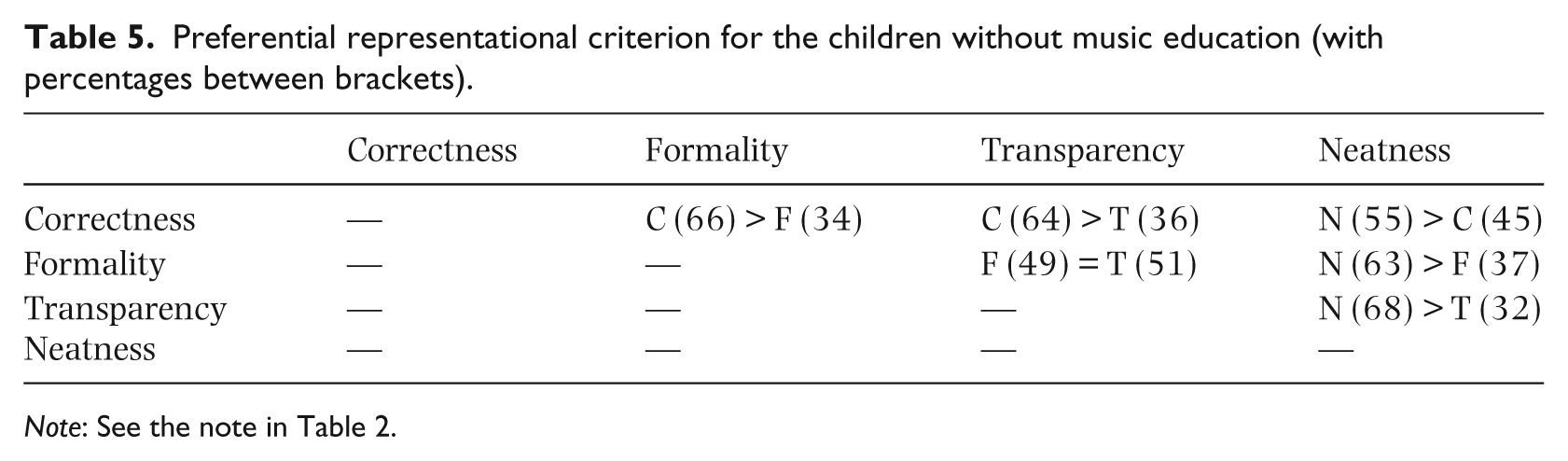
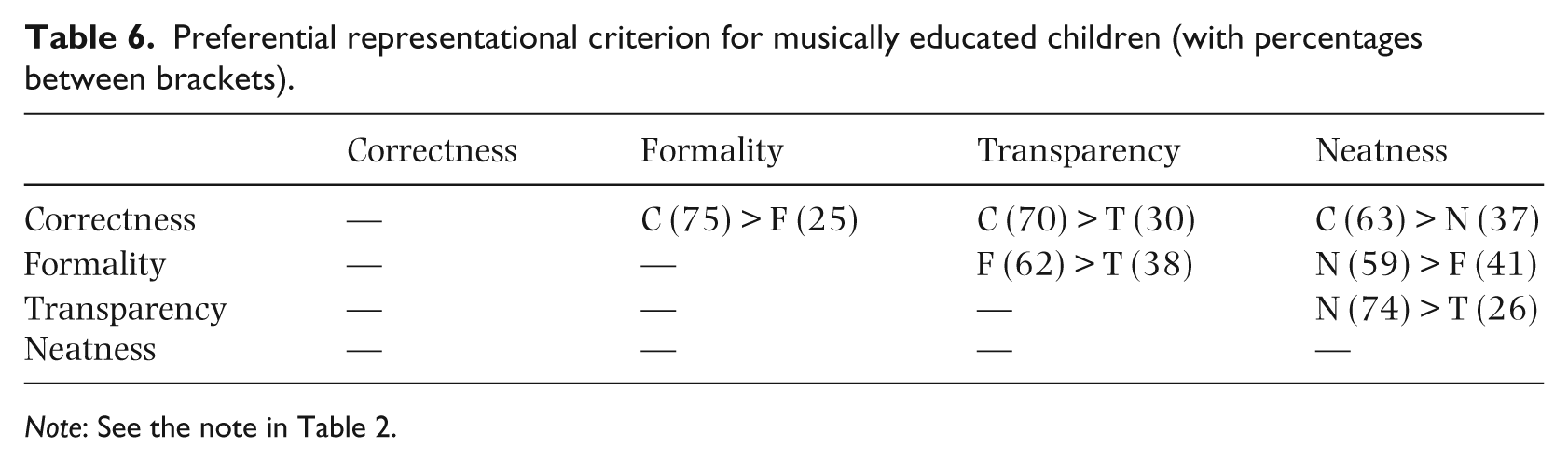
The results for the impact of children’s music education on the six pairwise comparisons are shown in Tables 5 and 6. Interaction effects between age and music education are also reported, but only in case of significance.
Preferential representational criterion for the children without music education (with percentages between brackets).
Note: See the note in Table 2.
Preferential representational criterion for musically educated children (with percentages between brackets).
Note: See the note in Table 2.
We found a significant main effect of music education, Wald χ2(1) = 4.483, p = 0.034, for the contrast between correctness and formality: children with music education favored correctness (75%) significantly more frequently than children without (66%). There was also a main effect of music education for the contrast between correctness and transparency, Wald χ2(1) = 4.107, p < 0.001: children with music education valued correctness higher (70%) than those without (64%). There was also an interaction effect between age and music education, Wald χ2(1) = 4.212, p = 0.040, showing that the aforementioned preference for the correct representations among the children with music education was only found among the sixth-graders. Furthermore, musically educated children preferred correctness to neatness more often (63%) than children without music education (45%), Wald χ2(1) = 11.783, p = 0.001. There was again an interaction effect between age and music education, Wald χ2(1) = 5.054, p = 0.025, which revealed that the group of musically educated sixth-graders was the only group that (significantly) preferred correctness to neatness.
Musically educated children also preferred formality to transparency significantly more often (62%) than children without music education (49%), Wald χ2(1) = 5.905, p = 0.015. There was no significant effect of music education for the contrast between formality and neatness, Wald χ2(1) = 0.328, p = 0.567. So musically educated children did not prefer formal representations more often (41%) than children without music education (37%). Finally, there was no significant effect of music education for the contrast between transparency and neatness, Wald χ2(1) = 2.927, p = 0.087, even though non-musically educated children tended to prefer the transparent representation somewhat more often (32%) than those without music education (26%).
In sum, as far as the effect of music education is concerned, a first remarkable finding is that children without music education put neatness before correctness whereas the musically educated ones put correctness on top of their ranking. Second, whereas the children with music education did show a preference for formality over transparency, the children without music education did not.
Conclusion and discussion
The aim of this study was to examine the impact of age and music education on the relative importance of children’s criteria for assessing the adequacy of graphical representations, using the notion of metarepresentational competence (MRC) – introduced by diSessa (2002) for the domain of science-related activities – as a theoretical framework. This study built on a previous study by Verschaffel et al. (2010b) in which they confronted children with pairs of representations of simple sonic fragments that were provided to them and that systematically differed with respect to one representational criterion. Although that study (2010a) already yielded a number of interesting findings about: (1) the manifestation of MRC in children’s representational choices; (2) the impact of age and music education on their use of various representational criteria as well as on their appreciation of particular representational features; and (3) the difficulties they met for articulating their MRC, it did not provide insight into the relative importance of the different representational criteria involved and the impact of age and music education on this relative importance. Therefore we set up a new study aimed at assessing how children of different ages and with different musical education backgrounds value different representational criteria. By putting them in a position in which they had to trade off criteria against one another, we hoped to make a significant contribution to our understanding of the meta-component (the ‘M’) of MRC, and to demonstrate the value and operational power of this theoretical notion for research on children’s (informal) representations of sound or music. As such we made an attempt to go beyond common theoretical groundings that are couched traditionally in general theories of cognitive development (see Hargreaves, 1996), perceptual learning (see Bharucha, 1991; Dowling & Tillmann, 2004), and symbol use, tool use, and modeling (Barrett, 2000), which have been until then the dominating theoretical perspectives. However, further reflection and research is absolutely needed to disentangle the complex interplay between MRC on the one hand, and cognitive, perceptual, and representational developmental factors on the other, in the domain of sound and music in particular, but also at a more general level.
The essential part of our assessment instrument consisted of 24 experimental items that asked children to choose between a representation that combined the positive operationalization of criterion A with the negative operationalization of criterion B (e.g., a correct but sloppy representation), and another representation with the opposite combination of representational features (e.g., an incorrect but neat representation). The test contained four items for each of the six pairwise contrasts between two representational criteria out of the four criteria involved in our study, namely correctness, formality, transparency, and neatness. As to the overall ranking of these criteria, we found that children considered the criteria of correctness and neatness to be more important than formality and transparency (see Table 2). Furthermore, with increasing age their pattern of preferences corresponded more clearly with the following ranking: (1) correctness; (2) neatness; (3) formality; (4) transparency. Finally, musically educated children also valued correctness higher than neatness whereas the opposite held true for children without music education. Formality also ended up higher in the hierarchy of musically educated children than those without musical education.
As a matter of fact, we only found partial confirmation for the general hypothesis (based on the previous work of diSessa [2002], and Verschaffel et al. [2010b]) that, with age and experience, children would put ‘epistemic’ criteria of correctness, transparency and formality higher, and ‘aesthetic’ criteria lower in their personal rankings, since this hypothesis was only completely confirmed for correctness, and partially for transparency and formality.
At a more general level our study provided some new insights about children’s choices for representing sonic fragments, the impact of age and music education on these choices, and the relative importance of the different representational criteria (as summarized in the preceding section). As such, it represents a first attempt to investigate in a systematic, quasi-experimental way the important but underrepresented metarepresentational issue of how people balance various representational criteria against each other when being engaged in a semiotic task. Moreover, this study also shows how theoretical insights about the development of metarepresentational competence developed in the domain of science education may be transferred cross-disciplinary to the field of music perception, and how they can further our understanding of the ways in which notations can be used for making sense of sound phenomena. For instance, the present study replicated to some extent diSessa’s earlier findings about the increasing importance of epistemic criteria and the decreasing importance of esthetic criteria in the domain of sound and music. Such communalities across disciplines are particularly interesting, both from a theoretical and educational perspective (see below).
Besides these findings, however, this study suffers from a number of drawbacks that need serious consideration in further research. First, the experimental and quantitative nature of our study does not yield a rich picture of the nature of the sense-making and evaluation processes underlying children’s selection for a given representation. A particularly intriguing aspect of this selection process is, for instance, the extent to which children are aware of their personal hierarchy of representational criteria and how able they are in articulating this metarepresentational aspect. Taking into account the findings by diSessa (2002) and Verschaffel et al. (2010b) about the largely implicit nature of metarepresentational competence (MRC), we expect well-articulated and systematic hierarchies to be very rare among children, with the majority of them being unable to identify the different representational criteria involved and to articulate the rationale behind their choices; furthermore, we anticipate that children will gradually become more able to do so with growing age and musical experience. It is recommendable, therefore, to set up follow-up studies with participants of different ages and different musical experiences being explicitly and systematically asked to explain why they prefer one representation to another, preferably in the context of an interview with individuals or small groups.
Second, in the present study the response categories that were available to the children were highly restricted (i.e., one out of two alternative representations) and each representational criterion that was involved was either positively or negatively operationalized in a dichotomous way with a positive and negative pole only. While an important advantage of this methodological approach was its strict and feasible experimental design, allowing a ranking of the four different criteria with high internal validity, its ecological validity is questionable in the sense that the material and the response mode were quite unlike what people normally encounter in their everyday sonic experiences. The latter, in fact, are not likely to involve such dichotomized choices but entail processes of balancing and trading off of criteria against each other that are much more subtle and complicated than in the present study.
Third, for methodological and practical reasons we decided to restrict the number of representational criteria to four and to specify each of these criteria in only one particular way. These four criteria are only a small subset of the more exhaustive set that was proposed by diSessa (2002) to describe the way in which people reflect on the quality of their own representations or those made by others, but we made this restriction in order to keep the number of experimental items manageable. The actual selection was based on the outcomes of our previous study (Verschaffel et al., 2010b). In order to obtain a better view on the genesis and actual development of children’s hierarchies of representational criteria in the domain of sonic experiences, however, we feel the need to extend the present study with other criteria from diSessa’s classification schema. With respect to the way in which these four criteria were made manifest in the respective representations, we also emphasize that, besides the representational elements that we decided to use, there are many other ways to operationalize and visualize each representational dimension (see Tan & Kelly, 2004, for an overview). The aesthetic criterion beauty, for example, was narrowed down to neatness in our study, but in doing so, other important aspects of beauty (such as the presence of attractive ornaments) that might have another effect on children’s valuations of the importance of representational aspects, were neglected. Likewise, we operationalized informality in one particular way, namely by means of vertical bars with their height corresponding with pitch. But, as the research literature on children’s informal representations has amply documented (see introduction section), there are many other kinds of informal notations (e.g., contour lines), some of which may be more or less appealing or apprehensible to children. The same holds true for transparency, the negative operationalization of which comprised one or more notes or bars being put in a different color. Again, our findings might have been different if we had used another (e.g., more or less striking) operationalization of this criterion.
Fourth, in the present study, we worked with sonic fragments, which – again, for experimental reasons – were very short and very similar to each other, and which also showed variation on one sonic parameter only, namely pitch. It would be interesting to also investigate children’s rankings of representational criteria when confronted with more extensive and more complicated sonic fragments, involving variation with respect to several sonic parameters. Working with such more extensive, more attractive and more varied fragments could be beneficial for children’s continued motivation for and involvement in the task. However, it would also hold the risk that children change their listening strategies to more global ways of processing, as was found in one of our earlier studies (Reybrouck et al., 2009). Anyhow, the fact that, compared to the participants in diSessa’s (2002) study, who commented on representations of authentic (scientific) phenomena, in the present study the phenomena to be represented were self-generated, manufactured and inauthentic sound fragments, may have shaped the results.
Fifth, contrary to diSessa’s (2002) work, our study did not engage children in the full problematic of representation – from design through critique. Whereas diSessa asked participants to generate their own representations of (scientific) phenomena and to comment on these, the children in our study did not generate any representations themselves, but responded to those presented by the researchers. As such, our findings may contribute to the literature on how children interpret and comment on given representations rather than on the role of MRC in children’s own representational design activities. Moreover, the context of the setting in which the children in our study had to make their choice between two given representations of a particular sonic fragment was (deliberately) kept rather neutral or vague, according to the instructions they had to select ‘the notation that shows best what they were hearing.’ It would be interesting, therefore, to also manipulate these contextual circumstances or instructions and to see how this could affect participants’ use and valuation of different representational criteria. In this respect, we point to diSessa’s (2002) comment that no criterion uncritically applies outside a functional context of design or use, suggesting that judgments about the preferential valuation of contrastive representations and the representational criterion that is the more important one, may be dependent on the context.
Given these drawbacks, the educational applications of the present study are still somewhat limited. Nevertheless, some tentative recommendations can be made. First, the fact that no intervention was built in our design entails an important general implication, namely that students even at elementary school level do not necessarily need systematic instruction to show some positive signs of MRC. Second, in the domain of music education, many theorists and practitioners argue for giving more attention to informal representations prior to imposing conventional notational systems on children (see Bamberger, 1991; Elkoshi, 2002; Reybrouck et al., 2009; Verschaffel et al., 2010a; Walker, 1990). According to these authors, the rigid conventions of standard notation may not be the best way to learn to graphically encode music, especially in the early stages of the music learning process. While we strongly support this view, the present study suggests that the feasibility of using informal representations will depend not only on children’s music development but also on the development of their MRC. Especially for young children, this may raise difficulties that need to be foreseen and addressed properly by curriculum developers and teachers who are willing to give a greater role for informal representations in children’s music education. Third, the available research on representations of sonic and music fragments suggests that, just as with mathematics and science, music may be a very promising domain for the elaboration of children’s MRC, which is becoming gradually recognized as an essential aspect of their intellectual development in general (diSessa, 2002). So, if MRC is a generic competence that should be supported across multiple domains, the music class may be one of the privileged places to accomplish this goal.
Footnotes
Funding
This study was funded by the grant GOA grant 2012/010 from the Research Fund KU Leuven, Belgium.