



Abstract
An affective cross-modal priming paradigm was used in three experiments to test the effects of mode, consonance, and register in picture-evaluation and word-evaluation tasks. In experiment 1, participants heard major mode/minor mode, high-register/low-register chords (three tones) as primes and then they had to categorize a ‘happy’ or ‘sad’ word as a target. Participants evaluated target words faster if the words were preceded by a similarly valenced chord as opposed to affectively incongruent chord-word pairs. In experiments 2 and 3, target words were replaced by target affective pictures. In experiment 2, the primes were consonant/dissonant, high register/low-register chords. Register influenced picture evaluation whereas consonance was not effective for the affective priming. In experiment 3, the primes were major mode/minor mode, high-register/low-register chords. Register induced a faster recognition of targets while mode was not effective. Register is suggested to be a more powerful structural aspect of music than mode or consonance in influencing ongoing cognitive activities.
Mode, register and expression of emotions in music
The easiest emotions to communicate through music tend to be happiness and sadness (Gabrielsson & Juslin, 1996). One way to convey these emotions is through variations of mode, related to the subset of pitches selected in a given musical segment. Numerous studies have induced happy and sad mood by presenting listeners with music in major and minor mode (Hevner, 1935; Kenealy, 1988; Parrott, 1991; Peretz, Gagnon, & Bouchard, 1998; Thompson, Schellenberg, & Husain, 2001; Wedin, 1972). Mode best differentiates between positive and negative valence (Gomez & Danuser, 2007).
Gregory, Worrall, and Sarge (1996), required children to match schematic happy and sad faces to tunes which were either in the major and minor mode, and found that children aged 7–8 showed a significant association between mode and valence, whereas 3-4 year old children did not show any such significant association between musical mode and emotional response. Similar studies were conducted by Gerardi and Gerken (1995) and Kastner and Crowder (1990). Hill, Kamenetsky, and Trehub (1996) showed that adults as well as children judged the Ionian mode (identical to the major mode) more suitable for expression of ‘salvation/reward’ and the Phrygian mode more suitable for expression of ‘condemnation/punishment.’ Gagnon and Isabelle (2003) have investigated the interaction between mode and tempo showing that tempo is more effective than mode in conveying emotions in melodies.
Another structural factor in music that has been associated with positive and negative valence is register or pitch level. Rigg (1940) showed that shifts an octave upward cause a musical phrase to be perceived as happier, whereas shifts an octave downward cause a musical phrase to be perceived as more sorrowful. High pitch tend to be associated with expressions such as happy, graceful, serene, dreamy, and exciting and, furthermore, with expressions like surprise, potency, anger, fear and activity. Low pitch may suggest sadness, dignity/solemnity or vigor (Gabrielsson & Lindstrom, 2001). Collier and Hubbard (2001) found that ascending scales were rated as happier than were descending scales, and that musical keys that started on a higher pitch were rated as happier than were keys that started on a lower pitch. Similarly, higher pitch tones were rated as happier, brighter, faster and as speeding up more than lower pitch tones.
Costa, Bonfiglioli, and Ricci Bitti (2000) showed that the differences in emotional evaluation induced by register manipulation also arise in the evaluation of simple bichords. High-register bichords are evaluated more positively and as expressing more instability or restlessness compared to low-register bichords. The influence of register on the emotional evaluation of intervals was lower when the interval had a clear harmonic connotation, as in the case of perfect consonances (octaves, fifths), and dissonances (seconds, sevenths, augmented fourths), but not in the case of imperfect consonances (thirds, sixths). In this study, mode and pitch level were used in order to test their influence on a cognitive evaluation task (classifing words or pictures for their semantic content) using the affective priming paradigm.
The affective priming paradigm
The affective priming paradigm originates from the classic priming research concerned with spreading activation processes (Fazio, 2001). A word (prime) precedes the presentation of another word for a short interval (stimulus onset asynchrony [SOA]). The second word (target) has to be evaluated according to a particular dimension (for instance, whether it is a word or a non-word) by pressing a key as fast as possible. Word has to be considered in a broad sense since words, pseudowords, and non-word letter strings could be used. If the prime and the target word are semantically associated, the evaluation of the target word is faster than when the prime and the target are incongruent. Concepts associated with the prime are automatically activated from memory on its presentation and, hence, facilitate the response to semantically related target words (Schneider & Shiffrin, 1977).
Fazio, Sanbonmatsu, Powell, and Kardes (1986) extended this methodology to attitudes. Instead of being associated by a semantic relationship, primes and targets with congruent or incongruent affective values were chosen. Target words were to be evaluated as quickly as possible following a ‘good’ or ‘bad’ dichotomy. For example, presentation of ‘funeral’ as a prime appears to automatically activate a negative evaluation that will automatically facilitate the evaluation of a target adjective which is also negative (e.g., ‘sad’), and that will hinder the evaluation of a positive adjective (e.g., ‘joy’). A reverse pattern of facilitation is observed for primes associated with a positive evaluation. Thus a significant interaction between the valence of the prime and the valence of the target is the hallmark of the automatic activation effect.
The priming procedure employed by Fazio et al. (1986) does not require participants to consciously evaluate the primes. Participants are instructed to attend to the second word, to which they are required to reply. They are not asked to consider their emotional attitudes toward the primes during the priming task. Moreover, positively and negatively valued primes are equally likely to be followed by the presentation of a positive or negative target.
The affective priming effect reaches a peak for a SOA of 300 milliseconds (ms) but disappears progressively for longer SOA and is absent for a SOA of 1000ms (Tekman & Bharucha, 1992). This effect has also been found when the prime is presented subliminally (e.g., Greenwald, Draine, & Abrams, 1996; Wittenbrink, Judd, & Park, 1997), further attesting to its characterization as an automatic process. Black-and-white line drawings and high-resolution color images of objects have been demonstrated effective in functioning as primes (e.g., Fazio, Jackson, Dunton, & Williams, 1995; Giner-Sorolla, Garcia, & Bargh, 1999). The effect has even been observed across stimulus modalities. In Hermans, Baeyens, and Eelen (1998), positive or negative odours that had been idiosyncratically selected for each participant served as primes. The odours facilitated responses to visually presented target words that were affectively congruent.
The affective priming effect has been observed using a variety of target stimuli. Much research has employed evaluative adjectives (e.g., Fazio et al., 1986, 1995) in combination with primes that were selected within attitude objects (including the names of some individuals, animals, foods, social groups, nations, activities, and physical objects). Other studies, including Sollberger et al. (2003), have employed nouns as targets (e.g., Greenwald et al., 1996; Greenwald, Klinger, & Liu, 1989; Hermans et al., 1998). Hermans, Houwer, and Eelen (1994) employed pleasant and unpleasant color photographs as target stimuli.
Errors in evaluating the target are also influenced by the prime affective value. Fewer errors are committed during evaluatively congruent trials (Greenwald et al., 1996). In some studies participants are instructed to recite the prime aloud as a ‘memory word’ at the end of each trial (e.g., Fazio et al., 1986) or study the photos presented as primes so as to be able to perform a subsequent detection task (e.g., Fazio et al., 1995). Other experiments provide no specific task to perform regarding the primes, as in this study and that of Sollberger et al. (2003).
Affective priming with musical stimuli
Sollberger et al. (2003) applied the affective priming paradigm to test the hypothesis that short exposure to consonant and dissonant chords resulted in an automatic activation of positive or negative affect which influences the evaluation of positive or negative affected words. Target words were evaluated faster if the words were preceded by a similarly valenced chord (e.g., consonant – ‘holiday’), as opposed to when the chord-word pairs were affectively incongruent (e.g., dissonant – ‘humor’). The results from Sollberger et al. (2003) suggest that the affective tone of single musical elements is automatically extracted and can influence ongoing cognitive activities that are extraneous to the musical domain. Taking the results obtained by Sollberger et al. (2003) as a starting point, it is interesting to test the role of the different musical structural factors (Gabrielsson & Lindstrom, 2001) in determining emotional responses to music by measuring the extent to which they elicit an affective priming. In this experiment a similar procedure used by Sollberger et al. (2003) was adopted in order to verify whether mode (major versus minor) and register (high versus low) could also be effective in determining a significant influence in a word evaluation task.
Participants in these experiments had to evaluate positive and negative, or happy and sad, words or pictures as quickly and correctly as possible. In experiment 1, before each target, either a major or minor chord was presented to the participants. Pairing primes with targets resulted in congruent prime-target pairs (major prime [happy target] or minor prime [sad target]), and incongruent prime-target pairs (minor prime [happy target] or major prime [sad target]).
In experiments 2 and 3, the targets were emotional images from the International Affective Picture System (Lang, Bradley, & Cuthbert, 1997). Pictures, rather than words, were chosen as targets in order to test if stimuli with a greater arousal induction would hinder the affective priming induced by musical chords. Bayer, Sommer and Schacht (2011), using pupillary responses as a measure of arousal, have shown that, contrary to emotional pictures, high-arousing words elicited smaller pupillary responses than low-arousing words. This result is explained in terms of facilitation of word recognition in the case of words, rather than emotional sympathetic activation. Emotional words do not seem to impact the sympathetic autonomous nervous system as do pictures and sounds, for which enhanced autonomic activation, resulting in larger pupillary responses for highly arousing stimuli, has been demonstrated (Bradley, Miccoli, Escrig, & Lang, 2008).
Similar results have been obtained with electrodermal activity, which has been reported to be a sensitive indicator of the arousal level elicited by a picture (e.g., Amrhein, Mühlberger, Pauli, & Wiedemann, 2004). By contrast, evidence for skin conductance resistance to words seems to be limited to specific stimulus contents like taboo words (Buchanan, Etzel, Adolphs, & Tranel, 2006), to the extremes of negative valence and high arousal (Silvert, Delplanque, Bouwalerh, Verpoort, & Sequeira, 2004) or to specific participant groups like phobic patients (Bonnet & Naveteur, 2006).
Since images have a higher emotional arousal impact than words (Bayer et al., 2011), it was suggested that they would act as an interrupt process that hinders the priming effect of chords. This would mean that, in order to have an affective priming effect, the target should have a similar emotional arousal to the primes. In experiment 2 I tested the effect of consonant/dissonant chords, as used by Sollberger et al. (2003), on the evaluation of emotional images, whereas in experiment 3 the primes were major and minor chords, as in experiment 1, in order to test if mode was effective in inducing an affective priming effect using affective pictures as targets.
It was predicted that response times would be shorter for congruent prime target pairs than for incongruent prime target pairs because the auditory primes are automatically evaluated concerning their positive or negative affective connotation and a spread of activation to the mental representations of the target stimuli (e.g., Davidson, 1993; Duckworth, Bargh, Garcia, & Chaiken, 2002; Ito & Cacioppo, 2000; Zajonc, 1980).
Experiment 1
Method
Participants
Seventy psychology students at the University of Bologna participated in the study. The sample was composed of 65 females (mean age: 24.2; SD: 3.95) and five males (mean age: 24.2; SD: 2.16). Participants were enrolled in partial fulfillment of undergraduate course requirements. All participants were musically naïve, without any extracurricular formal training; none of them played a musical instrument.
Materials
The primes were two major and two minor chords synthesized with equal tempered tuning in which one semitone corresponded to a frequency factor of 21/12 (see, e.g., Burns, 1999; Pierce, 1992). The major chord in low register consisted of the root (the tone C, 130.81 Hz), a major third (E, four half-steps above, frequency = root × 24/12 Hz = 164.82 Hz) and the fifth (G, seven half-steps above, frequency = root × 27/12 = 195.99 Hz). The minor chord in low register was made up of the root (C, 130.81 Hz), the minor third (Eb, three half-steps above, frequency = root × 23/12 = 155.56 Hz), and the perfect fifth (G, seven half-steps above, frequency = root × 27/12 = 195.99 Hz). High-register consonant and dissonant chords were two octaves higher than the lower chords. The root tone of the high register was C5 (523.25 Hz). Chords had a duration of 800ms. The composition of the chords and all frequency ratios were exactly the same as in the lower register chords. The primes were recorded by means of Syntrillium CoolEdit software using a Roland ST-880 expander set to a Grand Piano sound module and connected to a Yamaha keyboard. Each chord was presented through Monacor MD-802 headphones for 800ms with an intensity of 65 dB SPL (measured with a Monacor SM-4 Sound Level Meter).
A set of 80 nouns were used as targets. They were selected from a preliminary word evaluation study in which 19 participants who did not participate in the affective priming studies had to rate the valence of 160 nouns on a scale ranging from 1 (very sad) to 5 (very happy). Based on their mean valence rating, the 40 most sad and the 40 most happy words were selected for the target-evaluation task (see Appendix 1). Mean length, in letters, was 6.75 for ‘happy’ words and 6.95 for ‘sad’ words, F(1, 78) = 0.31, p < 0.58. Target words were displayed centered on the screen with capital letters. Each letter had a height of 7 mm. They were displayed in black on a white background.
The experiment, including instructions, was programmed and run on E-Prime software (Psychology Software Tools Inc., Pittsburgh, PA) on a PC computer.
Procedure
Participants were tested individually. They were seated in front of the computer screen at a distance of about 50cm. Participants were told that words related to happiness and sadness would appear on the computer screen. They were instructed to evaluate these words as quickly and as correctly as possible by pressing one of two marked keys on the computer keyboard. For half of the participants the ‘happy’ key was the ‘f’ key covered with red tape, and the ‘sad’ key was the ‘j’ key covered with black tape, whereas for the remaining half the keys were inverted; that is, the ‘j’ key was for ‘happy’ words and the ‘f’ key was for ‘sad’ words. For all participants the ‘f’ key was pressed with the left forefinger and the ‘j’ with the right forefinger, and care was observed during the experiment that the participant did not change the finger that pressed each of the two marked keys. Participants were told that, shortly before the presentation of each word, an ‘acoustic signal’ from the headphones (the prime) would indicate the onset of the target. The intertrial intervals (i.e., the duration between a participant’s response and the onset of the prime in the next trial), were set at 2, 3, 4, or 5 seconds and randomly selected during trials, preventing participants from guessing when exactly the next target word would appear. During the intertrial interval, a fixation point appeared at the center of the screen. Target words were presented in upper case letters at the center of the screen 200ms after the onset of the prime (chord). Since prime chords were presented for 800ms, there was an overlap in time between prime and target. If a participant evaluated a target before prime-presentation was finished (i.e., within 600ms), the chord automatically stopped sounding. In order to increase motivation and reduce the number of errors, feedback was given immediately after the response. The feedback reported accuracy (correct wrong), response time in ms, and the cumulative percentage of correct trials. In the case of no answer within 3 seconds after target onset, feedback was given that alerted the participant about the missing response. Missing response trials were not repeated.
The experiment started with four practice trials that were not included in data analysis. Then, each of the 40 happy and sad words was presented once, preceded by a major or minor prime chord. Chord register was balanced across prime and target valence. Presentation order of the 80 trials was randomized.
For each word list the primes were subdivided in four groups: 10 major low-register chords, 10 major high-register chords, 10 minor low-register chords and 10 major low-register chords.
Data reduction and analysis
As in other affective priming studies (e.g., Hermans et al., 1994), response latencies higher than 1500ms and lower than 300ms (0.16%) were excluded from analyses to minimize the effects of outlier responses. In addition, wrong answers (8.3%) were not included, in order to exclude a speed-accuracy trade-off.
Latencies in ms were analyzed using a three-way analysis of variance (ANOVA). Factors were target (two levels: happy words and sad words), prime – mode (two levels: major chords and minor chords) and prime – register (two levels: high-register chords and low-register chords).
A preliminary ANOVA which tested the effect of response key assignment (‘f’ and ‘j’ for ‘happy’ and ‘sad’ and vice versa) revealed no significant main effect and no significant interaction with the other factors. For this reason the results were collapsed over response key assignment. The HSD Tukey test was used for post-hoc comparison, when appropriate.
Results
Response latencies
Target main effect
Sad words were classified with longer response times (M = 634.45) in comparison to happy words (M = 622.42), F(1, 69) = 8.28, p < 0.005, Cohen’s d = 0.08.
Target and prime (major vs. minor mode) interaction
Mean latencies for the interaction target × prime (major vs. minor mode) are shown in Table 1. The interaction was significant, F(1, 69) = 10.94, p < 0.0015. If a ‘happy’ word was preceded by a major chord (congruent condition) the response times were on average significantly lower than when the ‘happy’ word was preceded by a minor chord (incongruent condition), F(1, 69) = 16.95, p < 0.0001 Cohen’s d = −0.139. The type of prime, on the contrary, did not significantly influence the response times to ‘sad’ words (p < 0.16).
Mean evaluative response latencies (ms), followed by the standard deviation, and absolute error numbers (under) for target words (happy/sad) as a function of primes (major/minor mode, high/low-register chords) in experiment 1.

Target and prime (high vs. low-register) interaction
Mean response times for the target and prime – register interactions are shown in Table 1. The interaction was highly significant, F(1, 69) = 30.55, p < 0.000001. If a ‘happy’ word was preceded by a high-register chord (congruent condition) the correct evaluation required significantly less time than when preceded by a low-register chord (incongruent condition), F(1, 69) = 29.35, p < 0.000001, Cohen’s d = −0.249. The same effect, but in reverse order, was recorded in the case of a ‘sad’ word as target. If preceded by a low-register chord (congruent condition) response times were significantly faster than when the target was preceded by a high-register chord, F(1, 69) = 9.30, p < 0.003, Cohen’s d = 0.097. There was no significant interaction between target, prime mode (major vs. minor), and prime register (high vs. low).
Errors
Major/minor chords as primes
Three hundred and thirty-seven errors were recorded considering all participants (8.3% of all trials). This absolute amount of errors was subdivided into 197 (58%) errors in incongruent trials and 140 (42%) errors in congruent trials. Average values were 2.85 in incongruent trials and 2.02 in congruent trials. An ANOVA was performed setting congruence as a within-subject factor. The analysis was significant, F(1, 68) = 14.43, p < 0.0003. Errors were significantly more frequent in incongruent trials.
Errors were further analyzed in a 2 (prime mode) × 2 (target) ANOVA. This analysis yielded a significant two-way interaction between prime mode and target, F(1, 68) = 14.43, p < 0.0003. Errors were significantly lower on trials with ‘happy’ word as target if the preceding chord was in major mode (M = 1.01) rather than in minor mode (M = 1.64), F(1, 68) = 14.67, p < 0.0002. In contrast, errors were not significantly lower on trials with ‘sad’ word as target if the preceding chord was in minor mode (M = 1.01) rather than in major mode (M = 1.22).
High-register/low register chords as primes
Mean number of errors was 1.77 in incongruent trials and 1.21 in congruent trials. An ANOVA tested the difference between mean errors in congruent and incongruent trials and resulted as being significant, F(1, 68) = 14.43, p < 0.0003.
A 2 (prime register) × 2 (target) ANOVA showed a significant interaction between prime register and target, F(1, 68) = 5.91, p < 0.01. Post-hoc tests indicated that the significance was explained by the influence of prime register on the categorization of ‘sad’ targets. A ‘sad’ word as target was categorized with more accuracy if preceded by a low-register prime (M = 0.90), than if preceded by a high-register prime (M = 1.84), F(1, 68) = 11.19, p < 0.01.
Discussion: Experiment 1
Experiment 1 yielded an affective priming effect, as expressed by the significant prime × target interaction. Target words were evaluated faster when preceded by an affectively congruent, rather than incongruent, prime chord. The prime × target interaction for error rates bolstered the affective priming effect obtained from response time measures.
Sollberger et al. (2003) was the first to demonstrate that consonant/dissonant chords were effective in inducing an affective priming effect in the evaluation of the affective content of words. This experiment shows that mode and register are musical properties that are also effective in inducing the affective priming effect. Register induced a stronger prime effect than mode, which suggests that it is a more powerful and effective structural factor for inducing emotional connotations of happiness and sadness in music. These results show that elementary musical elements such as chords can have a significant influence on mental processes that are out of the musical domain. The common denominator of the two mental processes is the sharing of the affective content of the stimuli.
It would be interesting to examine to what extent the affective priming induced by musical stimuli persists if the arousal induction of the targets are increased. It can be suggested that simple musical stimuli such as single chords can influence ongoing mental processes only if they require low levels of cognitive-affective resources. To test this hypothesis, two experiments were conducted in which the target stimuli were not words but affective pictures. In experiment 2 the primes were consonant/dissonant chords, as in Sollberger et al. (2003), while in experiment 3 the primes were major/minor chords as in experiment 1.
Experiment 2
Method
Participants
Forty-one psychology students at the University of Bologna participated in the study. The sample was composed of 34 females (mean age: 23; SD: 4.21) and seven males (mean age: 24.8; SD: 3.89). The students participated in partial fulfillment of undergraduate course requirements. All participants were musically naïve, without any extracurricular formal training. None of them played a musical instrument.
Materials
The consonant and dissonant chords were the same as those used by Sollberger et al. (2003). The consonant chord in low register consisted of the root (the tone D, 146.83 Hz), a perfect fifth (A, seven half-steps above, frequency = root × 27/12 = 220 Hz) and the octave (D1, 12 half-steps above, frequency = root × 212/12 = 293.66 Hz). The dissonant chord in low register was made up of the root (D, 146.83 Hz), the augmented fourth/tritone (G sharp, six half-steps above, frequency = root × 26/12 = 297.65), and the octave (D1, 12 half-steps above, frequency = root × 212/12 = 293.66 Hz). The tritone was chosen as a dissonant interval instead of the minor/major second or major/minor seventh since it was only a semitone apart from the consonant tone (fifth), whereas in case of a second or seventh the greater difference in pitch between the middle component of the chord would have influenced the chord recognition. The choice of the augmented fourth was also in line with the choice of Sollberger et al. (2003). High-register consonant and dissonant chords were two octaves higher than the low-register chords. The root tone was D2 (587.33 Hz). The composition of the chords and all frequency ratios were exactly the same as in the lower register chords.
Pictures were selected from the International Affective Picture System (Lang et al., 1997). Each image in this database is completed with a mean rating of valence, arousal, and dominance. Valence refers to the pleasantness/unpleasantness axis, arousal measures the intensity and excitement of an emotion, and dominance refers to the approach/avoidance tendency. Images were sorted by valence and then 40 pleasant and 40 unpleasant pictures were selected from the extremes matching arousal (see Appendix 2). An ANOVA confirmed that arousal mean values in the two groups did not differ, F(1, 39) = 0.03, p < 0.86. Pleasant images depicted children, newborn babies, puppies, kittens, landscapes, playing animals, ice creams, cakes, and sporting activities, whereas unpleasant images depicted litter, car crashes, wounds, tumors, war actions, and weapons.
Procedure
The same procedure as that in experiment 1 was used, except for the target stimuli: pictures were used instead of words. The timing of each trial was the same as in experiment 1.
Data reduction and analysis
Response latencies higher than 1500ms (0.6%) were excluded from analyses. Wrong answers (8.05%) were not included in order to exclude a speed-accuracy trade-off. Data were analyzed with the same statistical design as in experiment 1.
Results
Response latencies
Target main effect
As in experiment 1, response times for unpleasant targets were significantly slower (M = 654.77) than those for pleasant targets (M = 624.13), F(1, 40) = 14.04, p < 0.0006, Cohen’s d = −0.193.
Target and prime (consonance/dissonance) interaction
The interaction target × prime (consonance/dissonance) was not significant (p < 0.52). Consonant and dissonant chords had no effect on the speed of evaluation of pleasant and unpleasant pictures.
Target and prime (high/low-register) interaction
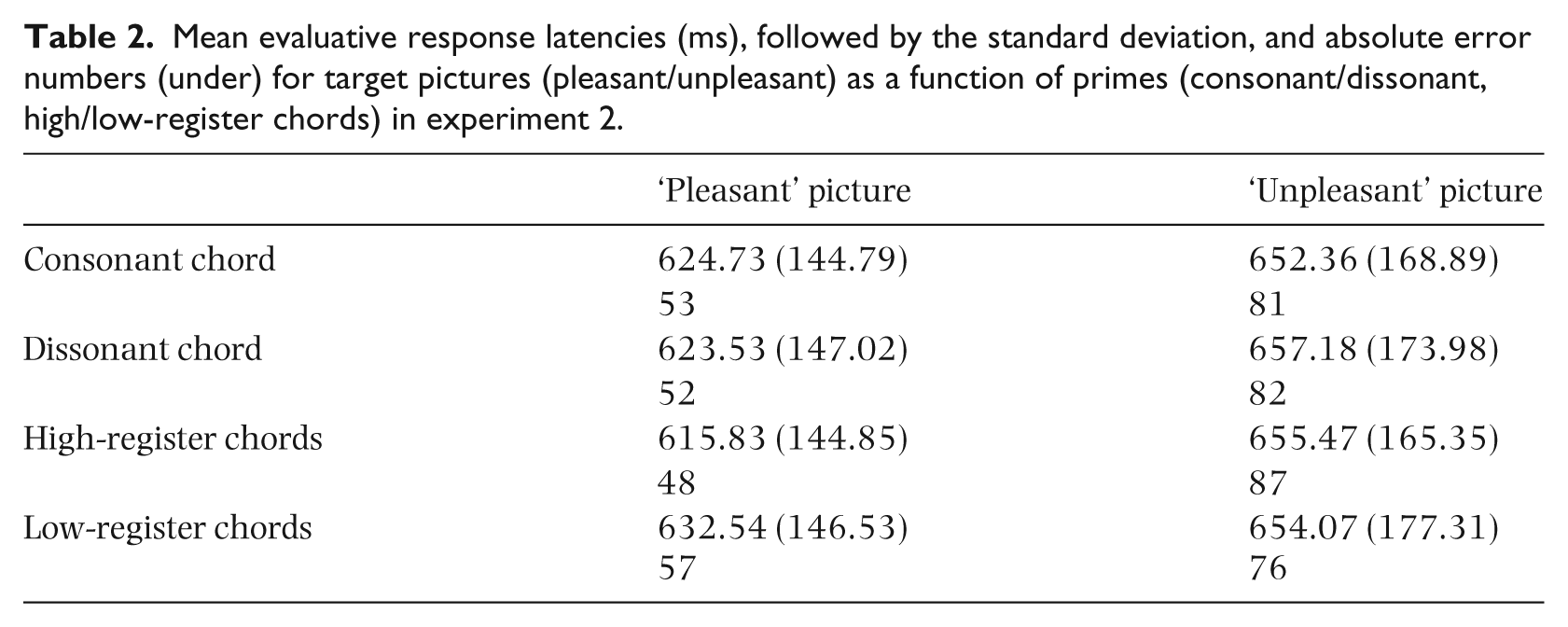
Mean response times for the target × prime (high/low-register) interaction are shown in Table 2. The interaction was significant, F(1, 40) = 4.16, p < 0.04. If a pleasant picture was preceded by a high-register chord (congruent condition) the correct evaluation required significantly lower time than when the picture was preceded by a low-register chord (incongruent condition), F(1, 40) = 4.28, p < 0.04, Cohen’s d = −0.115. Register did not significantly influence the responses to unpleasant pictures (p < 0.79).
Mean evaluative response latencies (ms), followed by the standard deviation, and absolute error numbers (under) for target pictures (pleasant/unpleasant) as a function of primes (consonant/dissonant, high/low-register chords) in experiment 2.
Errors
There were 268 errors (8.05%) considering all participants. In relation to primes composed of consonant/dissonant chords, errors were 144 in incongruent trials and 124 in congruent trials. With regard to primes composed of high/low-register chords, there were 124 errors in congruent trials, and 144 in incongruent trials (see Table 2).
An ANOVA tested the interaction (2 × 2) between prime type (consonant/dissonant) and target type (pleasant/unpleasant word). The interaction was not significant. A main effect emerged for target, being mean error rate higher for unpleasant words (M = 2.01) in comparison to pleasant word (M = 1.28), F(1, 40) = 15, p < 0.004.
A similar ANOVA was used to test the interaction considering high-register and low-register primes (prime type), and pleasant and unpleasant words (target type). The interaction was not significant.
Discussion: Experiment 2
A target that involves a higher level of arousal, such as a picture instead of a word, hinders affective priming when consonant and dissonant chords are employed as primes. On the contrary, the priming effect is maintained if the prime chords differ in register. This result suggests that register is more powerful than consonance/dissonance in inducing emotional arousal in music. In order to obtain a better generalization of the results, future studies should test whether a priming effect can be found using other dissonant intervals, such as the major and minor second or major and minor seventh instead of the augmented fourth used in this study.
In experiment 3 prime stimuli were varied for mode (major/minor) keeping target stimuli as in experiment 2.
Experiment 3
Method
Participants
Forty-one psychology students at the University of Bologna participated in the study. The sample was composed of 34 females (mean age: 25; SD: 6.19) and seven males (mean age: 21; SD: 2.75). The students participated in partial fulfillment of undergraduate course requirements. All participants were musically naïve, without any extracurricular formal training; none of them played a musical instrument.
Materials
The major and minor chords were the same as those used in experiment 1. The target pictures were the same as those used in experiment 2.
Procedure
The procedure was the same as that described for experiment 2 except for prime stimuli: major and minor chords were used in the place of consonant and dissonant chords.
Data reduction and analysis
Response latencies higher than 1500ms (0.36%) were excluded from analyses. Wrong answers (8.29%) were not included in order to exclude a speed-accuracy trade-off. Data were analyzed with the same statistical design as that in experiment 1 and 2.
Results
Response latencies
Target main effect
As in experiments 1 and 2, the response times for ‘sad’ targets were significantly slower (M = 630.33) than those for happy targets (M = 615.15), F(1, 40) = 6.34, p < 0.001, Cohen’s d = −0.096.
Target and prime (major/minor mode) interaction
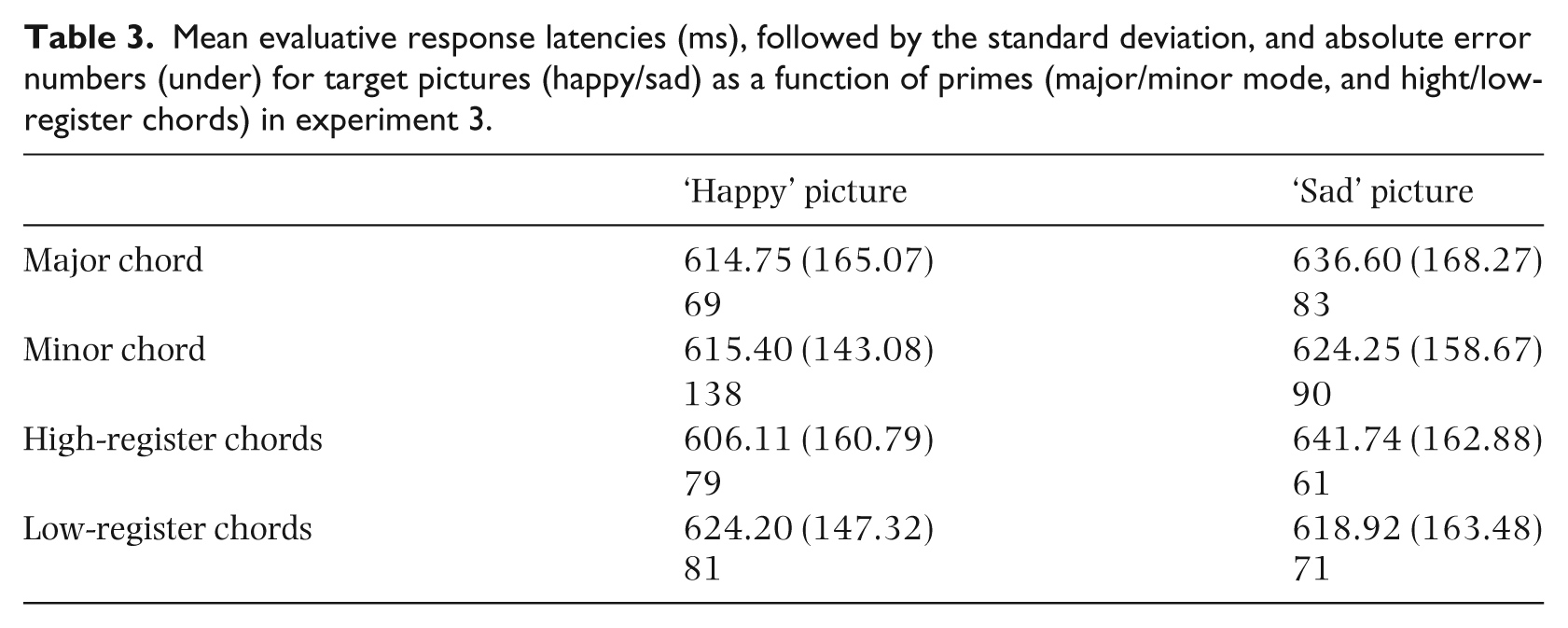
The interaction target × prime (major/minor mode) was not significant (p < 0.19; Table 3). Major and minor chords had no effect on the evaluation speed of ‘happy’ and ‘sad’ pictures. A ‘happy’ picture was not categorized faster if preceded by a major chord instead of a minor chord (Cohen’s d = 0.01 vs. d = −0.139 for the same comparison in experiment 1).
Mean evaluative response latencies (ms), followed by the standard deviation, and absolute error numbers (under) for target pictures (happy/sad) as a function of primes (major/minor mode, and hight/low-register chords) in experiment 3.
Target and prime (high/low-register) interaction
Mean response times for the target and prime (high/low-register) interaction are shown in Table 3. The interaction was significant, F(1, 40) = 6.81, p < 0.01. If a ‘happy’ picture was preceded by a high-register chord (congruent condition) the correct evaluation required a significantly shorter time than when the same picture was preceded by a low-register chord (incongruent condition), F(1, 40) = 4.25, p < 0.04, Cohen’s d = −0.117. The same effect, reversed, was recorded when the target was a ‘sad’ picture. If this ‘sad’ target was preceded by a low-register chord (congruent condition), response times were significantly faster than when it was preceded by a high-register chord, F(1, 40) = 5.75, p < 0.02, Cohen’s d = 0.140.
Errors
A total number of 292 errors were recorded considering all participants. In relation to mode as prime, 130 errors occurred in congruent trials and 162 occurred in incongruent trials. With regard to register as prime, 138 errors occurred in congruent trials and 154 in incongruent trials.
Considering mode as prime a 2 (prime mode) × 2 (target) ANOVA was performed on errors, and the interaction resulted as being significant, F(1, 39) = 5.36, p < 0.02. Post-hoc analyses evidenced that the errors were significantly more frequent when a ‘sad’ word was preceded by a major chord (M = 1.98) than when it was preceded by a minor chord (M = 1.52), F(1, 39) = 3.94, p < 0.05. A specular ANOVA was computed considering register as prime. In this case both main effects and the interaction were not significant.
Discussion: Experiment 3
The use of affective images as targets, due to their higher arousal induction in comparison to words (experiment 1) has inhibited the emergence of affective priming using major and minor chords as primes. The effect of mode in influencing ongoing cognitive activities seems therefore quite small. Register, on the contrary, maintained its effectiveness in inducing a significant affective priming, even when using affective pictures as targets. This shows its high influence in the emotional connotation of music. Register can actively ‘interfere with’ or facilitate other mental tasks even when they demand higher resources than the processing of affective words.
General discussion
The results from these studies in conjunction with those obtained by Sollberger et al. (2003) demonstrate that consonance, mode, and register of basic musical elements such as triads can automatically influence non-musical cognitive tasks such as word and picture evaluation. Target words or pictures were evaluated faster and more correctly if an affectively congruent chord was presented as a prime. The results are in line with the main findings of affective priming research (see, for a review, Fazio, 2001), which has repeatedly demonstrated that the affective valence of the prime influences the speed of responses to affectively congruent or incongruent target stimuli. The generality of the affective priming literature has used visual stimuli as primes and targets, with the exception of Duckworth et al. (2002), Hermans et al. (1998), and Sollberger et al. (2003). The results confirm that affective priming can also be elicited in a cross-modal stimulation. Once the affective properties of a stimulus are extracted, they influence ongoing cognitive activities, even those pertaining to different modalities.
These results are also important in clarifying some aspects of the Mozart effect, in which listening to music leads to improvements in the performance of cognitive tasks. Husain, Thompson, and Schellenberg (2002) examined effects of tempo and mode on spatial ability, arousal and mood while listening to a Mozart sonata. Performance on the spatial task was superior after listening to the sonata in the major mode version in comparison to the minor mode version. Mode also affected listeners’ mood. Participants who heard the piece in major mode had above-average improvements in mood after listening to the sonata; those who heard the minor version had below-average improvements. In this study I found that only major chords had a significant influence on the evaluation of affective laden words. Furthermore, a comparative evaluation of the employment of major and minor keys in Mozart’s compositions showed a proportion of 7:1 in favor of major keys (Corder, 1919). For all these reasons it can be suggested that the major mode has a more direct and significant influence on ongoing mental processes.
In these experiments, participants classified pleasant or happy stimuli (affective words or pictures) faster than unpleasant or sad stimuli. This effect can be ascribed to the Pollyanna principle according to which people typically process pleasant items more accurately and efficiently than unpleasant or neutral items (Matlin, 2004). People tend to recognize pleasant or neutral stimuli more quickly than unpleasant or threatening stimuli (Matlin, 1978). Stenberg, Wiking, and Dahl (1998), in a word evaluation task, also found that, overall, negative words required longer latencies to be classified than positive ones. Another consequence of the Pollyanna principle in the perceptual domain is that pleasant stimuli are judged larger in size than unpleasant or neutral stimuli (Matlin, 1978).
By keeping the prime stimuli constant and varying the degree of cognitive and emotional resource allotted to the target, it is possible to establish the strength of the primes in influencing a different mental process. Mode and consonance, for example, can influence a word evaluation task but fail to influence a picture evaluation task. Register, on the contrary, is effective for both targets, showing its greater importance in determining the emotional connotation of a musical stimulus. The affective priming procedure is therefore useful when comparing the effectiveness of different musical structure factors (Gabrielsson & Lindstrom, 2001) in contributing to emotional expression in music.
Footnotes
Appendix
IAPS codes of the pleasant/happy and unpleasant/sad images from the Lang et al. (1997) used in experiments 2 and 3
| Positive/happy images | Unpleasant/sad images |
|---|---|
| 1440, 1460, 1610, 1710, 1750, 1811, 1920, 2040, 2050, 2057, 2070, 2080, 2091, 2150, 2165, 2170, 2260, 2340, 2360, 2530, 2540, 2550, 2660, 5700, 5760, 5830, 5831, 5910, 5982, 7200, 7330, 7502, 8080, 8170, 8190, 8370, 8420, 8470, 8496, 8501 | 1050, 1220, 1230, 2100, 2205, 2692, 2700, 2722, 2753, 2750, 2682, 3063, 3140, 3170, 3300, 3350, 6010, 6210, 6241, 9000, 9001, 9008, 9010, 9041, 9140, 9190, 9230, 9265, 9280, 9290, 9330, 9331, 9340, 9421, 9440, 9490, 9530, 9561, 9570, 9912 |

Funding
This research received no specific grant from any funding agency in the public, commercial, or not-for-profit sectors.