



Abstract
This research examined individuals’ preference for happy music when dealing with resolved versus unresolved sad events. In experiment 1 (N = 49), participants dealing with unresolved sad events were more likely to select music that was happy, exciting, upbeat, and active than those dealing with resolved sad events. Unresolved sadness participants also wanted to listen to music that was significantly happier, more exciting, more upbeat, and more active than the music selected by the resolved sadness participants. In experiment 2 (N = 79), we employed a ‘mood-freeze’ procedure to investigate whether participants in the unresolved sadness condition were motivated to select happy music in order to cope with their unresolved sad events. Specifically, we tested whether these individuals would still be motivated to select happy music if they were led to believe they could not regulate their feelings of sadness. As predicted, participants whose sadness was ostensibly frozen (unresolved/mood-freeze condition) and participants in resolved sadness condition were significantly less likely to select happy music, and wanted to listen to music that was less happy compared to those in the unresolved/control condition. These findings suggest that choice of happy music by the individuals dealing with unresolved sad events is motivated.
While prior research indicates that individuals choose to listen to certain types of music to regulate their emotions, our conceptual understanding of the emotion-regulatory functions of music is still theoretically unstructured (Saarikalio & Erkkila, 2007; Sloboda & Juslin, 2001). In this paper we investigate the process and motivation underlying the regulation of sadness through music listening strategies. In addition, we propose an important distinction – whether the sadness event is resolved or unresolved.
Sadness is a response to a goal that was lost or not attained (Barr-Zisowitz, 2000; Camras & Allison, 1989; Shaver, Schwartz, Kirson, & O’Connor, 1987). Specifically, sadness occurs when people lose something that they personally consider precious and important (Ellsworth & Smith, 1988), such as the loss of a relative, friend, or even loss of an occupation or role (Haidt & Keltner, 1999; Keltner, Ellsworth, & Edwards, 1993; Rivers, Brackett, Katulak, & Salovey, 2007). Feelings of sadness are experienced when one self-identifies with the experienced loss and no general agent is available to be held responsible for the loss (Lazarus, 1991). While most emotions urge us to adapt swiftly and efficiently to the environment (Brehm, 1999; Duffy, 1941; Frijda, 1986; Izard, 1977; Scherer, 2005), sadness has been associated with an overall slowing of the body, passivity, and sluggishness (Averill, 1969; Schwartz, Weinberger, & Singer, 1981; Shields, 1984). Nevertheless, sadness does appear to have an adaptive function in that it urges inactivity that makes us withdraw from interactions with the world, think about the loss, and come to some sort of resolution (Cunningham, 1988; Frijda, 1986; Nesse, 2006; Stein & Levine, 1990).
Despite its adaptive function for the individual experiencing sadness, sadness-induced inactivity can have social costs. As a result, people may attempt to reduce their sadness in order to achieve a valued or desired short-term instrumental goal (e.g., being productive at work; Eisenberg, Fabes, & Losoya, 1997; Erber, Wegner, & Therriault, 1996; Frijda & Mesquita, 1994; Tamir, 2009; Tamir, Mitchell, & Gross, 2008). Individuals may attempt to feel better about the sad situation by making use of distraction, or may attempt to find meaning in the loss (Gross, 1998; Lazarus, 1991; Rivers et al., 2007; Sheppes & Meiran, 2007). For instance, studies have shown that participants experiencing sadness seek out pleasurable stimuli or engage in behaviors thought to reduce sadness, such as increased caffeine consumption, helping behavior, or music listening (Larsen, 2000; Manucia, Baumann, & Cialdini, 1984; Rentfrow & Gosling, 2003; Saarikallio & Erkkilä, 2007). Moreover, individuals experiencing sadness induced by an emotional depiction of social loss (e.g., death of a close other) show greater desire to interact with others in various social activities than individuals induced to feel happy or neutral (Gray, Ishii, & Ambady, 2011). This behavior is thought to be motivated by the sad individuals’ desire to restore positive mood.
Listening to music as a sadness regulation strategy
Research has revealed that sometimes individuals who experience sadness may prefer to listen to happy and relaxing music that will reduce their sad feelings. Knobloch and Zillmann (2002), for instance, found that participants in bad moods elected to listen to highly energetic joyful music for longer periods than did those in good moods. In other cases, sad individuals may prefer to listen to music that upholds their sadness. Gibson, Aust, and Zillmann (2000) found that individuals who were feeling melancholy indicated a preference for sad songs that mourn sorrowful moments. Similarly, Chen, Zhou, and Bryant (2007) found that sad mood initially fosters a preference for sad music but that this preference decreases over time. Given these conflicting past findings, it is important to investigate the conditions under which individuals would prefer to listen to happy or sad music when feeling sadness. One differentiating condition may be whether the sad event was resolved or still unresolved. In this paper, we explore the role of this particular event characteristic in sadness regulation.
To study the distinction between resolved and unresolved sad events, we asked college students to describe either a resolved sad event or an unresolved sad event. We operationally defined an unresolved event as an event in which the person did not come to terms with what has happened to oneself as a result of the sad event – that is, the person is still dealing with the loss. For instance, a person experiencing an unresolved event may not believe that a close other has died, may state that they are still not over the loss, or that they are still dealing with the event. A resolved event was defined as an event in which the person came to terms with what has happened – that is, the person has ‘closed’ the event. A person experiencing a resolved event may state directly or indirectly that they have dealt with the event and have found some sort of closure with regards to the event.
To our knowledge, there is no prior work addressing the distinction between resolved versus unresolved sad events. In the clinical field, the term ‘unresolved loss’ is used to describe the experience of individuals who appear disorganized and disoriented when speaking about a significant death. These individuals are classified as unresolved, based on the Adult Attachment Interview (AAI; George, Kaplan, & Main, 1996; see work by Busch, Cowan, & Cowan, 2008; Fearon & Mansell, 2001). According to this line of research, these individuals display ‘lapses in reasoning’ which may include ‘signs of disbelief that the person is dead, or an irrational sense of being responsible for the death’ (Busch et al., 2008, p. 718). For instance, Busch et al. (2008) cite one woman who displays signs of unresolved loss: ‘There’s still a part of me that doesn’t quite believe that she’s really gone. And I’m still waiting. Part of me is still waiting for her to come out’ (p. 718). While in the view of these authors unresolved loss is perceived as dysfunctional or semi-pathological (see Busch et al., 2008) we believe, as other authors do (Bonanno, 2004), that the behaviors people engage in when dealing with unresolved events are normal and adaptive – part of the normal course of adapting to loss though sadness. Moreover, because individuals are motivated to deal with the unresolved sad event, they should engage in sadness-regulating behaviors when they are offered the opportunity to do so. In this paper, we offered participants dealing with resolved or unresolved sad events the opportunity to select happy music in order to self-regulate the sadness they are experiencing due to these events. We propose that participants experiencing unresolved sadness should prefer to listen to happy music to a greater extent than those experiencing resolved sadness.
Why might unresolved sadness lead to a preference for happy music?
Certain properties of music induce different moods or emotions in listeners (Juslin, Liljeström, Västfjäll, Barradas, & Silva, 2008; Juslin & Vastfjall, 2008; Rentfrow & Gosling, 2003; Västfjäll, 2002; Zentner, Grandjean, & Scherer, 2008). For instance, legato or smooth rhythms are related to low arousal, whereas descending melodies are related to pleasantness (Gomez & Danuser, 2007). Moreover, an increasing tempo elicited self-reports of arousal for listeners of pop music and pleasure for listeners of classical music (Kellaris & Kent, 1994). Minor mode was related to negative feelings, whereas positive feelings were related to consonance (Hunter, Schellenberg, & Schimmack, 2010).
Given that music can induce specific emotions, individuals may prefer to listen to specific types of music depending on the situation and the activities they engage in (Juslin et al., 2008; Zentner et al., 2008). For instance, a sad person may prefer to listen to music that involves fast tempo and major key, which was found to instigate positive feelings in listeners (Hunter et al., 2010; Knobloch & Zillmann, 2002).
Unresolved sadness in particular may lead a person to listen to happy music in order to feel happy and thus more capable of dealing with the unresolved event. There are two reasons for making this prediction. First, sadness slows the cognitive and physiological systems in attempts to regain energy, adjust to the loss, and somehow solve the problem (Cunningham, 1988; Ekman, 2003; Izard & Ackerman, 2000; Pyszczynski & Greenberg, 1987). Second, happy feelings have been associated with an action tendency of approach (Frijda, Kuipers, & Ter Schure, 1989) or with expansiveness and outgoingness (Lazarus, 1991). Happiness urges us to approach others, express joy, celebrate one’s success with others, or just be outgoing. According to Fredrickson (1998), happy feelings broaden an individual’s momentary thought-action repertoire, which in turn has the effect of building that person’s physical and psychological resources. Thus individuals dealing with unresolved sad events may expect to benefit from the ‘thought-action tendencies’ (Fredrickson, 1998) associated with happy feelings instigated by their chosen music (see also Isen, 2000).
Saarikallio and Erkkilä (2007) found that individuals select music because they believe that music is an effective means of regulating their emotions and changing energy levels (e.g., lifting spirits and getting energy from music; see also Thayer, Newman, & McClain, 1994). Moreover, clarification of one’s thoughts and feelings is considered a third outcome of musical activities expected by individuals. Given that those who are dealing with unresolved sad events still need closure from the event, they would be motivated to seek music that readies them for action. These participants will choose to listen to happy music in order to ultimately become energized to work through the sad event and regain control over the sad experience. Once the sad event has been resolved, the goal of sadness has been achieved and there may not be any need for the use of a sadness-regulation strategy. Thus we hypothesized that individuals in the unresolved sad event condition would be more likely to choose to listen to happy and upbeat music compared to individuals in the resolved sad event condition.
It should be noted that participants did not get to listen to music and, thus, the proposed effects are based on participants’ expectation to listen to music. We measured both the valence and the intensity of the emotion that our participants desired in their chosen music to instigate because valence and intensity of emotional experience are considered two important elements that musical activities appear to regulate (Saarikallio & Erkkilä, 2007). Moreover, the second dependent variable (i.e., intensity) should provide a more differentiated measure of participants’ desire to listen to happy music.
Overview of the current studies and hypotheses
In the current studies we explored how people deal with resolved and unresolved sad events through music listening strategies. In experiment 1, we asked participants to write either about an unresolved or a resolved sad event, and then gave them an opportunity to select music they would like to listen to. In experiment 2, we explored the motivation to select happy music of those dealing with an unresolved sad event. To test this idea we ‘froze’ the feelings of sadness of one group of participants who recalled an unresolved sad event. We predicted that participants in the ‘mood-freeze’ condition would no longer be motivated to select happy music because they believed that their feelings of sadness could no longer be regulated.
Experiment 1
Method
Participants and procedure
Participants were 49 undergraduate students (29 male and 20 female) enrolled in psychology courses at the University of Wisconsin Oshkosh, Unites States of America (USA), who received course credit in exchange for their participation. The students were randomly assigned to one of two conditions (resolved sadness and unresolved sadness) using randomization in blocks of four. They were directed to a quiet room that contained a desk and a chair. There they found two copies of the consent form and an MP3 player on the desk. The consent form stated that the researchers were examining music preferences and emotions. The research assistant asked the participant to read the consent form and sign it if they agreed to participate, and then left the room. When the research assistant returned to the room, she collected the signed consent form and removed the MP3 player from the room. The MP3 player was placed in the room and then removed in order to reinforce the cover story that the participants would be asked to choose music to listen to later in the study. In fact, participants were not asked to listen to music in either studies 1 or 2.
Manipulation of type of sadness event (resolved versus unresolved)
The researcher gave the participant a large manila envelope. The envelope contained a sheet that instructed them to write about one recent life event that had made him or her very sad. All participants read the following instructions: You will be asked to spend 10 minutes writing about a life event that has happened to you very recently. Your information will be completely anonymous and confidential, and your name will not be linked to the information that you are giving us. For time limitations, we cannot ask people to write about more than one event. Because of that, we ask each person to write about one single event and to try to be as detailed as possible.
Participants assigned to the resolved condition were additionally instructed as follows: Please write about an important event that has recently happened to you and which has made you very sad. This should be an event that has been resolved, which means that you have come to terms with the event and with what has happened to you. Please take 10 minutes to write down the event in detail and focus on the event and the emotions that you are experiencing now as you are thinking about the event. Use as much space as you need to.
Similarly, participants assigned to the unresolved condition were given the following instructions: Please write about an important event that has recently happened to you and which has made you very sad. This should be an event that is still unresolved, which means that you have not come to terms with the event yet and with what has happened to you. Please take 10 minutes to write down the event in detail and focus on the event and the emotions that you are experiencing now as you are thinking about the event. Use as much space as you need to.
After that, participants were asked to complete a questionnaire assessing the dependent variables and then, when done, to write about a happy event, in order to ensure that participants left the laboratory in a positive state of mind. Specifically, participants were asked to write about an important event that had recently happened to them and which had made them very happy. They were further instructed to take 10 minutes to write down the event in detail and focus on the event and the emotions experienced when thinking about the event. The research assistant then conducted an extensive 10-minute debriefing interview, during which she probed for suspicion, explained the nature of the study and the hypotheses, and checked if the participants were upset and if they had any questions about the study.
Dependent variables
The participants were instructed to notify the researcher when they had finished writing about the sad event. They were then asked to complete a questionnaire that assessed the dependent variables.
Valence of emotions in preferred music
Participants were asked to rate the extent that they would currently like to listen to music that is happy, sad, angry, calming, uplifting, relaxing, upbeat, soothing, exciting, depressing, active, passive, meditative, hostile, or sorrowful. Ratings were made on 10-point scales (from 0 = ‘not at all’ to 9 = ‘very much’).
Intensity of emotions in preferred music
They were also asked to rate on 10-point scales how happy, sad, angry, calming, uplifting, relaxing, upbeat, soothing, exciting, depressing, active, passive, meditative, hostile, or sorrowful the music should be (from 0 = ‘not at all . . . ’ to 9 = ‘extremely . . . ’).
Manipulation checks
Participants were asked whether the sad event they wrote about at the beginning of the study was resolved or unresolved. In addition, a graduate student who was blind to the experimental assignment of participants coded each sadness event in terms of (1) if the event had an ending/closure or not (1 = ‘yes’; 2 = ‘no’), and (2) the degree of self-mastery of the event displayed by the participants in their event recollection (1= ‘weak’; 2 = ‘strong’). The event was categorized as having an ending/closure if the participant stated explicitly or indirectly that they had dealt with the event (‘I have started to feel better,’ ‘Eventually I came to terms that he had gone to a better place,’ etc.). The degree of self-mastery was operationally defined as the extent to which participants indicated that they had some control (or no control) over the event (‘I couldn’t do anything about it,’ etc.).
Event characteristics
Participants were asked to estimate when the event occurred (seven-point scale; within the last day, week, two to three weeks, three to four weeks, one month, two months, or longer than two months). They were also asked to rate the intensity of the event (0 = ‘not at all intense’ to 9 = ‘extremely intense’) and how important the event was in their life, on 10-point scales (0 = ‘not at all’ to 9 = ‘extremely’).
Emotions
At the end of the questionnaire, participants were asked to report the extent to which they were currently feeling the following emotions: sad, happy, distressed, excited, upset, angry, calm, helpless, nervous, or annoyed (on nine-point scales; 1 = ‘not at all’ to 9 = ‘extremely’). We did not expect differences between the two sadness conditions with regard to the participants’ reports of the extent to which they were feeling sad, upset, and distressed, as the two sets of sadness-event instructions were expected to instigate the same level of sadness. The only difference between the two conditions should be the potential for action in the unresolved sadness condition that was absent for those writing about a resolved sad event.
Results
Manipulation checks
A chi-square analysis confirmed that the manipulation of sadness event type was successful. Twenty-one out of the 24 participants in the resolved condition reported writing about a resolved event and 18 out of the 23 participants in the unresolved conditions reported writing about an unresolved event, χ2(48) = 20.55, p < .001.
The manipulation of the sadness event type produced differences in the presence of an ending, χ2(1) = 10.78, p < .001; participants’ narratives in the resolved condition were more likely to have an ending than those of the participants in the unresolved condition. Similarly, participants in the resolved condition were more likely to display self-mastery than those in the unresolved condition, χ2(1) = 5.13, p = .02. This further suggests that our manipulation of the sad event type was successful.
Sadness event characteristics
One-way analysis of variances (ANOVAs) revealed no significant differences with regard to the other characteristics of the reported sad event. The sad event was rated as equally important (M = 7.28, SD = 2.03 in the resolved condition vs. M = 6.96, SD = 1.94 in the unresolved condition) and of equal intensity (M = 7.20, SD = 1.53 in the resolved condition vs. M = 7.21, SD = 1.06 in the unresolved condition) in both conditions, both Fs < .33, both ps > .56. The two conditions also did not differ as a function of the time when the event had occurred, χ2(6) = 5.29, p = .51.
Sad event types
The graduate student who coded the narratives for closure and degree of self-mastery also classified the participants’ written responses into five categories of sad events: (1) accidents, illnesses, or injuries; (2) transitions in relationships (e.g., breaking up with a significant other); (3) financial and work-related events (e.g., losing one’s job); (4) death of a family member or friends; (5) interpersonal conflicts; and (6) other (e.g., sports-related events). A chi-square analysis revealed no significant differences in terms of these six event categories as a function of the manipulation, χ2(5) = 5.86, p = .32. For instance, eight participants in the resolved condition and five in the unresolved condition mentioned death of a close other as a cause of sadness. It appears that the only distinction between the two conditions is whether the participants mentioned an ending/closing and showed some sort of resolution or coping success, as shown by the manipulation checks. 1
Valence of emotions in preferred music
A one-way ANOVA revealed that the manipulation of sadness event type had a significant effect on the kind of emotions desired by the participants in the music. As shown in Table 1, participants in the unresolved condition preferred to listen to happy, exciting, upbeat, and active music to a greater extent than participants in the resolved condition.
Means, standard deviations, and significant tests for music preferences of participants in the resolved and unresolved sadness conditions in experiment 1.
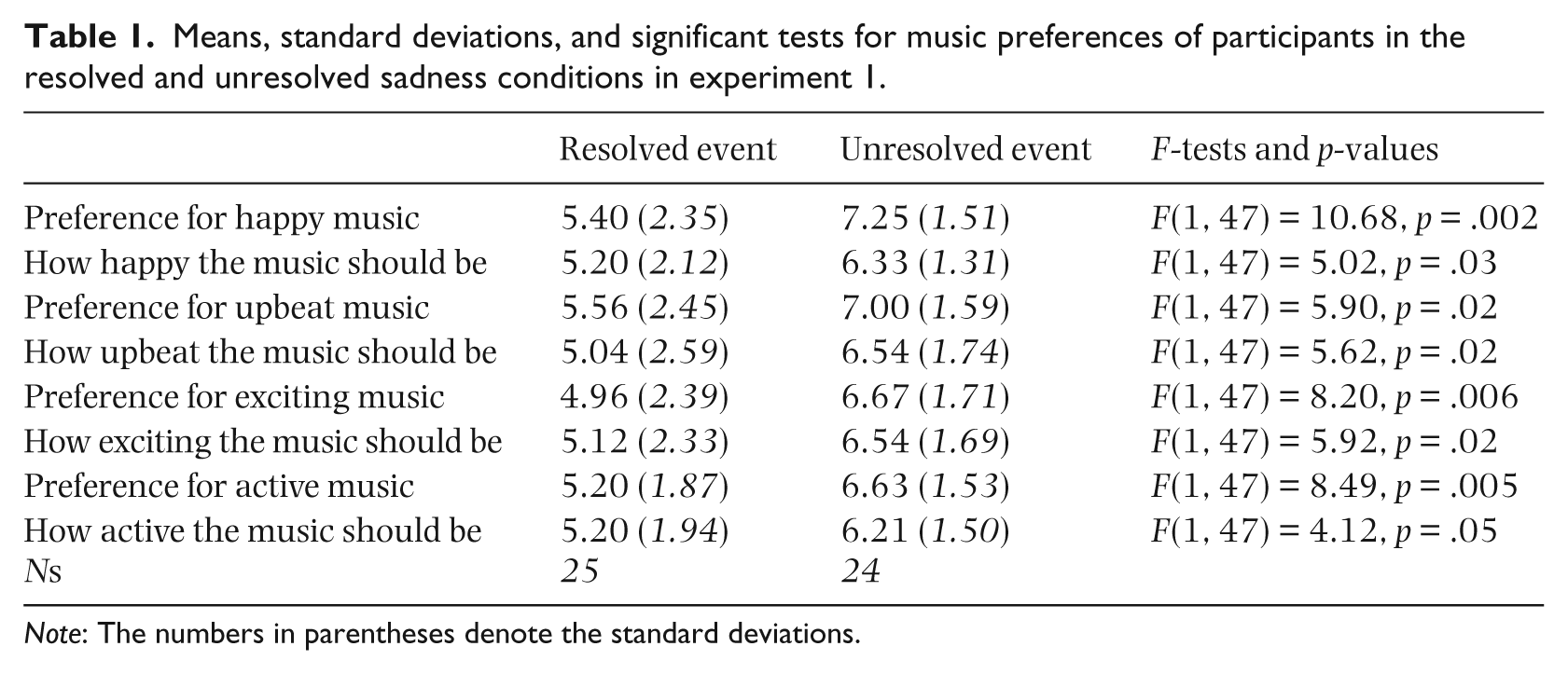
Note: The numbers in parentheses denote the standard deviations.
Intensity of emotions in preferred music
In addition, participants in the unresolved condition reported preferring to listen to music that was happier, more exciting, more upbeat, and more active than those in the resolved condition (see Table 1) 2 . Type of sadness event had no effect on preference for the other kinds of music, all Fs < 2.67, all ps > .10.
Felt emotions
There were no differences between the two sadness conditions on all measures of felt emotion, all Fs < 2.57, all ps > .11. Participants experienced similar levels of sadness (M = 4.36, SD = 2.11 in the resolved condition vs. M = 3.48, SD = 1.83 in the unresolved condition), F(1, 41) = 2.16, p = .15, similar levels of distress (M = 4.13, SD = 1.98 in the resolved condition vs. M = 4.57, SD = 2.23 in the unresolved condition), F(1, 41) = .46, p = .50, and were similarly upset (M = 4.00, SD = 2.33 in the resolved condition vs. M = 3.62, SD = 2.16 in the unresolved condition), F(1, 41) = .31, p = .58, in the two sadness conditions.
Discussion
Experiment 1 supported the hypothesis that individuals reminded of an unresolved sad event would want to listen to happy, exciting, upbeat, and active music to a greater extent than individuals who recalled a resolved sad event. In addition, participants in the unresolved sad event condition wanted to listen to music that was significantly happier, more exciting, more upbeat, and more active than the music preferred by the participants in the resolved condition. These preliminary results suggest that individuals in the unresolved condition preferred to listen to happy, active, upbeat, and exciting music in order to regulate their sad feelings.
Moreover, supporting our predictions, there was no significant difference with regard to participants’ choice of soothing, calming, or relaxing music. This may indicate that the differential choice of active-type music was done by the participants with the goal of getting energized to cope with the unresolved sad event. Moreover, the two conditions did not differ with regard to the choice of sad music; participants in the two conditions were equally likely to choose sad, depressing, sorrowful, or meditative music. In contrast, the significant findings with regard to active, upbeat, exciting, and happy music may reflect the unresolved participants’ need to choose the type of music (i.e., active-happy) that readies them for coping with the unresolved sad event.
Corroborating our interpretation, participants’ reports of unresolved events were less likely to have an ending/closure and revealed less self-mastery than the resolved sadness reports. These findings suggest that individuals dealing with unresolved sad events may still need to cope with the event, and prefer to listen to upbeat, happy, exciting, and active music in order to get energized. In other words, because they had yet to resolve the event in order to achieve an ending or closing they were ‘at peace with,’ they may have been more motivated to get mobilized by listening to happy and active music.
It is possible that participants in the resolved sadness condition no longer experienced sadness, given that they had resolved the sadness-instigating event. However, the fact that there were no significant differences between the two sadness conditions with regard to the extent to which participants experienced feelings of sadness, upset, and distress, suggests that both conditions instigated sadness. Nevertheless, one should interpret these findings with caution given that the emotion questionnaire was administered at the end of the study, and given the possibility that the unresolved sadness participants may have reduced their sadness by the act of choosing happy music, despite the fact that they were not actually given the opportunity to listen to it. Yet the high levels of sadness, distress, and upset feelings in the two conditions argue against this possibility.
Experiment 2
Experiment 1 did not explain why individuals in the unresolved condition chose different music to listen to, compared to individuals in the resolved condition. In experiment 2, we sought to directly test the hypothesis that individuals in the unresolved condition are more motivated to select happy music in order to cope with the still-unresolved consequences of the sadness event. Specifically, experiment 2 investigated whether individuals experiencing unresolved sad events would prefer to listen to happy and active music to help themselves deal with the sadness event if they believe that the strategy would be effective in changing their sad feelings.
As in experiment 1, all participants were asked to spend 10 minutes writing about an unresolved sad event or a resolved sad event. We then manipulated the participants’ beliefs about their ability to change their sad feelings in the unresolved sad event condition. Specifically, unresolved sadness participants were randomly assigned to one of three mood information groups: no mood information, mood-malleable condition, or mood-freeze information group. In addition, a fourth condition was included – resolved/no mood information condition – to replicate the results of experiment 1. We expected that participants in the unresolved sadness/mood-freeze condition, who believed they could not change their feelings of sadness, would be less likely to select happy music than participants in the other unresolved sadness conditions. Moreover, replicating the results of experiment 1, we predicted that the resolved sadness/no mood information participants would be less likely to select happy music compared to participants in the unresolved sadness/no mood information condition.
Method
Participants
The participants were 80 male and female undergraduate students enrolled in psychology courses at the University of Wisconsin Oshkosh, USA, who received course credit in exchange for participation. The data from one male participant were excluded because he wrote about an unresolved angry event. Thus only the data from 79 participants were included in the analyses (30 males and 49 females). Randomization in blocks of eight was used to assign the participants to each condition.
Participants were prescreened, using the psychology department’s Sona-Systems website, based on their responses to the Eating Attitudes Test (EAT)-26, in order to control for eating disorders (Garner, Olmsted, Bohr, & Garfinkel, 1982; Ocker, Lam, Jensen, & Zhang, 2007). Another item, specific to our study, was added to the scale: ‘I feel uncomfortable after eating salty food and carbohydrates.’ Participants reporting a score of four or higher on all of the six scales were not eligible to participate in this study. A seventh question asked participants to report if they had any food allergies. Participants with food allergies were also restricted from participating. This prescreening method was used because we manipulated participants’ motivation to change or maintain their sad mood by asking them to eat (or not to eat) specific foods.
Design and procedure
The design of the study was an incomplete between-subjects factorial design. As part of the manipulation of type of sadness event, participants were instructed to write either about an unresolved or resolved sad event. As part of the mood changeability manipulation, the implicit beliefs of the participants were altered depending on the type of mood information they were given in the food questionnaire. Participants assigned to the unresolved/mood-freeze condition were given information leading them to believe their mood was ‘fixed’ and could not be changed, whereas participants assigned to the unresolved/no mood information, unresolved/mood malleable, and resolved/no mood information conditions were not given any ‘mood freezing’ information.
Participants were immediately directed to a secluded room. There were two consent forms and an MP3 player on the desk. The consent form stated that the investigators were examining life events and preferences for music and food. The participants were instructed to notify the researcher after the consent form was read and signed. The consent form and the MP3 player were then removed from the room.
Manipulation of type of event (resolved versus unresolved)
The researcher first gave the participant a large manila envelope. As in experiment 1, the envelope contained a sheet that instructed them to write about one recent life event that had made them very sad. Depending on the condition, the participants were assigned to write about a sad event that was either resolved or unresolved. The participants were instructed to take 10 minutes to think and write about the event.
Manipulation of mood information (no mood information, mood-malleable information vs. mood-freeze information)
After writing about the sad event, the participants were then given a large manila envelope that contained questions regarding their food preferences. Two goldfish crackers and two pretzels were placed in a plastic sandwich bag, and the bag was stapled to the upper left corner of the questionnaire. The researcher was blind to condition assignment.
Participants were first asked to rate their preferences for salty, sweet, bitter, and sour food. Also, they were asked to rate the different characteristics (texture, smell, and appearance) of the pretzels and goldfish crackers on scales that ranged from −5 = ‘extremely dislike’ to +5 = ‘extremely like’ (11-point scales) and 0 = ‘not at all’ to 9 = ‘very much’ (10-point scales). Participants in the unresolved/mood malleable and unresolved/mood-freeze information groups were instructed to taste and rate the pretzels and goldfish crackers. The participants in the no mood information group (either resolved or unresolved) were not instructed to taste the food but only to rate it.
Participants in the unresolved/mood-freeze condition were instructed to taste the food in order to effectively manipulate their belief that their mood will freeze after tasting the snacks. The following paragraph, adapted after Tice, Bratslavsky, and Baumeister (2001), was presented towards the end of the food questionnaire along with one additional question: You should know that even though people believe eating makes them feel better, scientific evidence points to the contrary. Eating does not make you feel better; if anything, it prolongs your current mood state for a period of time, irrespective of what you do after eating. Whatever mood you are in right now, you are very likely to stay in the same mood throughout the experiment.
After the participants in the unresolved/mood-freeze group read this paragraph, they were asked to answer the extent that their mood changed before receiving the food questionnaire compared to their current mood.
Research shows that food may have a temporary effect on mood (Tice et al., 2001). Thus in order to ensure that tasting the food items did not account for group differences in music preferences between the unresolved/mood freeze and unresolved/no mood information condition, it was necessary to include a second control condition that asked the participants to taste and rate the food items (unresolved/mood-malleable condition). We hypothesized that there would be no differences between the unresolved/no mood information and unresolved/mood-malleable conditions as both groups would prefer to listen to happy music, compared to the participants in the resolved/no mood information and unresolved/mood-freeze conditions, respectively.
Participants in the unresolved/no mood information condition and resolved/no mood information conditions were asked to rate the food items based only on visual, tactile, and odor inspection (no tasting), and were presented with a question that asked them to rate the extent that their current mood had changed during the time that the food questionnaire was completed.
Dependent measures
The final questionnaire was then given to the participants in another large manila envelope. The first part of this questionnaire reminded the participant of the sad event that he or she wrote about in the beginning of the study. The participants were asked how important the event was, when it occurred, and how intense the event was. The second part of the questionnaire informed the participants that the researchers wanted to select a musical piece for them to listen to. Therefore they were to select music they would like to listen to at that moment. As in experiment 1, they would (but unbeknownst to them) not be given the opportunity to listen to the music. A questionnaire asked the participants to answer questions regarding their music preferences.
Valence and intensity of emotions in preferred music
As in experiment 1, participants were asked to rate the extent that they would currently like to listen to music that is happy, sad, angry, calming, uplifting, relaxing, upbeat, soothing, exciting, depressing, active, passive, meditative, hostile, or sorrowful (in this order) on nine-point scales (from 0 = ‘not at all’ to 9 = ‘very much’). The students were also asked to rate on nine-point scales how happy, sad, angry, and so on, the music should be (from 0 = ‘not at all . . .’ to 9 = ‘extremely . . .’).
Manipulation checks
After the participants completed the music preference questions, they were asked to indicate whether or not they felt their mood changed after eating or rating the food items (yes; no). Another question asked whether they were instructed to taste and rate or to only rate the food items. One more question asked whether or not the sad event the participant wrote about was resolved.
Sad event characteristics
Participants were asked questions regarding the sad event they wrote about in the beginning of the study. They estimated when the event occurred (within the last day, week, two to three weeks, three to four weeks, one month, two months, or longer than two months). They also rated the intensity of the event and the importance of the event in their life on 10-point scales (0 = ‘not at all’ to 9 = ‘extremely’).
Felt emotions
At the end of the questionnaire, participants were asked to report the extent to which they were currently feeling the following emotions: sad, happy, distressed, excited, upset, low-spirited, helpless, joyful, or sorrowful (on a nine-point scale; 1 = ‘not at all’ to 9 = ‘extremely’). As in experiment 1, we did not expect differences between the two sadness conditions with regard to participants’ reports of the extent to which they were feeling sad, upset, distressed, low-spirited, and sorrowful.
Results
In order to run one-way between-subjects ANOVAs and a priori polynomial contrasts, the data were re-coded. The ‘resolved/no mood information’ was coded as condition 1 (n = 20), the ‘unresolved/no mood information’ as condition 2 (n = 20), the ‘unresolved/mood-malleable’ as condition 3 (n = 19), and the ‘unresolved/mood freeze’ as condition 4 (n = 20).
Manipulation checks
Event type
As expected, a chi-square analysis confirmed that the manipulation of sadness event type was successful, χ2(1) = 40.36, p < .001. All participants in the resolved condition reported writing about a resolved event, and 47 out of 57 participants in the three unresolved conditions reported writing about an unresolved sad event (four participants did not answer this question).
Rating and tasting food items
A second chi-square analysis confirmed that the participants followed the instructions to rate/taste the goldfish crackers and pretzels or only to rate the food without tasting, χ2(3) = 74.21, p < .001. All participants in the resolved/no mood information and unresolved/no mood information conditions only rated the food items, all the participants in the unresolved mood-malleable condition tasted and rated the food. Only one of the 19 participants in the unresolved mood-malleable condition reported not tasting and rating the goldfish crackers and pretzels.
Mood change appraisals
An inspection of the frequency tables indicates that 80% of the participants in the mood-freeze condition reported that their mood did not change after tasting the food. As expected, participants in the other conditions were equally likely to report that their mood changed after rating or tasting and rating the food: 45% of the participants in the resolved/no mood information condition, 40% in the unresolved/mood information condition, and 50% in the unresolved/mood-malleable reported that their mood did not change. Because there was no difference between the unresolved/no mood information condition (rating only) and the unresolved/mood-malleable condition (tasting and rating), χ2(1) = 1.62, p = .20, we can be confident that the participants’ sad mood in the food tasting conditions did not change due to their tasting of the food (but rather was maintained). Collapsing the first three groups and comparing them collectively to the unresolved/mood-freeze condition, where we expected no change in mood due to the mood-freeze instructions, resulted in a marginally significant chi-square test, χ2(1) = 3.67, p = .055. This provided further evidence for the effectiveness of the mood-freeze manipulation.
Given that the initial analyses suggested that, as predicted, there were no differences between the unresolved/no mood information condition and the unresolved/mood-malleable condition on all the dependent measures (all Fs < 1.86; all ps > .07), as well as with regard to their self-appraisals of mood change, we collapsed the two controls into one group (unresolved/controls group).
Sad event characteristics
As in experiment 1, there were no significant differences with regard to the characteristics of the reported sad event. The sad event was rated as equally important (M = 7.30, SD = 2.62 in the resolved condition; M = 7.21, SD = 1.91 in the unresolved/controls condition and M = 7.50, SD = 1.61 in the unresolved/mood-freeze condition) and of equal intensity (M = 6.90, SD = 2.29 – resolved condition; M = 6.90, SD = 1.79 – unresolved/controls condition and M = 7.40, SD = 1.43 – unresolved/mood-freeze condition) across conditions, both Fs < .88, both ps > .57. The groups also did not differ as a function of the time the event had occurred (M = 4.85, SD = 1.81 – resolved condition; M = 4.49, SD = 2.01 – unresolved/controls condition and M = 3.95, SD = 2.14 – unresolved/mood-freeze condition), χ2(12) = 8.54, p = .74.
Valence and intensity of emotions in preferred music
We predicted that individuals in the unresolved/controls condition would be more likely to choose to listen to happy music than the individuals who wrote about a resolved sad event. We also predicted that individuals in the unresolved/controls condition would be more likely to choose to listen to happy music compared to individuals in the unresolved/mood-freeze condition. As predicted, one-way ANOVAs revealed significant polynomial contrasts of the effect of the manipulation on preference for happy music and on the intensity of happy music. Figures 1 and 2 display these effects.
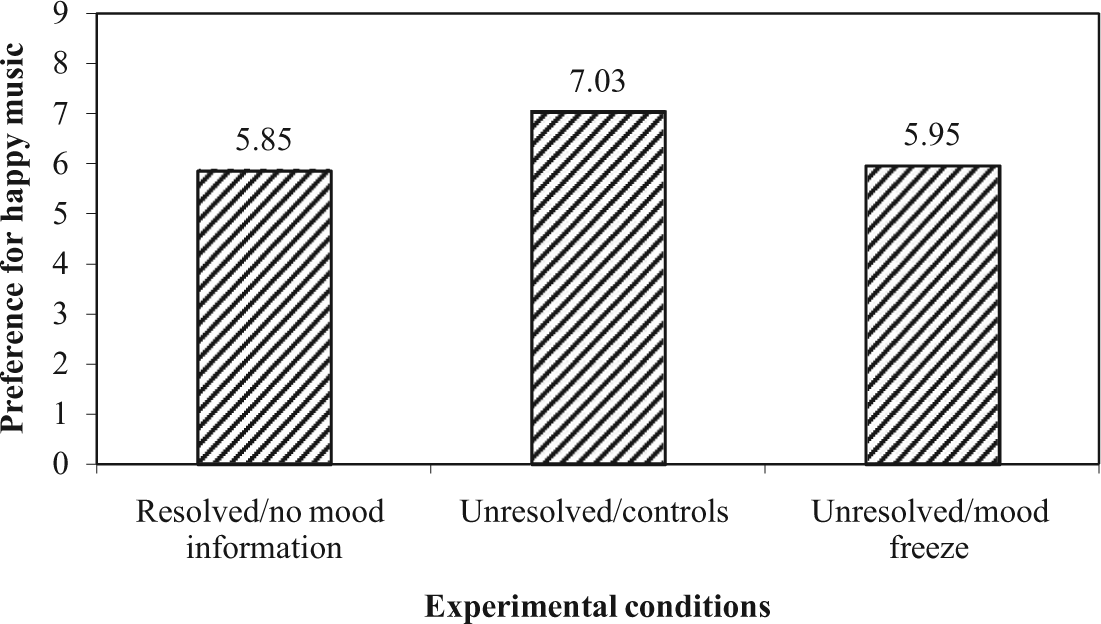
Preference for happy music in each condition in experiment 2.
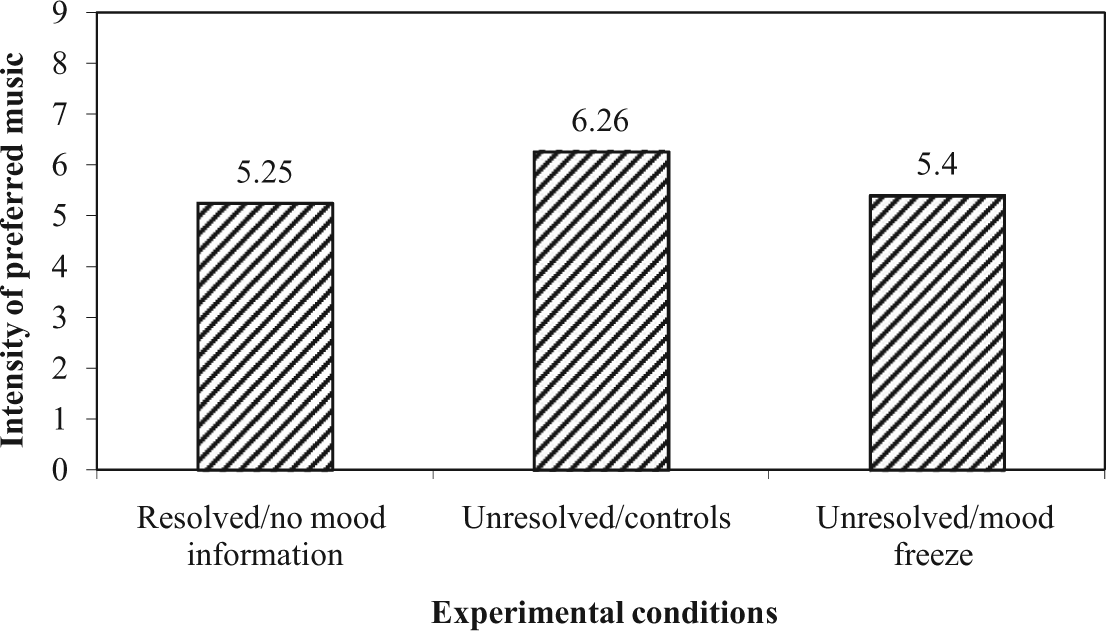
Ratings of the intensity of the preferred happy music (e.g., the extent to which the music should be happy) in each condition in experiment 2.
Preference for happy music
A polynomial contrast testing for the overall predicted polynomial pattern (1 −2 1) revealed that individuals in the unresolved/controls condition (M = 7.03, SD = 1.40) had a significantly stronger preference for happy music than participants in the resolved/no mood information condition and the unresolved/mood-freeze condition (M = 5.85, SD = 2.13 and M = 5.95, SD = 1.96), t(75) = 2.82, p = .006. 3
As predicted, and replicating the results of experiment 1, planned polynomial contrasts revealed that participants in the unresolved/controls condition had a significantly stronger preference for happy music than did participants in the resolved/no mood information condition, t(75) = 2.42, p = .02. More importantly, preference for happy music was higher for participants in the unresolved/controls condition than for participants in the unresolved sadness condition, whose sadness was frozen and ostensibly could not be changed, t(75) = 2.21, p = .03. As expected, there was no significant difference on this measure between the resolved/no mood information condition and unresolved/mood-freeze condition, t(75) = .18, p = .86.
Intensity of happy music
A polynomial contrast testing for the overall predicted pattern (1 −2 1) revealed that individuals in the unresolved/controls condition (M = 6.26, SD = 1.27) preferred to listen to music that was happier than did participants in the resolved/no mood information condition and unresolved/mood-freeze condition (M = 5.25, SD = 1.68 and M = 5.40, SD = 1.85), t(75) = 2.69, p = .009. Replicating the findings of experiment 1, participants in the unresolved/controls condition wanted to listen to music that was happier than the music preferred by the participants in the resolved/no mood information condition, t(61) = −2.45, p = .02. More importantly, participants in the unresolved/controls condition wanted to listen to music that was significantly happier than the music preferred by the participants in the unresolved/mood-freeze condition, t(75) = 2.03, p = .05. As expected, there was no significant difference on this measure between the resolved/no mood information condition and unresolved/mood-freeze condition, t(75) = .31, p = .76. There were no significant effects on the other music preference measures, all Fs < 1.89, all ps > .14.
Felt emotions
There were no differences between the three sadness conditions on any of the items measuring felt sadness (sad, distressed, upset, low-spirited, and sorrowful), all Fs < 1.62, all ps > .20. Overall, there were no differences on any of the emotion measures, all Fs < 2.98, all ps > .08.
Discussion
Prior research indicates that individuals regulate their feelings depending on their current motivational goals (Erber et al., 1996). Our results suggest that individuals may be less motivated to utilize sadness regulation strategies when they believe there is nothing they can do to regulate their unresolved sadness in the short-term. Specifically, we found that individuals in the resolved/no mood information and unresolved/mood-freeze conditions had a lower preference for happy music and selected music that was significantly less happy than the music selected by the individuals in the unresolved/controls condition. Individuals in the resolved/no mood information and unresolved/mood-freeze conditions may have been less motivated to listen to music that could help them reduce their sad mood when the event they wrote about was already resolved or when they believed they could not regulate their (frozen) sadness.
Our results extend prior findings, which similarly revealed that individuals whose mood was ‘frozen’ are less motivated to regulate their feelings because they believe their mood cannot be changed. Two prior studies used a mood-freeze procedure that manipulated the participants’ beliefs about their ability to regulate their sadness. Findings from Manucia et al.’s (1984) study indicate that individuals regulated their sad moods by engaging in helping behaviors only when they believed their sadness was malleable. Similarly, Tice et al. (2001) found that distressed participants in a mood-freeze condition refrained from short-term gratification (impulsively eating snacks) when they believed that eating snacks would not improve their distressed mood. Altogether, these findings support the notion that, when individuals hold the implicit belief that their emotion is fixed and uncontrollable, they may be less motivated to use emotion regulation strategies (see also Tamir, John, Srivastava, & Gross, 2007).
As in experiment 1, we found no differences between the sadness conditions with regard to the extent to which participants reported feeling sad, distressed, upset, low-spirited, and sorrowful. This may indicate that sadness was instigated in all conditions, irrespective of whether the event was resolved or unresolved, and of whether participants thought they were able to regulate their feelings of sadness or not. This suggests that anticipated use of a sadness-regulation strategy does not reduce sadness, whereas actual listening to music may do so.
Unlike experiment 1, only preference for happy music was influenced by the experimental manipulations in experiment 2. Specifically, in experiment 2 we found that individuals in the unresolved/controls conditions were more likely to choose to listen to music that was happy and were more likely to choose a higher intensity of happy music than those in the resolved and unresolved/mood-freeze condition. Given that ‘happy’ was the first emotion adjective listed on the music preferences questionnaire, it is possible that participants believed that happy music was all that they needed, without the valence of the music needing to be qualified by an activity dimension (upbeat, active, etc.). It is also possible that the characteristics of experiment 2 (e.g., the longer length of the study and having to rate food items) may have made the prospect of listening to active music less appealing to the participants.
General discussion
Theoretical and practical contribution of the current research
Overall, the results of the two studies suggest that individuals dealing with unresolved sad events are more likely to choose to listen to happy music than those dealing with a resolved sad event. The happy music may help participants to mobilize energy by providing them with a reason for feeling happy, thus readying them for action (Fredrickson, 1998; Isen, 2000). Moreover, the results of experiment 2 suggest that individuals who believe their sadness cannot be changed are less motivated to resolve the sad event they experienced and thus reduce their sadness. This confirms our prediction that unresolved sadness motivates individuals to select happy music in order to cope with the sadness.
To our knowledge, our studies are the first to explore the distinction between resolved and unresolved sad events. Aside from providing a novel method for studying the motivational functions of sadness (by comparing resolved to unresolved sadness), these studies also provide new information about the role of music listening strategies in sadness regulation. Future research would benefit from a closer look at the motivational functions of sadness by examining other types of emotion regulation strategies individuals may use, particularly when sadness is elicited by resolved or unresolved events. In addition, the distinction between resolved and unresolved sadness may have implications for distinguishing between sadness, grief, and depression, and for uncovering the differential strategies used by sad, dysphoric, and depressed individuals to cope with the sad events they experience.
Prior studies on emotion regulation have usually focused on internal cognitive strategies such as rumination or cognitive reappraisal (e.g., Gross, 1998). Our current research follows the assumption that individuals use a wider variety of regulatory strategies in their everyday lives to reduce negative emotions, such as listening to music. Finally, our experiments suggest that people’s current choices of music depend not only on their experienced emotion but also on perceived necessity to regulate the emotion and the perceived efficacy of the choice of music in regulating the experienced feelings.
Limitations and future directions
We assumed that unresolved sadness causes people to select happy music that would ready them for dealing with the still-unresolved event. However, it is possible that individuals dealing with an unresolved sad event may choose to listen to happy music because happy music has a happy resolution, which can superficially improve their mood. Another possibility is that fast happy music can induce faster thinking, which in turn instigates positive mood (Husain, Thompson, & Schellenberg, 2002; Pronin & Jacobs, 2008). One other possibility is that unresolved sadness participants expressed a preference for listening to happy music in order to distract themselves from sad thoughts because they could not deal with the unresolved event. Indeed, recent work has shown that distraction accomplishes rapid recovery from sadness at any point after the sad event started and while it is still present (Sheppes & Meiran, 2007). Future work should address the cognitive mechanisms underlying the choice of happy music by individuals experiencing unresolved sadness.
The distinction between unresolved and resolved sad events is novel. Given that there were no differences between the two conditions in terms of the categories of events participants wrote about, participants in the unresolved condition may have focused on the stage in which the event was unresolved, even though their sadness may have been resolved already. This means that, in the unresolved sadness condition, participants may have chosen a sad event and focused on the unresolved stage in the coping process, which brought to mind aspects such as low-coping potential, desire to undo the event, and so on. However, it is equally possible that participants indeed chose events that were resolved or unresolved. A study utilizing a within-subject design instructing participants to select a sad event and focus first on the unresolved stage and then on the resolved stage would better address the differential preference for happy music at the different stages of coping with sad events.
The possibility that individuals choose different regulation strategies during the different stages of the sadness process has widespread implications in the clinical field, suggesting different interventions depending on the coping stage the person is in (see recent work by Sheppes and Meiran [2007] on the use of distraction and reappraisal to down-regulate sadness at different points in the regulation process). Indeed, sadness may ready us for action only during the stage when we are still dealing with the unresolved event; once the event is resolved, the goal of sadness has been achieved, and there may not be any need for the use of a regulation strategy.
The lack of differences in sadness between the unresolved sadness and resolved sadness conditions may be explained by the fact that the expectation of listening to music was not enough to reduce sadness; rather, individuals needed to actually listen to music in order to down-regulate their sadness. Future studies should assess sadness earlier in the study to capture the extent to which unresolved sadness participants may experience more sadness than the resolved sadness participants, because in their case the sadness goal has not yet been achieved. The caveat of that approach is that, by expressing sadness on the questionnaire, one of the goals of sadness (expressing sadness or sharing one’s feelings of sadness) may have been achieved, not allowing us to assess whether unresolved sadness motivates music choice as a means of down-regulating feelings of sadness.
Future work should also investigate whether actual listening to happy music leads to a temporary resolution of the unresolved sad event as well as a reduction in sadness. In our studies, participants just selected the music they wanted to listen to, but did not get to listen to the music. A related question is whether individuals hold implicit beliefs about the effect of music on their ability to come to terms with personal unresolved events, and these beliefs may make them more effective in down-regulating sadness through music choice.
We are hopeful that future work will take a further look at the distinction between resolved and unresolved emotional events, and how this conceptual distinction contributes to a better understanding of the emotion-regulation functions of music.
Footnotes
Acknowledgements
The experiments reported in this paper are based on the first author’s Master’s thesis work. We thank Cassie Tate for assistance with data collection.
Funding
This research received no specific grant from any funding agency in the public, commercial, or not-for-profit sectors.