



Abstract
The research literature concerning gesture in musical performance increasingly reports that musically communicative and meaningful performances contain highly expressive bodily movements. These movements are involved in the generation of the musically expressive performance, but enquiry into the development of expressive bodily movement has been limited. In two studies this paper explores the expressive components of bodily movement in both solo and ensemble musical performance. The first study examined flute and clarinet performers in both solo and duo settings. Whilst each player had a specific way of expressing musical goals through their bodily movement, there were features common to the woodwind instruments investigated. Detailed analyses revealed that, although many movements were possible, performers used only six basic expressive gesture types. The second study described a performance of the internationally celebrated pianist, Lang Lang, focusing on the relationship between musical affect, bodily movement and facial expression. Analysis also revealed extensive and striking use of combined bodily and facial expression, which were involved in articulating structural features of the music and the narrative of the work. Findings suggest the existence of a repertoire of expressive information used for the generation of expressive ideas, and available to the observers of music performers.
Introduction
The role of the body in the production and perception of music has been discussed for many centuries. For instance, baroque treatises on performance explained the subtle interaction between posture, gesture, emotion, and meaning in musical performances for both performers and audience (Gellrich, 1991). Experimentation by Truslit (1938, cited in Repp, 1993) revealed that music is ‘expressively shaped’ by the performer’s body. He asked performers to execute short musical excerpts whilst performing motion curves: open movement, closed movement, and winding movement. Using the objective measurement of the acoustic signals achieved, he discovered that, whilst embodying different motion curves, differences were created in the musical products (see Repp, 1993). Truslit’s was an important foundation for empirical investigations into music production, the body, and generated and perceived expressivity.
Little systematic empirical research was done in classical music performance, however, until I undertook my own PhD studies, which were completed in the early 1990s (Davidson, 1991). Now, along with the growing interest in and general understanding of how body and mind interact in the generation and performance of skilled and expressive human behaviours, the study of the relationship between the body and music is a rapidly growing area of research (see Broughton and Davidson, 2012). But the work has been diverse, and questions have been wide-ranging, varying from what actually constitutes movement in a musical performance (technical, essential/expressive, ancillary, etc.), to how social and cultural context promotes different types of physical interaction. An interest in understanding how expressive, affective meanings in music are produced and perceived through body movement has led to three fundamental questions underpinning my own work:
What type of bodily movements and facial actions are used in the production of an expressive musical performance?
To what degree are bodily movements and facial actions used for purely musically expressive effects?
To what degree are bodily movements and facial actions in a musical performance of a socially communicative nature; that is, for co-performer and performer–audience interactions?
In this paper, I begin by outlining the major trends in investigations into bodily movement and music in order to address my on-going research questions and provide a contextual framework for the studies undertaken. The first study aimed to explore the use and development of bodily movements in duo performances. It was a laboratory study in which musicians learned a piece of music composed with an explicit range of expressive musical goals. It explored the strategies and outcomes the performers developed from first sight-reading through to final performance. The second study adopted an ecological approach to methodology, using film footage for analysis of a live performance by a world-famous concert pianist in a solo recital. Systematic observations were undertaken with the aim of understanding which movements were used in the production of musical features and other extra-musical elements.
Background literature
In 2009 I wrote a survey chapter exploring both movement and collaboration in musical performance (see Davidson, 2009). In it, I identified four major areas of empirical enquiry into the role of the body in musical performance that have emerged in the growing research literature: (1) motor programming studies, that is, investigating how the body assembles a musical performance; (2) musical affect studies, those studies exploring expressivity and its communication through bodily means; (3) training studies, which explore techniques that use bodily movement and movement metaphors for the development of strategies to enhance physical, musical and expressive elements of performance; and (4) collaborative music-making studies, including co-performer interaction and performer–audience concerns, that explore the ways in which bodily communication is used for the coordination of musical and extra-musical material. I draw upon these categorizations, reproducing parts of the survey chapter of 2009, as well as more recent work, to offer an overview of current research to situate my own studies reported in the current paper.
Motor-programming studies
An immediate challenge in understanding movement systems is that there is a ‘degrees of freedom problem’ associated with the millions of bone, muscle, and nerve impulses that create human actions (Davidson, 2009). The suggestion that motor programmes operate for classes of movements (Bernstein, 1967) has been widely supported. However, functional-operation theories range from those that consider the brain as a central executive to control movements, to ideas where movement control arises in an open system, and the movements are self-organizing (Dahl, 2004; see also Davidson, 2009). System function is far from understood, but music performers do need to understand that the generation and embedding of motor programmes in memory is a vital process.
Palmer and Dalla-Bella (2004) have shown that highly skilled, well-practised pianists move their fingers approximately three-to-four events ahead of time, suggesting that an early retrieval for action is required, motor activity being an anticipatory and unfurling behaviour in performance (see Davidson, 2009). So at the level of motor programming, we see that musicians develop powerful mechanisms to enable the production of a piece of music. By achieving such skill, a high degree of automation results (motor programmes so strongly mentally embedded that action is produced through unconscious thought processing). It is evident that the expert performer’s conscious thoughts become relatively ‘free’ to deal with moment-by-moment modifications that may be necessary as the music is performed; for example, adapting the pianist’s ‘touch’ to accommodate a keyboard or a specific room acoustic (see Lehmann & Davidson, 2002). It has been demonstrated that the accumulated practice necessary to achieve automation and fluency to a professional skill level (see Ericsson, Krampe, & Tesch-Römer, 1993) results in enlarged representations of somatosensory and auditory cortex (Pantev, Engelien, Candia, & Elbert, 2001), as well as in motor areas of the brain (Altenmüller & Gruhn, 2002).
But this physical skill is not a simple mechanical process. It also has within its programming material of an expressive and culturally determined nature. In a pioneering study of piano keyboard performances Shaffer (1984) noted that, additional to achieving motor programming automaticity for fluent production of the music, the performers also embedded within motor programmes timing profiles that were related to musical structure features; for example, slowing always occurred at phrase boundaries. In other words, the performer does not play in a purely mechanically efficient manner. The performer also has a set of representations that draw on knowledge and experience of culture and musical style, impacting how their movements are assembled and presented.
Coupled with motor programming, biomechanical factors shape how we produce musical performances. Wiesendanger, Baader and Kazennikov (2006) have shown, for example, that the bow arm of the string player is constrained by the dynamic principles in operation between the bow, string, and arm. Baily (1985) discussed how the cultural characteristics of musical instruments depend upon ergonomic principles. The example cited was the dutar of Afghanistan, which is similar to all other lute-like instruments in shape and size, evidently for hand-holding benefits. Bejjani and Halpern (1989) investigated both jazz and classical trumpet playing to discover differences between neutral and playing postures. With variables including neck shape and length and dental overbite impacting outcomes, the authors concluded that anthropometric factors constrain performance. Thus all these fundamental bodily elements need to be considered in an effort to understand the expressive elements and constraints on musical performance.
Musical affect studies
A controlled study revealed that when the same piece of music was played with different expressive intentions (deadpan or withheld expression, with usual expression, and with exaggerated expression), the performers moved their bodies in identifiably different ways (Davidson, 1993). This research enabled me, as the investigator, to show that, although the hands, arms, head, and torso of performers followed similar movement contours (those required to execute the music) across performances, there were significant differences in the scale of the movements. These suggested that the more highly expressive the intention, the larger and more ample the movements; the less expressive the intention, the smaller the movement (Davidson, 1994).
Other researchers, including Wanderley and colleagues (Wanderley, 2002; Wanderley, Vines, Middleton, McKay, & Hatch, 2005; Wanderley & Vines, 2006) found relationships between movement quantity and expressivity. Exploring individual differences in clarinettists, they found that musical considerations – mainly phrase structure and metrical considerations – seemed to be the points at which most movement beyond the bare minimum required for technical execution occurred.
I went on to discover that there were indeed concentrated moments where specific identifiable movements could be found. These movements had qualities akin to the types of non-verbal communication that accompany speech, such as metaphorical and illustrative features, which both generate and react to ideas being expressed (Davidson, 2005). The example of head shaking during playing is a useful case for discussion. This movement type took place in a rapid series, seeming to mirror musical repeats of a specific figure or sequence. Other gestures seemed to have iconic value; that is, where some feature of the musical action was being described. For example, pianists used their hands, upper torso, head, and even sometimes their elbow to trace the contour of the music being played. This arguably is done to ‘draw out’ the smooth legato line that is being attempted in the music (see Davidson, 2009).
I refer to these specific movements embedded within the overall flow of the performance as identifiable, individual gestures. Delalande (1990) had already categorized three types of such identifiable movements: effective gestures – those tied directly to sound production; accompanist gestures – those supporting, but not directly involved in, sound production; and figurative gestures – symbolic rather than physical in nature, and envisaged to be perceived by the observer. From my extensive observations, such accompanist and figurative gestures do become integrated into the overall motor programme to such an extent that, even if in one way their function may not be ‘necessary’ to the musical production, their role becomes nonetheless essential for the individual performer and at some level this impacts the sound produced. For example, singing which focuses physically outward towards the audience may employ larger projected postures and gestures, and these larger movements in turn have an impact on the sounds produced (see Davidson & Coulam, 2006).
Individual instrumentalists use a restricted number and range of gestures, yet these have the potential to express highly variable information depending on the musical and social context in which they are used. Indeed, in 2007 I undertook an assessment of a pianist’s movement vocabulary and showed that the movements were limited to less than 20 movement types, which happened to appear across all sorts of musical styles. In one style of music (Beethoven, for example) an emphatic ‘wiggle’ of the torso might be used illustrate an ornament in the music, yet in another context (C. P. E. Bach), it could signal the start of a long legato passage (Davidson, 2007). Such gestures were found to be person-specific and there was a high degree of individual variability in how many gestures were used, with some people having a far more restricted vocabulary than others (Davidson, 2005).
So far, in reviewing my own research, specific gestures have been shown to articulate musical expression – ideas about structure – to facilitate the production of musical sounds. Some researchers (e.g., Watt & Ash, 1998) have taken these ideas to an extreme to suggest that musical material itself operates like a virtual person – a social inter-actor – with the performer. So, in a score-indicated fortissimo, a pianist may nod her head as she plays loudly. This action could be an illustration of the force of the movement required, or she may be ‘agreeing’ with the force of the musical sounds by nodding in ‘agreement’, as if interacting with another person. These are all speculative ideas, but it is feasible that the music itself operates on the performer like a partner in conversation, and in the case of a musical performance, the performer both generates and reacts to the musical structures (Davidson, 2009). In addition to these musical goals, the movements are used for social function, but a function typically focused on the effective coordination and communication of the performance material (see Davidson, 2005).
Music training studies
The relationship between movement, metaphor and musical meaning has featured in several schools of music pedagogy. For instance, Dalcroze’s pedagogical approach, Eurhythmics, draws on human behaviours such as breathing and walking, aiming to integrate and strengthen links between the body and brain through kinesthetic awareness for musical engagement (Farber & Parker, 1987; Galvao & Kemp, 1999). In essence, bodily activity provides metaphors for expression and understanding of, and developing sensitivities to, musical concepts (Juntunen & Hyvönen, 2004). For example, movement coordination is achieved through activities such as groups of children bouncing balls in unison to illustrate how musical material needs to be coordinated and musical phrases shaped. At a more advanced level, Pierce (1994, 1997) has drawn on movement concepts to assist tertiary level and professional performers to optimize the expressive features of playing.
In addition to the use of metaphor for musical meaning, movement techniques have also been developed based on detailed anatomical knowledge to optimize physical posture, stance and alignment. The motor programming required for energy efficient action is the focus of both the Alexander Technique (Tarr, 2008) and the Feldenkrais Method (Buchanan & Ulrich, 2001). The techniques have often been applied as psychological tools to reduce some of the physical problems that can occur when performers become overly tense and anxious (Jain, Janssen & DeCelle, 2004). Indeed, generally, there has been an increased awareness of how body and mind need to be aligned in order to minimize psychological stressors on musicians. Focus on conditioning of the body now includes concern with diet, exercise and rest (see Williamon, 2004).
Collaborative music-making studies
Co-performer interaction
In an exploratory study, Davidson and Coulam (2006) showed that a co-performing accompanist preferred collaborating with singers who coordinated musical detail through non-verbal means, using the sorts of metaphoric musical movement devices mentioned earlier. Also, in addition to these, illustrative gestures were found to be useful and popular. Techniques used included clicking fingers to set a tempo, or a series of regulatory head nods and arm gestures to monitor entrances and exits. When interviewed after rehearsal and performance activity, the co-performers spoke about these non-verbal signs as being crucial to the successful ensemble.
In an earlier work, Davidson and Good (2002) showed that collaborative activities between string quartet members depended in almost equal measure upon: (1) the dynamics of musical content and its co-ordination; and (2) those dynamics of a more personal nature (for example, the first violinist making a head nodding gesture of approval to the second violinist after executing a particularly well-accomplished passage), in order to make the social group cohere. The case also showed that individual agendas – even if at odds with the musical goals – were expressed through bodily posture and gestures. Indeed, in the study there was personal tension between several members of the ensemble and this was apparent in physical behaviours.
Williamon and Davidson (2002) found that piano duet partners most frequently used a looking movement behaviour as an indication for timing regulation; with practice, from first meeting through to a performance, the quantity of non-verbal interaction increased. Through the course of the rehearsals the movement styles of the two individuals altered. While the player who moved the most reduced the quantity of his movements, the other player produced more movement; the two beginning to move as one, adapting to accommodate one another’s movement styles.
Focusing on the requisites of ensemble performance, Davidson and King (2004) highlighted that specific moment-by-moment information needs to be processed and responded to in an on-going manner; for example, in order to accommodate a co-performer’s sudden change of tempo or cope with a memory slip. Such a capacity to deal with these matters clearly depends on former exposure to such situations and so also relies on knowledge gained from similar situations. But, most powerfully, it depends on the attentional focus of the co-performers.
Work by King (née Goodman) and colleagues (see Davidson & King, 2004; Ginsborg & King, 2012; Goodman, 2002) has drawn on Bales’ (1950, 1999) small group behaviour framework. It has shown that, in terms of both speech and gesture used in music rehearsals, performers’ discourses exceed a suggested ‘normal’ social upper limit found in spoken interaction, suggesting that the performers gave mainly positive socio-emotional reactions (perhaps stronger than witnessed in other small-group scenarios).
In addition to the illustrative, regulatory and emblematic gestures reported in many of the studies, it has been both observed and discussed (Davidson, 2007; Davidson & Coulam 2006) that performers – whether singers or instrumentalists – also make non-verbal signals which reveal unconscious processes of self-stimulation (e.g., rubbing the ear lobe in a gentle manner, or flicking the finger tips in a particularly soft but repetitive manner). These completely unconscious movements have been regarded as important factors in determining performance quality. Those performers who were rated highest by their collaborating accompanist used more of these self-stimulating adaptors, the movements seeming to offer some cue as to the performer’s own socio-emotional state.
Performer–audience interaction
Performers usually develop their musical material for audience consumption. Frith (1996) observes that a performance involves thoughts and actions which relate to: (1) the occasion itself (e.g., postures and gestures of the larger than life ‘stage persona’); (2) the music to be performed (the musical material’s narrative content, e.g., ‘living’ out the qualities of the character depicted in a song); and (3) the individual performer’s true states (current mood, sense of self, etc.). This suggests that there is potential for tension between the information contained in the music (its own narrative content), the performer’s real state (the individual performers on stage, presenting their own personalities), and behaviours they may engage in to present the music and themselves to their co-performers and audience. It would seem that performers need to be efficient at managing these aspects in combination.
Robbie Williams, a top pop performer, creates a seamless coherence between himself and co-performing musicians to engage the audience actively in the performance. In an analysis of Williams’ performance of ‘She’s the One’ at the Knebworth Music Festival in 2004, I was able to show that Robbie used empathic gestures with his band, making movements in time with their accompaniment, and took time engaging with them on stage (see Davidson, 2006). He also engaged his audience on a special performance ‘catwalk’ which stretched out into the crowd. Additionally, the audience was very familiar with Robbie’s performance content through extensive exposure on video. In the analysis, it became evident that the crowd knew Robbie’s own emblematic gestures and could make them ahead of cue in the song, anticipating the unfurling narrative. Despite the thousands in the crowd, the whole audience was found to sway, swirl, dance, and sing in perfect unison with their idol. Thus the example revealed that the pop audience has a special kind of attunement to the musician’s stage persona in the performance.
Of course, each individual performance is a unique confluence of new interactive elements, and familiarity with such experiences prepares co-performers for likely scenarios and outcomes. Audiences are also likely to influence the way in which the performers interact.
Empirical studies
With the above findings in mind, two studies were undertaken, each focusing on the bodily and facial actions of performers, but each study dealing with very different types of data. The first study collected video of duo players developing a performance from their individual practice to work in an ensemble, and how this progression shaped expression and coordination as observed in movement. As the outcomes were rather unexpected due to a lack of facial actions, a second and very different study was undertaken, focusing on a case study pianist. A pianist was selected because the instrument is not held or blown, and thus may afford more freedom for facial as well as bodily expression. With this idea in mind, the second study focused again on the question relating to how bodily and facial actions interacted, but with a hypothesis that the pianist would be more likely than the clarinet and flute duos to show the relationship between the body and face. Also, given that the duo study did not include a live performance, this final condition enabled observations of a performer who was dealing with a real audience. Thus analyses were undertaken of a world-renowned pianist in a live concert.
Study 1: Clarinet and flute duo performance
This study builds on work published along with Malloch (see Davidson & Malloch, 2009), but it does not replicate any analyses from that publication. The current paper looks at two performers who featured in the Davidson and Malloch publication, but uses different recordings of the performance data, the emphasis being on the bodily expressions and facial actions observed in a full video display. In 2009, the data analyzed were collected from one single motion capture marker placed at the end of each player’s instrument, revealing how each player moved the instrument: (a) in first establishing a solo version of a short duo piece; and then (b) how the instruments were then moved as the two players collaborated inter-musically and inter-personally, moving towards an agreed interpretation. The results of the 2009 study were described only using motion capture technology and were mapped onto the sounds/musical effects of the performance. The results of these mappings revealed a relationship between overall musical effects and the movement of the instruments – such as phrase peaks being created through a ‘surging forwards’ of the instruments. Also, an instrument’s movement often created continuity to link sections of the music together, generating a sense of wholeness: for instance, a sustained musical note was given an assisted sense of connection to the next note through a forward-moving instrument. The study also showed how the two players worked with their instruments to produce a coordinated duo. For example, the clarinettist used forward movements with the clarinet to literally move the flautist’s tempo along, and to coordinate a specific point of arrival. These results did not, however, look at video material and thus did not examine a full visual display of the bodies of the performers themselves. Furthermore, facial and physical actions per se were not identified, so the explanations that emerged in the discussion were limited to the general points just summarized.
In the current research, the video-only data are now analyzed for specific physical behaviours and identifiable gestures, and an extra ensemble of players is considered for comparative purposes.
Method
Participants
The study required players of flute and clarinet. Four players were recruited, all of them being female. Two performers were professionals who work as a flute-and-clarinet duo and their motion capture data had been analzsed in Davidson and Malloch (2009). Both of these women were in mid-life, the clarinettist being approximately eight years older than the flautist. They are referred to as ensemble 1. The other two were post-graduate students – friends who had attended the same secondary school and university music department. Both in their mid-20s, and though they had not played a flute and clarinet duo before, they had extensive experience playing together in a large ensemble which had the same regular music director. These players are referred to as ensemble 2.
Materials
The performers worked on a short piece of music for flute and clarinet especially composed for the study by British composer and academic Mark Slater. Mark had been asked to compose a work that could be performed as two solos, or that the lines could combine and function as a duet. The underlying research question was whether the players would play the solo lines with the same facial and bodily actions as the duo. To control for potential variability between instruments, Mark was asked to compose parts of equal technical difficulty which used a very similar range of musical effects. The score in the duet form is shown in Figure 1.

For Stephen and Jane, composed by Mark Slater
The work is based on both stepwise and arpeggiated melodic material that reappears in slight variation and extension across its three short sections. The rhythmic energy of the piece passes between flute and clarinet as each takes on and off beat melodies. The three sections each have a strong phrase boundary and a different expressive timing and dynamic effect: section A (bars 1–8) begins at a tranquil crotchet moving at 68 bpm, alternating between 4/4 and 3/4 time and requiring only a small dynamic range from pp to mp levels; section B (bars 9–13) moves into a clear waltz as it increases its speed to crotchet at 104 bpm, and the dynamics and pitch range augment in volume and height, until a sudden shift back to the original speed and 4/4; section C again moves between 4/4 and 3/4, gradually reducing the melodic material and the dynamics back to the opening levels, but now incorporating a molto ritenuto. Thus, in duo performance, good coordination is required in order to agree and establish the changes requested in the score.
Two video cameras were used to record the performers from front and side angles in order to capture all of their motions. (This was in addition to the motion-capture system [PEAK Motus] from which data were collected, analyzed and published in Davidson & Malloch, 2009.)
Procedure for current study
As it was an explicit aim to investigate how the music was approached as a solo line and then as a duo, it was necessary to begin by showing the players their solo lines only. Then, and only when the solo version had been achieved, the duo version was shown to them and they were able to work with their duo partner to achieve an agreed version. Thus video recordings were made of each player working from sight-playing of the solo line through to final duo collaboration. The women were all invited to practise the piece for as many times as they felt necessary, and in a manner of their choosing, in order to feel they had achieved a grasp of the musical content and a desired interpretation. In the solo condition, each player chose to play the piece four times in run-though, each having additionally practiced small sub-sections or single notes between the run-throughs.
After each instrumentalist had played the piece through by themselves, the two different duo pairings were asked to come together to work on the piece – in a practice akin to preparing for an ensemble concert. At this point they were given the duo version and the opportunity to see how their solo line fitted with their partner’s. They were free to work on the piece and each duo discussed and then played through the duo version five times, prior to giving a sixth and agreed ‘final and polished interpretation’.
From these data, owing to analyses that had occurred in the 2009 paper, the following run-throughs were examined:
Solo 1, solo 4 (referred to in the following analysis as solo A and solo B)
Duo 1, duo 6 (referred to in the following analysis as duo A and duo B)
Unlike the 2009 publication, which focused on only a part of the data, this paper undertakes an analysis of the entire piece.
In order to explore how the music was approached and then achieved using bodily expressions, it was necessary to undertake a systematic observation procedure, using strong criteria for the selection of specific movements/facial actions. This was achieved by drawing on my extensive experience of observing and identifying expressive vocabularies (Davidson, 1991, 1994, 2005, 2007). My knowledge of previous analysis categories was applied to the data observed; but previous knowledge also permitted the possibility for the determination of new categories. In this report, movement category only and not amplitude of a movement is determined. This is because most movements were of a similar amplitude across performers, and also as no objective measurement was made (e.g., motion capture measurement techniques), the movement types were labelled, thus permitting comparisons of whether or not these movements persisted or modified in multiple solo and duo renditions.
Results
The solos – number 1 (solo A) and number 4 (solo B)
A first level of description of the performances is show in Appendix 1, which traces the expressive body movement and facial expressions across two run-throughs for each solo performer. This itemizes expressive movements by bar. Table 1 distils these expressive body movement descriptions further, grouping movement types according to individual. Looking at these, several points can be summarized:
The movements comprise side-to-side torso sways, knee bends and torso movements which often combine into bobbing movements, elbow circling, instrument circling, and raising up of the end of the musical instrument;
The flautists seem to make similar kinds of movements, as do the clarinettists. In other words, players of the same instruments move in similar ways;
Despite clearly identifiable flute playing expressions (sideways leaning when bobbing) and clarinet playing expressions (raising the bell of the instrument upwards), the types of bodily engagement were similar – legs and torso movements relating to rhythmical swaying or bobbing, and movements related to holding the instruments such as circling the instrument;
Between the two flute players, flautist 1 moves less than flautist 2;
Clarinettist 1 moves in a more variable manner than the other players;
Movement effects coincide with musical contours:
The rising and falling of a phrase being associated with knee bending;
Held notes associated with a crouched upper body position;
Rhythmic passages associated with rocking, swaying and toe-tapping.
Summary of the expressive movement used by soloists (two flautists and two clarinettists) in solo A and solo B
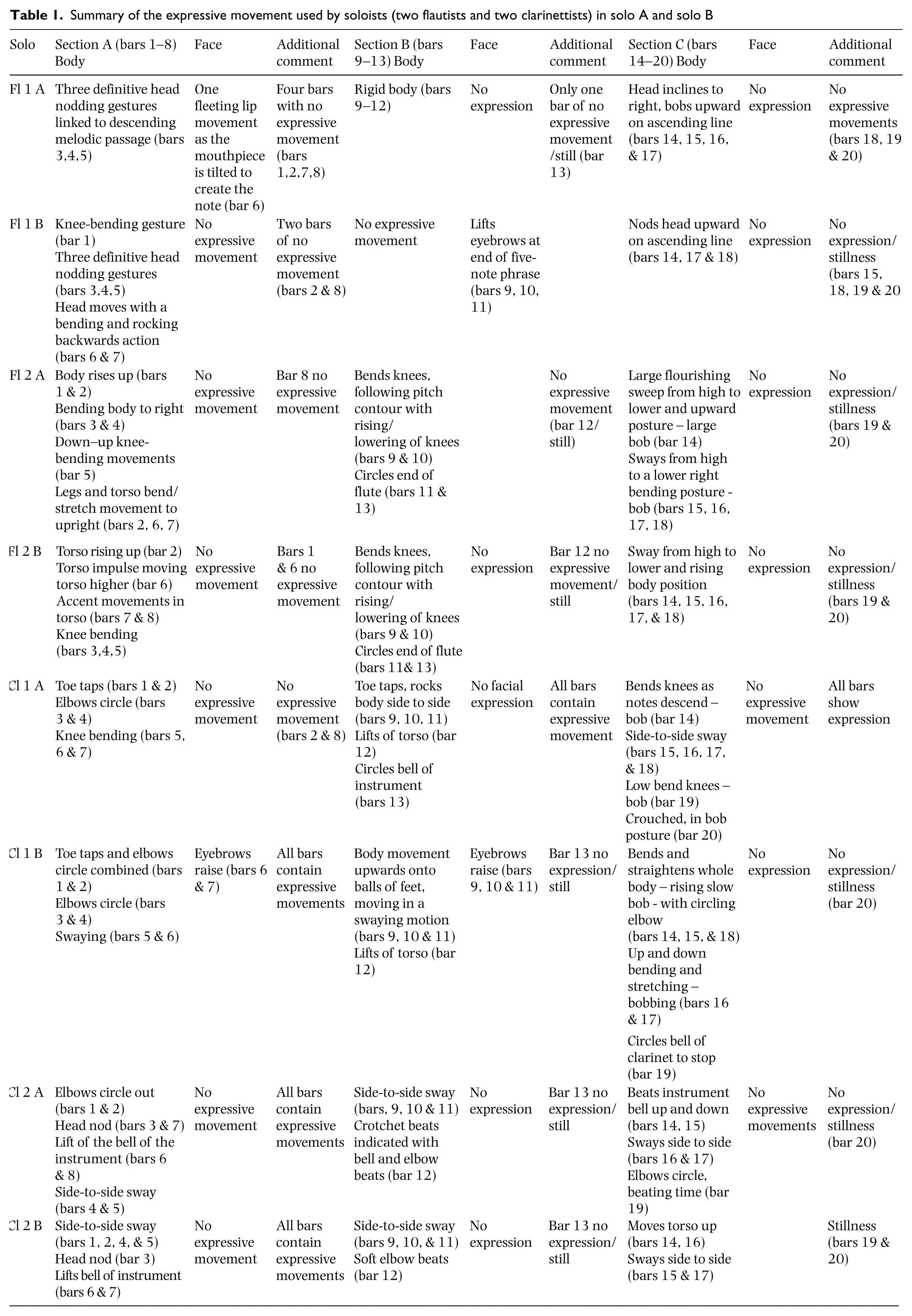
A final level of descriptive analysis is shown in Table 2, distilling the expressive movements observed in these performances into a movement vocabulary employed by the instrumentalists. It is clear that, though there are small variations between instruments, the movements generated are of a consistency that at some level relate to the way in which the instruments are held and blown.
Types of movement across performers
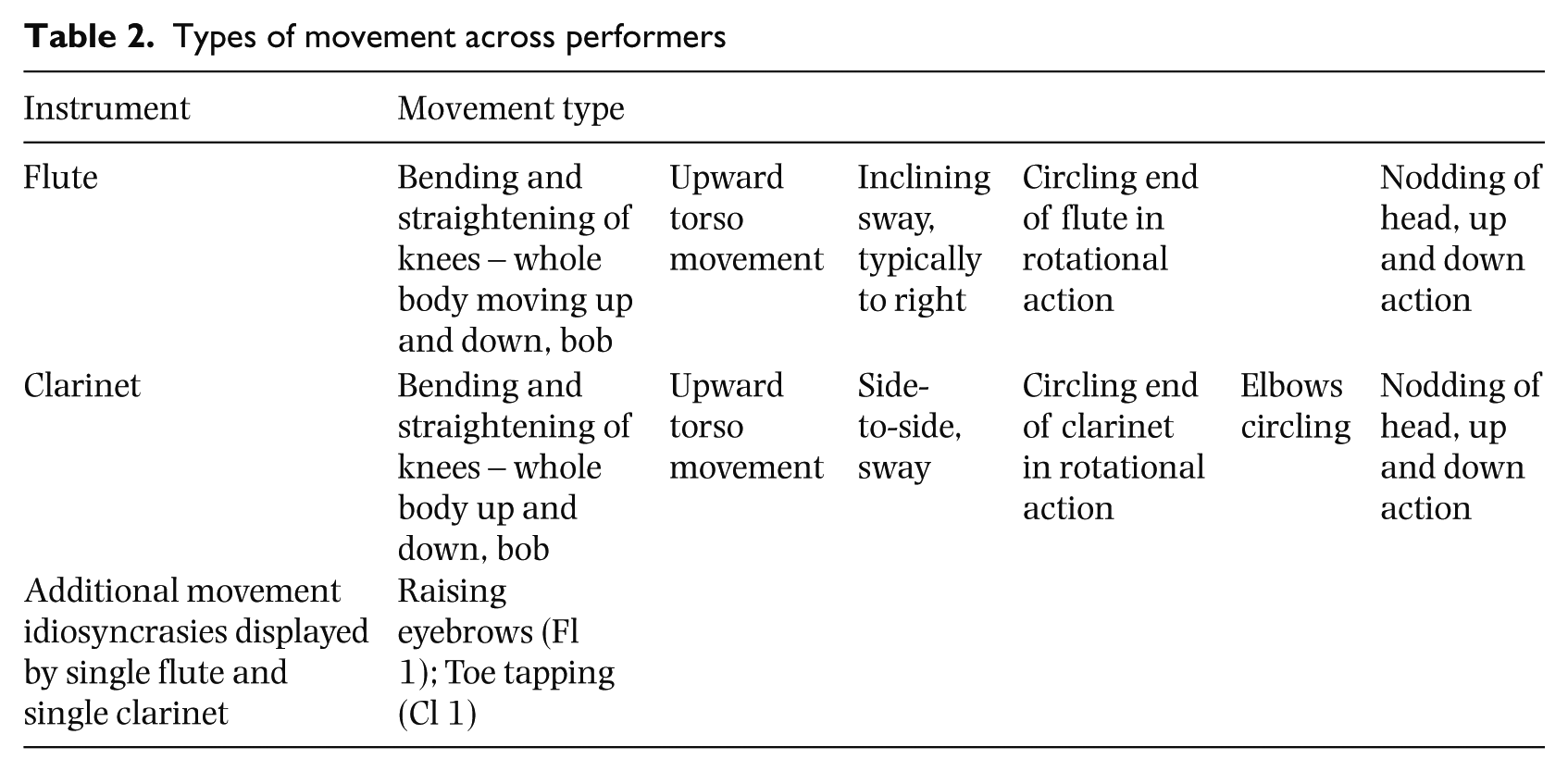
Furthermore, both instruments seem to use similar physical means of generating musical effects. For example, the continuity between notes across a bar-line or in an arpeggiated figure is achieved with specific movements. The sway (side-to-side rocking action, with weight being shifted from one foot to another and the torso inclining in the direction of the foot bearing the weight of the body) or the bob (an action of bending and straightening the knees, with an accompanying rising and falling of the torso) appear to be used to generate energy and direction in the musical phase. The four instrumentalists use the circling action of their instrument as an expressive gesture, most typically in situations of phrase end and musical closure.
As Wanderley and Vines (2006) and others have noted (see Thurston, 1977 on clarinet technique), whilst these actions are not necessary to close a phrase – a dabbing, punctuated action could equally be employed – there is evidently a cultural practice that encourages this movement. Also, the players report that this sort of rotational action: ‘feels natural, is pleasurable to do, and beneficial to achieving musical goals’ (clarinettist in ensemble 1, commentary in between run-throughs). This is of course connected in a direct physical way to the elbow circling, again something both clarinettists observed to be a characteristic of western classical playing. Though the clarinettist in ensemble 1, who was also a highly experienced teacher, noted that it is a very natural and pleasurable movement, she does try to moderate the amount of movement undertaken, for if too much movement is present ‘some of the technical control issues of blowing are negatively affected’. Surprisingly, there were very few facial expressions, except for raised eyebrows, which were not consistent features of the run-throughs. The fact that both instruments involve the mouth in holding the instrument and generating the breath-flow required to produce the musical tone could affect the degree to which the face is used for expressive ends.
Coordination is necessary for ensemble performance, so it was in this context that expressive facial actions were specifically hypothesized as communicative tools.
The duos – number 1 (duo A) and number 6 (duo B)
The same process of descriptive analyses was undertaken in the duos as in the case of the solo performances. Appendix 2 reveals the movement profiles of players in the duo condition. Evidently these share strong characteristics with the solo run-throughs. But, as Table 3 condenses this information, in the duo condition, we see that the musicians modify the way in which they move in order to synchronize and interact closely with one another.
Summary of the expressive movement used by the flautists and clarinettists in ensemble 1 and ensemble 2 in the duo A and duo B performances of Mark Slater’s composition

The following points are worth noting:
Although once again there are no facial actions, these performances include a number of glances to coordinate entrances, exits and musical effects;
Whilst the types of movements used are of the same gestural repertoire as those adopted in the solos, in the ensemble condition the movements are clearly undertaken for interactive purpose, for example the bobbing and swaying in bars 14–18 show the interactions between the instrumentalists and the musical lines, the bodies clearly contributing to the achievement of the coordination;
With the first performers – the professional ensemble 1 – it is the clarinettist who leads the movements/music, whereas in the second ensemble, it is the flautist who seems to lead – evidenced by the nature of the glances between players, and the more dominant role in leading a bar or bringing off notes.
The ensemble work shows its interactive nature and the usefulness of the glances as well as bobs, nods and sways to coordinate musical effects. In fact, in both ensembles there was little discussion, but an entwining of bodies that settled the interpretation almost immediately. In ensemble 2, the B duo was very similar in its musical ideas to A duo, and the video data demonstrates a tuning in to the task through the movement style.
The long-established ensemble 1 reveals a contrast in personal playing styles. The clarinettist is highly dynamic in musical ideas and the use of her body. She leads the flautist, who becomes far more active with her body in the ensemble condition than the solo performances.
Discussion
This study provides rich data going some way to understand the type of bodily movements and facial actions used in the production of an expressive musical performance. In summary, it seems that the biomechanical features of playing the specific woodwind instruments used leads to some rather specific uses of the body; for example, the leaning movements of the flautists. The range of expressive bodily movements used are limited (see Table 2), but seem to serve a function closely allied to articulating expressive effects depicted in the musical score. For example, the subito tempo primo in the clarinet part at bar 12 leads to both clarinettists beating the crotchet pulse, one using the upper torso, the other using elbow beating movements, thus moving the end of the instrument. This specific example raises a point that draws this study’s findings back to the results of previous research: there is a movement vocabulary, but it can be used in a variable manner for similar expressive ends. Indeed, in the duo conditions the two clarinettists still make the emphatic beat movements on the crotchets, but in the case of clarinettist 1, she uses head nods instead of upper torso beats, whereas clarinettist 2 continues to make elbow beats and circles with the end of the clarinet. This finding was also apparent in analyses of detailed repeat performances by a pianist (see Davidson, 2007).
The duo performances are highly interactive, showing how these performers coordinate using movement in order to achieve a consistent musically expressive goal, for example in bars 9, 10 and 11, the on- and off-beats of the clarinet to flute bounce between one another with bodily movements of sways, bobs and nods, that bring the players into a tight coordination.
We also observe that glances assist with musical coordination, but that these are not as frequent as one might have imagined. They do not happen regularly, but rather at major boundaries: at the start of the work, the transitions between sections at the end of the work. This is consistent with the observation of piano duettists (Williamon & Davidson, 2002).
It is somewhat surprising to note that, with the exception of isolated moments when eyebrows are raised or the lip moved, generally, the performers do not display any of the expressive effects on their face.
The movements described in this study are a phenomena I have observed in every single study I have undertaken, and has led me to refer to Cutting and his colleagues’ work on the idea of a centre of moment for physical expression (Cutting & Proffitt, 1981; Cutting, Proffitt, & Kozlowski, 1978). The theory argues that there is a central point about which all other movements operate – swinging, swaying, and rotating – which is crucial in the disclosure of information about intention. Working with a pianist/composer (see Davidson, 1995), I attempted to control a music-learning situation by introducing a learning condition that constrained pianists from moving in this circular, swaying movement during learning and performance. The results revealed the final performances to be far less musically expressive than those where the performers were allowed to sway and rotate freely. The upper torso swaying or rotation observed in the flute and clarinet work may indeed be a core element for generating coordinated and pleasurably natural musical expression (see Davidson, 2005, for a fuller discussion of this idea), since Cutting and colleagues argue it is the natural means through which the body manifests its internal intention. Or, as Runeson and Frykholm (1983) note, movements specify their causes. In Davidson and Malloch (2009), I noted that the core of a good musical interaction seems to depend on the musicality inherent to the performer and naturally expressed through the body.
Intuitively, we all know that we rely on facial expressions for the communication of emotional intention in social meeting: the face revealing vital cues about the emotional state of the person encountered. Yet the woodwind players in the study barely showed any expressions on their faces. One possible explanation for this is that, since they hold their instrument in or close to their mouths, the face is too occupied with the activity of instrument control. Another allied possibility is that the gestures they do make, such as sways and bobs, are in fact expressions of internal states that can be expressed at a number of levels from face to finger tip, and that, in the context of woodwind playing, the body is a better means of articulating this inner intentional state. This idea would be consistent with the work by Cutting and colleagues, which showed that any part of the moving body could provide sufficient expressive information for identity to be revealed. Also, in Davidson (1997), I revealed that head-only and hands-only information from pianists revealed virtually identical expressive information to observers, suggesting that the movements had an expressive equivalence.
Facial expression has been reported in studies on co-performer coordination (see, for example, Davidson & King, 2004; Williamon & Davidson, 2002), revealing that glances and eyebrow expressions as well as smiles have been used to coordinate entrances and exits in string and keyboard ensembles. But empirical work on instrumentalists has been very limited, certainly in terms of facial expressions generated as the player performs. Facial expression has received some experimental coverage in the music, movement, and expression research, but focused centrally on singing. For example, in observing singers, Ohgushi and Hattori (1996) showed that musically trained observers found facial expression better at communicating emotion than the auditory alone. Scotto di Carlo and Guaïtella (2004) demonstrated that emotion was identified better in speech than song; however, voice alone did not communicate emotions as well as when combined with a visual image. The singer’s facial expression was found to influence observers’ judgements of musical dissonance, interval size, and affective valence (Thompson, Graham, & Russo, 2005). Thompson and Russo (2007) revealed that observers were able to detect the size of the interval sung based on visual information from facial expressions and head movements alone.
Given the result that no expression was found on the faces of both flautist and clarinettist it was decided to develop a study of another instrument. Even though we know the face to be a rich source of expressive information in many contexts and in some musical contexts, the second stage of the current paper was to investigate whether instrumentalists who do have the freedom to make facial expressions in their playing – that is players who do not blow a musical instrument – do so in a manner consistent with the overall body gestures used. For this reason, a single exploratory case study of a pianist was undertaken.
As the expressive bodily movement in the first study seemed very clearly related to musical structure of the work, it seemed that a second useful step would be to perform a work where there was an explicit emotional narrative, hence one of the major Romantic works for piano was chosen, to see whether this affected expression. Finally, the first study had not involved live performance, so there was no sense of whether or not some communicative audience-directed expressions could have been used and added to the palette of expressive movements. Rather than working in the confines of the laboratory, it seemed necessary to explore real live concert performances to explore audience effects. These approaches had been adopted before in my observations of popular performance (e.g., Robbie Williams in Davidson, 2006). In this context, the approach was to look for a world-leading performer working in major live concert situations.
Study 2: A pianist’s use of bodily and facial expression in performance
A second step in understanding the physical expressions of musicians was to look again at pianists, as previous studies had revealed identifiable expressive body movements (see Davidson, 1994, 2007). These included head nodding, head shaking, body swaying, and a range of wrist rotation, hand lifts and hand and arm lifts. In the studies from 1994 and 2007, the face was not examined. For the current study, given the recent results of research by Thompson and colleagues, and also adopting Cutting’s ideas of expressive intentions being represented at a number of levels in the body (e.g., upper torso movement as well as hands), it was hypothesized that compound body movements/facial actions would be generated by the pianist for expressive purpose. For example, a raising of the eyebrows and lifting of the left hand as a creation/reaction expression to the pianist anticipating a resolving chord in a cadence. Taken together it was posited that these combined movement/facial expressions would be part of a movement vocabulary for the communication of the performer’s expressive intention.
Stimuli
A filmed recording of a live performance was used in this study. It was necessary to use filmed data, so that repeated viewings of the data could be used to create an analysis. The artist, Lang Lang, was chosen since he is renowned for his highly communicative and expressive performances. The film was accessed through YouTube (Sissco, 2006).
Musical stimulus material
Rather than using a work composed specifically for the task (as in the first study in this paper), it was deemed valid to draw upon the standard concert repertoire. Liszt is popular core repertoire for pianists. The Liebestraum (Dream of love), Nocturne no. 3 is based on a poem by Freiligrath, O lieb, so lang du lieben Kannst (O love, as long as you can love). The poem expresses the ‘all-conquering power of love and kindness’ that urges lovers to love with the essence of their beings and never to express a harsh word, for death soon brings separation and regret. Whether or not Liszt follows the narrative literally, it is obvious that the work is created with this poem in mind. Also, the pianist performing this work will certainly be familiar with the narrative and so it could be considered as a known element for expression in performance.
Procedure
The filmed recording of the performance was observed through multiple viewings by the author and a graduate student, Sharon Chung. Initially this was done independently, and then the observations were brought together, compared and discussed. Since there was more than 95% agreement in both the location and type of movement identified independently, and the conversation between observers brought 100% agreement, no statistical test of agreement level was undertaken.
Results and discussion
This live performance had been edited for broadcast using cameras set at five different camera angles, with the final version for broadcast being shown in each camera angle as follows:
Front-view close up (1 minute, 10 seconds);
Rear-view close up (44 seconds);
Side profile shot – medium distance (14 seconds);
Side profile shot – long distance from back of auditorium (5 seconds);
Keyboard close-up (2 minutes, 1 second)
As the body including face was only in camera shot for a quarter of the whole performance, the total description of note-by-note expressive movements/facial actions that had been possible in the first study (Appendices 1 and 2) was not possible in this context. However, after multiple observations of the film, it became evident that the pianist did produce compound bodily gesture/facial actions on every observable moment of expressive action seen on film. That is, all the expressive moments identified included the compound body/face actions. These compound expressions could be implied in some other camera shots; for example, the rear view shot often showed the head turned to the side so a facial expression could be in part observed and so seen to coincide with a forward and crouched torso movement; and the medium distance shots showed the face in side profile. Thus careful viewing by the two analysts permitted a gestural repertoire to be recorded for Lang Lang performing this work, and this is listed in Table 4.
Showing bodily and facial expressions used by Lang Lang in his performance
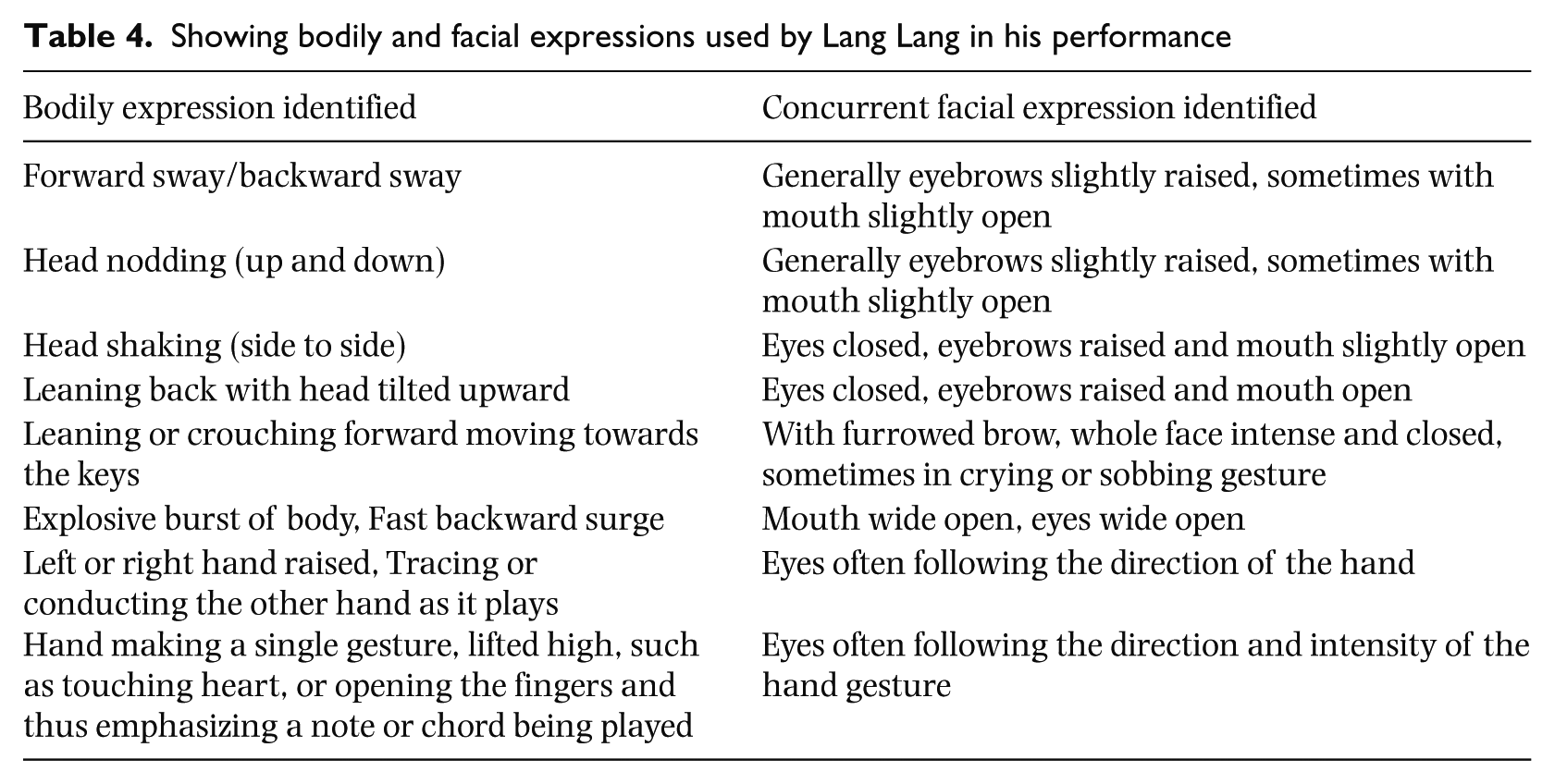
From this table, the initial hypothesis for this study is supported. That is, there would be facial expressions and a relationship between the facial expressions and the body movements generated by this performer. Furthermore, it became evident that the body movements were rather similar in type to those discovered in a study of another pianist in Davidson (2007). For example, body swaying, head nods and shakes and hand lifts. Given the commonality in these major areas of the body used for expressive purpose, it could be that these indicate types of expressive body movement most typical for generating expressive gestures in piano performance. These expressive movements were found to have links to musical structure. For example, the swaying seemed to have some correspondence with the overall rhythmic pulse; the nods were related to the placement of chords or key notes and the hand lifts traced a melody line or chordal effect occurring in the other hand. But these body gestures each have a corresponding facial expression: the crouched, hunched position having a frowning intense facial expression to accompany it; the backward stretching body posture having a raised eyebrow and closed eyes.
To illustrate Lang Lang’s movement repertoire, examples of these compound bodily and facial expressions are captured in a sequence of photographic stills, kindly created from the video by Sharon Chung. 1 Though these images ‘freeze’ the dynamic and unfurling performance, they nonetheless indicate the different types of expressions found. Note that these stills come from the opening six bars (bars 1–6), and the musical climax of the work (bars 55–60). These two points were selected as they were both available for observation from the film edit in front/side view and because they represented key moments in the work’s structure.
From the initial upbeat note in the left-hand, Lang Lang began to move with a swaying movement towards the keys. As he played the third repeated middle C, he shook his head from side to side and changed the direction of the sway backwards, away from the keyboard.
During these first six bars, Lang Lang swayed forwards and backwards, and as he approached the cadence over bars 5–6, his body moved backwards in the swaying action, raising from a crouched to upright sitting position, and shaking the head over the three ascending notes at bar 5. The eyebrows were also raised during this action (see Figure 2 and Figure 3).
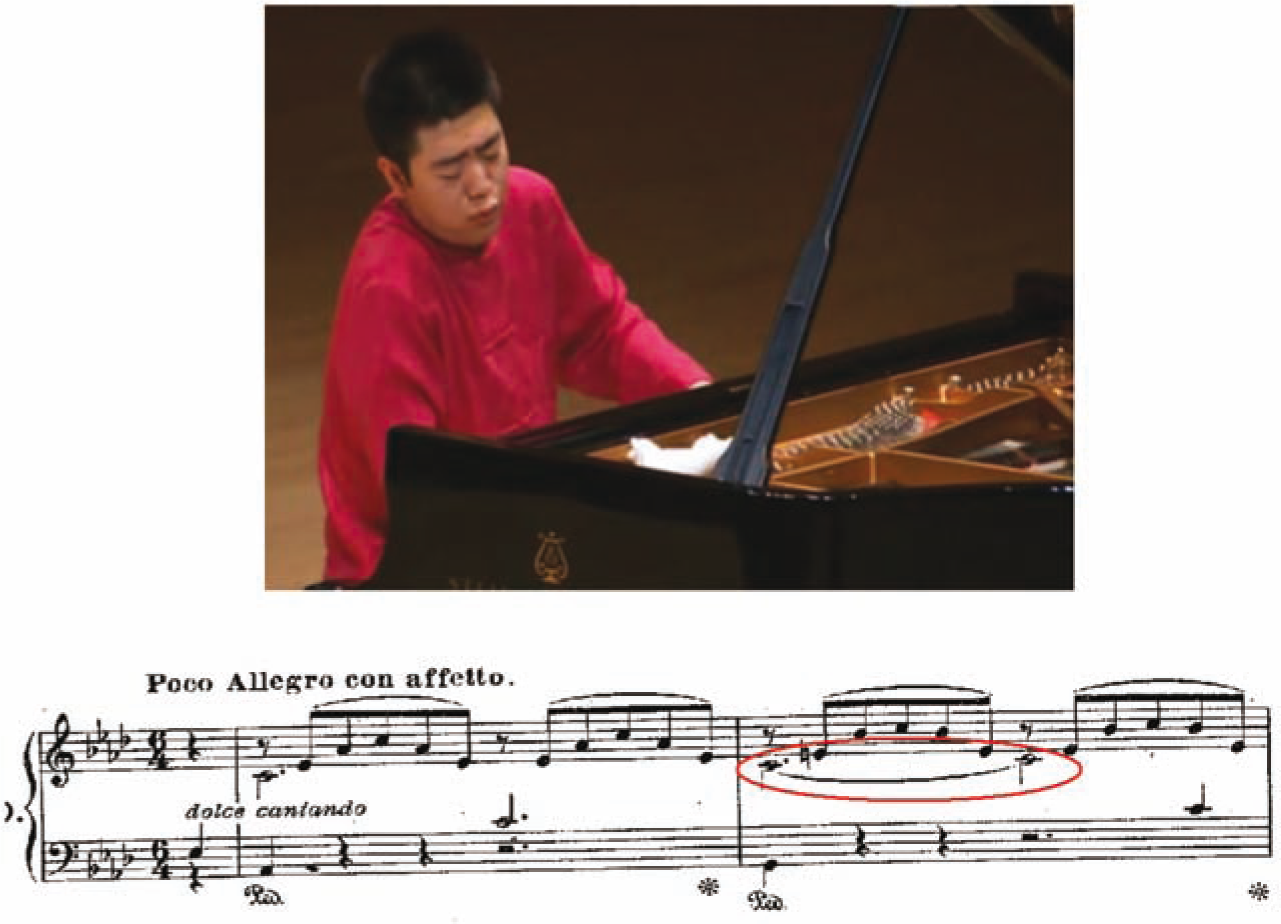
Showing the first expressive gesture, captured in bar 2, as Lang Lang plays the third C of the phrase (the corresponding musical moment is also shown in the score excerpt)

Measure bar where Lang Lang is playing three ascending crotchets, the musical score excerpt indicates the precise location
The movements seem to indicate the musical relaxation and a lessening of physical tension. Then, as Lang Lang struck the C minim in the middle of bar 5, he relaxed and nodded his head backwards, releasing his jaw and letting his mouth fall open (see Figure 4).

Lang Lang playing the minim C in the melody of bar 5
At the work’s climax, bars 55–56, the body is swayed in quite an exaggerated manner, and before reaching the climax of the high-G octave, Lang Lang’s facial expression anticipated the building tension with frowning eyebrows, closed eyes, and tensed facial muscles, with the mouth slightly opened. The image shown in Figure 5 is one of anticipation of the musical/emotional climax. At this point, the musical interpretation is highly involved, with a strong dynamic and building musical tension. The climax and release, and subsequent movements are shown in Figures 6 and 7. The body surged forward (in the swaying action), the left hand and arm burst off the chords and Lang Lang surged backward, his face showing the open-mouthed release of tension.

Lang Lang’s expression at the first chord of the main climax of the work at bar 55
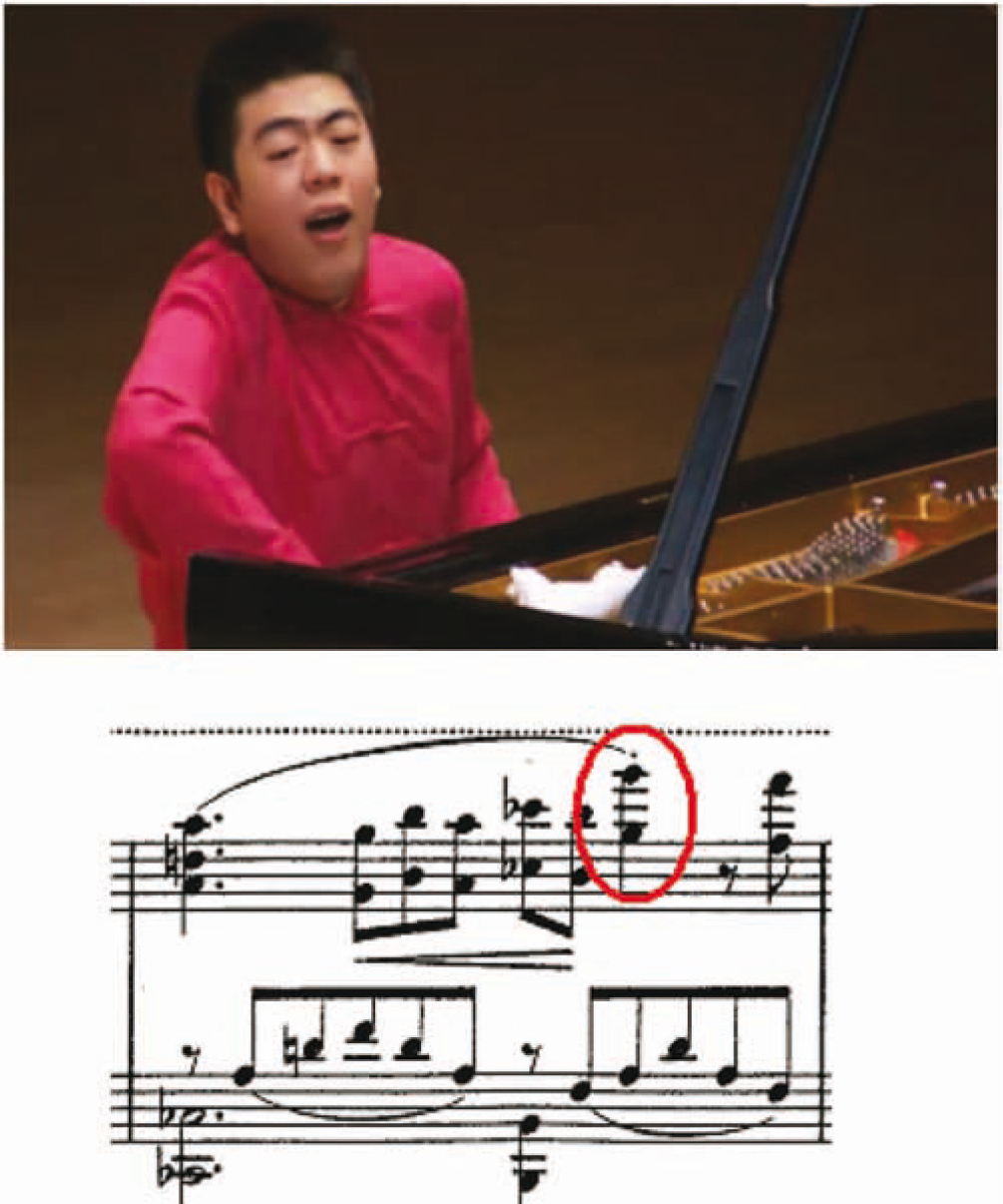
Execution of the octave Gs, the notes of the phrase climax at bar 55
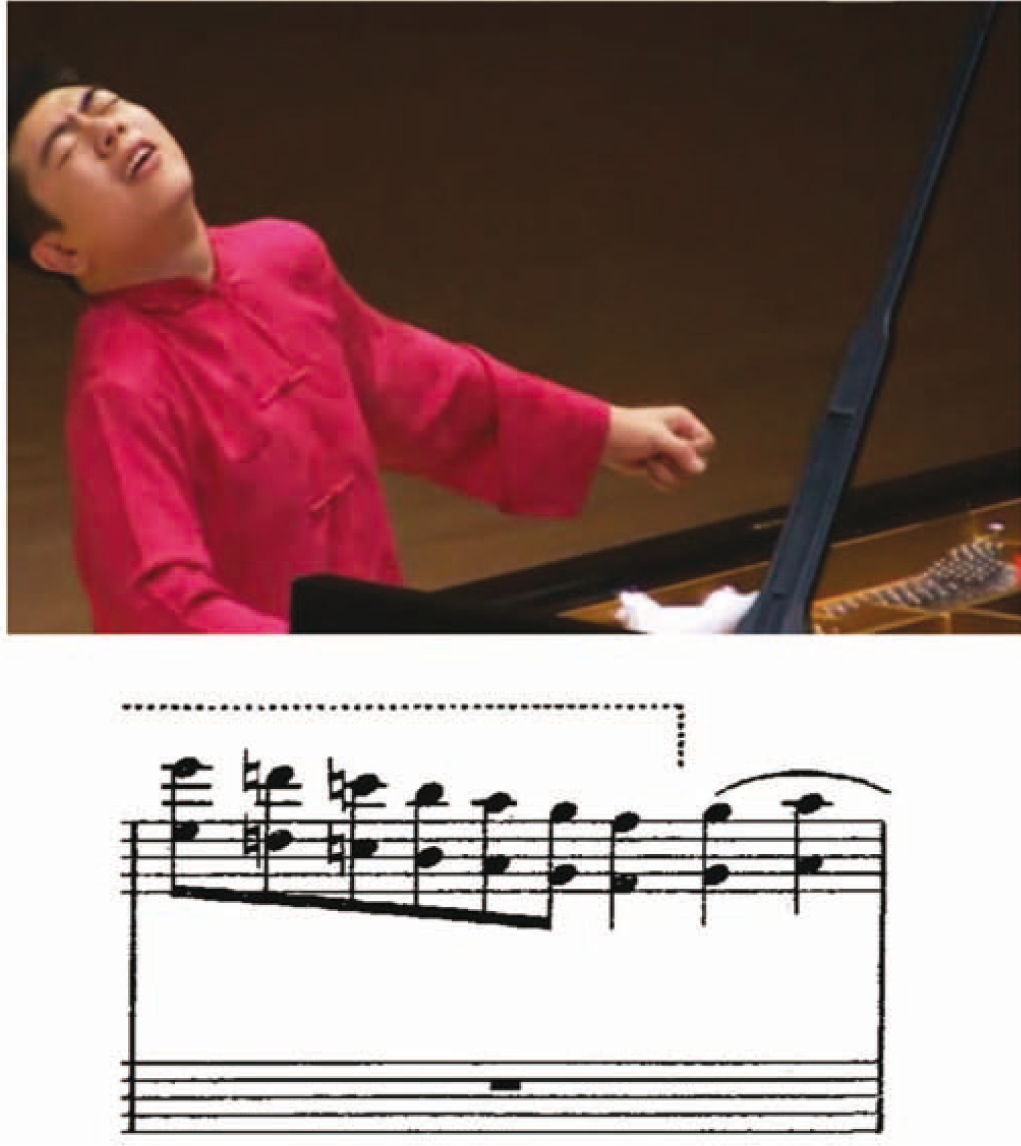
Lang Lang plays the descending quaver passage as the musical climax subsides, bar 56
After the climax, the downward octave melody in bar 56 was played with emphasis on every note, now in a slower tempo, and the physical expressions displayed a reflective and contemplative rather than tense quality. Lang Lang’s body swayed backwards, away from the piano with a tilt to the back of his head. He frowned, closing his eyes and slightly opening his mouth, raising the left arm and hand towards his chest, in a gesture which strokes the location of his heart (Figure 8).
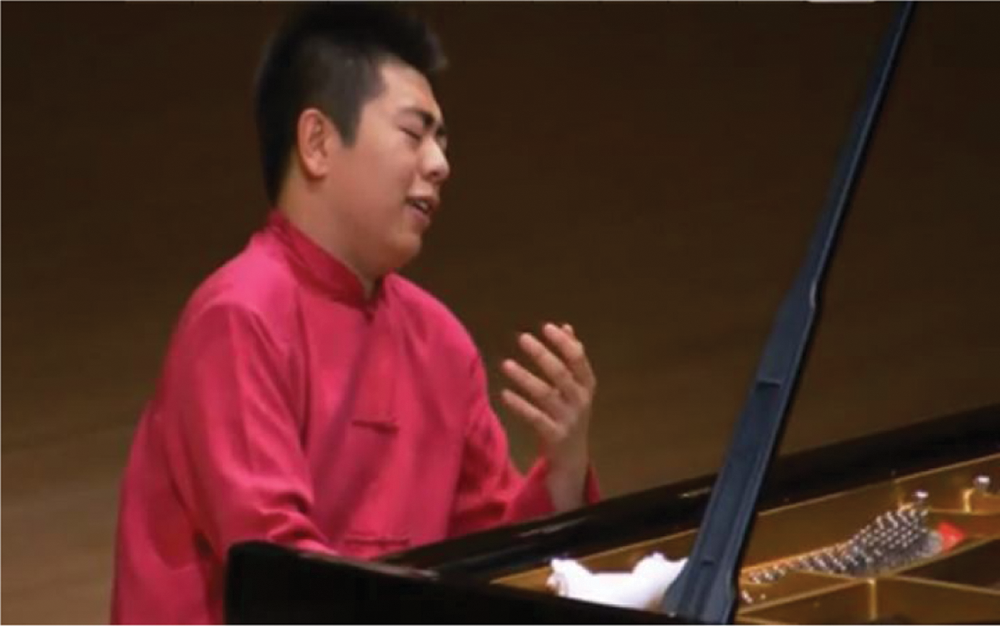
Lang Lang as he plays the last two crotchet octaves of bar 56
After this short period of musical and physical relaxation, the music builds again (bars 57–59) and the forward and backward swaying once more began to build in momentum. Lang Lang revealed a more fragile expression with frowning eyebrows, tensely closed eyes, and upward moving cheek muscles causing the edge of the lips to raise into a crying/sobbing gesture (see Figure 9).
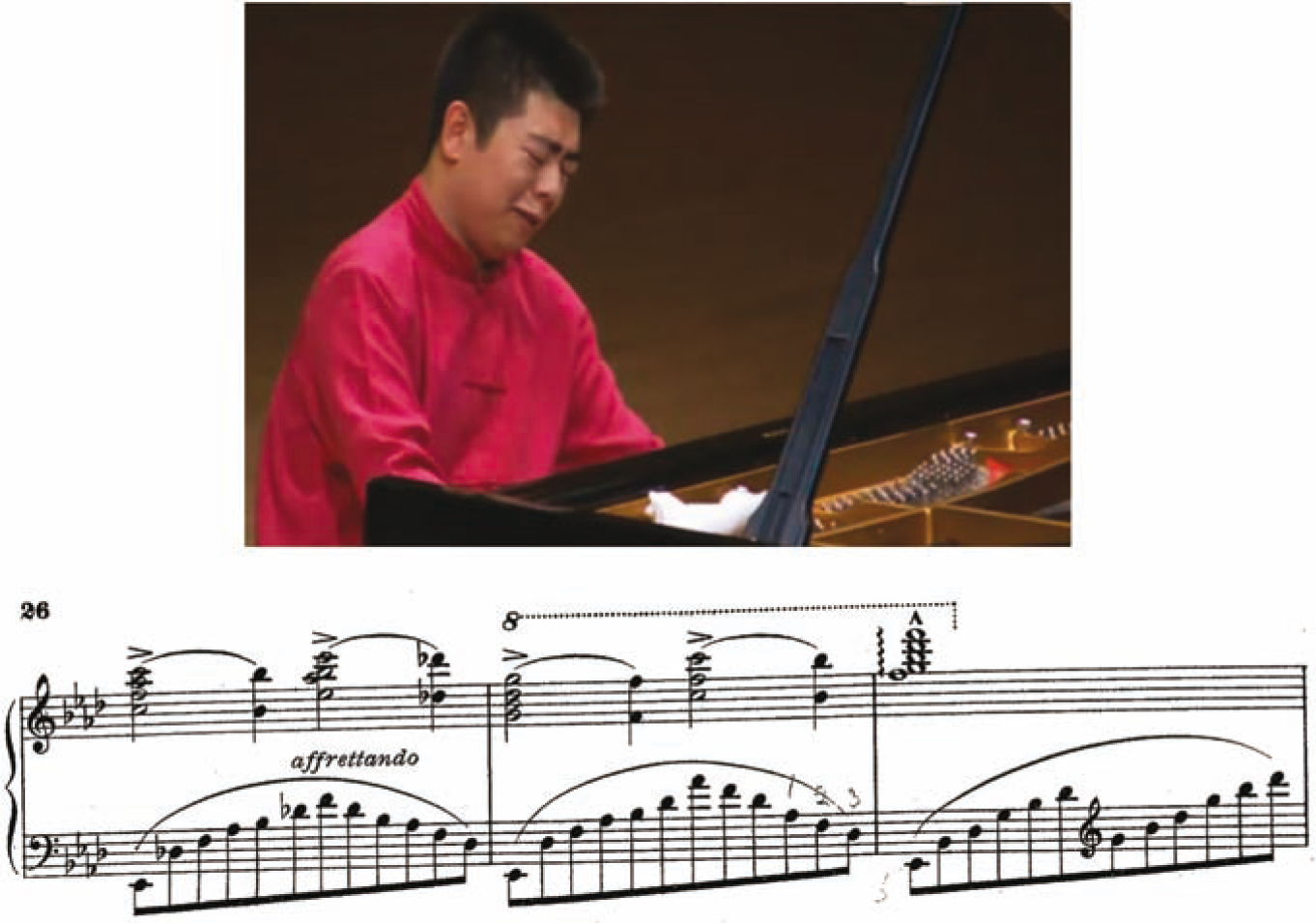
Lang Lang playing bars 57–59, and the music excerpt from the score
After this passage, the music moves into a chromatic ornamented cadenza at bar 60, during which Lang Lang bent forward, hunched over the keys, but with the face in a smiling position, the corners of the lips and eyebrows being raised (see Figure 10).

Bar 60 – and the chromatic descending melody line
After this passage, Lang Lang smiled more broadly, lifting his head and raising his eyebrows across a rising arpeggio figure (see Figure 11). As he struck the first note of the re-commencement of chromatic notes, he raised his left hand and moved it forwards, as if marking the new section and then tracing the shape of the melodic line being played in his right hand.
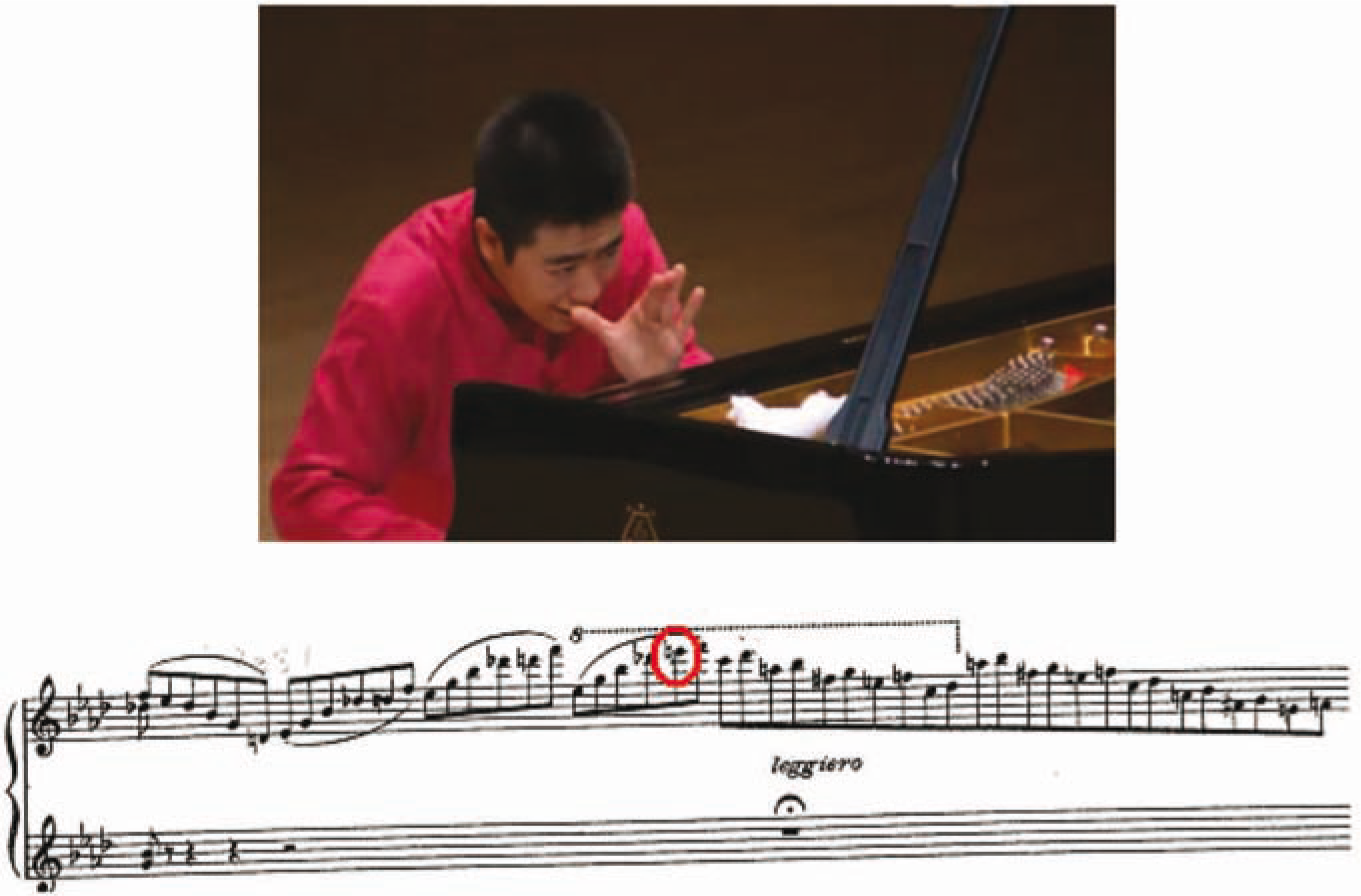
Bar 60 on the turning point of the chromatic descending passage, after the extended arpeggio passage
At this turning point from major chord arpeggio to the leggiero chromatic descending passage, Lang Lang looked up to his left hand, keeping a smile on the edge of the mouth as this chromatic passage continued in the lighter sonority. The hand gesture makes the musical turning point very prominent together with the use of Lang Lang’s facial gesture.
In summary, Lang Lang generates an intense expressive intention whose message is distributed across both body and face. Evidently, there is a strong relationship between musical structure, its execution and gestures that suitably accompany it, either to generate, coincide with, or respond to the structure and its effects. Although an audience per se has not been asked for feedback here, I spent many hours analyzing this performance, and it is apparent to me as a perceiver that an expressive narrative can be read into the performance which maps consistently with what we know about the compositional intention of the work by Liszt. In this context, it is an intimate love encounter. Lang Lang’s own use of physical tension and abandon leads to a decoding of the meaning associated with the tension and release of physical intimacy, as shown specifically in bars 55 and 56. Whether consciously employed or not, the physical expressions of the body and face offer a means by which the performer can generate expression which is both integrated into the musical effects created – timing and dynamic effects – and which exists independently of them. That is, I can observe these expressions of physical release in the still images, or better still, experience them as I observe the dynamics of the performer as observed on film, or indeed in the live performance context.
Conclusions
This paper has comprised a literature review and two rather different case studies. Taken together, the contents demonstrate that playing a piece of music requires high-level interaction of developed cognitive and action processes. Musical performance skills involve the biomechanical aspects of playing the music fluently, but coexist with expressive intentions manifested through bodily movements and facial expressions that permit the communication of musical intention (clarifying musical structural features), or meaning (narrative designated such as the Liszt piano work).
In the first study there was a strong and common base for the expressive gestural vocabulary for the two clarinettists and the two flautists. Across the two different types of woodwind instrument used, there were identifiable gesture types employed, though there were individual stylistic differences. Surprisingly, facial expressions were lacking in the performances of these woodwind players, but this was explained at least in part as a consequence of playing the instrument by mouth. The study demonstrated both individual differences and how performers influence one another when playing in a duo. The results showed that in an ensemble a more dominant player shapes the less-dominant individual’s interpretation and movement patterns. In the case of an experienced professional duo, this interaction encouraged a physically and musically restrained interpreter to engage in a dance-like interaction with her more fluent partner affecting a positive, rather than negative, outcome.
The second study revealed that, for the case-study pianist, facial expressions were present and were clearly consonant with the larger-scale expressive bodily gestures that were being generated. In other words, the facial expressions provided information of a similar type to the overall bodily movements, offering an additional layer of information about expressive intention.
Revisiting the research questions asked at the start of this paper, we have been able to explore bodily movements and facial actions used in the production of an expressive musical performance and noted that, despite differences according to instrument, swaying is an overarching expressive device used by three different types of instrumentalist. We also found that, owing to the interactive movement activity in the duo study, bodily movements can be of a communicative nature for co-performers. In the case study by Lang Lang, we see that the compound movements of body and facial expressions offer audience members an insight into the articulation of musical structures as well as the narrative of an underlying meaning of the work – in this case the power of physical love.
Whilst the work offers only preliminary observations, it does much to reinforce previous studies and supports again this notion of a physical centre for expressive information which might operate in a hierarchical manner (cf. Cutting & Proffitt, 1981; Cutting et al., 1978). That is, at a global level as captured in swaying or swinging gestures or in a local manner in a movement such as a raised eyebrow or a hand lift. Indeed, the movements categorized in Table 2 and Table 4 all stem from the core swaying movement as a fundamental element of movement expression in the woodwind and the pianist’s performance. At an initial level, then, the expressive bodily movement operates to generate in the music an immediate and communicative purpose for the performer as he/she creates the performance (generating and responding to the musical sounds in an interactive manner between self and music, rather like what Watt and Ash suggested in 1998). But the data in the first study also reveal a second level of function: to provide co-performer cues for regulation of musical content and expression of immediate and perhaps idiosyncratic expressive content. The movements used to generate these stimuli draw from individual movement repertoires that are based on a shared biological/culturally bound way of moving, as shown in the commonality of the areas of the body which revealed expressive information.
Returning to the overarching research questions that underpin all my research into expressive body movement, it is evident that the two investigations undertaken in this paper have contributed new knowledge in the area by showing which movements are regarded as positively musically expressive. It has been demonstrated that bodily movement is a key area for further enquiry for both performers and audiences alike.
Footnotes
Appendix
Bar-by-bar description of the duettists movements in duo A and duo B
| Bar no., section A | 1 | 2 | 3 | 4 | 5 | 6 | 7 | 8 |
|---|---|---|---|---|---|---|---|---|
| Fl 1 duo A | Glance to Cl, nod | Up and down movement matching of head nods of Cl | Head nods in time with elbows of Cl | Head nods in time with elbows of Cl | Head nods | Body moves upward | Beats time with head | Beats time with head. Looks to Cl |
| Cl 1 duo A | Glance to Fl, nod | Nod on strong beat | Elbows circle outwards | Elbows circle outwards | Elbows circle | Bending knees, following pitch contour with rising/lowering of knees | Bends knees, following pitch contour with rising/ lowering of knees | Glances to Fl for end |
| Fl 1 duo B | Inclines torso towards Cl | Still | Moves with fluency, knees bending in time with Cl circling | Head nodding and knees bending | Head nodding and knees bending | Head nodding and knees bending | Glancing Cl, head nodding on accents | Glances to Cl |
| Cl 1 duo B | Inclines towards Fl | Elbows circle out | Elbows circle, more energized | Elbows circle, more energized | Elbows circling | Up and down nodding with flautist | Watching Fl, directing timing | Glances to Fl and brings them off with circling of bell |
| Fl 2 duo A | Glancing at Cl, body rises up | Body moving to a high still position | Up and down, bobbing | Sways | Sways | Glancing at Cl, sways | Reaches full height and stays still | Still |
| Cl 2 duo A | Bobs up and down in synch with Fl | Bobbing with elbows circling | Bobbing | Bobbing | Side-to-side sway | Lifts bell of instrument elbows circle | Sways side to side, accenting notes | Holds bell up still |
| Fl 2 duo B | Still | Torso rising slightly to higher posture | Gives upward body impulse, then bends down | Gives upward body impulse, then bends down | Smooth gradual raising of torso, | To still posture | Pulses the accented beats with torso movements | Beats torso in silence |
| Cl 2 duo B | Side-to-side sway | Side-to-side sway | Up and down nod with bell of instrument | Side-to-side sway | Side-to-side sway | Lifts bell of instrument | Lifts bell of instrument | Holds bell up still |
| Bar no., section B | 9 | 10 | 11 | 12 | 13 | |||
| Fl 1 duo A | Inclining sway, to right, in synch with Cl | Inclining sway, to right, in synch with Cl | Inclining sway, to right, in synch with Cl | up and down head nodding, accompanies Cl accents | Still | |||
| Cl 1 duo A | Sways body side to side | Sways body side to side | Sways body side to side | Head nods on accents | Circles bell to close off the note, then still | |||
| Fl 1 duo B | Bobbing in time with quaver beat | Bobbing in quaver rhythm | Bobbing up and down in quaver rhythm | Inclining towards Cl | Glances to Cl | |||
| Cl 1 duo B | Vigorous bobbing and circling of instrument | Vigorous bobbing and circling of instrument | Vigorous bobbing and circling of instrument | Head nods on accents | Glancing to finish in synch | |||
| Fl 2 duo A | Down up nodding | Down-up nodding | Circles end of flute, rises up to full height | Still | Circles end of flute in silence | |||
| Cl 2 duo A | Up down nodding, | Up-down nodding | Side-to-side sway | Strong crotchet beats indicated with bell | Circles Cl to come off note | |||
| Fitting timing with Fl | ||||||||
| Fl 2 duo B | Bobbing - follows pitch contour with rising/ | Bobbing – follows pitch contour with rising/ | Bobbing | Still | Circles end of flute in silence, looks to Cl | |||
| Lowering of knees | Lowering of knees, interacting with Cl | |||||||
| Interacting with Cl | ||||||||
| Cl 2 duo B | Sway | Sway | Sway | Soft elbow beats | Circles Cl, glances to Fl | |||
| Bar no., section C | 14 | 15 | 16 | 17 | 18 | 19 | 20 | |
| Fl 1 duo A | Sway and head nods | Sway | Sway | Sway | Sway | Still | Still | |
| Cl 1 duo A | Bends knees as notes descend | Sway | Sway | Sway | Sway | Glancing to Fl to finish | Still | |
| Fl 1 duo B | Playing off Cl, bobbing | Bobbing against Cl | Bobbing against Cl | Bobbing against Cl | Sway | Looking to clarinet for end point | Holds position, standing firm | |
| Cl 1 duo B | Bends and straightens whole body, with circling elbow relaxing on rest | Bends and straightens whole body | Up and down bending and stretching | Up and down bending and stretching | Bends and straightens whole body, with circling elbows | Circles bell of clarinet to stop | Stands still and upright | |
| Fl 2 duo A | Large flourishing sweep from high to lower torso and knee upward posture | Bobbing | Sways from high to a lower right bending posture | Sways from lower right posture up to full height | Sways from high to a lower right bending posture | Circles flute to bring off last note | Still | |
| Cl 2 duo A | Mirrors | Bobbing | Mirrors Fl posture | Bobbing | Bobbing | Elbows circles and beat time | Still | |
| Posture of Fl | ||||||||
| Fl 2 duo B | Smooth sway from high to low and then rising body position | Gentle swaying from high to a lower right bending posture | Gentle swaying from high to a lower right bending posture | Gentle sway from high to a lower right bending posture | Gentle sway from high to a lower right bending posture | Still | Still | |
| Cl 2 duo B | Moves body up to full height | Sways | Bobs | Sways | Sways | Still | Still | |

Funding
This research received no specific grant from any funding agency in the public, commercial, or not-for-profit sectors.