



Abstract
The last decade has produced a growing number of studies examining the potential psychological benefits of singing in a choir. Studies have tended to focus on the benefits for groups that might be described as marginalized or criminal. In contrast, the current study focused on members of the general public who regularly participate in choral singing. An in-depth qualitative design was utilized to explore the meaning and importance of group singing for 10 participants. Thematic analysis based on an interpretive approach was utilized to analyse the data. Psychological benefits emerged as two themes: individual and group. A third theme, mediating factors, impacted upon both individual and group outcomes. Eight sub-themes were identified and labelled: psychological, musical, physical, ethos, group dynamic, past experiences, type of choir and musical director. Results illustrate that group singing is a joyful activity that promotes wellbeing and is life enhancing for those involved. Future research directions are briefly discussed.
Choral singing is a popular recreational activity for many individuals. The International Federation for Choral Music currently has over 2,000 members, including choirs, individuals, organizations and businesses and is recognized by the United Nations Educational, Scientific and Cultural Organization (UNESCO). Further to this, the 2003 Chorus America Study reported that 23.5 million American adults participate in choral singing on a weekly basis (Bell, 2004), which indicates that more Americans participate in choral singing than in any other form of artistic activity. Choral singing also has a strong tradition in the United Kingdom, Norway, Sweden and Finland. Between 500,000–600,000 people are involved in choral singing in Sweden alone (Durrant, 2005). Singing in choirs has been found to provide emotional, social, intellectual, creative and physical benefits (Clift, Nicol, Raisbeck, Whitmore, & Morrison, 2010; Gick, 2010). The last decade has produced a growing number of studies examining the potential psychological benefits of singing in a choir (Clift et al., 2010). However, the area of group singing for wellbeing remains under-researched (Gick, 2010).
Music as therapy
The use of music as a tool to promote health and wellbeing can be traced back to ancient times. The first person recorded as using music in this way was Pythagoras, a Greek philosopher and mathematician who lived in the 6th century BC (Gaynor, 1999). However, music therapy as we recognize it today has its origins in World War II, when musicians played for wounded soldiers with the aim of relieving their boredom whilst they were bedridden. More than just being entertained, it became apparent that, for many of these convalescing soldiers, the music provided added benefits such as decreased depression, increased emotional expression and the improvement of socialization and morale (Gaynor, 1999). The earliest studies into the efficacy of music therapy occurred in the 1950s, with the majority of studies exploring the relationship between singing and wellbeing occurring in the 1990s onwards (Clift et al., 2008).
One of the earliest teachers of music therapy, Gaston (cited in Grinnell, 1980), described three basic principles underlying its effectiveness: ‘the establishment of interpersonal relationship through shared musical experience, the enhancing of self-esteem through successful participation in musical activities, and the utilization of the unique potential of rhythm to energize and bring order’ (p. 58). These principles are all intrinsically present in the experience of singing in a group.
Community music therapy
Community music therapy (CoMT) evolved from music therapy utilizing the principles outlined by Gaston (cited in Grinnell, 1980) within a non-medical environment. A qualified music therapist uses music in a group setting, generally involving marginalized or disadvantaged participants, with the aim of achieving a therapeutic outcome (O’Grady & McFerran, 2007). The activities of the group are dependent on the setting and the health of the participants. Although CoMT and community choirs share some characteristics there are some important differences. The music therapist is trained to be able to respond to the health needs of the participants, the music activities are led by the needs of the participants and the therapist has a strict code of professional ethics they must adhere to (O’Grady & McFerran, 2007). It is argued by Davidson (2004) that the social aspect of CoMT plays a significant role in achieving therapeutic outcomes. Davidson focuses on three themes, namely: ‘the individual, the group and the development and emergence of a social self’ (p. 116) in her discussion of the social psychology of music in relation to CoMT.
In contrast, a community-based choir is run by a musical director whose primary focus is music-making and who possesses the ability to nurture musicality in choir members (Murray & Lamont, 2012). In a study exploring the link between conductors, choral singers and their sense of identity, Durrant (2005) reported that conductors referred to themselves as singing teachers. Durrant found the choir was motivated as a group by the musical and interpersonal skills of the conductor. Several choir members spoke of the nurturing quality of their conductor (Durrant, 2005). Unlike a CoMT group, a community choir is open to anyone who is interested in participating, the music activities are directed by the conductor’s musical vision and any therapeutic benefit achieved by choir members is secondary.
Choir-based research
The majority of research conducted into choral singing has focused on participants from specific populations. Examples include homeless people or people living with mental illness or physical disabilities (Bailey & Davidson, 2003; Cohen, 2009; Dingle, Brander, Ballantyne, & Baker, 2012; Silber, 2005). Silber (2005) was interested in secondary therapeutic benefits when she undertook a qualitative study of a choir based in a women’s jail in Israel. The prison choir provided positive benefits to all seven regular attendees that were ascribed to: the relationship between the conductor and the choir members; the relationship between choir members; and the individual’s role as a choir member. In another prison-based study, Cohen (2009) administered The Friedman Wellbeing Scale (FWBS) to two groups of male prisoners, an inmate-only choir (n = 10) and a group of 10 inmates who did not sing in a choir. Data collected before and after the choir’s first performance within the correctional facility revealed no significant difference between the groups on composite wellbeing scores. In the second phase of the study Cohen compared the scores of the same control group with a larger choir made up of inmates from two facilities and volunteers (n = 48). Data collected before and after the combined choir performed outside of the correctional facilities did reveal a significant difference between the control and experimental group in the sub-scales of sociability, joviality, emotional stability and happiness. This result supports the hypothesis that participating in a prison choir, in particular performing outside of the facility, may benefit the wellbeing of inmates.
In a study that included choristers from the general public, Bailey and Davidson (2005) studied the effect of group singing and performance on a Canadian choir established in a disadvantaged community, in comparison to choral singers from a middle-class background. Both choirs derived identical positive emotional benefits from choral singing, although the role of camaraderie was identified as being considerably more important to the marginalized singers. While the activity gave marginalized singers opportunities to improve their cognitive skills, the middle-class singers were more focused on developing musical skills. The opportunity to perform was experienced as inclusive and empowering by the marginalized choristers, whilst the middle-class singers placed less importance on performance but were more conscious of meeting the standards of musical excellence expected by contemporary society (Bailey & Davidson, 2005).
Adding to the body of work focusing on marginalized populations, a recent longitudinal study interviewed 21 members of a choir established for people with a chronic mental illness or disability over the course of 12 months (Dingle et al., 2012). Four themes emerged: personal impact, social impact, functional outcomes, with time being the fourth theme. Results supported the social identity theory that becoming a choir member and thereby creating an additional social identity may result in positive emotional and physical benefits. In support of the physical benefits attributable to choral singing, two studies found that choral singing resulted in increased levels of S-IgA and decreased levels of cortisol during rehearsals (Beck, Cesario, Yousefi, & Enamoto, 2000; Kreutz, Bongard, Rohrmann, Hodapp, & Grebe, 2003). Both studies reported a link between positive emotions and the response of the immune system, thereby suggesting that choral singing may influence an individual’s health and wellbeing (Beck et al., 2000; Kreutz et al., 2003). The current study is aimed at discerning more clearly what the psychological benefits are for participants of choral singing.
Methodology
Research design
Following the methodology of Hays and Minichiello (2005) and Minichiello, Aroni, Timewell, and Alexander (1995), the researcher anticipated that in-depth interviews would illuminate the meaning and importance of singing in the participant’s lives. An in-depth qualitative design was utilized to explore the meaning and importance of singing for choir members within the metropolitan area of Perth, Western Australia. Qualitative research was chosen as it is well suited to uncovering the meaning people attach to the activities they are involved in (Maxwell, 1996). An interpretive approach was adopted as interpretive questions ask people about the meaning of activities they are involved in, ‘their thoughts, feelings, and intentions’ (Maxwell, 1996, p. 59). The in-depth interviews followed the recursive model, being unstructured and conversational in nature (Minichiello et al., 1995). Probing questions were used to gain more detail and aid the researcher to better understand the meaning of the participant’s discourse (Minichiello et al., 1995).
Participants
Participants were recruited via their involvement in choirs and all resided in a metropolitan area of Western Australia. Participants comprised six females and four males, ranging in age from 33 to 72 with the average age being 54. All were members of amateur or community choirs that rehearsed once a week and performed several times during the year. The music performed was eclectic in nature but excluded classical pieces. Eight of the 10 participants had immigrated to Australia at various ages, seven from the United Kingdom and one from Norway. The remaining two participants were born in Australia. Saturation occurred within 10 interviews as the researcher recognized emerging themes and no new information was emerging from the participants (Minichiello et al., 1995).
Materials and procedure
Once ethics approval was obtained an interview schedule, guided by the work of Hays and Minichiello (2005), was finalized. After an introductory preamble, participants were advised that the researcher was interested in hearing about their personal experience of singing in choirs and the role that being a choir member has played in their daily life. The initial question was always, ‘How did you first come to join a choir?’. The interviews were conversational in nature with the focus always being on the participant’s experiences. Where appropriate the interviewer used probing questions – for example, ‘Can you tell me more about that?’ – to gain a clearer understanding of what was being said.
In keeping with the guidelines of the ethics committee of the administering institution, all identifying details of participants were omitted and they were assigned pseudonyms to ensure confidentiality. Additionally, all people and choirs discussed by participants have been given pseudonyms.
Procedure
Analysis was based on the framework described by Braun and Clarke (2006). The digitally recorded interviews were transcribed verbatim and any notes of observations included. The researcher adopted an inductive approach whereby the themes identified were data driven. Analysis of the data followed the procedural framework described by Braun and Clarke (2006). Initial analysis of the data involved the researcher transcribing and reading the interviews several times. Once familiarity with the data was established initial codes were generated. The codes were words or short sentences used to identify sections of data and the first step in enabling the arranging of the large quantity of data into meaningful groups. At this point we began analysing the codes and placing them into potential themes using thematic maps to assist with this process. Thematic maps are diagrams that could be referred to as mind maps. Several flow charts were created illustrating the connections between initial theme ideas created by organizing codes into possible themes (Braun & Clarke, 2006). We employed peer review to maintain the rigour of this process (Liamputtong & Ezzy, 2005). Themes were then reviewed, defined and named. Awareness that the analytic process is reflexive by nature was maintained and the researcher remained flexible throughout the process. Scientific rigour was assessed using the 15-point checklist of criteria for good thematic analysis as provided by Braun and Clarke (2006). These criteria cover the process of thematic analysis including the transcription, coding and analysis of the data, the time allowed for each phase, and the manner it is presented (Braun & Clarke, 2006).
Findings and interpretations
The aim of the present study was to build on existing research by exploring the experience of members from the general public involved in a choir and to discern more clearly the psychological benefits of singing with others. In presenting the multiple factors that result in the psychological benefits experienced by choral singers, the findings will be related to the current literature.
Results
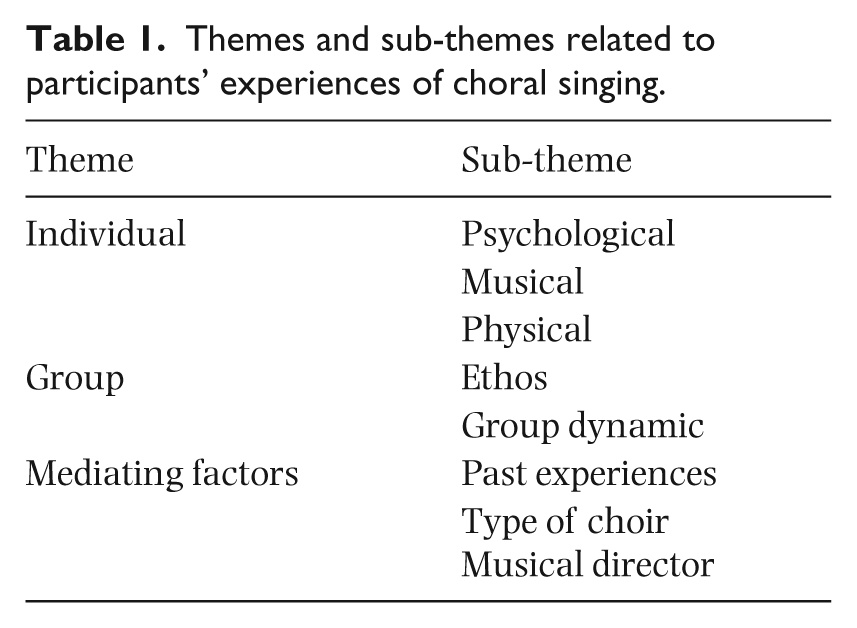
The participants’ experiences of singing in choirs were coded into three themes. These themes were labelled: individual, group and mediating factors (see Table 1). The three themes are interactive in that individual and group influence each other whilst mediating factors has an impact upon both individual and group. Also listed are the eight sub-themes that were identified.
Themes and sub-themes related to participants’ experiences of choral singing.
Individual
This theme relates to the intrapersonal experience of choral singing as described by the participants. Three sub-themes emerged: psychological, musical and physical.
Psychological
Psychological findings relate to the way in which the participants’ individual inner psychology was affected by being a choir member. Of the 10 people interviewed, all described positive emotions as an outcome of choral singing. Most expressed a love of singing and half of the participants used the term joy: I love it, yeah it’s been one of the best things. (Gerard)
Choral singing was described as an activity that is both uplifting and relaxing: … it’s my release, it’s my weekly thing that I do to relax … I love doing it … I’d be less of a person if I didn’t do it. (Lisa) I have a pretty stressful job and singing is what keeps me sane. It’s my thing that it’s like I have to be on my death bed to miss a singing practice. … I just love it. (Nellie)
Choral singing was described by Beth as a ‘valuable tool’, an opinion that was shared by other participants who discussed the benefit of choral singing in assisting them to cope with work-related stress, home duties and major transitions in their lives. The positive affect of choral singing does not only occur during choir practice or performances: this affect was also found for some participants during times of reflection on past choral activities or whilst practising alone.
When it was commented to one participant that they were still wearing a wrist band from a weekend choral event the response was: I do, I’ve still got it on. It keeps me sane when I’m at work. I just go, it’s ok. … I look at that when I’m at work and just think that was ok. I was ok during that weekend. I was actually myself for a little bit. (Mike)
Being part of a choir was described by several participants as being beneficial during times of depression, major life changes and during recovery from illness: … it definitely you know, lifts my spirit so that’s good um and now, after 30 years I’m living along um and I found that quite a hard adaptation um … I miss having you know, people around so it’s, the choir’s good for that ’cause you’ve got the people but you’ve also got the music that’s um, you know. When I’m learning something new it’s a challenge and when I’m singing something I know well it’s a joy to be doing it. (Celia)
The above data extracts illustrate the ability of choral singing to promote positive emotions and decrease feelings of stress, outcomes which have been well documented by previous studies (Bailey & Davidson, 2003, 2005; Clift, Hancox, Staricoff, & Whitmore, 2008; Hays & Minichiello, 2005; Unwin, Kenny, & Davis, 2002).
Physical
Physical findings relate to the way in which the participants’ bodies were affected by singing in a choir. This sub-theme also covers the ways in which the physical body was utilized in this activity. This sub-theme is based on the hypothesis that the activity occurring within the physical body affects the mental and therefore the psychological processes of the individual: … just the sheer physical aspect of it is really important. I mean this is one of the things that I think people tend to forget about music and that is that it is completely physical. You cannot, you know if you can’t, if your ear drums and your body does not resonate to those sound waves, nothing’s going on. So there’s an actual physical, I mean real physical process that happens. (Bob) … singing also gives you this endorphic lift as well all by itself so you come away feeling fantastic and you take that back into your life for that night and the next few days and then you look forward to the next session. So there’s always this anticipation or this after glow. (Lisa)
Endorphins are ‘chemicals the body produces that stimulate the same receptors as do opiates’ (Kalat, 2001, p. 538). As such they have pain relieving properties. Opiates increase the release of dopamine, a precursor to adrenalin, a hormone which is a nervous system stimulant (Kalat, 2001).
… for that little bit of time I could just forget everything that was you know, happening, not happening to my body. (Gina talking about the pain relief experienced during choral singing)
The above data extract may support the notion that the act of singing in a choir releases endorphins in the body, thereby providing temporary pain relief. Previous studies have reported a decrease in cortisol levels, indicating that singing in choirs provides stress relief to participants (Beck et al., 2000). Findings are mirrored in the current study with many participants stating that they found the stress-reduction powers of choral singing an important tool in coping with everyday stressors.
Musical
The sub-theme musical relates to the way in which the participants experience the musical component of being in a choir. For a small number of participants the technical aspect of music-making was their main priority: … I really enjoy the company and all that kind of stuff but it’s really all about the music you know. I mean even like from very early on it’s always um, to me it’s always been about like the sound of the music, the voices, the timbre of the voice, the music, rather than the words. (Greg)
The above data extract is distinct from the majority of participants in its focus on the technical aspect of choral singing. More usually, what is reported is the concept that singing allows the participant to express emotions or music’s ability to facilitate mood changes (Davidson, 2004; Hays & Minichiello, 2005). Nearly all of the participants in this study spoke of the uplifting effect of singing, in particular singing harmonies: … because to me a good harmony often to me, sounds better than just a single voice … when you sort of resonate with some other, and particularly some voices you get to sing with, some other people you get to sing with, your voice and their voice really resonate. When you singing the right harmonies. And there’s nothing [passionately] … Yeah, yeah. And um and when you get that it’s just sort of euphoric almost. You know it’s really, really good. (Greg)
Despite the difference in focus for Greg, the euphoric state discussed was congruent with the comments of other participants.
For some participants, four-part harmony singing was a new experience: I’d never sung in a four-part harmony either, so that was quite new to me. I walked in the door and they said which section do you want to sing in and I said, well what are they? (Gina)
The two participants whose main enjoyment of choral singing came from the technical component of music-making also experienced negative affects in relation to this facet: … I suppose that’s an excellence element. But that’s never gonna happen with a group of people all the time. It just doesn’t, you know. … When you’re singing through a song and it all comes together as it should it’s just magnificent. Just so beautiful. It really, really is. I guess I’m impatient because I like, I can hear something, I know what it should sound like and I want it to happen. And for me to have to sit there and go through the motions of getting it there over a long period of time, I just switch off and get bored. So I like to be able to get in and do it, but as you say you can only work as fast as the slowest person, and that’s just the way it goes. (Bridget)
A survey by Chorus America in 2003 found that the music was the primary reason adults gave for joining a choir (Bell, 2004). The majority of participants in the current study declared their love of singing and joined a choir in their adult years with a view to enjoying singing as a recreational activity.
Group
This theme relates to the interpersonal experience of choral singing as described by the participants. The choir or choirs that the participants sing with have a direct bearing on the type of experiences they have as choir members and therefore the psychological benefits they gain from the activity. This theme contains two sub-themes: ethos and group dynamic.
Ethos
Findings in this sub-theme relate to the characteristics of the choirs that participants spoke about. These are related to the personality of the choir as a collective group of individuals that form a unique organism and include the general feeling of the group, its spirit and values: Um, you can imagine in a remote town that people can get very depressed because they haven’t got family around them. They might have just moved and don’t have any friends right. So this sort of thing you are immediately thrown into a very loving, generous, laughing atmosphere. A fun thing and it just takes them out of that period of transition very quickly. (Lisa)
In the above data extract Lisa is discussing the ethos of a community choir based in a large country town in Western Australia. The fun spirit and welcoming feel of the group has the effect of assisting new community members through a major life transition whilst having a positive impact on the individual’s psychological state. This supports previous research which found the group aspect of choral singing important in creating a social network for choir members and fostering a sense of belonging (Bailey & Davidson, 2003; Silber, 2005): I think it’s nurturing because to be, to be vulnerable with other people who, for whom that, who appreciate the vulnerability, who are vulnerable themselves, who, who trust. You have to trust when you do that with people. That’s why it’s nurturing. You have to trust the other people that you sing with. You have to trust that they’re going to be as, trying as hard as you are. They want to get it right as much as you do. They are going to commit themselves and expose themselves as much as you are. So that’s why I think it’s nurturing. (Bob)
Bob is discussing the ethos of an auditioned choir. The choir has a nurturing, trusting ethos that allows the members to expose a vulnerable part of themselves as they commit to learning new material and performing to their best ability. This level of concentration and focus balanced with the skill of the individual singers is likely to lead to a state of flow and therefore increased feelings of positive affect (Csikszentmihalyi, 1992). In their study, von Lob, Carmic and Clift (2010) provide support for the idea that the singing group is a safe environment where singers feel a sense of belonging in a non-judgemental environment as a response to adverse life events.
Group dynamic
Findings in this sub-theme relate to the connection between members in choirs, as discussed by the participants. All of the participants spoke about the social aspect of being part of a choir. This aspect was part of the group dynamic and included facets such as the type of people that were in the group, the strong bonds that developed within the group and the family-like characteristic of the group. Nearly half of the participants talked about the range of people that belonged to their choral group: Yeah, well for a start it was the experience of ‘step out of the square that you live in’ because you grow up, you’ve got friends and family that have got like interests and you pretty much stay in that social circle. … I found when I went to the choir, you’re meeting people from completely different walks of life that have the common denominator is that they love to sing and … we had a journalist from The Women’s Weekly, we had an engineer that flies over to Africa, and we have people that are in social work, people that are teachers, and just so many different points of view and different things to talk about. It just opens your world. So that was really beneficial to do that sort of. Open your eyes. (Beth)
Findings by von Lob et al. (2010) support the idea that a singing group is a place which brings a member into contact with people they would not normally meet.
Nearly half of the participants spoke of the strong bonds that existed within their choirs.
The success of Yellow lies in the strong bond we forge each week as we sing our cares away. We care for one another in a way that rarely exists in choral groups. We truly are a choir with heart. (Beth)
Beth proudly shared an extract about Yellow in a promotional flyer. When questioned as to why this choir is so different to other choirs Beth said: I think it [Yellow] brings it out in you, I mean there’s a lot of different personalities that come along and I think it’s the fact that it’s all so easy and open and friendly that that part of your personality just comes out.
Beth is suggesting that the ethos of the choir can influence the way that an individual interacts with other people within that group. This phenomenon was reported by other research with marginalized populations. Silber (2005) and Bailey and Davidson (2003) both reported the ways in which the social aspect of the choirs taught members a new way of interacting with others.
I would think most people in Indigo would see themselves, if you like, as sort of a family, sort of a group that depended on one another, that trusted one another. Cared, certainly while we’re doing the singing. It doesn’t make it some idealized, angelic place. People are people. (Bob)
In the above extract Bob is talking about an auditioned choir. Relevant to this is the work of Irvin Yalom and the research he has undertaken into the therapeutic quality of group therapy. The notions of cohesiveness and recapitulation of the primary family group that Yalom (1995) explores can be likened to the strong social bond and family-like connection between choir members. A small number of participants spoke of their experience of being a new choir member and how they experienced the process of being accepted into this tight-knit group.
When I went to the community choir they just went, Oh who are you, come in, stand here, do this. When I went into Indigo [an auditioned choir] it was a bit like … you have to prove your worth. … it was like trial by fire. (Gina)
Whilst all interviewees enjoyed the social aspect of being in a choir, several discussed the negative impact that an untrustworthy or ‘poisonous’ choir member had on the rest of the group.
… we had one guy join at one time who’d had a fairly extensive musical background and I think he was quite a poisonous presence ’cause he, I think he saw it as something that it wasn’t and it frustrated him and he would regularly put people down and ah, criticize and was frustrated with the whole process. … So he was quite destabilizing for a lot of the choir members that were very intimidated by him. So yeah we had to part ways in the end. (Bridget)
Carl Rogers (1970) discusses the therapy group as an organism that rids itself of harmful members (p. 47). Participants in the current study also talked about the group ridding itself of poisonous members. Some interviewees also used the term organism when discussing choral groups.
… because the choir, when it’s working well, is almost like an organism. It’s sort of, it’s bigger than the sum of its parts you know. It’s not like 20 individuals singing, it’s like this whole different thing. (Greg)
The previous extract reflects the symbiotic nature of choral singing, the quality of the sound created is greater than the individuals that make up the group. This was a point made by more than one participant.
Mediating factors
This theme is all about the factors that influence the group known as a choir, and the individuals who make up the choir, thereby influencing the psychological benefits gained by the choristers. This theme contains three sub-themes: past experiences, type of choir and musical director.
Past experiences
Findings in this sub-theme relate to the past experiences of participants that led them to be current choir members. All participants were questioned about how they came to be choir members. Past musical experiences were important aspects of how the decision was made to join a choir as an adult and how the individual responded psychologically once part of a choir.
The majority of participants in the current study had been involved in school choirs. Additionally there was a strong cultural influence on the exposure to choral singing during childhood: I was an English school boy and in primary school we had singing as part of the lessons. … In primary school we used to sing in the … mornings. There was a daily, no a weekly assembly and you sang you know hymns and stuff. Um and then when I got to grammar school we … also had a similar thing, sang at the assemblies um which were religious, morning prayers, that sort of stuff. It wasn’t a religious school; it was just the situation it was. And I started … doing classes for singing … which was extracurricular stuff you know. Um before I took it any further we left we immigrated to Australia where that was the end of it. Boys didn’t sing, boys didn’t do art. (Gerard)
The above comments by Gerard reflect the common experience of most participants in the current study. The majority of interviewees had moved to Australia from a European country. Choral singing was commonly taught in their schools and it was regarded as prestigious to belong to the school choir. The comment about boys and art in Australia are a reflection of the cultural orientation towards sports and outdoor activities.
But I remember I was shocked when I came to Australia (at about age 20) I found out that music was a subject that was ah what do you call it, not compulsory. Phhrt [makes funny noise] to me that was like, weird. Everyone learned music at home. Everyone learnt how to read music … It wasn’t optional. Everyone learnt it in primary school. (Nellie)
In the above data extract Nellie is referring to the experience of growing up in Western Europe, in a country where choral singing is a popular recreational activity. Research into choral singing in America has found that there is a strong connection between the involvement in music programmes at school and adult participation in choirs (Bell, 2004). However, not all participants in the current study reported positive experiences of singing at school.
I was totally put off music as a child. I used to think I could sing ok but my music teacher told me I couldn’t. And I was in what was called The Crows. You used to have the somethings, and I don’t know what the somethings were, and The Crows. The Crows were the people that couldn’t sing. (Gina is currently a member of an auditioned choir.)
This is an important finding in that it disagrees with the notion that only people who have a positive experience of singing in childhood will go onto become adult singers. Csikszentmihalyi (1992) states that the focus of music lessons for children should be on how they feel whilst participating rather than their technique.
Participants in the current study also spoke of the influence their parents had in their exposure to music and singing: I grew up in a pub. My father was the publican. … we went there when I was six and there was a local 12-voice choir called The Skinners Bottom Male Voice Choir. … Now several of those guys were regulars at my dad’s pub and they would sing in the evening and the Cornish sing in pubs anyway. So I went to sleep many a night to the sounds of people singing in the bar and you know so that sort of that cultural choral singing tradition and history was a very much a part of my introduction and my mother who came from Somerset, where it isn’t quite so strong also used to get the three of us … around the stove in the kitchen in winter when we were sort of drying off after our baths and stuff and teach us harmonies to things like Silent Night … And yet she wasn’t a great singer herself. (Bob)
The influence of parents in developing a young person’s interest in music is evidenced in other research (Bell, 2004). In addition, Szubertowska (2005) argues that family and peers are important to the development of a music culture and, more specifically, Bell (2004) reports that ‘early exposure to choral singing is an enormous influence on the choices adults make later in life’ (p. 48).
The majority of participants described a ‘big gap’ of time between their experience of singing in choirs as school children and their current choir membership as an adult: I came to Australia when I was 23 and um didn’t do any singing until I ended up in Port Hedland um and I was there for a few years and don’t know how I found out about the choir in Port Hedland but um it was only small … I was in that choir probably for about two years and, and I had one baby, then I had a second baby, and it all just became too complicated, too hard. I couldn’t manage to do it and so then had quite a long gap again, um and moved to Perth and … after a while I, I was thinking I wanted to sing and … I heard a choir on the radio and it made me curious to go looking. (Celia)
Periods of not singing in a choir ranged from 10 to 30 years. For many this coincided with marriage and the raising of small children. Additionally, the majority of participants interviewed were immigrants from European countries, where choral singing is traditionally more prevalent. Durrant (2005) found a strong link between choral singing and cultural identity. The ‘big gap’ that many participants experienced in their lives may be partly reflective of the fact that choral singing is culturally not a widely accepted activity within Australia and therefore not as accessible or socially acceptable.
Type of choir
Findings in this sub-theme relate to the type of choir that participants belong to, in particular community choirs and auditioned choirs. The majority of participants elected to join a community choir when they first started singing again after a break of many years: … had missed it when I was in Australia. The only choirs I’d heard of were church choirs and I wasn’t interested in church choirs. ’Til a lady came to work one morning and she … was singing away and she said ‘Oh you would love this, I went to this choir, you don’t have to do any audition or anything, you just go along, and they sing and it’s not attached to any church or anything and you just sing these good songs … You have to come along’. … And ah if it had been auditioned I certainly wouldn’t have gone because I didn’t have any confidence myself as a singer. Was the fact that it was a community choir and … that’s what I wanted. And they did … songs and music that I really like singing. (Nellie)
The genre of music sung by the choir also impacted on how people felt about approaching the group initially.
Yeah, should have done it a long time ago, but it wasn’t around. The choir movement I mean, there’s always been choirs but they’ve always seemed to be highbrow, you know what I mean. There was the university choirs … A lot of it was classical stuff … So this was good. Singing you know a cappella versions of the Beatles was great. And ah, jazz songs that I sort of used to know as a kid you know. Dad used to have all these little records and I thought, ‘Oh I know that song, I’ve heard it before. Oh great’. (Gerard)
Over half of the participants currently belong to an auditioned choir. Many of the participants decided to join an auditioned choir after singing with a community choir for several years.
I was looking for something a bit more than Yellow because although it’s really social, Bevin’s a love but he’s an absolute chaos when he’s trying to teach. (Beth)
Beth has been a member of the same community choir for over 15 years. After singing with the group for a number of years, Beth went on to be a member of at least four different choirs, all performance based, which she has enjoyed very much.
Musical director
Findings in this sub-theme relate to the effect that the musical director (MD) has on the choir as a group, and on individual members: Jane was very competent musically but she also had a lot of drive. Even though she could obviously hear that we were dropping and not blending she never stopped trying to get us closer to where we should be. (Greg) People weren’t put off by the fact that maybe they couldn’t read [music] … and he’s an encouraging and very positive person anyway. People could generally just see how simple it was actually to make … a really complex sound out of just quite simple individual melodies. (Mike)
The MD affects the overall tone of the choir via their personality, musical ability, teaching style and their vision for the group: It may not be that big anymore because they’ve gone through various directors, which happens too, you know because everyone leaves so you’ve got to keep finding a new one. Jill ran it when the girl that I had running it after me, when she left town. When Jill left town a doctor guy took over. He left town and somebody else stepped in. It keeps on going and morphing and becoming something different. (Lisa)
In the above data extract Lisa is referring to the succession of MDs in a country town community choir.
The MD can also have a negative effect on the group dynamic.
I watched just the short time that John was there. He was well liked as a person … I really liked his sense of humour. But nobody liked what he was doing with the choir. They felt they were going nowhere and they were losing the essence of what they felt Indigo was, at the time. (Gina)
Durrant (2005) found that choirs were motivated as a group by the musical and interpersonal skills of the conductor. As in Durrant’s study, participants in the current study discussed the nurturing qualities of their MD.
Summary and conclusions
The aim of the present study was to broaden the existing research by exploring the experience of members from the general public involved in a choir and to provide more detail of the psychological benefits of singing with others. This study adopted an interpretive approach, using in-depth interviews as a tool for data collection. Data were analysed using thematic analysis as defined by Braun and Clarke (2006).
Participating in choral singing was found to have psychological benefits for the individuals involved in this study, congruent with those described by studies utilizing populations facing adverse life conditions (Bailey & Davidson, 2003; Silber, 2005; von Lob et al., 2010). Benefits were divided into two themes, with individual referring to those benefits derived from personal experience and group referring to benefits derived from being part of the singing group and dependent on the ethos and group dynamics of the choir. A third theme, mediating factors, was also discussed. The three themes are interactive in that individual and group interact with each other whilst mediating factors has an impact upon both individual and group.
Implications and recommendations
It has been suggested that singing should be promoted by health practitioners as an effective coping tool (von Lob et al., 2010). However, in order for this to be viable there needs to be more awareness of the benefits of singing within the general public and more acceptance of the activity. It has been reported that an interest in choral singing is heavily influenced by school experiences of music education, and this could be one avenue to commence enhancing the image of choral singing (Bell, 2004). Currently singing, music and art are not compulsory subjects in Australian primary schools, the focus being on literacy and numeracy (Department of Education and Training, 2010). It is argued by Harvey (2008) that, over time, research will reveal that music and dance are important components of a child’s education. Harvey claims that music has a de-isolating ability that can ‘foster social cohesion’ (p. 41) and may have an important role to play in quelling the rising rate of suicide amongst the 15–24 year age group.
The current study was focused on a metropolitan area within Western Australia. It could be considered an initial step in the broadening of knowledge that exists in this field. Future studies could explore the psychological benefits of choral singing in rural and remote communities or other areas within Australia. It is our belief that choral singing could offer these communities a useful, low-cost and accessible mechanism for increasing the wellbeing of their residents. As evidenced by the current study, choral singing is a joyful activity which has the potential to enhance the lives of those people fortunate enough to discover the benefits it can facilitate.
Footnotes
Funding
This research received no specific grant from any funding agency in the public, commercial or not-for-profit sectors.