




Abstract
This phenomenological study investigated the meaning of Dalcroze-inspired activities for first-year Baccalareus Musicae (BMus) students during a music education module and describes the essence of this experience for them. In the first semesters of 2011 and 2013, these movement activities were concurrently facilitated during workshops by a licensed Dalcroze teacher and during the semester by a senior lecturer in music education. In the first semester of 2012, a Dalcroze student in her final year presented workshops and another music education lecturer facilitated the activities. Data were collected by means of in-depth interviews, reflective essays and reflective descriptions until data saturation was reached. Data were organized using Atlas.ti 7 and analysed by means of coding, categorizing, and the identification of themes. The following main themes have been identified: social integration, joyful experience, bodily experience, easier understanding, and musical expression. This article will provide a deeper understanding of what it is like for first-year BMus students in South Africa to experience Dalcroze-inspired activities. Their experiences can inform the use of Dalcroze-inspired activities in music education at tertiary level and support advocacy for the embodied and enactive view of music cognition.
Keywords
This study was shaped by my first extraordinary experience with Dalcroze Eurhythmics during a workshop 1 by a licensed Dalcroze teacher from Sweden. 2
I can still remember it very clearly. As we moved through the room I could feel how my muscles relaxed, mind cleared, heart opened and ears became more aware. I stood in a new, open, uninhibited relation to my colleagues and students. Without words we shared the wonders of musical expression and understanding. The experiences I had in these workshops correlated with the way I feel when performing in a symphony orchestra or chamber music ensemble, but without the pressure and stress of giving a perfect performance. I enjoyed the expressiveness which came so easily. For the first time in my life I could experience structure in music kinaesthetically and respond to it intuitively. The overall experience was a joyous one that sparked an interest.
3
After this experience, I immediately started a process of implementing Dalcroze-inspired activities in my tertiary music education. This qualitative study is concerned with the need to develop a richer understanding of the experiences and the meanings that they had for first-year music students in a degree course. The results of this exploration could contribute towards the improvement of general music-teaching and point towards the contribution that Dalcroze activities specifically can make towards students’ overall musical and personal development. This study supports advocacy for the “inseparability of mind and body” and the “indispensability of corporeal experience to all human knowledge” (Bowman, 2004, p. 4). Music education students could benefit from an approach that connects mind and body in music learning.
While many studies have been done on the Dalcroze approach, very few phenomenological studies in music education explore people’s experiences with this approach. In a literature review of phenomenological studies in education and music education research, Randles (2012) reports only one phenomenological study on the Dalcroze approach, namely that of Juntunen and Hyvönen (2004). In that article, the authors rely on the empirical findings of Dalcroze himself and the philosophical ideas of Merleau-Ponty. They use the philosophy of phenomenology as a theoretical framework to argue that “the body is our primary mode of knowing” (Juntunen & Hyvönen, 2004, p. 199). In one of the sub-studies of her doctoral thesis, Juntunen (2004) reports on how the master teachers 4 articulate their pedagogical content knowledge of the Dalcroze approach. Through a narrative, she focuses on master teachers’ experiences of facilitating the Dalcroze approach, but not on the experiences of the students being trained in it.
A related study to this article is Alperson’s doctoral thesis, which focused on “What happens in adult Eurhythmics classes taught by master teachers?” (1995, p. 9). Later in the study, questions emerged such as: “How did the students feel when they were moving?” (1995, p. 9) and “What did the experience of moving with the music mean to the students, personally and musically?” (1995, p. 9). The following four themes emerged from the students’ experience:
“Student-centred teaching” (p. 190);
“Cooperative learning” (p. 194);
“The use of visual imaging” (p. 198);
“The process of internalization” (p. 200).
Another qualitative study, which focuses on the experiences of student composers during a short course of Dalcroze Eurhythmics, was conducted by Habron, Jesuthasan, and Bourne (2012). They identified four themes, namely:
“Influence on compositional work and processes” (p. 24);
“Influence on musical understanding and knowledge” (p. 27);
“Experiences and benefits of learning through movement” (p. 28); and
“Feasibility of Dalcroze Eurhythmics for composers in Higher Education” (p. 30).
Stone (1986) studies instructional sequence and process in a freshman Eurhythmics class, but does not focus on the students’ lived experience of Dalcroze-inspired activities. My study differs from the five abovementioned studies because phenomenology, as a qualitative strategy of inquiry, was adopted to describe “the common meaning for several individuals of their lived experiences of a concept or phenomenon” (Creswell, 2013). Bresler (2010) states that phenomenological studies that use students’ own words to describe their lived experiences are almost absent in the literature on music education. To my knowledge, there are no other studies exploring the experiences of first-year BMus students with Dalcroze-inspired activities. A phenomenological study devoted to understanding these students’ lived experiences lends itself best to examining this issue. Jaques-Dalcroze’s (1920) own words describe this well: “one does not learn to ride by reading a book on horsemanship and eurhythmics are above all a matter of personal experience” (p. 16).
Therefore, the purpose of this phenomenological study is to describe and understand the essence of the experiences of first-year BMus students with Dalcroze-inspired activities during a music education module at a South African university. At this stage in the research, these activities will be generally defined as “a bodily way of being in the sound” (Juntunen, 2004, p. 68). The research question that guided this inquiry is: What meaning do first-year BMus students ascribe to their experience of Dalcroze-inspired activities?
The Dalcroze approach
The object of the method is, in the first instance, to bring about by the help of training in musical rhythm a better co-ordination of mind and body. (Jaques-Dalcroze, 1920, p. 16)
As Professor of Harmony at the conservatoire of Geneva, Emile Jaques-Dalcroze noticed that his pupils had difficulties with inner hearing, sense of rhythm, singing, and improvisation. He therefore decided to start training the aural skills of his students as early as possible. He used physiological activities that harmonized the mind, body, and soul. These activities were aimed at the re-education of the nervous faculties, relaxed concentration and aesthetic musical expression. After the First World War, he wrote the following:
now the War is over, the coming generation will experience this need of forming groups for the expression of common emotion. (Jaques-Dalcroze, 1919, p. xii)
In this time of restoration, he was concerned with social reconstruction and strove to get students to live their lives in harmony with themselves and in harmony with those around them. He envisioned the musical expression of common emotion (Jaques-Dalcroze, 1919, pp. vii-xii).
In The Dalcroze Identity (Le Collège de l’institut Jaques-Dalcroze, 2009), the distinctive Dalcrozian characteristics are described as rhythmical body movements in response to the elements of music through active listening and inner hearing. Movement in a Dalcroze class explores aspects of space, duration, weight and speed in locomotor and non-locomotor movements with all parts of the body.
Movement is the link between ear and brain leading the students to an embodied and deeply internalised understanding of music. (Le Collège de l’institut Jaques-Dalcroze, 2009, p. 11)
In the Dalcroze approach, the nervous system, natural rhythms of the body, automatisms, imagination, and the musical mind are developed at the same time. The three interdependent aspects of the approach are rhythmics, solfa, and improvisation, and it aims to develop important qualities in a musician, namely inner hearing, sensibility, spontaneous expression and a sense of rhythm (Juntunen, 2004).
In the first-year BMus music education module, the Dalcroze-inspired activities were structured around responding with movement to the following elements in music: pulse, tempo, metre, note values, rhythm, phrases, melodic contours, harmonic progression, form in music, textures, and timbres. Each lesson ended with a small group improvisation exercise that served as assessment. Solfège was also done in some lessons. The detailed course content can be seen in the Swedish book by Eva Wedin (2011) Spela med hela kroppen: rytmik och motorik i undervisningen, which may be translated as: “Play with the whole body: Eurhythmics and motor skills in teaching.” All three teachers presenting the music education module and workshops taught similarly, since we all learnt from the licensed Dalcroze teacher, Eva Nivbrant Wedin.
Procedures
Phenomenologists focus on describing what all participants have in common as they experience a phenomenon. The basic purpose of phenomenology is to reduce individual experiences with a phenomenon to a description of the universal essence . . . (Creswell, 2013, p. 76)
In this qualitative inquiry, hermeneutic phenomenology was chosen as an approach, since the focal point was the interpretation of lived experiences and how these experiences were changed into consciousness 5 (Creswell, 2013; van Manen, 1990). The Dalcroze approach lends itself well to a phenomenological investigation, since “consciousness [of sound] is acquired after repeated experiences of both ear and voice” (Jaques-Dalcroze, 1921/1967, p. 36).
Hermeneutic phenomenology as the research approach shaped the decisions that I made in this study regarding:
the topic of the article (lived experiences with Dalcroze-inspired activities);
participants (those who have experienced the phenomenon);
context (natural setting – class time);
research question (understanding lived experiences);
data collection (phenomenological interviews, reflective journals and vignettes);
data analysis (coding for the meaning and structure of experiences); and
discussion (thematic description and interpretation of lived experiences).
Hermeneutic phenomenology contributes to revealing the meaning that music students ascribe to their experiences with Dalcroze-inspired activities. The basic structure of such an experience will be illustrated here and described using images I created in Atlas.ti 7.
Data collection
The three first-year BMus groups of 2011 (9 students), 2012 (15 students) and 2013 (3 students) all experienced the Dalcroze-inspired activities for a semester. They were therefore selected as a purposeful sampling of individuals (Creswell, 2013, p. 154). After the analyses of 13 primary documents in Atlas.ti 7 6 (2 in-depth interviews, 8 essays and 3 reflective descriptions), data saturation was reached. Data saturation was confirmed by member checking when all 27 participants read the findings and could not add anything extra.
In South Africa, there are currently no national training opportunities in Dalcroze Eurhythmics, and neither are there any professionally qualified Dalcroze teachers in South Africa. This study therefore reports on workshops conducted by a qualified Swedish Dalcroze teacher and a final-year Dalcroze student, 7 while Dalcroze-inspired activities were used during music education modules by two South African lecturers. In the first semester of 2011 and 2013, these movement activities were concurrently facilitated during workshops by a licensed Dalcroze teacher and during the semester by a senior lecturer in music education. In the first semester of 2012, a Dalcroze student in her final year presented workshops and another music education lecturer facilitated the activities (Table 1).
Participants and presenters.

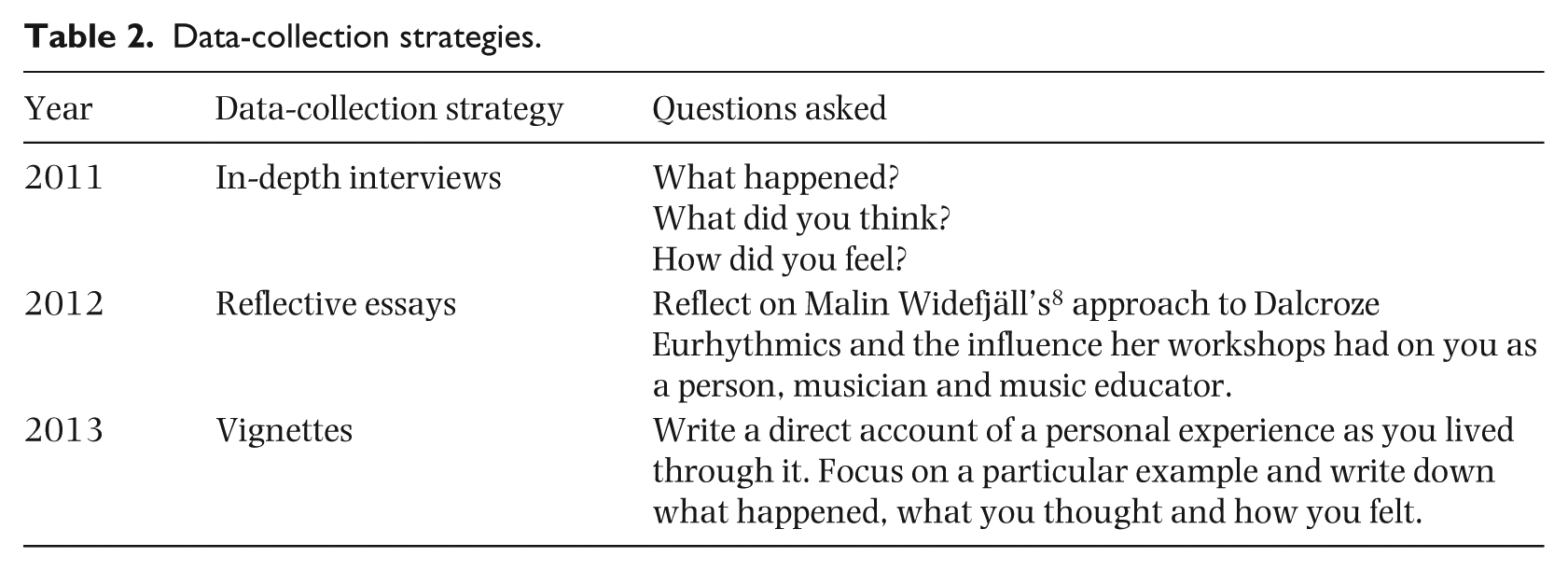
In a phenomenological research approach “the major instruments are open-ended interviews and reflective journals” (Bresler, 2010, p. 12). Therefore data were collected through the data-collection strategies illustrated in Table 2. The multiple data-collection strategies also serve the purpose of triangulation.
Data-collection strategies.
Data analysis
This hermeneutic phenomenological analysis focused on the content of the experiences that the students had with the Dalcroze-inspired activities (Bartholomew, 1995). During the analysis, I continually returned to the data to derive their inner structure and meaning (Merriam, 2009). I used the three approaches van Manen (1990, pp. 92–93) refers to for the uncovering of thematic aspects of the phenomenon described, namely the holistic, highlighting and line-by-line approach.
The interview transcriptions, reflective essays, and reflective descriptions were incorporated as primary documents into one heuristic unit in Atlas.ti. 7, and data were combined during a systematic hermeneutic phenomenological analysis. The NCT (Noticing, Collecting and Thinking) model was used for data analysis (Friese, 2012). Significant statements were noticed, codes were collected and thinking took place when codes were conceptualized into categories and themes, and links were made and described.
Ethical issues
Reference numbers for quotes are used to ensure the participants’ anonymity. The nature and aim of the study were explained to the voluntary participants, who gave their informed consent in writing.
Results
The five interrelated themes that emerged from the data are social integration, joyful experience, bodily experience, easier understanding, and musical expression (Figure 1). These themes are interconnected as well as linked to categories. The categories that emerged are cooperative learning, active, concentration, teaching strategies, different, holistic, accessible, rhythm, relaxation, and listening skills (Figure 2). The relationships between codes, categories and themes will be described per theme. The meaning that the participants ascribed to these codes will be interpreted in the reflection and discussion sections. These themes describe the essence of the experience for the first-year students and include textural descriptions (“what” the students experienced) and structural descriptions (“how” they experienced it) (Moustakas, 1994).
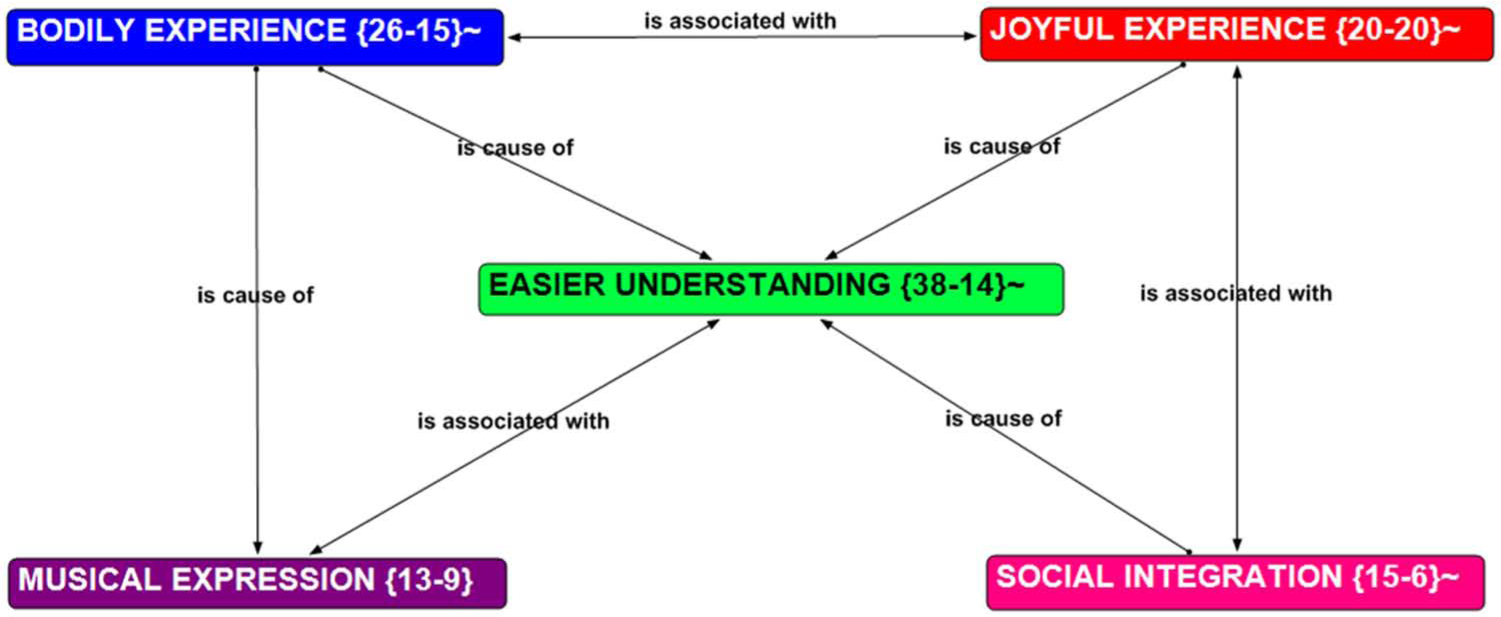
Interaction between themes associated with the Dalcroze experience.
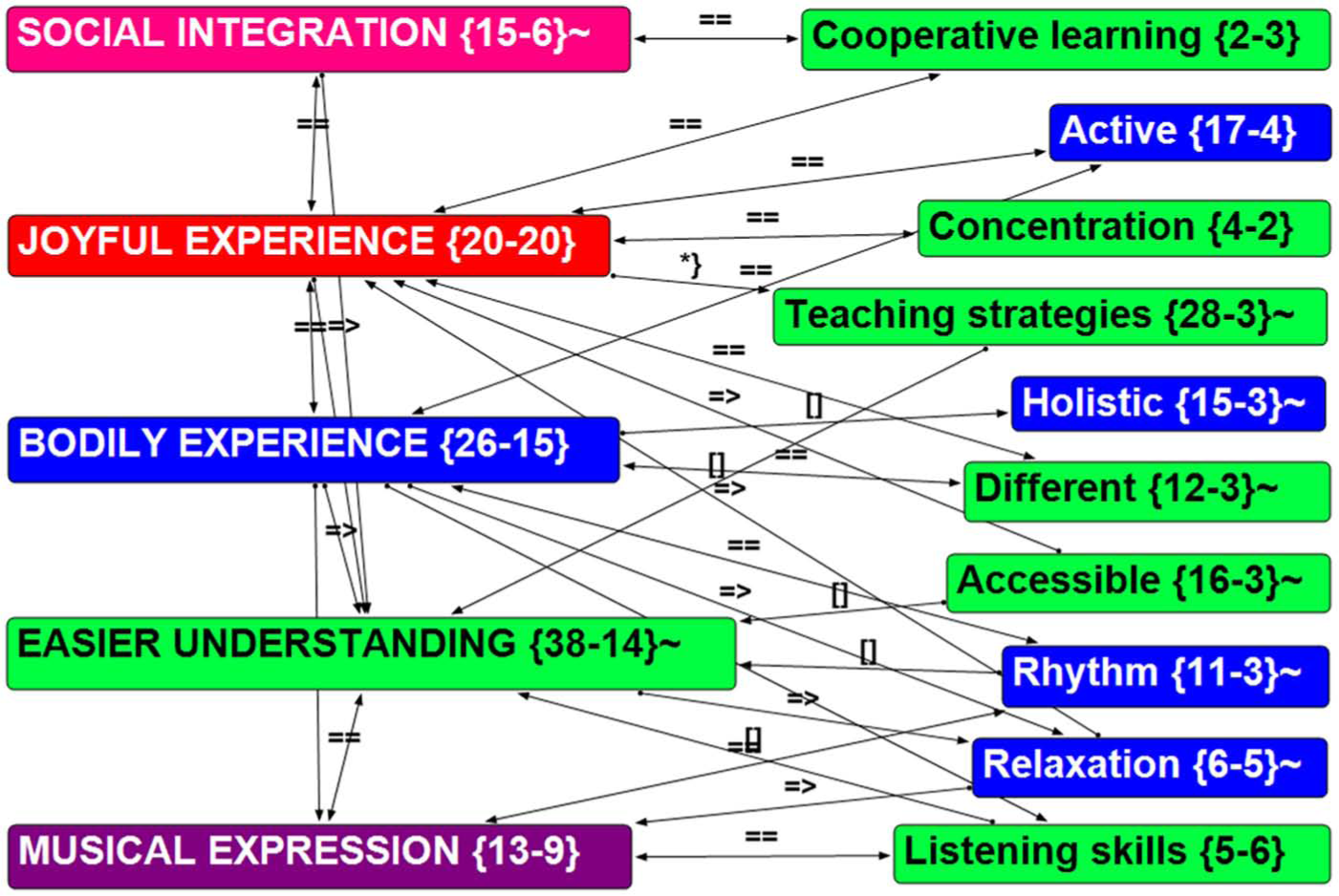
Themes and categories associated with the experience of the Dalcroze-inspired activities.
The results indicated that the central theme that emerged is easier understanding of musical concepts. This easier understanding was facilitated by the joyful, social, bodily experience associated with the Dalcroze approach (Figure 1).
The first number in each rectangle in all the figures (Figures 1–6) refers to the groundedness and the second number refers to density. “Groundedness counts the number of links to quotations; density counts the links to other codes and memos” (Friese, 2012, p. 140). In other words, in Figure 1, the theme with the most quotations is easier understanding with 38 quotes, and the theme with the most links to other codes is joyful experience with 20 links.
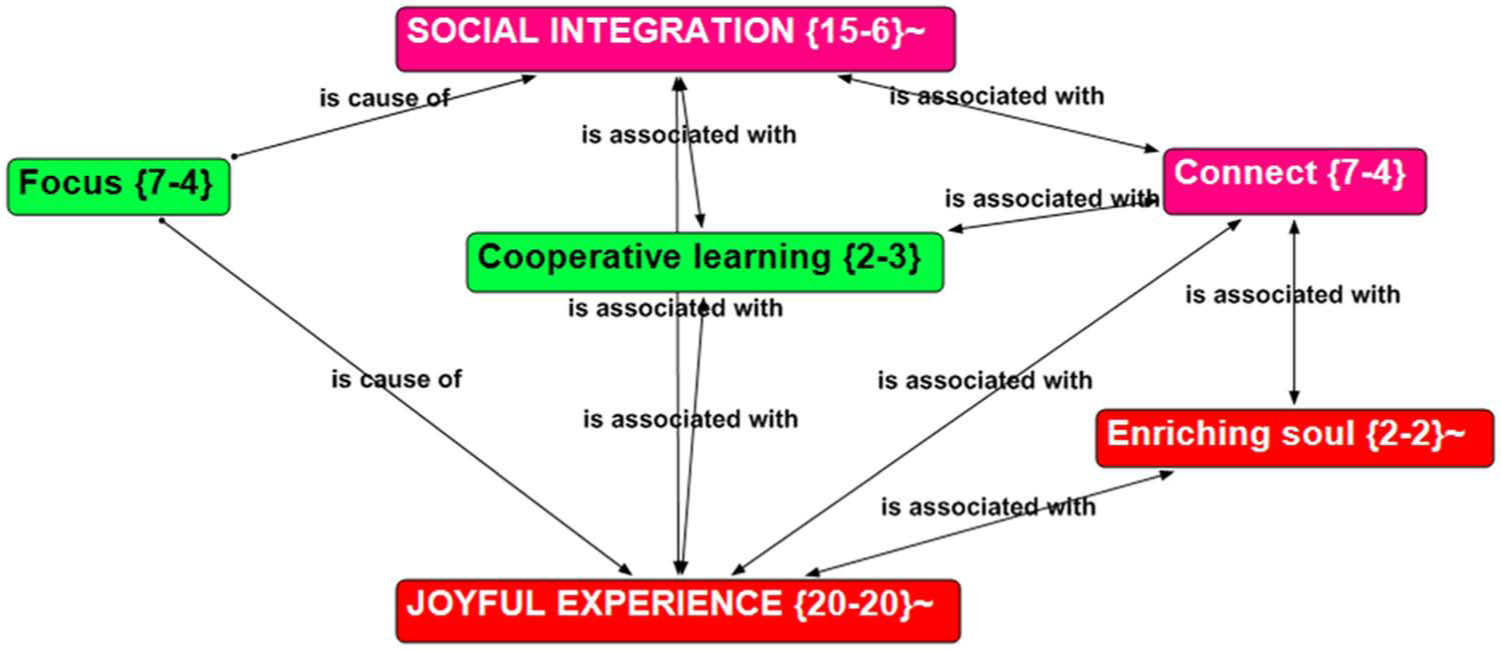
Social integration in relation to other codes 10 and themes.

Joyful experience in relation to other codes and themes.
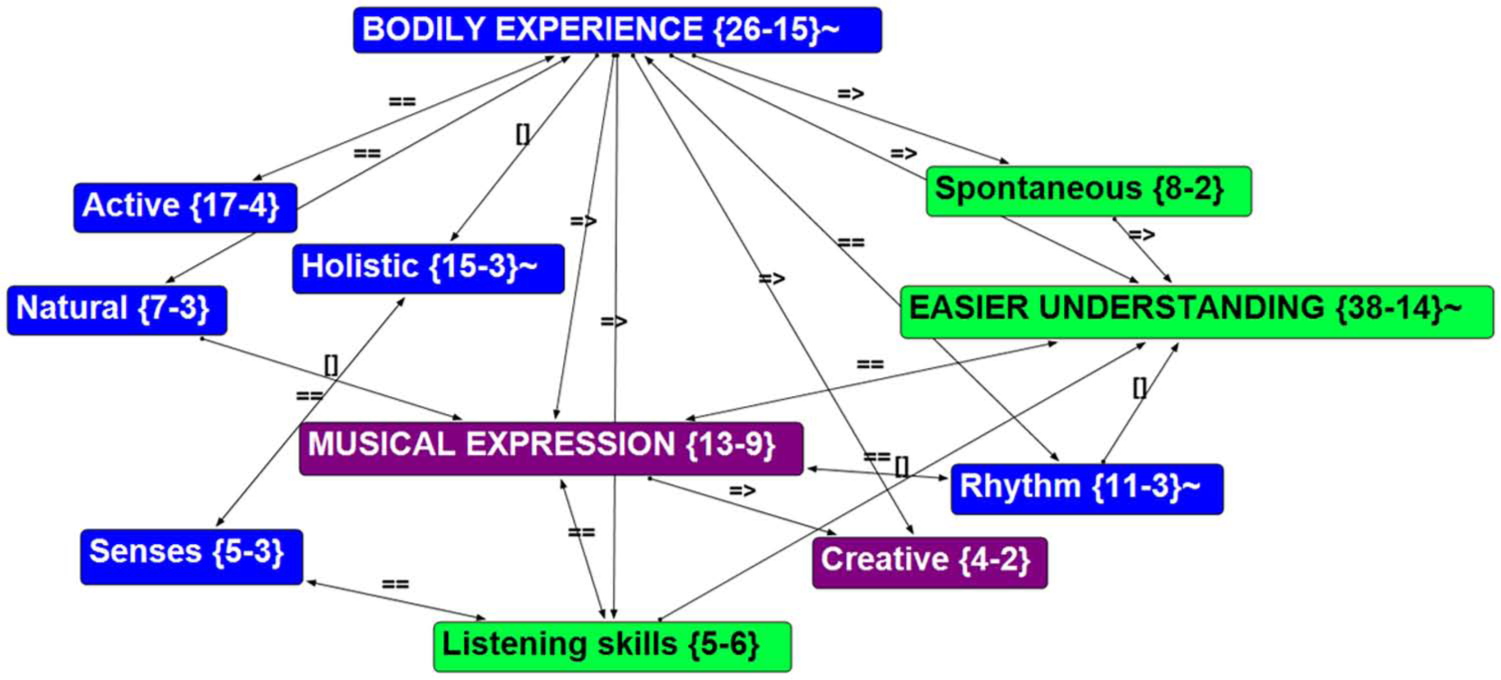
Bodily experience in relation to other codes and themes.
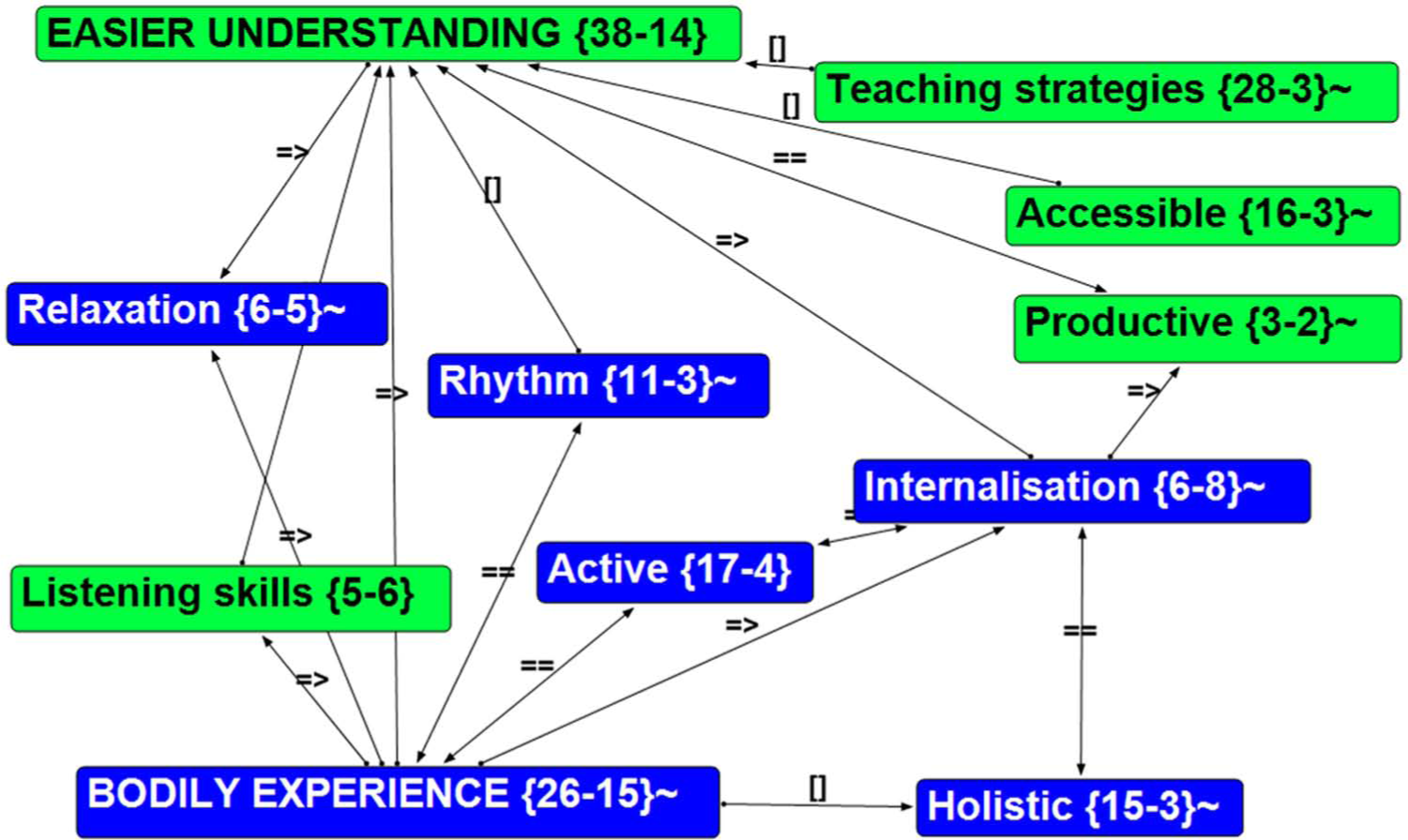
Easier understanding and relation to other codes.
Theme 1: Social integration
At the beginning of our first Dalcroze session, the lecturer asked us to take off our shoes as soon as we entered the classroom. This was certainly unusual, but I played along anyway. We started walking on the beat of the song and indicated each strong beat by patching with our hands on our thighs. I find Dalcroze to be very valuable because it involves what one sees, hears and feels. One has to move to what one feels. Furthermore, I find it meaningful because there is physical and social interaction with each other and this enables me to understand all aspects of the music. (13:7)
9
The Dalcroze-inspired activities were valuable for the first-years in their first semester as they helped the students “to get to know each other” (9:1). A student compared this to “when you go on a camp and you do trust exercises” (8:17). This student believes “it is that connection which is absolutely important” (8:18) and describes it as being “in sync” with each other (8:29). This connection made cooperative learning possible (Figure 3) and, in the opinion of a voice student, it “makes the work easier and makes the end product excellent.” She feels that “learners must be grouped during improvisation so that those who are rhythmically strong can help and guide those who are struggling, indirectly, just by being part of the group” (3:9).
A student noticed that “attention and concentration were constantly part of the mutual integration or social experience (through the comparison of yourself with those around you in movement and rhythm)” (5:8). The joy of the social activity was described as “enriching my soul” (1:22). It might have been such a positive experience because the activities “make it possible to learn a little about yourself” (7:14) and give you confidence “to stand in front of a class of children” (7:18).
Theme 2: Joyful experience
All the participants commented on the joyful experience they had during the Dalcroze-inspired activities. Some students ascribed this joy to the fact that the lessons are “exciting” (4:10). One voice student ascribed the joy to the accessibility of the approach: “no one will ever be able to complain that the music is too boring or too difficult” (1:21). A string player said it was “nice” because “I felt awake” (8:7). This relaxed focus was also enjoyable to a voice student, because “it was a way to just forget for a few moments about the stress out there” (1:24).
The joy helps the first-year students to remember the lessons: “It was incredible fun and I will never forget it” (2:22). It motivates them to use the approach in their teaching one day so that they can share the joy: “I will definitely apply Dalcroze in my education techniques and make sure my learners can enjoy music as much as I know I did” (1:26). The joy they experienced is associated with concentration, social integration and being actively involved as well as with the lessons being different and interesting (Figure 4).
Theme 3: Bodily experience
Everyone sat with their eyes closed in a circle, and focused on the single note that Mrs Wedin played on the piano. We had to show the length of each tone by moving a hand in any direction, and then stopping when the tone finally faded away. Then another tone, that we had to depict with another hand, was added. The two tones that changed from one pitch to another forced the group to listen with great concentration, intensely, to each tone from its beginning to its end. It felt as if the tones travelled through the floor, flowed up through and whirled in my body, continuing to the tips of my fingers where they were set free through the movements of my hands. I didn’t just listen to the tones and identified the contours, but the tones became part of me. This is an experience that I will never forget. It completely changed the whole way in which I thought about and understood music. (11:7)
This vignette, by a voice and flute student, illustrates how she experienced “a bodily way of being in the sound” (Juntunen, 2004, p. 68). To some students, the Dalcroze activities were an “eye opener” (7:10). The participants realized that the body helped them to “understand how long the tone value really is” (7:6) and “in a pleasant way the metre was captured in one’s body” (10:5). One string player said movements helped him “with rhythmical dictation and rhythm exercises in aural training” (2:18). A percussionist said that the experiences were presented “extremely creatively, physically and at the same time musically” (6:17).
The first-year students experienced this as a holistic, natural, active and physical experience (Figure 5) of transferring intellectual and formal knowledge “by using your whole body and all your senses” (6:1). A voice student’s comment contains the essence of this theme:
I realised that there are things in life that are not dependent on only good brains but the combination of both brains and physical (body) senses and muscles, which result in spontaneous reasoning which is a special tool in music making. (3:3)
Theme 4: Easier understanding
The Dalcroze method is the easiest and quickest way to acquaint oneself with music that I have come across. This applies especially to someone like me who lacks experience with regard to music theory as well as technical aspects of music. For example, we had to do a listening activity which was a Dalcroze exercise: The lecturer sat in front of the piano and played a tune for us. She asked us to stamp our feet on the lowest tone and to clap our hands on the highest tone of each phrase. A lot of concentration was needed to focus on the melody. But the activity kept my attention and my body responded to the various tones. It wasn’t just a listening exercise: I experienced the music with my whole body. I immediately felt a connection to the new song and it was surprising how quickly I was able to learn it. It was completely different from a normal music class in which one just sits and listens. Not only was it fun to learn a song in this way, but it was also nice to stand in a group and do the exercise. It helped me not only to learn music when I felt insecure because I was inexperienced and struggled, but also to share a music learning experience with others. (12:11)
This students’ experience that Dalcroze-inspired activities facilitated her understanding was shared by most of the students, and therefore, this theme had by far the most quotes. A string player said the most valuable thing he learnt was “how to simplify any given rhythm” (8:3) for himself. A voice student said that it became easier for her “to recognise the time signature of a song” (1:13), something that she had previously found very difficult. She also noticed that “if the metre is established in the body, it is so much easier to work with the melody” (1:17).
The participants acknowledged that it was the active, holistic bodily experience that facilitated internalization, listening skills and as a result easier understanding (Figure 6).
One of the most important things I learned is that once music is internalised through body movements, it will be easier to apply all the aspects learned in performance. (3:8)
Two string players believed that the Dalcroze-inspired activities can make practice sessions “more productive” (3:11) and “a person will understand the music so much faster” (8:9). The first-year students experienced the activities as very accessible and therefore they intend to apply them in their own teaching one day. “I will definitely use it because if you have a group of people, it is a fun way to work with them because everybody can do it” (9:6). The following quote contains the essence of this theme: “I think through movement one understands better what music is” (2:11).
Theme 5: Musical expression
One voice student said “the thing I find to be the most important is that body movements affect musicality and interpretation very positively” (3:13). A string player expanded on this idea and said he used the connection of movement to music in performance and composition: “Performance: to feel how the tension line flows by analysing it through movement. Composition: I used movement to enable me to feel where the contour must go and then used this feeling to write a theme” (2:16). In Figure 7, it is clear that the body was instrumental in developing the students’ expressiveness and creative interpretation in a natural process: “Each person gets the opportunity to give expression in a personal manner through physical movement” (6:13). One string player felt that the Dalcroze activities contribute to “more well-rounded musicians” (8:16) and take musicians “to a completely different level” (8:26).

Musical expression in relation to other codes.
Validation of results
The findings of this article were unanimously confirmed by the participants. In response to the question “Is this how you experienced the Dalcroze approach?” statements such as the following were made: “This is exactly how I experienced it. It was the best learning experience and most enjoyable phase of my life. One learns so much easier through the use of your body” (V1) 11 . To the question “Did I leave anything out that you would like to add?” the following is an example of responses that were given: “I find the results to be complete” (V12). To the question “Do you disagree with anything?” answers such as the following were given: “No, because all the facts given are based on practical experiences of people” (V3).
Reflection
Van Manen (1990, p. 101) suggests using, amongst other things, thematic analysis and the existential features of temporality, spatiality, corporeality, and relationality as guides for reflection. The explanation of the themes, in the discussion section, can be understood as the structure of the experience the first-year students had with Dalcroze-inspired activities. To understand the life-world of the first-year students better, I will reflect on their experiences by referring to the four life-world existentials in the following four paragraphs.
Lived space in the Dalcroze class
The first-year students became aware of their space when they had to choose how to move in it. Taking off their shoes also brought them into direct contact with their space, which was a new and different experience for them. They described feeling relaxed and comfortable in the space. They also had to learn to share space and be sensitive to each others’ space and negotiate how to share space. These students also referred to their own inner space which they discovered. They also came to associate the classroom space with positive memories and associations, and as such their experience changed the space for them.
Lived body during Dalcroze-inspired activities
The first-year students experienced their bodies as facilitating easier understanding and contributing to the joyful experience. They became aware of how learning through their bodies can support their intuitive musical knowing. They also felt the music in their bodies and used their bodies for musical expression. Their bodies helped them to connect with themselves and those around them. They got to know music, themselves, and others better through their bodily response to music.
Lived time during Dalcroze-inspired activities
Students enjoyed these activities, which made time seem to speed up. These activities also made them experience relaxed concentration and some also reported a flow experience 12 . The joy they experienced lifted them to a better place where they could forget about their stress. Rhythm is essentially movement through time and as such they all reported on understanding rhythm better after they experienced it through movement. The temporal aspects of music were understood better after these activities, which they thought made them better musicians.
Lived human relationships in the Dalcroze class
The students connected with each other in the Dalcroze class. They even felt they got to know each other better just by moving together. They also connected with themselves and stood in a clearer relation to their inner being. The social aspect of the activities facilitated their easier understanding of music. They also found the social aspect to be enjoyable. This motivated them to consider using similar activities in class one day. They constructed meaning for themselves about music through social interaction.
Discussion
Social integration
The Dalcroze approach can be placed in the social constructivist paradigm, because participants construct the meaning of their experiences through interaction with others (Creswell, 2013). Moran (2011) states that the study of musical meaning requires, among other things, attention to human bodies and their relation to each other. According to Greenhead (2009), “The social aspect of the class, in which participants play many different roles while working rhythmically in movement related to music, provides an inbuilt therapeutic effect” (p. 59). Participants in this study described this therapeutic effect as a connection with each other and an enriching spiritual and joyful experience of cooperation, which led to increased self-knowledge and self-confidence (Figure 2). Some participants in the study by Habron et al. (2012) also experienced increased confidence and positive psychological impacts (p. 29). Johnson and Johnson (2008) confirm that cooperative learning increases positive interpersonal relationships and psychological health.
Joyful experience
I like joy, for it is life. I preach joy, for it alone gives the power of creating useful and lasting work. (Jaques-Dalcroze, 1920, p. 31)
Juntunen (2004) suggests that master teachers of Dalcroze “today believe that joy is the most powerful mental stimulus to learning” (p. 75). This belief is substantiated by Pekrun, Elliot and Maier’s (2009) findings that enjoyment has “a positive influence on motivation, flexible learning strategies and self-regulation, and the availability of cognitive resources for task engagement” (p. 119). Matuliauskaite. and Žemeckyte. (2011) also found a positive interrelation between enjoyment and learning productivity. Jaques-Dalcroze (1967) explains that cooperation can contribute to joy “as the child feels himself delivered from all physical embarrassment . . . acquired by the practice of combining his individual efforts with those of the rest of the class . . . he will conceive a profound joy of an elevated character” (p. 98).
Jaques-Dalcroze (1967) found that the learners experience joy when they feel emancipated, realize their creative potentialities and then attain their ambition. Participants in the study commented on feeling focused yet free and relaxed. They also referred to developing musical skills such as improvisation, singing and sight reading. Acquiring skills and learning in a playful manner might have contributed to the joyful nature of the experience. One string player comments that she enjoyed the approach, “because it feels like playing but actually one is learning something” (9:14).
Juntunen and Westerlund (2001, p. 206) state that “Although pleasure does not need to be our primary aim in education, it is involved with objects of interest that promote growth, such as learning music” (Juntunen & Westerlund, 2001, p. 206). In other words, if the students enjoy the Dalcroze-inspired activities they will learn better (Juntunen & Westerlund, 2001). One participant in the study by Habron et al. (2012, p. 30) did make the connection between having fun and learning a lot. As in this study, all the participants in the study by Habron et al. (2012) enjoyed the Dalcroze workshops.
Bodily experience
The body facilitated the joyful experiences. Juntunen (2004, p. 27) quotes Dalcroze: “the better we know and use our body, the more joy and freedom of spirit we have.” According to Merleau-Ponty’s philosophy, perception is a bodily phenomenon (Carman, 2008) and distinctions such as subjective vs. objective, inner vs. outer and mental vs. physical should not be made about perception. Therefore when the body is mentioned in this article, it is understood as a thinking, feeling, experiencing, and sensing body that is capable not only of musical thinking but also of transformation (Juntunen & Westerlund, 2001).
The findings of this article can be located within the paradigm of embodied cognition. This is defined as knowledge not emerging from passive perception, but arising from “the need to act in an environment” (Leman, 2008, p. 43). The body has even been recognized as a form of intelligence (Galvao & Kemp, 1999). The participants in this study experienced Dalcroze activities as active involvement: “Eurhythmics is to do things” (9:10).
Participants in this study came to understand music better through the living body-subject: “It made me realize that through movement one can understand and remember rhythms and time signatures much easier” (4:7). They also realized that the body is a part of creativity; a student who is also a choral conductor mentioned that “one could be creative and simultaneously become aware of how your body moves with the music” (7:7). Two thirds of the participants in the study by Habron et al. (2012, p. 35) stated that the Dalcroze workshops increased their body awareness.
Easier understanding
According to Jaques-Dalcroze (1967), “The whole method is based on the principle that theory should follow practice, that children should not be taught rules until they have had experience of the facts which have given rise to them” (p. 63). The conceptual knowledge about music should develop from earlier embodied experience (Juntunen & Hyvönen, 2004).
Sadly, music education today is often still based on conceptual abstraction that “reflects the mind-body separation of Cartesian dualism that is typical of Western thinking” (Juntunen & Hyvönen, 2004, p. 199). As one voice student explained:
As musician I was exposed to the Western way of education, an education where I could notate rhythms and melodies before I could play the notes. This is a way of education that is only based on the intellectual understanding and learning of music. (1:2)
Previously, she had experienced problems with rhythm as a result of this approach to music education.
Many of the participants were used to this way of learning about music and experienced the Dalcroze-inspired activities as a refreshing new way of learning about the elements of music more easily. In the 13 primary documents, 38 comments were made regarding easier understanding of music. As Seitz (2005) explains, all the elements of music are “informed by, and draw on, bodily processes” (p. 431). Therefore, it makes sense that movement activities best facilitate learning about these elements. Two thirds of the participants in the study by Habron et al. (2012, p.35) reported that Dalcroze Eurhythmics speeded up their learning processes.
The findings of this study confirm the statement by Juntunen and Hyvönen (2004) that what is learnt through bodily experience is known at a deeper level. We also get feedback through movement about the music and can make adjustments accordingly, if we are able to listen to our moving bodies. Movement focuses the learners’ attention on listening to the music actively, with the whole body (Juntunen & Hyvönen, 2004). This results in “a ‘felt’ bodily understanding” (Juntunen & Hyvönen, 2004, p. 209), which the participants in this study expressed as easier understanding.
Musical expression
To be completely musical, a child should possess an ensemble of physical and spiritual resources and capacities, comprising, on the one hand, ear, voice, and consciousness of sound, and on the other, the whole body (bone, muscle, and nervous systems), and the consciousness of bodily rhythms. (Jaques-Dalcroze, 1921/1967, p. 36)
According to Juntunen (2004), “Dalcroze Eurhythmics can be seen as a process for awakening musicality and developing musicianship in a broad sense” (p. 15). Seitz (2005) also states that musical expressiveness is both embodied and social. Musical expression can also be understood as praxial knowledge that is rooted in personal experiences (Juntunen, 2004). One student expresses this clearly: “Each person gets the opportunity to be expressive in his/her own personal way through physical movement” (6:13).
Participants in this study felt that they became better musicians as a result of the Dalcroze-inspired activities and associated this approach with creativity. One student explained this as follows: “The fact that everybody must improvise movements draws on my ability as musician to come up with creative movements and creative thinking” (6:7).
Conclusion
Through Dalcroze-inspired activities the first-year music education students learnt through social interaction about themselves in relation to others. This experience was a joyful one, because the participants were actively involved and simultaneously experienced relaxed concentration in an approach that differed from what they were used to. Through bodily perception, students experienced spontaneous, holistic, and creative reasoning, which led to an easier understanding of basic musical concepts such as rhythm, meter, and melody. Bodily experience was instrumental in the development of these students’ creativity, interpretative skills and musical expression. The essence of the experience was an active bodily participation in musical activities, which led to the experience of joy, easier understanding of musical concepts, greater musical expressivity and social integration.
Footnotes
Acknowledgements
I would like to thank the two anonymous reviewers for sharing their expertise, challenging my understanding of the topic and giving constructive comments. They contributed a great deal to the improvement of this article. I am very grateful to Dr John Habron, senior lecturer in music, Coventry University, for his advice, support and attention to detail when he read through earlier drafts.
Funding
This research received no specific grant from any funding agency in the public, commercial, or not-for-profit sectors.