



Abstract
This article reports an observational study exploring the effects of naturally-occurring hearing impairments on musicians’ behaviour and communication with each other while rehearsing and performing. Two groups of three pianists and three flautists, one in each group with normal hearing, and the others moderately or profoundly deaf, formed duos working on two pieces of music: a movement from a Bach flute sonata and a new composition. The profoundly deaf musicians spent significantly more time looking at and talking to their co-performers than moderately deaf and hearing players. In response, hearing players looked at and talked more to their profoundly deaf partners. Profoundly deaf players also spent significantly less time on complete runs of the pieces from start to finish, without stops. While these findings have implications for the teaching and practice of musicians with and without hearing impairments, we suggest that social factors are as, if not more, important to the success of collaborative musical performance.
Communication in music, as in everyday life, is both verbal and non-verbal. Models of group interaction developed in the 1950s and 1960s (Bales, 1950; Young & Colman, 1979) have been used to explore interactions between ensemble musicians and identify some of the characteristics peculiar to musical groups. For example, one study of string quartets, often cited, highlights paradoxes of leadership and democracy, the role of the second violinist, and provides examples of confrontation and compromise (Murnighan & Conlon, 1991).
More recently, researchers have investigated influences on verbal and non-verbal communication while making music. Analysis of a singer-pianist duo’s rehearsal talk revealed the development of shared performance cues as the musicians created a single interpretation of the work to be performed from their initial, individual, understandings (Ginsborg, Chaffin, & Nicholson, 2006). Subsequently, King and Ginsborg (2011) found that physical gestures and movements were used to a greater extent with familiar and same-expertise partners. It is hard, however, to generalize from such studies, since individuals’ personalities and uses of the body can differ so widely in the same as well as different contexts: as Goodman (2002) points out, ‘an ensemble performer exhibits individual, “solo” tendencies in performance at the same time as he or she tries to blend with the rest of the group’ (p. 165).
It is generally accepted that too much talk during rehearsal is a bad thing, and this is reinforced by evidence from observational research that high-expertise ensembles talk less than low-expertise ensembles (Ginsborg & King, 2012; Murnighan & Conlon, 1991). Yet the content of rehearsal talk can reveal social dynamics within groups as well as their musical intentions: members of a string quartet studied by Davidson and Good (2002) demonstrated gender-stereotypical role behaviours, for example. Seddon and Biasutti (2009) proposed the existence of three hierarchical ‘modes of communication’: Instructive, Cooperative and Collaborative, where the latter indicates a state of highly-empathetic creativity facilitating spontaneous musical interactions.
Very little is known, however, about the possible effects of hearing impairments on communication in musical groups; the empirical observation of deaf and hearing-impaired musicians, especially adults, is rarely undertaken or reported, perhaps because of the commonly-held but mistaken belief that people with hearing impairments cannot or would not want to ‘do’ (make or appreciate) music, let alone become professional musicians (Fulford, Ginsborg & Goldbart, 2011). Levels of deafness are measured by identifying the threshold, or quietest sound, that an individual can hear. In comparison with ‘normal’ hearing, for which the threshold is 0–20 decibels (dB), the thresholds for mild, moderate, severe and profound deafness are 25–39, 40–69, 79–94 and higher than 95 dB, respectively (Action on Hearing Loss, 2011). Unlike speech, which averages 65 dB with a range of only 12–15 dB, music can range from the sound of brushes on a snare drum at 20 dB to a full symphony orchestra at 120 dB, with a solo trumpet or horn playing mezzo piano producing around 90 dB (Chasin, 2006; Hansford, 2011). Listeners with mild levels of deafness are therefore unable to hear some quiet sounds in music, while those who are severely or profoundly deaf can perceive only the loudest sounds.
Hearing impairments vary by level, laterality, pattern or distribution of loss across frequency range, and cause, and are therefore difficult to control for experimentally. An additional potential confound is musicians’ use of hearing aid technology. A previous study of the effects of hearing impairment on communication between musicians attempted to address these issues by asking hearing musicians to wear earplugs so as to attenuate auditory information artificially (Fulford, Ginsborg & Goldbart, 2012). In the present study, however, musicians with and without hearing impairments were observed rehearsing and performing two pieces of music, one familiar and one newly-composed, in a more ecologically-valid setting. Musicians with hearing impairments interviewed by Fulford et al. (2011) reported relying on visual cues. So the first aim of the study was to explore the effects of deafness on ‘looking behaviour’, a form of non-verbal communication, while playing. Also, previous studies of rehearsal talk have not involved the participation of musicians with hearing impairments. The second aim of the study was therefore to explore the effects of deafness on the nature and content of verbal communication, while rehearsing, and the impact of both forms of communication on the extent to which the musicians’ rehearsal intentions were fulfilled, as shown by their use of different ‘play modes’ (after Ginsborg, 2003).
Method
Design
A quasi-experimental design was used. The independent variable was hearing, with three levels: normal, moderate impairment and profound impairment. For the purposes of the present study, the dependent variables were looking behaviours, rehearsal talk and rehearsal outcomes; a subsequent analysis of musical shaping gestures while talking about music is reported elsewhere (Fulford & Ginsborg, 2014).
Participants
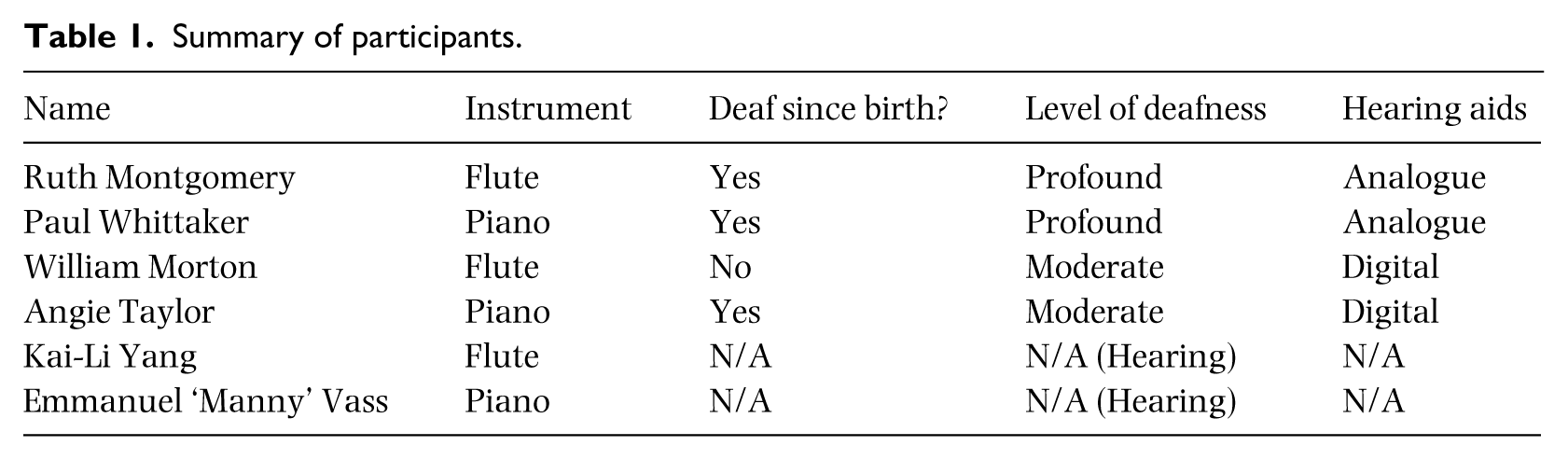
In all, six participants were recruited; three flautists and three pianists, with three different levels of hearing ability. Moderately and profoundly deaf participants were recruited from the pool of musicians with hearing impairments who had taken part in the interviews reported by Fulford et al. (2011). Two advanced students of flute and piano, with normal hearing, were recruited from a UK conservatoire. As shown in Table 1, the participants, all of whom wished to be identified by their real names, were matched by history, level of hearing impairment and instrument to form three duos: hearing, moderately and profoundly deaf. The profoundly deaf musicians had been so since birth and were fluent in British Sign Language (BSL). Angie had been moderately deaf since birth while William attributed his hearing impairment to work in the military profession followed by 40 years of playing the piccolo with the orchestra of the Royal Opera House, London.
Summary of participants.
Materials and apparatus
The duos rehearsed and performed two contrasting works each lasting approximately 2m 30s: the Adagio movement from Bach’s Sonata in E major and the specially-commissioned Petite Sonate for flute and piano by Jacob Thompson-Bell, a PhD student of composition at the RNCM. The latter consists of a brisk, contrapuntal opening section, a calm, melodic middle section and a lively ending recalling the themes of the opening. Audio-visual recordings were made using two Panasonic NV-GS280 video recorders to ensure that both members of the duo were in view at all times. Noldus Observer XT9 and QSR NVivo 9 were used to transcribe and code looking behaviour and verbal data, respectively.
Procedure
Participants were given scores of the two pieces of music 1 month before the study was to take place, and asked to practise them until they were ‘under the fingers’. The four musicians with hearing impairments undertook two 12-minute rehearsals followed by a performance of the Adagio and Petite Sonate, one with a co-performer with the same level of hearing impairment and one with a hearing co-performer; for logistical reasons it was not possible to pair musicians with different levels of hearing impairment. The two hearing musicians undertook three rehearsals and performances with a hearing, moderately and profoundly deaf co-performer.
Analyses
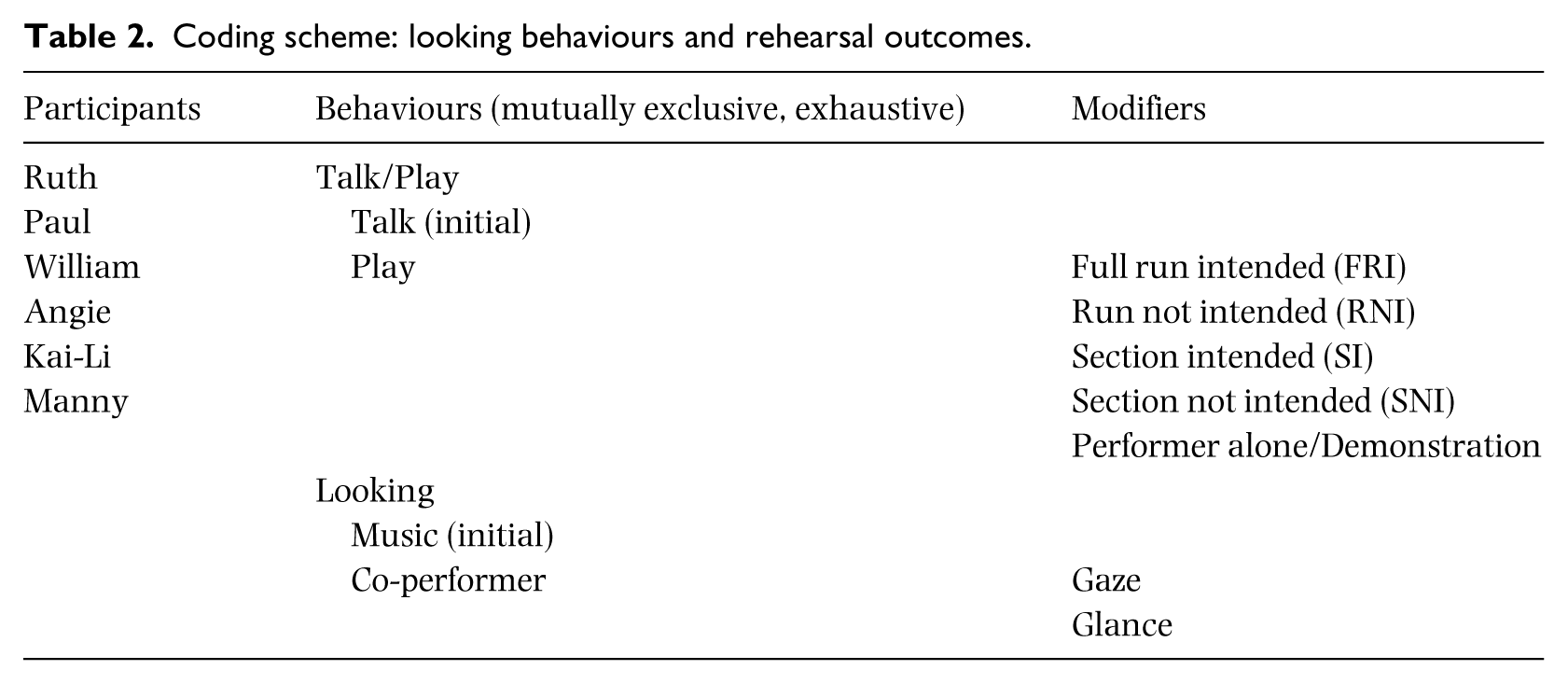
In all, 14 rehearsals and performances were analysed, since seven duos were formed and each worked on two pieces of music. Analyses of looking behaviours and rehearsal outcomes were carried out using the scheme illustrated in Table 2. Looking behaviours (defined as such whenever one performer looked away from the musical score towards his or her co-performer) were categorized, after King and Ginsborg (2011), as Gazing (long) or Glancing (short) during Play. Following the analysis of verbal data, Play was ‘modified’ or sub-categorized into four ‘play modes’: Full run intended (FRI), where participants explicitly stated their intention to run the whole piece and did so; Run not intended (RNI), where participants stated their intention to rehearse a section or phrase but in fact continued to the end; Section intended (SI), where players stated their intention to rehearse a section or phrase and did so, and, finally, Section not intended (SNI), where players stated their intention to rehearse a section or phrase but did not do so, including failed full runs. FRIs, RNIs and SIs were defined as positive outcomes, while SNIs were defined as negative outcomes since they occurred when the performers experienced problems and stopped playing to resolve them.
Coding scheme: looking behaviours and rehearsal outcomes.
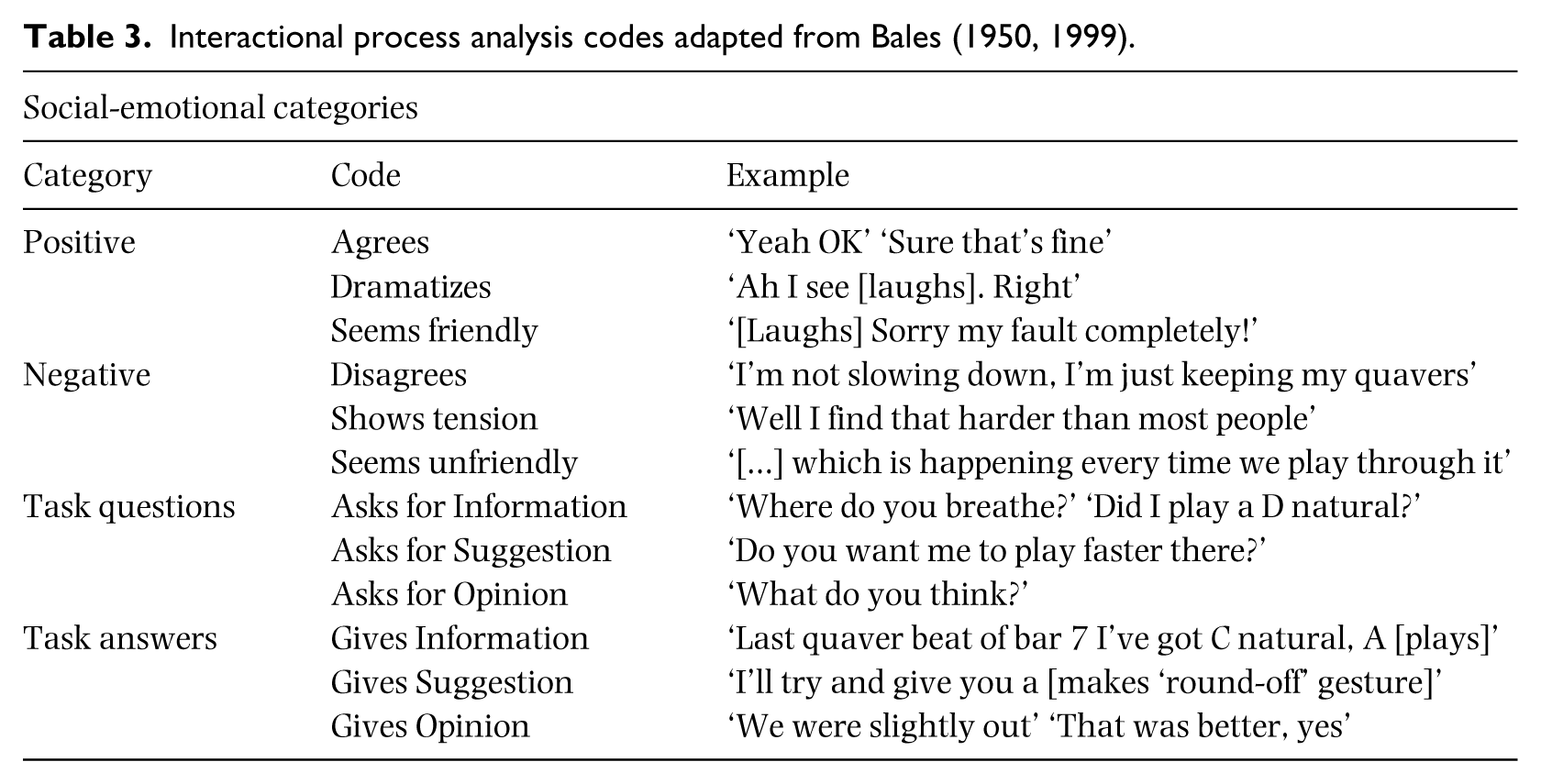
Content analyses of rehearsal talk were undertaken using adaptations of two coding schemes, Bales’ Interactional Process Analysis (IPA; Bales, 1950, 1999), shown in Table 3, and Seddon and Biasutti’s Modes of Communication (MoC; Seddon & Biasutti, 2009), shown in Table 4. These schemes were applied in parallel, so single utterances could be coded according to one or both schemes.
Interactional process analysis codes adapted from Bales (1950, 1999).
Modes of Communication codes adapted from Seddon & Biasutti (2009).

To establish inter-rater reliability, an independent judge coded behaviours in one rehearsal and two performances with a combined duration of 15m 38s representing 8.3% of the total data coded (3hrs 9m 55s). Agreement between the first author’s and independent judge’s coding was substantial or better (Landis & Koch, 1977): Cohen’s Kappa values were 0.70 for the rehearsal and 0.83 and 0.61, respectively, for the two performances.
One-way ANOVAs were carried out to test the effects of the independent variable (normal, moderately and profoundly impaired hearing) in both performers in each duo, henceforth referred to as ‘player’ and ‘partner’, on both performers’ looking behaviours and rehearsal talk, and the player’s level of hearing on joint rehearsal outcomes. Effect sizes were calculated using Omega squared. Post-hoc comparisons were made using Tukey’s HSD. Where data were not normally distributed, Kruskal-Wallis tests were used and post-hoc comparisons made using a maximum of two Mann-Whitney tests with Bonferroni corrections. Only the results of post-hoc tests significant at p < .05 are reported.
After the participants had undertaken the rehearsal/performance sessions they were sent copies of the audio-visual recordings on DVDs and asked to watch them and report on their experiences during the sessions. These qualitative data were used to help interpret findings but are not reported here.
Results
Looking behaviours
The decision to distinguish between gazes and glances was supported by the finding that gazes lasted significantly longer than glances (z = −5.76, p < .001, r = −.86, glances: mean = 0.86 s; gazes: mean = 2.14 s). As shown in Table 5, profoundly deaf players spent significantly higher proportions of time looking towards their partners than moderately deaf and hearing players and their rate of looking (frequency per minute) was also significantly higher. Their partners responded by looking for longer, and more frequently, at the profoundly deaf players than the moderately deaf or hearing players. No significant differences were found between looking behaviours in rehearsals and performances.
Effects of levels of hearing on looking behaviour.

Rehearsal talk
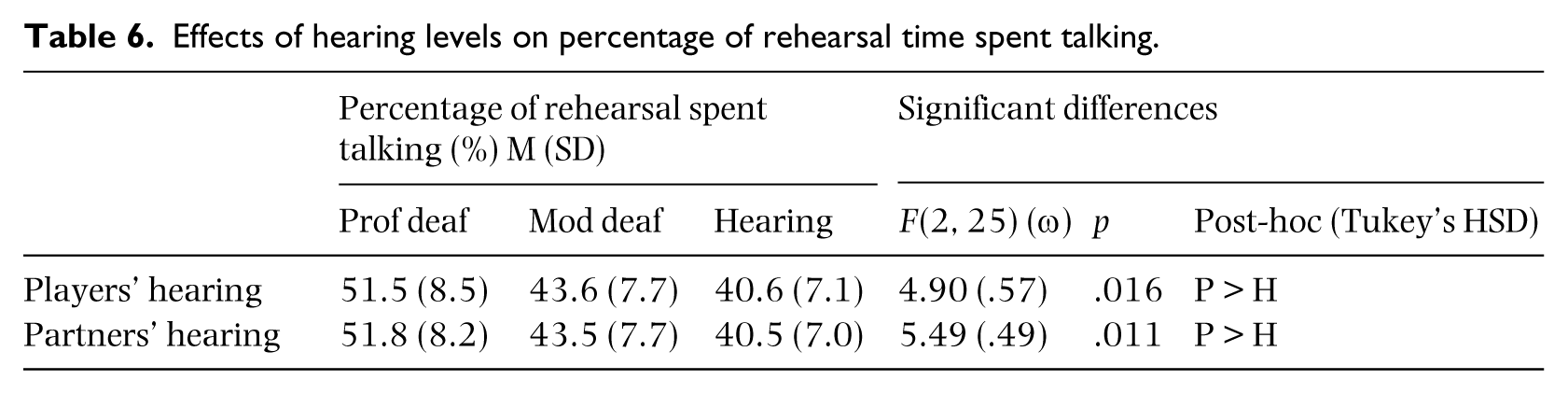
The percentage of time spent talking in all rehearsals was calculated by dividing the coded duration of time spent talking by the total duration of the rehearsal and multiplying by 100. As shown in Table 6, there was a significant effect of players’ hearing levels such that profoundly deaf musicians talked significantly more than hearing musicians, and all performers, regardless of their own hearing level, talked more when playing with a profoundly deaf partner than with a hearing partner.
Effects of hearing levels on percentage of rehearsal time spent talking.
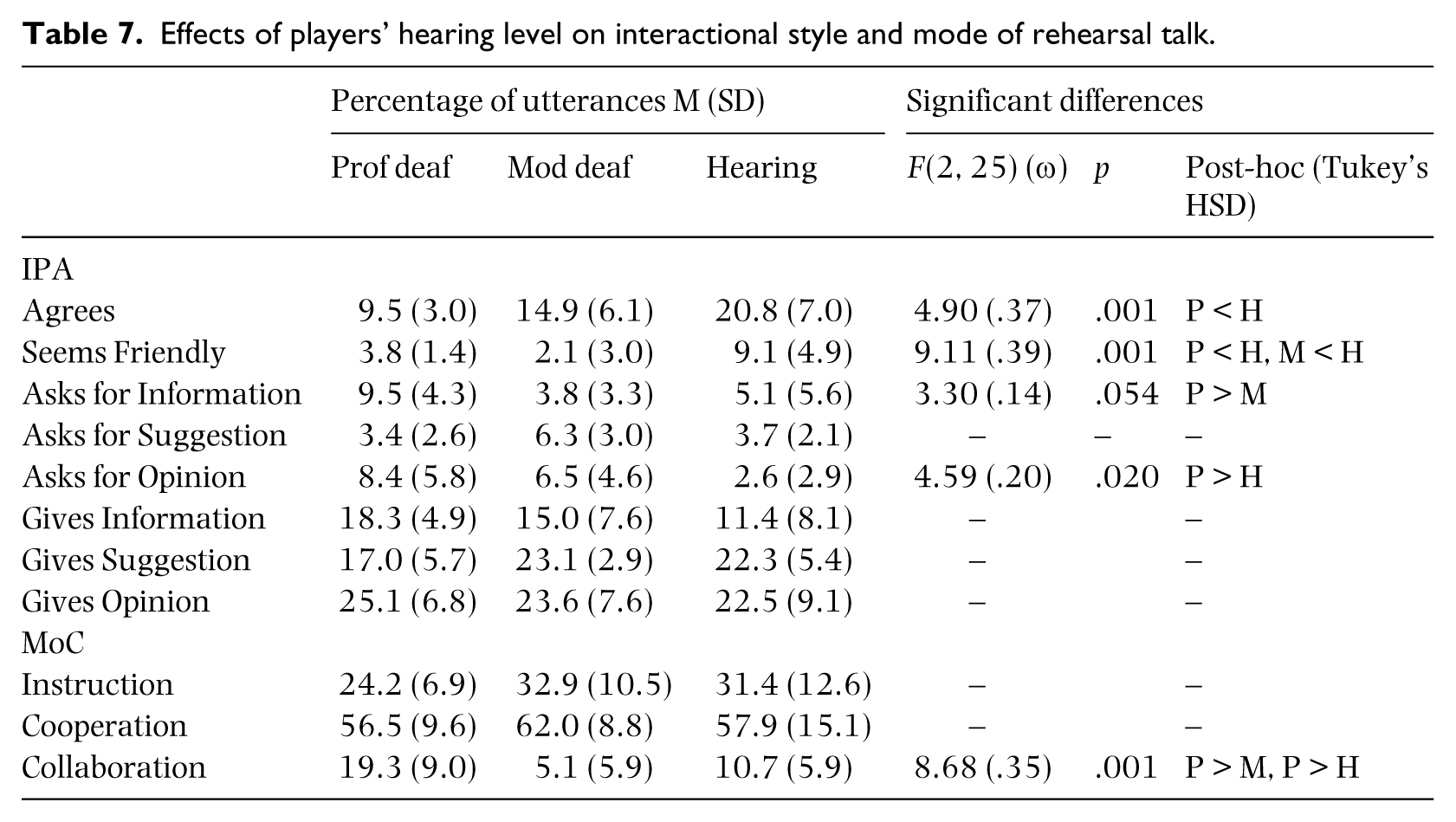
Effects of hearing level on interactional style and mode of rehearsal talk, measured by calculating the mean numbers of performers’ utterances in each of the IPA and MoC categories (other than those for which there were insufficient data) are shown in Table 7. Profoundly deaf musicians Asked for Information more than those who were moderately deaf and Asked for Opinions more than hearing musicians. Hearing musicians Agreed more than those who were profoundly deaf and made more Seems Friendly utterances than both moderately and profoundly deaf musicians. Profoundly deaf musicians made more Collaborative utterances than both moderately deaf and hearing musicians.
Effects of players’ hearing level on interactional style and mode of rehearsal talk.
Rehearsal outcomes
The effects of hearing levels on the percentage of Play in each of the three positive-outcome modes, Full run intended (FRI), Run not intended (RNI) and Section intended (SI), and the negative-outcome Section not intended (SNI), are shown in Table 8. While there was no significant effect of hearing level on time spent on SNIs, profoundly deaf musicians spent significantly less time on RNIs than hearing musicians and on the three positive-outcome modes, combined, than hearing players.
Effects of hearing level on rehearsal outcomes.
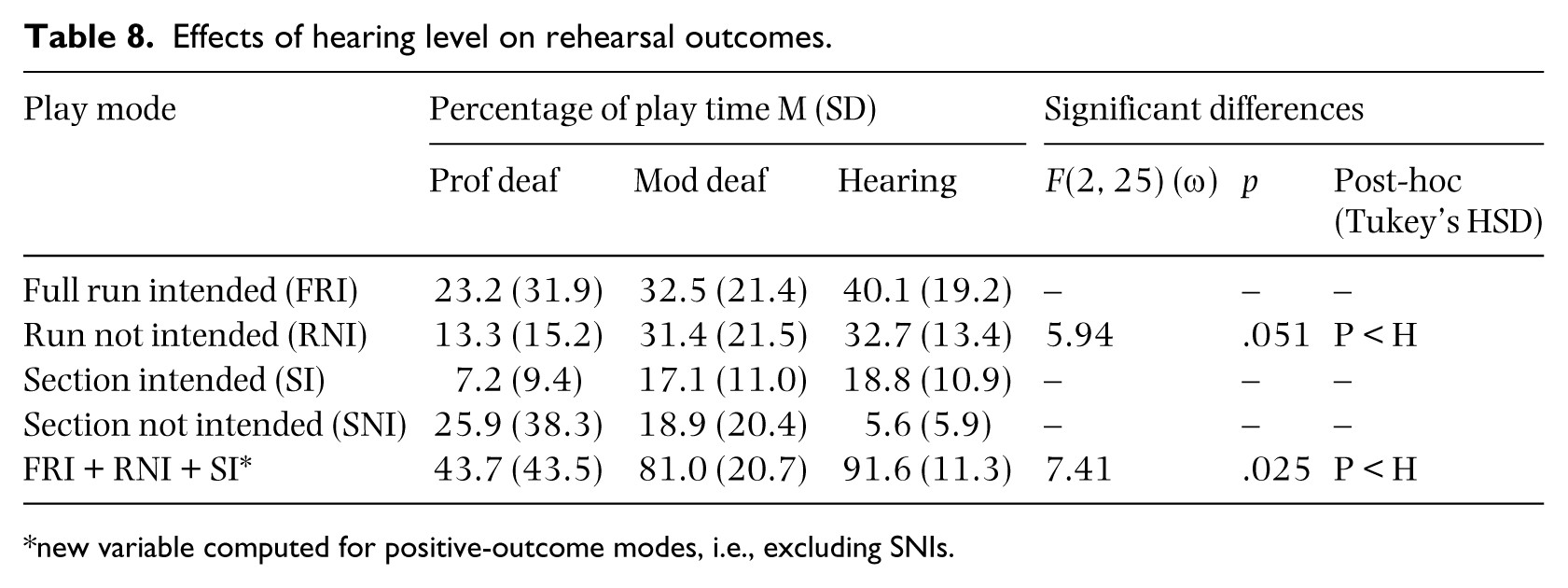
new variable computed for positive-outcome modes, i.e., excluding SNIs.
Discussion
Looking behaviours
Profoundly deaf musicians looked more often at their co-performers and for longer than moderately deaf and hearing musicians, confirming the reports of Fulford et al.’s (2011) interviewees with hearing impairments that they rely on visual cues when performing with other people. It may be that performers born profoundly deaf learn to use their eyes in the course of taking part in group music-making to a greater extent than those who acquire deafness later in life. The musicians with normal hearing were found to look more towards their duo partners the greater the level of their hearing impairments, suggesting a conscious, empathetic response to their perceived needs. It may be that no significant differences were observed between looking behaviours in rehearsals and performances because the latter did not take place in public; they might therefore have been seen by the musicians as final runs undertaken merely to motivate the rehearsals.
Rehearsal talk
Profoundly deaf musicians spent a higher proportion of rehearsal time talking than hearing musicians. It is likely that profound deafness impairs the ability to make on-the-spot decisions while playing, increasing the need to articulate intentions, and plan in advance certain aspects of the performance, particularly those facilitating temporal coordination between the musicians such as tempo and rubato. Again, the effect of a co-performer’s hearing impairment on the amount of talk in rehearsal may indicate that their responses were empathetic.
Seddon and Biasutti (2009) suggest that the modes of communication they identified are ordered hierarchically: ‘modes of communication related to cohesive performance were interpreted as being of a lower order than those related to interpretation of the music’ (p. 403). In the present study, profoundly deaf players made significantly more utterances categorized as Collaborative, concerning musical style and interpretation, than either moderately deaf or hearing players. Even though achieving cohesion while playing may be challenging for profoundly deaf musicians, they are clearly capable of the highest-order mode of communication during rehearsal: Co-operation, according to Seddon and Biasutti’s definition, is not necessarily a precondition for Collaboration.
Analysis of interactional style showed that profoundly deaf musicians were more likely than moderately deaf and hearing musicians to ask questions, reflecting their preference for negotiating tempo changes and dynamics in advance, rather than by initiating or responding spontaneously to their partner while playing. The musicians with normal hearing Seemed Friendly and Agreed more often than those who were profoundly deaf, probably for social reasons: they were students and both younger than and less familiar with the other participants, and so were perhaps more polite than they would have been with their contemporaries. This finding confirms earlier research in which students and professionals worked together: Ginsborg and King (2012) showed that students were more likely than professionals to ask for orientation, and professionals were more likely than students to ask for, and give, opinions.
Rehearsal outcomes
Profoundly deaf musicians spent significantly less time on FRIs, SIs and especially RNIs than musicians with normal hearing. RNIs indicate that the rehearsal is going well. By contrast, SNIs represent a form of trouble-shooting since performers usually stop because they have spotted, and wish to correct mistakes. While profound deafness may hinder ensemble synchrony, for example, it does not affect the ability to monitor this aspect of performance using visual cues.
Conclusions
This quasi-experimental study, involving the participation of musicians with different levels of hearing, revealed significant effects of hearing level on looking behaviours (the frequency of glances and duration of gazes), rehearsal talk (proportion of rehearsal time, mode of communication and interactional style) and rehearsal outcomes. The strongest effects of hearing impairment were such that profoundly deaf musicians spent more time talking than the other performers and were more likely to stop playing so as to address problems with ensemble synchrony. They also looked more at their partners, which may be a learned compensatory strategy, developed over time. All participants glanced more frequently and gazed for longer periods when paired with profoundly deaf partners, perhaps reflecting spontaneous responses. The effects of social dynamics on performers’ rehearsal talk were just as striking: mode of communication and interactional style were affected by the musicians’ subjective perceptions of their own and each other’s expertise and familiarity with one another, factors that may be linked only indirectly, if at all, to hearing impairment.
Qualitative feedback revealed that personal and social factors such as fatigue, performance anxiety and age, in addition to familiarity with co-performers and repertoire, may have affected rehearsals. This serves as a reminder that the results of the statistical analyses reported above must be interpreted with caution: since the sample was so small, idiosyncratic differences contribute to observed effects at the group level, and general conclusions cannot be drawn with confidence. For example, the two profoundly deaf players in this study only encountered problems with ensemble synchrony when playing with each other, despite their use of eye contact, highly Collaborative mode of communication and use of ‘musical shaping gestures’ (MSGs) (Fulford & Ginsborg, 2014). Other pairings were problematic for social, rather than musical reasons. Thus, the effects of social factors may be just as important as those of hearing impairment on communication in group music-making. While deafness may affect the development of non-verbal strategies for communication such as looking behaviour, this probably depends on the severity of the individual’s hearing impairment and when it was acquired. And while profound deafness may make ensemble synchrony hard to achieve, thus affecting rehearsal outcomes, further empirical research on these hypothesised relationships remains to be undertaken. Mode of communication and interactional style are vital to the success of musical collaborations but seem to be less affected by hearing impairment than might have been thought.
In conclusion, successful collaborative performances can be achieved by musicians including one or more with hearing impairments. Difficulties achieving temporal cohesion are likely to occur only when all performers in a given group are profoundly deaf. Effective verbal communication about musical style and interpretation remains possible and there is little evidence of hearing impairments affecting social interaction in the context of music-making. While this is generally accepted in educational and therapeutic settings, social stigmas about deafness in professional musical contexts persist. A renewed focus on verbal and visual communication by teachers and practitioners will benefit deaf and hearing students alike. The learning of musical theory and history plays a key role in facilitating access to verbal discussions about stylistic and interpretative issues in music for deaf students. Finally, many issues affecting communication were identified by the musicians themselves having watched video-recordings of their rehearsals, underlining the potential for students at music conservatoires to evaluate their own looking behaviours, talk and strategies in rehearsal so as to improve musical communication in collaborative performance.
Footnotes
Acknowledgements
The authors would like to thank the six musicians for their enthusiastic participation.
This paper was written on the basis of a poster that was presented at the inaugural Nordoff Robbins Plus Research Conference “Music and Communication: Music Therapy and Music Psychology.”
Funding
This research was supported by AHRC Research Grant AH/H008926/1.