




Abstract
Two studies considered whether psychological variables could predict everyday music listening practices more than those demographic and technology-related variables studied predominantly hitherto. Study 1 focused on music-listening devices, while Study 2 focused on music selection strategies (e.g. playlists). Study 1 indicated the existence of a one-dimensional identity based on music technology. Further, psychological variables (such as innovativeness and self-efficacy) predicted whether individuals possess such an identity. Moreover, while psychological variables predicted whether individuals preferred ‘familiarized’ advantages inherent to listening devices, a preference for ‘progressive’ advantages was predicted by technological behaviors. Study 2 supported the first study in terms of identity, and demonstrated that a different pattern of variables predicted playlist listening from listening to music via shuffle. More generally, the findings suggest the utility of applying constructs from consumer psychology to everyday music-listening behaviors.
Digitization is changing the ways in which we carry out many everyday activities, including creation of, access to, and consumption of music (Avdeeff, 2012; Molteni & Ordanini, 2003; North, Hargreaves, & Hargreaves, 2004). Moreover, advances in mobile devices mean that people can expand how, when, and where they experience music (Heye & Lamont, 2010; Juslin, Liljeström, Västfjäll, Barradas, & Silva, 2008) so that we now have numerous ways to access recorded music. The clear technological change that has occurred, and its prevalence in our culture, means that the dearth of technology-related research concerning musical behavior is surprising. Much of the research regarding the Internet has been descriptive and has not been carried out in the context of the various theories of consumption and consumer psychology that might reasonably be expected to shed light on the issue: there is a need to move beyond the identification of basic consumer typologies and market segmentation towards understanding music consumption in terms of the acquisition/diffusion of new technologies instead (Goldsmith, 2001; Mick & Fournier, 1998).
Consumer psychology has considered the adoption and diffusion of technology via opinion leadership and innovativeness, with particular emphasis on marketing implications. While different technologies and individuals have been considered – such as mobile devices and mobile-commerce (Mahatanankoon, 2007), context aware services (Kwon, Choi, & Kim, 2007), hand-held Internet devices (Bruner & Kumar, 2007), general information-seeking websites (Chung & Tan, 2004), heavy Internet users (Assael, 2005), and gadget lovers (Bruner & Kumar, 2007) – research specifically concerning music technology is scarce. The greater number of ways in which people are able to access music means that it is important to account for such technology in our understanding of everyday musical behavior, and in particular to move from merely describing music usage in everyday life to explanations of the same based on consumer psychology and more general psychological theories.
Music is a means of defining one’s identity (Hargreaves, Miell, & Macdonald, 2002; North & Hargreaves, 2003), both in terms of performing and listening (MacDonald, Hargreaves, & Miell, 2009), and also demonstrated by more specific behaviors, such as collecting music (Giles, Pietrzykowski, & Clark, 2007). Moreover, individuals believe that music preferences reveal information about personal qualities (Rentfrow & Gosling, 2003, 2006), and individuals make purchases partly to express themselves (Dittmar, 2008), in the same way that devices, such as mobile telephones, may be representative of identity (Craig, 2007). There is also some research concerning identity and technological intentions and adoption (Lee, Lee, & Lee, 2006; Thorbjørsen, Pedersen, & Nysveen, 2007). This suggests the potential for research on identity in music technology usage (see e.g. North & Hargreaves, 2008; O’Hara & Brown, 2006).
Previous research suggested that female children had more positive attitudes towards music, whereas males were more positive towards and confident in using music technology (see review by O’Neill, 1997; and Armstrong, 2001; Folkestad, 2007). Regarding adults, women have viewed men as more able to understand technology, such as the Internet, and have more negative attitudes towards computers (although opinions and attitudes change with greater use – Wasserman & Richmond-Abbott, 2005). Such sex differences in attitudes towards music and technology may impact the adoption of music technology. Similarly, younger individuals behave innovatively (Lambert-Pandraud & Laurent, 2010), and college students, in particular, are frequent early-adopters (Tepper & Hargittai, 2009). Further, access may be related to country of residence; North and Davidson (2013) provided evidence that the uses of music can vary by global region. In addition to demographic factors, we would also expect that innovativeness influences adoption of music technology. Innovative consumers are the first to buy a new product, are interested in and knowledgeable about the product, own more products, and talk to others about the product area (Goldsmith & Hofacker, 1991). Although there is a considerable literature on the subject, of particular relevance are studies showing that innovativeness moderates technology adoption (Agarwal & Prasad, 1998; Yi, Fieldler, & Park, 2006); that income, age, and innovativeness relate to the ownership of new consumer electronic products (Im, Bayus, & Mason, 2003); and that those classified as ‘tech hunters’ (Lim & Lee, 2010) purchase more products.
Other research indicates the potential importance of a related variable, namely opinion leadership: this is the extent to which individuals share their information in the domain with other consumers, so that the latter regard the former as reliable guides. In two particularly relevant examples of this, Lyons and Henderson (2005) found that Internet opinion leaders had greater computer skills, were more involved, were more curious, had higher levels of self-perceived knowledge, spent more time online, and were early adopters; and Kang and Yoon (2008) found users who were more comfortable with the various operations of a device explored its functionality to the full. Also, technology adoption appears to be related to attitudes towards products (e.g. Kulviwat, Bruner, & Al-Shuridah, 2009), playfulness (e.g. Bruner & Kumar, 2005; Mahatanankoon, 2007), and self-efficacy beliefs (e.g. Kwon et al., 2007) (which refers to a person’s belief in their ability to perform a certain task). Of particular interest with regard to self-efficacy is that Kwon et al. (2007) and others have also found it to be associated with the perceived ease of use and usefulness of technology: this, of course, is intuitive and also suggests the importance of this concept to the use of music technology in everyday life.
Two conclusions can be drawn from this brief review concerning music technology. First, research has focused on the technology itself or variables directly related to consumption. Second, this notwithstanding, there are some clear indications that psychological variables, and individual differences in particular, also play a role, even though they have tended not to be the focus of much research. The potential importance of this second point becomes more apparent if we adopt a slightly different approach to the literature and instead attempt to identify individual pieces of research in which psychological factors have already been shown to influence everyday uses of music technology. For instance, Assael (2005) found that overtly considering lifestyle variables could lead to a better understanding of technology users than demographic factors alone. Similarly, research on music consumption (Chamorro-Premuzic, Swami, & Cermakova, 2012) and entertainment preferences (Rentfrow, Goldberg, & Zilca, 2010) shows relationships involving personality and demographic factors; and more musically-engaged participants identified more complex ways of categorizing and organizing their music collections and were more consciously aware of how they used music (Greasley, Lamont, & Sloboda, 2013; Heye & Lamont, 2010). Avdeeff (2012) maintains that music engagement is technologically dependent, and that developments in the latter are fundamentally altering the nature of the former. Consistent with this, Heye and Lamont (2010) identified two types of mp3-player engagement, by distinguishing technology users (who demonstrate sophisticated use and knowledge of their devices) and technology consumers (who demonstrate less skill and knowledge regarding their access of music). It is possible that a similar distinction may apply to music technology more broadly. Other studies have shown that different reasons for choosing to listen to music relate to psychological factors, such as personality (e.g. Chamorro-Premuzic & Furnham, 2007) and engagement (Greasley & Lamont, 2011; Greasley et al., 2013). Such findings are scarce, however, and moreover, we are not aware of any information concerning the impact of psychological variables on how individuals choose to access music.
In short, while consumer psychology has considered diffusion, adoption and usage of various technologies, there has been little consideration specifically of music technology from these perspectives. Moreover, it is important that we move from describing to understanding and explaining music technology behaviors, and the literature indicates clearly that psychological variables might contribute to this endeavor. While adoption and usage of digital music technology has grown massively over the past decade, the literature has not kept pace: there is a particular dearth of attempts to explain usage of digital music technology in terms of variables often considered by consumer psychology and related domains. The present research aims to address this imbalance by considering the extent to which (particularly consumer) psychological variables and other approaches can explain the devices on which people listen to music and the means by which they go about selecting music on those devices.
Study 1: Devices
The objective of this study was therefore to explore how participants access music and examine whether individual differences (namely, personality, identity, opinion leadership, innovativeness, and self-efficacy) relate to musical identity and the perception of the advantages associated with using various technologies to listen to music. Three research questions were addressed. First, can technology behaviors and/or psychological variables predict differences in the extent and nature of music in an individual’s identity? Second, can technology behaviors and/or psychological variables predict variations between individuals’ evaluation of the advantages of differing listening devices? Third, does the extent to which one appreciates certain advantages of technology relate to use of different listening devices?
Method
Participants
While 415 individuals took part, analyses used the data from the 342 individuals who resided in the USA and the UK (25.1% US, 74.9% UK). Of those, 64.9% were female; age ranged from 16 to 72 years (M = 27.15, Mdn = 22); and 42.1% had a university qualification. Individuals were approached in person during a local arts festival and on a university campus. The questionnaire was also advertised online via the first author’s website, the university’s student research participation program, and websites dedicated to listing online psychology research opportunities (e.g. http://www.socialpsychology.org). Mean responses to each variable were calculated separately for the paper- and web-based samples. The product–moment correlation between these two data sets was .96. Therefore, the two sets of data were pooled in subsequent analyses. Some current university students received participation credit, and the remaining individuals received no compensation.
Questionnaire
Participants provided questionnaire data, using seven-point scales (1 = not at all, 7 = extremely) where applicable. Participants rated separately the importance of technology and music in their lives (hereafter the ‘technology importance rating’ and ‘music importance rating,’ respectively); how many hours they listened to music on an average day and how many hours they interacted with technology on an average day (as a measure of engagement); and stated the amount of minutes for which they used each of various technologies (e.g. radio) to listen to music on an average day. A series of specific individual difference measures then followed.
Personality
Langford’s (2003) Big Five proxy scale was used because of its concise nature, and reliability in previous research (Langford, 2003; North, 2010). The scale requires participants to rate themselves on one seven-point scale for each of the five dimensions. Openness, conscientiousness, extroversion, agreeableness, and neuroticism are represented by ‘uncreative–creative,’ ‘lazy–hard working,’ ‘shy–outgoing,’ ‘headstrong–gentle,’ and ‘nervous–at ease,’ respectively.
Consumer psychology variables
Participants were presented with a list of 26 items drawn from the consumer psychology literature on attitudes towards and usage of digital technology. These concerned opinion leadership; individual playfulness; optimum stimulation level; computer self-efficacy and anxiety; perceived ease of use; perceived usefulness; and the behavioral intention to continue using digital listening technology. Participants indicated the extent to which each of 26 statements described themselves using a five-point scale (1 = not at all to 5 = very well). A full list of the statements is available in Appendix A.
Identity
The authors developed four statements to determine whether music and/or technology played a role in the participants’ conceptions of their own identity. The four statements asked participants to state respectively the extent to which each of ‘Music,’ ‘Music technology,’ ‘Technology,’ and ‘Cloud-based technology’ ‘is central to my identity’ on seven-point scales (1 = not at all, 7 = completely).
Self-efficacy
Since self-efficacy measures require domain specificity for accuracy (Bandura, 1997), Spreitzer’s (1995) scale was adapted for digital listening technology. The resulting measure required participants to mark agreement with three statements on a five-point scale (1 = not at all, 5 = completely) for four different listening technologies: in the case of each of listening to music on a computer, using a mobile device, using the Internet, and using cloud technology, individuals responded with regard to whether they felt they were, ‘Confident about their ability,’ ‘Had mastered the skills necessary,’ and whether they ‘Believed in their capabilities.’ The ratings were summed separately for each device, leading to four device-specific self-efficacy scores per participant.
Technology use
Respondents rated (from 1 = never to 7 = always) how often they accessed their music collection in five different ways (namely, physical CDs, tapes, and records; digitally via a computer; a mobile device; an Internet source; and a cloud source); rated how much they would like to use each of those five ways (regardless of their confidence; 1 = not at all to 7 = extremely); and indicated specifically which of the five ways they used most often. Finally, participants rated the extent to which each of 12 items was a potential advantage of the method of listening they used most often (from 1 = not an advantage at all to 7 = very much an advantage): these 12 items were, ‘Ease of use,’ ‘Storage size/space,’ ‘Accessibility,’ ‘Familiarity,’ ‘Centralization of accessing one’s music collection,’ ‘User control,’ ‘Latest technology,’ ‘Management ease,’ ‘Financial reasons,’ ‘Portability,’ ‘Compatibility,’ and an ‘Other’ option.
Procedure
Individuals participated in one of two ways. People were approached in person to take part, and were given the printed survey to complete. Upon completion, the individuals were debriefed and thanked. Additionally, an electronic version was hosted on the author’s research website. Individuals who participated electronically were directed to the questionnaire via a direct link in the online advertisements. Participants indicated their consent on the study information webpage before being guided through the questionnaire via a series of webpages, and were debriefed via a final page. Ethics approval was granted by Heriot Watt University (number 2011-90).
Results and discussion
Factor analyses
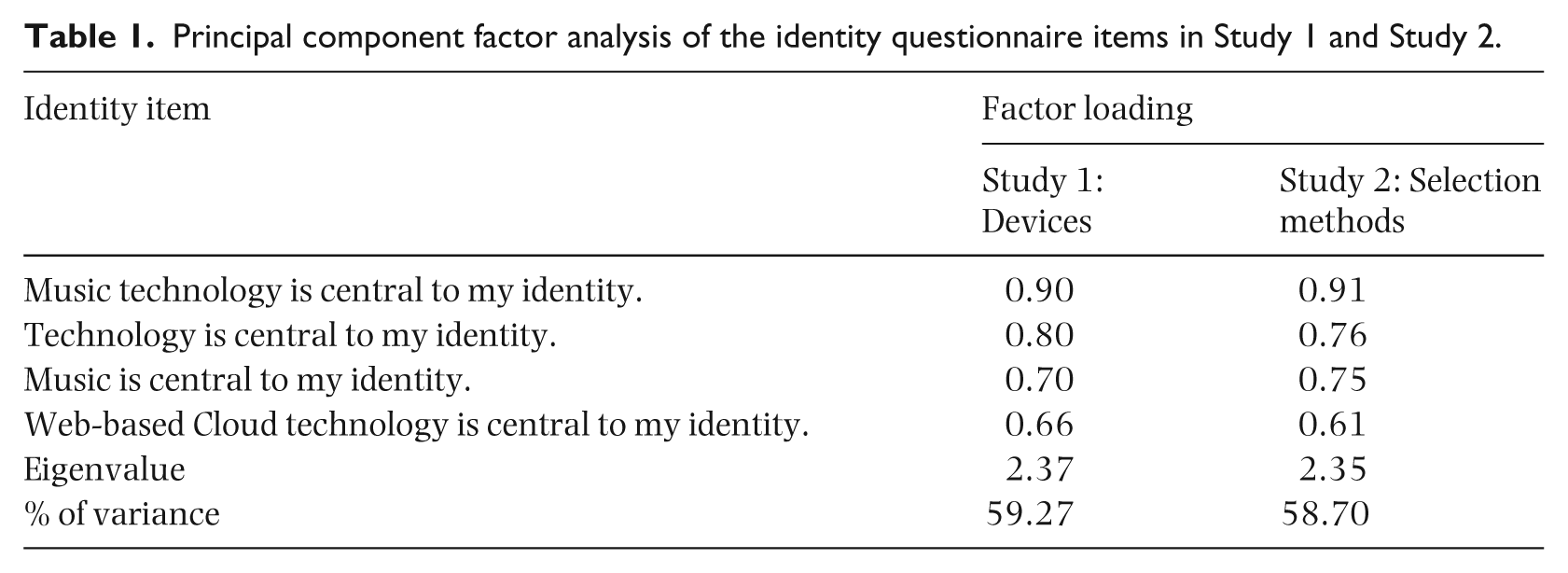
The four identity statements were entered into a principal components factor analysis. As shown in Table 1, varimax rotation led to a single factor upon which all four statements loaded positively. This indicated that the four items were not therefore measuring separate identities, but instead represented a unidimensional identity, labeled as a “music technology based identity”. Whereas numerous authors have considered musical identity as a discrete entity, the present findings indicate that musical identity is part of a more general technological identity.
Principal component factor analysis of the identity questionnaire items in Study 1 and Study 2.
A second principal components analysis with varimax rotation on ratings of the 26 consumer psychology variables revealed five factors, accounting for 59.07% of the variance (see Table 2). Items related to seeking out and trying new digital listening technology (hereafter, ‘DLT’), providing information about DLT to others, being confident about using DLT, and finding DLT fun and easy to use loaded onto factor 1. This factor reflects both the early adoption and opinion leadership concepts; thus, this factor was labeled as ‘trail blazers.’ Loadings onto factor 2, ‘troubled users,’ concerned feeling intimidated, frustrated, and needing assistance using DLT. The third factor comprised statements that reflected that individuals did not intend to use DLT in the future and felt overwhelmed and required assistance to use DLT, and so this factor was labeled ‘uninterested users.’ Factor 4 suggested that while DLT was considered useful, actual use of DLT was limited to simple activities, and so was labeled ‘basic users.’ Statements that loaded onto factor 5 reflected waiting for widespread use of a specific technology before personal use. As such, factor 5 was labeled ‘late adopters.’
Consumer psychology questionnaire statement factor loadings for Studies 1 and 2.

Note. Digital music technology (DLT) was defined as: ‘Technology, applications, and devices that allow you to listen to music digitally. These include, but are not limited to, computer applications (such as iTunes, Winamp, etc.), mobile devices (such as MP3 players, phones, and tablets), Internet streaming applications (such as Internet radio stations, YouTube, Vevo, Pandora, etc.), and cloud-based applications (such as Spotify, Amazon, iCloud, etc.).’
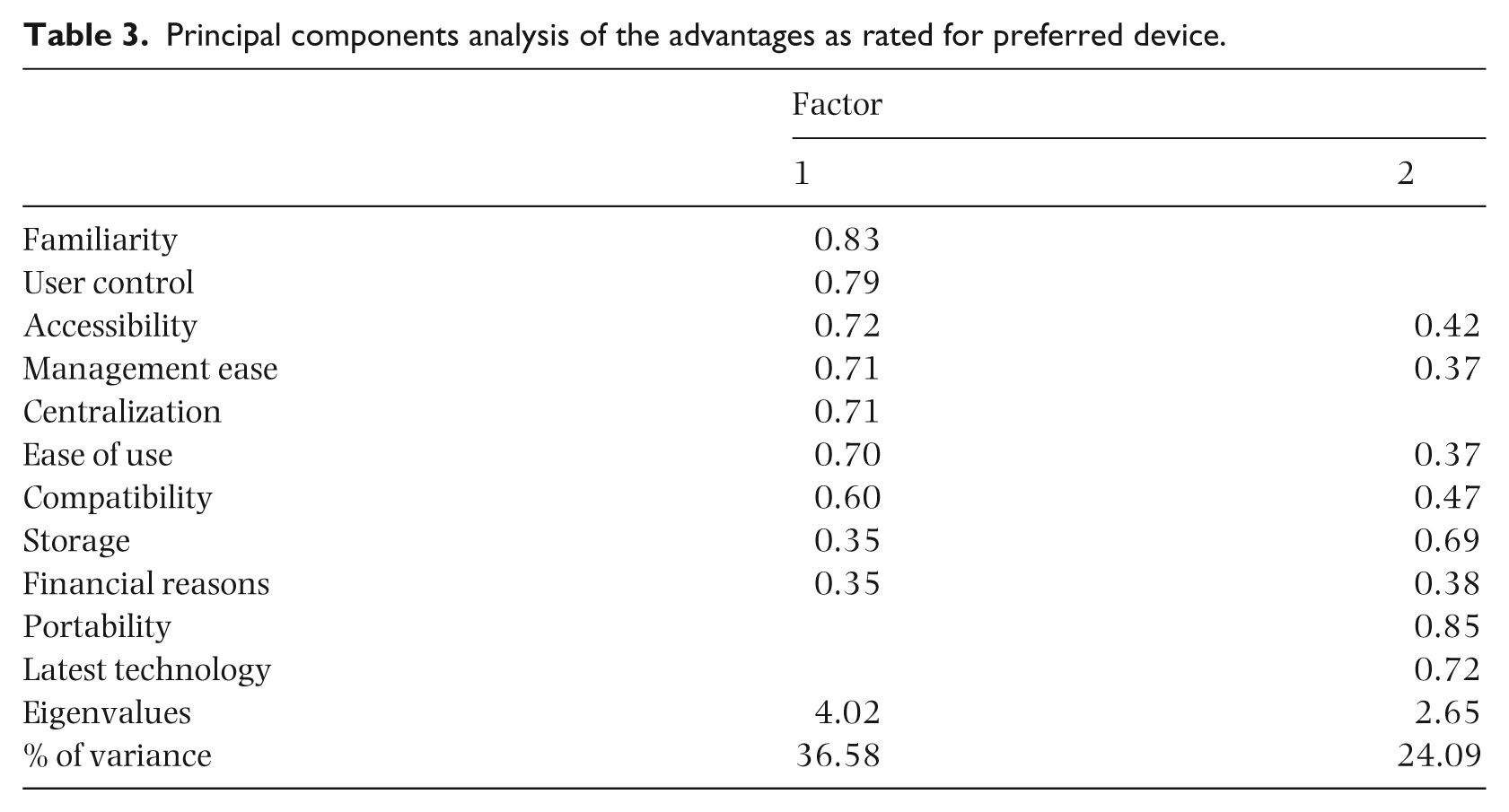
A third principal components analysis with varimax rotation on participants’ ratings of how well the 11 specific potential advantages were associated with the device that they used most frequently to listen to music yielded two factors with eigenvalues greater than one. Together the two factors accounted for 60.67% of the variance and the loadings are displayed in Table 3. Familiarity, user control, and centralization loaded strongly on the first factor. Portability and latest technology gave rise to the highest loadings on second factor. Consequently, factor 1 was labeled as representing “familiarized” advantages and factor 2 was labeled as representing ‘progressive’ advantages.
Principal components analysis of the advantages as rated for preferred device.
Correlations
Prior to the analyses addressing the research questions, bivariate correlations were conducted between the predictor variables and criterion variables. Only predictor variables demonstrating significant correlations (α < .05) were retained for use in the multiple regression analyses. Online Appendix B displays the predictor variables and corresponding correlation results.
Identity
A hierarchical multiple regression analysis was employed to answer the first research question, whether technology usage and psychological variables accounted for a significant proportion of variance in music technology identity beyond that accounted for by demographic factors. In combination, all of the predictor variables explained 40.3% of the variance, R2 = .40, adjusted R2 = .34, F(24, 237) = 3.70, p < .001, f2 = .68. Details concerning individual variables are presented in Online Table 4.
The lack of a relationship between identity and gender is interesting given that research described earlier showing that technology is associated stereotypically with males whereas music is associated stereotypically with females (O’Neill, 1997): it seems that the combined music technology identity identified in the present data is not gender specific. Similarly, that music technology identity is unrelated to age perhaps represents a disconnect from recent decades, in which musical innovations have been associated with youth subculture. Since the music importance rating arguably reflects engagement with music, it is not surprising that it related positively to identity. While prior research has demonstrated a link between identity and technological adoption (e.g. Kulviwat et al., 2009; Lee et al., 2006; Thorbjørsen et al., 2007), the present findings demonstrate that engagement with music technology specifically is also tied to one’s consideration of his or her identity.
Addressing the first research question, the statistical significance of the psychological variables included in the full model (step 3) indicates that these constructs also contribute to music technology identity. Thus, psychological variables contribute to an understanding of music technology beyond that provided by demographic factors or consideration of technology usage, and should be considered explicitly. This contrasts with existing research on music, technology and identity, which has tended to focus on demographic characteristics of the individuals concerned (e.g. Lonsdale & North, 2011; MacDonald et al., 2009) and their simple usage of the relevant technologies (e.g. North, 2010; North & Davidson, 2013). In particular, the positive associations between music technology identity and both the ‘trail blazer’ score and self-efficacy with regard to cloud devices indicate that those who use DLT as early adopters and opinion leaders as well as those who feel confident with their ability to utilize the cloud in order to listen to music have stronger music technology identities. While previous research has indicated a link between innovativeness and adoption (e.g. Agarwal & Prasad, 1998), these findings suggest that early use of technology also relates to one’s identity. It is fitting that the trail blazer score was the only significant consumer psychology factor, as it is the user type that most embraces new technology. In contrast, none of the personality variables were able to predict music technology identity significantly, such that it is the individual’s approach to DLT specifically that appears to be important in predicting music technology identity, rather than more generic, underlying personality dimensions.
Advantages of listening devices
To address the second research question, two separate hierarchical multiple regression analyses investigated the extent to which demographic, technology usage, and psychological variables could predict scores on the familiarized and progressive advantages of the participants’ preferred music listening devices respectively.
Concerning the familiarized advantages, the hierarchical multiple regression was statistically significant, R2 = .29, adjusted R2 = .26, F(9, 294) = 13.02, p < .001, f2 = .40; full details in Online Table 5. Time spent listening via cloud sources was negatively associated with the familiarized advantages score. This is logical as this type of advantage is concerned with familiarity and cloud sources represent the latest listening technology. The late adopters consumer psychology DLT factor was positively associated with familiarized scores: as they adopt new technology later, these individuals would likely be comfortable with traditional listening-devices and appreciate familiarized advantages of new technology. The country of residence association may be a consequence of technological factors (e.g. bandwidth variations) or cultural differences in attitudes towards music. Hofstede’s (2001) cultural dimensions describe how cultures differ along dimensions; and it is possible that cultural differences on these dimensions influence how individuals interact with music and technology. For instance, ‘indulgence versus restraint,’ the dimension that refers to controlling desires and enjoying life, may be of particular relevance to future research.
The hierarchical multiple regression concerning the progressive advantages was significant, R2 = .41, adjusted R2 = .36, F(23, 233) = 7.12, p < .001, f2 = .70; details in Online Table 6. While the overall model was significant, the psychological variables entered on step 3 did not add significantly to the proportion of the variance explained, and so it is the second model that serves as the parsimonious, statistically significant explanation. Results indicate that residents of the UK were more appreciative of the progressive advantages of listening technology, although it is difficult to understand why without additional research. One possibility may relate to different uses of music in different global regions (North & Davidson, 2013), but future research is better suited to investigate this further.
Second, those who preferred progressive advantages tended not to use physical media in their daily listening (minutes spent listening to physical media) but used mobile devices (rating for how often one uses a mobile device). It is unknown whether such advantages are learned as a consequence of actually using devices or whether devices are chosen a priori because of their perceived advantages. Regardless, the association between progressive advantages and mobile device use reflects the practical manifestation of the portability feature inherent to this type of advantage. Regarding the non-significant psychological variables, it is possible that these technology usage variables directly assessed the practical manifestation of a progressive approach to music technology, which may have crowded out any variance attributable to the psychological variables entered on step 3.
Preferred devices
When participants were asked to report which device they used most often (henceforth ‘preferred device’), mobile listening devices were most popular (33.8% of citations), followed by a desktop computer hard drive (32.6%) and Internet access (15.4%). Cloud sources, on the other hand, were listed the least often: only 2.1% indicated that this was the way they most often accessed music. It is interesting that physical media that were invented in the 20th century (CDs, cassette tapes, and records) were chosen approximately seven times more commonly (15.5%) than cloud-based technology.
A MANOVA in which preferred device was employed as the grouping variable to investigate differences on three dependent variables, namely music technology identity scores, scores on the familiarized factor, and scores on the progressive factor addressed research question 3. Due to the small number of participants listing cloud sources as their preferred device these were integrated into the ‘internet’ category for analysis. The MANOVA was statistically significant, F(9, 957) = 13.27, p < .001, ηp2 = .11. Univariate data indicated no significant effect on familiarized factor scores, F(3, 319) = 2.28, p = .08. However, the identity score and progressive advantages score were statistically significant, F(3, 319) = 4.44, p < .01 and F(3, 319) = 40.80, p < .001, respectively. Group means and standard errors are presented in Online Table 7.
Understandably, users preferring a physical media format did not associate the progressive advantages with their preferred device. In contrast, mobile device users experienced this advantage most acutely, which is logical as portability and latest technology were the highest loading items on this factor (see Table 3). In short, participants’ preferred devices appear to align with the intuitive advantages of those devices. Additionally, results indicated that music technology identity scores differed according to preferred device. Specifically, individuals who utilized the Internet (and cloud devices) to access music were most likely to have a high music technology identity score, while those who preferred physical devices had lower scores. As noted earlier, musical identity among young people has tended to be based around particular musicians or musical styles (Rentfrow & Gosling, 2003), and Dittmar (2008) maintains that individuals make purchases in part to communicate their identity to others. The present findings suggest that, beyond musicians and musical styles, it may also be appropriate to define one’s musical identity in terms of the device by which one consumes music (since the one-dimensional identity shown in Table 1 does not separate music from technology). Perhaps Avdeeff’s (2012) assertion that musical engagement is technologically dependent extends to music identity as well. Future research will be better placed to further explore technology-based identities (as related to music and other subjects, like reading and telephones) as well as detail the implications of these. One interesting possibility is that the present findings indicate that musical identity may be less of a social and artistic phenomenon than it was historically, but is perhaps nowadays more rooted in technology. The possibility exists, furthermore, that such a conclusion is dependent on the age cohort of the individual concerned: The link between technology and music identity could conceivably be stronger among younger than older users, although it would become more commonplace over time as currently young users age.
Study 2: Music selection
The means of selecting and interacting with individual pieces and collections of music have changed also as a consequence of digital technology. While the technology of the late 20th century grouped individual pieces of music on CDs, vinyl records or tapes containing approximately an hour of music that was played sequentially, digitization allows users to select individual pieces based on any number of attributes (Molteni & Ordanini, 2003). Moreover, in addition to selecting individual pieces of music or music by a particular artist, digital technology allows users to define ‘playlists’ to be played automatically, or to use ‘shuffle’ options through which a device will randomly select a series of pieces from a user’s collection. While Study 1 focused on the type of device used to access music, Study 2 explored how listeners select music to listen to from a collection. Three popular selection methods were considered, namely specific items (i.e., songs/artists/albums), playlists, and device-generated random presentation (i.e., shuffle).
Cunningham, Bainbridge, and Falconer (2006) recognized that there is a difference in the effort needed to craft a playlist as opposed to listening via shuffle. In particular, Heye and Lamont (2010) suggested that shuffle-listening might be related to lower engagement with technology and/or music. Other research suggests that shuffle is used to keep one’s music collection ‘fresh’ (Batt-Rawden & DeNora, 2005); to introduce serendipity into one’s listening (Leong, Howard, & Vetere, 2008); to overcome boredom (Cunningham et al., 2006); and when there is no strong preference (Kibby, 2009; Leong, Vetere, & Howard, 2008). This raises the issue of how music selection by these methods can be explained, and it is possible to speculate on a number of possible relationships between music selection strategies and the variables employed in Study 1 (namely demographic factors, identity, personality, and the consumer psychology variables).
We might expect that those demographic factors associated with a more general predisposition towards technology would also be associated with playlist listening, as these indicate a willingness to engage in the manipulation of a music collection in order to create personalized listening. For similar reasons, those who score highly on an identity pertaining to music technology might display a greater use of playlists. With regard to the personality dimensions, we might expect that openness, in particular, is associated with music selection strategy, such that those scoring higher on this dimension would be disposed more positively towards using the shuffle function as a consequence of their more general curiosity and enjoyment of the unexpected. Finally, we might expect that those with scores reflecting innovativeness and confidence with DLT will also employ playlists as a listening strategy.
As with Study 1, the main issue investigated was whether the variables in question, in this case music selection strategy, could be explained by psychological variables as well as more conventional demographic factors and music-technology usage variables alone. As such, the analysis closely followed that employed in Study 1 in addressing two research questions. First, do demographic, technology usage, and/or psychological variables predict individuals’ musical identity (as in Study 1) and, second, what variables pertain to music selection strategies (i.e., making a specific choice, using playlists, using shuffle)?
Method
Participants
Individuals were approached in person (at a local arts festival and on a university campus) and the study was advertised online for participation. As in Study 1, mean responses to each variable were calculated for the paper- and web-based samples and, because the product-moment correlation between these data sets was .96, they were merged for subsequent analyses. Analyses were conducted using the data from 275 individuals from the US (25.1%) and UK (74.9%). Ages ranged from 16 to 64 years (M = 22.28, Mdn = 19), 72% of the sample was female, and 22.9% of the participants had university qualifications. Participation was voluntary, although some university students received coursework credit for their participation.
Measures
The demographic questions, the four identity statements, Langford’s (2003) Big Five proxy scale, and the consumer psychology items were as per Study 1. Additionally, participants indicated the average amount of time they spent listening (in minutes) to music via different 13 technologies (which were then reduced to six groups, namely physical media, computer, mobile, internet, cloud, and broadcast technologies). Lastly, to provide information on their listening selection habits, individuals indicated how often they used different methods (specific artist, album, song; playlist; random/shuffle) to select music via a seven-point scale (1 = never, 7 = always).
Procedure
As per Study 1, participants completed a questionnaire, either online or on paper. In both cases, participants were provided with instructions for completion in advance and were then thanked and debriefed upon completion. Ethics approval was granted by Heriot Watt University (number 2011-89).
Results and Discussion
Factor analyses
As in Study 1, varimax rotation of the solution from a principal components analysis indicated the existence of a unidimensional ‘music technology-based identity’ (see Table 1). In a second principal components analysis, varimax rotation of the 26 consumer psychology questionnaire items indicated the existence of six factors, which accounted for 59.71% of the variance. Item loadings are shown in Table 2. While the consumer psychology factors in this study did not match those of Study 1 exactly, there were several notable commonalities. As per the pattern of item loadings, the six factors were labeled ‘confident users,’ ‘explorers,’ ‘uninterested users,’ ‘opinion leaders,’ ‘hesitant users,’ and ‘basic users,’ respectively.
Correlations
Again prior to regression analyses, bivariate correlations (see Online Appendix B were conducted first to determine relevant predictor variables.
Identity
Addressing the first research question and compatible with the results of Study 1, the results of a hierarchical multiple regression (R2 = .39, adjusted R2 = .35, F(14, 218) = 9.98, p < .001, f2 = .54; see Online Table 8) show that the importance of music and technology in one’s life positively related to possession of a music-technology identity. Moreover, the opinion leader consumer psychology factor score was positively related to possessing this identity. Therefore, results suggest that those who embrace new digital listening technology do not merely use said technology but may also incorporate it into their identity. These results support those of Study 1 and complement Thorbjørnsen, et al.’s (2007) suggestion that we must consider identity not only in terms of technology adoption, but also in terms of the features of those who use technology.
Selection methods
Research question 2 queried whether demographic, technology usage, and psychological variables could account for a significant proportion of the variance in how often music was selected via three different methods respectively, namely by choosing a specific selection, a playlist, or a random/shuffle function.
Regarding choosing a specific selection method, only one variable, university qualification, was correlated, r (271) = .14, p < .05. This result implies that individuals with a university qualification select specific music as an access strategy more often. Perhaps this type of access is too idiosyncratic or complex to be predicted by the variables examined in the present research, and conventional musical taste variables, such as those considered within the field of experimental aesthetics (such as considering the selected music in terms of pleasure and arousal as per Berlyne’s [1971] theory), should be considered in future research.
As for selecting music via playlists, the predictor variables, in combination, explained 18.8% of the variance, R2 = .19, adjusted R2 = .14, F(14, 220) = 3.64, p < .001, f2 = .23; details in Online Table 9. The results indicate that scoring higher on the opinion leader score as well as higher on the conscientious personality trait were both associated with being more likely to use playlists. As playlists require effort beyond a simple choice (e.g. choosing and creating lists, ordering presentation, etc.), their usage may require a user to find worth and put effort into such an endeavor. Thus, being high in conscientiousness makes sense as this might tap into the planning/preparedness element of this personality trait. Playlist usage by opinion leaders supports previous research that indicates that opinion leaders are more involved and have greater computer skills (e.g. Lyons & Henderson, 2005) and are more likely to fully use a device’s full functionality (e.g. Kang & Yoon, 2008).
For listening via shuffle, the predictor variables, in combination, explained 9.2% of the variance, R2 = .09, adjusted R2 = .07, F(7, 249) = 3.63, p < .01, f2 = .10; details in Online Table 10. The uninterested DLT score was negatively associated with using shuffle, which may be because these individuals do not want to engage in the selection process. As a listening strategy, it has been suggested that shuffle requires less effort and involvement (Heye & Lamont, 2010), so it is possible that the lack of cognitive involvement with the music selected via shuffle explains why few psychological predictor variables were retained for the analysis. By choosing shuffle, listeners have given control of the song selection to a program rather than putting in personal effort. Interestingly, Heye and Lamont (2010) commented that females tended to be less knowledgeable about their devices, and here the results indicated that females were more likely to use shuffle.
General discussion
In Study 1, a singular music technology identity was found, and two types of advantages (familiarized and progressive) were associated with the devices used by participants to listen to music. Technology usage, self-efficacy, and how one approached using listening technology were significantly related to both identity and the advantages perceived endemic to differing listening devices. Moreover, the music technology identity score and perceived advantages differed according to the users’ preferred device, such that users of physical media did not place emphasis on the progressive advantages of differing devices while mobiles users did; and those who accessed their music via the internet had the strongest positive music technology identity.
Study 2 confirmed the singular music technology identity identified in Study 1; and adoption of this identity was predicted by opinion leadership and by considering both music and technology important in life. Results indicated that a different pattern of significant predictor variables existed for listening to music via playlists and shuffle respectively. Females were more likely to use shuffle compared to males. Listening via playlists was predicted by scoring more highly as an opinion leader and by conscientiousness.
Importantly, this research indicates that in order to understand how people interact with music in everyday life it is insufficient to merely map the demographic characteristics of the individuals concerned or to know how much time people spend with different listening devices. Rather, the consideration of psychological constructs commonly considered in consumer psychology research (such as opinion leadership and self-efficacy) contributed to a better understanding of everyday listening habits and technology use. The present research, then, represents only an initial but nonetheless encouraging exploration of the utility of applying constructs from consumer psychology to everyday music listening behaviors. While previously opinion leadership and self-efficacy have been considered in terms of technology adoption, the present findings show that they appear to also relate to continued usage of music technology and also musical identity. Beyond identifying consumer typologies (see e.g. Goldsmith, 2001), this research therefore helps explain the motivations of music consumers and their consumption habits.
Musical taste and its associated behaviors are obviously complex, and while it was not expected that a single variable would predict these different behaviors, the all but complete absence of significant effects concerning personality is a surprising reminder of this. Though personality is an area that has aroused recent research interest (e.g. Rentfrow & McDonald, 2010), the absence of effects involving personality traits is consistent with prior research: North (2010) found that personality could predict only very small amounts (typically around 2–5%) of the variance in musical taste among a very large sample. Future research may consider listening habits in terms of different uses of music, as Chamorro-Premuzic et al. (2012) found that the uses to which music was put were stronger predictors of consumption than were intra-individual traits.
The present findings also raise a number of questions for future research concerning device usage, selection behaviors, and (music) technology-based identity. Specifically, while age was included in the present analysis, one limitation of the present research was that the sample comprised predominantly young adults. Thus it would be interesting to explore these topics with a sample representing a wider age range, and also to include income as a covariate: this research might investigate the extent to which age (and cohort) may explain variations in music technology usage. Similarly, adopting an explicitly cross-cultural approach could employ broader cultural differences between regions (in terms of, for example, individualism – see Hofstede, 2001) to explain variations in how individuals interact with their music collections (and the extent to which these variations are related solely to corresponding variations in income).
It is also important to consider the way in which variables in the present work were operationalized. For instance, items that addressed consumer psychology constructs were adapted from previous measures that addressed other technologies: it may be important to consider factors specific to music technology in future work. Moreover, the apparent contribution of variables investigated within consumer psychology to the understanding of music consumption does not preclude the possibility that other fields may also be relevant. For instance, consideration of variables usually considered within media research has obvious potential: there exist findings demonstrating that the uses and gratifications associated with music differ from those associated with other activities (Lonsdale & North, 2011), and so it is not unreasonable to suspect that music technology usage might be associated with particular uses and gratifications that may differ from those associated with other media-related activities.
Lastly, the connection between music, technology and identity deserves more attention. The present results have suggested that music and technology are intertwined, via concepts such as opinion leadership, and relate to one’s sense of identity. However, a broader consideration of the role of technology that incorporates both music and other domains may assist explanations of musical behavior through the remainder of the present century.
Footnotes
Appendix
Consumer psychology items.

| Item | Targeted concept | Adapted from |
|---|---|---|
| I usually provide information about new digital listening technology to others. | Opinion leadership | Goldsmith, Flynn, & Goldsmith (2003) |
| Using digital listening technology bores me. | Individual playfulness | Agarwal & Karahanna (2000) |
| I feel confident using digital listening technology. | Computer self-efficacy/anxiety | Thatcher & Perrewé (2004) |
| When using digital listening technology, I am playful and spontaneous | Individual playfulness | Agarwal & Karahanna (2000); Mahatanankoon (2007) |
| I can use digital listening technology only with help. | Computer self-efficacy/anxiety | Thatcher & Perrewé (2004) |
| I do not intend to use digital listening technology in the future. | Behavior intention to use | Agarwal & Karahanna (2000); Mahatanankoon (2007) |
| I regularly seek new digital listening technology experiences. | Optimum stimulation level (arousal) | Mahatanankoon (2007); Thatcher & Perrewé (2004); Yi et al. (2006) |
| Even if I haven’t heard about it before, I will consider trying a new digital listening technology. | Personal innovativeness | Agarwal & Karahanna (2000); Goldsmith et al. (2003); Mahatanankoon (2007); Thatcher & Perrewé (2004); Yi et al. (2006) |
| Digital listening technology is not beneficial to me. | Perceived ease of use/ usefulness | Yi et al. (2006) |
| Other people rarely come to me for advice about digital listening technology. | Opinion leadership | Goldsmith et al. (2003) |
| I have fun interacting with digital listening technology. | Individual playfulness | Agarwal & Karahanna (2000); Mahatanankoon (2007); Thatcher & Perrewé (2004) |
| The range of digital listening technology options available to me are overwhelming at times. | Computer self-efficacy/anxiety | Thatcher & Perrewé (2004) |
| I find digital listening technology useful. | Perceived ease of use/ usefulness | Agarwal & Karahanna (2000); Yi et al. (2006) |
| My opinions about digital listening technology do not seem to count with others. | Opinion leadership | Goldsmith et al. (2003) |
| I find digital listening technology easy to use. | Perceived ease of use/ usefulness | Yi et al. (2006) |
| I often influence people’s opinions about digital listening technology. | Opinion leadership | Goldsmith et al. (2003) |
| I view digital listening technology only as a tool to access music. | Individual playfulness | Agarwal & Karahanna (2000); Mahatanankoon (2007) |
| I can figure out digital listening technology without help. | Computer self-efficacy/anxiety | Thatcher & Perrewé (2004) |
| In general, I am the last in my circle of friends to know about the latest digital listening technology. | Personal innovativeness | Agarwal & Karahanna (2000); Goldsmith et al. (2003); Yi et al. (2006) |
| I plan to use digital listening technology in the future. | Behavior intention to use | Agarwal & Karahanna (2000); Mahatanankoon (2007) |
| I like to keep things simple when using digital listening technology. | Optimum stimulation level (arousal) | Mahatanankoon (2007); Yi et al. (2006) |
| In general, I am hesitant to try new digital listening technology. | Personal innovativeness | Agarwal & Karahanna (2000); Mahatanankoon (2007); Thatcher & Perrewé (2004); Yi et al. (2006) |
| I like to find some new ways to use digital listening technology. | Optimum stimulation level (arousal) | Agarwal & Karahanna (2000); Mahatanankoon (2007); Thatcher & Perrewé (2004); Yi et al. (2006) |
| I find digital listening technology intimidating. | Optimum stimulation level (arousal) | Agarwal & Karahanna (2000); Mahatanankoon (2007); Thatcher & Perrewé (2004); Yi et al. (2006) |
| I know about new digital listening technology before other people. | Personal innovativeness | Goldsmith et al. (2003); Mahatanankoon (2007) |
| I find using digital listening technology frustrating. | Perceived ease of use/ usefulness | Yi et al. (2006) |
Funding
This research received no specific grant from any funding agency in the public, commercial, or not-for-profit sectors.
References
Supplementary Material
Please find the following supplemental material available below.
For Open Access articles published under a Creative Commons License, all supplemental material carries the same license as the article it is associated with.
For non-Open Access articles published, all supplemental material carries a non-exclusive license, and permission requests for re-use of supplemental material or any part of supplemental material shall be sent directly to the copyright owner as specified in the copyright notice associated with the article.
