




Abstract
The study examined the impact of a cross-cultural musical programme on young Portuguese adolescents’ anti-dark-skin prejudice. A sample of 229 sixth-grade pupils who attended public schools in the area of Lisbon, Portugal, were presented with the Implicit Association Test (IAT) – an instrument that measures the strength with which dark-skinned faces or light-skinned faces are associated with attributes that can be considered as negative or positive, and with a test measuring explicit anti-dark-skin prejudice. Half of the pupils were subsequently exposed, at school, to a 6-month musical programme that included Cape Verdean songs and Portuguese songs. The other half was exposed to the usual programme. Measures taken at the end of the programmes showed a reduction in anti-dark-skin prejudice, either implicit or explicit, among pupils in the experimental group and no reduction among pupils in the control group. Measures taken 3 months later and 2 years later showed that the impact of the experimental programme was enduring.
Prejudice is detrimental to social relationships in general (Aboud & Levy, 1999). Researchers who have tested techniques aimed to reduce prejudice (Crisp & Turner, 2009; Paluck & Green, 2009; Ward & Kagitcibasi, 2010) have concluded that changing them is difficult. Stereotypes, positive or negative, fulfil important cognitive and social functions. In particular, they help organize our immediate environment by providing meaning to the many inputs one receives from others (e.g., by close contact with the family or through the media). More generally, they help interpret many aspects of the surrounding world, including complex issues such as inequalities between groups, and regional conflicts.
Despite its usefulness as a cognitive tool, prejudice is at the root of homophobia, sexism, ageism, and racism; that is, at the root of social plagues that, in modern societies, should, as far as possible, be eliminated (Adams, Biernat, Branscombe, Crandall, & Wrightsman, 2008). Greenwald, Poehlman, Uhlmann, and Banaji (2009) reviewed more than 120 studies on prejudice, physiological reactions, social judgment, and social behaviour; they concluded that prejudice and social behaviour were linked. Green et al. (2007) showed a negative relationship between physicians’ level of prejudice toward Black patients and appropriateness of prescription for myocardial infarction. Greenwald, Tuker Smith, Sriram, Bar-Anan, and Nosek (2009) suggested that implicit attitude affects voting behaviour.
Researchers have examined the effect on prejudice of alterations in the social context such as affirmative action, and culturally sensitive health and social services (e.g., Aboud & Levy, 1999). They have also examined the effect of psychological variables such as favoring closer contacts between groups, and cooperative education (e.g., Hewstone, Carpenter, Franklyn-Stokes, & Routh, 1994). The present study was conducted within this framework. It examined the impact of a cross-cultural musical program on implicit and explicit anti-dark-skin prejudice among young Portuguese adolescents aged 11–12 years. It built on a previous study by Sousa, Neto, and Mullet (2005) that was conducted among primary school pupils aged 7–10 years.
Reducing anti-dark-skin prejudice
As shown in Williams and Morland’s (1976) initial work, anti-dark-skin prejudice is usually present not only among American pre-schoolers of European origin but also among American pre-schoolers of African origin. Neto and Williams (1997) and Neto and Paiva (1998) have found that anti-dark-skin prejudice was still clearly present among Portuguese children in the 1990s, and thus, by implication, is still an issue now.
Prejudice can be activated by simple exposition to stereotypical information. For example, Johnson, Trawalter, and Dovidio (2000) have shown that participants exposed to violent rap music performed by Black musicians tended to attribute more violent dispositions to Black people in general than participants exposed to non-violent music (see also Rudman & Lee, 2002). Prejudice can be inhibited when participants are motivated to be neutral (Monteith, 1996), or when they are led to focus their attention on an individual and not on a group (Fiske, 1989).
Music can play a role in people’s positive or negative attributions to other people they do not know well. Tarrant, North, and Hargreaves (2002) suggested that, from benign statements about the kind of music people like or do not like, people draw implications about non-musical characteristics, and overall personality.
Sousa et al.’s (2005) specific contention, inspired by Tajfel and Turner’s (1979) social identity theory, was that pupils who were exposed to African songs (out-group songs) in addition to national songs during regular music classes showed less anti-dark-skin prejudice than pupils who only studied and learned national songs (in-group songs). According to Russel (2000), each person’s musical tastes are closely associated with the musical tastes of their friends and relatives. In other words, we like to listen to the same music as the people we love, and with whom we identify (see also, Bakagiannis & Tarrant, 2006). Sousa et al. (2005) posited that the reverse effect might also be true: if people like the music produced and performed by people with whom they had no previous contact (from an out-group), they may feel inclined to like these people or, at least, recognize that they have something in common with them.
In the study by Sousa et al. (2005), anti-dark skin prejudice was assessed using the Preschool Racial Attitude Measure II (PRAM II; Neto & Williams, 1997) in school. Half of a sample of about 200 pupils was exposed to the usual musical programme (Portuguese songs), and the remaining half was exposed to 18 sessions, lasting 60 minutes, of cross-cultural musical education (African and Portuguese songs). In the control group, pre-test and post-test ratings were found to be similar; they showed a moderate level of anti-dark-skin prejudice, which was consistent with early findings. In contrast, in the experimental group, post-test ratings were significantly lower than pre-test ratings, and close to the absence of prejudice score. Interestingly, anti-dark-skin prejudice was reduced to a larger extent among 9–10-year-old children than among 7–8-year-old children. Subsequent interviews with pupils showed that they very much liked the African songs which they were exposed to and learned.
Sousa et al. (2005) pointed out several limitations to their study. The most severe was that there was no follow-up. As it is important to study prejudice over relatively long time spans, it would have been useful to examine whether the reduction effect observed at the end of the programme endured or weakened over a long period of time (e.g., 2 years). Another limitation was that anti-dark-skin prejudice was assessed at the explicit level only because explicit prejudice can, at least partially, be self-controlled. Testing the effect of a music programme on implicit prejudice would have provided a more robust test of the intervention than only examining explicit prejudice. In addition, as the effect of the musical programme appeared to be limited to older participants, one may wonder whether this finding reflected 9–10-year-old children’s better ability to control their prejudices.
The present study addressed some of these limitations. Four measurements instead of two were taken for both groups (control and experimental): before the beginning of the programme (pretest); after its completion (post-test); 3 months after its completion; and, for a reduced set of participants, 2 years after its completion. As stated above, such a design should allow a more precise assessment of the longevity of the effects of the programme. The Implicit Association Test was also used (Greenwald, McGhee, & Schwartz, 1998; Nosek et al., 2009), a technique that has been shown to validly assess various kinds of prejudice (Cunningham, Preacher, & Banaji, 2001). Finally, participants were older; that is, they were aged 12–14 years. As a result, if the effect of the programme was really a function of age, a strong reduction in prejudice among 12–14-year-old participants was expected.
Method
Participants
The sample consisted of 229 sixth-grade pupils who attended two public schools in the area of Lisbon, Portugal: one in Cascais and one in Setúbal. Their mean age was 11.87 years (SD = 0.80); 57% were boys and 43% girls; 67% were from blue-collar families, 14% from employee families, 13% from white-collar families. The remaining 6% were from families whose parents were unemployed. All children were from light-skinned families and were aware that Cape Verde (a former Portuguese colony) was an African country populated by Black people.
Material
Two instruments were used. The first one was, as stated early, the Implicit Association Test (IAT) (Greenwald et al., 1998; Neto, Sriram, Nosek, Greenwald, & Banaji, 2007; Nosek et al., 2009). The IAT measures the strength with which dark-skinned faces or light-skinned faces are associated with attributes that can be considered as negative (e.g., horror) or positive (e.g., love). Participants are asked to categorize, as quickly as possible, stimulus items representing faces or attributes using two keys (E or I) on a computer keyboard. There are two critical conditions. In the first condition, dark-skin faces and positive attributes must be categorized using the left-hand response key (E), and light-skin faces and negative attributes must be categorized using the right-hand key (I). In the second condition, the response pairing was reversed: dark-skin faces and negative attributes must be categorized using the left-hand key and light-skin faces and positive attributes must be categorized using the right-hand key.
The rationale under this procedure is that if the stimuli (faces or attributes) ‘sharing’ the same response key (E or I) were associated in the participant’s mind (e.g., dark skin = negative attributes), categorization should be quicker than if they were not associated in the participant’s mind (e.g., dark skin ≠ negative attributes). In the present study, participants were first trained for the categorization task using age and attributes stimuli. Once training had been completed, they were presented with the critical faces and attributes stimuli.
The second test was the Explicit Anti-Dark Skin Attitude Test (Greenwald et al., 1998). Explicit attitude toward skin-tone was measured using a 7-point scale ranging from 0 (‘I strongly prefer dark-skinned people to light-skinned people’) to 6 (‘I strongly prefer light-skinned people to dark-skinned people’).
Procedure
Once local school authorities formally accepted invitations to participate in the study, letters requesting parental consent were sent. All parents returned the consent form signed. A testing session comprising the two instruments (see Material) took place in October, 2010 before the beginning of the musical education program (Time 1). Tests were administered in groups of 20–29 pupils in the schools’ computer labs.
At the end of October 2010, the experiment was launched. Five classes, taken at random among the ten classes that were involved in the study, followed the ordinary programme (the control group); that is, no changes were introduced to their usual classes. Pupils in the other five classes were exposed to 90-minute sessions of the cross-cultural programme of musical education specifically developed for this intervention. As indicated early, it included both Portuguese (e.g., Fado) and Cape Verdean (e.g., Morna) songs (see Table 1).
Contents of the 20 sessions.
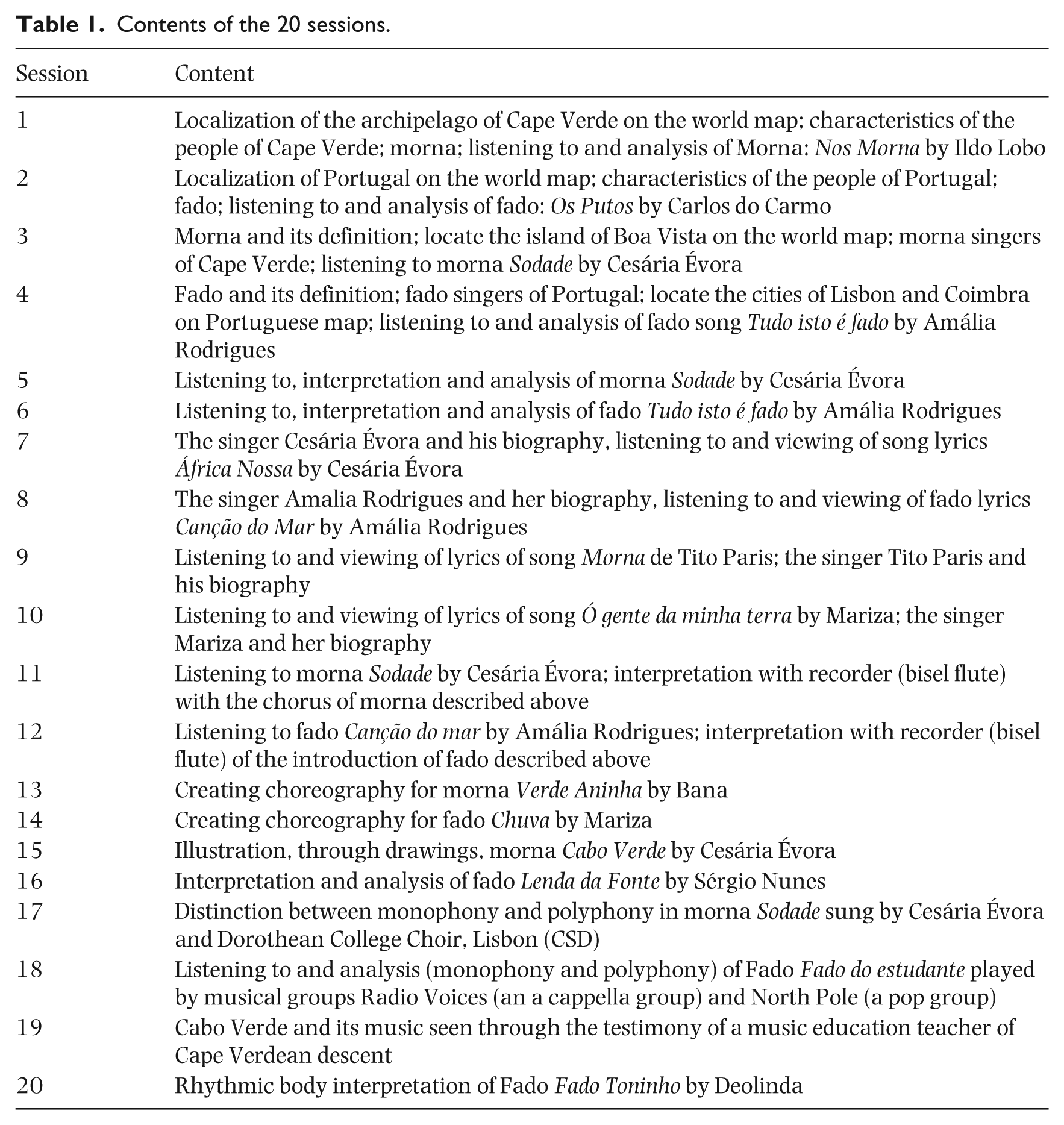
All these songs were in Portuguese (the official language in both countries) and Crioulo (a language in Cape Verde). They were adapted for a young audience. For administrative reasons, it was not possible to have a group of participants exposed only to Cape Verdean songs. The participants were not aware that an experiment was taking place in their school. They were, however, told which songs were Cape Verdean and which songs were Portuguese. The three music teachers who conducted the sessions were from European (light-skinned) origin and they were blind to the hypotheses of the study. They had no information regarding the measurements used in the study.
In March 2011; that is, just after the completion of the program (Time 2), a second testing session (comprising the two instruments) took place, and tests were administered in the same conditions as at Time 1. In June 2011; that is, 3 months after completion (Time 3), a third testing session took place. Tests were administered in the same conditions as at Times 1 and 2. Finally, in May 2013, about 2 years after completion (Time 4), a fourth testing session took place, which involved only 60 participants and the IAT measurements. The four testing sessions were supervised by a light-skinned Portuguese woman, previously trained for this task.
Results
Figure 1 shows the effects of Condition and Time (Time 1 to Time 3 only) on the IAT raw scores (see left panel). Measures of prejudice are on the y-axis. The three time levels are on the x-axis: before exposure to the programme, immediately after, and 3 months later. In the control condition, the three mean scores were similar: Time 1 (M = 5.20, SD = 1.20), Time 2 (M = 5.45, SD = 0.97), and Time 3 (M = 5.59, SD = 0.73). The level of prejudice remained constant. In the experimental group, mean scores linearly decreased: Time 1 (M = 5.43, SD = 0.96), Time 2 (M = 3.86, SD = 1.31), and Time 3 (M = 3.10, SD = 1.23).
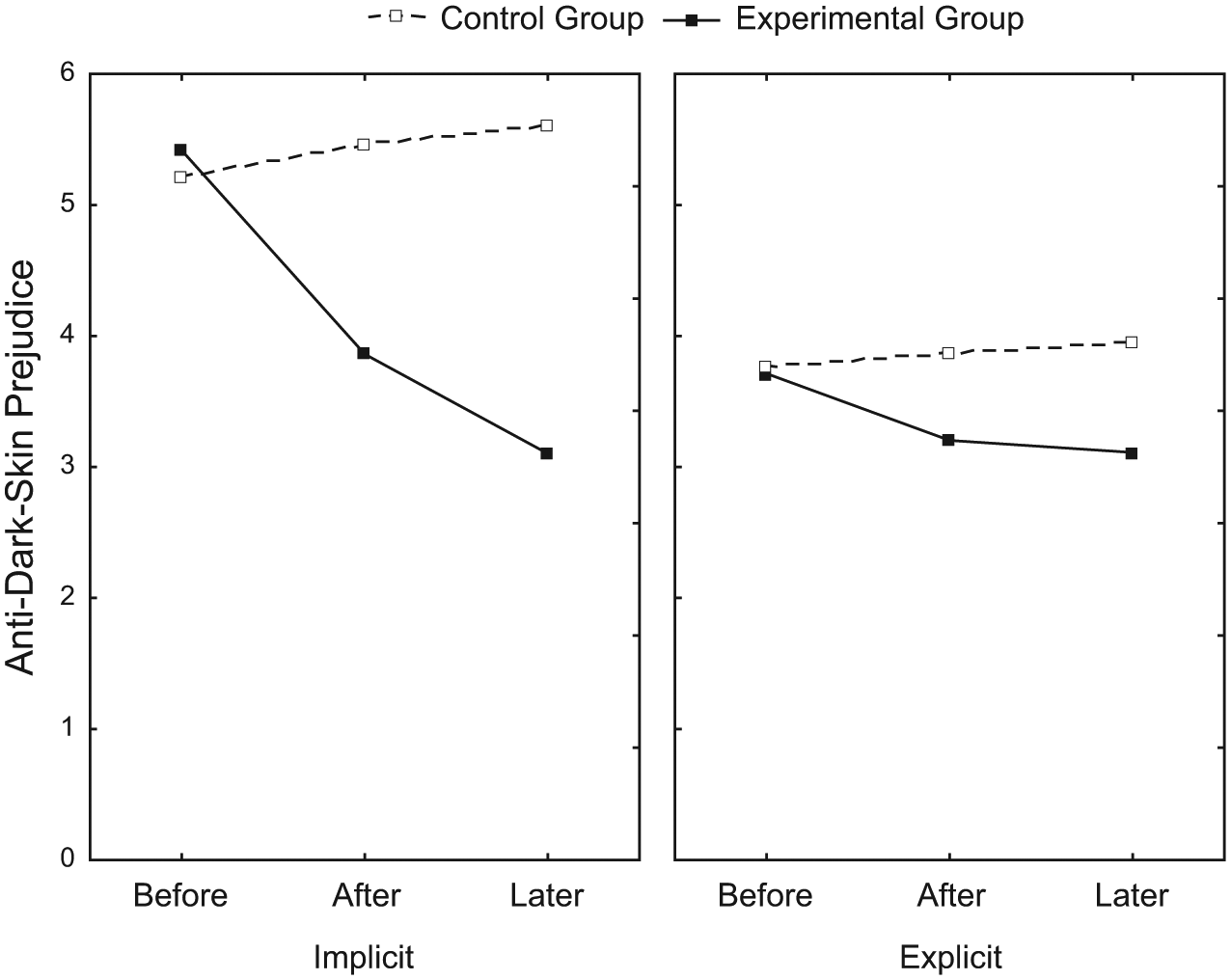
Effect of condition and time on anti-dark-skin prejudice measured, for the whole sample (N = 229), at the implicit level (left-hand panel) and at the explicit level (right-hand panel).
An ANOVA was conducted on these scores with a Condition × Time, 2 × 3 design. The two main effects were significant, F(1, 225) = 172.30, η2p = .43 for Condition, and F(2, 450) = 59.40, η2p = .21 for Time, p < .001. More importantly, (a) the Condition × Time interaction was significant, F(2, 450) = 116.91, p < .001, (b) its effect was moderate in size; that is, higher than .30, η2p = .34, and (c) it was concentrated in its bilinear component, F(1, 225) = 224.34, η2p = .64. A series of three t tests were conducted to assess the effect of condition at each level of the Time factor. The t values were 1.64 (pretest, ns), 10.49 (post-test, p < .001), and 18.71 (3 months later, p < .001); that is, clearly increasing.
Figure 1 also shows the effects of these factors on the explicit attitude score (see right-hand panel). In the control condition, the three mean scores were similar: Time 1 (M = 3.77, SD = 1.26), Time 2 (M = 3.88, SD = 1.22), and Time 3 (M = 3.95, SD = 1.21). In the experimental group, they linearly decreased: Time 1 (M = 3.72, SD = 1.22), Time 2 (M = 3.20, SD = 0.75), and Time 3 (M = 3.10, SD = 0.53).
The two main effects were significant, F(1, 225) = 24.14, p< .001, η2p = .10 for Condition, and F(2, 450) = 4.10, p < .02, η2p = .02 for Time. The interaction was significant, F(2, 450) = 11.84, p < .001, but its effect size was smaller than in the previous analysis, η2p = .05, although it was also concentrated in its bilinear component, F(1, 225) = 18.88, p < .001, η2p = .09. The t values, computed in the same conditions as in the previous analysis, were 0.20 (ns), 5.00 (p < .001), and 6.65 (p < .001).
Figure 2 shows the effects of Condition and Time (Time 1 to Time 4) on the IAT raw scores. As in Figure 1, measures of prejudice are on the y-axis. The four time levels are on the x-axis: before exposure to the programme, immediately after, 3 months later, and 2 years later. The two curves correspond to the two conditions.
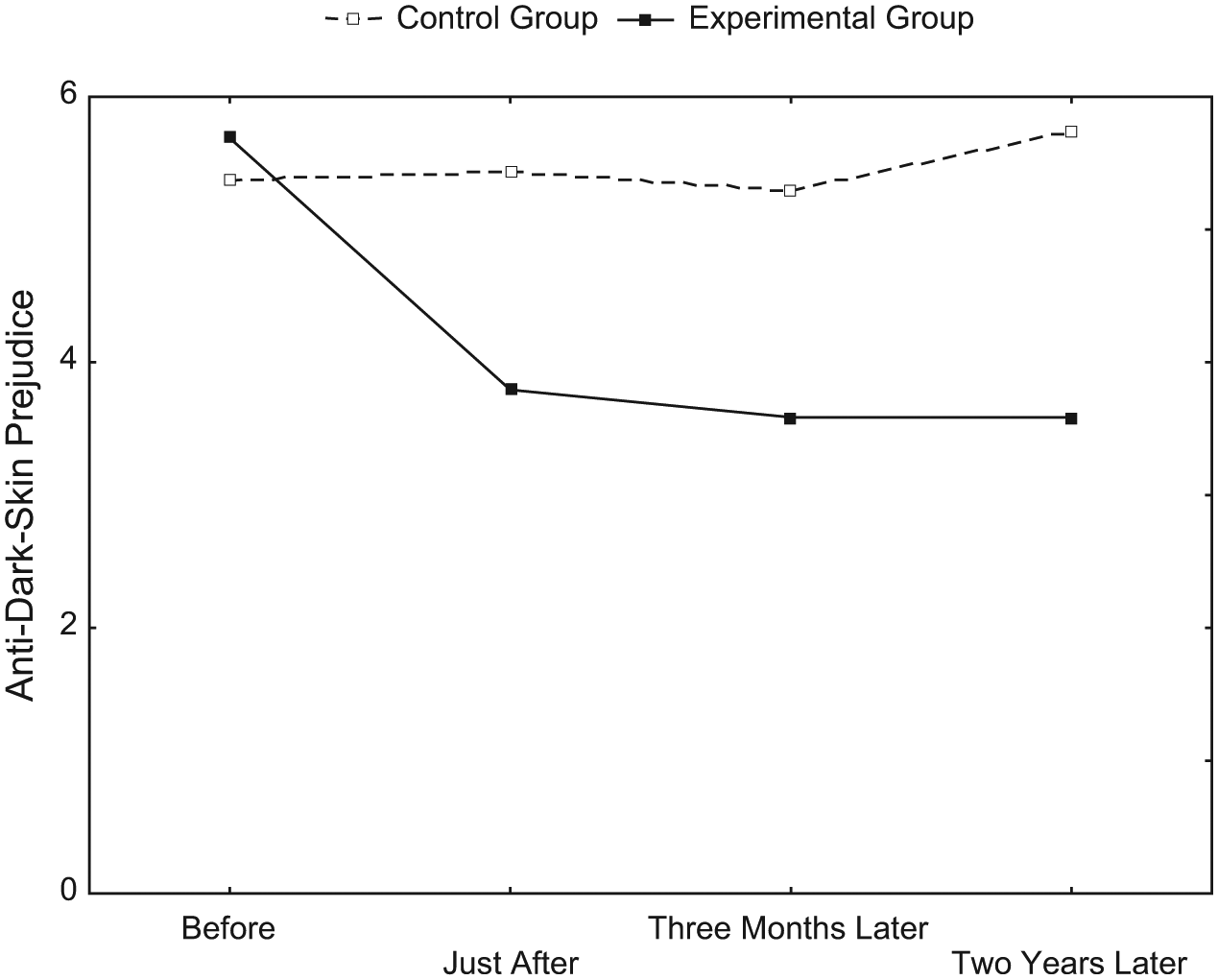
Effect of condition and time on anti-dark-skin prejudice measured, for a reduced subsample (N = 60), at the implicit level.
An ANOVA was conducted on these scores with a Condition × Time, 2 × 4 design. As in the first analysis, the main effects were significant, F(1, 57) = 88.48, η2p = .61 for Condition, and F(3, 171) = 14.60, η2p = .20 for Time, p < .001. The interaction effect was, again, moderate, F(3, 171) = 18.47, p < .001, η2p = .25, and it was concentrated in its bilinear component, F(1, 57) = 60.03, η2p = .55. A post-hoc analysis showed that the difference between the last two means was not significant. The values of the t tests were 1.50 (ns), 5.16 (p < .001), 6.39 (p < .001), and 10.33 (2 years later, p < .001).
Correlation coefficients were computed between implicit and explicit scores. Their values were .23 (before the programme), .26 (at the end of the programme), .41 (3 months later), and .43 (2 years later), all ps < .001. They show that the relationship between explicit and implicit prejudice is not very high.
Discussion
The study examined the impact of a cross-cultural musical programme on young Portuguese adolescents’ anti-dark-skin prejudice. As expected, implicit anti-dark-skin prejudice was lower at the end of the programme than at the beginning, and it was still lower 3 months after its completion. In addition, the effect of the programme was remarkably enduring: 2 years after its completion, the level of prejudice was not different from the one registered 3 months after completion.
Explicit anti-dark-skin attitudes were also lower at the end of the programme than at the beginning, immediately after and 3 months later. These results were consistent with previous findings by Sousa et al. (2005), and with findings by Bakagiannis and Tarrant (2006) who showed that simply knowing the musical preferences of one unknown group of people was enough to make these people seem closer to the self, on condition that preferences were similar. There is now some empirical ground to assert, with these results, that music can be ‘used to promote improvements in group relations’ (p. 133).
The correlation between implicit and explicit scores was low, although positive and significant. Such a relative dissociation has frequently been observed for racial attitudes (Rutland, Cameron, Milne, & McGeorge, 2005).
These findings were also consistent with early findings by Hewstone et al. (1994). These authors assessed the effectiveness of workshops on the quality of co-operation between social workers and doctors. Members of both groups worked as a team to find reasonable solutions to difficult cases. At the end of the programme, members of both groups better recognized each other’s competencies and limitations regarding different aspects of their practice. Finally, these findings were consistent with findings by Hill and Agoustinos (2001). These authors examined the impact of an in-house education program that was specifically designed to reduce the prejudice of White employees working in public service organizations towards Aboriginal Australians. Immediately after completion, the programme had a strong positive effect.
The current results, together with similar findings from Portugal (Sousa et al., 2005), Australia (Hill & Agoustinos, 2001) and the UK (Hewstone et al., 1994), suggest that increasing the perception of similarity with unknown people, either through cross-cultural music education, through statements about common music preferences, or through collaborative work can reduce possible negative stereotypes towards these people. Overall, this set of findings is consistent with Tajfel and Turner’s (1979) social identity theory according to which people perceived as forming part of the in-group are viewed in a more favourable light than people perceived as belonging to an out-group.
Limitations
A first limitation of the study related to the way the sample was constituted. All the young adolescents agreed to participate in the study but, for organizational reasons, the 10 classes were not randomly selected from the population of classes in the district. We had to take into account the heads of schools’ willingness to participate and, in each school, the teachers’ good will. Although we have no reason to suspect any major difference between the schools and classes that we selected and the remaining schools and classes in the school district, we are unsure about the representativeness of our sample.
A second limitation was the composition of the sample at Time 4; that is, 2 years later. Although we made special efforts to contact as many students as possible from the two groups, we could only find 60 of them who accepted to take part. This subsample did not, fortunately, significantly differ from the whole sample in terms of gender, age or other demographic characteristics.
A third limitation resided in the fact that, as IAT compares people’s assessments of an out-group with people’s assessments of an in-group (Karpinski & Steinman, 2006), it is not possible to know whether a change in observed scores corresponds to a decrease in anti-dark skin prejudice or to a decrease in pro-light skin favouritism.
Implications
The current study, together with the one by Sousa et al. (2005), has evident implications for music teachers and also for policymakers. Whether teachers systematically focus on national songs and compositions for music education or they incorporate musical creations from the whole world, without probably being aware of it, they may deeply change their pupils’ views about other people and other cultures. Policymakers should encourage European music teachers and art teachers in general to open their pupils’ ears and eyes to African and Asian songs, paintings and crafts. However, they must also be sensitive to the fact that putting pupils in contact with other cultures’ artistic production can be a double-edged sword. If perceived similarity in taste can improve intergroup relations, perceived dissimilarity in taste can produce the opposite effect (see Johnson, Trawalter, & Dovidio, 2000).
Future studies
Future studies should try to assess the generalizability of the present findings by replicating the study among pupils from other countries, and/or by changing the content of the programme (e.g., visual art instead of music). It would be interesting to see whether a dance programme or the making up of a play produced effects that are similar to the effect of music education observed in the present study.
Future studies should try to disentangle the effect of music itself from the effect of simply introducing Cape Verdean music in the music curriculum. By deciding to teach Cape Verdean songs alongside Portuguese songs, teachers gave value and consideration to the people who produced this music, and this had an impact on positive pupils’ attitudes to these people (McGuire, 1985).
Future studies should also try to disentangle the effect of music itself from the effect of lyrics. Morna expresses deep human emotions such as nostalgia, love for nature, and friendship. As a result, the lyrics themselves, independently of music, may have led pupils to more clearly perceive Cape Verdeans as having similar values to their own, which may have positively affected their attitudes. What if the lyrics had expressed messages that were at odds with pupils’ values (Ali & Peynircioğlu, 2006)?
Future studies should, finally, be devoted to test the idea that a positive change regarding a specific aspect of reality (here, anti-dark-skin prejudice) would be accompanied by other positive changes regarding other aspects of reality. For example, would changes in people’s level of prejudice regarding a specific characteristic of an out-group (e.g., skin tone) be associated with changes in the same people’s level of prejudice regarding other characteristics of this out-group (e.g., intelligence)? In summary, future studies should disentangle the effect of music itself from associated effects and should assess the generalizability of the present findings to other artistic domains, to other cultures, and to other kinds of prejudice.
Footnotes
Acknowledgements
Thanks are expanded to the Heads and personals of Escola Luisa Todi, Setubal, and of Escola Prof. Antonio Pereira Coutinho, Cascais, Portugal. The authors would like to thank Margarida Machado, Helder Caramba, and Sérgio Oliveira for implementing the cross-cultural musical program in their courses.
Funding
This work was supported by Advancing Interdisciplinary Research in Singing (AIRS) project.