



Abstract
Earlier research has emphasized the emotional nature of frisson (pleasurable aesthetic chills) and has suggested that the personality trait Openness to Experience may predict more frisson episodes. The present study tested these notions by administering a measure of Openness and inducing actual instances of frisson using musical stimuli. One hundred college students completed the NEO-PI-R, which assesses the five factors of personality (Openness, Extraversion, Neuroticism, Agreeableness, and Conscientiousness), and then listened to five musical selections that were likely to elicit frisson. Frisson was assessed via a combined self-report and physiological (galvanic skin response) measure. As predicted, frequency of frisson was positively correlated with overall Openness to Experience, as well as five of its six subfacets: Fantasy, Aesthetics, Feelings, Ideas, and Values. Examination of the more specific relationships suggests the possibility that cognitive attentiveness to music may be more closely related to frisson than had been emphasized in past research.
Over the past few decades, research has exposed a particularly curious phenomenon: aesthetic chills, or the ability of some people to experience pleasurable chills and goose bumps in response to emotionally moving stimuli. In an early and influential paper written on aesthetic chills, Sloboda (1991) suggested that, due to the numerous descriptive terms that have been associated with this experience (chills, thrills, goosebumps, shivers, and goosetingles), researchers would benefit from borrowing the succinct French term, frisson, in order to provide continuity to this body of research. We chose to follow this tradition as we examined the relationship between personality and frisson.
In his seminal investigation on the topic, Goldstein (1980) synthesized the following description of what frisson feels like: a pleasurable chill or tingle originating ‘in the area of the upper spine and back of the neck… spreading… in a radiating or sweeping pattern, upward over the scalp… outward over the shoulders and arms, down the spine… [which] may be accompanied by “goose bumps” on the arms’ (pp. 126–127). Other studies have shown that these physiological effects last for about 10 seconds, on average, and usually come in what are described as waves of pleasure (Panksepp, 1995; see also Blood & Zatorre, 2001). Music has been found to be the most common frisson-producing stimulus reported (Goldstein, 1980), and, consequently, many studies have focused on frisson as a response to musical stimuli (e.g., Grewe, Nagel, Kopiez, & Altenmüller, 2007b; Guhn, Hamm, & Zentner, 2007; Panksepp, 1995).
Fortunately for researchers, most listeners are able to pinpoint precise moments in musical selections when they are likely to experience frisson (Sloboda, 1991). Guhn et al. (2007) found that certain musical instances were independently identified and shared by a significant number of listeners as the cause of frisson. Common examples of such musical instances are unexpected harmonies, unexpected dynamics, or the unexpected entrance of a new voice (such as a solo). The unexpected entrance of a new voice seems to be the most significant musical cause of frisson (Grewe, Nagel, Kopiez, & Altenmüller, 2007a; Panksepp & Bernatsky, 2002). Meyer (1956) suggested that unexpected musical instances are emotionally charged for the listener because they violate the musical expectations of the listener and are, thus, pleasant surprises. In line with the pleasant nature of the experience as a reaction to music, Panksepp (1995) found that the degree to which an individual reported liking any given piece of music was positively related to the intensity of their experience of frisson.
At least part of what makes frisson so captivating to the interest of research is, as Grewe, Katzur, Kopiez, and Altenmüller (2010) explain, that ‘no other known indicator of emotions combines a strong, positive, subjective feeling, and a measureable physiological arousal response in one reaction’ (p. 221). Despite a healthy body of frisson research, estimates of how prevalent the effect is amongst the general population have varied widely (see Goldstein, 1980; Panksepp, 1995; Grewe et al., 2007b), leading researchers to pursue individual differences as a desirable lens through which to study frisson in greater depth. Beginning with McCrae (2007), studies have repeatedly shown a positive link between frisson and the personality trait of Openness to Experience, one of the domains of the Five Factor Model of personality (McCrae & Costa, 1997). Openness refers to an individual’s ‘recurrent need to enlarge and examine experience’ (McCrae & Costa, 1997, p. 826), especially through cognitive exploration (DeYoung, 2014). It includes ‘active imagination, aesthetic sensitivity, attentiveness to inner feelings, preference for variety, intellectual curiosity, and independence of judgment’ (Costa & McCrae, 1992, p. 15).
This tendency for people high in Openness to explore sensory experiences may help explain why McCrae (2007) found a significantly positive correlation between individuals’ overall Openness score and their endorsement of a frisson-related item, item 188 (r = .59, for the American sample), on the Revised NEO Personality Inventory (NEO-PI-R; Costa & McCrae, 1992). This item directly addresses the experience of frisson and reads, ‘Sometimes when I am reading poetry or looking at a work of art, I feel a chill or wave of excitement’ (McRae, 2007, p. 6). Surprisingly, McCrae (2007) found that this Openness item was the best overall indicator of Openness across all translations of the NEO-PI-R and that the experience of frisson is a universal marker of Openness.
McCrae (2007) also suggested that two subfacets of Openness, Aesthetics and Feelings, are most likely the strongest correlates of the experience of frisson. Specifically, individuals high in Aesthetics are ‘moved by poetry, absorbed in music, and intrigued by art’ (Costa & McCrae, 1992, p. 17) more readily than their peers, and individuals high in Feelings experience ‘deeper and more differentiated emotional states and feel both happiness and unhappiness more intensely than others’ (p. 17), lending insight into why McCrae (2007) would conceptually identify these emotion-laden subfacets as being most likely linked to frisson, which is an emotional experience.
Several self-report studies seem to have confirmed the findings of McCrae and demonstrated a clear connection between Openness and self-reported frisson as a response to music (e.g., Nusbaum & Silvia, 2011; Nusbaum et al., 2014; Silvia & Nusbaum, 2011). In particular, Silva and Nusbaum’s (2011) study examining the relationship between The Big Five Aspects Scale and self-reported frisson episodes found that individuals high in Openness reported experiencing frisson more often. Interestingly, the study also found a negative correlation between the cognitive aspect of Openness (Intellect) and self-reported experiences of frisson, lending support to McCrae’s (2007) suggestion that Aesthetics and Feelings are the two subfacets of Openness most likely to correlate (positively) with the experience of frisson.
Of particular interest to the present study, the methodologies used by the aforementioned researchers have relied on self-report data alone. In all three studies (Nusbaum & Silvia, 2011; Nusbaum, et al., 2014; Silvia & Nusbaum, 2011), participants were asked to report the general frequency of their chill episodes, rather than the researchers recording live instances of those episodes using physiological measures. Surprisingly, no study found in an extensive literature review has undertaken the task of directly correlating Openness to live, empirically recorded experiences of frisson, although Liljeström, Juslin, and Västfjäll (2013) came close. In their study, the NEO-PI-R was administered and participants’ emotional reactions to music were assessed physiologically, but not specifically coded as frisson. Their analyses indicate that individuals who score high on Openness are more likely to experience intense emotions while listening to music, but, as stated above, these findings were not specifically analysed relative to the experience of frisson.
The present study seeks to go well beyond these methodologies by measuring actual episodes of frisson, concurrent with self-reported confirmation of each episode, in addition to examining all five traits of the NEO-PI-R including all of their 30 subfacets. Primarily, the present study suggests that Openness to Experience, as one of the primary components of personality, could explain a large share of the individual differences in frisson experiences. Furthermore, since McCrae (2007) intuitively suggested that Aesthetics and Feelings are the two subfacets most likely to correlate with the experience of frisson, the present study was designed to more thoroughly investigate these claims and to do so in an empirical manner by correlating each of the subfacets of Openness with the experience of frisson using a combined self-report/physiological measure.
Because frisson is such an intensely physiological experience, studying live, empirically observed instances of frisson is especially valuable. As an improvement on earlier neurophysiological methodologies (Blood & Zatorre, 2001), Salimpoor, Benovoy, Larcher, Dagher, and Zatorre (2011) used fMRI to conduct an analysis of the temporal components of the experience of frisson, examining the stages of frisson as it unfolds over time, rather than examining frisson as one holistic neurophysiological event. Their results indicate that frisson may initially begin as a cognitive experience that crescendos into an emotional release. Salimpoor et al. (2011) found that, while the rewards associated with frisson clearly reside in an especially emotional area of the striatum (the nucleus accumbens), neural activity leading up to the onset of a frisson causing event was more closely associated with activity in the caudate. This finding is important because studies have found that the caudate is involved in executive functioning, particularly the ability to make predictions and to understand connections between actions and outcomes (Grahn, Parkinson, & Owen, 2009). Since frisson has been repeatedly and empirically associated with anticipation, (Grewe, et al., 2007a; Guhn et al., 2007; Panksepp & Bernatsky, 2002; Sloboda, 1991), this finding of the involvement of the caudate before frisson occurs is particularly fitting and may point to a greater involvement of cognition in the experience of frisson than previously presumed in the literature.
This fMRI research suggests that the cognitive aspects of Openness to Experience may be particularly important in the experience of frisson. Three of the subfacets of Openness are especially cognitive in nature (see Costa & McCrae, 1992, for descriptions). The Fantasy subscale refers to the tendency to engage in daydreaming and make-believe in which meaning and pleasure are derived from a purely cognitive experience. The Ideas subscale, arguably the most cognitive and intellectual of the Openness subscales, refers to intellectual curiosity. The Values subscale is marked by a tolerance for controversy and differences, a preference for flexibility of thought and open-mindedness, and a willingness to yield to changing trends.
Each of these subfacets could logically be related to frisson experiences derived from listening to music. Beaty and colleagues (2013) found that Openness was closely related to a predilection for experiencing musical imagery, a way of processing music that combines listening with daydreaming. Such fantastical cognitive immersion, which could stem from the Fantasy component of Openness, may feed directly into the musical attentiveness that so readily lays a foundation for the experience of frisson. Similarly, the Ideas subfacet has been linked to the ability to naturally detect complex patterns in sensory information (such as music) without conscious effort (DeYoung, 2014). Given that frisson tends to occur near unexpected musical events that violate established patterns within the aggregate of the musical piece, it makes sense that Ideas might be strongly connected to frisson. Individuals high in Values may process the unexpected musical events more openly than the average listener and might subsequently be better able to process the musical events more positively, given their tolerance for things that are different.
Thus, the fMRI research suggests that the cognitive components of Openness may contribute strongly to the experience of frisson, at least when frisson is assessed physiologically. While fMRI is perhaps one of the finest physiological measures available, the most commonly used measure of physiological arousal in frisson research is galvanic skin response (GSR). GSR has been shown in several studies to be a reliable method of assessing whether or not a person is actually experiencing a frisson episode. For example, using musical stimuli, Guhn et al. (2007) found that GSR levels were significantly higher in participants experiencing frisson (see also Craig, 2005). Similarly, Rickard (2004) found that emotionally powerful music elicited significant increases in skin conductance, while having ‘no significant effect on . . . heart rate, skin temperature, electromyography, or salivary cortisol’ (p. 382). This left her with the conclusion that GSR is an especially sensitive measure of frisson, especially compared to other biological feedback measures (Rickard, 2004). Steinbeis, Koelsch, and Sloboda (2006) also confirmed that changes in GSR significantly corresponded with frisson episodes induced by musical passages (see also Panksepp, 1995).
As such, the objective of the present study was to administer the NEO-PI-R and then record participants’ GSR levels during exposure to emotionally powerful music capable of eliciting a frisson response. The hope was to extend the previously established connection between Openness and frisson using live, physiologically recorded frisson episodes, rather than relying on self-report measures alone. Specifically, it was primarily hypothesized that physiologically recorded instances of frisson would correlate positively with Openness. Similarly, it was hypothesized that physiologically recorded instances of frisson would also exhibit strong correlations with the more emotional subfacets of Openness (Aesthetics and Feelings), as had been suggested by McCrae (2007). We also expected frisson to correlate strongly with the cognitive aspects of Openness (Fantasy, Ideas, and Values), given the involvement of the role of executive functioning in the onset of frisson experiences. Additionally, administering the entire NEO-PI-R allowed for analysis of the individual subfacets of Openness, as a means of shedding more light on the influence of individual differences relative to the experience of frisson while simultaneously providing greater insight into the emotional and cognitive contributing factors related to the experience.
Method
Participants
Participants were 113 undergraduate students at a 4-year university in Washington State. They participated in exchange for course credit within the departments of psychology and music. Data from 13 participants were excluded due to the following reasons: a) one participant openly admitting to providing false reports of frisson upon the conclusion of the listening session, b) inaccurate GSR data (due to equipment failure, experimenter error, or participant fidgeting), c) one participant admitting an inability to read English well enough to complete the survey, and d) one participant’s inability to finish the study in the allotted time. Of the remaining 100 participants, data from three were excluded as a result of being more than three standard deviations from the mean number of frisson episodes experienced during the 10-minute listening session (M = 2.68, SD = 3.69). However, including their data in the analyses produced the same statistical results. Thus, the primary sample consisted of 97 participants (62% females, Mage = 21). An additional fourth outlier was removed in analyses conducted on a supplemental self-report measure of frisson in order to eliminate all scores that fell beyond three standard deviations from the mean on that measure.
Design
A correlational design was used to examine the relationship between the experience of frisson and various aspects of personality, most notably Openness. Multiple regression analyses were also performed on frisson to examine the unique influence of the different Openness subfacets.
Materials and apparatus
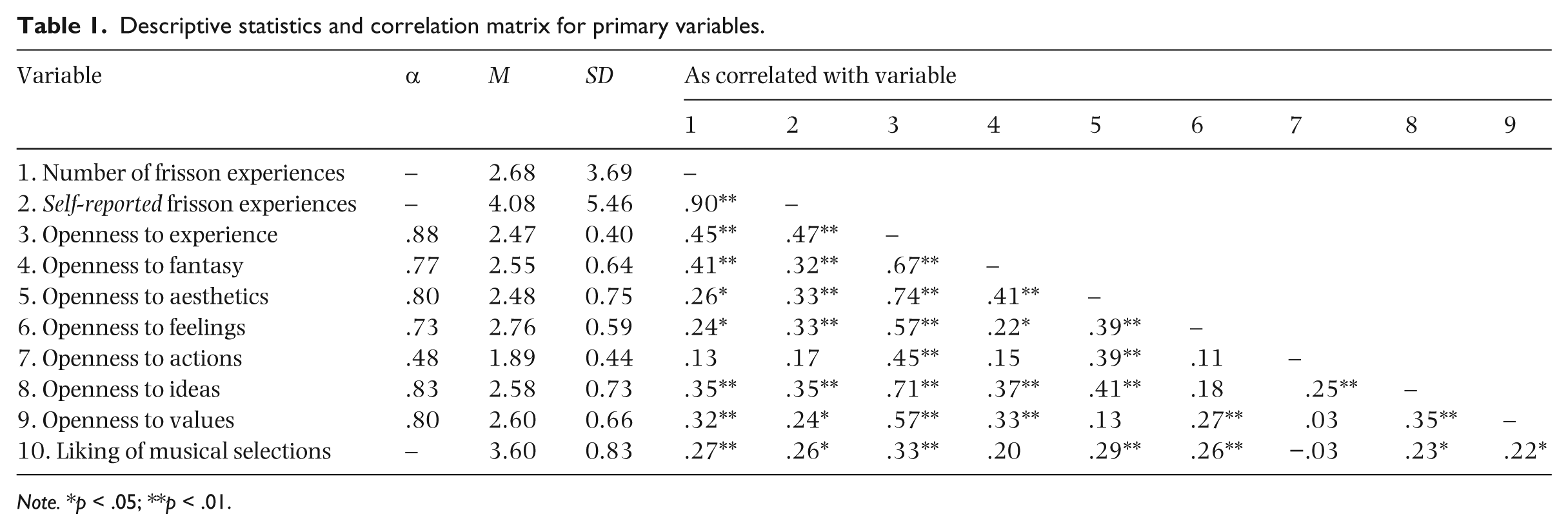
The materials used included a basic demographic information form (age, sex, and course of study) and the NEO-PI-R (Costa & McCrae, 1992), a standardized measure of five broad personality domains. This measure asks participants to indicate the extent to which they disagree or agree with 240 different statements about themselves using a 5-point scale from 1, Strongly Disagree, to 5, Strongly Agree. Scores were averaged for each of the five traits, which included: Openness (M = 4.94, SD = 0.40, α = .88), Conscientiousness (M = 2.42, SD = 0.40, α = .89), Extraversion (M = 2.47, SD = 0.45, α = .91), Agreeableness (M = 2.44, SD = 0.35, α = .85), and Neuroticism (M = 1.87, SD = 0.41, α = .89). Though not specific foci of the study, Conscientiousness refers to being efficient and organized, Extraversion refers to being outgoing, Agreeableness refers to being friendly and compassionate, and Neuroticism refers to being emotionally unstable and sensitive. These traits and all of their subfacets were assessed for purely exploratory reasons. Our focus was on Openness and its subfacets, the descriptive statistics for which are presented in Table 1.
Descriptive statistics and correlation matrix for primary variables.
Note. *p < .05; **p < .01.
The musical pieces used for the study were selected based on their likelihood of producing frisson in participants due to the presence of salient instances of frisson-inducing musical events that had been identified in previous research (Grewe et al., 2007a; Guhn et al., 2007; Panksepp & Bernatsky, 2002). Specifically, after sifting through music from a range of genres and styles (especially pieces identified in previous literature and by lab members as frisson-producing), nearly two dozen pieces were identified by a person trained in musical theory as examples containing instances of the unexpected entrance of a new voice. The unexpected entrance of a new voice was selected as a prime stimulus for frisson induction given its status in the extant literature as the most common contributor of music-induced frisson experiences. These specific musical instances of the unexpected entrance of a new voice within each piece were subsequently pre-tested on three male and three female college student volunteers who reported regularly experiencing frisson in their day-to-day lives. Five of the pieces produced frisson in all six pre-test listeners and were selected to be used as the experimental stimuli: 1) the first 2 minutes and 11 seconds of J. S. Bach’s St. John’s Passion: Part 1- Herr, unser Herrscher; 2) the first 2 minutes and 18 seconds of Chopin’s Piano Concerto No. 1; 3) the first 53 seconds of Air Supply’s Making Love Out of Nothing At All; 4) the first 3 minutes and 21 seconds of Vangelis’ Mythodea: VI; 5) the first 2 minutes of Hans Zimmer’s Oogway Ascends. The length of each selection was determined by starting the track at the beginning of the piece and allowing it to play through the first frisson-inducing moment of the piece and on to the next occurring coda, giving a sense of musical finality and closure to each listening episode. This method, while differing from earlier methods that used fixed periods of time for each listening session (e.g., 1 minute of music, regardless of whether the cutoff point made musical sense), was used to maintain fidelity to the compositional structure of each piece and to allow the listener to develop ample and appropriate musical expectations for each piece before encountering frisson-inducing moments. This approach was pursued under advisement of a professional music theory specialist.
GSR was measured using the GSR2 Biofeedback Machine and its accompanying CalmLink Biofeedback software. A follow-up questionnaire assessing familiarity and liking of the musical selections was also used. Overall familiarity with the pieces of music was assessed as a supplemental measure to ensure that it did not interfere with frisson experiences. Familiarity was assessed using a Likert scale from 1, Unfamiliar, to 10, Familiar (M = 2.91, SD = 2.13). As another measure of familiarity, this survey asked participants to name the musical selections to the best of their ability (although only two participants were familiar enough with the pieces to be able to name any). Additionally, the measure assessed participants’ liking of each musical selection using a 5-point scale from 1, Dislike, to 5, Like.
Procedure
Participants were brought into the lab on an individual basis, where they completed the basic demographic information form and the NEO-PI-R (Costa & McCrae, 1992). After completing this materials packet, participants sat in a comfortable chair in a small laboratory room where they could experience the musical stimuli alone. Participants were connected to the GSR machine using fingertip sensors attached to the index and middle fingers on their left hand. Participants were instructed to keep their hand as still as possible throughout the listening session because movements can lead to false readings. The experimenter then provided the following instructions to be followed during the experiment:
We’re going to have you listen to some music over the next 15 minutes. We’re going to be measuring your reaction to a number of different pieces of music. This machine measures the amount of blood and water in your skin. It will attach to your hand like this [demonstrated on self], with your index and middle fingers on the sensors… Now, I need to explain what we’re trying to measure. There are certain types of people that get physical chills or goosebumps on their neck, back, and arms, or elsewhere when they listen to certain types of music… Whether or not you have ever experienced physical chills or goosebumps in reaction to music before now, what I’m going to ask you to do is, while you listen to this music, if you should happen to experience any chills or goosebumps on your neck, back, arms, or elsewhere, just press and hold down this red button during the entire experience. Press it down when the physical chills or goosebumps start and hold it down until they end. This may or may not occur several times over the next 10 minutes. Either way, it’s okay. I’d like you to indicate it as often as you experience physical chills or goosebumps by pressing this red button. Now we’re going to begin. Please try to keep your body fairly still during this part of the experiment. I’m going to dim the lights a bit and shut the door. Try to relax and enjoy the music as you would listening at home. Do you have any other questions? Now let’s begin. I’ll come back in when the experiment is over, which will be in about 10 minutes.
The experimenter answered any questions the participants had, secured headphones to the participants’ head, dimmed the lights to a pre-established standardized level, left the room, and shut the door. In an adjacent room, the experimenter began playback of the five music clips (set to play at a standardized volume for all participants) and began monitoring GSR. Roughly 10 seconds of silence acted as a rest period between each musical selection.
During each listening session, the experimenter recorded the start and stop time of any instances of self-reported frisson that occurred, as indicated by a light and buzzer (located outside of the participants’ sight and earshot). This mechanism was activated by the participants’ indicator button and remained continuously active during the entire length of each button press, such that a participant could not only indicate the timing of each frisson episode, but also the length. As such, frisson episodes were not merely recorded by tally, but by temporally accurate timestamp (indicating onset, length, and cessation of each frisson episode).
The self-reported timing data was examined alongside a temporal log of the participants’ GSR levels. Instances in which the press of the indicator button simultaneously coincided with an abrupt positive directional change in the GSR graph were coded as individual frisson episodes in our primary assessment of frisson. See Figure 1 for a visual representation of this process, which exhibits the GSR data of one participant whose results portray a particularly salient and comprehensive example of this process.
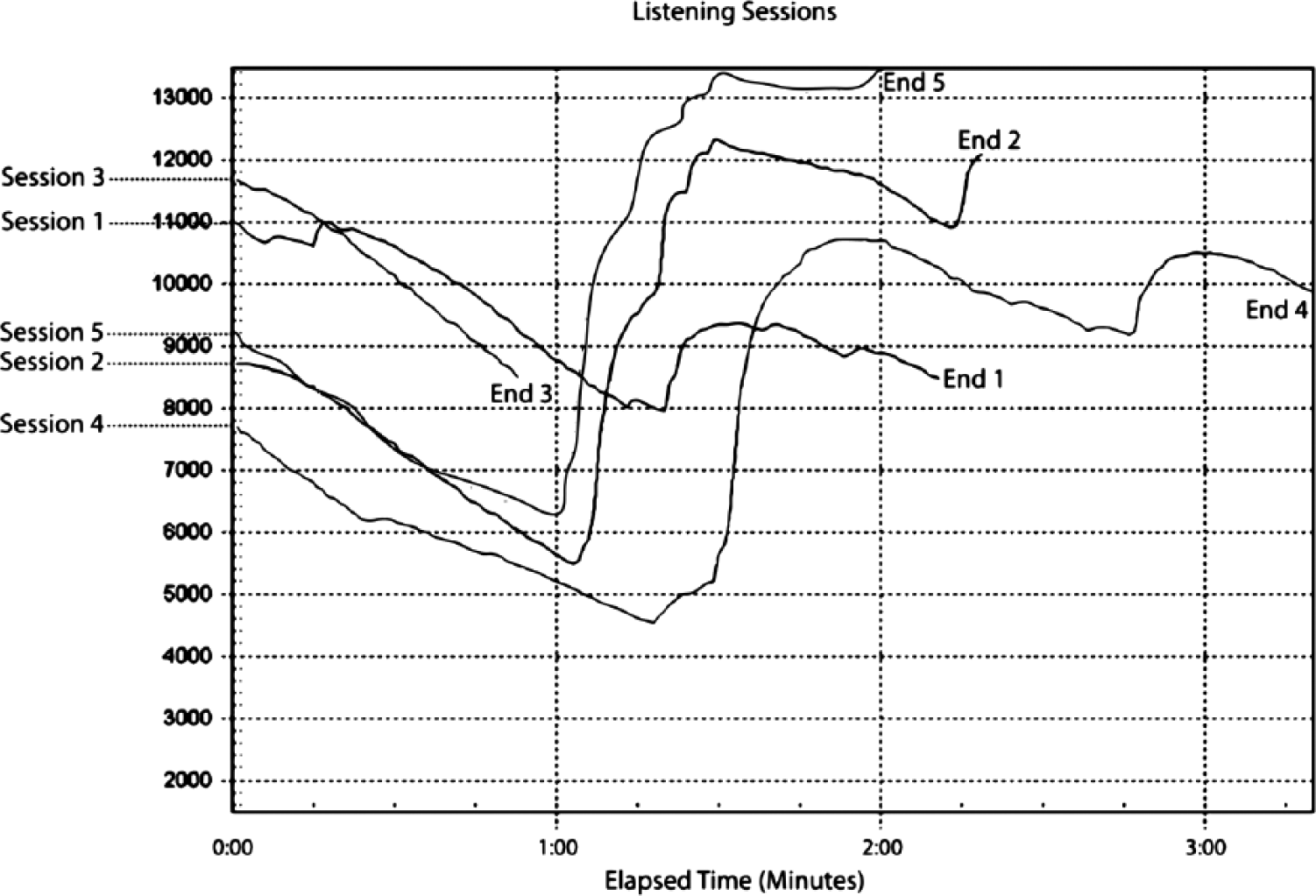
The five lines each represent the GSR of participant number 81, relative to each of five listening sessions (with each line representing GSR recorded during a specific song, displayed here in overlay). This participant did not signal a frisson episode with the indicator button during either the first or third listening sessions. As such, instances of increase in GSR that occurred during either of these sessions were identified as non-frisson arousal. During the second listening session, the participant signaled for 2 seconds at 0:01:03, for 2 seconds at 0:01:15, for 2 seconds at 0:01:22, and for 4 seconds at 0:02:10. Since the GSR graph includes coinciding increases in GSR, these four self-reported episodes of frisson were considered actual and real. Similarly, during the fourth listening session, the participant signaled for 3 seconds at 0:01:28. Since this coincided with an increase in GSR, another episode of frisson was identified. Note that, as before, the subsequent increase in GSR near the end of the fourth listening session was not accompanied by a signal by the participant and was therefore also identified as non-frisson arousal. Finally, during the fifth listening session, the participant signaled for 5 seconds at 0:00:58 and again for 7 seconds at 0:01:11, both of which coincide with instances of increase in GSR and therefore were documented frisson episodes. As such, participant number 81 was coded as having experienced seven total frisson episodes during the entire 10-minute listening period. Or, in other words, participant number 81 experienced seven total increases in GSR that were temporally consistent with their self-reported instances of frisson.
In keeping with Rickard (2004), test trials demonstrated that pressing the self-report button in a neutral context (not concurrent with the experience of frisson) does not cause significant increases in the GSR data (as might be expected), let alone any changes that would be mistaken for the sudden, visually dramatic, and sustained increases present during a frisson episode, as shown in Figure 1. Descriptive statistics showed that 60% of the 97 participants experienced frisson at least once.
Following all five musical selections, participants were disconnected from the equipment and instructed to complete the follow-up questionnaire regarding familiarity and liking. After completing this final questionnaire, participants were debriefed, thanked, and dismissed.
Results
The primary hypothesis was that higher Openness would correlate positively with frisson in response to specific musical instances. As predicted, higher overall Openness scores were related to more frisson experiences during the 10-minute listening session, r(95) = .45, p < .001. In line with the findings of McCrae (2007), overall Openness correlated with participants’ responses to NEO-PI-R item 188 at a significantly positive level, r(95) = .69, p < .001. Item 188 also correlated significantly with number of frisson episodes participants experienced, r(95) = .29, p = .004. The significance of this correlation provided some validation for McCrae’s use of that item as an indicator of frisson.
To examine the contribution of Openness while controlling for the other four main personality dimensions, we conducted a Simultaneous Multiple Regression analysis with each of the five facets of the NEO-PI-R entered as predictors and the number of frisson experiences treated as the criterion. The full model was statistically significant, F(5, 91) = 4.93, p < .001. As hypothesized, the Openness dimension was a statistically significant predictor within the model, β = .45, p < .001, while the remaining four facets were unrelated to frisson, βs = −.07 to −.01, ps = .513 to .900.
Correlations were also performed separately between frisson and each of the six facets of Openness (see Table 1 for these values). Openness to Aesthetics and Openness to Feelings were both positively correlated with frisson, but these were not the strongest relationships between Openness and frisson. As shown in the table, Openness to Fantasy had the strongest positive correlation with frisson, followed by Openness to Ideas and Openness to Values. The sixth facet of Openness, Openness to Actions, was the only facet of Openness not found to have a significant relationship with frisson, perhaps partly due to its especially low internal consistency reliability (see Table 1).
To examine the contribution of each subfacet of Openness while controlling for the remaining subfacets, we included all six Openness subfacets as predictors in a Simultaneous Multiple Regression performed on the number of frisson experiences. The overall model was significant, F(6, 90) = 4.88, p < .001. Interestingly, the only facet of Openness whose unique variance was related to frisson experiences was Openness to Fantasy, β = .27, p = .014.
To gain a more comprehensive picture of potential personality differences, correlations were performed between each of the five domains (and 30 subfacets) of the NEO-PI-R to uncover any other possible correlations with our primary measure of frisson. The domain of Openness and its five aforementioned facets were the only significant positive correlates of frisson found within the data. A facet of Conscientiousness, Self-Discipline (M = 2.33, SD = 0.70, α = .84), served as the only negative correlate of frisson, although it reached only marginal significance, r(95) = −.19, p = .06. Although prior work on sensation-seeking (Grewe et al., 2007b) would suggest a negative correlation between frisson and the Excitement-Seeking facet of Extraversion (M = 2.56, SD = 0.63, α = .65), no such relationship emerged in the present study, r(95) = −.08, p = .414.
Supplemental analyses were performed to examine the possible roles of familiarity and liking of the musical pieces in the experience of frisson. As in previous research (Grewe, Kopiez, & Altenmüller, 2009), having greater familiarity with any given piece was not significantly correlated with number of frisson experiences, r(93) = .08, p = .433, confirming that familiarity did not complicate the results.
Also in-line with past research (Panksepp, 1995), we found a significant positive correlation between how much individuals liked the pieces of music and how often they experienced frisson during the 10 minute listening session, r(95) = .27, p < .01. Since liking and frisson were related, we computed partial correlations between Openness and frisson, while factoring out the influence of liking to see whether it accounted for any of the Openness-frisson relationships. The correlations between frisson and overall Openness, Fantasy, Ideas, and Values all remained significant. However, the correlations between frisson and Aesthetics, r(92) = .19, p = .069, and Feelings, r(92) = .19, p = .073, dropped to marginal significance. The inclusion of liking in the regression which examined the predictive effects of the Openness subfacets on frisson had no effect on the outcome. Openness to Fantasy served as the only significant predictor, β = .27, p = .017, and liking was not statistically significant, β = .14, p = .172.
In order to further tease apart the difference between using the combined measure of frisson (which included both self-report and GSR data) and using a self-reported measure of frisson alone, correlations between Openness and frisson were also computed using participants’ button-press counts by themselves, without referencing physiological data at all (see Table 1 for these values). The correlation with overall Openness was equal in strength regardless of which frisson measure was used. The most notable differences were that the correlation between the Fantasy subfacet and frisson became significantly weaker when using the self-report measure of frisson, t(93) = 2.14, p = .035, whereas the correlation between the Feelings subfacet and frisson became significantly stronger when using the self-report measure of frisson, t(93) = −2.08, p = .041.
We also performed a Simultaneous Multiple Regression examining the effects of the Openness subfacets on self-reported frisson. Once again, the overall model was significant, F(6, 89) = 4.57, p < .001. However, the only facet of Openness whose unique variance was related to frisson experiences was Openness to Feelings, β = .21, p = .05, when physiological data were not taken into account.
Discussion
The present study investigated whether qualitative differences in personality, particularly Openness, may affect frisson experiences. Although a relationship between Openness to Experience and frisson has been posed in past research, it was tested using only self-report measures of frisson and without examining direct responses to live frisson-inducing musical stimuli (McCrae, 2007; Nusbaum & Silvia, 2011; Nusbaum et al., 2014; Silvia & Nusbaum, 2011). Using a combined self-report/physiological measure of frisson, the present study found that higher Openness scores on the NEO-PI-R correlated with a greater number of actual experiences of frisson (aesthetic chills) during a live music listening session. This result both substantiates an Openness-frisson relationship and sheds greater light on its complex nature.
Previous research had pointed to Aesthetics and Feelings as the two subfacets of Openness most likely to correlate with frisson (McCrae, 2007). There was some evidence of this in the present study, but only when examining self-reported frisson. The Feelings subscale was identified as the only Openness subfacet with a unique contribution to frisson experiences. However, judging by the results involving our primary measure of frisson, cognitive and intellectual factors may play an even bigger role in frisson than emotional and aesthetic factors, something not indicated by previous research using self-report measures. When using this combined physiological/self-report measure of frisson, Fantasy (a cognitive dimension of Openness) was shown to be the only subfacet whose unique variance was related to the experience of frisson.
As such, the results of the present study indicate that emotions alone may not explain the phenomenon of frisson as comprehensively as previously shown in research that relied exclusively on self-report measures of frisson. Cognitive factors have been mentioned in previous research, but rarely given the spotlight. For example, a significant finding of Grewe et al. (2007b) was that listeners who tend to focus more attention on the music they listen to are also more likely to experience frisson. Within the present study, the relatively strong significant correlations we found between frisson and Fantasy, Ideas, and Values (with particular attention given to Fantasy) may be a viable link to why attentiveness and other cognitive features matter so much to frisson. In fact, Fantasy, Ideas, and Values were the only three facets of Openness that were still correlated with the combined self-report/physiological measure of frisson after accounting for individual differences in liking of the musical pieces. Thus, the results of the present study warrant a more in-depth exploration of the contributing factor that the cognitive components of Openness play into the experience of frisson. DeYoung (2014) reminds us that Openness was originally referred to as Inquiring Intellect, and was indicative of the ability to process complex information with greater flexibility.
On the emotional side of the spectrum of Openness, while Aesthetics is characterized by an appreciation for and involvement in the fine arts (Costa & McCrae, 1992), this subfacet may be less conceptually related to the anticipation that facilitates frisson than other cognitive components, such as Fantasy. Similarly, Feelings, while an excellent indicator of experiencing emotions in great depth, may lend a hand in intensifying the experience of frisson, but may not necessarily enable it to happen in the first place. The relatively underemphasized nature of the cognitive features of frisson within the extant literature could be precisely why, as one example, Grewe et al. were ‘surprised’ (2010, p. 233) to find that 17 of their participants were able to elicit frisson using nothing more than mental self-stimulation.
Given the findings of the present study, it might be reasonable to conclude that processing music in a cognitive or intellectual way might make the unexpected musical instances that cause frisson more cognitively salient to listeners, subsequently causing listeners to be more emotionally moved and, therefore, likely to experience frisson. This conclusion, which advances a cognitive foundation for frisson, is conceptually in line with one of the more prominent theories of how musical expectation evokes strong emotional reactions. Huron (2006) outlines the ITPRA theory of expectation, which posits that emotional response systems can be conceptually divided into two different domains: pre-outcome responses and post-outcome responses. In the first category, Huron outlines Imagination Response and Tension Response, which define the experiences of the listener before the onset of a musical event, such as the unexpected musical instances that so frequently enable frisson.
Huron’s Imagination Response describes the human ability ‘to make future outcomes emotionally palpable’ (2006, p. 8) and that this ability extends directly from accurate predictions of future events (expectation). Along these same lines, Kaufman et al. (2010) associated Openness with the ability to detect patterns within stimuli (also called implicit learning). In other words, the conceptual foundation of Huron’s Imagination Response is closely aligned with meaningful cognitive components of Openness, as described by Kaufman at al. (2010). Similarly, Huron’s (2006) description of the Tension Response is also closely related to some of the more cognitive aspects of Openness. Specifically, Huron (2006) explains that the Tension Response extends from mental and physiological anticipation and a critical aspect of this response is perceptual preparation, which benefits from precise, accurate, and vigilant anticipation of future events. Not surprisingly, Huron’s theory, as it relates to frisson and Openness, is supported by the fact that Openness has been defined as ‘engagement with perceptual or sensory information’ (DeYoung, 2014, p. 7), and has been associated with the surprisingly cognitive ‘ability to maintain and manipulate information in short term memory, despite distraction’ (DeYoung, 2014, p. 16). As such, it is reasonable to assume that cognitively apt engagement with a piece of music might make individuals who are high in Openness all the more susceptible to experiencing the tension and release so frequently associated with frisson
While these results and implications do not undermine the body of previous research that has primarily associated frisson with emotional factors (see Blood & Zatorre, 2001; Grewe et al., 2007a; Panksepp, 1995; Rickard, 2004; Sloboda, 1991; Steinbeis et al., 2006), the strong correlations between frisson and Fantasy, Ideas, and Values in the present study help to expand and enrich our understanding of the frisson phenomenon, especially as it relates to individual differences. However, these results are also in contrast to the work of Silvia and Nusbaum (2011), in which results of the Big Five Aspects Scale (BFAS) showed a negative correlation between the cognitive aspect of Openness (Intellect) and self-reported experiences of frisson. One possibility that this discrepancy may point to is a significant difference in the nature of results obtained using a self-report measures of frisson alone. The results of the present study demonstrate that self-report measures may tend to skew results in favor of the more emotional subfacets of Openness over the more cognitive or intellectual subfacets (see Table 1).
While earlier research has emphasized emotional factors over cognitive factors, this emphasis may likely be a product of the zeal of an earlier generation of frisson researchers for emotion research in general (see Panksepp, 1995). This is understandable and not necessarily inappropriate given the characteristically emotional nature of the experience. Emotional explanations could also have extended from early neurophysiological methodologies that painted an overgeneralized emotional (rather than cognitive) picture of the experience of frisson in the first place (see Blood & Zatorre, 2001). As previously explained, the methodologies of Salimpoor et al. (2011) significantly improved on earlier methodologies to reveal certain temporal nuances of the experience. These nuances, such as the involvement of the caudate (which is physiologically connected to both executive functioning and making predictions), speak to the importance of examining to what extent cognition aids in the precipitation of frisson episodes. For example, while the outcomes of an episode of frisson are clearly emotionally charged for the listener, the results of the present study, in connection with the work of Salimpoor et al. (2011), could easily implicate that cognitive aspects of Openness may be more closely associated with the psychological mechanisms that create frisson episodes in the first place.
The most notable limitation of the present study was the use of GSR data collection software that was not sophisticated enough to be subjected to pre-processing by high-pass filtering to obtain the phase part of the signal, as outlined in Grewe et al. (2007b). While this means that the present study is not as technically sophisticated as other studies might be, a good-faith effort was put forward to ensure that GSR data analysis was fair, consistent, and accurate so far as options within the software allowed it to be. Directions for future studies include replication using more sophisticated physiological equipment, most especially fMRI and the type of optical recording device used by Benedek, Wilfling, Lukas-Wolfbauer, Katzur, and Kaernbach (2010), which appears to be one of the finest methodologies for recording instances of frisson in an objective and continuous manner. An ideal study might involve a blend of methodologies: the self-selection of musical pieces used by Silvia and Nusbaum (2011), the administration of the entire NEO-PI-R or similarly robust measures of personality as in Liljeström et al. (2013), and the use of an optical recording device as in Benedek et al. (2010), as one possible combination of methodologies.
In sum, frisson likely includes an important cognitive component associated with anticipation, prediction, and working memory, all of which have been directly associated with the more cognitive features of Openness. In other words, for people high in Openness, unexpected musical events may be far more cognitively salient and, subsequently, far more emotionally moving and likely to induce frisson. This knowledge could allow individuals to put forth more cognitive effort in order to achieve frisson experiences more readily.
Footnotes
Funding
This research received no specific grant from any funding agency in the public, commercial, or not-for-profit sectors.