



Abstract
Music research focusing on infants shows that there are functional specializations for music processing in the human brain, and that, for infants and toddlers, music education starting at an early stage is important in their development. However, research has not yet provided solid evidence on what developmental (biopsychological) potential the educational ‘tools’ used in these kind of settings may carry, considering that these settings or educational practices constantly vary. This study focuses on the musical elements of tempo (rhythmical pace) and beat (sound impulse), and investigates the way these are handled by an educator in a formally structured early years (0–2) music education course of seven episodes. The study also examines how two different age groups of participants biologically perceive the specific aforementioned rhythmical elements. In contradiction to relevant communication theories and the hypothesis followed in this study, results show no significant differences in the way the specific educator handles rhythm for the two groups, following a similarly increasing trajectory of rhythmical development for each session per group. Additionally, there were no significant differences in the way the infants physiologically reacted to the above rhythmical handling, presenting an overall increasing heart rate trajectory.
Music research focusing on infants shows that there are functional specializations for music processing in the human brain (Perani et al., 2010) and that, for infants and toddlers, music education beginning at a very early stage is important in their development (Gerry, Unrau, & Trainor, 2012; Poch de Grätzer, 1999; Trainor, Marie, Gerry, Whiskin, & Unrau, 2012; Trainor, Shahin, & Roberts, 2003). Early music training and involvement is claimed to be responsible for superior development of pre-linguistic communicative gestures and social behaviour (Gerry et al., 2012), while early exposure to music in children as young as 4 years has been shown to enhance the P2 Auditory Evoked Potential compared to children who were not exposed to music (the P2 AEP reflects the post-synaptic activity of a specific neural process measured through EEG, peaking at about 200 ms after the onset of an external stimulus) (Trainor et al., 2003). It has been found that early music involvement is especially crucial for the auditory system, which mostly matures during the first 6 months after birth (Werner, 2002). The cochlea of the middle ear and the auditory cortex in the temporal lobe are both affected early by the environment and care practices, thus making this first period of life the most critical time for the development of the neurosensory paths of the auditory apparatus (Graven & Browne, 2008).
Studies of the early years development process, and how this may be enhanced through both formal and informal learning settings, indicate that communication through music is vital for shaping an efficient environment for development (for further information, see Landry, Smith, & Swank, 2006; Landry, Smith, Swank, Assel, & Vellet, 2001). The ‘communication through music’ concept is understood here as musical intercommunication and approached as the bidirectional and reciprocal communicative responsiveness between human beings through music, assuming a constant mutual involvement in between the different parts/human beings of the communication process. In the music research domain, the very same process is also termed as ‘communicative musicality’: a music-based non-lexical form of communication between adult and infant, which exploits pulse (tempo) and quality (pitch) as well as narrative vocalizations (Malloch & Trevarthen, 2009; Papousek, Deliège, Sloboda, & Papousek, 1996).
In this intercommunicative context, as far as the sound ‘quality’ (pitch) is concerned, research has shown that adults use rising pitch contours (motherese) to engage and alert infants (Stern, Spieker, & MacKain, 1982) and falling pitch contours to soothe distress (Fernald, Kermanschachi, & Lees, 1984; Papousek & Papousek, 1984). It has been also found that infants prefer a happy voice quality to vocal modes of speech or singing, paying more attention to the presented stimulus, regardless of age (Corbeil, Trehub, & Peretz, 2013). For the temporal – ‘pulse’ – domain, research has shown that neonates are sensitive to certain temporal characteristics, for example sound duration (Kushnerenko, Ceponiene, Fellman, Huotilainen, & Winkler, 2001) and detection of periodical repetition of sound patterns (higher order temporal structure; Stefanics, 2007). Infants are also able to detect the beat in music (Winkler, Haden, Ladinig, Sziller, & Honing, 2009) while surprisingly, infants can learn rhythmic patterns more readily than adults (Hannon & Trehub, 2005).
In an investigation studying the relevant perception of temporal parameters of sound grouping, it was found that infants 5 months of age exhibited discrimination of patterns comprising identical component tones but contrasting temporal arrangements of these tones (Chang & Trehub, 1977b). In another study, Thorpe and Trehub (1989) tested infants for their detection of extended silent intervals between elements of mixed auditory patterns (groups), consisting of six 200 ms tones with 200 ms intertone intervals and either a 2.5 octave disparity or a disparity in the overtones structure. In both cases, the detectability of the structure-violating (within-group) increments was significantly greater than that of the structure-conserving (between-groups) increments. Infants grouped or chunked the patterns on the basis of similar frequency in one case, and similar overtone structure in the other, imposing rhythmic patterns on melodic sequences with equal durations of notes and intertone intervals. Thorpe, Trehub, and Cohen (1986) also attempted to ascertain the generality of infants’ representation of rhythmic patterning by, in two different experiments, examining the infants’ ability to discriminate contrasting sets of rhythms. The results of both experiments revealed discrimination between contrasting rhythms and, by implication, the ability to create perceptual categories based on temporal structure.
It is reasonably well established in the relevant literature that ‘infants can [cognitively] categorize auditory sequences on the basis of rhythm and [. . .] on the basis of tempo’ (Trehub & Thorpe, 1989, p. 217). They are biologically capable to perceive and make meaning out of rhythm at a very early stage of their lives. Nevertheless, not much research (Lonie, 2010) seems to have addressed whether there is a biological effect emanating from the perceptual processing of rhythm. 1 More specifically, is there a connection between the musical rhythm perception and the infant’s cardiac state? It is already well known that passive listening of music has noticeably positive effects on oxygen saturation levels and the heart rate of adults (Cassidy & Standley, 1995; Loewy et. al., 2013; Roque et al., 2013; Vickhoff et al., 2013).
Hypothesis
There are a limited number of research projects that have either used cardiac rhythm as an indirect point of reference to measure behaviour sourcing from musical interactions, or to measure music’s impact in clinical settings as a rehabilitation tool. A study by Chang and Trehub (1977a), focusing on 5-month-old infants, examined how they processed relational information of music: a six-tone pattern which was shifted later on, either to a transportation of the standard pattern or to a control pattern which comprised of elements of the transposed pattern in scrambled order. Response measures in this project included cardiac deceleration, while results indicated that infants can indeed process relational information using tonal and rhythmical patterns. The impact of music on HR has been also investigated in relation to heel lance processes in a group of 14 preterm infants (Butt & Kisilevsky, 2000). The investigation protocol showed that recovery at the HR baseline levels was faster for those infants listening to music, and that the latter could be an effective anti-stress stimulus having a direct impact on the infants’ physiological state.
In this research project, the researcher specifically focused on the musical elements of tempo (rhythmical pace) and beat (sound impulse), and investigated (a) the way these are handled (rhythmical handling) by an educator as well as (b) how these elements are biologically perceived (HR manifestation) by two different age groups of infants (range 0–2 years) in a series of 10 similarly structured episodes of a music education ‘course’. In more detail, the project looked to discuss the following two topics: (a) whether there is a differentiated rhythmical handling approach – as of the relevant trend (increasing/decreasing trajectory) – from the educator when deploying the same educational content in two different age groups of infants and (b) whether the supposed (see detailed hypothesis below) differentiated rhythmical handling impacts the toddlers’ HR in a different way – thus affecting their potential subcortical auditory system development (Engineer et al., 2011; Spreng, 2004; Valenti et al., 2012). Does the educator render an inconsistent context for the two different groups in terms of rhythmical handling? And, based on this likelihood, is there a significant difference in the way children physiologically react to the environment, taking into consideration the acoustical configuration of the context and their HRs when both are measured cross-episodically?
The study is structured around the hypothesis suggesting that an educator who uses the same course content to stimulate two groups of infants of a different age range (14–18 and 21–25 months, respectively) will handle the rhythmical elements inherent in the structure of the course (rhythmical handling) in a completely different way for the two groups, owing to constant intercommunication differences existing across the investigated age ranges (Darrah, Hodge, Magill-Evans, & Kembhavi, 2003; Krauss & Glucksberg, 1969; Mundy et al., 2007). According to these hypothesised rhythmical handling differences, different physiological measures are expected to emerge too, showing an overall variability in the HR trajectories of the study groups.
Cognitive performance, group dynamics and cardiac state
Research based on Dynamic Skills Theory (Fischer, 1980) – an evolved approach of Piaget’s theory on children’s cognitive development (Piaget, 1976) – has shown that children from different age ranges perceive, analyse and communicate the same stimulus or set of stimuli with completely different processing and synthesis of information level (habituation), due to their varied cognitive and biomechanical maturation (Fischer & Bidell, 2006; Geier & Luna, 2009; Luna, Garver, Urban, Lazar, & Sweeney, 2004). According to Dynamic Skills Theory, children in the very first months and up to their first year of life, start to analyse, understand and communicate single and multiple sensory-motor informational sets and systems only, while in their second year of life and later on, they gradually evolve, reaching a level of cognitive analysis and communication where representational systems and mappings of a certain stimulus emerge, leading finally to abstract thinking (see Table 7 in Fischer, 1980, p. 522). Children are able, in other words, to initially understand, handle and intercommunicate simple sets or systems of movements, basic feelings, and attentional processes, while as they grow older, they progress to processing levels where more complex information analyses, understandings and social intercommunication occur. Performance levels of all the above are influenced from the existing group dynamics when measured in different social settings (Mundy et al., 2007) while this line of levelled information processing, cognitive perception and communication has been shown to also have a direct impact on children’s heart rate state, extending to a between-age differentiation – ascending to descending trajectory as children grow – of their cardiac vagal tone (Berg, Berg, & Graham, 1971; Bornstein & Suess, 2000; Graham et al., 1970). So, can these findings be extended to the music education context during this early period of development?
Materials and methods
Participants
Six (five female, one male) healthy, full-term infants, taking part in a music education course in Greece specifically designed for their ages (see below), were studied. Verbal and written informed consent was obtained from the parents before the start of the experiment, explaining both the educational and the data collection processes. The ages of the infants were from 14 to 25 months. Two age groups were formed for the needs of the study, following the aforementioned ‘Dynamic Skills Theory’ segregation of cognitive development: the ‘younger toddlers’ (1Ba; 2Ba; 3Ba) and the ‘older toddlers’ (1N; 2N; 3N); 14–18 and 21–25 months for each group, respectively. For the younger toddlers group (M = 16, SD = 2.0 months of age), all subjects had a two-parent household history showing, according to the parents’ statements, an average income and life background (OECD, 2013), typical development (not known disorders) and no prolonged injuries. A 95.83% rate of attendance (SD = 0.0721) for the 10-episode research period was recorded for the younger toddlers. For the older toddlers group (M = 23, SD = 2.0 months of age), all subjects had a two-parent household history and an average income and life background (OECD, 2013), typical development (no known disorders) and no prolonged injuries as well. A 91.67% rate of attendance (SD = 0.1443) for the 10-episode research period was recorded for the older toddlers.
Music course and study design
A toddlers’ music education course was specifically designed for the study. An educator, the toddlers, plus one of their parents participated in each one of the episodes of the course. An active and experienced primary and toddlers’ music education professional (15 years of practical classroom experience) being naïve of the study’s hypothesis, collaborated with the researcher to develop content for a 10-episode music education course, using 10 activities, targeting the ages of 0.5 to 3 years. The specific age range was employed in order to compensate for cognitive maturation differences, as according to the Dynamic Skills Theory paradigm followed in this study, the second tier of cognitive maturation the ‘older toddlers’ group belong to may extend slightly beyond the first 24 months of life.
In accordance with the research design, parents were not expected to play a vital intercommunicative role. They were asked to just follow the educator’s rhythmical lead as if they were on their own in the relevant educational context, without hence interfering with their child’s performance or reactions. This latter directive was, of course, waived in the case of other nursing reasons irrelevant to the course content or process (i.e., excessive crying or feeding issues). According to the aforementioned outline, parents were approached as observers/mimicking followers of the course content, and thus an independent variable in the research design system. They were therefore expected to move along with the educator’s and toddlers’ intercommunicative system without providing any exogenous force to it. For this latter reason, too, the parents’ reactions or involvement was not studied as a separate research element.
During the course design process, the Greek cultural context was considered, whilst certain safety and health elements were also maintained. A classroom, 9 × 6 m2, was used, which was well-ventilated, with no loose or sharp-ended objects. The course site was fully covered with baby-mats. The aim for each episode was to not exceed 50 min, while 7–10 min of time before and after each episode was also included in the course design to enable the collection of biorhythmic (cardiac rhythm), nutrition and sleep data.
The 10 episodes were implemented once per week in a consecutive 8 + 2 week period (interrupted by Christmas holidays). Episodes were run in parallel for both groups, taking usually place in the late morning–afternoon (10:30 a.m. to 1:00 p.m.), except the last two episodes, which took place in the late afternoon (5 p.m. to 7 p.m.). The researcher controlled for a relaxed (resting) HR state to occur in the immediate period before each episode for all participants; therefore no HR data distortion was expected due to the aforementioned timing differentiation. The participants were invited to arrive on-site 15 min prior to the implementation of the episode to avoid any unnecessary HR fluctuations. As there is no relevant evidence in literature suggesting different resting HR numbers in humans in different parts of the day, it was expected that the toddlers would reach their resting HR in these 15 min, hence starting from a similar cardiac state baseline before each episode.
As far as the course content was concerned, a student-centred approach (O’Neill & McMahon, 2005) was followed, providing ample opportunities to infants for hands-on, sensory-motor, and emotional experiences as well as for educator-infant interactions. The 10 activities comprising each episode of the course were common for both groups and implemented in the same order for each episode. A set of different musical instruments and sound-producing objects or techniques (n = 21) 2 relevant to primary and preschool education were used during the episodes’ delivery.
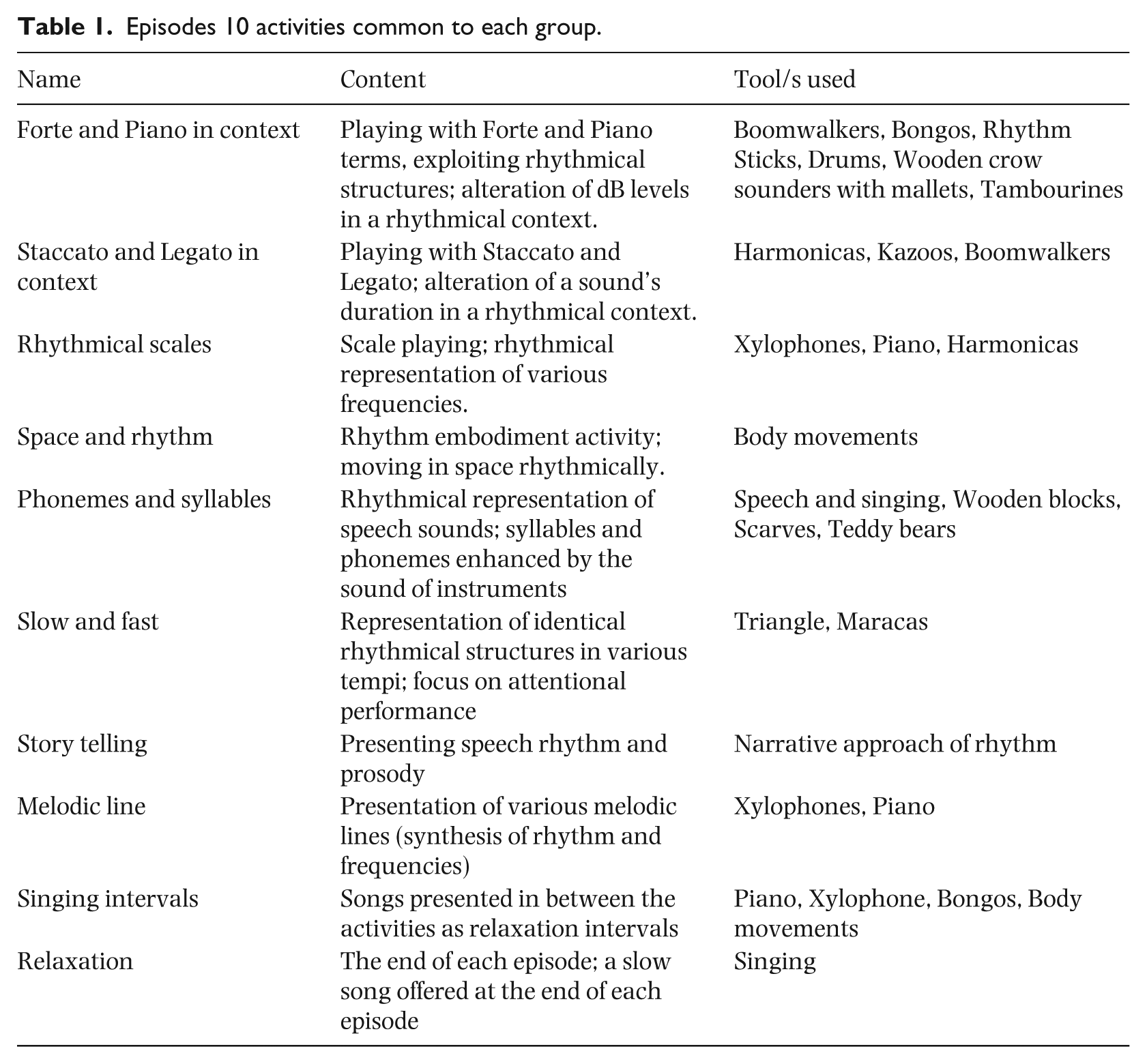
The course was philosophically-based on the GIML method for infants’ and toddlers’ music development (http://giml.org) adapted thereafter for the project’s specific population. The activities in each episode presented rhythmical structures, covering sound exemplifications, singing, imitation, rhythm games, scales, spatiotemporal movements coordination, body mapping through sound and movement coordination, examples of speech prosody and wording, cradling and relaxation (see Table 1 for full list of the 10 activities, plus the two examples in what follows). It was not expected that the toddlers should fully imitate or follow the content, although maximum exposure to it was a desirable aim.
Episodes 10 activities common to each group.
Activity example 1
The first example is ‘rhythmical phonemic games’, where phonemes or syllables like /α:/, /Ʊǝ/ and /dα:/ were presented by the educator in different rhythmical groupings (e.g. three crochets and a pause in a 4/4 measure) or single rhythmical modes (e.g. a phonemic stimulus matched to a semi-quaver) for a few minutes in each episode. The activity started with its ‘pure’ version, where the phonemes were individually presented in a specific pitch and rhythmical mode. After a few minutes and repetitions, the same phonemes were combined in mixed rhythmical groupings following the same pitch, while in the enriched version towards the end of the activity, there was a mixed grouping of phonemes and rhythm, changing pitch randomly while co-ordinating the phonemic presentation with the sound of an instrument or movement. This instrument or movement – like the wood blocks or the movement of a scarf in space using one hand or a foot – was progressively introduced in rhythmical coordination with the phonemic sound, enhancing multimodally the rhythmical stimulus. The core aim of this activity’s content was to cover different sound exemplifications through gradually evolving rhythmical games. The parent present in this activity was helping towards a maximum stimulus exposure by fully imitating the educator’s presentation.
Activity example 2
Another example is the ‘illustrating song’ which was combined with specific body movements, aiming to get the toddlers to reflexively imitate the different sound/rhythm movements in play. This activity exploited specific movements mainly belonging to the Central Pattern Generators (CPG) neuronal network (Hooper, 2000). This neuronal network underlies the production of most rhythmic motor patterns in mammals, while it is suggested that for repeating them, there is no need for an intrastimulus evoked potential – that is, a cognitive decision. In the ‘illustrating song’ activity, when, for example, a rhythmical structure of repeatable crotchets was found in the song, it was matched to hand slapping the floor using an analogous repetition rate and rhythm (vertical hand movement belonging to the CPG network; that is, movement of the hand during walking). If another group of crotchets was found after the first one, then the other hand would be used, alternating hand movements accordingly. If a group of quavers was found, this was then matched to the movement of clapping both hands (clapping mode of the CPG network) following the same pattern across the whole song.
Data registration rationale
As it is hard to fully isolate the exogenous rhythmical elements of the course content (i.e., random movement sounds, random speech, crying etc.) in a non-laboratory based music study, it was decided for all episodes to be fully videotaped, digitally recording their continuous rhythmical soundscapes for further investigation and analysis (see the Data measurements and analysis section for a detailed presentation of analysis).
Nevertheless, it should be noted here that the study’s specific intention was not to individually record, analyse and compare the ten activities’ beat and tempo components, rather, it tried to approach the episodes as a continuous real-life music education environment and construct, thus registering the episodes’ summative rhythmical handling trajectory from start to end. In the recording and data analysis process, therefore, all other possible manifestations of beat and tempo elements and fluctuations were allowed and included, even if originating from random speech, crying, movements, discussions, and random beat and tempo occurrences emanating from the outer classroom surroundings, during or in between the activities. Based on this environmentally holistic rhythmical registration rationale, the pre- and post-episodic registration of HR was also used in preference to the pre and post activity HR registration. The aim was to capture the true – non lab-based, that is – summative impact on the infants’ HR of the whole-episode rhythmical soundscape.
Instrumentation
A digital Toshiba (Camileo BW10) video camera was used for the videotaping process, having attached a condenser microphone (Audio-Technic®, ATR25 condenser microphone) for a more detailed raw sound recording. The camera and microphone were placed in the same physical spot in the room for each of the episodes in order to avoid sound-recording differentiations and distortions. Video was decoded in an H264 format, for future acoustical and behavioural analysis of the episodes. A sole audio signal was extracted from the digital video recording in an off-time sequence using Audacity software. All audio data was decoded in – and used as – WAV-Lossless files.
In order to measure the infants’ heart rates, a photoelectric finger oximeter (EDAN H10) was used. The specific transducer was properly placed on the right hand index finger for every infant before and after each episode.
Acoustical analysis of the episodes was performed using Sonic Visualiser software (Cannam, Landone, & Sandler, 2010). Sonic Visualiser is a program for viewing and exploring audio data for semantic analysis and annotation. In order to extract two specific audio features in this research project (tempo and beats), two different VAMP plug-ins were used on Sonic Visualiser. ‘A Vamp plugin is a chunk of compiled program code that carries out analysis of a digital audio signal, returning results in some form [picture] other than an audio signal’ (Cannam, n.d., p. 1). In this case, BBC Rhythm-Tempo and Queen Mary, University of London Tempo and Beat Tracker plug-ins were installed on the software. Specific configurations were implemented on certain software parameters to illustrate and then analyse the audio signal through the specific plug-ins. 3 These are shown in detail in the next section.
Data measurements and analysis
In order to validate or reject the study’s hypothesis and answer its related research questions, the researcher decided to perform a two part comparative-descriptive statistical analysis: (a) in between the summative rhythmical data collected from each episode for each group, and (b) in between the summative rhythmical data collected from each episode for each group and the infants’ HRs for each group.
Ten episodes were videotaped and recorded during the course delivery, although seven of them were finally analysed. Out of the 10 episodes, the first two were excluded for reasons of ‘calibration.’ These were perceived during the analysis as the accustomization period for the infants and the educator in the new educational environment. The last of the 10 episodes was also excluded from the analysis owing to the infants’ low attendance in both groups. The final seven episodes studied were parallel in the course delivery timeline. For the ‘young toddlers’ group, 5 h and 26 min were recorded in total through the seven episodes, while for the ‘older toddlers’ cohort, 5 h and 9 min. For the ‘young toddlers,’ a 46 min 41 s average episode duration was calculated (SD = 8.6 min), whilst for the ‘older toddlers,’ a 44 min and 8 s average episode duration was recorded (SD = 11.24 min).
According to the study’s approach on rhythm perception and rhythmical handling, 1 the following measurements were collected for each group and episode separately:
Rhythmical data: average tempo
Rhythmical data: beats/sound impulses
Heart rates before and after the episode
In order to find and cross-correlate the in-between groups’ rhythmical trajectories, as well as the groups’ rhythmical trajectories to the summative HR trajectories for each group for the seven episodes (hence validating or rejecting the study hypothesis), a beat analysis was initially performed using Sonic Visualiser. The ‘Beat Tracker’ VAMP plug-in was employed with the following parametrical configurations: Beat Tracking Method [New]; Onset Detection Function Type [Complex Domain]; Adaptive Whitening [No]; Window Size [1114]; Window Increment [557]; Window Shape [Hamming].
In order to follow a common basis for each episode, a 5-min continuous and consecutive epoch segregation and analysis approach was chosen (Figure 1). After segregating each episode in 5’ epochs, the number of beats found in every epoch was averaged. The beats trajectory (increase/decrease) for each episode was then presented based on these averaged 5’ epochs. Scatter plots were used and the fitting regression line (R²) was calculated to project the beats trajectory for each episode (Figure 2).
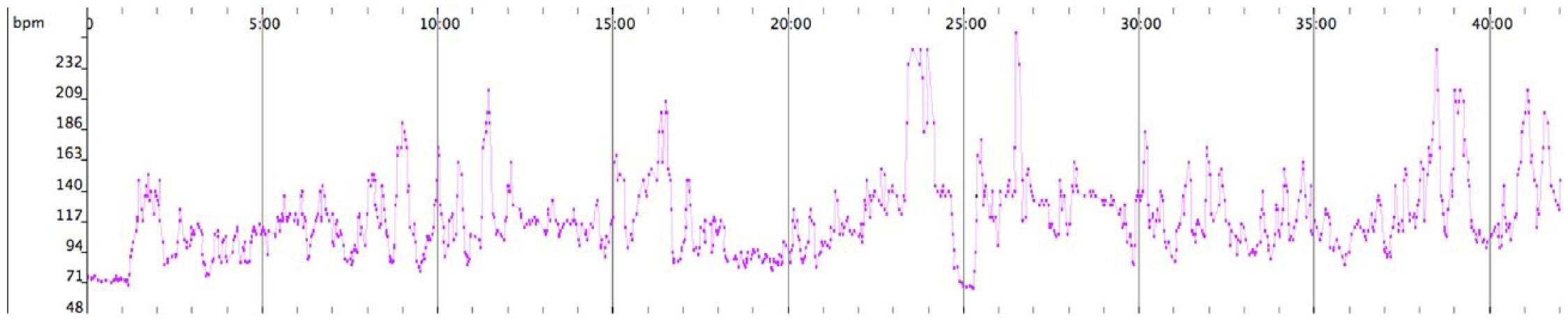
Example of the ‘beat tracker’ vamp analysis for a whole episode. Data are segregated in 5’ epochs.
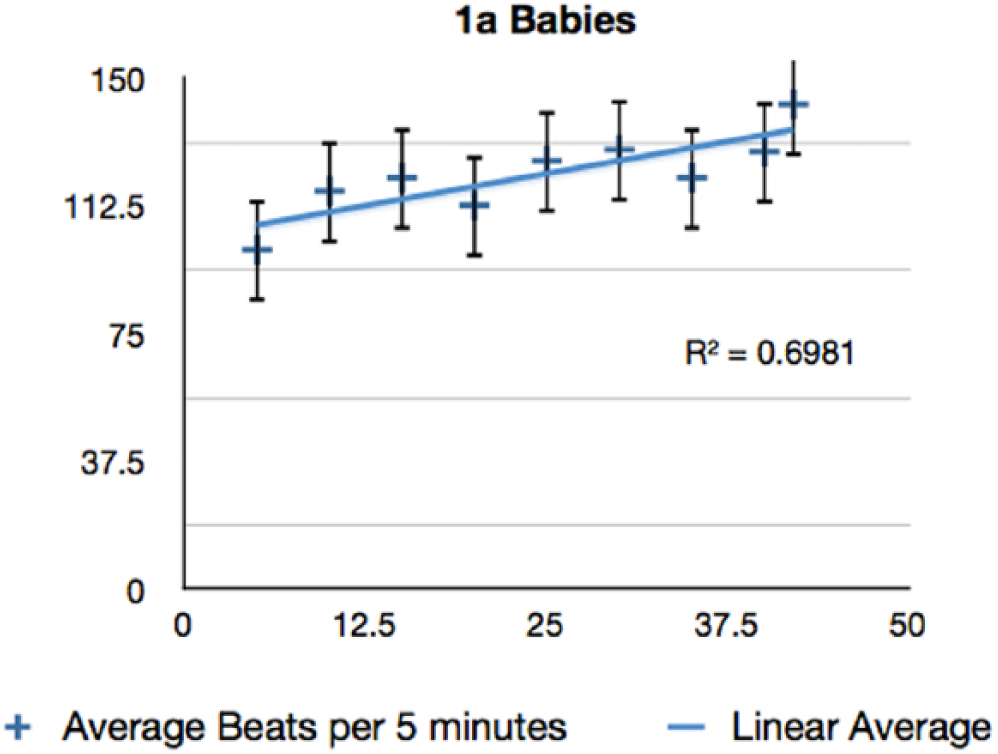
An example of averaged 5’ epochs, showing the line of regression for the specific episode.
In order to measure the tempo aspect of the rhythmical data in each episode, the BBC Vamp plugin was employed, directly providing
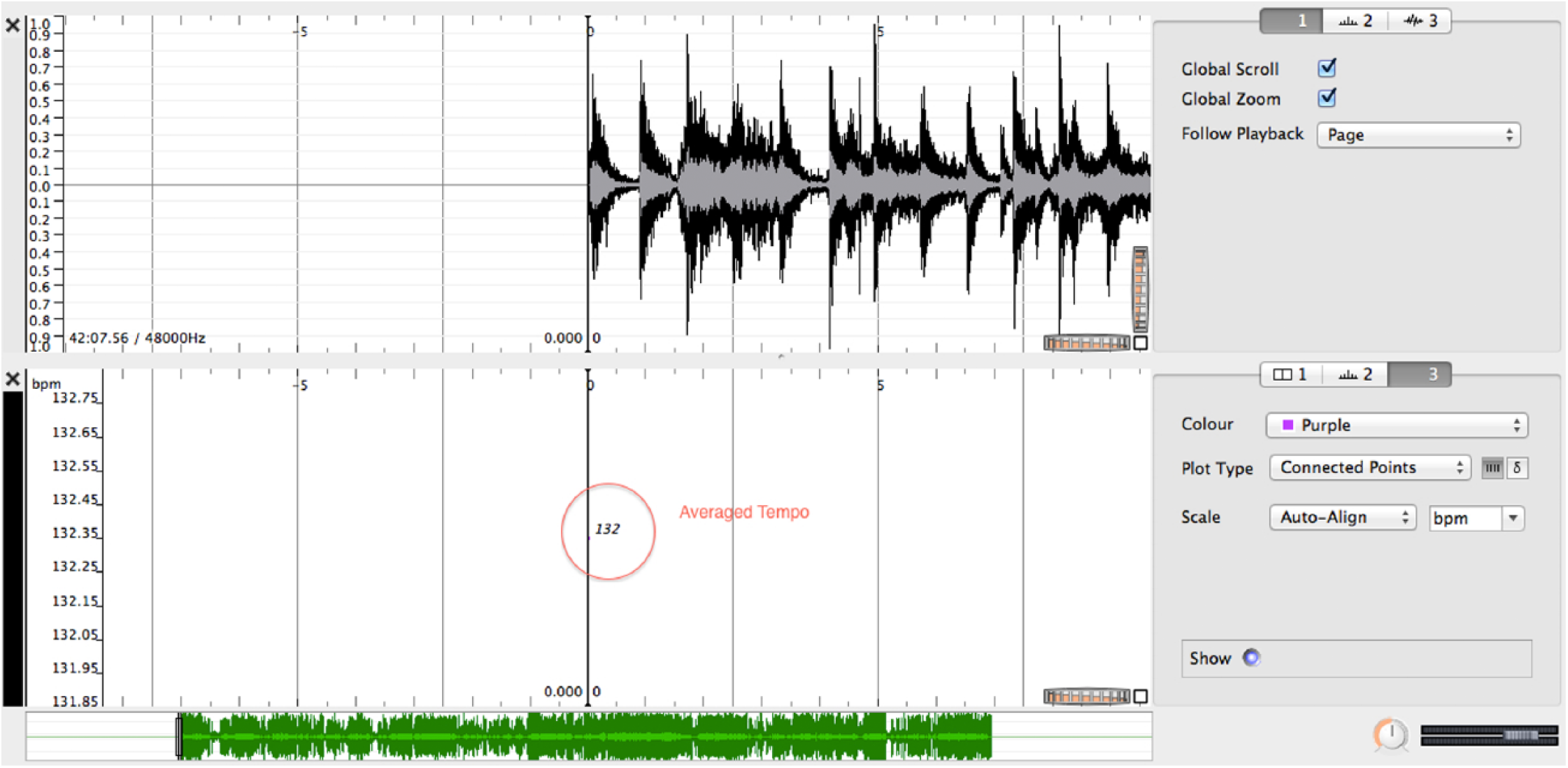
Tempo averaging example on Sonic Visualiser.
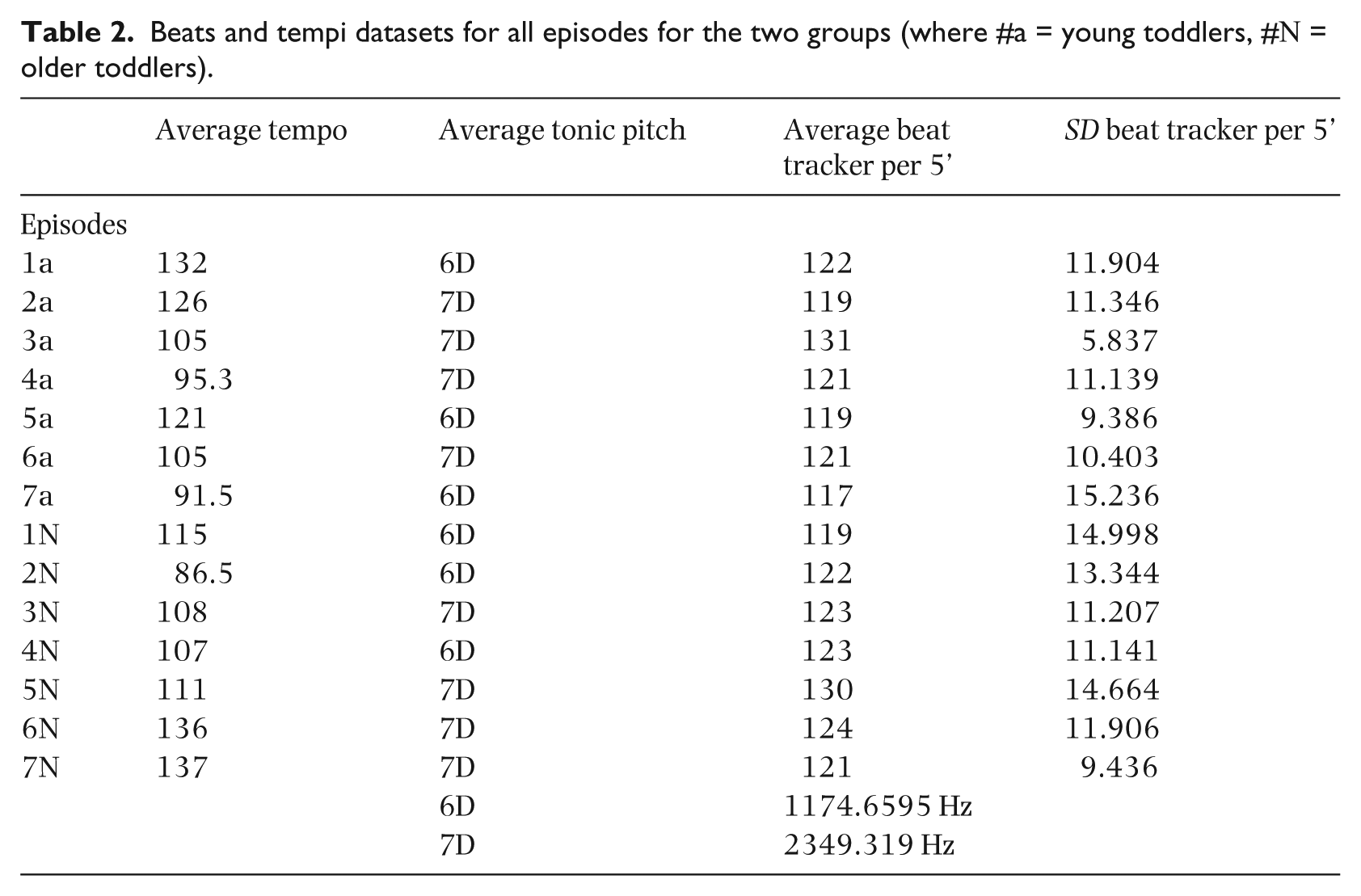
The aim of the tempo analysis was to provide metadata (Table 2) to statistically assess whether or not the overall tempo implementation differed significantly or not in between the episodes. Statistical analysis should show if the overall rhythmical structure of the episodes
Beats and tempi datasets for all episodes for the two groups (where #a = young toddlers, #Ν = older toddlers).
In order to fulfil the second part of the study, heart rates for all six infants were registered for all 10 episodes, while a statistical analysis was carried out on the two groups’ HR data by performing a t test. For reasons mentioned above, only seven episodes’ measurements were included in the analysis. Heart rate levels are displayed before (upper reading for each subject) and after (lower reading for each subject) each episode in Table 3. Before performing the t test on the aforementioned data, a MANOVA on the dependent variables (tempo; beats, HRs) and the two independent variables (groups) was first performed, controlling first for significant interactions among the variables.
HRs (bpm) before (upper line) and after (lower line) each episode.

Results
During the seven-episode implementation period, no major differences or fluctuations in sleep or nutrition were registered for the six subjects. Each child had followed a normal sleep cycle (10–13 h on average) the night before each episode. Nutrition-wise, no major differences were shown either, noting in this case that most of the children ate their breakfast or lunch almost 2 h before each episode. No major injuries or illnesses were registered during the course of the project. Therefore, it can be assumed that these factors had no direct effect on HR.
For the between-groups rhythmical trajectories cross-correlation, the initial beat tracking analysis for the young toddlers yielded three episodes having an increasing average beats trajectory, two decreasing and two almost stable ones (Figure 4). For the older toddlers’ episodes, the results yielded four episodes having an increasing average trajectory and three almost stable ones (Figure 5). From Table 2, we see that the average level of sound pulsation (analysing 5’ beat epochs per episode) for the young toddlers extending from 117 bpm (SD = 5.837) to 131 bpm (SD = 15.236) lower to higher measurement, while for the older toddlers from 119 bpm (SD = 9.436) to 130 bpm (SD = 14.998). Calculating the SD for all episodes, SD = 10.75 bpm for the young toddlers, while SD = 12.38 bpm for the older toddlers.
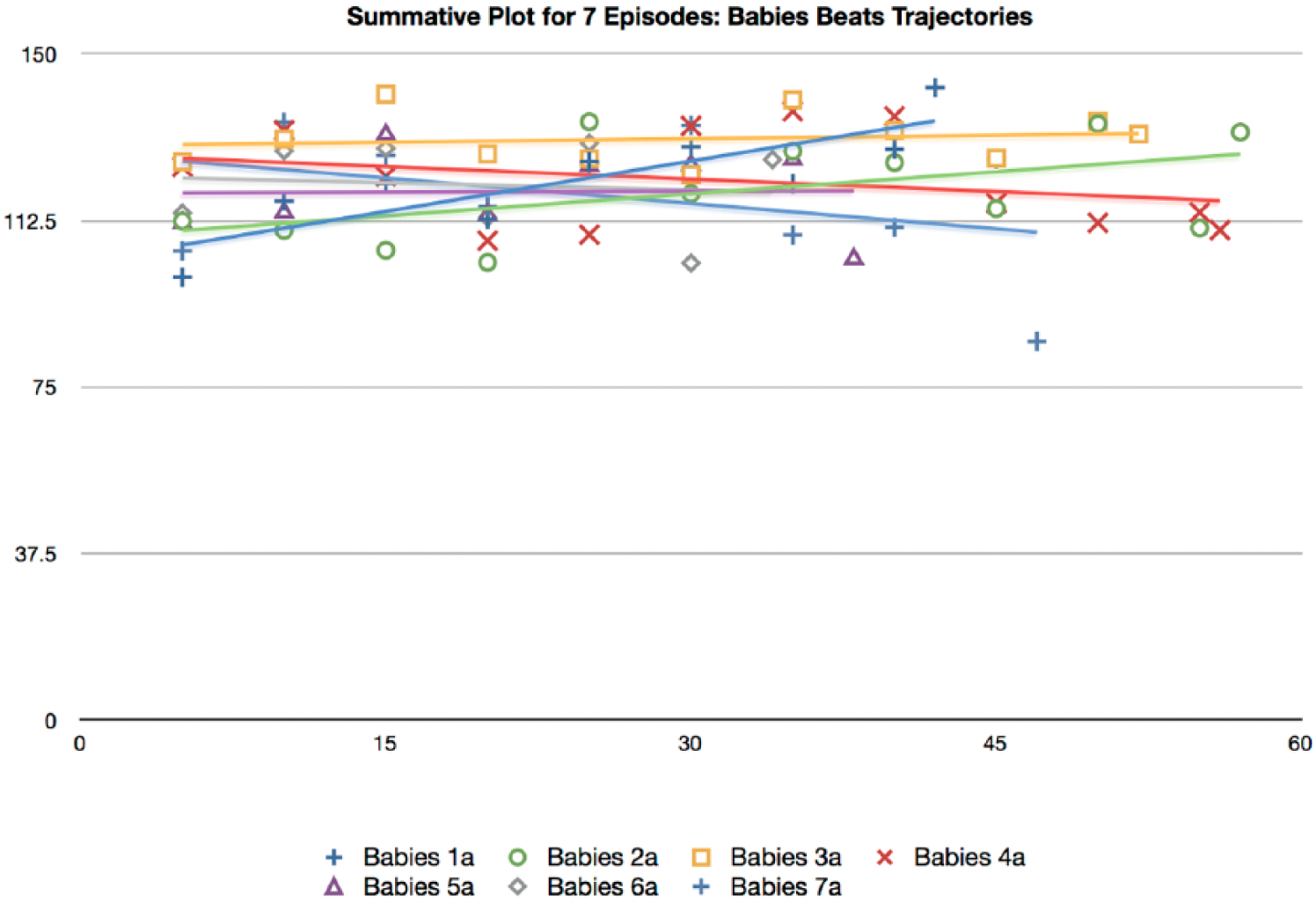
Summative plot for 7 episodes: Young toddlers beats trajectory.

Summative plot for 7 episodes: Older toddlers beats trajectory.
A t test (unpaired) was employed to calculate whether there was a significant difference in the average bpm fluctuations for the episodes in between the young toddlers and the older toddlers, thus controlling the null hypothesis suggestion that (N0) there is a difference in between the average beat fluctuations for the young toddlers’ episodes to the average beat fluctuations for the older toddlers’ episodes. The calculations rejected the null hypothesis, showing in this case that there is no significant difference in the young toddlers’ episodes scores (M = 121.43, SD = 4.54) and the older toddlers episodes scores (M = 123.14, SD = 3.44) for the beat fluctuations; t(12) = 0.797, p = 0.441.
In order to verify and strengthen the above result, the same process of analysis (t test) was followed for the ‘tempo’ measurements. The calculations yielded similar results: no significant difference in the young toddlers’ episodes scores (M = 110.829, SD = 15.623) and the older toddlers’ episodes scores (M = 114.357, SD = 17.623) for the tempo fluctuations; t(12) = 0.396, p = 0.699.
For the second part of the research query (cross-correlation of the groups’ rhythmical trajectories to the summative HR trajectories for each group for all seven episodes), a one-way multivariate analysis of variance (MANOVA) was first employed to discern statistically significant effects and differences between the two sample groups with respect to the dependent variables; in this case, the HRs and the summative cross-episodic tempo and beats data. Following the results of the multivariate tests, and reporting the Wilks’ Lambda, it was found that there was not a statistically significant difference in the way the individuals in the two sample groups reacted based on the acoustical environment (beats and tempo) and their HR trajectories; F(15, 98) = 1.111, p > .005 (.358); Wilk’s Λ = 0.638, partial η² = 0.139.
To thoroughly investigate the above result and avoid a type II error (false-negative outcome), further analysis took place, cross-correlating the in-between groups HR variance. A t-test was employed to control for HR significant differences, safely being based on the previous MANOVA calculations showing no overall significant effects in between the groups with respect to the dependent variables including the HRs. The t-test calculation yielded no significant difference in the young toddlers’ HR trajectories (M = 0.857, SD = 0.143) and the older toddlers’ HR trajectories (M = 0.428, SD = 0.571) for the in-between groups measurements; t(1.260) = 4, p = 0.219, α = 0.05 (calculations in this case were followed as 1 = positive HR trajectory; 0 = flat HR trajectory; −1 = negative HR trajectory).
Discussion
This article tried to answer two interconnected questions: whether the educator renders a different rhythmical handling in the particular music education context for the two infant groups under investigation, and how the particular rhythmical environment (i.e., the acoustical effect of beats and tempo, plus the rhythmical sound emanating from movements or other peripheral to the educational process sound- and rhythm-making elements) impacts infants’ HRs, according to the specific cross-episodical content structure followed by the educator.
For the first part of the inquiry, research revealed that there was no significant difference in the handling approach by the educator of the rhythmical environment between the two groups, thus rejecting the initial hypothesis. As presented earlier in the introduction, previous research in early human development suggests that there are indeed communication differences between children and adults in specific formal or informal environments of development. Therefore, someone might expect to see a differentiated rhythmical handling develop during the period of the particular music education context of which this study investigated. However, this is not the case in this study as a close average of rhythmical imprint and a similar regression trajectory outcome for the two age groups was found.
One possible explanation for this result might be that the expected bidirectional communication between the infants and the educator is not able to carry the necessary and different emotional load that different parent-infant communication systems carry (DeNora, 2000; Street, 2003; Trehub et al., 1997) for such a hypothesized differentiation to take place. This emotional load has been shown to be a catalyst towards the way communicative interactions between infants and parents take place, and in many ways lead the communicational ‘tools’ to be presented in an explicitly specific shape or quality across specific age ranges (i.e., motherese). In the case of this study, we may assume that the specific educator-infant musical interactions are probably not able to expose different communication approaches according to age differences, as they are not as powerful as those naturally seen between parents and infants (Dissanayake, 2000). Perhaps it is also the case that musical intercommunication – as approached in this study – has not that capacity to differentially evolve in these kinds of early years music education settings and social relationships. This may suggest that either the innate organization principle of music communication naturally existing between parent and infant cannot successfully be ‘built’ in between a distant person and the infant in the same way as it is built in between a parent and an infant, or following a more optimistic account, that more time than the 10 weeks duration the specific study used for the first signs of handling variability of rhythm – and thus different levels of intercommunication – would be needed for the hypothesized elements to show their presence.
Another possible explanation for the particular outcome may rest on the type of musical content the particular sessions used. On the one hand, we do know that infants are well ‘wired’ to detect variances in the beat of music (Winkler et al., 2009) from the very beginning of their lives. On the other hand, the temporal coordination between adult and infant is essential for effective intercommunication to take place (Jaffe & Beebe, 2001), otherwise what exists is a mono-directional exposition of sound stimuli. In this case, it may be possible that the (same) musical content for all the sessions was not sufficient – in terms of rhythmical stimuli and educational substance – to promote a bidirectional coordination and dialogue, and thus a plausible differentiated intercommunication basis for one of the two groups (or even both). Whichever the right direction might be for the above, it is conceivable that more research is needed on the topic of music content inclusion, implementation and handling in the specific adult-infant communication and developmental environments of music. In future research, it would be advisable to test possible variables of slow versus fast tempi, complex versus simple rhythmical and melodic structures, and how these may affect physiology, emotions, cognitive music perception, and bidirectional response.
For the second part of the inquiry, the study showed that there was not a statistically significant difference in the way the individuals in the two sample groups reacted physiologically, based on the structure of the intercommunicative environment (beats and tempo) and the HR trajectory data collected. Most infants showed an increasing average HR trajectory which, according to the above cross-correlations, appears to be somehow connected to the overall rhythmical approach the educator followed. Recent studies (Vickhoff, et al., 2013) indeed support this result, suggesting that similar musical structures which are followed in a unison approach from a certain performing-attending population (for example a song structure sung in unison by a choir) may present similar physiological effects on the subjects’ physiological states – including a change in the HRs – of the particular population.
The rhythmical projection and progress followed in the sessions in this investigation appeared to be very similar for the two age groups, thus possibly imposing the same physiological reaction at the end. It should be pointed out, however, that this uniformly increasing HR trajectory might be the byproduct of a continuous communicative process taking place in between the educator and the infants, starting from the already existing physiological arousal that the infants or the educator bring into the particular context (i.e., being happy to take part in the session), hence impacting first on the overall acoustical environment, and then returning as a double effect to impact on the HRs of the infants. Similar data and results have been presented in the domains of sports and music interdisciplinary research (Karageorghis, Jones, & Low, 2006) where the listener’s physiological arousal and the context in which the music is heard is shown to affect the tempo preference (North & Hargreaves, 1997) and thus its relevant handling (Priest & Karageorghis, 2008).
Limitations
This study may have produced different results if more groups had been available. It is not suggested, however, merely to include more infants in every available group, but instead to increase the actual number of the groups under investigation. It has already been shown that (especially in educational contexts) group dynamics play a major role in the way individuals perceive their environment, hence learning approaches change according to the level of interdependence links available in the group (Forsyth, 2009, p. 8). Thus, more infants in the group might have structured completely different variables of intercommunication and stimuli exposure for each individual, providing a completely different physiological or acoustical (rhythmical) result. On the other hand, having more groups – hence cross-individual data – to investigate would have certainly provided a wider cross-correlation basis.
Furthermore, it should be noted that there was no control over the wider infants’ exposure to the specific stimuli and learning approach. The specific developmental context included both children and parents in its process. Thus, there is a possibility that some or all of the parents used the sessions’ content to ‘improve’ their parenting. If this was the case, it may or may not have had a certain effect – either behavioural or physiological – on the participating infants during the delivery of the course. The study did not account for this particular research angle, and it was assumed from the beginning a similar base line of exposure for all infants. Still, this is a limitation to be considered, and one should proceed with a certain caution towards generalization even for the specific group of infants.
Conclusion
This study investigated an infants’ music education structure; how tempo and beats are handled by an experienced educator in the specific context, how they are communicated, and how these had a physiological impact on two different age groups of infants. Tempo and beats data were collected and cross-correlated to the infants’ heart rate measures taken before and after each session of a course. Results showed no significant differences in the way the specific educator handles rhythm in the sessions, showing a similarly increasing trajectory of rhythmical development for each session by group. Additionally, there were no significant differences in the way the infants reacted physiologically to the above rhythmical handling as they presented an increasing HR average trajectory.
Taking into consideration the study’s outcome, its limitations, plus the available literature on the wider early music education context, it is suggested that we may need to start researching more thoroughly the quality of the content used in the specific learning environment and how the former is implemented for the different age groups of infants taking part in them. Future research may try to disentangle possible structural differences of the content and how this could be more effectively applied in this context.
Footnotes
Funding
This research received no specific grant from any funding agency in the public, commercial, or not-for-profit sectors.