



Abstract
Group musical improvisation is a unique psychological phenomenon. Cognitive literature on jazz musicians argues that creativity in improvisation is constrained by stylistic conventions and facility with existing musical elements. However the expanding field of free improvisation is predicated on avoiding idiomatic expectations and familiar material. To model musical improvisation in its widest sense, 15 diverse free improvisers were video recorded performing in trios, and interviewed in-depth while reviewing the recording. Improvisers chose on an iterative basis whether to maintain what they were doing or change, either to initiate a new direction or to respond to another improviser. Responses were subjectively understood to adopt, augment or contrast the contributions of others. These choices were based on evaluative dimensions of texture, rate of initiatives, and degrees of novelty and diversity, as well as structural and practical concerns and experience of enjoyment. Improvisers did not perceive consistent agency for themselves while improvising, and their evaluations were influenced by constructions of the social context. Results highlight that new material is generated at a variable rate by any one individual during this collaborative creativity, and indicate that constraints on choices to cope with high cognitive demands are subjective and situation-specific rather than objective.
Over the past decade, an exponential growth in interest in improvisation has produced a research imperative to develop understanding of its underlying processes. Live improvisation of music by two or more individuals is a creative activity that unfolds in real time within a social group, yet does not depend on verbal or visual communication. As such, it is a unique phenomenon requiring psychological explanation (MacDonald & Wilson, 2014a). Despite parallels drawn with conversational language use (e.g. Doffman, 2009; Donnay, Rankin, Lopez-Gonzalez, Jiradejvong, & Limb, 2014; Monson, 1996), contributions to improvised music are predominantly simultaneous rather than turn-based. Unlike conversation, participation in improvisation may be shaped by instrumental limitations. Instrumental music is essentially ambiguous and improvised for the ends of aesthetic achievement and involvement, unlike those of information exchange or task completion through talk; the expectation of creativity and innovation within the former activity means that goals are necessarily contingent or flexible (Bryan-Kinns & Hamilton, 2009).
Improvising has been seen to require a balance of attention between individual and group processes (Bastien & Hostager, 1988), achieved through self-regulation (Wopereis, Stoyanov, Kirschner, & Van Merriënboer, 2013). Cognitive theories suggest that individuals generate novel material through a recursive cycle of ideation, execution and evaluation focused on events (Pressing, 1998); Johnson-Laird (2002) has influentially derived algorithms on this basis to model the improvisation of jazz musicians playing bebop. Optimal improvising has been held up as exemplary of Csikszentmihalyi’s (1991) concept of flow states, wherein the balance of challenge and perceived competence creates intense focus and lowered awareness of functional aspects (Doffman, 2011; McPherson & Limb, 2013). In qualitative studies, improvisers attest to a lack of awareness during optimal improvisation of the processes and skills they are using (MacDonald & Wilson, 2006), and recent neuroscientific research indicates suppression of central processes associated with self-monitoring and conscious volitional control (Limb & Braun, 2008). As such, expert knowledge in improvising is largely tacit, and may be difficult to articulate (Jensen & Marchetti, 2010; Wopereis et al., 2013).
There is nevertheless a research imperative to develop an understanding of practices that encompasses the diversity of musical situations within which improvisation occurs. Improvisation routinely involves groups of three or more (Hallam & Ingold, 2007; Sawyer, 2006; Seddon, 2005) across a very wide range of musical activity (Bailey, 1993). Yet the upsurge in psychological interest in improvisation tends to focus on individual (Limb & Braun, 2008; Norgaard, 2011; Wopereis et al., 2013) or dyadic improvising (Bryan-Kinns, 2013; Schober & Spiro, 2014). Furthermore, this literature overwhelmingly examines improvisation practised by jazz musicians, identifying parameters for improvisation that may define jazz performance, but not apply in other approaches: for instance, reliance on the guiding influence of rhythmic feel (Norgaard, 2011, p. 110). Committing to long-term memory motifs, patterns or voicings favoured by previous jazz musicians can facilitate the evaluative phase of the creative cycle by attenuating the cognitive demands of spontaneous group creativity (Kenny & Gellrich, 2002; Norgaard, 2011; Schütz, 2012, p. 907). Thus Johnson-Laird’s parameters for the creative process in bebop specify that outputs should satisfy external criteria for that music and be constructed from existing elements (2002, pp. 419–420). This model presupposes objective standards to judge the success of an improvisation, yet it is notable that a jazz musician participating in a recent study repudiated objective standards of “wrong” or “right” in relation to improvisation (Schober & Spiro, 2014). Stylistic constraints and reliance on pre-existing material furthermore contradict the idea of improvisation as a process-based, contingent endeavour characterised by an expectation of maximal innovation (Bryan-Kinns & Hamilton, 2009; emphasis added).
Free improvisation, an expanding field across the performing arts, questions prevalent assumptions in research literature. In this approach, innovation towards aesthetic ideals is consistently valued over meeting idiomatic expectations or established criteria (Bailey, 1993; Nyman, 1999). The choices of the improviser in the moment are central to shaping the music, whatever they may be (Lewis, 2002; MacDonald, Wilson, & Miell, 2012). For instance, a drummer spontaneously choosing to stand up and mutter loudly instead of providing rhythmic accompaniment would break expectations within a jazz ensemble, and distract other players from interacting within that idiom. In a free improvisation, this might constitute a novel direction, to be accommodated or oriented to by the other players in whatever way they choose. As such, the social relationships between those improvising may be uniquely influential on the music (Linson, Dobbyn, & Laney, 2013). This approach creates challenges for a unified theory of improvising. Since free improvising is not amenable to style-based criteria for evaluating improvisation within specific genres (Linson, Dobbyn, & Laney, 2012), it is not clear what range of options such improvisers might perceive; nor how evaluation processes shape their choices; nor what influence the social context may have on how they construct their musical interaction (Wilson & MacDonald, 2005, 2012).
A new psychological model is required to take account of group improvisation in its broadest manifestations within contemporary practice. To this end, a recent qualitative study of trios of free improvisers from a range of musical backgrounds and arts disciplines explored their experience of improvisation by gathering their detailed reflections on purposely recorded music. This project aimed to extend understanding of which musical events can signify meaning within improvised music, and how they may be constructed by individual musicians and artists in relation to the group’s interaction and to their social, physical, cultural and research contexts. Research questions that are addressed here are:
What types of musical options do improvisers perceive for themselves in a shared instance of group improvisation?
In participant accounts of group improvisation, what evaluative criteria inform their musical choices?
How are their accounts of improvised musical interaction influenced by the negotiation of identities in a social context?
Methods
Qualitative methods were appropriate to the exploratory aims of this study (Banister, Burman, Parker, Taylor, & Tindall, 1998). Since the study aimed to capture any divergence in construction of musical meaning between participants in the same musical event, individual interviews were used to avoid the negotiation of consensus views (Barbour, 2005). In previous interviews with improvisers, however, we have found a tendency to generalise experience. “Think aloud” interviewing (Fonteyn, Kuipers, & Grobe, 1993) requires that interviewees voice their thought processes as they complete a specific task, for instance reflecting on transcriptions of their audio diaries, or, in arts research, examples of their practice, giving the data a sharper focus. In the present study, a video recording of a musical interaction was used as a referent around which to structure participant interview immediately afterwards, making interviewees’ accounts more specific and comparable (cf. Bastien & Hostager, 1988; Doffman, 2011; Schober & Spiro, 2014).
Three trios of improvising musicians and two of visual artists working with sound performance were sought, this format allowing an optimal balance of complexity of interaction and scope for individual participation. Performers from other arts backgrounds than music were included to reflect the diversity of contemporary practice in free improvisation. Participants, all adults, were recruited through personal contacts and snowballing, proceeding from improvising musicians based in Scotland and an ensemble of visual artists performing with voices based in the North East of England. It was intended that at least half the sample comprise improvisers not previously known to the first author (GW). Purposive sampling aimed to recruit both male and female improvisers from varied musical and artistic backgrounds, and to recruit performers on a range of instruments including voice and electronics.
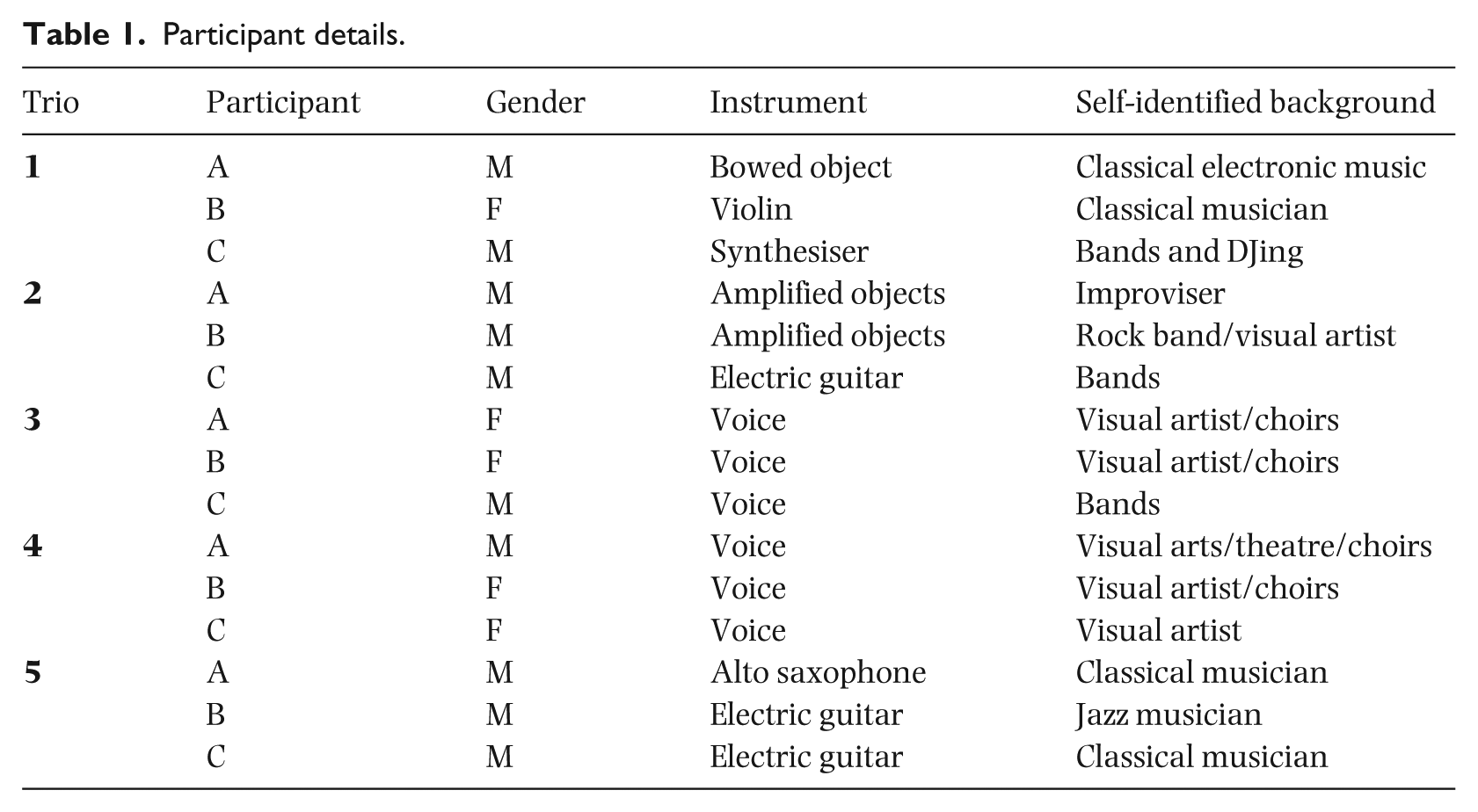
The nature and purpose of the study were explained to potential participants before requesting their written consent; none of those approached declined to take part. Participants were asked to improvise freely two trio performances of approximately five minutes each in the recording studio of an academic music department; one trio was recorded at the participants’ convenience in their institution’s studio. To ensure that this constituted musical rather than verbal interaction, participants were asked not to discuss what was played beforehand or between the recording and the interview, and none of the trios communicated verbally during the improvisations. Performances, lasting between four and nine minutes, took place at separate times with no trio hearing another’s performance. Each performance was video and audio recorded by GW, who was present throughout without commenting; audio examples can be accessed at https://dx-doi-org.web.bisu.edu.cn/10.7488/ds/285. From the longer recordings, GW selected a five-minute section for the interviews. Table 1 gives details on the musicians and instrumentation of each trio with their self-reported musical background, indicating the diversity of musical approaches between them. Four of the 15 indicated in their interviews that they had undertaken higher education in music; six were currently working or studying in music departments. All were currently active as performers of improvised music.
Participant details.
Participants were individually interviewed directly after performing by GW or, in one case, a research assistant, without other trio members present. In three of the trios, participants were co-present while waiting to be interviewed, but were engaged in unrelated tasks (rehearsing or meeting). After a brief account of their overall practice, each improviser talked through a replay of their improvisation, stopping as necessary, to explain what they understood to be communicated by their own and other improvisers’ contributions (see the interview guide in Supplemental Material Online). Interviews (mean length 48 minutes, range 34 to 74 minutes) were audio recorded and transcribed anonymously for analysis. The qualitative data were analysed using the grounded theory approach of constant comparison (Henwood & Pidgeon, 2004): the researchers read transcripts repeatedly to identify recurring themes and key musical signifiers. Selected passages were submitted to discourse analysis of how interviewees orient towards particular expectations of themselves and others.
Results
Options perceived when improvising
One problem in trying to model psychological processes in free improvisation is players’ apparent rejection of guiding principles; their determination to avoid pre-existing musical forms leaves the observer unsure what form an improviser’s contributions might take in any given performance, or whether any recurring features could be expected. Choices made while improvising were therefore a focus of interest in the interviews. As they talked through the recording, interviewees’ descriptions of their involvement suggested a hierarchy of options. Asked to indicate what was taking place at any given moment in the video, they defined their activity and others’ in terms of parameters (e.g. playing long notes, making brief arrhythmic sounds, repeating a short motif, or remaining silent), within which there might be variations of pitch or volume. At a primary level, they faced an ongoing choice of whether to maintain the parameters of their own current activity, or to change these: The fact that I’m just keeping that note there I knew at some point they would both be like “Ok he’s going to do something in a minute.” You keep that idea going and the chances are that at some point you’re going to move away from it… I think it empowers you to be the person who does the next change. If you keep doing the same thing people know that you’re probably going to do something quite dramatically different. [5A]
5A’s quote exemplifies this active and iterative consideration, relative to the ensemble, of whether to keep playing what he was or move on to something different. The decision to maintain could reflect either a participant’s perception that there was no need to modify what was currently taking place; or that the participant could not identify a suitable change to make at present, and was “treading water”: I think I was actually slightly, what’s the word, not put off by what 3C was doing, but discombobulated by what 3C was doing and I think I was trying to work out how to interact with that. So I think I was more “okay, what do I do with this?” So I just waited to think about it. [3B]
Interviewees characterised change in what they were doing during the improvisation either as an initiative, something new that they had chosen to instigate, or as a response to someone else’s contribution to the improvisation. Initiatives were understood either to introduce a new idea or theme, or to transform an element of what was currently being played. For instance, a participant in the second group gave this account of a change in the sounds he was making at one point: I remember that bit where it got noticeably louder being aware that, oh hello, things are a bit louder than often when I improvise … and I’ve maybe thought I could exert some control over it by that kind of [makes noise] had a real kind of final part to it as if right, we’re moving on to something else from here. … I think both those guys stopped and then 2B used it as a springboard to go, there’s a brief gap and then you noticed that 2B came in with that rubbing sort of crackety-crackety-crack-type noise. [2A]
2A describes his sound as an initiative: an exertion of control consciously intended to bring an end to what had been taking place and introduce “something else” to the improvisation. He characterises subsequent changes by the others in the trio as a response to his action, using it as a “springboard”.
Further distinctions were made within the category of response. These were coded into three emergent categories, which can be labelled as: adoption, augmentation and contrast. An adoptive response involved making contributions that were substantively similar to those of another player, in terms of rhythm, pitch, motif, etc. In the example below, participant 1C describes an instance where all three members of the trio adopt on their own instruments the “squeakiness” initiated by 1A: Certainly at the end of it you can hear this sort of squeaky sound that I’m making, that’s quite suggested from 1A’s [object] squeaking, but then 1B’s on it really quickly as well so we just all hit the squeakiness. [1C]
An augmentative response involved a contribution that adopted some aspect or aspects of what another player was doing, but diverged from that player in other respects; for instance, adopting another’s rhythmic pattern but varying the pitches or choosing a very different register. This was intended to enhance or develop what the other improviser was doing in a distinct way: … it’s just building that idea and throwing in a few more textual anomalies. In keeping with what the guitars had been doing previously, really, with the long harmonics and the “bup bup bup” sort of stuff. [5A]
Responses were coded as contrasting where interviewees played something substantively different from another improviser, but claimed the difference between these two sounds as an aesthetic objective for the improvisation at that point. For instance, a player in the second trio gave this account: … just holding the slide down on the strings, it can make a sort of like big noisy, droney sort of sound, and I thought that might sound quite good with this sort of constant chattering of the glasses box chattering. [2C]
2C recognises another player’s sounds (“constant chattering”) as a dominant motif that he chooses to complement with a contrasting sound (“big, noisy, droney”); he does not see the guitar sound as a proposed new direction, but as an embellishment of sounds already in play. Contrasting responses could also be positioned explicitly as accompaniment, supporting or contextualising the improvisation of others, for instance providing a constant tone or bass line under a higher pitched pattern of sounds. In the example below, 3C characterises the “burbling sounds” from himself and another improviser as being expressly “underneath” the very different sounds from the third member of the trio: … that’s sort of leaving space for 3B to sit over the top of that with what she’s doing which is nice. So she’s providing the textures. We’re providing the undercurrent of burbling nonsense underneath it. [3C]
It is worth noting that initiative and contrast are distinguished here as discrete strategies from the subjective perspective of the improviser. The first is a choice to offer new material unrelated to what others are doing to take the improvisation in a new direction, while the second is a decision to provide material in accompaniment to another improviser’s contribution but which does not share characteristics with it. Nevertheless, it is not clear on what basis a listener or another improviser would identify a contrasting sound as either an accompaniment or a new direction. In the comment above from 2C, even though 2C explains his guitar drone as a sound that complemented the ongoing “chattering”, a listener or one of the others in the trio might have heard his drone as an attempt to bring something new to the music. As such, whatever the intention of the person providing an initiative or contrast, another improviser or listener is faced with an interpretive choice as to which of these options they are hearing. A representation of this process of choice is given in Figure 1.
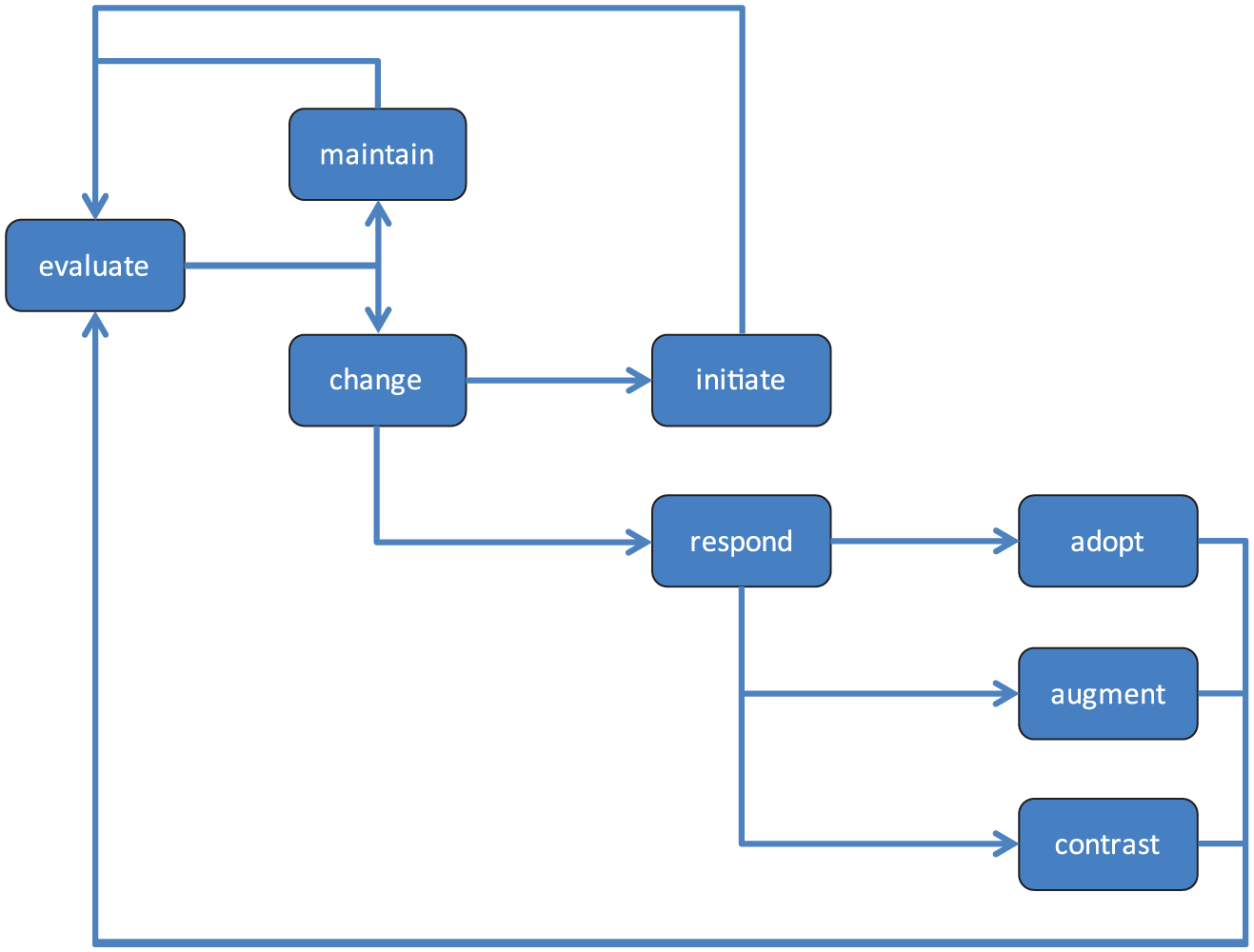
Model for the process of individual choice during group musical improvisation.
The representation is of an open-ended iterative cycle where all choices lead to a subsequent reconsideration, with each trio member constantly “scanning” the emergent sound of the piece and actions of their collaborators. The improvisation was sometimes characterised by interviewees as an external entity or process, within which events arose independently of those creating it. For instance, participant 3C said of one point in his trio’s improvisation: That comes out of where we’re all back in it there, rather than anyone in particular leading that section. It’s developing and it’s rising of its own accord, really. So it’s become its own beast there. It’s got a life of its own at that point rather than being pushed. It’s suddenly on a downhill, it’s got gravity behind it, running away with itself rather than having to force it in one direction or the other. [3C]
The improvisation is described as a thing, or “it”, shaping itself, rather than arising from the conscious efforts or influence of those taking part. This indicates that improvisers could perceive themselves as having more or less agency in relation to the music from moment to moment, and therefore more or less capacity to exercise the choices outlined above.
Evaluative criteria when improvising
It was also of interest to the research to establish why the improvisers made the choices they did; all of the choices outlined above were based on an iterative evaluation of the music in play. In free improvisation, choice of material at any given point is entirely up to the improviser and can include nothing (choosing not to play). In theory this leaves infinite possibilities. In practice, their decisions are driven by individual tastes and judgement of the emerging music, subject to contextual factors including their perception of others involved; and limited to the practical potential of instrument and individual. Analysis identified a number of dimensions or qualities central to how the participants evaluated their emergent music, detailed below.
Texture
Episodes in the recorded improvisations were often accounted for in terms of textural qualities. Interviewees commented, for instance, on whether the pattern of sound emerging from the group at a given moment was too busy or had too little going on; whether or not an ongoing texture was too melodic or rhythmic; and whether the music was too energetic or too restrained.
Rate of innovation
The decision to introduce change or innovation has been highlighted as a central choice. Changes could be justified on the basis that the music had gone for long enough in the same vein, was becoming too repetitive or was showing too little variation, and therefore “needed to change”. Alternatively, a current activity might be maintained because it was felt that it had not reached a point where it could or should be changed. To this extent, participants oriented towards a preferred rate of innovation for the improvisation, neither too static nor too protean; contributions from the group were thus structured into episodes, positioned by each participant as having an optimal length.
Novelty
Interviewees expressed concern with whether material was surprising or familiar. At times, well-worn practices or recognisable music “that already exists” were emphasised as something to be strenuously avoided: That’s interesting because it’s kind of the most rhythmic, consistently rhythmic part of it, the whole way through which I think we typically try and stay away from because that’s not what it’s necessarily supposed to be. But actually it was quite nice. Why is that, it’s not supposed to be that? Well, I suppose because it’s non-traditional music. Otherwise you would potentially start falling into patterns of referencing music that you already know which is not what it’s supposed to be about. It’s about creating something new and spontaneous and unique. It’s so boring having pieces that start and they get louder and louder and crescendo and then they either stop or they get very crescendo and then they decrescendo and they fade out and it’s so much crappy free improv that just does that basic shape, and it’s just dull, generally. It can be done well of course, like anything, but it’s just a bit of a generic cliché isn’t it? [1C]
Chance occurrences were prized as a means of generating unpredictable material, or achieving novel directions that would not have come about otherwise. In the recordings, for example, the sound of a plane became influentially audible during trio 3’s improvisation, while members of trio 1 appreciated the occasional failures of their instruments to produce intended sounds. At other times, however, participants described deliberately making a contribution that would be recognisable to others in the group, or else interpreted someone else’s contribution as a reference to a previous piece of work they all knew. Fielding something familiar in these instances was seen as a means of steering the group towards a shared path or coordinating contributions: … there’s probably bits you know are different from what you’re doing just now that would be a nice contrast and you’re probably going through your Rolodex in the mind going “oh, that would be good.” … There’s probably certain things I kind of hope 4A and 4B are going to do, that I’ve heard them do before. [4C]
Diversity
Another concern was with how sounds from different improvisers complemented each other, or with whether the contributions of the members of the trio were too similar or too dissimilar. For instance, a participant might speak of a passage of music as having arisen from a need for players to “come together”. While the relationship of each person’s playing to the others’ was a central concern, evaluations on this dimension were flexible, and always referred to immediate context. Ensemble playing could be perceived as coherent in its homogeneity (everyone playing long notes, for example) or in the complementarity of discrete contributions (for instance, providing a low sound in a bass role to accompany another’s high pitched sounds). At other times, homogeneous playing could also be viewed as uninspiringly uniform or a “default”, and discrete contributions could be taken to imply a lack of “togetherness”. Some interviewees also stated that it was important not to be seen to dominate the music, to ensure that all members of the trio could view their contributions as equal or equivalent.
Structural concerns
Individuals’ choices were shaped by a perceived need for endings, openings, points of climax, or events within the piece. For example, even if at another point they might have considered getting louder or busier, they would tend to restrain or limit what they were doing near the end. If a sudden silence occurred during a busy texture, an improviser might choose on the instant not to play what they had been about to, given that a climactic point had thus been effected.
Practicality
Some actions within the improvisations were explained simply in terms of physical limitations particular to an individual’s instrument – for instance, the need for wind players to recover breath, or difficulty of sustaining a sound on instruments such as found objects, or the ease or comfort of producing particular sounds with one’s voice. However some interviewees said they wanted to feel they were pushing their physical limits, again as a means of arriving at unpredictable sounds.
Enjoyment
Interviewees accounted for some choices, particularly a choice to maintain activity, in terms of an emotional reaction or enjoyment experienced. For instance some episodes were appreciated for their humour or playfulness; others for their delicacy or subtlety. More broadly, parts were described as, for instance, “fun” or “rocking”. At some points, interviewees explained their actions by stating that they enjoyed working with sounds that they positioned as potentially ugly, unusual or contrary: … I thought doing some sort of stabs and some sort of quite jarring sort of sound and stuff would sound quite good with what they were doing. [2C]
Enjoyment differs from the preceding categories in not being tied to a specific musical feature, and conceptually overlaps them in that, for instance, different textures may be enjoyed more or less. It is included separately here because, as in this excerpt, some choices were not justified in any other way. It may represent a strategy to account for a choice where an interviewee felt unable to articulate a reason, reflecting the difficulty of representing a non-verbal activity in words.
Influence of the social context
While the participants gave an account of their choices and evaluations during improvisation, it is important to recognise the social context; any expression of decisions or reactions must have been shaped by the tastes and identities they constructed for themselves and others in the trio, as well as the interviewer. Interviewees ascribed distinct attributes and preferences to themselves and others in their trio. For instance, two members of trio 1 in their interviews distinguished themselves as having, respectively, an irreverent approach consistent with a relatively untrained performance technique, and a highly trained classical technique that had to be relinquished or “loosened up” to a certain extent for improvising. Yet preferences were also attributed by interviewees to the ensemble as a whole: … we like to play with a lot of space and we like to play a proper range of dynamic, dynamic range from very, very quiet to reasonably loud and it’s, you know, that’s important, um, for all the kind of work that we do. [1C]
Constructions of the tastes of others were deployed to account for individual choices and activities during the improvisation, by positioning them as consistent with a shared group taste. For instance, one participant in trio 2 commented that he would not have played anything on his guitar using a slide in this trio: … I knew that was quite a nice muted sound and not all that sort of like musical or anything as well, so, you know, obviously I can’t just start doing like some sort of slide guitar thing or something like that with them. [Laughter] Why would, why would that be? Um, well ’cause I don’t really do that sort of thing anyway. But um, yeah, I don’t know. They don’t really do anything like that tonal or anything like that. So I mean yeah, I probably wouldn’t do that sort of thing anyway.
Although no discussion had taken place amongst the trio about what could or could not be played, and the other two did not express any specific opinion on this during the study, 2C constructs their taste as not encompassing anything too “musical” or “tonal”. He therefore suggests that the other two would not expect or appreciate slide guitar (an approach which has specific genre associations, for instance with blues or country and western) and finally aligns himself with the taste he has attributed to them (“I probably wouldn’t do that sort of thing anyway”). It is also noteworthy that he expects this perspective or taste to be readily accessible by the interviewer, since he positions it as “obvious” that slide guitar would be inappropriate. To this extent, the value judgements that interviewees applied were treated as expected; they positioned their decisions and evaluations as normal within their construction of the social and musical context. However, although two of the trios included both male and female participants, none of the interviewees made specific attributions on the basis of their own or another’s gender.
Conclusion
In this paper we have examined how 15 free improvisers account for their recorded trio improvisations, to identify the bases on which they choose and evaluate their contributions. The emergent model (Figure 1) suggests that, on an iterative basis, improvisers choose whether to maintain what they are doing or else change. Change involves a choice either to initiate a new direction or to respond to another improviser. Responses were subjectively understood to adopt, augment or contrast the contributions of others within the ensemble. Each individual’s choices were justified with reference to a number of evaluative dimensions of the music: texture, rate of initiatives, and degrees of novelty and diversity, as well as structural and practical concerns and the participant’s experience of enjoyment. The results also indicate that improvisers within an ensemble do not always perceive themselves as having agency in the direction of the improvisation. Their evaluative processes were shaped by the social context and the tastes and identities they constructed for other members of the group.
Many of the processes described in our analysis will be familiar to free improvisers. Indeed, some strategies devised for improvisers by composers reflect aspects of this hierarchy of choices. Lewis’s score Artificial Life (2011), for example, gives ensemble members the choice to adopt or contrast what someone else is playing at certain points. However, a score sets out explicit instructions. Our model is derived from inductive analysis of the gathered views of individuals improvising together as the most parsimonious account of their psychological processes, and one radically different from that in existing literature. Their choices suggest a focus on larger structural aspects of the music as it emerged, such as overall texture or need for, and rate of, change. Yet participants did not recognise themselves as adhering to stylistic constraints or relying on internalised figures, as cognitive theorists stipulate (e.g. Johnson-Laird, 2002); indeed, some purposefully disavowed learned or familiar material. Why then are free improvisers’ choices not overwhelmed with an infinite array of options?
Our model extends existing theories by suggesting their choices may be narrowed in three alternative respects. First, the option to maintain what is being played allows the generation of new material to be deferred. Bebop soloists by convention generate a continuously novel melody over recurring harmonic sequences. Roles and musical structures within a free improvising ensemble are more flexible and can encompass periods of relative stasis in pitch, rhythm or harmony, such as the “long harmonics” referred to by participant 5A. Second, the option to respond to another’s improvisation constrains choice to material perceived as consistent with that other contribution. Thus, when participant 1C chose to respond to another’s “squeakiness”, his options were constrained to adopting only that sound or sounds he regarded as compatible. Third, improvisers’ perceived options are narrowed by the identities they construct for their fellow improvisers; they choose to play or sing material that they view as consistent with fellow improvisers’ musical tastes and objectives. Participant 3B, for example, observed that his trio tended to avoid consistent rhythm; he might have perceived different expectations improvising with someone else.
In other improvising contexts than jazz, then, change may be more interspersed with stasis, and choices limited by contingent constraints arising from the music and individuals specific to that situation. At points in a free improvisation where an individual must modify material rapidly, their choices are narrowed and thus facilitated by focusing on the contributions and perceived preferences of others in the group, highlighting the importance of psychosocial dynamics rather than any reducible musicological features (Linson et al., 2013). Subjective constraints reflect the rejection by Schober and Spiro’s (2014) participant of objective criteria for success in improvisation, and can develop the understanding of group creativity as a “series of differentiated moments” with distinct resource requirements (Doffman, 2011, p. 223). Although research tends to focus on events within group improvisation, our findings highlight the interplay of stasis and change: a potential for change does not mean that it will always be chosen. For instance, sustained sounds predominate drone-based improvisations, but are still subject to constant ongoing review by the improvisers. Participants also attended to the perceived rate of change, suggesting that they negotiate an optimal rate of innovation rather than the maximal rate proposed by Bryan-Kinns and Hamilton (2009).
A theory of improvising that understands constraints as essentially socially constructed and context-specific does not preclude jazz. Maintaining a swing feel or particular scale choices allows jazz improvisers to make what they play identifiable with this genre. However they engage the same underlying process as free or other improvisers while doing so, even if the latter make no concessions to the parameters of jazz: they review the group’s music as it unfolds, choosing to make initiatives or respond to other musicians. A trumpeter playing a jazz solo may choose a higher rate of initiatives than an accompanist. But they may also choose to adopt a drummer’s rhythm, or indeed to contrast whatever the others do with sustained “squeakiness”. A choice not to “squeak” may be driven by a perception that their group is engaged in playing jazz, and by their social construction at that moment that “squeakiness” is not jazz; but options to play non-jazz things exist as much for them as for any other improviser. In Archer’s terms, constraints are a feature of the structure of a genre, while the choices made by an improviser arise from the individual agency they would have in any generic context (Archer, 2003). As a process separate from but interacting with genre practices, improvisation can indeed be considered a universally applicable model. This is important in the development of a genre; parameters can only change over time through the initiatives of individuals intent on playing something different.
The findings challenge the conception of improvisation as an unbroken creative stream emanating from an individual soloist (Clarke, Doffman, & Lim, 2013; Wilson & MacDonald, 2012). Participants’ perceptions of their improvisation as an external entity in the course of playing suggests a process in which individuals relinquish some agency at times, contributing a nuanced understanding of an essentially interpersonal creativity (Hallam & Ingold, 2007; Sawyer, 2006). Maintaining a constant sense of an ongoing piece and adjusting that vision as it unfolds in unexpected directions or dimensions is consistent with physical changes observed at points of structural change during improvisation (Bryan-Kinns, 2013). The unforced and detached feeling described, for example, by participant 3C, seems consistent with flow states recognised in improvisation literature (Biasutti & Frezza, 2009; MacDonald & Wilson, 2006). Yet flow is typically taken to imply heightened rather than reduced agency; future research might usefully explore how agency is manifest within group improvisation, or the relevance of theories of other group phenomena such as social loafing (Karau & Williams, 1993). We believe this is also the first study to observe and invite improvisers’ comments on a trio interaction, highlighting the more commonly investigated dyad as an insufficient basis for theories about improvisation at large. Conversational behaviour within a group changes depending on its size (Fay, Garrod, & Carletta, 2000), and it would be useful to consider at what size of ensemble improvisatory behaviour changes (Schober & Spiro, 2014), for instance breaking into sub-groups.
Reflexive considerations apply to our interpretation. The participants knew other trio members; as such they may have avoided appearing disparaging in their comments, though it was stressed that interviews would be anonymised and kept confidential. All of the trios were convened from larger existing groups, and therefore represented a novel environment. However, part of the appeal of free improvisation is in the potential for strangers to create music spontaneously; many free improvisation performances are programmed as unprecedented collaborations. The improvisers also commented that they had felt “watched” while performing. Some commented that awareness of a time limit had perhaps meant they played more busily than usual, or had lacked the opportunity to “think in larger structures”. Although the recording was not a “natural” performance, a generalisable setting for free improvisation may be unrealistic. One participant (2A) commented that all performing contexts had varying influences; for instance he worried about “infringing on other people’s time” in certain venues. Finally, GW, as a researcher and improviser, may have been viewed as seeking or valuing particular accounts of improvisation, in line with the psychological construct of demand characteristics (Orne, 1962). 2C’s response regarding slide-guitar playing certainly indicates an assumption of knowledge shared with the interviewer, and both authors’ professional backgrounds must be understood as aligning them with free improvisation. Our subjective stance is nevertheless consistent with our aim to develop theory on how free improvising musicians express their objectives and decisions within a shared instance of practice. Further consideration of the words of free improvisers by researchers less inclined towards free improvisation might compound the understanding gained here with a distinct interpretation.
This study has addressed a recent call to consider improvisation in genres other than jazz, in situations where improvisers know each other, and where improvisers are co-present in a “live” playing situation (Schober & Spiro, 2014). Examining a broader range of improvisatory practice indicates that while “objective” constraints are specific to genre, subjective constraints characterise group improvising as a universal practice. It would be informative for future research to apply this model to free improvisation in mainstream music therapy to consider its correspondence to Wigram’s (2004) categories of therapeutic improvisatory options (MacDonald & Wilson, 2014b).
Our findings highlight that while psychological research has tended to identify a fixed locale of practice as the subject of enquiry, innovation in unforeseen directions is not only the objective of free improvisation (Linson et al., 2012), but of development across all the arts. Practice is always driven by taste in a chaotic system. Psychological research must recognise that processes appearing consistent across improvisations may only appear stable if certain cultural tropes become established through social relations; they remain subject to transformation if tastes change.
Footnotes
Acknowledgements
The authors are very grateful to all the improvisers who took part in this research, including members of Grey Area [www.research.ed.ac.uk/portal/en/projects/grey-area(f6cbdf94-0b35-4b7a-b243-ae75b29d2640).html] and Noize Choir [noizechoir.tumblr.com]; and to Dr Jill Morgan for assistance with interviewing.
Funding
The author(s) received no financial support for the research, authorship, and/or publication of this article.
References
Supplementary Material
Please find the following supplemental material available below.
For Open Access articles published under a Creative Commons License, all supplemental material carries the same license as the article it is associated with.
For non-Open Access articles published, all supplemental material carries a non-exclusive license, and permission requests for re-use of supplemental material or any part of supplemental material shall be sent directly to the copyright owner as specified in the copyright notice associated with the article.
