



Abstract
Recognizing the need to include musicians in mainstream wellbeing profiling and to move beyond a focus on debilitating factors of the music profession, this study aimed to understand how professional musicians experience wellbeing in the light of Positive Psychology. Guided by the PERMA model, the goal was to track enhancers and challenges for wellbeing in relation to the model’s five components: positive emotions, engagement, relationships, meaning and accomplishment. Participants included six professional musicians from six activities: solo, orchestral, choral, chamber, conducting and composing. Two interviews were conducted with each participant, separated by two weeks of diary record-keeping. Results point to high wellbeing. A clear sense of self appears as an overarching sustainer of wellbeing and the transition to professional life as the most challenging time regarding musicians’ flourishing. Positive emotions emerged as highly related to musical moments, while varying repertoire and experiencing different ensembles appeared as central sources of engagement. Meaning emerged as linked to the shared nature of music-making, and a sense of accomplishment was built on internal goals and oneness in performance with others. The key processes for positive functioning appeared to involve responses to, and regulation by, relationships. Implications are discussed in relation to the role of holistic training in educational settings.
The meaning of a good life has long shaped philosophical debate and is becoming a fundamental topic in psychological research. However, the mainstream approach has tended to focus on alleviating symptoms of ill-health and coping with problems. Recent studies have helped to redefine how being well means more than just the absence of disorder (Seligman, 2008). At the forefront of Positive Psychology is the attempt to study what we can do to help individuals not just get by in life, but to flourish and live to their fullest potential. As Lopez and Gallagher (2011) point out, the goal is clear: employing the same tools that have been used to explain, treat and prevent illness, we can enhance understanding of strengths and promote wellbeing. Following this progressive shift of paradigm, psychological research has begun to incorporate a new definition of mental health. The construct of “being psychologically well” refers to a state that is qualitatively different from the absence of mental illness and stands now as a quantifiable and predictive entity, defined by a combination of excellent status on biological, subjective and functional measures (Seligman, 2008).
Shifting from an initial focus on the affective dimensions of living well, a multidimensional construct of wellbeing is now emerging, bringing to light the importance of components such as meaning, purpose, engagement, relationships and mastery. Within this framework, wellbeing indicators have been shown to predict future positive outcomes, besides relating to higher psychological and physical levels of functioning in the present. The former include productivity and job satisfaction, relationship stability, physical health and longevity (Lyubomirsky, King, & Diener, 2005). Professional musicians, however, are still to be included in mainstream wellbeing profiling. It seems timely to improve our understanding of their wellbeing experience through the positive psychology lens and to move beyond a focus on the potentially debilitating factors of the music profession alone, as has often been the case in the growing literature on performing artists’ health.
Professional musicians and wellbeing
Making music has been identified as a wellbeing enhancer in several contexts: everyday use (e.g., Västfjäll, Juslin, & Hartig, 2012), community (e.g., Perkins & Williamon, 2014), clinical (e.g., Pothoulaki, MacDonald, & Flowers, 2012) and education (e.g., Boyce-Tillman, 2000). Music has also been associated directly with moments of optimal state through energized focus or flow (Csikszentmihalyi, 1991; Fritz & Avsec, 2007). Despite this, when engaged at a professional level, music activity has typically been considered a threat to holistic wellbeing. Several mediators for this have been put forth. First, research has pointed to the physical challenges of making music at a professional level (Wynn Parry, 2004). Musicians have been associated with high rates of injury, the most common including performance-related musculoskeletal disorders, but also neuropathies and focal dystonia (Fishbein, Middlestadt, Ottati, Strauss, & Ellis, 1998; Watson, 2009). Prevalence rates have varied between study samples, for instance ranging from 39% to 87% of musicians experiencing pain when performing (Zaza, 1998), but they are consensual in pointing to music-making as a significant risk to health among professionals and students. A second group of studies has focused on the psychological demands of professional music-making. Within this context, the majority of accounts have focused on music performance anxiety (MPA) (Kenny & Osborne, 2006). This is now understood as a widespread phenomenon and has remained central in shaping the profiling of musicians’ wellbeing. Further accounts of psychological mediators for ill health among musicians have pointed to general stress, mental fatigue (e.g., Steptoe, 1989) and boredom (e.g., Parasuraman & Yasmin, 2000).
What is not yet understood, however, is what it means to live “psychologically well” as a professional musician. One limitation to better understanding this phenomenon has been that, despite the variety of accounts covering the relationship between music and wellbeing, high divergence in the underlying theoretical grounds and operational definitions of wellbeing still prevails. Additionally, the majority of studies exploring the positive effects of musical engagement have targeted the listener or receiver of interventions and not the performer, and attempts to address professional musicians’ wellbeing have not been oriented towards a positive approach, nor have they done justice to the construct’s multidimensional nature.
The PERMA model of wellbeing
Research on wellbeing has been derived from two general perspectives: the hedonic and eudaimonic. The first focuses on happiness and positive affect and defines wellbeing in terms of pleasure attainment and pain avoidance. The latter is centred on meaning, virtuous action and self-realization and maintains a working definition of wellbeing based on the degree to which a person is fully functioning (Ryan & Deci, 2001). This had led to a body of research both divergent and complementary. As Keyes, Ryff, and Shmotkin (2002) highlight, mental health in a “positive health” perspective (Seligman, 2002) can be conceived as a combination of both hedonic and eudaimonic components of wellbeing, and in recent years, while contention continues, the definition of wellbeing has progressed towards encompassing both traditions (Samman, 2007).
Reconciling both hedonic and eudaimonic traditions, the Wellbeing Theory (Seligman, 2011) represents a recently revised version of Seligman’s (2002) Authentic Happiness framework. Adding to the original elements of positive emotion, engagement and meaning, wellbeing in the context of this model is now defined as a five dimension construct integrating: positive emotions, engagement, relationships, meaning and accomplishment. All five components maintain three characteristics that make them eligible as elements of wellbeing: (1) they contribute to wellbeing, (2) they are pursued for their own sake and (3) they are defined and measured independently from one another (Seligman, 2011).
Positive emotions have long received the greatest attention in positive psychology research as markers of wellbeing. The construct involves not only feelings but also an appraisal of the situation (Seligman, 2011). Pleasant affect has appeared as a major aim for action; however, as Cohn and Fredrickson (2011) point out, looking at positive emotions as outcomes is just the beginning. Their benefits have been shown to go far beyond simply making us feel good, to the effective building of our physical, psychological and social resources. Positive emotions are linked to an increase in problem-solving skills, greater satisfaction and success at work, improved immune function, better social connections and resilience. As Fredrickson (2001, 2003) highlights, they seem to broaden the individual’s momentary thought and action repertoires, and broadening helps build enduring personal resources, outlasting the temporary emotional state.
Engagement refers to a “psychological state in which individuals report being absorbed by what they are doing” (Forgeard, Jayawickreme, Kern, & Seligman, 2011, p. 84). It implies interest, intense involvement, effort and immersion in a task (different from just “being busy”). This is an area of wellbeing that has received less empirical attention. One exception is the work of Csikszentmihalyi (1991) relating to flow, a concept close to that of peak experience (Privette, 1983). This stands as a high form of engagement. Irrespective of the type of task, it occurs only when the individual moves beyond his or her average experience of challenge and there is complete investment. These experiences, described as autotelic, bring high intrinsic reward and motivation to return to them. In a state of flow, action and thought become merged and awareness of feeling is usually absent (Csikszentmihalyi, 1991). Thus, while the element of positive emotions can be assessed in the present, the state of engagement can only be monitored retrospectively (Seligman, 2011). Levels of flow have been associated with increasing motivation and creativity in work and leisure contexts (Csikszentmihalyi & LeFevre, 1989), and Csikszentmihalyi (1991) suggested that artists and athletes are particularly prone to experiencing flow.
The belief that one is cared for, loved and valued has been consistently presented as one of the most essential factors for wellbeing for people of every age (Berscheid & Reis, 1998). Additionally, social relationships have emerged as the only factor that holds constant in predicting wellbeing across nations (Reis & Gable, 2003). That relationships contribute to wellbeing has been clear. However, as Seligman (2011) points out, the new assertion put forth by the PERMA model is that positive relations qualify as an element of wellbeing: they can be measured independently, and are pursued for their own sake (Sober & Wilson, 1998; Wilson & Wilson, 2007). In other words, people may pursue relationships not only because they bring positive emotions or engagement, meaning or accomplishment, but as an end in themselves.
Meaning is closely linked to purpose and stands as a highly subjective element. It has been defined as the ontological significance of life from the point of view of the individual, or the feeling of belonging and serving something larger than one’s self (Forgeard et al., 2011; Seligman, 2011). It refers to a sense of direction, self-transcendence and the feeling that what one does is worthwhile. Meaning was highlighted in early humanistic debates (e.g., Maslow, 1954) but has since been largely neglected, due to a lack of empirical evidence and a prevailing focus on hedonia (Ryan, Huta, & Deci, 2008). Following the growth of positive psychology, researchers have returned to the topic, and meaning has now been consistently emphasized as a key component of wellbeing (Baumeister, 1992; Ryff, 1989).
The final component of PERMA refers to achievement, success and mastery (Forgeard et al., 2011). Accomplishment is often considered in terms of external indicators, but it is also linked to internal goals. The achievement does not have to appear significant to the outside world, as long as it is intrinsically meaningful to the individual. Additionally, the process of achieving the goal is key, alongside the achievement itself (Ryan et al., 2008).
Following the need to address the wellbeing experience of professional musicians through a positive lens and honouring the construct’s multidimensional nature, the aim of this study was to answer the following research question: how do professional musicians experience wellbeing? An in-depth understanding of wellbeing through PERMA seems the first step for paving the way toward grounded and comprehensive wellbeing interventions for musicians.
Method
This study set out to understand the processes behind the wellbeing experience of musicians. It was designed to assess the mechanisms of wellbeing ideographically and to look for the rich subjective meanings and complexity that experiencing wellbeing as a professional musician may imply. These subjective meanings are not simply imprinted in the participants, but constructed through social interaction and mediated by their historical and cultural background. Therefore, to enable this kind of knowledge, prioritizing the space for subjectivity, a qualitative approach was adopted.
Participants
The sample comprised six professional musicians aged between 32 and 52 years, employed full-time as performers (see Table 1). Pseudonyms are used to preserve anonymity. The number of participants was chosen to include one representative of six main pathways of professional musical activity in the Western classical tradition: solo, orchestral, choral, chamber, conducting and composing. Three participants were men and three were women. The inclusion criteria were: being engaged in music performance or composition as the main source of income and maintaining a highly acclaimed level of performance in their fields of expertise. Participants either belonged to a high-profile orchestra, opera house or ensemble or, in the case of the conductor and composer, had a prominent individual profile in the classical music scene.
Characteristics of the sample, including areas of professional activity, age, nationality, city of work and years as a professional musician.

Procedure
Participants were recruited through invitation, following purposive sampling of a quota of one musician per category of musical activity. Data were collected through in-depth interviews and self-report diaries. Two interviews, in person, were conducted per participant: a non-structured interview at the beginning of the study and a semi-structured interview at the end, a fortnight apart (see Appendix for interview schedule). Drawing only on the question “Can you comment on your wellbeing?” the first interview was designed to depend wholly on the content introduced by the participant. A bottom-up approach was deemed relevant as wellbeing within this population is under-researched.
Participants responded to the diary self-report task starting on the day after the interview. They were asked to record descriptions of seven days of their choice within the following two weeks leading to the second interview. They were informed that the reported days should represent a typical working day and were instructed to: list the activities they were involved in by period of the day (morning, afternoon, evening), how these activities made them feel and any further comments they considered relevant regarding their wellbeing on that day. A total of 263 moments were reported in brief sentences, and two participants (soloist and composer) chose to add additional personal reflections with five full-page comments in total. Data collection and analysis were completed side-by-side, allowing for initial collection of a first group of dominant themes from the first interview and the diary reports.
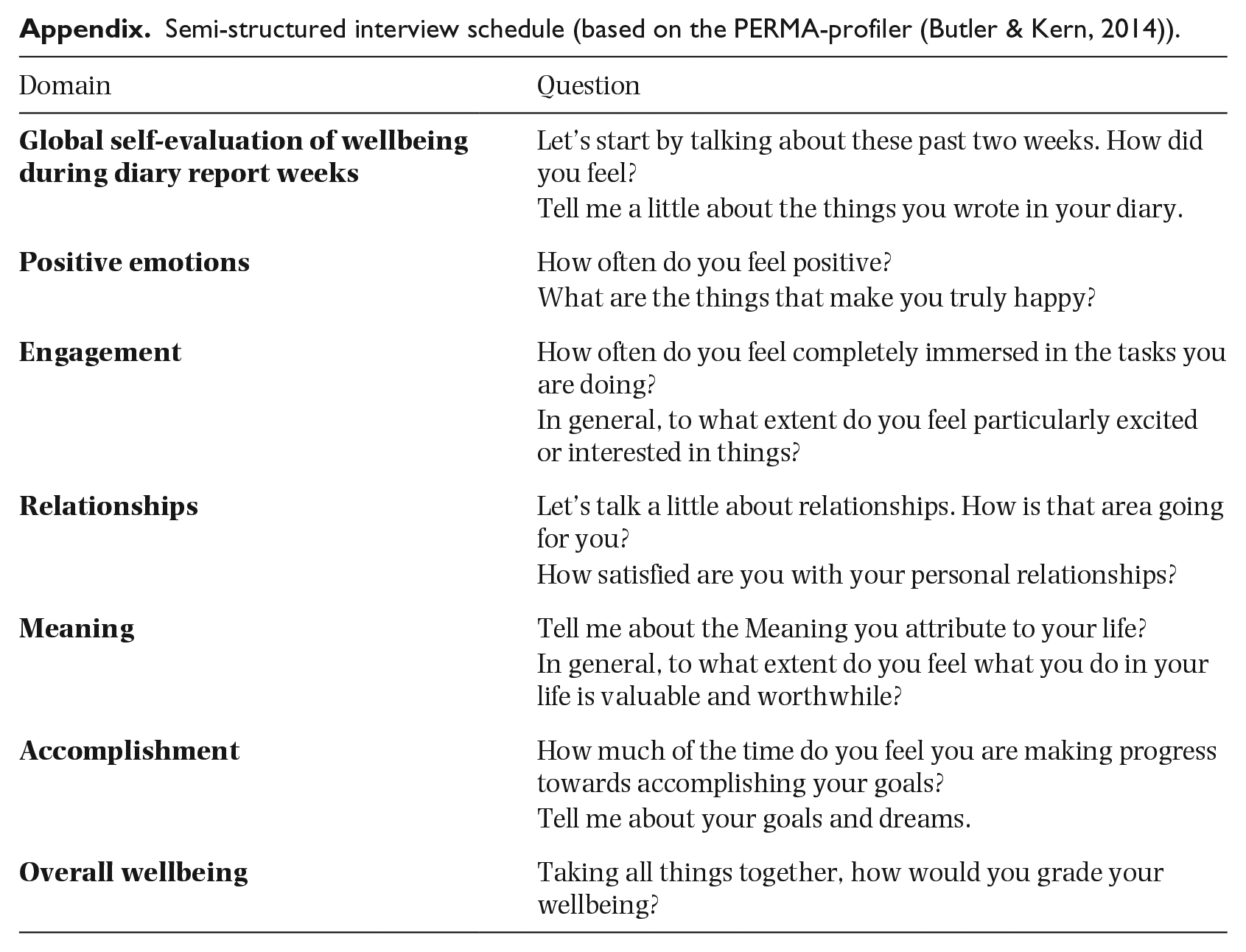
The second interview was intended to explore these themes further and, integratively, address the five components of the PERMA model. A semi-structured format was adopted, based on the PERMA-profiler (Butler & Kern, 2014; Butler, 2011), with open questions delivered in flexible order (see Appendix). Participants were prompted to comment on both their general wellbeing and their wellbeing in relation to being a musician. This design allowed, therefore, the integration of both exploratory and confirmatory procedures. Each interview lasted approximately 75 minutes.
Ethical approval
The study was granted ethical approval by the Conservatoires UK Research Ethics Committee and was conducted according to the ethical guidelines of the British Psychological Society. Informed consent was obtained and no payment was given in exchange for participation.
Analysis
Data were fully transcribed and analysed through Interpretative Phenomenological Analysis (IPA). IPA is grounded in an inductive approach, phenomenological in its essence: it focuses on how the participant, in context, constructs meaning and makes sense of a given phenomenon (Smith & Osborn, 2003). The IPA process followed five steps. The first consisted of multiple and detailed readings of the transcripts leading to the identification of central meaning units in the text. These were recorded on the left-hand margin of the transcripts. Following this, a second step consisted of the translation of the meaning units into emergent themes, short phrases or words that carried the essential meaning of the larger sections of the data identified in step one. These themes were systematized on the right-hand side of the transcript. In the third step, all themes were listed and clustered together. As a result, subordinate and supra-ordinate themes began to emerge. The fourth step consisted of generating a table of themes, incorporating the hierarchies from all sources of data for the participant (two interview transcripts and diary records). Finally, after applying this procedure to the six data sets sequentially, emergent themes across the six participants were clustered together and successive hierarchies of themes were built leading to an overarching table including all participants. Validity was optimized through the triangulation of data sources, coding discussions and collaborative interpretations within the team, recognizing the importance of continual reflexivity in the qualitative research process.
Results
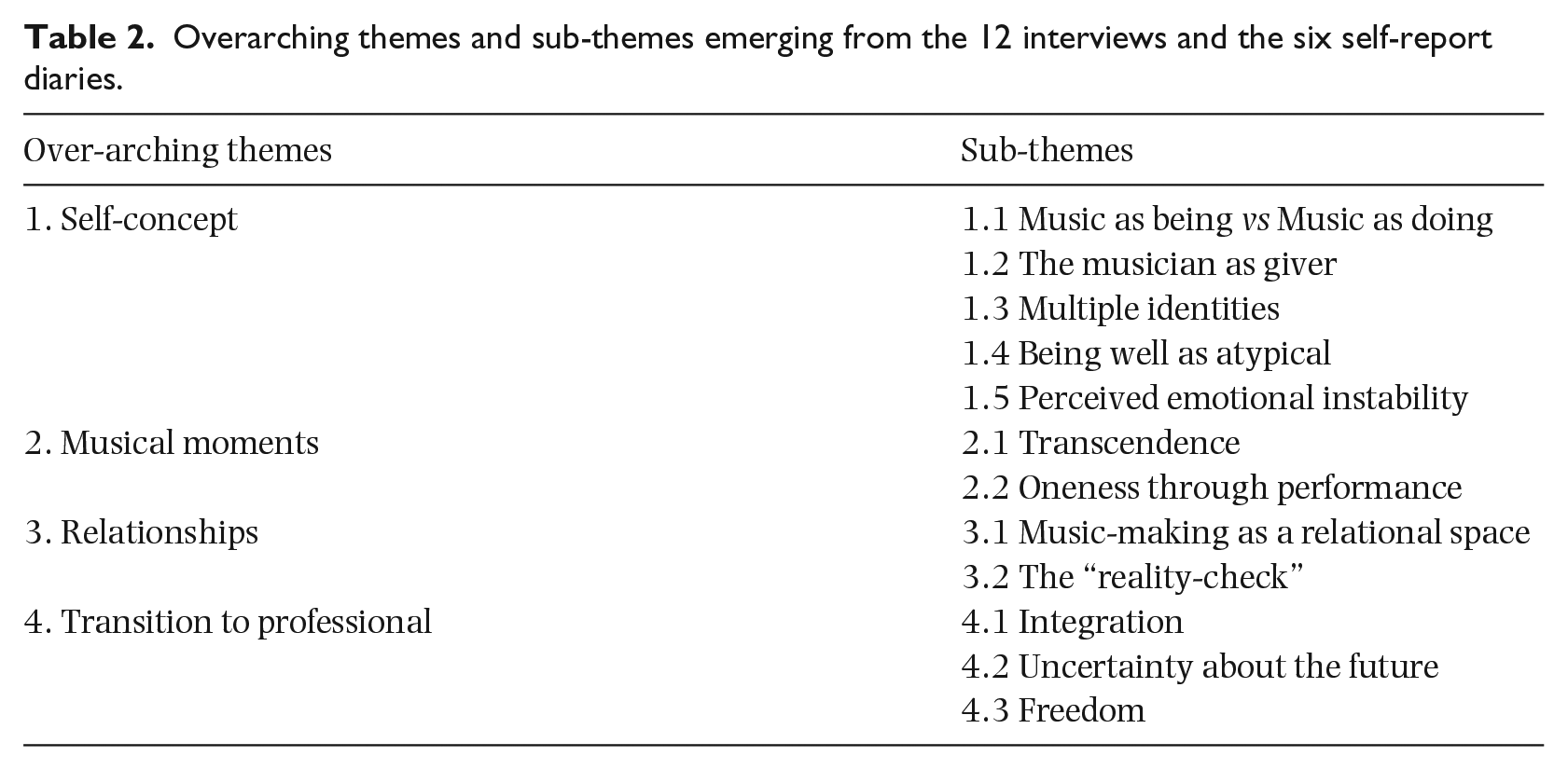
IPA for both the 12 interviews and the diaries revealed high overall wellbeing. Emergent themes highlighted general and activity-specific enhancers and challenges for musicians’ optimized functioning (see Table 2). In what follows, each overarching theme is explored in relation to its constituent sub-themes and example quotes that encapsulate their meaning are presented.
Overarching themes and sub-themes emerging from the 12 interviews and the six self-report diaries.
Theme 1: Self-concept
The definition of self emerged across all participants as a structural sustainer of wellbeing. A clear sense of one’s identity, learning to accept limits, filtering negative inputs and knowing how to manage music’s simultaneous role as a self-definer and a professional structured routine, were strongly regarded as fundamental. For the more experienced musicians, wellbeing enhancement was also reported as related to the cumulative development of a group identity in the context of collaborative practice.
The first subtheme (1.1) captures the emergent conflict between being a musician and the doing of music. The fact that making music is for all participants an intrinsic need, a definer of the self and a central element in life, makes musical activity a strong source of meaning:
There is just not a way I could work on something else because this is who I am in my essence. (Phillip, composer, interview 1) If I don’t play, I’m not well. And I mean that even at home, not only concerts but just practising. It’s part of me. (Isabel, chamber musician, interview 1)
At the same time, being a music employee, immersed in the structure and dynamics of music as an industry, brings specific challenges regarding psychological integrity. Politics, power roles and conflicts of interests were seen as responsible for grief over the loss of beauty and art as the highest value in the hierarchy ruling the music world. A tension was felt between being artistically true to oneself and, as the soloist put it, “being an emotional machine, just pleasing powers by playing the game” (Maria, soloist, interview 1). In relation to this, emerged the view that being successful in the music industry is not dependent primarily on musical quality:
It’s all about the image these days. And sometimes you have to “sleep with the devil”, if you know what I mean. (Daniel, conductor, interview 2) Am I really ready to live in this stressful job, where I always find politics and business getting into the way of true artistry? Where it’s not about quality … Am I brave enough to be true to myself and fight for it even if I have to take the longest and hardest path? Every day I see more of these non-artistic choices and behaviours … (Maria, soloist, diary)
This was put forth as one of the major crisis moments for a musician. Linked with such crisis the musicians reported a need to create a belief of self-worth that is independent from the “doing” of music and its inherent achievements. In this context, participants highlighted the definition of performances as moments and not rigid self-definers and the need to set boundaries between one’s intrinsic value and the institutional label that is set upon them:
One thing is you as a person. Another is your performance; it’s a moment – not you. (Isabel, chamber musician, interview 2) I am not a place, or a moment, I am something different than my commercial value as a musician. The [opera house] is the place where I spend the majority of my time but it is not my life, it’s not me. (Maria, soloist, interview 2)
Further, musicians working in group settings placed an emphasis on monotony from routine and repetition as a major challenge to flourishing in their true musical selves:
I miss music in the midst of the mechanical production of music. Sometimes at rehearsal break, I run hysterically to my dressing room to just do music. The routine is terrible … Repetition ends up killing everything. (Teresa, choral musician, interview 1) This week is my 50th performance of Rigoletto. We have to constantly search for that balance between routine and spontaneity. That can be a big challenge! (Daniel, conductor, interview 2)
Self-expression and freedom for autonomy were emphasized as vehicles for wellbeing and musicians reported seeking new musical opportunities outside their main job in order to enhance their individual musical voice. Increasing the variety of repertoire also emerged as a significant strategy for engagement. In particular, new music was consistently highlighted as an intellectually stimulating endeavour.
A second sub-theme (1.2) referred to the musician as giver. The shared nature of musical activity emerged as a definer of the self for all participants; that is, the musical identity appeared as a giving identity. This was strongly highlighted as a significant source of positive emotions, meaning and accomplishment throughout all accounts, sourced from both interviews and diaries. Giving through being a musician was stated both in relation to audiences and to fellow musicians:
Doing the diary I realized that what brings me most happiness is the moment of the concert. My ultimate goal is to give music. (Isabel, chamber musician, interview 2) My central purpose is to give people the pleasure of music. And it’s the sharing not only with them, but also with your colleagues, with one another. The giving … The moment. You can’t really put this into words. (Teresa, choral musician, interview 2)
Further, the development of multiple identities (sub-theme 1.3), was consistently highlighted by four participants as a source of meaning, engagement and positive relationships. The orchestral musician found a new conducting career, the choral singer actively engages in performing in small groups and developing skills on a new instrument, and the chamber musician, the composer and the choral singer have found teaching to be highly rewarding. The composer adds roles as critic, researcher, editor and orthodox minister:
I am a composer, that’s how I define myself in terms of … self-description, my identity. But I do many others things too, and they keep me … engaged … in relation to people. (Phillip, composer, interview 1) I have a small ensemble. Medieval music. I play the viol. It is a great way of having some diversity. I feel I have a voice. I can express myself in a different way … I also enjoy teaching. I would say all these are important for my balance as a musician. (Teresa, choral musician, interview 1)
The development of multiple identities was expressed in relation to both a diversity of professional activities (within or outside music) and the intentional development of other roles in life, such as parenthood.
Finally, the last two sub-themes refer to the definition of self in relation to assumptions about musicians as a “professional class”. The idea that being well was atypical of the professional group (sub-theme 1.4) emerged transversally across the data. All participants shared a consistent assumption that being a musician is not usually linked with experiencing high wellbeing and that their own personal cases of high perceived wellbeing were, therefore, uncommon:
I am an outlier of your study. I feel great, and I know I’m not a typical musician. Maybe I’m ruining your study … (Franz, orchestral musician, interview 1) So great that you are doing this. We need to study musicians’ wellbeing. You’ve got the wrong person here. I’m well and happy! I think I might not be a typical musician. (Isabel, chamber musician, interview 1)
Perceived emotional instability (sub-theme 1.5), frequently referred to as “ups and downs” or “peaks and lows”, emerged as a final recurrent sub-theme linked with participants’ views of what it means to be a musician. All participants perceived themselves as experiencing more extreme emotional states than other professionals outside of music and considered this to be a characteristic inherent to their profession. In this regard, there was divergence between younger and more experienced participants, as the first years as a professional in music seem to represent a greater challenge. This theme was particularly evident in the accounts of the orchestral musician who is living a transitional status as conductor side-by-side with a 20-year career as a percussionist:
My daily life is less intense than it was some years ago. You find a way of having some constancy … The high and lows have met in the middle. When you start, the peaks are bigger. Now you don’t have so many deep holes to fall into … I’m starting conducting now and the ups and downs there, the “waves”, are bigger. It’s all still new. (Franz, orchestral musician, interview 1) We are constantly juggling the extremes. It’s violent. (Maria, soloist, interview 2)
Interestingly, the diaries did not appear to confirm emotional instability. For all participants, emotional accounts appeared consistently positive throughout the seven reported days.
Theme 2: Musical moments
The music profession emerged as a privileged enabler of meaningful musical moments: a fundamental source of positive emotions and engagement. Two sub-themes corroborated by all participants, accounted for this theme: experiences of transcendence through music (sub-theme 2.1) and oneness with other musicians through performing together (sub-theme 2.2).
Both concerts and rehearsals as “moments of transcendence”, “transformative events” or “peak experiences” were mentioned by all participants:
The moment of the concert is always the peak … I’m usually always on a high during the performance. (Isabel, chamber musician, interview 1) My flat mate had passed away, I was feeling terrible. On stage I was 100% in my role, light and lively. It was hard but at the end of the day I realized even more that I really want to do this. That moment of being on stage and performing keeps me alive! (Maria, soloist, diary notes)
The more experienced musicians accounted for a decrease in the quantity of peak musical moments with time, but an increase in intensity (in line with sub-theme 1.5). For the composer, a specific thread regarding transcendence emerged. The mediation of wellbeing through musical moments seems to have different contours within this activity, as they are expanded beyond the actual performance and can happen without an effective acoustic stimulus:
It’s not real thinking. It’s not applied thinking. It’s mulling things over … going for a walk, having the idea. I’m writing this piece in my head, and things happen during that walk … so then I make the piece happen in terms of … notes and that’s very positive … because I feel highly involved. I’m in the creative process … It’s something that takes hold of you. Not something you control. It takes me away! I can hear it. That’s tremendous … It’s very exciting … and it can happen any time … I can be in the car, walking the dog, eating lunch, asleep! (Phillip, composer, interview 2)
The convergence in musical ideas and symbolic meaning creating oneness through performance (sub-theme 2.2) – referred to as “being one” (soloist) or “soul fusion” (choral musician) – recurred as both a highly significant vehicle for wellbeing and a hard-to-reach goal. The perspective of performance as a system and the longing for a common good and accomplishment of others as a condition for one’s own wellbeing was consistently highlighted:
That moment where there is a fusion – a soul fusion … (Teresa, choral musician, interview 2) I am not fully satisfied when I do okay. I like everything around me to be good … The performance is one; we are all part of it. (Maria, soloist, interview 1)
Side-by-side with self-concept and musical moments, another central theme in musicians’ accounts of wellbeing experiences focused on relationships.
Theme 3: Relationships
Both the interview accounts and diary records highlighted that family, social and work-related connections were integral in sustaining positive functioning, and all participants indicated satisfaction in this domain. In particular, perceived support within the musical working context was highly recurrent. Two strands of meaning emerged within the theme of relationships: the relational nature of music-making and the need for engagement with life outside music as a means for experiencing a deeper sense of connection.
Music-making was regarded primarily as a relational space (sub-theme 3.1): music performance implies the construction of shared meaning with both the self, the audience and, for group musicians, other group members. While this can lay the foundation for enhanced wellbeing through meaning, it also represents a challenge as it can place demands regarding social skills:
What I do is 10% conducting, 90% psychology – knowing how to deal with people. (Daniel, conductor. interview 1) There is a double duty: getting along well and doing music together. These are all different skills. … The hardest is flexibility. In chamber, people can get very individualistic … my way of playing, my expression, my way of tuning. This can turn into a personal conflict … You are entering the emotion that the other person is feeling. You can’t say “no this is wrong” … because it’s a little abstract … In engineering, it’s either a certain way or the bridge falls … or the lawyer has laws … but in music it’s harder! (Isabel, chamber musician, interview 2)
In the shared space of music-making, the group as a social unit was also emphasized, especially in the case of chamber and orchestral contexts. It was consistently placed as both a family and a mini society with hierarchies, revolutions and natural leaders. Participants highlighted the group unit as prone to regular social processes – namely, acculturation, adjustment and hierarchy:
You come and enter my group; it’s like in a family! We adopt a new child, the other kids have to make serious changes in the kitchen … Each of us pulls their chair in a slightly different way to accommodate the other … In the first days it becomes weird, but then we get used to it … You know [speaks quieter] we have “the soloists”! Guys with a character that … needs a lot of space; everything around them has to give them the space … It’s a mirror of a world this orchestra … Sometimes we are called a small republic and it’s exactly that: a small democracy. (Franz, orchestral musician, interview 2)
An emphasis was placed on group identity as a source of meaning, self-actualization, positive emotions and on engagement through sharing and learning with colleagues. In the case of solo-oriented musicians, relationships appeared hardest to establish and maintain, particularly outside of the music world. Emergent themes from these musicians pointed to group projects as sources of wellbeing through positive relationships.
The need to force oneself not to be isolated by music and music-related relationships and be connected to routines and roles outside music was often referred to as the “reality-check” (sub-theme 3.2):
I would tell any beginning composer: make sure you wash the dishes, help change the baby’s diapers and make it to family reunions … It puts you in your place, it makes you feel connected and it keeps you humble. Don’t take yourself so seriously … Be a normal person! Keep the perspective! The great musicians do everything else as well. It has a great purpose … psychological, spiritual! (Phillip, composer, interview 1)
This theme appeared linked with the potential volatility of work relationships in music during short-term projects:
We spend a lot of time together, we are like family and then we never see each other again… Relationships in opera are very volatile. And all the characters we play imply a huge emotional effort. To help with all this, I am now trying to separate my life from my profession a bit more. (Maria, soloist, interview 1)
Finally, this theme was also related to the emotional weight music activities can bring and the challenge of resting and finding silence. In the particular case of the chamber musician, the difficulty in fulfilling life roles outside the music profession was consistently highlighted in relation to motherhood.
Theme 4: Transition to professional
Finally, the transition to professional phase was consistently regarded as the most challenging concerning wellbeing. Different mediators for this were put forth. Integration in the professional world (sub-theme 4.1) emerged as a major process in this phase. Musicians working in group settings (orchestral, choir and chamber) highlighted integration in relation to group acculturation: the sense of having to prove one’s worth to the group, meeting expectations and feeling the pressure of competition. The shared memories of success, positive relationships and the construction of group identity appeared as sources of security:
When you start here it means you are being observed for two years, each note that you play … can end your life here! So the insecurity of a young person is huge … Then you can have mistakes. I mean … in the relationship with your colleagues you … start to feel more secure. (Franz, orchestral musician, interview 2) It is hard to prove your worth when young … to make the orchestra respect you when they are all older than you. (Daniel, conductor, interview 2)
The remaining participants reinforced the integration underlying the transition, in relation to the need to develop life skills. Social skills and an enlarged social network outside music were particularly emphasized. For all participants, this phase represented a period of more extreme emotional responses to the positive and negative moments related to professional activity:
We have this jump from student to here. It’s very easy when you achieve this level in the beginning and in [the opera house] … you allow that it affects you in that sense that it becomes your life so everything that happens there affects you a lot – for the worst and for the better. (Maria, soloist, interview 1)
Uncertainty about the future (sub-theme 4.2) also emerged as undermining to wellbeing in this stage:
Am I able to fight for a career at the highest professional level? Will I accept if I cannot achieve the career I wished for? Will I be prepared if that happens? What else can I do if not singing? (Maria, soloist, diary notes) When you start, you don’t know the future. That is hard. You jump from audition to audition, spending money and not getting rewards. (Isabel, chamber musician, interview 2)
Additionally, however, this emerged as a period of higher freedom (sub-theme 4.3). Leaving the directedness of educational contexts was seen as conducive to fewer restrictions and boundaries:
When you stop having a teacher every week to correct you, you’re free to be yourself. You feel free … but you need to be very disciplined to keep the level and … yeah, to keep motivated! (Isabel, chamber musician, interview 2)
The period of transition was found to represent both a resource for growth and a challenge linked to the need for higher self-regulation and discipline.
In summary, for all participants in this study, being a musician at a high professional level brings possibilities for wellbeing on all components of PERMA, suggesting the specific challenges associated with the profession in previous literature may not be as limiting to wellbeing as could have been thought.
Discussion
This study has shed light on the ways in which these six professional musicians build and maintain wellbeing. Results point to overall high wellbeing for all participants, as evidenced in both global and daily accounts, and across different types of musical activity. The results stand in contrast to previous literature and the group’s apparent self-concept: “I am well, therefore not a typical musician”. A stereotype regarding the music profession as a source of stress and strain seems to prevail and to be deep enough to permeate musicians’ identity constructions. The challenges of the profession remain central, in tune with previous profiles (e.g., Steptoe, 1989), but it appears that some musicians may be more resilient towards these challenges than is commonly believed.
Referring back to the PERMA model, the experience of positive emotions was highly related to “musical moments” (theme 2) – including moments of transcendence (sub-theme 2.1) – particularly when shared, with audiences or fellow musicians. Perceived emotional instability (sub-theme 1.5) was reported by all participants but did not emerge from the diary records. Given the stereotypical construction around musicians’ wellbeing highlighted earlier, the question remains as to whether the perceived emotional instability might be part of this stereotype.
The conditions for greater flourishing regarding engagement as a professional musician were linked to a variety of activity, repertoire and setting, opportunity for self-expression and autonomy in the course of performance, and group context (sub-theme 1.2). This was also associated with the development of portfolio careers: the musicians who have the space for experimenting with different musical identities and varied roles outside of music find satisfaction through enhanced engagement (sub-theme 1.3).
Relationships, as for the general population (Reis & Gable, 2003), remain a strong element of wellbeing for musicians (theme 3). There is high satisfaction with relationships and an attribution of centrality to this feature. At the same time, flourishing in relationships appears as one of the highest challenges in both work and personal contexts, bringing to light the importance of social skills training in the context of professional musicianship.
A major finding of this study is the role of meaning, through the construction of a solid sense of self (theme 1), supporting the possibility that being “psychologically well” as a musician is sustained primarily through the eudaimonic route. This could possibly be the key for understanding the apparent dissonance between the mostly negative wellbeing profiles that have been drawn in previous research, and the contrasting results of this study. Models of wellbeing based on contentment and pleasure alone would very likely fail to grasp the profile of the wellbeing experience reported by these six musicians.
Alongside musical identity, the shared nature of musical moments emerged at the core of the construction of meaning. Musical moments gain a dual status in musicians’ lives as they increase their years as professionals. On one hand, they are integral to the self (as the being and doing of music are sometimes merged). On the other, more experienced musicians intentionally invest in detaching musical moments from their self-evaluation and construction, as a protective strategy for wellbeing.
Additionally, musicians reporting high wellbeing seem to be the ones who, while thriving in working hard towards accomplishing musical skill, are more “wider achievers” rather than “high achievers” (exploring multiple identities, relationships and settings of “being”) both within and outside the musical domain. Additionally, performing regularly and building a solid positive performance narrative throughout the years, allows for a validation of self-perceptions of competence. This is particularly relevant in group settings, in the process of building a new group self.
A somewhat curious finding, in a profession particularly linked with external evaluations and competitions, was that accomplishment emerged as primarily related to inner goals – namely, being true to the self, sharing and reaching oneness in performance and investing in different identities and roles. Linked with the strong role of meaning, this provides relevant insight regarding assessment of musicians’ wellbeing in both educational and clinical settings, pointing to the need of prioritizing the space for subjective idiosyncratic subtleties.
A topic worthy of attention, given its centrality in previous wellbeing research with musicians, is Music Performance Anxiety (MPA). It was surprising that MPA was not a predominant component of the discourse agenda of musicians during either interviews or diary records. Despite remaining an inherent challenge, it appears from the accounts of this study that, on a professional level, MPA stands more as an occasional “tip of the iceberg” of deeper challenges, particularly related to identity and life-skills, notably in the case of more experienced musicians.
A final area deserving careful attention, and in reinforcement of previous studies (e.g., MacNamara, Holmes, & Collins, 2008), is the marked challenge the transition to professional life represents to wellbeing. This period has been identified as one of the most challenging processes of human development across a variety of areas of expertise (Gerrish, 2000). In the case of music, growing attention has been given to this phase, as it is considered, along with entering a higher music education programme, the most challenging process for a developing musician. This has been attributed both to general practicalities of the adjustment to adult life and the emotional impact it brings, and to the new habits and challenges of the activity of playing professionally. Cumulatively, society is changing and imposing new demands on professional musicians. Seltzer and Bentley (1999) describe a “skills paradox” for the present day, as there has been an increasing demand for versatility and new, extraordinary skills, but at the same time the need to maintain traditional ones at the highest level. The multi-level challenge that this transition embodies, along with the centrality of self-concept for musicians’ wellbeing, reinforce the double role presented to higher music education institutions towards pre-professionals: going beyond refining musical skills and focusing also on resilience and life-skills in an anticipatory approach to professional life. More than training performers (the “doing”), empowering musicians (in the “being”) should be part of the mission. While musical skills need to be refined like never before, resilience deserves a place at the centre of the educational agenda (Gaunt, Creech, Long, & Hallam, 2012). Innovative educational programmes have been emerging, in an attempt to maximize this process (Johnsson & Hager, 2008) through a “living curriculum”, targeting the development of the whole individual. The central role of modelling and expert guidance through mentoring in enabling these features has gained greater attention in recent years (Manturzewska, 1990; Renshaw, 2009). The individual tests possible selves to negotiate a new work identity, and this can happen by observing coping models and using their feedback on their experimenting provisional selves to evaluate their validity and efficacy (Smilde, 2006). Finding a way to foster a highly developed musical self-concept should be the core focus of the curricula in later years, as well as focusing on creating peer networks, varied performance opportunities and growing self-discipline and autonomy. A highly practically-oriented programme of study may help ease this process as the provisional selves are formed in parallel with the highly structured skill training and feedback is more available and intentionally delivered.
Further research is needed to explore the multiple components of wellbeing for professional musicians fully. A large-scale study attempting to construct a general PERMA profile seems relevant in order to position musicians in relation to other populations on each of the PERMA components. Extending this study to music students and teachers also seems highly relevant, especially concerning the findings on the transition to professional phase and the role of portfolio careers in this context. Furthermore, the replication of this study with jazz and pop musicians would represent a valuable addition to the literature, especially acknowledging recent findings (Dobson, 2010) on the differences between these professional groups and classical musicians regarding freedom and autonomy in performance and its relation to identity.
Footnotes
Appendix
Semi-structured interview schedule (based on the PERMA-profiler (Butler & Kern, 2014)).
| Domain | Question |
|---|---|
|
|
Let’s start by talking about these past two weeks. How did you feel? |
| Tell me a little about the things you wrote in your diary. | |
|
|
How often do you feel positive? |
| What are the things that make you truly happy? | |
|
|
How often do you feel completely immersed in the tasks you are doing? |
| In general, to what extent do you feel particularly excited or interested in things? | |
|
|
Let’s talk a little about relationships. How is that area going for you? |
| How satisfied are you with your personal relationships? | |
|
|
Tell me about the Meaning you attribute to your life? |
| In general, to what extent do you feel what you do in your life is valuable and worthwhile? | |
|
|
How much of the time do you feel you are making progress towards accomplishing your goals? |
| Tell me about your goals and dreams. | |
|
|
Taking all things together, how would you grade your wellbeing? |
Acknowledgements
We wish to thank our participants for giving generously of their time and for their input.
Funding
The authors disclosed receipt of the following financial support for the research, authorship, and/or publication of this article: The research reported in this article was carried out as part of the MSc in Performance Science at the Royal College of Music. It was supported by Musical Impact, a Conservatoires UK project funded by the UK’s Arts and Humanities Research Council (grant ref. AH/K002287/1).