



Abstract
The aim of this study was to investigate, describe and understand the developmental function (musical and social/emotional) of nine toddlers’ private spontaneous songs. Between the initial interviews with the eight families and follow-up interviews 5 to 6 weeks later, parents observed their child at home twice a week for 4 consecutive weeks. When the child was alone at bedtime, the parents stood outside the bedroom door and completed a written Parent’s Observation and Reflection Form (PORF) describing and contextualizing what they heard on a minute-by-minute basis for the first 15 minutes of each session. Additionally, the parents collected audio recordings of the eight sessions using a smartphone that they placed inside the child’s room. Data sources included transcripts from family interviews, field notes, PORFs, and audio recordings. Findings suggest that many of the toddlers used solitary spontaneous singing at bedtime as a way to demonstrate and practice musical skill, reflect, experiment, self-soothe, and understand their own worlds. Spontaneous singing functioned to support these adaptive strategies during this intense developmental period. Further research is needed to understand the conditions and varieties of toddlers’ private spontaneous crib song.
Keywords
All over the world, children use music in their daily lives for communication, comfort, play, exploration, and self-expression. They are innately musical as they regularly initiate vocal play and improvised song (Campbell, 2010; Kartomi, 1991). These songs that children repeat and create provide us with information about how they develop musical skills and language, self-soothe, and use music to make sense of their worlds. Research on children’s spontaneous singing provides insight into how music functions for them. The study of children’s spontaneous vocalizations has become an established area of interest for researchers from the early studies from the Pillsbury Project (Moorhead & Pond, 1941/1978) to the present day where researchers have sought to examine the function and developmental role that these spontaneous vocalizations fulfill in toddlerhood (M. Barrett, 2010; M. S. Barrett, 2006; Bjørkvold, 1992; Tafuri, 2008; Young, 2002, 2004).
As a music educator, researcher, and mother of two young children who is attuned to listening for children’s spontaneous songs, I realized that my own daughters were engaging in solitary spontaneous singing when alone in their cribs at bedtime. Through my personal exposure to and systematic observation of my children’s bedtime vocalizations, which I call ‘crib songs,’ I realized that the pre-sleep period is a unique, private environment in which to observe the solitary and non-communicative spontaneous vocalizations of toddlers. This led me to wonder if many other toddlers sing in their private pre-sleep moments. If so, how do these songs function for them? How do crib songs help toddlers to understand their worlds and participate in their own singing and social/emotional development?
Singing and development
Music is present in development even before a child is born (Parncutt, 2009). In the early months of their lives, infants spontaneously vocalize to communicate with their caregivers. Malloch and Trevarthen’s (2002, 2009) theory of communicative musicality asserts that babies and parents engage with each other in musical dialogues that are both cooperative and co-dependent. These musical communications serve to bond parents and their infants.
Tafuri & Welch (2008) comprehensive review of the literature on singing skill development in early childhood is organized to show a progression; from vocal communication between parent and child, which leads to song, to imitative song, and finally original song. She maintains that musical qualities are observable at different ages.
Davidson’s work on melodic development (1985, 1994) showed that young children first develop the ability to master singing intervals and ultimately connect the singing of these intervals within the profile of the melody. Landmark research by Moog (1976) shows that by the age of 2, all children can sing, and they continue to do so more frequently as they grow. Moog’s work also focused on the development of singing in tune, an area that has been explored in depth by a number of researchers including Welch (1979), Luchetti (1987), Bjørkvold (1990), and Davidson (1994).
In his work on musical child cultures in the United States, the Soviet Union, and Norway, Bjørkvold (1990) illustrates the different ways that children sing in their daily lives. From sound play to musical speech acts to song as part of play, children develop the ability to structure their improvised song within a form. Welch’s research on singing development (Welch, 2006; Welch, Sergeant, & White, 1998) provides a 4-phase model to illustrate how children develop the ability to sing.
The aforementioned studies on singing development have provided great insight into the process by which children learn to sing. However, less is known about how children play a role in their own development through singing. The study of spontaneous singing gives insight into how young children participate in this process. The preceding review of related literature illustrates insights gained from the study of solitary spontaneous singing and also shows how the pre-sleep period can be particularly effective in examining how toddlers contribute to their own singing skill development and social/emotional development when they are alone.
Solitary spontaneous singing
The developmental stage of toddlerhood (age 18–36 months) is an intense period of transformation where children learn to walk, talk, exert independence, and make sense of the world around them (Bruner, 1983; Erickson, 1950; Piaget, 1929, 1952, 1962; Vygotsky, 1962). For many toddlers, music is a powerful tool that supports them as they navigate through this turbulent time (Dissanayake, 2000; Hallam, 2010). Landmark research by Moorehead and Pond (1941/1978) indicated that solitary spontaneous singing differs from spontaneous vocalizing in groups as it is more introspective with amorphous rhythmic structure and features lyrics that are reflective of daily experience.
Around the globe, researchers have studied the function of children’s spontaneous vocalizations and have continually made a distinction between social vocalizations and more private solitary spontaneous songs. Japanese infants in Shimada’s study (2012) sang to explore their own voices, even without response or feedback from adults. Sundin (1997) found that in Sweden, young children’s solitary vocalizations were more complex and elaborate than social or communicative vocalizations. In Italy, Tarfuri (2008) made a distinction between social and private spontaneous song showing that solitary vocalizations take the form of expressions, monologues or recounting. Young (2002) noted the presence of solitary spontaneous songs in an English daycare that were free flowing or used fragments of learned songs. M. Barrett (2010) showed that solitary spontaneous song was a tool for self-regulation and identity formation in a 2-year-old child in Australia. Recent studies in the US (Campbell, 2010; Custodero, Calì, & Diaz-Donoso, 2016; Koops, 2014) confirm that children at schools, in playgrounds, on the subways, and in cars all sing solitary spontaneous songs. Further research into solitary spontaneous song may provide even more information about how children use music when they are alone. Observation of these songs may help to illustrate children’s singing skill development as well as how music supports social and emotional development.
The Pre-Sleep Period
In some cultures, and for many toddlers who are put to bed alone, the crib becomes a private space for reflection. Often, the child is left alone to fall asleep, no longer has a partner in conversation, and shifts from a social context to one of private reflection (Nelson, 1989). The physical space of the child’s room seems to reinforce this atmosphere of a private space; the room is often darkened, the child is lying down within the enclosure of a crib.
Some researchers and theorists believe that toddlers are unique in that many are not yet capable of inner speech and tend to verbalize their thoughts by means of overt self-talk before they develop the ability to internalize their own speech (Bivens & Berk, 1990; Flavell, Green, Flavell, & Grossman, 1997; Vygotsky, 1962; Winsler, De León, Wallace, Carlton, & Willson-Quayle, 2003; Winsler & Naglieri, 2003). Because of the presence of overt self-talk, researchers have studied toddlers in the private moments before they fall asleep as a way to gain insight into how extended solitary monologues function for linguistic practice, cognitive representation, self-regulation, role playing, and play (Kuczaj, 1983; Nelson, 1989; Weir, 1962). Research has shown that it takes the average toddler (ages 21–31 months) approximately 21 minutes to fall asleep on their own (Agnew & Webb, 1971).
The pre-sleep phase can also be viewed as a period of transition, where the child is moving from a conscious state to an unconscious one. This transitory period sees a shift in energy as the child relaxes from the day’s activities (Keller, 2011). Separation anxiety at bedtime is frequently the topic of discussion in parenting books, blogs, and articles in many Western cultures (Brazelton, 2006; Karp, 2008; Sears & Sears, 2002; Spock & Needleman, 2004; Weissbluth, 1999). Some young children experience a fear of the dark or of being alone (Spock & Needlman, 2004). Experts like Weissbluth (1999) and Sears and Sears (2002) cite the importance of acknowledging these fears but teaching young children to fall asleep on their own. They encourage parents to create a soothing routine at bedtime that may include a bath, reading stories and singing together. Establishing a familiar routine helps the child to know what is coming and relax and become independent in falling asleep. From a psychological perspective, Stern (1989) highlights the significance of the nightly separation of parent and child. Many parents engage in nightly rituals with their toddlers (bath-time, story-time, lullabies) as a way to ease the transition from togetherness to being alone. He suggests that some toddlers engage in crib speech as a way to ‘hold onto’ their parents or ‘bring them along’ as they move from a state of awake to sleep.
These studies on crib speech and the pre-sleep period (Kuczaj, 1983; Nelson, 1989; Weir, 1962) all cite the presence of spontaneous vocalizing, yet none of the studies examined the developmental function of this singing for the toddlers.
The study of toddlers’ private pre-sleep speech and song is significant as it may reveal how toddlers use music when they are alone. Private bedtime speech shows how toddlers develop language skills. Singing serves to intensify speech and imbue words with emotion and expression. The purpose of the current study is to examine the possible musical and social/emotional developmental functions of solitary spontaneous vocalizations in the lives of toddlers.
Participants
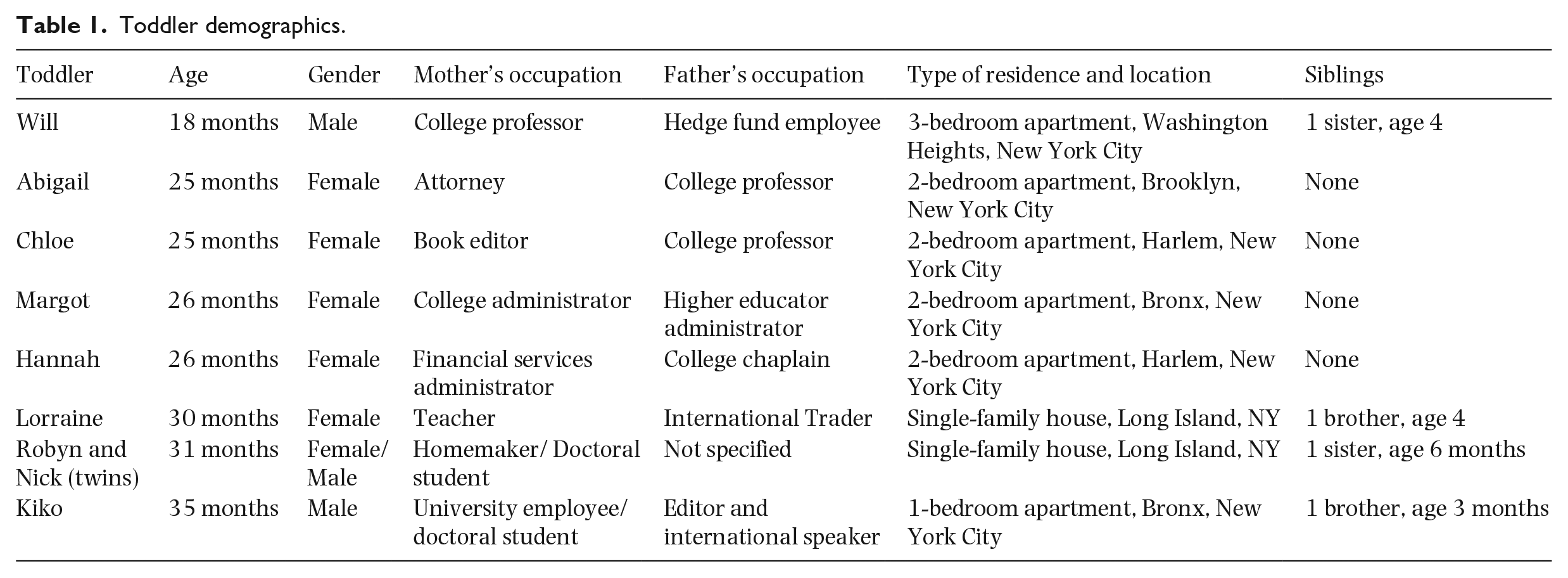
Participants in the study included nine toddlers (1 set of twins) from eight families. Families were recruited from two early learning centers (1 urban and 1 suburban) in the New York metropolitan area. I contacted the directors of the early learning centers who provided me with a list of families who had toddlers aged 18–36 months who were put to bed in their own room and were usually put to sleep awake. A letter was sent to 11 qualified families asking for participation in the study. Nine families agreed to participate. Most participating parents were white, with the exception of the parents of one female toddler, who were both Pacific Islander and one male toddler, whose father was of Asian descent, and whose mother was Latina. Table 1 represents the demographic characteristics of the participating children and their families.
Toddler demographics.
Procedure
The parents acted as co-researchers in the study as they observed their own children at home twice a week for a period of 4 weeks. Given the close relationship and access that parents have to their children, they were able to provide the richest descriptions of and contextual information about their children’s spontaneous songs. For the first 15 minutes of each observation session, the parents stood outside the child’s room at bedtime and described and contextualized what they heard on a minute-by-minute basis on a written parent observation and reflection form (PORF) (see Figure 1). The PORF was modeled after the family music diaries used by parent co-researchers in Custodero’s (2006) study and tested in a pilot study of crib songs conducted in 2012.

Sample PORF completed by ‘Abigail’s’ parents.
Additionally, the parents collected recordings of the sessions from inside the toddlers’ rooms using a smartphone or voice recorder. In-depth interviews were conducted with the families at the beginning and conclusion of the study.
A coding scheme was developed using all of the descriptions of sounds and vocalizations that were used by the parent co-researchers and myself. First, I listened to all of the recordings of the observation sessions and described what I heard on a blank PORF. At first I listened to each session on a minute-by-minute basis. After a few listenings, I realized that distinct episodes became obvious within each observation session. Next, I compiled a list of all of the descriptions of vocalizations that I used. Many of these descriptive terms were informed by Young’s (2002) categories of types of vocalizations including chanting, intoning, free-flowing vocalization, reworking of known songs, movement vocalizing, and vocalizing to animate. I combined this list with all of the descriptions that the parents used on their forms. From this master list of descriptions, two main categories of observed sounds emerged: (1) musical utterances/vocalizations, and (2) non-musical sounds. Within the category of musical utterances, vocal behaviors, lyrical sources of vocalizations and functions of the vocalizations were described. Non-musical sounds were organized by emotional expressions, physical expressions, language and external sounds. All of these descriptions were put together to create the coding scheme (Figure 2) that was used to analyze and interpret the data that was gathered from the audio recordings and PORFs.
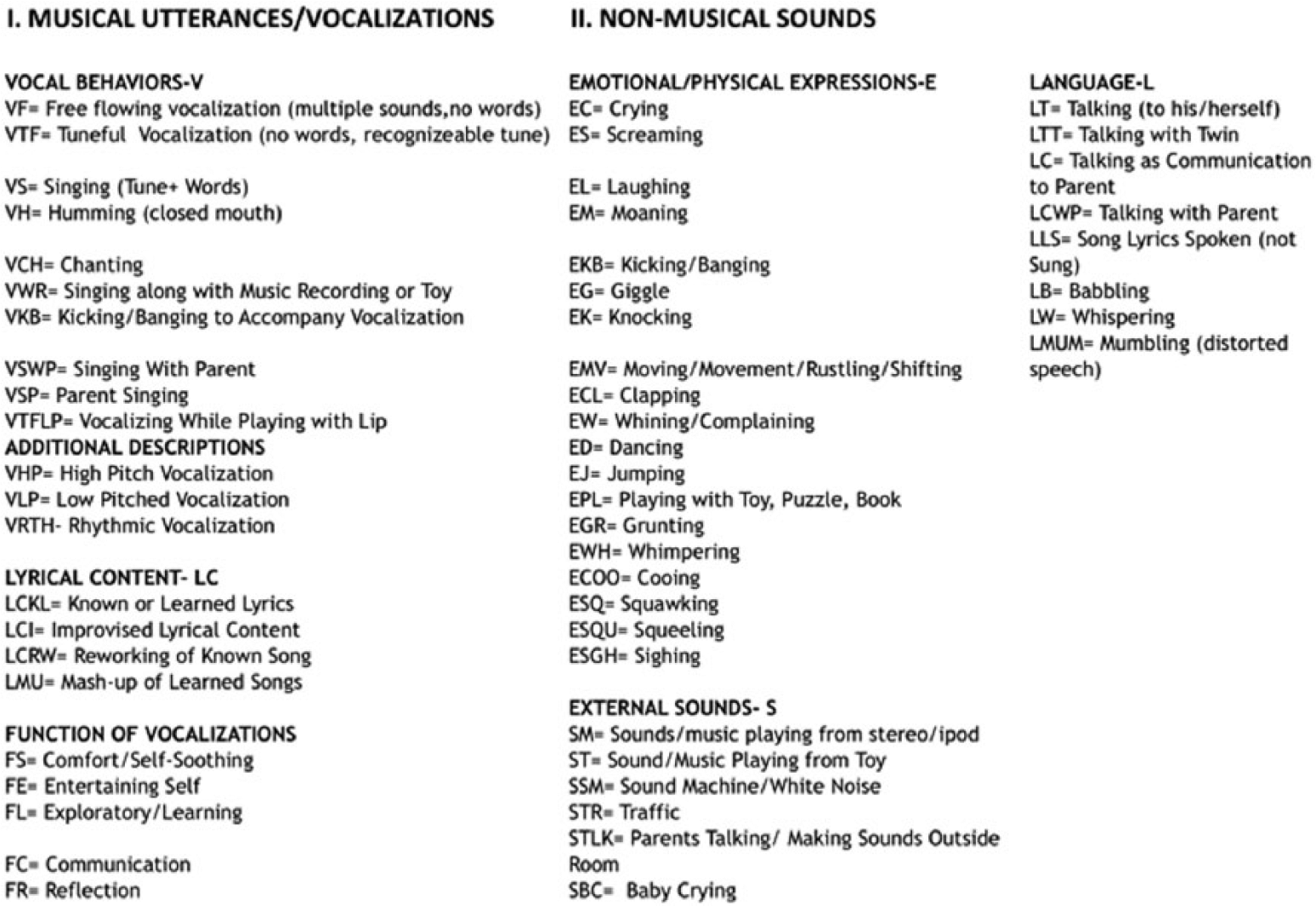
Coding scheme.
Based on the codes, a frequency of vocalization chart was devised for each child. The highlighted cells in Figure 3 represent musical vocalizations.
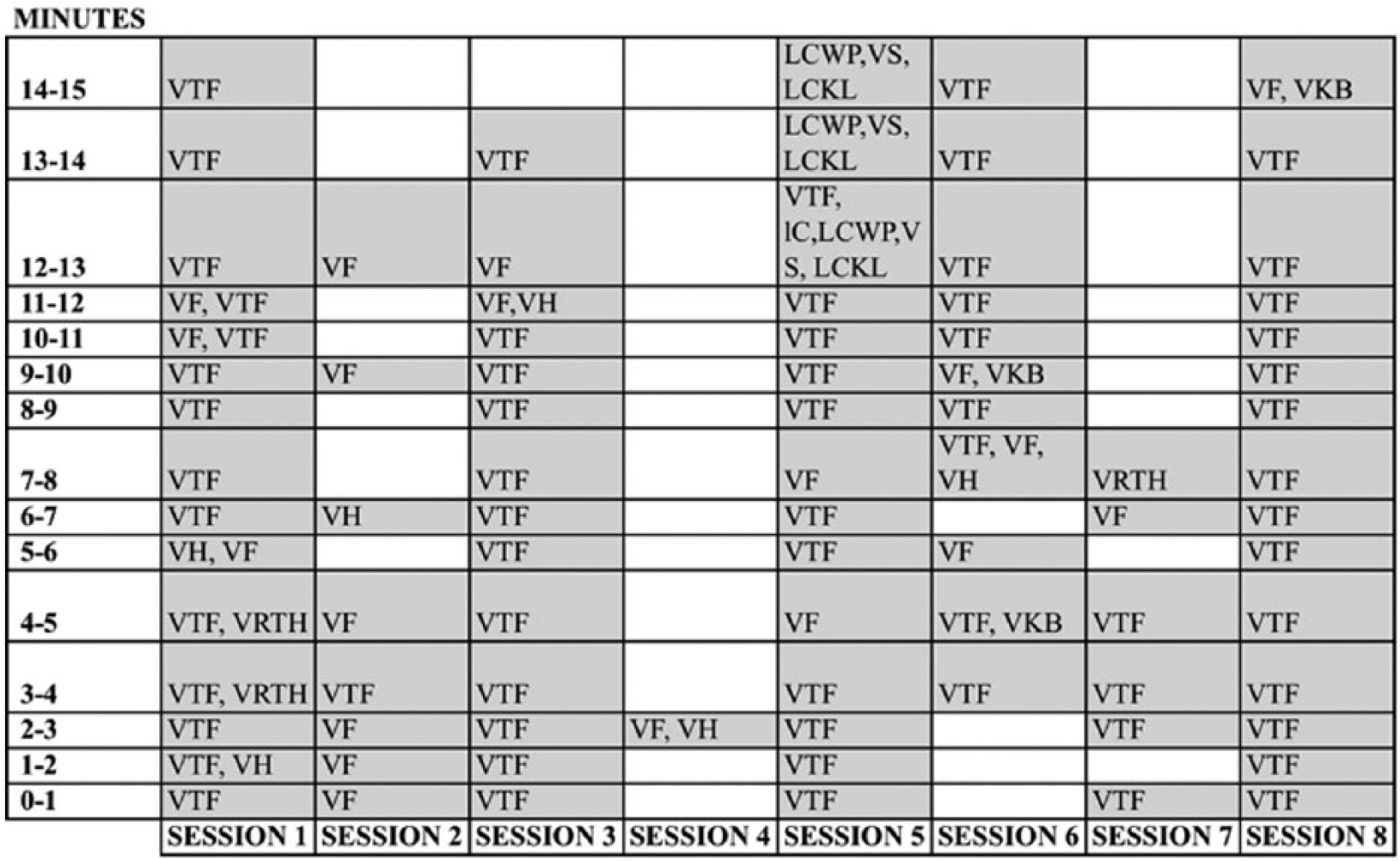
Sample frequency of vocalization for ‘Margot’.
In addition to analysis of the coded audio recordings, the following were other sources of data collection: PORFs collected by the parents and in-depth interviews with the parents before and after the study. The initial interview provided important information about each family in the study and a baseline of information about what they already heard from their toddlers at bedtime. The final interview centered on the parents’ experiences of listening to their children for the duration of the study. Information from these interviews gave a context to what the parents heard. During this interview, I asked for clarification of some of the content that I heard on the audio recordings.
Solitary spontaneous song in developmental contexts
As indicated by the coding scheme described in Figure 2, a main focus of the study was to determine the function of the musical utterances for the toddlers. The following section discusses the findings of the study as organized by developmental function; singing skill development and social/emotional development.
Crib songs and singing skill development
Each of the toddlers described in this section exhibit characteristics that show them to be in different stages of vocal development as they experiment with their voices. A few of the toddlers in the study vocalized at bedtime as they experimented, and played with sound and music.
Sound play for vocal experimentation
At the age of 18 months, ‘Will’ was the youngest child in the study. He was very focused on learning language and exhibited a lot of babbling and speaking isolated words. The details of Will’s language development that were described by his mom seem to fit the typical benchmarks of linguistic development that are outlined by researchers such as Hulit and Howard (1993).
Will’s musical utterances were always mixed with talking or babbling. In the second observation of week 3, Will gave his longest demonstration of a babbling song when he showed free and improvised singing on the sound ‘Bah’ (see Figure 4). During the five prior observations, Will was put in his crib with an electronic doll that played music when he pushed the buttons. Will engaged musically with the doll by turning on different songs and moving to the recorded music. On the night of the sixth observations, Will’s mom removed this toy from the crib and then observed this solo vocalizing. This singing occurred in between brief moments of babbling and speaking. When he vocalized, Will used the sound ‘bah’ rather than a word to move his voice into different registers and glissando into his upper range.
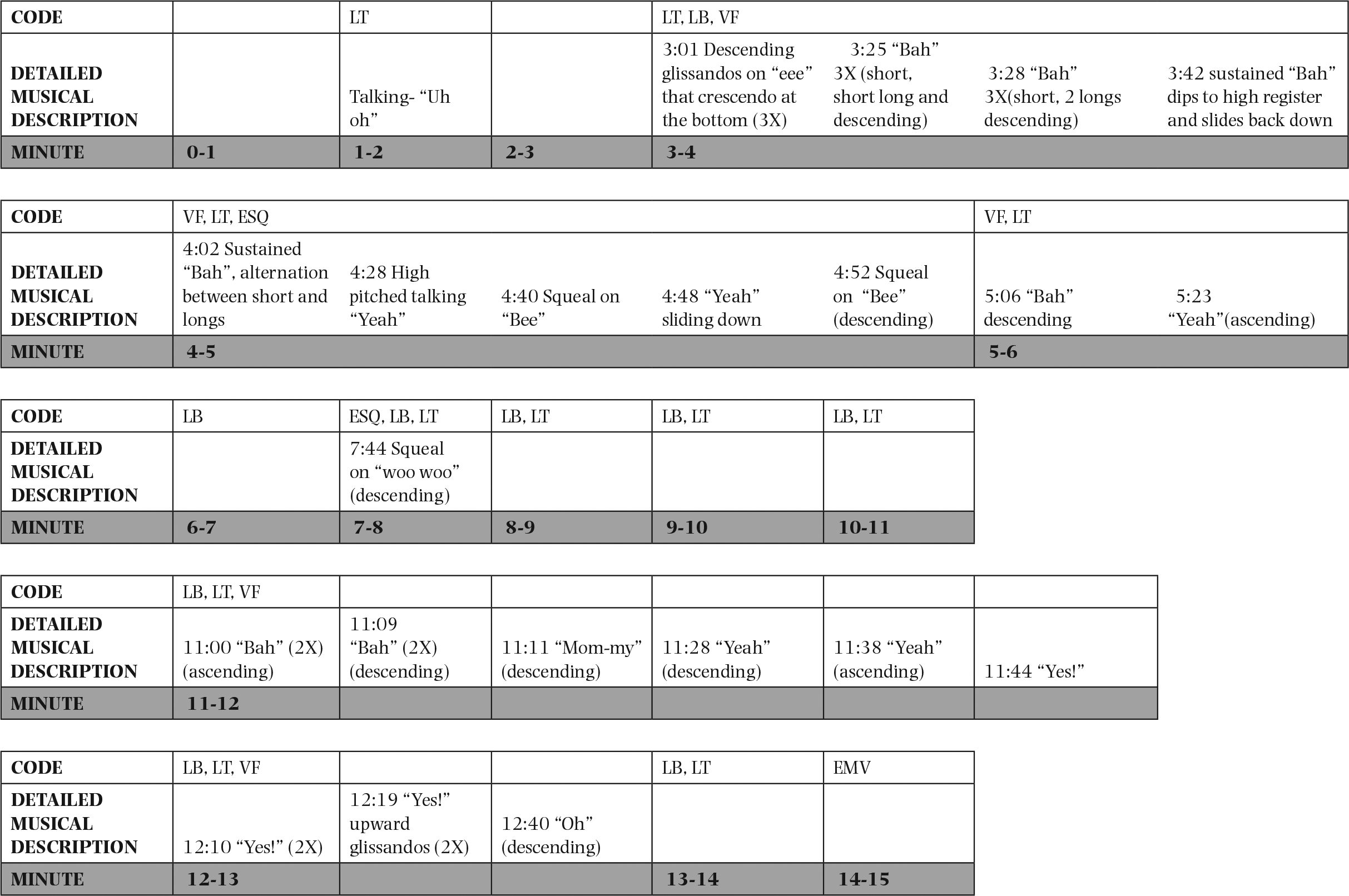
Description of Will’s ‘Bah song’.
Most of Will’s free-flowing vocalizations used consonant sounds like ‘bah.’ Linguistic research has shown that infants and toddlers experiment with consonant sounds using well-formed syllables (canonical babble) as a way to prepare them for word formation (Hulit & Howard, 1993). Will’s vocalizing is similar to what Bjørkvold (1992) described as improvised, wordless and jazz-like singing on open vowel sounds and short repeated syllables. It is also similar to what Sundin (1997) identifies in early singing as ‘vague, floating and can be compared to scribbles’ (p. 55). At 18 months, Will’s vocal exploration clearly fits into stage one of Welch’s (2006; Welch et al., 1998) model as he explores pitch and regularly utilizes descending pitch patterns.
Like Will, ‘Abigail’ (25 months) also experimented with her voice and freely vocalized without words. She often drifted between vocalizing and chanting as she talked. These chants were similar to what Moorehead and Pond (1941/1978) described as vocalizing that ‘takes on the rhythm of speech’ (p. 5). Her speech-like chants often utilized sounds like ‘boo’ or ‘ahh,’ featured glissando to the upper register of her voice and were always occurred in between talking. Abigail’s speech also had a very musical quality where words seemed pitched and groups of words moved up and down on ascending and descending pitches. Her speech was highly animated and seemed to narrate recent experiences, similar to ‘crib speech’ (Nelson, 1989) that was very musical. Moorehead and Pond (1941/1978) claimed that children make a fluid connection between musical and non-musical experience and that ‘speech becomes song or chant and again speech’ (p. 11). This movement from speech into singing happens in a fluid manner. Like Will, Abigail’s vocal explorations also fit into stage one.
Learned song for vocal practice
‘Hannah’ was 26 months old at the beginning of the study. Her parents reported that she had a repertoire of songs that they regularly sang together, like ‘Hark the Herald Angels Sing,’ ‘Angels We Have Heard on High,’ ‘Row, Row, Row Your Boat,’ ‘Hallelujah,’ and ‘Old MacDonald.’ In each observation, where Hannah vocalized, she sang lyrics to learned songs. In the fourth night of observation, Hannah sang a version of ‘Twinkle, Twinkle Little Star’ and then segued directly into the ‘ABC Song.’ Her version of ‘Twinkle’ was performed with remarkable rhythmic accuracy and an extremely steady pulse. She took great care to perform the song slowly, paying attention to each word. While her pitch was not accurate, the song was recognizable due to the lyrics and rhythms, which she sang with accuracy. After cheering for herself at the end of the song, Hannah again immediately segued into the ‘ABC Song,’ utilizing the same melody that she sang in ‘Twinkle, Twinkle.’ Again, she performed the next song with a steady pulse and rhythmic accuracy, stopping herself when she forgot a letter of the alphabet. Each time she began ‘ABC’ or ‘Twinkle, Twinkle’ she started on the pitch D4. Figure 5 shows a notation for Hannah’s vocalization to illustrate the overall form and structure of the episode.
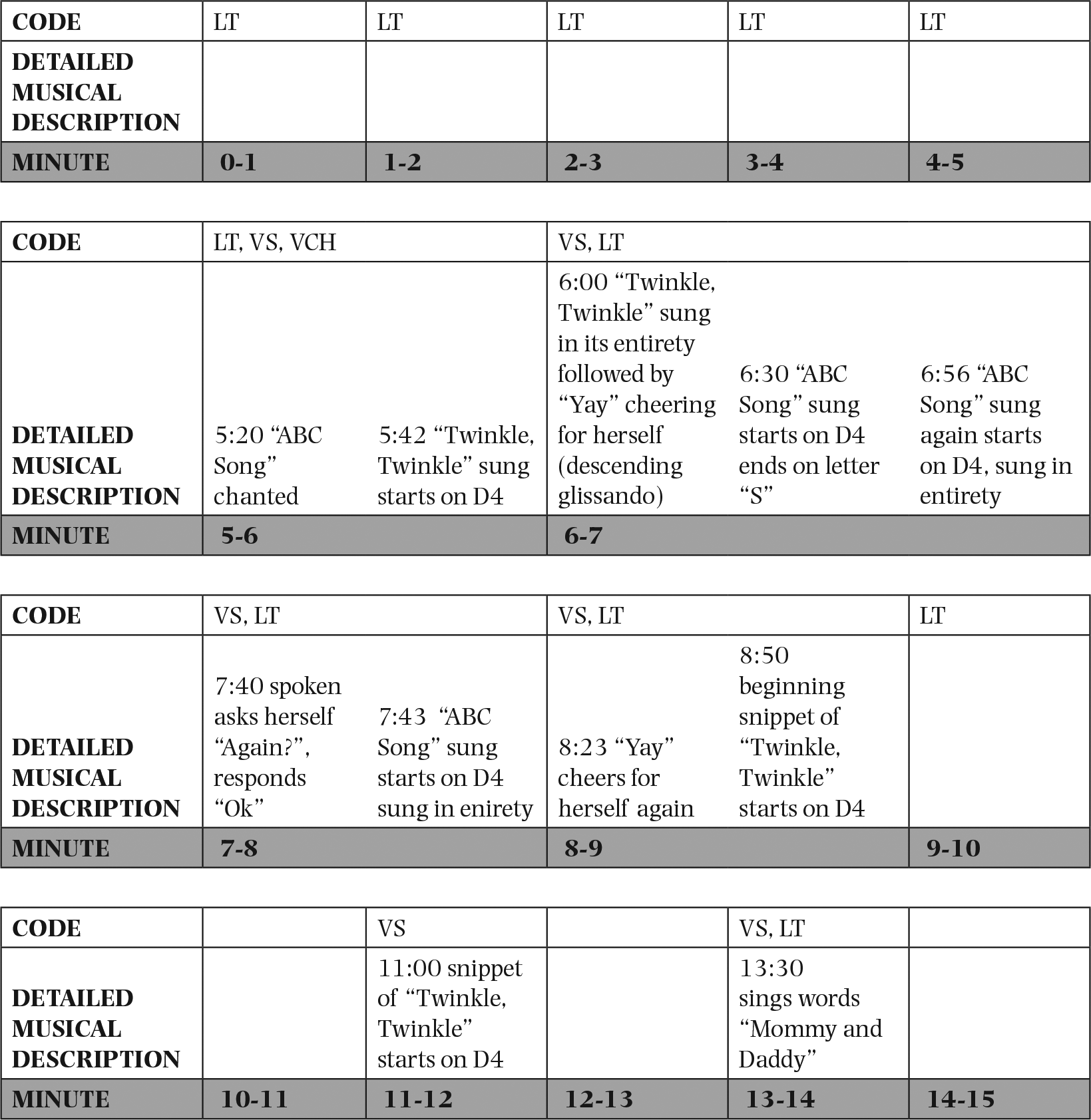
Description of Hannah’s singing.
At 2 years of age, Hannah possessed the ability to repeat lyrics to entire songs, perform with a notable sense of steady tempo and her rhythmic abilities superseded her ability to perform with accurate pitch. Whether she was singing ‘ABC’ or ‘Twinkle, Twinkle,’ the opening interval of a fifth was always correct. The interior pitches (particularly descending seconds) were sometimes incorrect, but the overall melodic contour was recognizable. Developmentally, this is consistent with findings by Moog (1976) who claims that children first sing melodic profiles, then intervals and then fill in with smaller intervals. It is also consistent with findings by Davidson (1985, 1994) who states that children develop the ability to sing thirds, fourths, and then fifths. Hannah’s singing fits into the second stage of Welch’s (2006, Welch et al., 1998) model where children begin to sing general contours of the target melody. It seems as if Hannah used her private moments before sleep as a space to practice her singing and experiment with her musical skills.
At the age of 36 months, ‘Kiko’ was significantly more linguistically advanced than Will, Abigail, and Hannah. Kiko spoke in full sentences in both English and Spanish and at many times engaged his parents in conversations through the thin wall that separated his bedroom from the living room. When Kiko did experiment with his voice, he did so with words and phrases. During one of the final observations, Kiko vocalized through tunes like ‘Thomas the Train Theme Song’ and ‘Row, Row, Row Your Boat’ using nonsense words and vowel-heavy sounds. This is very different compared to Will’s consonant-heavy vocalizations. As an older child, Kiko played with sound using single words, groups of words, and mixtures of consonant and vowel sounds.
Kiko also used learned songs as a tool for exploring sound. Custodero (2006) claimed that when learned songs are used spontaneously, they are ‘performed with unconventional characteristics’ (p. 53). Young (2002) expresses the same idea by claiming that for children, known songs are a ‘pliable tool or medium for finding their way in the world’ (p. 67) and that known songs can be played with, altered, and easily changed. In the fifth observation session, Kiko vocalized through a medley of familiar tunes including ‘Thomas the Train Theme Song,’ ‘Old McDonald,’ ‘Twinkle, Twinkle’ and ‘BINGO.’ He manipulated these known songs, singing them with very unusual characteristics. Instead of singing the lyrics to each song, Kiko vocalized using his fingers to play his lips as an instrument, resulting in a vibrating ‘brrr’ sound. All of the tunes were clearly recognizable and featured very accurate rhythms and pitches. In other observation sessions, Kiko vocalized through known tunes and replaced the lyrics with what his mother described as ‘nonsense words.’ Many of his vocalizations are reminiscent of what Kartomi (1991) and Campbell (2010) describe as ‘vocal doodling,’ a form of self-entertainment.
Moog (1976) claimed that 3- and 4-year-olds create ‘potpourri songs’ of some tunes they may know that usually feature nonsense texts where the ‘little singer is probably just singing any words which come into his mind’ (p. 44). It’s a beginning of an ability to ‘feel the sound of the words and that of the music as separate entities’ (p. 44). A number of Kiko’s private songs showed his musical ability to differentiate between text and melody. He also showed how pitch accuracy improves between the second and third year of life, especially in comparison to Hannah’s crib songs. Kiko’s bedtime vocalizations seem to fit into Welch’s (2006; Welch et al., 1998) stage three as he presents very accurate melodic shape and pitch.
For the toddlers who appeared to sing to explore their own voices (Will, Abigail, Hannah and Kiko), their solitary spontaneous singing confirms models of singing development (Welch, 2006; Welch et al., 1998). As the youngest child (18 months), Will’s babbling ‘Bah song’ moved across different registers and utilized numerous gestures with descending pitches. The oldest toddler, Kiko (36 months), showed great pitch accuracy as he played with learned songs to explore sound. The future study of private crib song may be able to provide us with even more information about how musical skills develop at different stages and ages, especially given that the privacy of the pre-sleep period lends itself to be a quiet practice space for some children.
Crib song and social/emotional development
For many of the toddlers in this study, their singing helped them to self-soothe and ease the transition from ‘together to alone.’ Young (2006) stated that there is a unique type of singing that occurs when a child’s body is still or relaxed. She states that this ‘free flow singing’ serves the purpose of helping the child to wind down and relax. A number of the toddlers in this study used their singing in this manner.
Singing to self-soothe
In addition to repeating and experimenting with learned songs as a way to practice musical skill, one toddler seemed to use known song to self-soothe. Bjørkvold (1992) claimed that children sing ‘preset songs’ for ‘emotional introspection or contextual related accompaniment’ (p. 132). ‘Margot’ (age 26 months) was observed in almost every session vocalizing through a repertoire of learned tunes. Each night, her mother put her in her crib with a bottle of water, which Margot used for comfort. With the bottle in her mouth, she moved from one tune to the next, changing songs as a new tune came into her head. Margot never sang any lyrics, but instead took small parts of the tune from each of these songs and used them like motives. Her repertoire included ‘Skip to My Lou,’ ‘Frère Jacques,’ ‘Alouette,’ ‘Itsy Bitsy Spider,’ ‘Twinkle, Twinkle,’ ‘If You’re Happy and You Know It,’ ‘Row, Row, Row Your Boat,’ ‘Mary Had a Little Lamb,’ ‘Jingle Bells,’ ‘All Through the Town,’ ‘Wheels on the Bus,’ ‘London Bridge,’ and ‘This Old Man.’ Sometimes, she played with the motives by speeding them up or slowing them down. Other times, she repeated a segment of a tune in different pitch registers. Her vocalizing was reminiscent of humming as her mouth was closed around her bottle. Her mother indicated that this must feel comforting for Margot as she could feel the vibrations of the sounds in her body as she seamlessly moved through her familiar repertoire. For Margot, floating from one tune to the next seemed to provide comfort and a way to relax and fall asleep.
Singing to reflect musical bonds
Moorehead and Pond (1941/1978) claimed that children’s solo private songs are often reflective in nature. The private, darkened and quiet environment seemed to become a space for private reflection for many of the toddlers. When they were alone, a number of the toddlers in the study sang songs that were reflective of musical interactions they had recently shared with their parents. This idea of sharing meaningful musical communication between parent and child is also known as communicative musicality (Malloch, 1999). M. S. Barrett (2006) adds to the definition of this by explaining that ‘musical elements are drawn upon to shape mutually supportive communicative and caring acts’ (p. 201). A number of episodes in this study highlight the children’s musical reflections of recent shared interactions with their parents.
‘Lorraine’ was 30 months old at the beginning of the study. Lorraine’s mother shared in a musical routine with her daughter every night at bedtime, a routine that they shared since Lorraine was an infant. Each night, Lorraine’s mom sang songs with her daughter as they rocked together in the rocking chair. The repertoire included traditional children’s songs and an original song that Lorraine’s mother created with the lyric, ‘Lorraine is my baby.’ On the fifth night of observation, Lorraine sang a song with the lyrics, ‘My Baby.’ The tune was improvised and the rhythm was free flowing. She repeats the motive ‘Lorraine is my baby’ over and over again for minutes 1 through 2 of the session. The singing segues into talking and whispering and the ‘My baby’ motive returns again in minute 5 to 6. Figure 6 illustrates a notation for the overall form and description of the episode.
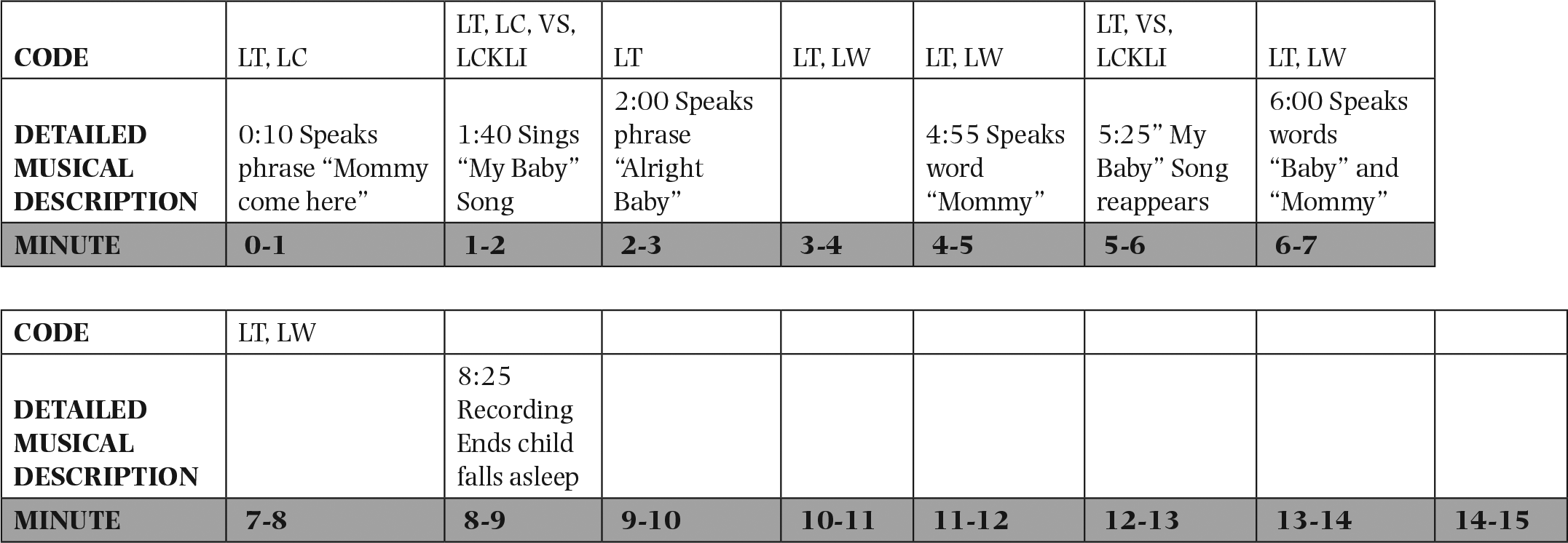
Form and description of Lorraine’s ‘My baby song’.
Lorraine’s mom immediately identified this song saying that she was certain that Lorraine was singing and rocking her baby doll. She reported, ‘I think she wants to sing to her babies like I sing to her.’ Lorraine’s mother said that she sings these exact words and tune with her daughter each night before bedtime as they sit together in a rocking chair. During the only episode where Lorraine sang privately, she did so in the same way that her mother sang with her demonstrating that these shared bedtime songs were very important to her. Lorraine imitates her mother as a way to bring her back into the room after she has left, thereby easing the transition of being alone. In the first minute, Lorraine speaks, asking her mother to come back into the room. When she does not, Lorraine begins to sing. Through her song, it seems as if she is still with her mother.
Kiko shared a complicated musical relationship with his mother. Often, Kiko would tell her ‘I do not like it when you sing.’ Kiko’s mom told me that during the time of the study, Kiko would often resist her singing and stop his own singing if she would join in with him. It was during this period that Kiko’s mother was preparing to sing a solo at their church, a song called ‘Jesus, Jesus.’ She was very concerned that Kiko would have a poor reaction in public to her solo. For days, she prepared him for the performance by singing the song with him, slowly getting Kiko used to the idea that she would sing at church. The night of the performance at church, Kiko was observed singing his own version of the song when he was alone in bed. After a bit of talking, Kiko said, ‘I didn’t want you to sing. But then I wanted you to sing. I was confused.’ Then, he continued to sing the ‘Jesus, Jesus’ tune and a few minutes later, sings it again. Figure 7 represents the form and structure of this episode. Through this private musical reflection, Kiko illustrates the complex range of emotions he felt surrounding this musical exchange with his mother.
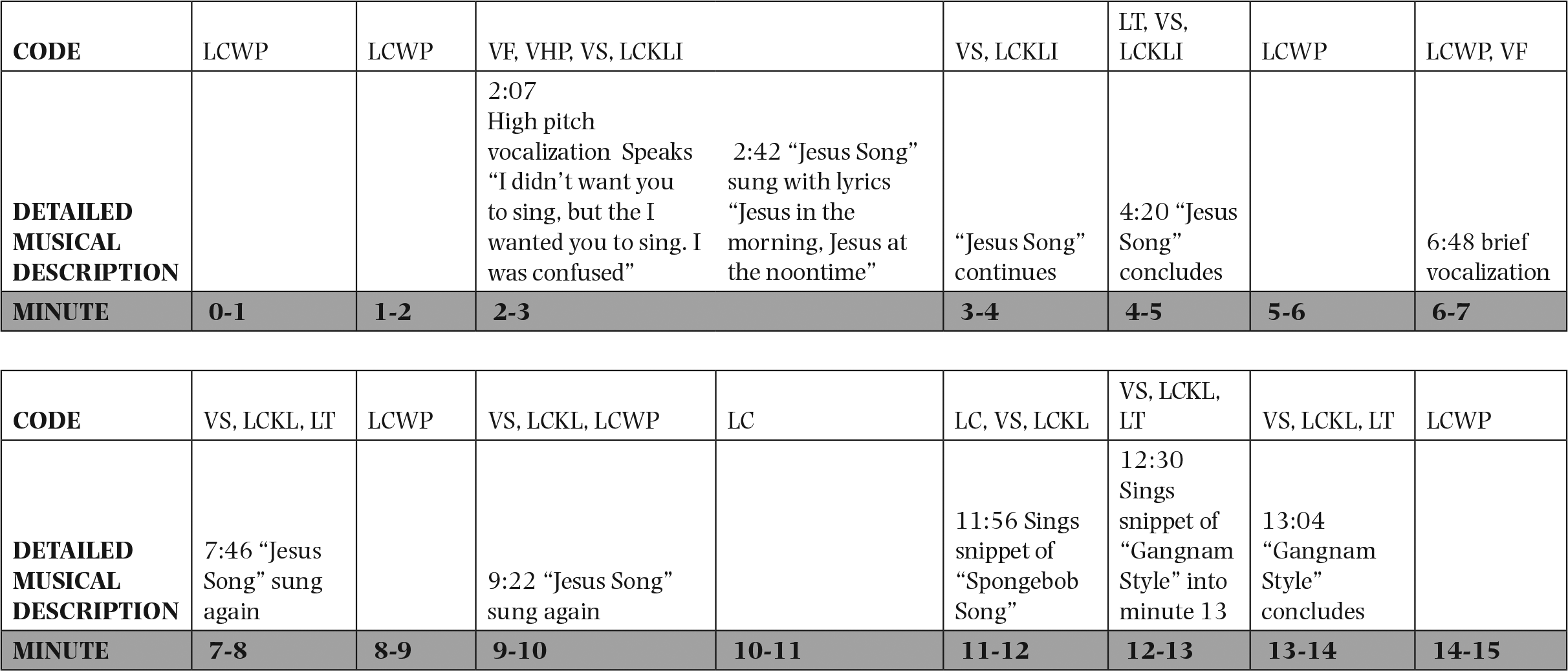
Form and description of Kiko’s ‘Church song’.
Singing to make sense of relationships and process transition
Some of the older toddlers in the study began to sing fully improvised songs at bedtime in addition to experimenting with known songs that they learned at home and at school. By creating both original lyrics and melody, they created songs that helped them to make sense of recent experiences. M. Barrett (2010) claimed that children’s spontaneous songs have a narrative function. It seems that a few toddlers in this study sang original songs as a way to describe and understand people, events and ideas that had impacted them. At bedtime, some toddlers struggle to separate from their parents and remain alone in their own rooms. For three of the toddlers, music appeared to ease this transition from being together to being alone.
Abigail sang a number of what her mother called ‘songs of her own design.’ During the first session, she created a song with the lyrics ‘It’s bedtime now.’ She was obviously trying to make sense of the recent experience of being put in her crib. ‘Robyn,’ a 31-month-old twin who shared her bedroom with her brother was frequently recorded creating fully improvised songs about her parents. During one observation, she sang a song with the lyrics ‘Daddy, Daddy.’ Her mom reflected, ‘She loves her daddy. He left the room and said goodnight before she started singing this.’ Robyn created this song as a way to ‘meet the needs of the moment.’ She was thinking about her father and used a song to make sense of their recent interaction. A minute after she sang this song about her father, Robyn sang another song on the lyrics, ‘Mommy, Mommy.’ Her mother indicated that, ‘Mom is the last person to leave the room.’ Again, Robyn used song as a way to think about and process people and events that were significant to her.
The ‘Mommy song’ utilizes one lyric, ‘Mommy,’ and one rhythmic motive of two dotted eighth notes each followed by a 16th and then two quarter-notes (Figure 8). This motive is similar to what Bjørkvold (1992) describes as a communicative motive that is present in many cultures during childhood. Robyn creates and uses a musical motive to represent her mother through the song. This motive has similar characteristics to what Bjørkvold (1992) illustrates as a ‘provocative and narrative’ motive of childhood culture (p. 128).
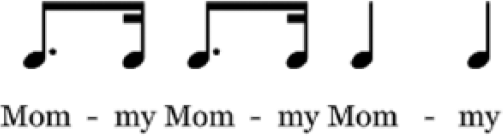
‘Mommy song’ rhythmic motive.
The song can be divided into distinct sections: an introduction, a development with a climax and a resolution. Bjørkvold (1992) asserts that children’s spontaneous song forms do not happen ‘by chance’ (p. 126), but are governed by ‘the rules and intersubjective standards of childhood culture itself, with its own children as the virtuoso experts’ (p. 126). Figure 9 shows the main features of each section of the song. Figure 10 shows the pitch plots of each 3 sections as well as the pitch contour. To analyze a musical conversation between infant and mother, Malloch and Trevarthen (2009) utilize pitch plots and spectrograph analysis to illustrate the pulse, quality and narrative of the musical dialogue. Their analysis shows the communicative musicality in the reciprocal exchange as it is divided into the musical form of introduction, development, climax and resolution. Robyn’s improvised song about her mother can also be analyzed in this ‘poetic form of protoconversation’ (p. 4) by examining the musical features that stand out within this structure of introduction, development, climax and resolution. In the introduction, Robyn conceives and finalizes the ‘mommy motive.’ In the development section she plays with the motive, making it descend lower and lower, crescendo-ing until it lands on the low b-flat. The pitch contour chart in Figure 10 clearly shows this active descent. The final section resolves the song as we hear the ‘mommy motive’ morph into the word ‘mum’ and conclude on the b-flat. Again, the pitch contour chart in Figure 10 shows the slowing down of activity and resolution back to the b-flat.
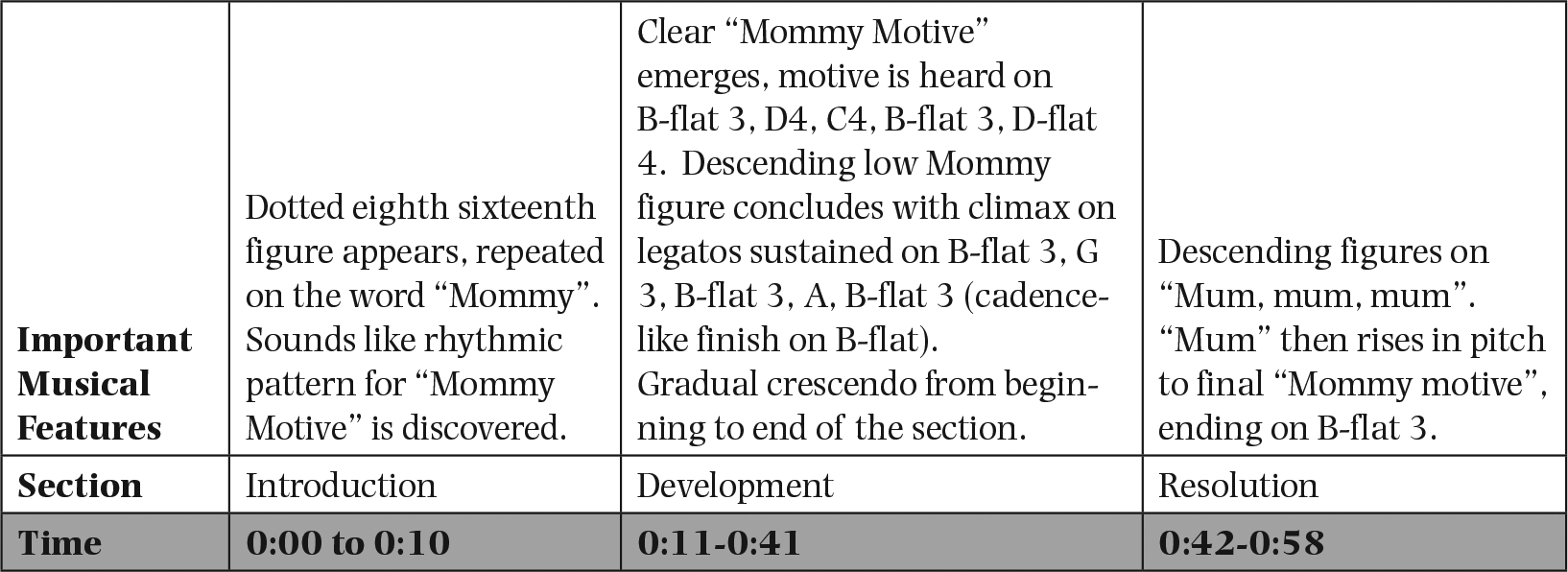
Form and description of Lorraine’s ‘Mommy Song’.
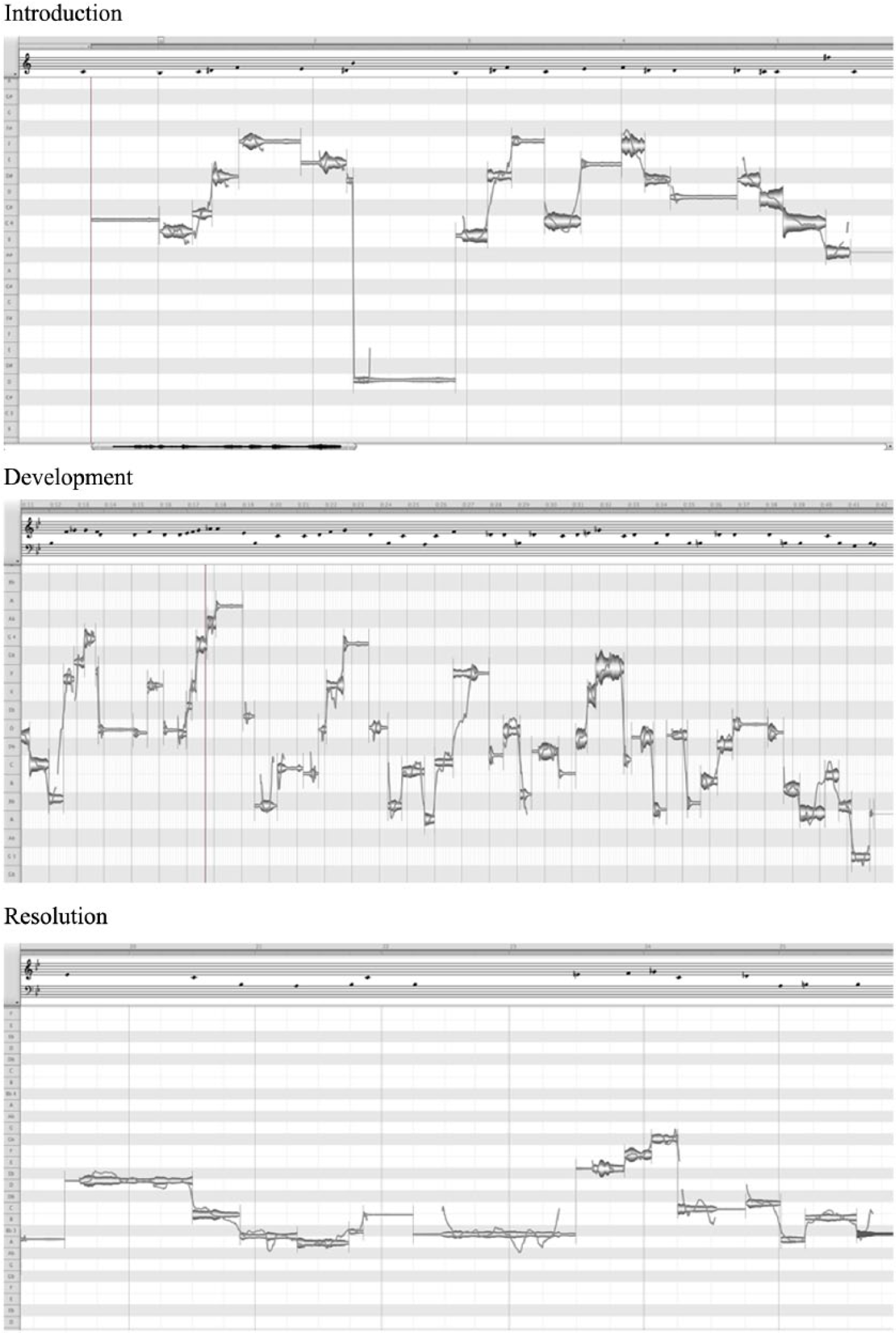
Pitch plots and pitch contours of the ‘Mommy song’.
Robyn mirrors the meaningful relationship she shares with her mother through the song that she creates. She brings her mother into the song and back into her room through her singing. In a study of crib speech, Stern (1989) claims that the anxiety a child feels about bedtime separation from her parents often triggers monologues that serve to ‘… hold onto the parent in some meaningful manner’ and allow the child to fall asleep without being ‘fully alone’ (p. 312). In Robyn’s case, it seems that her songs also function in this manner as she creates a presence for her mother even though she has physically left the room.
Conclusions
The findings of this study support the theory of Trevarthen and Malloch (2002), who highlight the innate musicality of children and importance of music in everyday life. Dissanayake (2000) suggests that music is who we are from the beginning. From pregnancy through birth and early infancy, babies are predisposed to use music as a tool for communication, soothing, and bonding with their parents. For children between infancy and the more verbal preschool years, music is also an essential part of human development. Custodero (2002) states that infants and toddlers seek out music because it ‘motivates them to participate physically, emotionally, and cognitively. Musical expression provides young children with a personally rewarding resource, as accessible as the imaginative worlds they construct’ (p. 4). The nine toddlers in this study seem to seek out music and use it as a rewarding resource, a tool to support their musical and social/emotional development.
Children sing throughout the day and use music to entertain themselves, self-regulate, communicate and express themselves. The toddlers in this study showed that even in the quiet and private moments before sleep, this singing is still present. The research on crib speech (Kuczaj, 1983; Nelson, 1989; Weir, 1962) showed that toddlers use this pre-sleep period to practice language, process experiences, and develop a narrative self. Within this crib speech, the singing becomes a powerful tool. Young (2006) claimed that ‘learning to make words sing is to imbue language with meaning and expression, to animate the words and give them emotive and motive power’ (p. 274). Toddlers speak at bedtime as a way to learn and process, but they sing to infuse their experiences with emotion. When we listen to the songs they choose to sing, we learn what is important to them.
For many toddlers, this short period at bedtime is the only time during the day that they are free from direct interactions with their parents, teachers and siblings. Through participation in the study, many of the parents became aware that these private, solitary bedtime moments were a valuable and important time for their children. After five observation sessions in which Will played with an electronic doll, his parents chose to remove it to give him the private space to express himself and explore his own voice. Observation of their child’s crib songs altered these perceptions and enabled them to acknowledge the important role that music played for their child. These parents reported altering daily practices to share more music with their toddlers. The results of this study may have implications for parenting as focused listening may increase parental awareness of the importance of music for children as well as a need for a private space in which to use it.
Limitations of this study include the small sample size. This study was limited to families on the east coast of the United States and is not representative of diverse musical cultures, particularly those in which bedtime rituals and sleeping practices vary greatly. It would be worthwhile to complete further investigations into this topic to learn more about how private spontaneous singing serves this age group in different cultures and geographic locations.
Additional implications of this study show that supporting musical behaviors and singing together are essential in childhood development. The songs that parents share with their children throughout the day come back to them at night, reflected in the spontaneous vocalizations of the toddlers who sing them. In infancy, the theory of communicative musicality shows that music serves to bond parent and child. Through their musical reflections, the children in this study illustrate that this musical bonding is still a strong force in toddlerhood. Young (2006) maintained that the study of children’s expressive singing allows us to foster and encourage the social and emotional dimensions of their lives. Further study of musical reflections like the ones described above may teach us more about the importance of musical communications in toddlerhood and how to support and nurture musical communications between parents and children. Singing together and providing a private space for practice and reflection may allow toddlers to learn how to use music and become the driving force in their own development.
Footnotes
Acknowledgements
The author wishes to thank Dr. Lori Custodero and Dr. Claudia Calì for their support and dedication to this research project.
Funding
The author(s) received no financial support for the research, authorship, and/or publication of this article.