



Abstract
This research aimed to consider whether there were gender differences in the amount of practice undertaken by boys and girls, the practice strategies adopted and motivation to practise. A sample of 2027 girls and 1225 boys aged 6–19 years, ranging in level of expertise from beginner through to conservatory entrance level, playing instruments representative of the classical and popular instruments played in the UK completed a self-report Likert scale questionnaire. There were no statistically significant gender differences in weekly practice time or motivation to practise. Factor analysis of statements relating to practice revealed seven factors. There were statistically significant gender differences in relation to the adoption of systematic practice strategies (girls were more systematic), concentration (boys perceived they had higher levels of concentration) and immediate correction of errors (girls reported more immediate correction). There were no statistically significant gender differences in relation to the organisation of practice, the use of recordings and a metronome, the use of analytic strategies, and the adoption of ineffective practice strategies although for this factor there was a statistically significant interaction between gender and level of expertise.
This article presents a reanalysis of a factor analytic study which addressed issues relating to changes in individual practice in young people as they developed instrumental expertise (Hallam et al., 2012). The current paper reanalyses the data to enable comparisons to be made of the practising strategies adopted by boys and girls. The earlier paper was based on data from 3,325 children ranging in level of expertise from beginner through to Grade 8 level (the minimum required for conservatory entrance in the UK). Participants completed a questionnaire which consisted of a number of statements relating to practising strategies, organization of practice, concentration and attitudes towards practising, using a 7-point Likert rating scale. Data were analyzed in relation to nine levels of expertise. Factor analysis revealed seven factors relating to practice itself: the adoption of systematic practice strategies; the organization of practice; the use of recordings for listening and feedback and use of the metronome; the use of analytic strategies; the adoption of ineffective strategies; concentration; and the immediate correction of errors. There were statistically significant linear relationships between grade level and the adoption of systematic practice strategies; use of recordings for listening and feedback and use of the metronome; the adoption of ineffective strategies; and immediate correction of errors but not for organization of practice; use of analytic strategies; and concentration. The data on attitudes towards practice showed that students enjoyed practice less the more advanced they became. The research reported here extends that research exploring gender differences in approaches to practising.
There is a long history of research on practice. Two main strands have emerged, one focusing on the amount of time spent practising, the other on the quality of practice. This research has demonstrated the key role of accumulated practice in determining the level of musical expertise attained, although there are substantial individual differences (e.g., Ericsson, Krampe, & Tesch-Romer, 1993; Hallam, 1998; Hallam et al., 2012; Jørgensen, 2002; Platz, Kopiez, Lehmann, & Wolf, 2014; Sloboda, Davidson, Howe, & Moore, 1996) and the importance of the quality of practice with strategy use changing as expertise develops (e.g., Chaffin, Imreh, Lemieux, & Chen, 2003; Duke, Simmons, & Cash, 2009; Gruson, 1988; Hallam, 1997; Hallam et al., 2012; McPherson & Renwick, 2001). Research on the quality of practice has considered the strategies adopted, the organisation of practice, concentration, self-regulation, meta-cognition and the development of aural schemata. For full reviews of the research on practice, see Hallam et al. (2012) and Jørgensen and Hallam (2016). Surprisingly, no research to date has focused on the ways in which boys and girls may differ in their approach to individual instrumental practice. This article addresses that issue.
Research on gender differences in music education
Boys are underrepresented in those learning to play an instrument (see, for instance, ABRSM, 1994; Green, 1997; Hanley, 1998). Girls also tend to perform better in school music examinations (JCQ, 2014; Keiper, Sandene, Persky, & Kuang, 2009) despite there being no consistent gender differences in measured musical ability (Gordon, 1986), or teachers’ ratings of musical ability (Hallam, 2004). Music tends to be regarded as a feminine subject (Green, 1997; Hargreaves, Comber, & Colley, 1995), although boys playing instruments tend to report higher levels of enjoyment of music than girls (Hallam, 2013). Boys tend to demonstrate more interest in music when it is linked to technology and report more positive attitudes towards and confidence in using music technology than girls (Comber, Hargreaves, & Colley, 1993; Green, 1997; Hanley, 1998). Research on school music suggests that girls value music more than boys and perceive that they have higher competence levels (McPherson & O’Neill, 2010), although, overall, findings on gender differences in musical self-efficacy are mixed depending on the context (Hendricks, 2014; Nielsen, 2004; Ritchie & Williamon, 2011a, 2011b; Wehr-Flowers, 2006; Welch et al., 2008). There are also gender differences in attributions of success with female students generally rating statements related to effort higher than males (Schatt, 2011).
There continue to be differences in the instruments that are played by boys and girls with girls tending to play the smaller higher pitched instruments (Abeles, 2009; Abeles & Porter, 1978; Cramer, Million, & Perreault, 2002; Hallam, Rogers, & Creech, 2008; Harrison, 2000; Killian & Satrom, 2011; Sheldon & Price, 2005; Wych, 2012), although girls tend to select a wider variety of instruments which they would like to play along the feminine–masculine continuum than boys, particularly at primary school (Zervoudakes & Tanur, 1994). This stereotyping extends to world music instruments (Kelly & Van Weelden, 2014) and is evident in very young children (Marshall & Shibazaki, 2012). However, for less gender-stereotyped instruments the musical style and the performance context play a part. Instrument choice to some extent is linked to genre with girls being under-represented in some popular music areas (Baker & Cohen, 2008).
There are some identified differences in the ways that boys and girls approach musical tasks. When composing in groups boys tend to combine musical gestures and non-verbal communication while girls separate these (Abramo, 2011). In music lessons girls tend to adopt a more compliant style with the boys adopting a more serious style (Zhukov, 2007), while male teachers adopt a more analytic approach, females more balanced. The lessons of female students tend to focus more on expression, those of males on structure (Zhukov, 2008). In higher education male students have been found to adopt higher levels of critical thinking (Nielsen, 2004), while female students tend to appreciate the benefits of attending master classes valuing the opportunity to hear others and their interpretations (Long, Hallam, Creech, Gaunt, & Robertson, 2012). Girls are also more influenced in their attitudes towards practice by their teachers and parents whereas boys are more influenced by their friends (Hallam, 2004), although there is some evidence that boys playing classical instruments perceive greater parental support than girls (Hallam, 2013). Despite this body of research on gender differences we know little about the ways in which boys and girls may differ in their approach to individual instrumental practice. The research reported here aims to address that issue comparing the nature and amount of practice undertaken by boys and girls and whether there are any interactions with level of expertise.
The specific research questions were:
Are there gender differences in the frequency and amount of practice?
Are there gender differences in practising strategies, levels of concentration and the organisation of practice?
Are there gender differences in attitudes towards practising?
If there are gender differences in the above do they interact with level of expertise?
Method
Participants
A total of 3,325 children ranging in level of expertise from beginner through to Grade 8 level (minimum required for conservatory entrance in the UK) completed questionnaires. The age range was from 6 to 19 years. The instruments that they played were representative of the classical and popular instruments played in the UK (for further details see Hallam et al., 2012). The sample consisted of 2027 (61%) girls and 1225 (37%) boys; a total for the reanalysis of 3,252 as some students did not indicate their gender. The male participants were on average slightly older with a mean age of 13.3 years (SD = 2.8) while the average female age was 12.9 years (SD = 2.8). These differences were statistically significant, F(1, 3211) = 17.74, p = .0001. There were also differences in the number of months of learning, with the boys on average having been learning a little longer (M = 60.8, SD = 37. 2) than the girls (M = 58.23, SD = 37.7). These differences were not statistically significant. There were no statistically significant gender differences in relation to the average most recent grade examination taken (boys M = 4.0, girls M = 3.9) or the pass level at which the last grade was attained (boys M = 1.59, girls M = 1.62).
Materials
A self-report questionnaire was used as a means of collecting data. The students were asked to indicate their gender in terms of male/female. While acknowledging the multiple forms that gender can take, it was decided that the addition of further choices might be confusing for the younger participants. The questionnaire was identical to that used in the earlier study (Hallam et al., 2012) and sought information about the level of expertise attained as assessed by the highest examination grade achieved in graded independent instrumental examinations from preliminary to Grade 8. Respondents were also asked to indicate the number and length of practice sessions in a typical week and respond on a 7-point Likert scale (7 indicating the strongest agreement) to a series of statements relating to: the practising strategies adopted; the organization and management of practice; and motivation to practise. Cronbach’s alpha for the questionnaire items included in the analysis was .78. The full questionnaire is included in the Appendix (see Supplementary Material Online) and indicates which statements relate to each element of the analysis.
Procedure
The research was designed taking account of the ethical guidelines of the British Psychological Society and the British Educational Research Association and was approved by the ethics committee of the Institute of Education, University of London. Details of the procedures adopted can be found in Hallam et al. (2012).
Results
Gender differences in the frequency and amount of practice
The boys reported practising slightly more days each week than the girls (boys M = 4.7; girls M = 4.5 days). This difference was statistically significant, t(3219) = 2.26, p = .025. The boys also reported practising for slightly longer on each day (boys M = 43 minutes; girls M = 41 minutes). This difference was not statistically significant. Combining these two data sources led to the boys on average reporting 230 minutes of weekly practice as opposed to 209 minutes for the girls. This difference was not statistically significant. There was also no significant interaction between gender and level of expertise although there were statistically significant differences in the amount of weekly practice by level of expertise, F(8, 2795) = 48.52, p = .0001, ηp2 =.123 (see Figure 1).
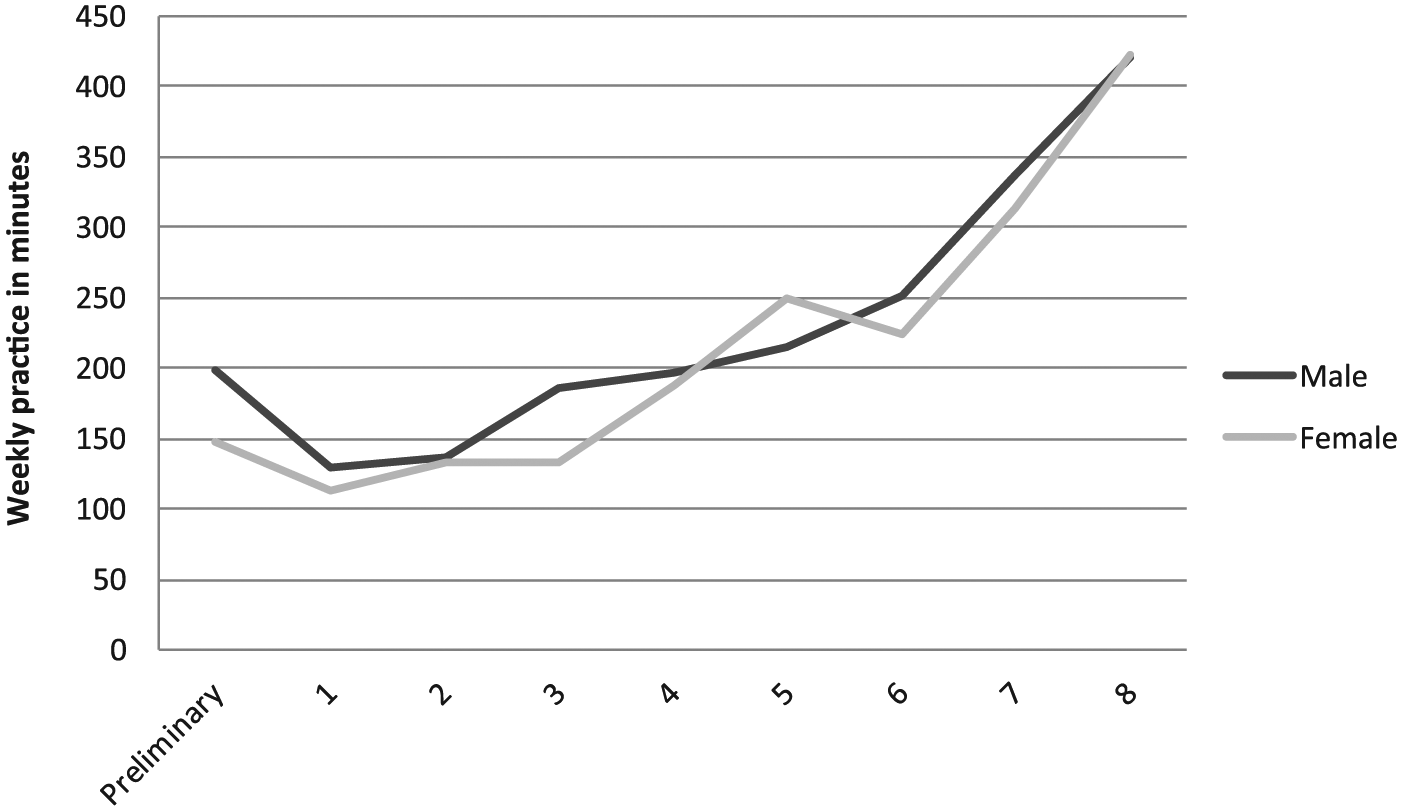
Average weekly practice in minutes by gender and level of expertise.
Are there gender differences in practising strategies, levels of concentration and the organisation of practice? Do any gender differences interact with level of expertise?
To explore the relationships between the practice variables, factor analysis was undertaken. A principal components analysis was undertaken as it provides an empirical analysis of the data set (Tabachnick & Fidell, 2001), followed by a varimax rotation (Green, Salkind, & Akey, 2000; Tabachnick & Fidell, 2001). Eigenvalues were retained if they were greater than 1 and the scree plot was used to support the identification of the number of factors. A Kaiser-Meyer-Olkin (KMO) test and an anti-matrix of covariances and correlations were used to check sampling adequacy. The latter showed that all elements on the diagonal of these matrices were greater than -.5, the necessary requirement. The KMO was 0.86, greater than the 0.5 required to assess the adequacy of the sample (Field, 2000). Following these procedures a seven factor solution was deemed to be the most appropriate. Full details of the factor analysis are provided in Hallam et al. (2012). Multivariate analysis of variance taking account of gender and level of expertise in relation to the factors showed highly significant outcomes for gender, F(7, 2421) = 7.85, p = .0001, ηp2 = .021, for level of expertise, F(56, 16989) = 14.5, p = .0001, ηp2 = .052, and for the interaction between gender and level of expertise, F(56, 16989) = 1.53, p = .007, ηp2 = .005. Post hoc analysis focused on linear trends relating to the development of expertise rather than differences occurring at specific levels of expertise.
Factor 1: Adoption of systematic practice strategies
Factor 1 had an eigenvalue of 2.9, accounting for 10.7% of the variance. This factor had high weightings for practising sections slowly when having made a mistake (.737); practising difficult sections over and over again (.68); slow practice (.649); gradually speeding up when learning fast passages (.585); recognising errors (.558); marking things on the part (.308); and practising small sections (.404). There was a significant effect of level of expertise on Factor 1, F(4, 2492) = 4.09, p = .0001, ηp2 = .011, with a statistically significant linear trend, F(1, 2492) = 6.79, p = .01 (see Figure 2), indicating that as the level of expertise increased the adoption of systematic practice strategies increased. There was a statistically significant gender difference in relation to the use of systematic practice strategies, F(1, 3045) = 23.28, p = .0001, ηp2 = .01. The girls were more likely to adopt systematic practice strategies (M = .069) as opposed to the boys (M = -.069). The negative score for the boys on this factor reflects the fact that the mean for each factor is 0. There was no statistically significant interaction between gender and level of expertise (see Figure 2). A multivariate analysis of variance on the statements which had high weightings on Factor 1 as outlined above was highly significant, F(8, 3050) = 16.14, p = .0001. The items within that analysis which indicated statistically significant gender differences related to the statements “I practice things slowly”, F(1, 3050) = 13.8. p = .0001, ηp2 = .005 (boys M = 4.76, SD = 1.4; girls M = 4.95, SD = 1.3); “When I make a mistake I practice the section where I went wrong slowly”, F(1, 3050) = 36.7, p = .0001, ηp2 = .001 (boys M = 5.31, SD = 1.3, girls M = 5.6, SD = 1.2 ); “When something is difficult I play it over and over again”, F(1, 3050) = 8.87, p = .003, ηp2 = .003 (boys M = 5.47, SD = 1.2, girls M = 5.6, SD = 1.2); “I learn by playing slowly to start with and then gradually speed up”, F(1, 3050) = 78.4, p = .0001, ηp2 = .012 (boys M = 4 .76, SD = 1.5, girls M = 5.11, SD = 1.4); and “When I am practising I mark things on the part to help me”, F(1, 3050) = 71.19, p = .0001, ηp2 = .023 (boys M = 4.33, SD = 1.7, girls M = 4.87, SD = 1.6).
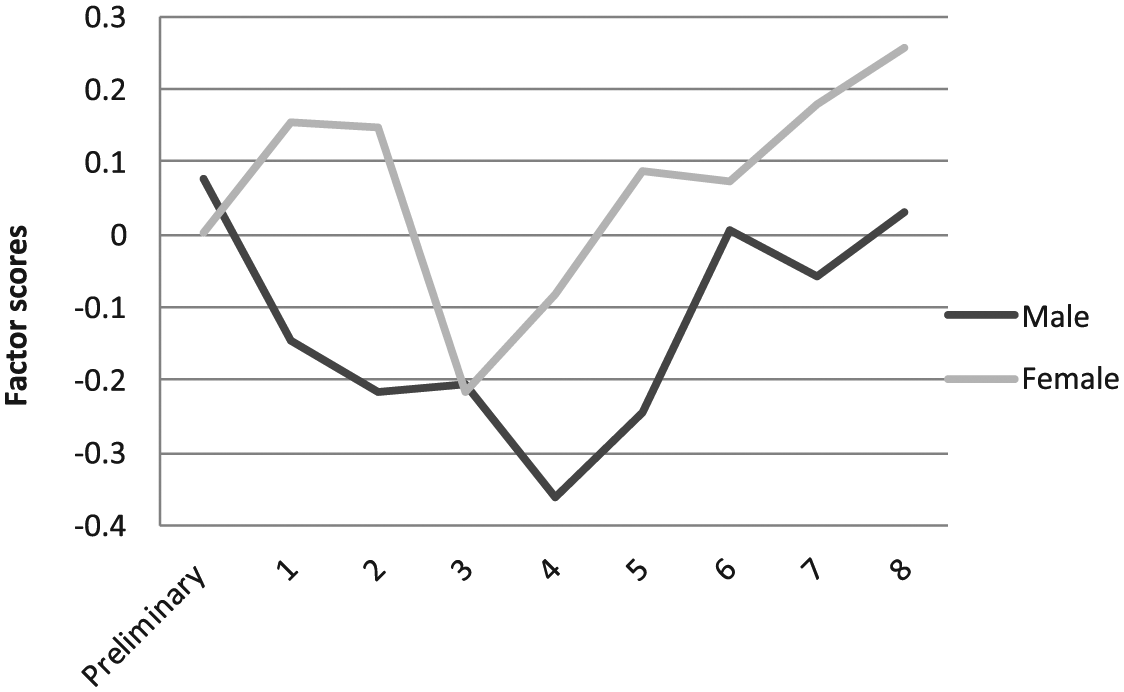
Mean of adoption of systematic practice strategies by gender and level of expertise.
Factor 2: Organisation of practice
Factor 2 had an eigenvalue of 2.073 accounting for 7.7% of the variance. This factor related to the organisation of practice including starting practice with scales (.734); making a list of what had to be practised (.621); starting with warm up exercises (.546); starting with studies (.444); setting targets to achieve in each practice session (.381); and marking things on the part (.302). There was a significant effect of level of expertise on Factor 2, F(8, 2492) = 4.92, p = .0001, ηp2 = .016, but no statistically significant linear trend indicating that as level of expertise increased there was no systematic increase in the organisation of practice. At the factor level there was no statistically significant gender difference and no interaction between gender and level of expertise (see Figure 3), although a multivariate analysis of variance of the five statements with high weightings on the factor was statistically significant, F(5, 3137) = 18.7, p = .0001. The analysis of individual items within the multivariate analysis showed statistically significant differences in relation to the setting of targets, F(1, 3137) = 5.03, p = .-25, ηp2 = .002 (boys M = 3.99, SD = 1.6, girls M = 4.14, SD = 1.5); making a list of what had to be practised, F(1, 3137) = 28.87, p = 002, ηp2= .003 (boys M = 3.33, SD = 1.7, girls M = 3.53, SD =1.7); doing warm up exercises, F(1, 3137) = 4.23, p = .039, ηp2= .001 (boys M = 4.77, SD = 1.8, girls M = 4.63, SD = 1.7); starting practice with scales, F(1, 3137) = 13.13, p = .039, ηp2 = .001 (boys M = 3.99, SD = 1.8, girls M = 4.12, SD = 1.7); and marking things on the part, F(1, 3137) = 71.5, p = 0001, ηp2 = .022 (boys M = 4.37, SD = 1.7, girls M = 4.89, SD = 1.6).
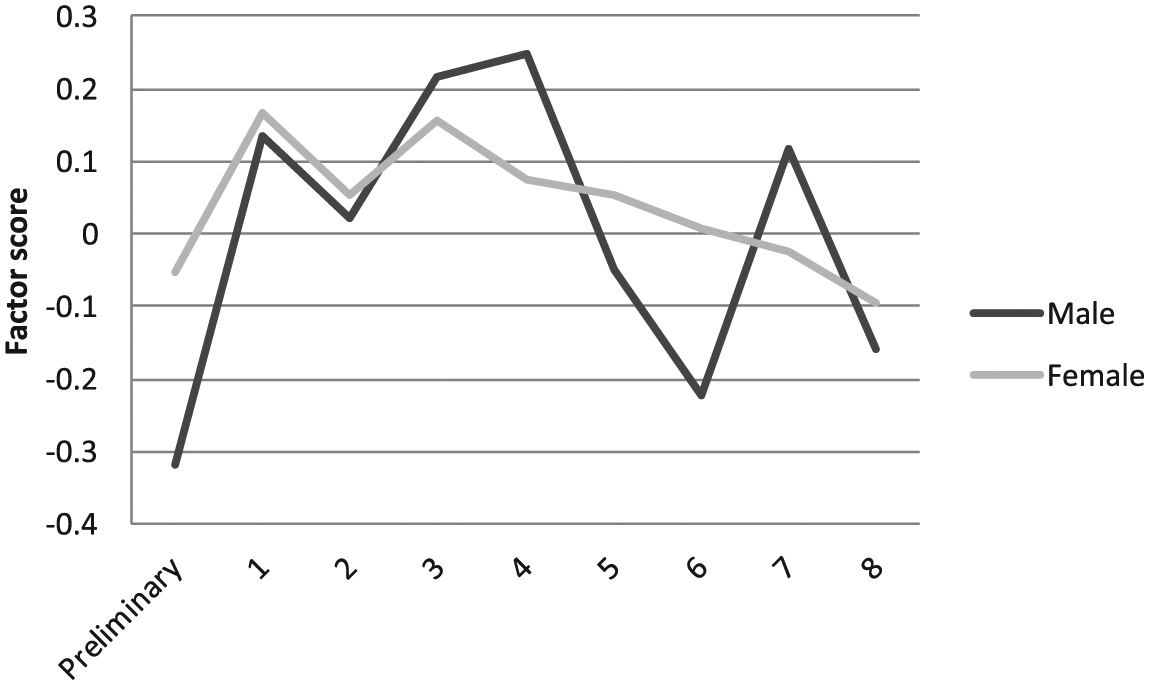
Mean of organisation of practice by gender and level of expertise.
Factor 3: Use of recordings for listening and feedback and use of metronome
Factor 3 had an eigenvalue of 2.048 accounting for 7.6% of the variance. It had high weightings for recording self-playing and listening to the recording (.738); listening to other recordings of the piece to be learnt (.671); and practising with the metronome (.639). There was a significant effect of level of expertise on Factor 3, F(8, 2492) = 29.48, p = .0001, ηp2 = .086, and a highly statistically significant linear trend, F(1, 2492) = 184.5, p < .0001 (see Figure 4). There were no statistically significant gender differences or interactions between gender and level of expertise (see Figure 4). Mulitvariate analysis of variance of the items with high loadings on the factor confirmed this.
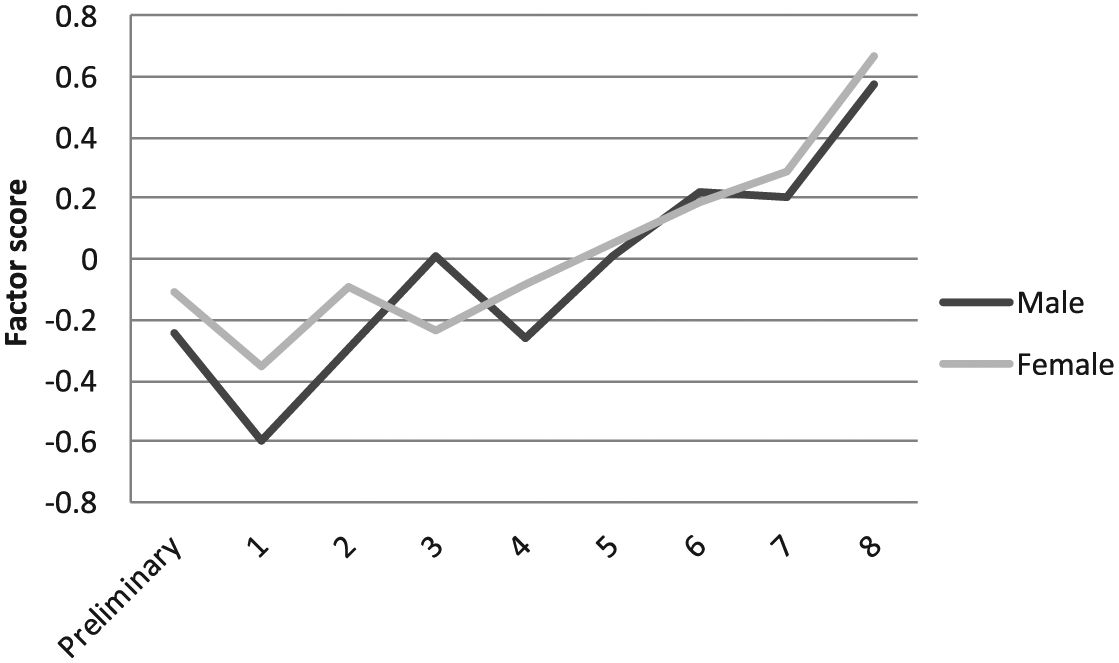
Mean of use of recordings and a metronome by level of expertise.
Factor 4: Use of analytic strategies
Factor 4 had an eigenvalue of 1.98 accounting for 7.3% of the variance. The factor had high weightings for: trying to find out what a piece sounds like before trying to play it (.759); getting an overall idea of a piece before practising it (.663); identifying difficult sections (.516); analysing the structure of a piece before playing it (.427); thinking about interpretation (.324); and working things out just by looking at the music and not playing (.318). There was a significant effect of level of expertise on Factor 4, F(8, 2492) = 3.249, p = .001, ηp2 = .01, but no statistically significant linear trend, no statistically significant gender differences or interactions between gender and level of expertise (see Figure 5). Multivariate analysis of variance confirmed this.

Mean of use of analytic strategies by gender and level of expertise.
Factor 5: Adoption of ineffective practising strategies
Factor 5 had an eigenvalue of 1.87 accounting for 6.9% of the variance. There were high loadings on only playing pieces from beginning to end without stopping when practising (.7); and going back to the beginning and starting again when making a mistake (.644). There was a smaller loading on working things out just by looking at the music and not playing (.451). This latter might be conceptualised as a useful strategy, for instance, in terms of mental rehearsal. However, in previous research (Hallam, 2001b) it was consistently adopted by beginners who also tended to repeat the whole piece with no identification of difficult passages, returning to the beginning of a piece when a mistake was made. For this reason the factor was conceptualised as referring to ineffective practising strategies. This is supported by the negative loadings on identifying difficult sections (-.222); thinking about interpretation (-266); marking things on the part (-302); and practising small sections (-.403). There was a significant effect of expertise on Factor 5, F(8, 2492) = 75.72, p = .0001, ηp2 = .196, and a highly statistically significant linear trend, F(1, 2492) = 462.3, p = .0001. Although there were no statistically significant gender differences in relation to the factor itself there was a statistically significant interaction between gender and level of expertise, F(1, 8) = 2.39, p = .015 (see Figure 6). A multivariate analysis of the items within the factor elucidated this, F(3, 3149) = 7.46, p = .001. Within the multivariate analysis there was a statistically significant gender difference in relation to the statement “When I make a mistake I go back to the beginning of the piece and start again”, F(1, 3149) = 17.7, p = .001, ηp2 = .006 (boys M = 3.36, SD = 1.7, girls M = 3.57, SD =1.6).
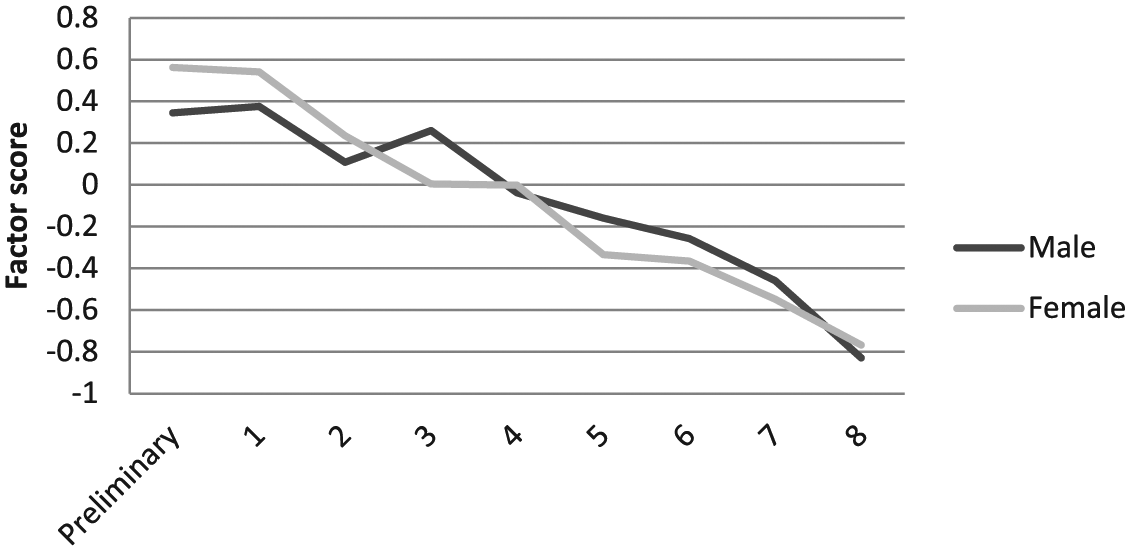
Mean of use of ineffective practising strategies by gender and level of expertise.
Factor 6: Concentration
Factor 6 had an eigenvalue of 1.48 accounting for 5.5% of the variance. The factor had high weightings on finding it easy to concentrate (.699) and negatively on being easily distracted when practising (-.773). There was a significant effect of level of expertise on Factor 6, F(8, 2492) = 3.218, p =.001, ηp2 = .01, but no significant linear trend. There was a statistically significant gender difference in perceived concentration with the males perceiving that they concentrated better (boys M = .095, girls M = -.051), F(1, 8) = 9.059. p = .003, ηp2 = .004, but no statistically significant interaction between gender and level of expertise (see Figure 7). Multivariate analysis revealed no statistically significant gender differences for the two individual statements.
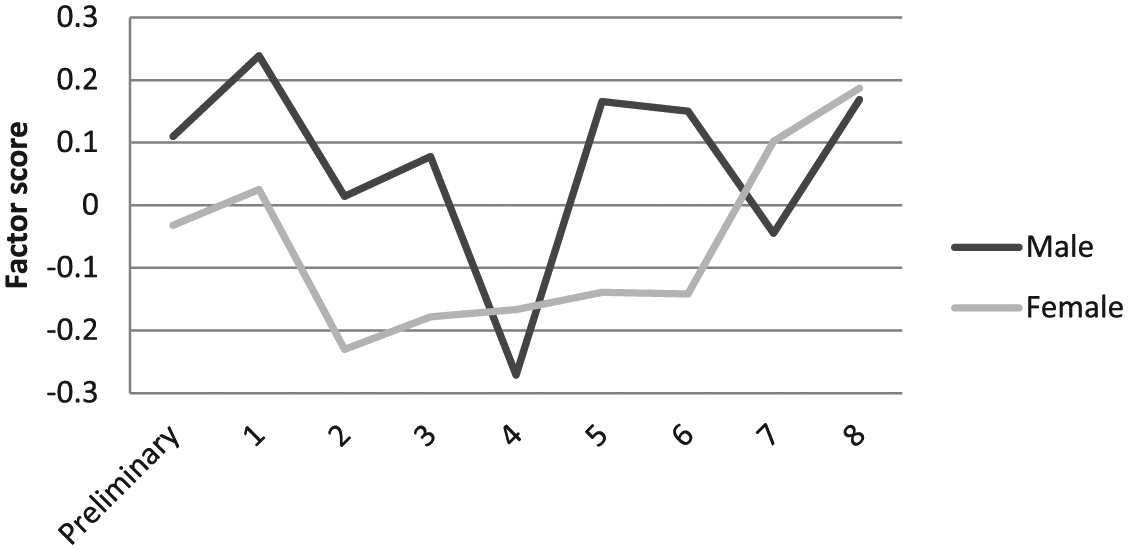
Mean of perceived levels of concentration by gender and level of expertise.
Factor 7: Immediate correction of errors
Factor 7 had an eigenvalue of 1.34 accounting for 5.0% of the variance and high weightings in relation to “When making a mistake the wrong note is corrected and then I carry on” (.705); “When I make a mistake I carry on without correcting it” (-.795). There was a statistically significant effect of level of expertise on Factor 7, F(8, 2492) = 2.54, p = .01, ηp2 = .006, but no statistically significant linear trend. There were statistically significant gender differences with the female students reporting more immediate correction of errors, F(1, 8) = 14.33, p = .0001, ηp2 = .006 (boys M = -.119, girls M = .064), but no significant interaction between gender and level of expertise (see Figure 8). This was confirmed by a multivariate analysis of variance, F(1, 3185) = 12.0, p = .0001. There were statistically significant gender differences within the multivariate analysis in relation to the statements “When I make a mistake I stop correct the wrong note and then carry on”, F(1, 3185) = 11.77, p = .001, ηp2 = .004 (boys M = 4.79, SD = 1.6, girls M = 4.97, SD = 1.4); and “When I make a mistake I carry on without correcting it”, F(1, 3185) = 18.84, p = .0001, ηp2 = .006 (boys M = 3.18, SD = 1.6, girls M = 2.9, SD = 1.5).

Mean of immediate correction of errors by gender and level of expertise.
Are there gender differences in attitudes towards practising? Do these interact with level of expertise?
A principal components factor analysis was undertaken with varimax rotation on the variables related to attitudes towards practising. The details of this are set out in Hallam et al. (2012). The weightings for the variables were “I like practising” -.743; “On some days I don’t want to practise” .623; and “I find practising boring” .808. The factor focus is negative in terms of not enjoying practice. There was a significant effect of level of expertise on attitude to practice, F(8, 942) = 3.8, p = .0001, ηp2 = .031, and a statistically significant linear trend, F(1, 942) = 12.5, p < .0001, indicating that as expertise increased enjoyment of practice decreased. There were no statistically significant gender differences or interactions between gender and level of expertise (see Figure 9). This was confirmed by a multivariate analysis of variance which also showed no statistically significant gender differences.

Mean of lack of commitment to and enjoyment of practice by gender and level of expertise.
Discussion
There are limitations to this research in that it was based on self-report rather than observations or recordings of practice. Participants may not have reported their actual practice behaviours. As this limitation applies equally to the male and female participants the differences found are likely to reflect practice behaviours, although it is possible that there are gender differences in approaches to responding to rating scales which may have distorted the findings. Notwithstanding these limitations the research has demonstrated some statistically significant gender differences in approaches to practice.
There were no differences in the overall time spent practising, although the boys reported practising on slightly more days than the girls. This is somewhat surprising as research on homework more generally has tended to show that girls spend more time undertaking homework than boys (Mau & Lynn, 2000; Rogers & Hallam, 2006; Wagner, Schober, & Spiel, 2008), although high-attaining boys have been shown to do more homework than girls as they approach examinations (Rogers & Hallam, 2010). This may explain the findings given that the current sample includes boys from across the expertise continuum including those at high levels of expertise.
Of the seven factors identified, there were gender differences relating to three factors: adopting systematic practice strategies, adopting ineffective strategies, and concentration. The girls were more likely to adopt systematic practice strategies than boys including practising things slowly, gradually speeding up, adopting repetitive strategies when sections were difficult and marking things on the part to help them. The girls also reported correction of errors more frequently than the boys suggesting that their monitoring processes were more effective. However, the boys were less likely to adopt ineffective practising strategies particularly as beginners, for instance, going back to the beginning when making a mistake. The more systematic approach adopted by the girls is to some extent supported by the research on homework which suggests that girls manage the motivational, emotional and workspace elements of homework more successfully than boys (Xu, 2010), although Hong, Yun, and Rowell (2009) found no difference in self-regulation strategies and Rogers and Hallam (2006) found that while high-attaining boys did less homework than the girls they had more effective study strategies.
There were no statistically significant gender differences in relation to the factors organisation of practice, use of recordings and the metronome, the use of analytic strategies and attitudes towards practice. When individual items with high weightings on these factors were considered there were differences in organisation of practice relating to setting targets, making a list of what was to be practised, marking things on the part and starting practice with scales, with girls more likely to undertake these activities. The boys were more likely to start their practice with warm-up exercises. This difference might reflect instrument differences as warming up is particularly stressed in brass playing (Hallam, 2001a). Overall, the differences in individual statements relating to the organisation of practice reflect the findings relating to homework (Xu, 2010).
It is possible that the strategies adopted were influenced by the instruments played as boys formed the largest proportions playing brass instruments, percussion and drums supporting previous research on the gendering of musical instruments (Abeles, 2009; Abeles & Porter, 1978; Cramer et al., 2002; Hallam et al., 2008; Harrison, 2000; Killian & Satrom, 2011; Sheldon & Price, 2005; Wych, 2012). Certainly, undertaking warm-up exercises is generally more common in those playing brass instruments. We know relatively little about the way that those playing different instruments practise although there is some evidence of differences in the amount of practice undertaken by students in higher education with pianists and string players undertaking the most practice (Jørgensen, 2002). This is an area for further research.
In addition to the differences in the adoption of systematic practice strategies the boys also reported higher levels of concentration than the girls. While this may reflect actual gender differences in concentration it may indicate that the girls are more aware of when they are being distracted. Given the findings of Xu (2010) in relation to homework the latter is perhaps more likely.
The relationship between changes in practising and the development of expertise has been discussed extensively in Hallam et al. (2012). The findings for boys and girls reflect the broad trends reported there, although the patterns of change in some cases were less clear. In both studies, practice time was high in the initial stages of learning with a decrease after beginner level with a subsequent increase as repertoire becomes longer and more complex and there is the need for more technical work including scales and studies. Systematic practice for the whole sample showed an increase between beginner level and Grade 1 with a subsequent decline to Grade 3 followed by an increase to the higher levels of expertise. The gendered data reflected this although there was a considerable negative change for boys at the highest level of expertise. Why this might be requires further investigation. The factor relating to the use of ineffective strategies showed the overall decline found for the whole sample but there was a gender interaction as the boys in the beginner stages were less likely to return to the beginning of the piece if they made a mistake. Taken together these findings support the earlier literature indicating that overall as expertise develops practice tends to become more effective (Gruson, 1988; Hallam, 1997; McPherson & Renwick, 2001). In relation to listening to recordings and using the metronome and attitudes towards practice the pattern for the whole sample and the gendered analysis was similar. The remaining three factors organisation of practice, analytic strategies and concentration showed no consistent patterns across the whole sample. This was reflected in the gendered analysis.
The findings suggest that, while the boys are more effective in their practice when they begin to play an instrument, they may not organise their practice as effectively as girls and may not adopt the most systematic practice strategies as their expertise develops. There is evidence that suggests that learners perceive that they are not taught how to practise by their teachers (Jørgensen, 2000). The current findings support the need for teachers to put more emphasis on teaching learners how to practise taking account of gender differences.
Footnotes
Funding
The authors received no financial support for the research, authorship, and/or publication of this article.