



Abstract
There is evidence that, when given simple musical instruments, young children construct pretend play episodes centered on the shape of the objects rather than their sounds. This attention to shape has also been observed when children learn the names of novel objects. Such a “shape bias”, when engaging in pretend play with instruments and during linguistic tasks, may indicate the possibility that shape is a perceptually important attribute across contexts. The aim of this study was to determine whether children favor shape, color, or sound when identifying a novel object.
In two studies, 3- to 5-year-olds were shown target objects that were given a novel name and shared one attribute (e.g., shape, sound) with test objects. During one trial, the objects were shaken to produce sound, and during another, the children manipulated the objects in order to produce sounds. In both experiments, children selected based on shape significantly more often (p < .001) than chance rates, indicating a strong bias toward the shape of a novel object rather than the sound it produces during a cognitive task.
Keywords
Young children’s perceptual abilities and tendencies related to sound have been of interest to researchers for many years. Specifically, much attention has been paid to children’s abilities to perceive similarities and differences among various types of sound stimuli. For example, research shows that young children can discriminate between music that is fast/slow, smooth/choppy (Sims, 1991), loud/soft (Hair, 1987), and high/low (Flowers & Costa-Giomi, 1991), and representing various modes (Costa-Giomi, 1996; Thompson & Opfer, 2014) and styles (Marshall & Shibazaki, 2012). In addition, young children can perceive differences among melodies with various contours and alterations in contours (Fyk, 1995). Less attention has been paid, however, to children’s perceptual tendencies when confronted with multiple types of stimuli (e.g., visual, tactile), including sound. For example, how do young children respond when presented an object with obvious visual attributes like color, size, texture, or shape as well as sounding capabilities?
There is evidence that the shape of objects with which children play drives children’s pretend play episodes when the objects are non-sounding (Pellegrini, 2009), but also when the objects produce sound (Dansereau, 2015). That is, children are more likely to role-play cooking with upturned drums as pots and pans (attending to the drums’ shape) than use the sounds of the drums in their play – for example, forming a parade or concert, or pretending the drum sounds were monsters stomping (Dansereau, 2015).
There is abundant evidence that such attention to shape on the part of young children is not limited to pretend play episodes. Indeed, children demonstrate a clear “shape bias” when learning names of novel objects (Landau, Smith, & Jones, 1988). This shape bias is demonstrated when children extend the name of a novel object to other objects with the same shape, rather than to objects that are the same size, color, or texture.
Young children’s bias toward shape during linguistic tasks and when engaging in pretend play with objects may be unrelated, or it may point toward the possibility that shape is a perceptually important attribute across contexts. The saliency of shape may, as Landau, Smith, and Jones (1998) noted, be crucial in initiating the learning process. If this is the case, and children’s interactions with sound-producing objects are understood not to be discretely “musical” but rather tied to their developing language and play behaviors (Dansereau, 2015), understanding the role of sound during various cognitive tasks involving objects may provide insight into the nature of children’s early instrument play.
Previous research on shape and sound in object play
While studying preschoolers’ pretend play with objects, Pellegrini (2009) observed that the children’s play episodes seemed to be prompted by the physical attributes of the objects. Pellegrini took this tendency to be further evidence that “play may be preceded by exploration because in exploration children discover objects’ attributes and it is these attributes that form a basis for subsequent pretending” (p. 160). The examples Pellegrini provided of this tendency point to a particular focus on shape. That is, the children used U-shaped pieces of Styrofoam as hats on multiple occasions, and pretended that rectangular blocks were cars.
This shape-prompted pretend play was also documented in a recent study that I conducted (Dansereau, 2015) in order to better understand children’s play tendencies when offered musical instruments. Three- and 4-year-old children played with musical instruments once a week for 12 weeks. I documented the children’s play episodes and categorized them according to cognitive play, social play, and object play theories. It was notable that when the young children were engaged in nonmusical pretend play with the instruments, the play was centered around or initiated by properties of the objects other than their sound-producing capabilities (Dansereau, 2015). Shape was a particularly influential property, as opposed to the colors, textures, or sizes of the instruments. For example, the children favored playing airplane with rhythm sticks as microphones for flight-related announcements, rather than using the sounds the rhythm sticks can produce in their play. Because nonmusical pretend play was far more common than musical pretend play (involving purposeful sound), it could be concluded that shape is a stronger determinant of pretend play than sound for young children.
Previous research on shape bias
The saliency of shape as a physical attribute has been widely researched in relation to children’s word learning and categorization of novel objects. Specifically, when presented with a new object and count noun, 1 young children preferentially attend to the object’s shape over the object’s size (Landau et al., 1988; Landau, Smith, & Jones, 1992), color (Diesendruck & Bloom, 2003), texture (Graham, Namy, Gentner, & Meagher, 2010; Landau et al., 1988, 1992), function (Graham, Williams, & Huber, 1999), or taxonomic kind (Baldwin, 1992). This shape bias has been shown regardless of whether the novel object is an artifact or if it possesses “eyes” – and, as such, is potentially animate (Landau et al., 1998).
Preschoolers’ attention to shape over other physical attributes of a novel object has been observed when the syntactic context was varied. For example, when 3-year-olds were shown a test object and asked to find another object that was “of the same kind” as the test object (Diesendruck & Bloom, 2003), the participants chose according to shape. Additionally, Landau et al. (1992) found that 3-year-olds generalized according to shape when the researchers introduced the objects as count nouns (by saying “This is a dax”), but also when they used the superordinate context (“This is a kind of dax”). When the researchers introduced the object using an adjective context (by saying “This is a daxy one”), however, 3-year-olds made choices based on shape, but also on texture.
Shape can be a fairly reliable indicator of category membership; however, overreliance on such obvious perceptual clues can also be limiting and lead to inaccuracies, such as classifying a bat as a bird (Namy & Clepper, 2010). There is evidence that young children are capable of accounting for less salient properties of an object during classification tasks, though. For example, Gentner and Namy (1999) found that, when shown an apple and a pear, 4-year-olds chose a banana as a category match, overriding the perceptual dissimilarities; however, when children were shown only one target object (an apple), they were as likely to choose a shape match (a balloon) as they were to choose the taxonomic match.
While there is no debate as to the existence of a shape bias during lexical learning, there is much discussion as to the nature of this bias (see, e.g., Keil, 2008) – specifically, whether the shape bias operates from perceptual or conceptual knowledge (Elman, 2008). On the perceptual end of the debate are those who might assume that shape permits children to determine category members in the absence of rich knowledge about a category. In such a view, similarity in shape would comprehensively indicate to the child the underlying meaning of an object’s name (Landau et al., 1998). A less extreme form of this view would see shape similarity as the primary clue that allows for independent discovery and sense-making, or as Landau et al. (1998) described, “a critical bootstrapping device operating to initiate learning in children” (p. 20).
On the conceptual end of the debate are those who believe that conceptual information plays a large role in children’s word learning (Booth & Waxman, 2008). According to Markson, Diesendruck, and Bloom (2008), “a child will extend the word ‘ball’ on the basis of shape because, (a) she knows that ‘ball’ is a count noun, and as such it refers to objects of the same kind, and (b) she knows that shape is a reliable cue to object kind” (p. 204). Those advocating for this view also argue that the shape bias is not word learning specific, but appears in non-linguistic areas also (Elman, 2008). It is this idea that may potentially explain – at least theoretically – the influence shape plays in children’s pretend play episodes involving sound- and non-sound-producing objects.
Despite a great deal of research on shape bias, only one study was located wherein sound was part of the investigation. Graham and Diesendruck (2010) chose sound to serve as a “nonobvious” property of novel objects in order to determine whether infants were more likely to generalize based on shape, texture, or color. The researchers presented 15-month-old infants with a target object that produced sound when shaken, then presented a series of test objects that did not produce sound. According to the researchers, “if infants viewed two objects as belonging to the same category and thus expected them to share nonobvious properties, they should persist in trying to elicit the property” from the matching test object (Graham & Diesendruck, 2010, p. 113). As anticipated, the infants performed significantly more actions on objects of the same shape as the test objects, than on objects that matched the test objects’ color or texture. The researchers concluded that infants’ attention to shape is evident outside of lexical contexts and is present at the very early stages of language acquisition (Graham & Diesendruck, 2010).
Though much is known about the presence of shape bias when young children are presented with objects of varying visual attributes, such as shape, texture, or color, it is not known whether the bias toward shape would be impacted by the introduction of sound as a comparative physical attribute. This information, framed by the theory that shape bias is not constrained to linguistic domains (Elman, 2008), may offer insight into the cognitive tendencies at play when young children interact with musical instruments. Further, if it is concluded that children bias shape over sound, this finding would have ramifications for those concerned with young children’s sound perception and discrimination capabilities – both foundational cognitive processes in music learning. The purpose of this study, therefore, was to understand the role of sound for 3- to 5-year-old children engaged in a common cognitive task involving objects. I sought to answer the following questions. First, do children prioritize shape or sound while seeing and hearing a novel sound-producing object during an object naming task? Second, do children prioritize shape or sound while seeing, hearing, and manipulating a novel sound-producing object during an object naming task?
Method
Design
I conducted two studies in order to address the research questions. In the first, I began with a standard lexical extension task not involving sound-producing objects, in order to determine whether the participants exhibited shape bias consistent with previous research. Then, to address the first research question, I conducted a lexical extension task with the same participants involving a target object that produced sound and test objects that produced sounds. Finally, to address the second research question, I presented participants with a second target object that produced sound and a second set of test objects that produced sounds, and invited the children to manipulate the objects prior to providing their responses.
Because the standard lexical extension task not involving sound may draw participants’ attention to shape and consequently influence their responses to the subsequent trials involving sound-producing objects, I conducted Study 2. In Study 2, I omitted the standard lexical extension task and presented participants with the sound-producing objects only.
Study 1
Participants
Participants (N = 46) in Study 1 were drawn from the early childhood programs within two schools – a public elementary school located in a rural area in the northeastern United States, and a small independent school located in a large city also in the northeast US. The majority of the participants (n = 38) attended the elementary school. All children whose parents granted consent were included in the study. Participants were aged 3–5 years (M = 56.16 months, SD = 7.26) and English was their primary language. There were slightly fewer females (n = 21) than males (n = 25) represented.
Materials
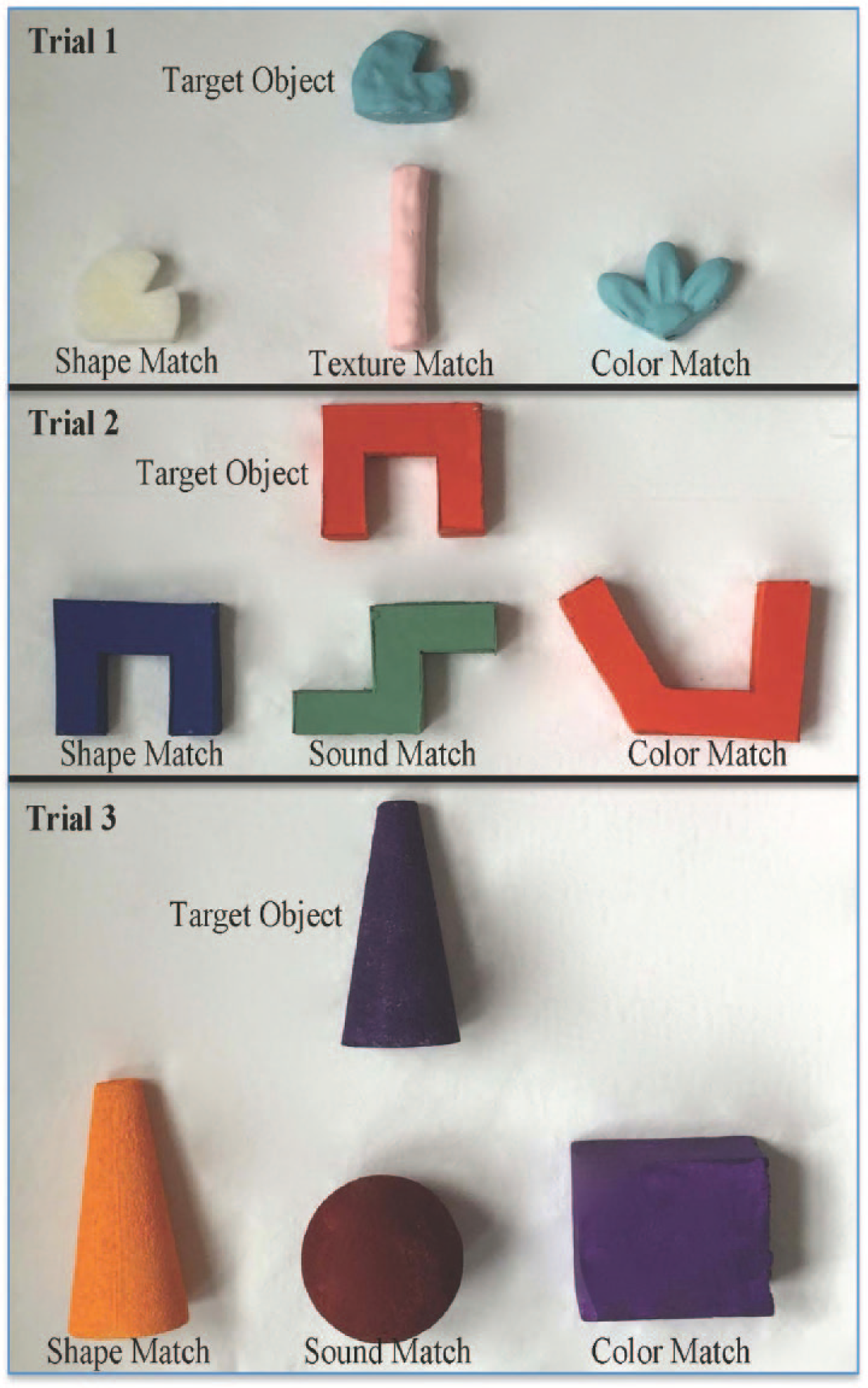
I created three sets of objects consisting of one target object and three test objects (Figure 1). The first set was used in a baseline trial (Trial 1), which I conducted as a standard lexical extension task in order to determine whether the participants showed bias toward shape. One of the test objects shared the same shape as the target object, but differed in color and texture. Another test object shared the same texture as the target object, but differed in shape and color. Yet another object shared the same color as the target object, but differed in texture and shape. I modeled this set of objects after the first set used by Landau et al. (1998). None of the objects used in Trial 1 produced sound.
Materials.
I conducted Trial 2 in order to determine whether the sound that objects produce – as demonstrated by me – influences children’s responses. This trial involved a target object that produced a gentle, jingly sound when shaken. One of the test objects shared the same shape as the target object, but differed in color and produced a loud, clattering sound. Another test object shared the same color as the target object, but differed in shape and produced a quiet, “sandy” sound. Yet another test object shared the same sound as the target object, but differed in shape and color. I modeled this set of objects after the second set used by Landau et al. (1998).
I conducted Trial 3 in order to determine whether the sounds objects produce – as invoked by the children and me – influence children’s responses. The decision to invite the children to manipulate the objects stemmed from research that indicates that perceptual modality (visual and/or haptic) may affect categorization choices (Cooke, Jäkel, Wallraven, & Bülthoff, 2007), particularly among young children (Kalagher & Jones, 2011). This trial involved a target object that produced a maraca sound when shaken. One of the test objects shared the same shape as the target object, but differed in color and produced a bell sound. Another test object shared the same color as the target object, but differed in shape and produced a loud, percussive rattle. Yet another test object shared the same sound as the target object, but differed in shape and color. I modeled this set of objects after those used by Samuelson and Smith (2005).
Procedures
Each child sat at a table in the corner of their classroom or just outside their classroom for the testing. I informed the children that they would be shown some objects, asked some questions, and then would receive a sticker for participating. The children participated in all three trials sequentially during a single sitting and all children completed all trials.
The testing began with the baseline trial, which followed typical shape bias investigation procedures and was used to determine whether the participants showed evidence of a standard shape bias. I showed the first target object and said, “This is a dax”. I then arranged the test objects on the table below the target object, pointed to them, and said, “Now, show me the dax”. Order of presentation of the test objects for all trials and for each child was determined using a random number generator. I recorded the child’s selection on a piece of paper and put the objects away. I acknowledged the child’s response in a friendly, but neutral manner.
For Trial 2, I showed the child the second target object, shook it to produce its sound, and said, “This is a flam”. I then took each test object, shook it to produce sound, set it on the table below the target object, and said, “Now, show me the flam”. The child’s selection was acknowledged, recorded, and the objects were put away.
For Trial 3, I showed the child the final target object, shook it to produce its sound, said “This is a barg: look and listen to it”, handed the object to the child and encouraged her to shake it. After the child shook the target object, I presented the first test object, shook it to produce sound, handed it to the child so she could produce the sound, and then set it on the table below the target object. I repeated this for the other two test objects, then said “Now, show me the barg”. I recorded the child’s selection and returned the child to her classroom activity.
Results
For each trial, the frequency with which each test object was chosen as matching the target object was tallied and percentages were calculated (Table 1). Children selected the shape match 78.3% of the time in Trial 1, 67.4% in Trial 2, and 87% of the time in Trial 3. A chi-square goodness of fit analysis indicated that the children’s selection of test objects did not occur with equal probabilities (at the rate of chance – 33%) for Trial 1, χ2(2, N = 46) = 42.30, p < .001, Trial 2, χ2(2, N = 46) = 24.04, p < .001, or Trial 3, χ2(2, N = 46) = 59.65, p < .001.
Frequencies and percentages of test object selection across three trials.
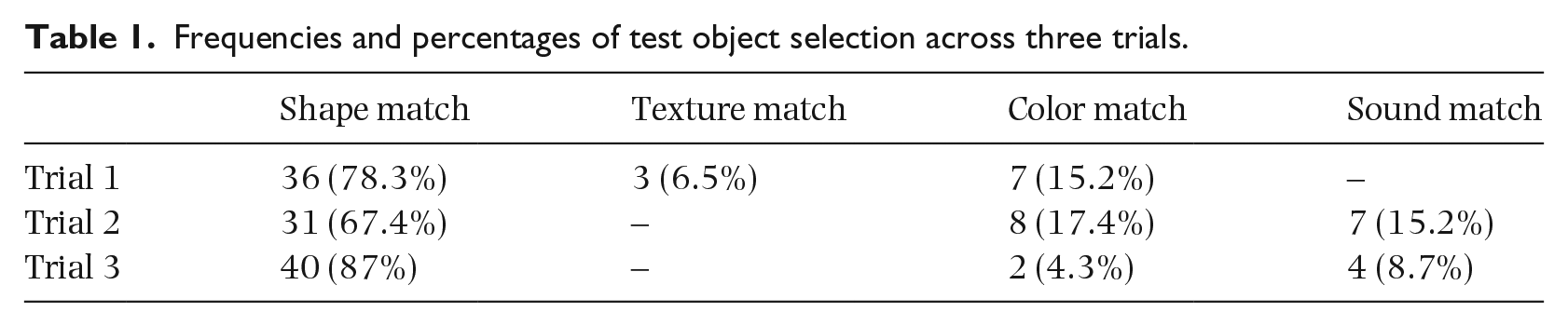
To determine whether manipulating the objects and producing sound firsthand influenced participants’ selections, I checked to see if there was a significant difference between the participants’ responses in Trials 2 and 3. In order to proceed with this analysis, data needed to be collapsed dichotomously. To that end, the frequencies of selections of color and sound were merged and compared with the frequencies of shape selection. The results of a related-samples McNemar test showed that participants chose according to shape more frequently, χ2(2, N = 46) = 4.27, p = .035, after manipulating the sound-producing objects than after watching and listening to a sound-producing object.
The number of shape selections across all three trials was summed and converted to a percentage for each participant. A 2 (gender) × 2 (school) × 3 (age in years) analysis of variance indicated no significant differences according to gender (p = .27), school (p = .84), or age (p = .14) and no significant interactions. To investigate the role of gender, school, and age within the sound conditions only, the number of shape selections in Trials 2 and 3 was summed and converted to a percentage for each participant. A 2 (gender) × 2 (school) × 3 (age in years) analysis of variance indicated a significant main effect for age (p = .04). Tukey post-hoc testing revealed that 5-year-olds selected based on shape (M = 89.58, SD = 21.08) significantly more often than 3-year-olds (M = 50, SD = 0) when sound was a feature of the objects.
Study 2
In order to determine whether Trial 1 of Study 1 may have drawn participants’ attention to shape and consequently influenced their responses to the subsequent trials involving sound-producing objects, I omitted this trial in Study 2. Accordingly, participants in Study 2 only encountered the sound-producing objects.
Participants
Participants in Study 2 (N = 37) were drawn from an independent early childhood center in a suburb of a large city in the northeastern United States. All children whose parents granted consent were included in the study. Participants were aged 3–5 years (M = 52.92 months, SD = 10.81) and English was their primary language. There were more males (n = 21) than females (n = 16) represented.
Materials
The same objects used in Trials 2 and 3 of Study 1 were used in the two trials of Study 2. Trial 1 of Study 2 consisted of a target object that produced a jingly sound when shaken. One of the test objects shared the same shape as the target object, but differed in color and produced a loud, clattering sound. Another test object shared the same color as the target object, but differed in shape and produced a quiet, “sandy” sound. Yet another test object shared the same sound as the target object, but differed in shape and color.
Trial 2 of Study 2 involved a target object that produced a maraca sound when shaken. One of the test objects shared the same shape as the target object, but differed in color and produced a bell sound. Another test object shared the same color as the target object, but differed in shape and produced a loud, percussive rattle. Yet another test object shared the same sound as the target object, but differed in shape and color.
Procedures
The procedures for Study 2 were identical to those for Study 1. For Trial 1, I showed the child the target object, shook it to produce its sound, and said, “This is a flam”. I then took each test object, shook it to produce sound, set it on the table below the target object, and said, “Now, show me the flam”. The child’s selection was acknowledged, recorded, and the objects were put away.
For Trial 2, I showed the child the second target object, shook it to produce its sound, said “This is a barg: look and listen to it”, handed the object to the child and encouraged him to shake it. After the child shook the target object, I presented the first test object, shook it to produce sound, handed it to the child so he could produce the sound, and then set it on the table below the target object. I repeated this for the other two test objects, then said “Now, show me the barg”. I recorded the child’s selection and returned the child to his classroom activity.
Results
For both trials, the frequency with which each test object was chosen as matching the target object was tallied and percentages were calculated (Table 2). Children selected the shape match 70.3% of the time in Trial 1 and 86.5% of the time in Trial 2. A chi-square goodness of fit analysis indicated that the children’s selection of test objects did not occur with equal probabilities (at the rate of chance – 33%) for Trial 1, χ2(2, N = 37) = 23.08, p < .001, or Trial 2, χ2(2, N = 37) = 47.08, p < .001.
Frequencies and percentages of test object selection across two trials.

As in Study 1, the data were collapsed dichotomously in order to determine whether manipulating the objects and producing sound influenced participants’ selections firsthand. Frequencies of selections of color and sound were merged and compared with the frequencies of shape selection. The results of a related-samples McNemar test showed no significant difference in the frequency of shape selection versus sound/color selection between the two trials, χ2(1, N = 37) = 3.13, p = .07.
The number of shape selections in both trials was summed and converted to a percentage for each participant. Similarly to Study 1, a 2 (gender) × 3 (age in years) analysis of variance indicated no significant differences according to gender (p = .33). While the percentage of shape selections increased with age in Study 2, (71.67% for 3-year-olds, 76.6% for 4-year-olds, and 100% for 5-year-olds) these differences were not statistically significant (p = .19).
Discussion
Results indicate that preschoolers are far more likely to show bias toward the shape of a novel object rather than the sound it produces during a lexical extension task. While this proclivity was evident among all participants in these studies, it was even stronger among older children. This finding is consistent with previous research that has shown that the shape bias is apparent, though fragile, by age 2, stabilizes by age 3, and is at an adult level by age 5 (Landau, 1994).
Children in Study 1 were significantly more likely to choose according to shape after handling and producing sound with the objects, than when simply viewing and listening to the objects. This trend was evident in Study 2 as well, but that finding did not achieve statistical significance. This tendency may have been due to the particular objects used in Trials 2 and 3. Perhaps those in Trial 3 were more obviously related according to shape and/or less obviously related according to sound than those in Trial 2. More research is needed in order to determine if this type of response is typical.
In these studies, no descriptors were used for the objects that may have given the participants clues to their potential functions. There is evidence, however, that function (Gentner & Namy, 1999) as well as conceptual context (Keil, 1994) may play a role in preschoolers’ generalizations. According to Keil (1994), “when, for example, an entity is labeled a frog, the shape change is critical; but when it is labeled a rock, color and texture becomes critical” (p. 191). Consequently, children as young as 4 years may use their understanding of category to assess the relevance of perceptual qualities. Follow-up studies should investigate whether introducing the objects as “musical instruments” would affect participant response.
On a few occasions during data collection, children commented on the sounds the objects made. For example, after shaking the test object in Trial 3 of Study 1 that matched the sound of the target object, one young girl remarked, “That sounds the same as this one”; however, she still chose the test object that matched according to shape. Comments such as this indicate that at least some participants were listening to and perceiving the sounds, but an object’s sound was not a strong enough indicator of membership in a category to override the shape option. The children may have perceived the sounds and their differences, but they clearly did not prioritize the sounds. A subsequent study that allows for children to think aloud as they make choices, or share their thought processes afterward might be informative.
These studies represent an attempt to begin to understand the factors that contribute to children’s interactions with sound-producing objects and the saliency of sound as a perceptual quality for young children. While it may be premature to conclude that shape bias plays a role in children’s attention to shape during pretend play with instruments, the findings of these studies indicate that the sound an object makes is eclipsed by its shape within the context of one cognitive task in which preschoolers engage regularly. More research is needed in order to uncover whether young children’s priority for shape over sound as evidenced during naming tasks is purely a discrete phenomenon, or if it is an indicator of a more integrated cognitive tendency that is at play when preschoolers seek to make sense of their world and the sounds within it. Mapping the findings from research on the role of sound within a variety of cognitive tasks with the findings from these studies may enable those concerned with young children’s interactions with sound, as a foundational step of musical development, to begin to piece together an understanding of children’s early interactions with musical instruments.
Footnotes
Funding
The author received no financial support for the research, authorship, and/or publication of this article.