



Abstract
Experiencing and engaging with music have been fundamental to all societies across the ages. This study explores the connection between habitual music engagement and subjective wellbeing. Subjective wellbeing (SWB) comprises individual evaluations of life satisfaction, and is internationally regarded at policy and government levels. The present study uses data gathered in 2014 as part of the 31st survey of the Australian Unity Wellbeing Index to provide insight into the relationship between music engagement and SWB. A stratified random sample of 1,000 participants was interviewed via telephone. The findings revealed that engaging with music by dancing or attending musical events was associated with higher SWB than for those who did not engage with music in these forms. The findings also emphasised the important role of engaging with music in the company of others with regard to SWB, highlighting an interpersonal feature of music. The study provides an overview of the general relationship between music and SWB at a population level, by contrast to most research in the area that has focused on evaluating clinical interventions involving music. The insight gained from these findings can be used to inform future interventions and to better understand how music is involved in emotional regulation.
Music is considered to be one of the most enjoyable and satisfying everyday activities (Mas-Herrero, Marco-Pallares, Lorenzo-Seva, Zatorre, & Rodriguez-Fornells, 2013; Morinville, Miranda, & Gaudreau, 2013), and engaging with music is proposed to offer a variety of benefits to health and wellbeing. For example, music is proposed to reduce stress, and can evoke positive feelings such as joy, relaxation, and empowerment (Beck, Gottfried, Hall, Cisler, & Bozeman, 2006). Music engagement can also be used as a problem-coping strategy, and as a medium for facilitating social relationships (Miranda & Gaudreau, 2011), and was even associated with a lower mortality rate in a large national Swedish study (Bygren, Konlaan, & Johansson, 1996). Perhaps most importantly, engagement with music is often associated with emotion regulation, with people turning to music as a strategy to help manage and regulate their mood (Chin & Rickard, 2014; Juslin & Laukka, 2004; Sloboda & O’Neill, 2001; van Goethem & Sloboda, 2011).
These hedonic properties of music have important implications for subjective wellbeing (SWB), the scientific psychological term for general mood ‘happiness’, which is positive, stable, and consistent over time (Cummins, 2010). It can be measured using general questions about life satisfaction (e.g., Satisfaction with Life Scale; Diener, Emmons, Larsen, & Griffin, 1985), or by domain-specific measures that capture the areas of life that statistically contribute to general life satisfaction (e.g., Personal Wellbeing Index; International Wellbeing Group, 2013). Regardless of the measure used, average scores on SWB measures generally approximate 75 when scores are standardised to a 0–100 scale (Cummins, 1995, 1998). This stability is attributed to a set point for SWB, which is genetically pre-determined to lie between 70 and 90 on a 100-point scale in normal Western populations (Cummins, Li, Wooden, & Stokes, 2014). Subjective wellbeing generally defines an individual’s perception of the quality of their own life, and is driven by an affective core (Blore, Stokes, Mellor, Firth, & Cummins, 2011; Davern, Cummins, & Stokes, 2007). Subjective wellbeing homeostasis theory (Cummins, 2010) describes the regulatory processes that operate to retain SWB at its set-point level in response to threat.
According to homeostasis theory, when a challenge is encountered to shift SWB below its set point, external and internal resources are engaged to aid mood regulation and facilitate set-point recovery (Cummins, 2010). External resources including money and relationships are powerful in the process of homeostasis. Money can be used as a flexible resource to defend against stressors, and a close relationship serves as an outlet for stress and anxiety (Cummins, 2010), while simultaneously reinforcing one’s belief that they are a loved and valued person. Internal resources include cognitive strategies that counteract the negative influence of a challenging event by enhancing self-worth, promoting the temporary nature of an adverse event, or reinforcing a sense of mastery over the world. These are captured by (but not limited to) self-esteem, optimism, and perceived control (Cummins & Nistico, 2002). Though these restorative processes are usually automatically engaged to combat threats to wellbeing, it seems intuitively appealing that they may also be manufactured, or facilitated through other means. Music may be one such pathway, and has been implicated in mood regulation in previous studies (e.g., Saarikallio, 2010).
Recent technological advances have increased the availability of and accessibility to music in the modern world. Though hearing music is practically unavoidable in today’s day and age, engaging with music extends beyond just passive listening. People engage with music in various ways and their engagement may be active, such that they are creating music, or passive, such that they are consumers of music. Though some studies focus on wellbeing outcomes for active engagement with music (e.g., Hallam, Creech, Varvarigou, & McQueen, 2012), positive relationships can be found in the literature for all types of music engagement. For example, positive relationships have been found between music and wellbeing for people who listen to music (Morinville et al., 2013), sing (Clift et al., 2007), play an instrument (Perkins & Williamon, 2014), dance (Koch, Kunz, Lykou, & Cruz, 2014), create or compose music (Habron, Butterly, Gordon, & Roebuck, 2013), and attend music festivals (Packer & Ballantyne, 2011), though these effects have generally been considered independently. In one study, Saarikallio and Erkkilä (2007) considered how adolescents engage with music in different forms in accordance with their intentions regarding mood regulation. For example, though listening to music was a typical activity for any regulatory strategy, those looking for ‘diversion’ away from an unpleasant mood typically sang or played music. Some studies also reveal gender differences, whereby higher life satisfaction is associated with singing, theatre and dancing for women, but the wellbeing benefits are limited to dancing for men (Cuypers et al., 2012). It is believed that active methods of music engagement generally provide greater individual benefits than passive engagement, because activities like producing music and performing encourage self-exploration, emotional expression, self-esteem and confidence (Creech, Hallam, Varvarigou, McQueen, & Gaunt, 2013). Active music engagement such as singing also has physical health benefits, while engagement via creating or composing music can have cognitive benefits (Hallam et al., 2012). Nevertheless, listening to music is associated with higher mood when considered in terms of activation and valence (Vastfjall, Juslin, & Hartig, 2012).
A key factor contributing to the positive outcomes for wellbeing associated with music is the social component of music engagement (Joseph & Southcott, 2014; Southcott & Joseph, 2015). While research has indicated that engaging with music alone may improve physical health and emotional wellbeing (Khalifa, Bella, Roy, Peretz, & Lupien, 2003), other research has shown that engaging with music in the company of others is associated with stronger positive experiences (Lamont, 2011). Given the importance of social connection to subjective wellbeing, it may be expected that the benefits of music to subjective wellbeing are limited to those who engage with music as a means of social facilitation.
Most of the studies described herein have considered the relationship between music and wellbeing through evaluation of the efficacy of music therapy interventions, with generally positive outcomes. However, given that engagement with music is so common in daily life, the overarching aim of the present study is to further our understanding of the relationship between habitual music engagement and wellbeing in a representative Australian sample. In this article, we focus on three key factors to further this understanding and contribute to the body of research in this area. First, we consider how the different modes of music engagement relate to subjective wellbeing. Second, we focus on the social component of music engagement, that is, whether people engage alone or in company. Third, we use a measure of subjective wellbeing designed to break down general life satisfaction into its constituent components, to better understand the ways and means by which music affects wellbeing.
Method
Participants and procedure
In 2014, ethics approval was obtained from Deakin University Human Research Ethics Committee to undertake the study. A geographically representative national sample of people aged 18 years or over and fluent in English was recruited as a stratified random sample to take part in the 31st survey of the Australian Unity Wellbeing Index by telephone. The Australian Unity Wellbeing Index began in 2001 and was designed to monitor the subjective wellbeing of the Australian population. It uses computer-assisted telephone interviewing (CATI) to recruit a different sample of at least 1,000 participants for each wave. Each survey includes the Personal Wellbeing Index (PWI; International Wellbeing Group, 2013) and a special topic for investigation. The special topic for the 31st survey was music engagement, and items were selected for inclusion accordingly. For randomisation purposes, callers asked to speak to the person in the household who had the most recent birthday and was at least 18 years old. Data collection spanned over 10 days until the quota of participants was reached, and data were exported to the authors and analysed in October 2014. This recruitment method allowed the interviewer to gather information quickly, and telephone surveys are seen as a good alternative to face-to-face surveys or online questionnaires where people may not wish to participate. An even geographic and gender split was maintained at all times through the survey, so that the sample comprised 500 males and 500 females. The total sample comprised 1,000 participants with an average age of 56.45 years (SD = 16.95). A majority of the participants were married (56.5%), and about a third (33.9%) were retired.
Measures
Participants responded to a series of questions regarding their general life satisfaction, subjective wellbeing, and engagement with music. These measures are detailed below.
General life satisfaction (GLS)
The single-item question “How satisfied are you with your life as a whole?” was used. Participants rated their level of satisfaction on a 0–10 scale anchored by not at all satisfied to completely satisfied. Though arguably the most comprehensive and holistic account of subjective wellbeing, the reliability of single-item measures has been questioned in the literature (Diener, 1984), and so a domain-specific measure of subjective wellbeing was also included.
Personal Wellbeing Index (PWI; 5th Ed)
This seven-item scale was developed and produced by the International Wellbeing Group (2013). Participants rate their level of satisfaction with various areas of life such as standard of living, health, achieving in life, relationships, safety, community connection, and future security, on a 0–10 scale from not at all satisfied to completely satisfied. Each domain earns inclusion in the scale because it contributes unique statistical variance in a multiple regression to predict general life satisfaction (described above). Scores on the domains are averaged to produce a total wellbeing score, but the domains may also be analysed independently.
Music engagement
Participants were asked a series of yes/no questions to establish their habitual modes of engagement with music. They reported whether or not they listened to music, played an instrument, sang, danced, created or composed music, and/or attended musical concerts, theatre or events. Participants who affirmed that they sang, danced, or played an instrument were subsequently asked whether they usually engaged in music in this way alone or in the company of others.
Results
Prior to analysis, data were standardised to a 0–100 range for ease of interpretation. No multivariate outliers were detected, and univariate outliers were recoded so that their scores fell within three standard deviations of the mean. This strategy is preferred to deletion, because it allows scores to remain in the dataset as extreme, but not so extreme that they bias the outcome (see Tabachnik & Fidell, 2013). Scores on both the General Life Satisfaction (GLS) item and the Personal Wellbeing Index (PWI) were negatively skewed, though no transformation of the data was conducted, as scores on these measures are, by nature, positive. A normal distribution is indeed apparent in the upper portion of the scale, reflecting the true nature of these measures in the population. In addition, the analyses used are generally considered to be robust to violations of normality, particularly with large sample sizes.
First, the total PWI score was calculated and compared for people who reported that they engaged or did not engage with music in each form. Table 1 shows the proportions of participants who reported that they engaged with music in each form.
Frequencies of engaging with music.
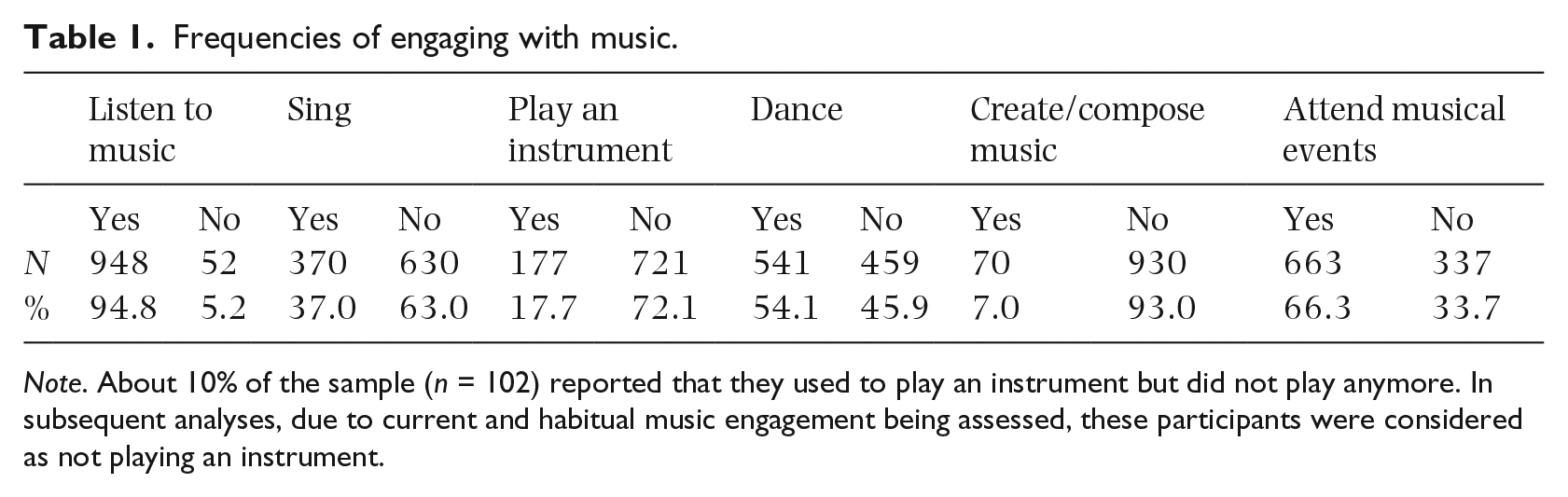
Note. About 10% of the sample (n = 102) reported that they used to play an instrument but did not play anymore. In subsequent analyses, due to current and habitual music engagement being assessed, these participants were considered as not playing an instrument.
Analyses by gender revealed that although more females reported that they sang (χ2(1) = 39.58, p < .001) or danced to music (χ2(1) = 27.74, p < .001), more males reported that they created or composed music (χ2(1) = 10.38, p < .01).
The average wellbeing of these groups is compared and presented in Figure 1. Asterisks represent significant differences between groups as evaluated by a t-test.
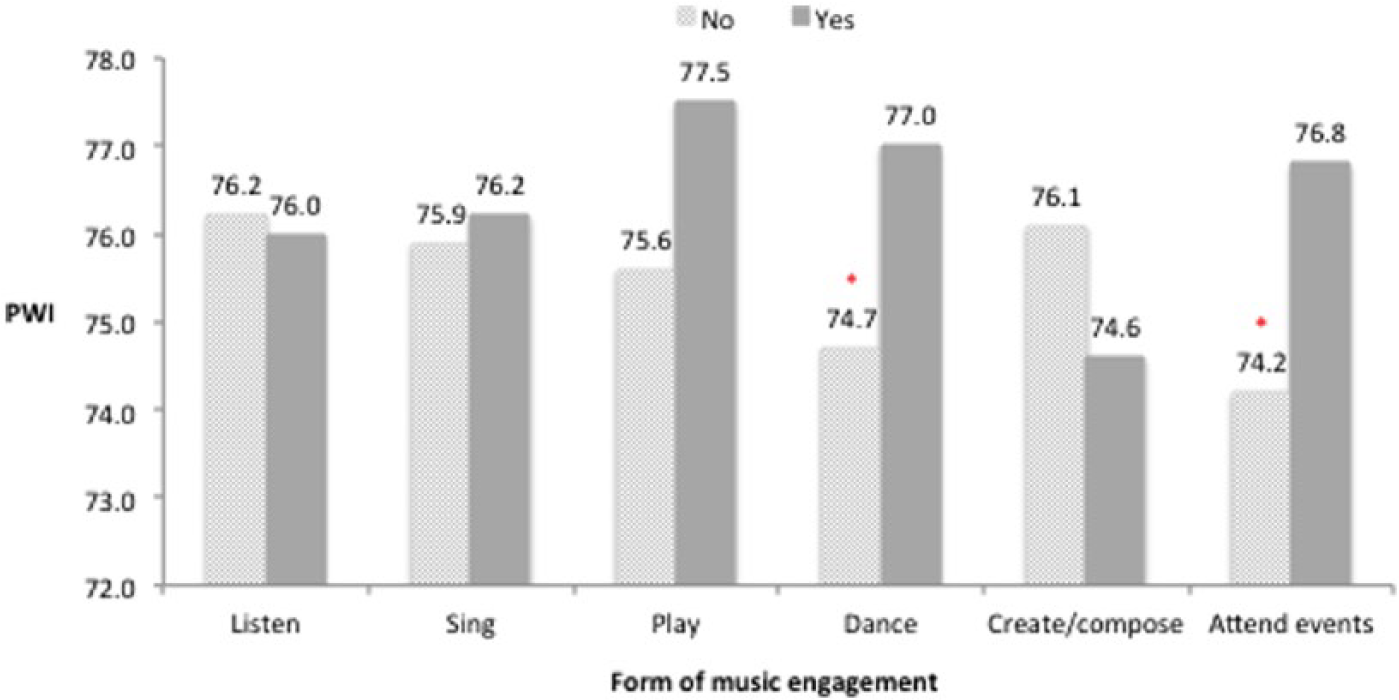
Personal wellbeing and mode of music engagement.
Figure 1 reveals that total wellbeing scores were significantly higher for people who reported that they danced (t (936) = 2.927, p < .01) or attended musical events (t (517) = 2.958, p < .01), compared to those who did not engage with music in those forms. There were no significant differences for those who listened to music, sang, played an instrument or created/composed music. These results remained after controlling for the influence of gender.
Though people who danced or attended musical events recorded significantly higher PWI scores, their scores on the single GLS item were not significantly different from those who did not engage with music in those forms. Thus, to provide further insight into the group differences on the PWI measure, the domains of the scale were analysed independently for the two significant modes of engagement. These results are presented in Table 2.
Domain-specific comparisons for ‘dance’ and ‘attend musical events’.
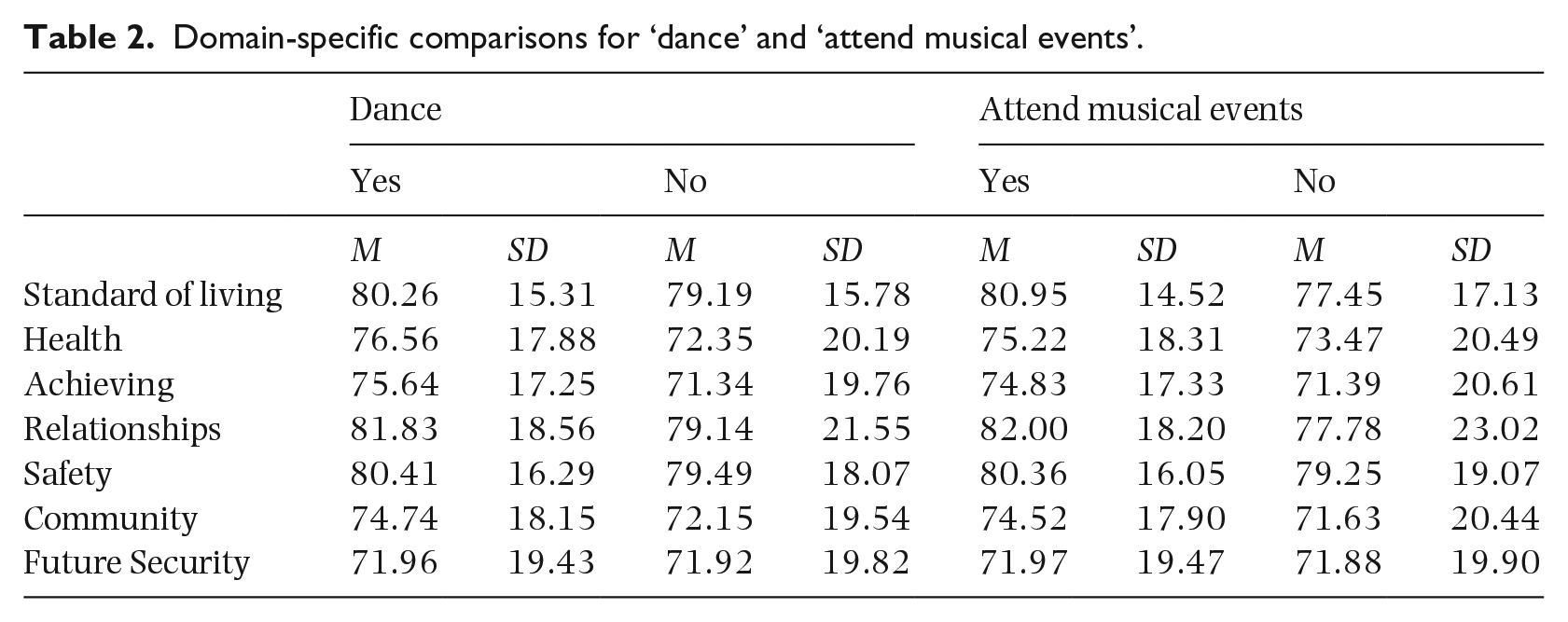
Compared to people who did not dance, those who danced reported significantly higher scores for satisfaction with health (p < .001), achieving in life (p < .001), relationships (p < .05), and community (p < .01). These results held after considering gender in the model, except for satisfaction with relationships, which no longer showed a significant difference in the presence of gender. Compared to those who did not attend musical events, those who did attend reported significantly higher scores for satisfaction with standard of living (p < .01), achieving in life (p < .01), relationships (p < .01), and community (p < .05). Once again, after considering gender as a factor in the model, the results for satisfaction with relationships were adjusted, although this time the results revealed an interaction between gender and whether or not one attended musical events on satisfaction. Specifically, satisfaction with relationships was higher for males who attended musical events than for males who did not, but there was no difference in scores for females based on whether or not they attended musical events.
Given that the domains above are inter-related, these findings were confirmed using multivariate analyses. Again, there was a significant overall difference between those who danced and those who did not dance (Wilks’ lambda = .974, p < .01) with univariate results observed for the four domains noted in the paragraph above. Similar results were obtained for attending musical events (Wilks’ lambda = .977, p < 0.01), with four domains recording significant univariate differences.
Finally, to explore the social component of music engagement, those who engaged alone were compared to those who engaged in the company of others, and those who did not engage. These comparisons were performed for the three available modes of music engagement: sing, play, and dance. There were no significant differences between groups with regard to playing an instrument alone or in company, but the results for singing and dancing are shown in Figures 2, and 3.
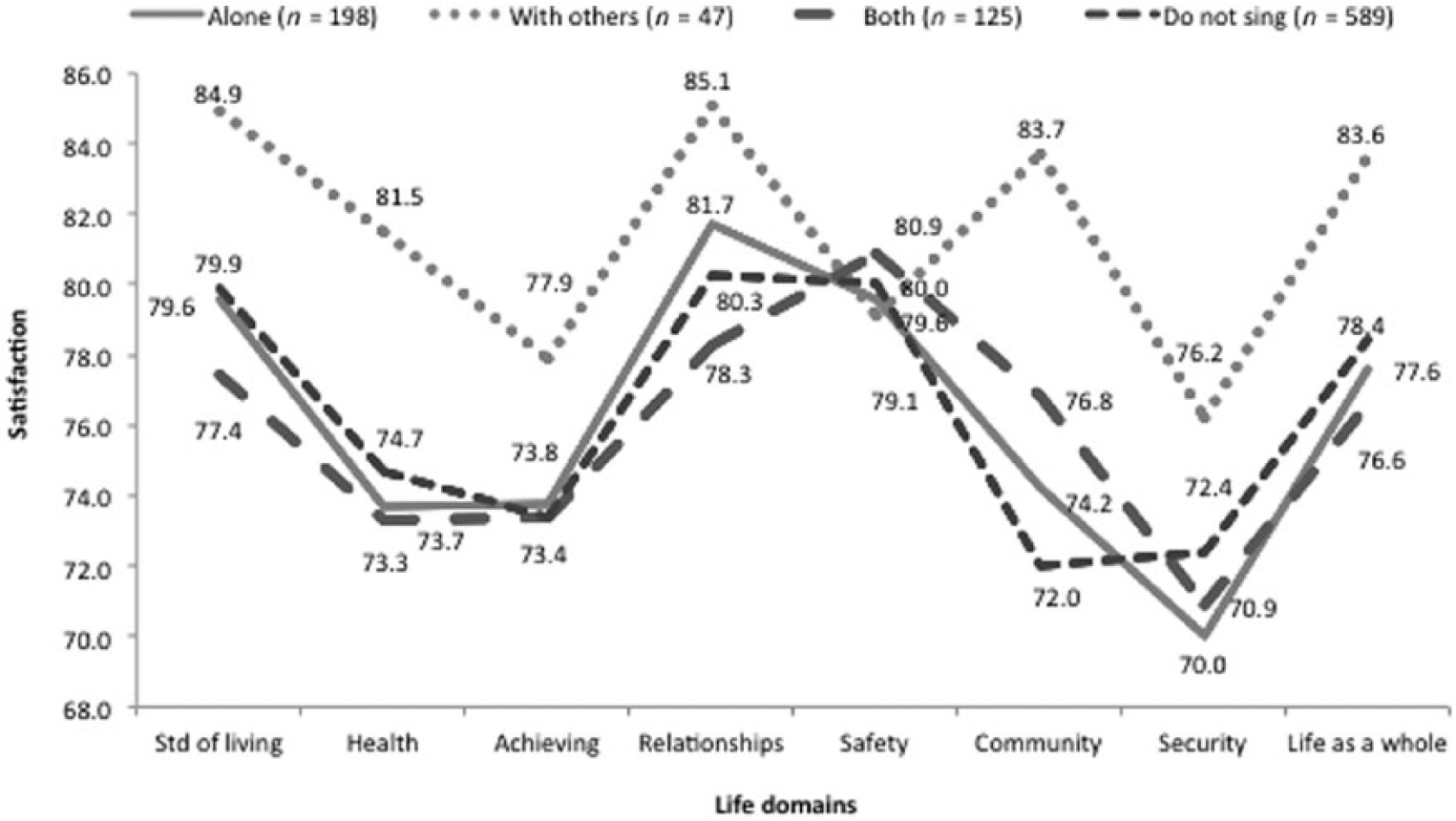
Subjective wellbeing and the social component of singing.
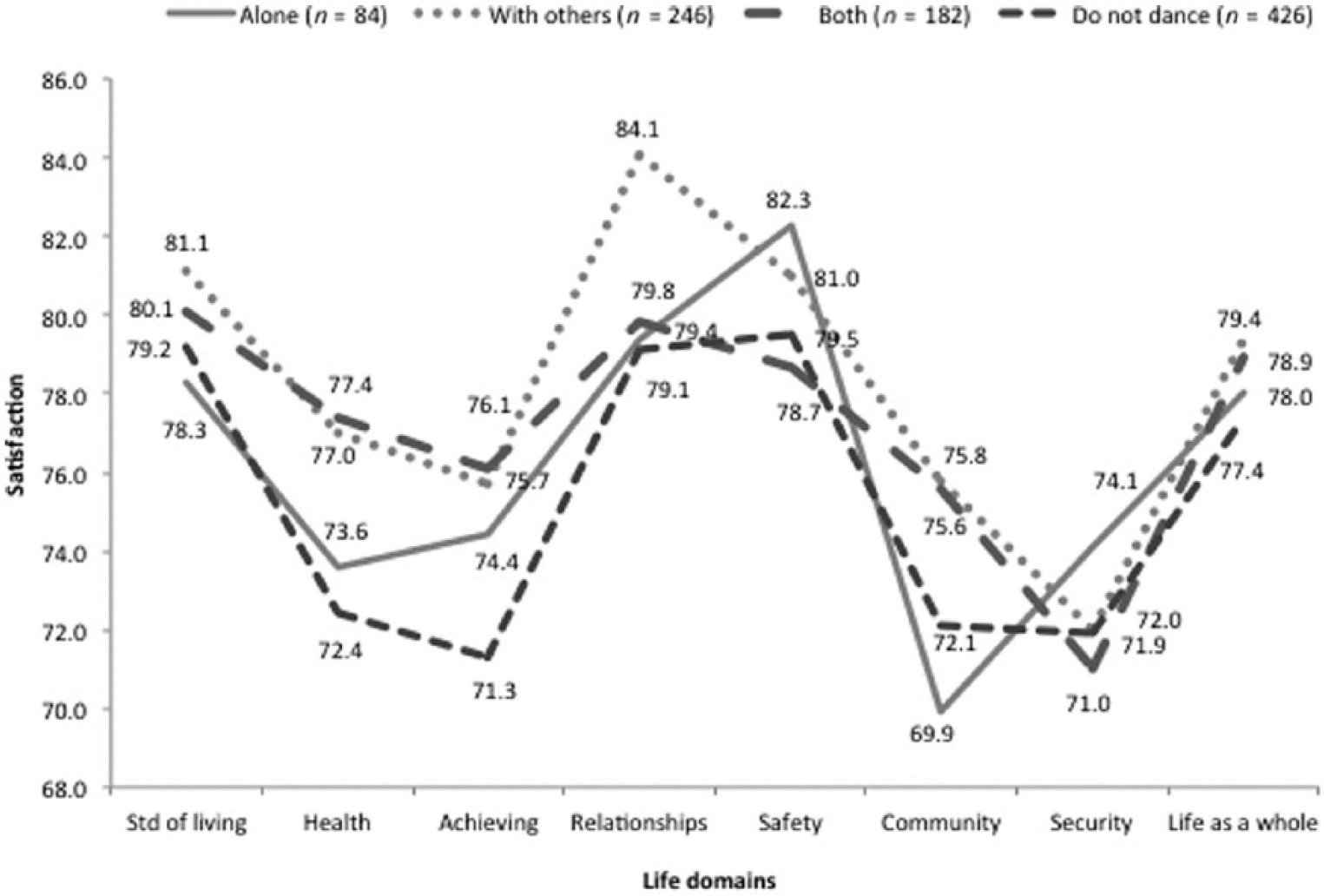
Subjective wellbeing and the social component of dancing.
Figure 2 reveals that people who sang with others had higher scores on almost all domains, though these scores achieve statistical significance for satisfaction with standard of living (p < .05) and community connectedness (p < .01). There were no significant differences in wellbeing for people who sang alone compared to those who do not sing, suggesting that any benefits to wellbeing associated with singing are restricted to those who sing in the company of others. These findings did not change when gender was included in the model.
Post hoc tests revealed that those who reported that they danced with others had significantly higher scores than those who did not dance on the domains of satisfaction with health (p < .01), achieving in life (p < .05), and relationships (p < .01; see Figure 2). Also, males who danced with others reported higher satisfaction with relationships than those who danced alone (p < .05). Those who danced alone reported similar scores to those who did not dance, suggesting that, as for singing, the benefits of dancing for wellbeing are limited to those who dance with other people.
Conclusion
The current study aimed to explore the relationship between engagement with music and subjective wellbeing in the general Australian population. Subjective wellbeing scores were significantly higher for those who engaged with music via dancing or attending musical events, compared to those who did not engage with music in those forms. Further, the social component of music engagement was illuminated in the results, with people who sang or danced in the company of others reporting higher scores on many domains of SWB than those who engaged with music alone.
The primary finding of higher SWB reported by those who dance or attend musical events compared to those who do not is consistent with the proposal that active forms of music engagement offer benefits to wellbeing over passive forms of engagement (Creech, Hallam, Varvarigou et al., 2013). Though Creech et al. suggest that active forms of music engagement encourage emotional expression and facilitate the development of confidence and self-esteem, the relationship between SWB and music engagement is actually bidirectional. For example, it is equally plausible that those experiencing higher than average levels of SWB tend to dance and attend music events more frequently in celebration of their good mood, as it is that dancing and attending musical events are precursors to higher wellbeing. The domain profiles of the different groups compared to those who do not engage with music offer a deeper layer of insight into the nature of these relationships.
People who danced reported higher scores on four of the PWI domains than those who did not dance: satisfaction with health, achieving in life, relationships, and community connection. The finding that health satisfaction was significantly higher for those who danced compared to those who did not implicates a physical component of musical engagement. For example, dancing may be a form of exercise that contributes to better perceived health. This finding is consistent with Koch et al. (2014) who revealed an association between dance movement therapy as an intervention and subjective health or perceived health-related quality of life. Though this association seems well established, it should also be noted that only those who are physically capable may have the functional ability to dance. This bias introduces an element of distortion to the results and suggests that they be interpreted with caution.
The higher scores recorded for the interpersonal domains of relationships and community connection hint at the relational component of music engagement, which is further supported by the subsequent finding that dancing with others is associated with greater SWB benefits than reported by those who did not dance.
With regard to attending musical events, significant differences emerged on the domains of standard of living, achieving in life, relationships, and community connection. The finding that participants who attended musical events reported higher scores on satisfaction with their standard of living and achievements implicates a financial component of musical engagement. In Australia, attending musical events is costly, and may be a privilege afforded to those who earn a higher income. Attending musical events was also associated with the interpersonal domains, further highlighting the social component of music engagement. Consistent with the findings of Packer and Ballantyne (2011), music constitutes a means of engendering commonality with peers that fosters a sense of belonging (Gregory, 1997).
In further support of the relational aspect of music engagement, higher scores on some domains were recorded for those who sang or danced in the company of others compared to those who did not engage with music in those forms. Interestingly, engaging with music in either form alone offered no advantage to SWB compared to those who did not sing or dance. Thus, the benefits of engaging with music by either singing or dancing appear restricted to those who do so in the company of others, consistent with the findings of Lamont (2011) who revealed that being amongst other people was important for the impact of the music experience on wellbeing. This highlights an important feature of the music experience that should be factored into future studies.
The emotional regulation feature of music may be best understood through the social connections it facilitates. The communal interaction and social medium may offer people a sense of purpose and belonging (Creech, Hallam, Varvarigou, & McQueen, 2014), and singing has been especially noticed as a mode that brings people together, offering social support and improving their wellbeing (Theorell, 2014). Specifically, shared music making (i.e., through singing) provides a sense of personal and group fulfilment for membership, creating a strong sense of social cohesion and community (Joseph & Southcott, 2014, 2015). Further, people often participate in music-making activities like singing, playing instruments, dancing or attending concerts to counteract loneliness, social isolation and negative feelings, which are all negative correlates of SWB.
These findings provide insight into habitual music engagement and SWB in a representative Australian sample, and may also be of interest to other Western cultures where accessibility to music is common and frequent, and where SWB is stable. In addition, though some subtle findings emerged with regard to gender, these were not consistent and so it would be premature to draw conclusions regarding gender differences in music engagement and SWB.
Despite this insight, the study has some limitations. In a general population sample such as this, the majority of participants would be expected to be experiencing a level of SWB that closely resembles their set point. Thus, any interpretations associated with emotional regulation should be treated as tentative, because there may be no deregulation in effect. Subsequent studies could distinguish between state-based mood and trait-based mood (HPMood; Cummins, 2010) to better understand how music engagement is involved in mood regulation. Saarakallio and Erkkilä alluded to the distinction between moods and emotions in their 2007 study, though their study subsequently focused on mood regulation.
Further, this study is only correlational in nature, and no causal explanations can be drawn. Though this is important to recognise, the aim of the study was not to disentangle a directional relationship, with the benefits of music interventions already well established. In addition, the use of yes/no questions regarding engagement with music in various forms is bidimensional, and neglects to acknowledge the frequency of music engagement. Given that some studies have shown that the benefits of music engagement for wellbeing are moderated by the frequency of engagement, this is important to consider in future studies. This feature was not overlooked in the present study, but it was not possible to incorporate it into the questionnaire due to the need for brevity with the telephone surveys. Finally, the study did not differentiate between people who were musically talented or not. It is assumed that in a general population sample, the majority of participants might have affirmed that they sing even if they just sing in the shower, or sing along to the radio. This is obviously quite different to people who sing with deeper intention, such as to relax or practice a skill. The same applies for dancing, where some may dance only on celebratory occasions, while others attend a regular dance class. These features associated with the reasons people engage with music should be teased out in further studies.
This study provides insight into the relationship between SWB and general music engagement in a subsample of the Australian population, and provides an impetus for further exploration. In particular, international research has considered the importance of time use for subjective wellbeing (e.g., Krueger et al., 2009), and so the voluntary versus intentional engagement with music as a leisure activity could be an avenue for investigation. With continued accessibility to music through different means as technology improves, the musical environment is dynamic and constantly changing. Future research may even come to consider the effects on wellbeing of engaging with music in a virtual or simulated space, where the social component of music engagement may be mimicked artificially. The findings herein appear to advocate for the social and physical elements of music as being associated with higher wellbeing.
Footnotes
Funding
The authors received no financial support for the research, authorship, and/or publication of this article.