



Abstract
This article reports a qualitative study investigating the factors affecting confidence levels amongst adult amateur choral singers. Three focus groups (involving a total of 18 participants) and 16 individual interviews were carried out with experienced choral singers, and over 40 hours of recorded verbal data were collected. The research aims were to explore the lived experience of choral singers; to examine the main influences on choral singers’ perceptions of their voices and performance ability; to identify factors affecting their confidence as choral singers; to extrapolate confidence-building strategies for amateur choral singers. One of the major emergent themes was choir configuration, which encompassed the spacing between singers, the layout of the choir, the position of the individual singer within the choir, and the position of the choir within the venue. All of these elements reportedly had effects upon the confidence of choral singers during rehearsal and performance. These findings have practical implications for leaders of amateur choral ensembles, as choir configuration may be used as one of the tools for building collective and individual choral confidence.
Although participation in amateur choral ensembles is one of the most common ways of accessing the benefits of musical engagement (Pitts, 2005), research into this area of musical activity has been relatively sparse. “Novice” or non-expert musicians have been largely absent from earlier studies (Smith, 1997), and it is still the case that, with a few notable exceptions (Pitts, 2004, 2009; Stebbins, 1996, 2004), amateur choral singers have rarely featured in published research. Arguably, many amateur singers cannot be classed as “novices”, as they have often acquired a wide range of musical skills, knowledge and performance experience, and may therefore be viewed as being strongly committed to an amateur “career” in music (Stebbins, 1996, 2004). However, research has tended to concentrate on college students (Nielsen, 2004; Sichivitsa, 2003) and professional ensembles (Lim, 2014) rather than exploring the feelings, perceptions and experiences of the large number of amateur choral singers who contribute to musical culture in Western society. This research project was initiated partly in order to focus attention on this neglected sector of musical participants.
The spectrum of benefits of choral singing includes improvements in physiological processes (Beck, Cesario, Yousefi, & Enamoto, 2000; Kreutz, Bongard, Rohrmann, Hodapp, & Grebe, 2004), general health and well-being (Mellor, 2013), psychological well-being (Clift & Hancox, 2010; Judd & Pooley, 2014) and social cohesion (Faulkner & Davidson, 2006; Parker, 2010). The therapeutic effects of group singing have been found to be particularly salient for adults with physical or mental health problems (Dingle, Brander, Ballantyne, & Baker, 2013, Eades & O’Connor, 2008), and choral participation can reduce social isolation in elderly or disadvantaged groups (Bailey & Davidson, 2002, 2005; Creech, Hallam, McQueen, & Varvarigou, 2013).
Although the literature on the benefits of group singing is compelling, choral activity is not always entirely free from negative experiences related to social interactions, leadership issues, conflicting expectations and performance stress (Kreutz & Brünger, 2012). There is also evidence that some adult amateur singers are adversely affected by confidence issues, which can have a negative impact upon their enjoyment of group singing, and can limit their choral participation (Bonshor, 2002). In instances where low confidence affects the level or extent of choral engagement, the social capital (Ruud, 2013) and community development (Murray & Lamont, 2012) related to choral participation, as well as the personal benefits that individuals derive from ensemble singing, are likely to be reduced.
In the related field of music performance anxiety (MPA), the majority of studies have concentrated on “advanced” musicians (Papageorgi, Creech, & Welch, 2013), such as professional instrumentalists (Abel & Larkin, 1990; Kenny, Driscoll, & Ackermann, 2014), and tertiary-level music students (Hamann & Sobaje, 1983; Kenny, Fortune, & Ackermann, 2013). Where MPA amongst adult singers has been explored, the emphasis has tended to be on professional soloists (Spahn, Echternach, Zander, Voltmer, & Richter, 2010; Wilson, 1994). Where choral singers have been studied, participants have usually been drawn from professional choruses (Kenny, Davis, & Oates, 2004) or semi-professional ensembles (Ryan & Andrews, 2009).
In related areas of psychological research, such as performance in sport (Hays, Thomas, Maynard, & Bawden, 2009) or academic achievement (Pajares, 1996), confidence issues have usually been explored within the framework of self-efficacy, which is “concerned with judgements of how well one can execute courses of action required to deal with prospective situations” (Bandura, 1982, p. 122). The terms “confidence” and “self-efficacy” are generally used interchangeably (Vealey, Hayashi, Garner-Holman, & Giacobbi, 1998), and this convention has been followed in the current study.
Self-efficacy is most commonly discussed in individual terms, but a sense of collective or group efficacy can develop in organisational settings (Pajares, 1996). This can have a profound impact upon the group as a whole as well as upon individual members, and can influence motivation and commitment, collaboration and cohesion, resilience and accomplishment (Bandura, 2000). Shared efficacy beliefs, like personal efficacy beliefs, are malleable to some extent; they can be influenced by personal mastery experiences, peer modelling, verbal encouragement, and the interpretation of physiological and psychological arousal (Bandura, 1977).
High self-efficacy is associated with high achievement in music (McPherson & McCormick, 2006), and perceived musical self-efficacy is often “the best predictor of actual performance” (McCormick & McPherson, 2003, p. 37). As with previous research on MPA, studies of musical self-efficacy have tended to concentrate on college students (McCormick & McPherson, 2003; Nielsen, 2004; Ritchie & Williamon, 2011a; Sichivitisa, 2003), primary children’s self-efficacy for music learning (Ritchie & Williamon, 2011b), and collective efficacy amongst music students (Hendricks, 2014). Self-efficacy research amongst adult amateur singers is, so far, relatively limited. This research project was therefore designed with the following aims:
- To explore the lived experience of amateur choral singers in relation to confidence;
- To identify some of the main influences on amateur choral singers’ perceptions of their vocal ability;
- To highlight some of the factors affecting amateur choral singers’ confidence in their performance ability;
- To extrapolate strategies designed to manage confidence issues amongst amateur choral singers.
Method
Due to the intrinsically subjective nature of self-reported confidence levels, and the personal nature of the voice as an embodied instrument (Thurman & Welch, 2000), a qualitative methodology was felt to be most appropriate for this research. Since the priority in this study was to give adult amateur choral singers a “voice” in the research process, semi-structured interview schedules were used, allowing the interviewee to be treated as the “expert on the subject” and given “the maximum opportunity to tell his or her story” (Smith, 1995, p. 12). This facilitated a relatively collaborative approach, allowing the singers to participate in guiding the interview, and to introduce themes which may not have been foreseen during the research design.
Interviews were carried out with three focus groups, involving a total of 18 choral singers. The first two focus groups consisted of female singers (12 participants in total), whilst the third was a group of experienced male singers (six participants). A further 16 individual interviews were carried out, with eight female participants and eight male participants. Focus groups were seen as a useful supplement to the individual interviews, as, in the relatively “naturalistic” setting of a group discussion, “the group context may actually facilitate personal disclosures” (Wilkinson, 2004, p. 180), and interactions between participants (including challenges and disagreements, as well as finding areas of common ground) can “generate elaborated accounts” (Wilkinson, 2004, p. 181).
Each interview lasted approximately two hours, so that more than 40 hours of recorded verbal data were collected. The interviews were transcribed and subjected to an inductive process of interpretative phenomenological analysis (Smith, Flowers, & Larkin, 2009). Emergent themes and significant issues were identified from within the data, and were then categorised and organised into superordinate and subordinate themes which reflected the participants’ reported perceptions (Smith, 1995, 2004; Smith, Jarman, & Osborn, 1999). Internal validity was ensured by carrying out post-interview member checks (Maykut & Morehouse, 1994) to verify that the participants agreed with this interpretation of the data.
Purposive rather than random sampling was used to ensure that all participants had sufficient experience of amateur choral singing to facilitate a meaningful discussion (Morgan, 1997). Most of the interviewees had more than five years of choral experience, and 23 participants had over 15 years of experience (Figure 1), and this is reflected by the age range of the participants (Figure 2). All participants had experience of a range of different types of choral singing (Figure 3), including church choirs, choral societies, chamber choirs and operatic societies. All of those who had belonged, at some stage, to an amateur operatic society, also performed regularly with a chamber choir or other form of choral ensemble, in accordance with the main focus of this research.
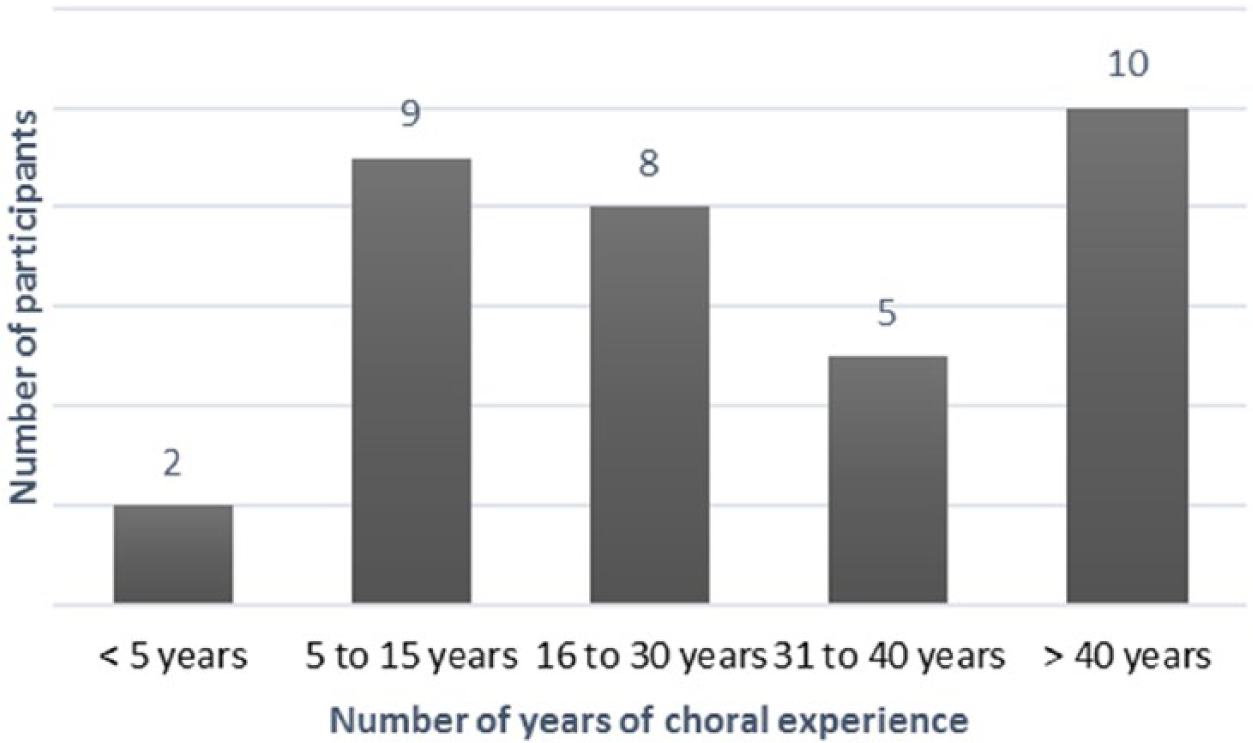
Participants: Years of choral singing experience.
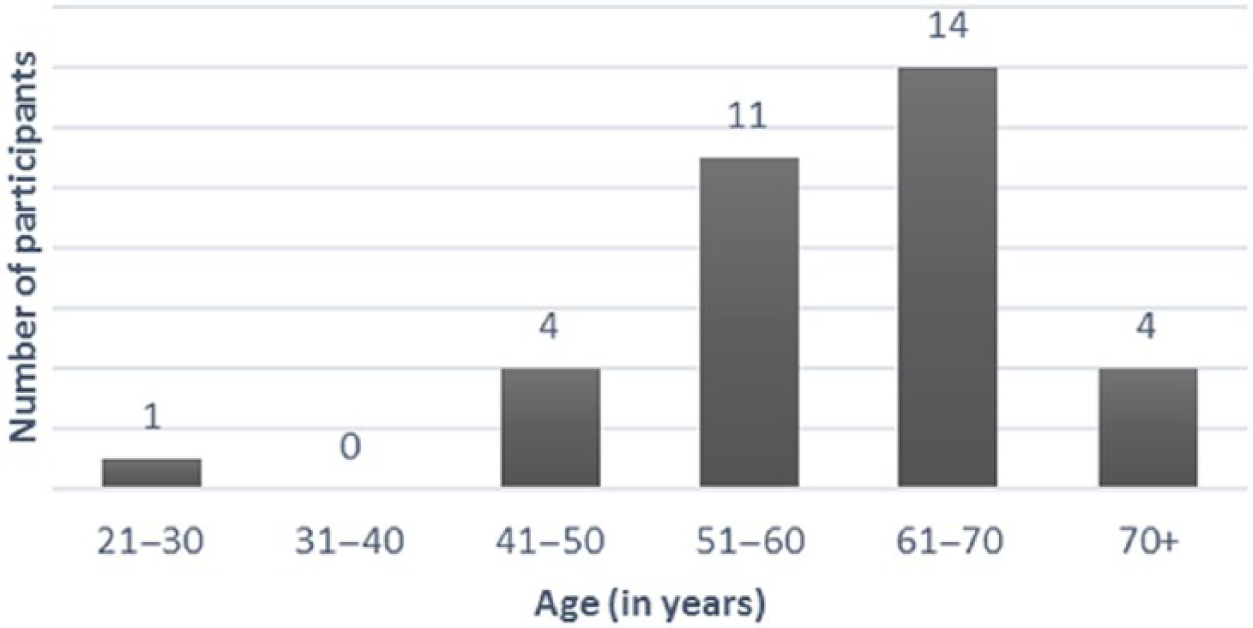
Age of interviewees.
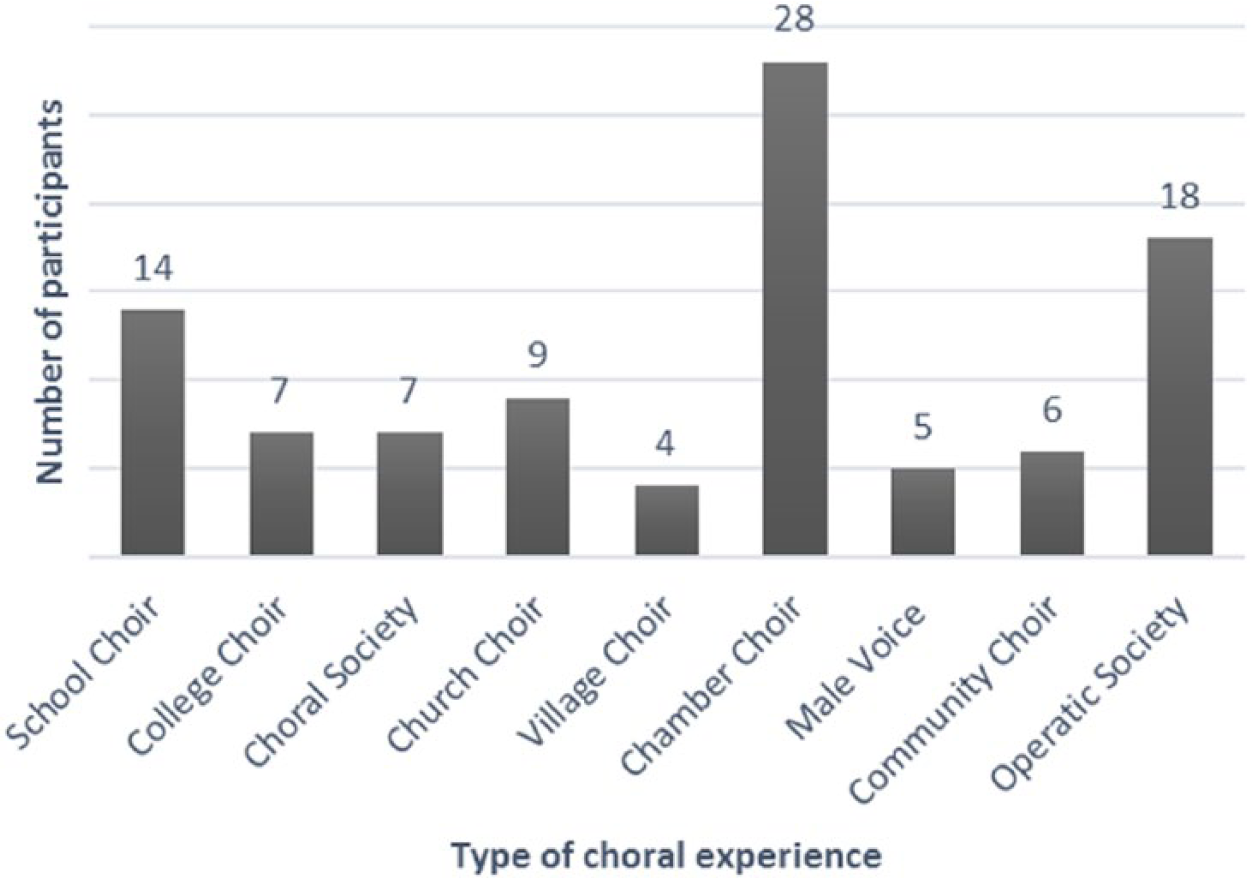
Participants: Types of choral experience.
Many of the interviewees were well travelled and had experience of singing with choirs in several different geographical areas. The combined experience of participants included singing with choral ensembles throughout the UK, encompassing Wales, Cornwall, Devon, Lancashire, Yorkshire, Leicestershire, Rutland, Nottinghamshire, Lincolnshire, Surrey and Hampshire. Despite their keen interest in choral singing, and their extensive practical experience, only two of the 34 participants had continued with any formal musical training beyond secondary school, and the majority reported receiving very little musical education during their school years.
Full, voluntary informed consent was given by all participants, and all data have been anonymised to ensure confidentiality. All individual interviewees are identified only by a number, which is followed by the page number of the transcription from which the quotation is taken. Focus group participants have been allocated a randomised letter to distinguish them from each other. The letter ‘S’ indicates a quotation from a singer participating in an individual interview, and ‘FG’ represents a focus-group extract.
Results
As this qualitative project was data driven, there were a number of superordinate themes which emerged spontaneously from the open-ended interviews. One of the main emergent themes was that of choir configuration and its impact on self-efficacy in choral rehearsal and performance. The theme of choir configuration, as raised by the research participants, encompassed the layout or formation of the choir, the spacing between the singers, the position of the choir within the venue and the position of the individual singer within the choir. All of these factors were reported as affecting the acoustic ambience of the choir, which had an impact upon the confidence levels of the choral singers participating in this study. A recurring theme was the importance of being able to hear their fellow singers, and the interaction of acoustics and choir configuration was seen as having a significant effect upon this.
Hearing and spacing
The subject of being able to hear their fellow singers was raised spontaneously by the participants during all of the focus groups, and in 13 of the 16 individual interviews:
It’s important to me, for my confidence, that I hear – that I can hear the other sections. (S8.33–34)
All focus groups and 11 of the individual interviewees related their ability to hear the other singers, and their associated feelings of self-confidence, to the amount of physical space between choir members:
It’s a lot, lot better if we’re all close together and can all hear each other … you can hear each other. And that gives you confidence as well. (S2.5)
The word “configuration” was used by some singers to describe the spacing within the choir. Closer spacing between singers was seen as helping them to hear other sections of the choir as well as their immediate neighbours, and was felt to add to their subjective comfort when singing:
I’m more comfortable with a more compact configuration, rather than stretched thin […] I think it’s easier to sing with other people. I can hear what’s going on, on each side of me, and I can hear the other parts. (S15.12)
The converse was also true for many participants, as feeling physically distant from fellow singers was associated with feelings of isolation, which adversely affected the performance experience for the singers:
It was awful really, because we were too far apart. We weren’t together – we didn’t feel together. And because you couldn’t hear what the other parts were singing, it was very, very difficult … At the end of it I felt as if I was going through the motions. I didn’t feel as though I was singing with the rest of them. (S11.3)
This sense of isolation, arising from the amount of space between choir members, led to feelings of exposure and insecurity, particularly if the singer felt as if they could only hear their own voice. S14 partly attributed this perceptual problem to the idiosyncratic room acoustics of some venues:
Places like the [concert hall] … the sound leaves you and you feel as if you’re doing a solo for the whole performance. It’s built that way, to go to the audience. […] It’s a very strange feeling, if you sing there. (S14.4)
It was recognised that, in some venues, the size and shape of the performance area can affect the positioning of the choir. If their position reduces the singers’ ability to hear each other, it can then adversely affect their confidence:
If we’re not positioned where you can hear people … I’ve been in quite a few churches … where, if you’re not in the position that you feel happy with, it can just crumble. (S6.4)
Performing outside was seen as bringing particular acoustic challenges and, in this situation, closer inter-singer spacing again reportedly helped singers to hear their fellow performers:
If we’re somewhere like in the open air, it’s really difficult to hear everybody unless we’re really, really close together. (S2.5) Outdoors when you can’t hear it – that’s the biggest danger. So [maybe] there needs to be a tighter formation outside. (S8.34)
In these circumstances, being unable to hear each other was reported as having serious effects on confidence levels, as the resultant disorientation led singers to question their intonation and accuracy, and the quality of the overall choral blend. Being unable to hear the other singers was repeatedly described as leading to feelings of exposure, self-doubt and isolation, and reductions in self-efficacy:
FG3.H: I think the other time that sapped our confidence was when we sang outside. FG3.N: And we couldn’t hear each other […] I think we were all just singing louder and louder, ’cause we thought they couldn’t hear us […] FG3.H: We didn’t feel too good that day! FG3.C: It was as if you were singing a solo. FG3.H: You didn’t know whether you were in tune or not. (FG3.39–40)
Choir formation and communication
Some participants used the word “formation” to describe the layout of the choir within the venue. It was generally felt that choral “formation” can interact with room acoustics and affect the singers’ ability to hear each other, which has an impact upon their self-confidence:
If you’re in an awkward formation, you know or the sound goes up into the ceiling, or you can’t hear them […] I think it affects your singing and therefore affects your confidence as well. (S4.12)
This singer associated the physical layout of the choir with his ability to hear the other singers:
I like it to be in a semicircle. So I can hear the rest of the guys singing. (S4.24)
This identification of the semicircular formation as allowing singers to hear each other was commonly expressed throughout the study:
I like […] it to be quite a tight semicircle really … so you can literally hear the tenors bouncing off you, the basses bouncing off … you can hear everybody around you. (S3.4)
When this formation was not achieved, it was felt that it was more difficult to hear the other singers:
The choir […] form a semicircle and then they seem to drift out of it and move … [draws straight line on table]. By the end of the concert, you can’t hear what anybody else is singing, because they’re singing straight outwards. (S3.4)
The majority of participants expressed similar preferences regarding choir layout. A semicircular formation was linked with improved communication and cohesion, compared with standing in a straight line:
Usually we stand in a semicircle, so with either end more or less facing each other […] We can see each other, and we can hear each other. (S13.15) If you’re in a straight line, you feel very isolated […] But you can actually see and communicate almost with the people the other side – you feel more of a whole – when you’re singing in [a semicircle]. (S2.33)
Choral confidence was commonly reported as being increased by being in a semicircular formation which allowed singers to see each other. In this formation singers were able to provide and receive cues for words and musical entries, and to exchange positive facial expressions and model positive body language, all of which had the effect of raising positive affect:
I still prefer to sing in a flat horseshoe, so you can see other people. It does help to see other people, rather than just sing at the back of their heads […] I think it does help for you to see people’s faces, because if they’re enjoying it as well, or you can see them with the words, and, you know, you can see them breathing. (S4.24–25)
There was also a strong preference for choir formations which allowed the singers to remain within their own vocal sections, rather than singing in “mixed voice” formats:
With the majority of stuff […] then I would sooner stay in the sections, the men’s section or the tenor section, than I would be mixing. (S8.34)
Only three participants, who described themselves as particularly confident performers, reported positive feelings about “mixed voice” formations. The advantages of “mixed voice” layouts were related to perceived improvements in choral blend rather than being associated with any positive effects on subjective confidence levels. In fact, it was generally acknowledged that a higher level of confidence is a prerequisite for using “mixed voice” layouts, due to the musical familiarity and independence required on the part of each singer:
[Conductor] quite regularly will say […] ‘I want you all to mix up. I don’t want you to be alongside people in the same part’. And it really is a learning curve, because you have to know what you’re singing, you have to be confident, and you’ve got different voices, different parts all round you, and a completely different sound is made as a result. (S14.22–23)
Consistency of position
Consistency of position within the choir was reported as having a strong impact on self-confidence:
I think, probably if you’re in the same position each week, that’s the right thing to do […] I think uniformity, continuity is important with regards to the rehearsals, but also that the rehearsal then replicates into the concert positions as well. ’Cause I think you do build confidence by singing with the people around you. (S8.29)
The majority of participants had clear preferences for particular positions within the choir, usually based on their ability to hear their fellow singers. These preferences often depended upon which vocal parts were perceived as most helpful in relation to their own vocal line. This bass had very definite ideas about which sections he needed to hear, and also which he preferred not to hear at times:
I think hearing the soprano line helps, ’cause that’s typically the melody and, you know, all the other lines fit into that. That certainly helps […] It’s sometimes a bit easier if you can’t hear the tenors ’cause you will clash. So maybe it’s easier if you don’t hear the one next to you. (S4.24)
Many participants felt unsettled if it was not possible to stand in their accustomed position, often due to the physical constraints of the performance space:
It’s not the singing that’s worrying me, it’s where on stage … And we all feel comfortable in certain positions so, if you can’t get into the position you normally stand in, that can be a bit upsetting. (FG2.K.45)
The confidence derived from consistency of physical position is partly due to the resultant predictability of the acoustic environment:
It’s certainly very helpful that you position yourself in a performance the same as what you do rehearsing. If you’re rehearsing, week in, week out, you know, you just get that feel of people round about you, and it, to my mind, improves the confidence if you can stand in that same position […] ’cause it’s the environment you’re used to – the voices and the sound coming from either side of you. (FG3.C.18)
A number of singers gave examples of performances in which their confidence had been adversely affected by a change of choir configuration when performing at the venue, compared with the rehearsal configuration. Participants were particularly unsettled by changes in position, layout or inter-singer spacing which were perceived as having a negative effect upon their ability to hear their fellow singers:
Last year at the [annual concert] was the most appalling one, because of where we stood, and the acoustics. We just couldn’t hear each other, and everybody was really disappointed that we hadn’t done what we meant to do … It was a way we hadn’t stood and sung when we had rehearsed … We just couldn’t hear each other, and we just didn’t sing well at all. (S5.4)
In this particular instance, both the position of the choir within the venue and the layout of the choir limited the ability of the singers to hear each other. This adversely affected their perception of the quality of the performance, their affective response to the experience, and their perceived self-efficacy:
In the first half we stood on the stage, and in lines, and the basses – not just the basses but all the sections – were sort of interleaved behind each other, so it was a way we hadn’t stood and sung when we had rehearsed. […] We just couldn’t hear each other, and we just didn’t sing well at all […] It was extremely excruciating. Disappointing is too light a word […] That was all about the confidence bit, you know. ‘Ooh, we were awful’. […] People were using words like ‘I’m embarrassed by that’. So that’s the one I just cringe to think of. (S5.4–5)
The use of words such as “worrying”, “disappointed”, “upsetting”, “disconcerting”, and even “appalling”, “embarrassed” and “excruciating”, highlight the emotional impact of the interaction between acoustic perceptions, choir configuration, and perceived performance quality. All of this was reported as having a strong influence upon self-confidence during performance.
It is worth noting that, for the majority of singers, consistency of position was important, not only to maintain their preferred acoustic perspective in relation to the rest of the choir, but also to allow them to stand next to particular singers that they may have come to trust as reliable, in terms of intonation, pitching starting notes, or remembering harmonies:
I always like to be in the same relative position to the other singers all the time, because you get used to that environment, and it’s just comfort, that you’re not going to be next to someone who’s going to lead you astray if you’re not particularly strong on a piece – on holding a line. (S6.6–7)
Rehearsal spaces and performance venues
The impact of changes of position between rehearsal and performance, usually due to factors such as the size and shape of the concert venue, had a negative impact on confidence, particularly when singers had become reliant upon certain fellow choir members for musical cues:
Week in, week out, everyone sits in the same place, for the rehearsal. Then suddenly – dress rehearsal – ‘Ooh! Totally different!’ … So that person that you know always gets that entry – ‘I know she’ll do it’ – you can at least see her or hear her. And it gives you a little bit more confidence. And it’s not there on the performance, ’cause she’s gone somewhere else – she’s down there. And I can’t see her mouth! And that actually, for a nervous singer, is quite something really. (S9.4–5)
The opportunity to acclimatise to the performance venue was seen as a matter of great importance by all participants, with specific reference to dealing with some of the interdependent issues related to choral acoustics and choir configuration. Rehearsing in the performance space reduces potential distractions caused by unfamiliarity with the environment, including differences in the acoustic conditions of the concert venue compared with the rehearsal room. This aspect of preparation was spontaneously raised by the participants in the first two focus groups, and discussed at length:
FG1.K: I find it very useful to go, like, to the church and find out […] where are we coming on, going off […] how much room you’re going to have … FG1.C: And how it sounds as well […] FG1.H: Having the confidence that you know where you are, where you’re going to stand. FG1.K: It’s a security blanket really. (FG1.31)
Many singers shared a desire for more time to become accustomed to the interaction between configurational acoustic effects and the room acoustics in their concert venues, and felt that this would help them to perform more confidently:
Of course, the acoustics change and everything, which is another thing. And sometimes it reverberates, and you think ‘Are we behind? Are the men with us?’ (S9.6) In the [chapel] I find that very difficult. And the noise reverberating. And I’m not confident when I’m in there, particularly about really going for it … the sound is different, and we’re all anxious. (S15.8)
Some singers acknowledged that their preferences regarding spacing, layout and their own physical position within the choir, may be largely due to familiarity:
I think I’m naturally more comfortable when we do a semicircle. But I think that’s because we rehearse as a semicircle. And therefore we do it more often […] So it’s about comfort and practice. (S5.28)
It was suggested that practising in different configurations may help choral singers to prepare for any idiosyncrasies of performance spaces which may affect spacing, position and formation. This may also help to foster a more flexible attitude amongst choir members, as they become acclimatised to a variety of formats, rather than becoming attached to one particular set of configurational elements:
Maybe it’s just lack of experience, that we haven’t done these different … Where it was quite good was when [conductor] said ‘Let’s bunch up as we’re going to do it at the venue’. […] Because we’re not used to it and we don’t do it enough, it always seemed a bit ‘Ooh, where’s [alto], or where’s so and so?’ […] If you’re well practised, and well-rehearsed at singing in different groups, then that is just a variation of what you normally do. (S6.21)
Discussion
This exploration of factors affecting confidence levels amongst amateur choral singers has highlighted a number of significant emergent themes related to the interaction between ambient acoustics and choral configuration. My use of the term “configuration” here reflects its usage by a number of the research participants, and encompasses choir layout and position within the physical environment, individual placement within the choir, and inter-singer spacing. The interaction between all of these acoustic and situational elements was identified as having an impact upon the confidence of choral singers (see Figure 4 for a summary of these interconnected themes).
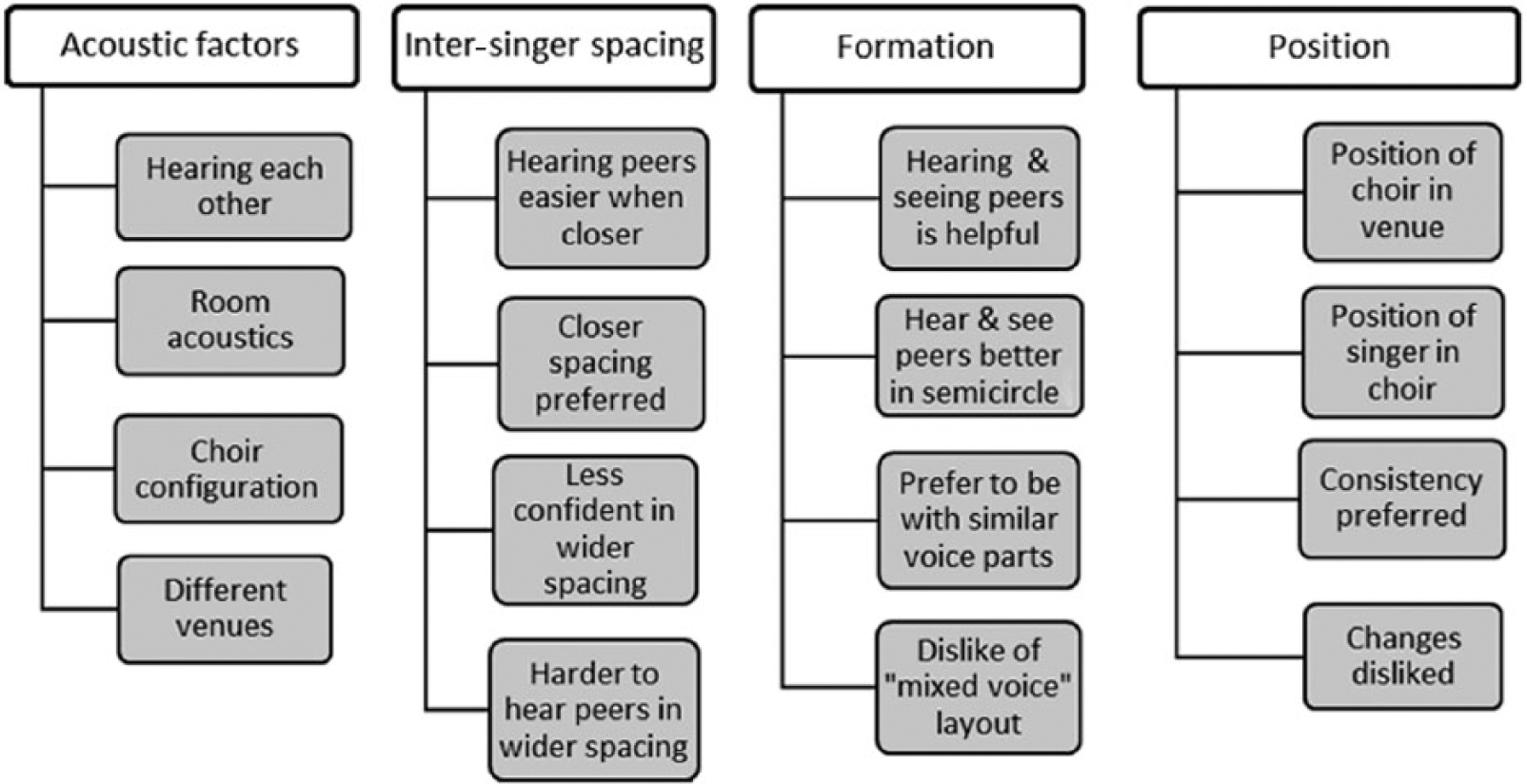
The effects of choir configuration on choral confidence.
The findings of this study differ markedly from the results of previous research in the field of choral acoustics in a number of ways. The relationship between the subjectively perceived audibility of the singer’s own voice compared with that of his fellow performers has been described as the preferred self-to-other ratio (SOR); previous research has established that choral singers generally prefer a SOR which allows them to hear their own voices above those of neighbouring performers (Ternström, 1994). This is usually facilitated by wider inter-singer spacing (Ternström & Karna, 2002), and several studies have confirmed this (Aspaas, McCrea, Morris, & Fowler, 2004; Daugherty, 1999, 2003; Ekholm, 2000). However, for the amateur singers in the current study, their priority was to hear the other singers around them, and they felt that this was facilitated by closer inter-singer spacing, which they therefore preferred.
Other studies have found that the formation (layout) of the choir is less important to singers and listeners than inter-singer spacing (Daugherty, 1999, 2003), and neither individual position within the choir nor the choir’s position within the venue have prominently featured in previous research. The participants in the current study felt very strongly that formation had an effect on whether or not they could hear each other, and that this had an effect on their confidence. They preferred formations which allowed them to see some of their fellow singers; this had a positive impact on their confidence, as it allowed them to receive visual cues and reminders of words. It is likely that the mirroring of positive body language and facial expressions, amongst the singers, increased their feelings of self-confidence (Bonshor, 2014a). Their confidence was also affected by their physical position within the choir, and by the choir’s position within the venue, as they felt that both of these factors affected their ability to hear their fellow singers.
Where preferences regarding layout have been expressed in other studies, the participants have tended to favour “mixed voice” formations, in which they are standing next to singers who are singing different vocal lines, as they prefer the perceived choral blend in this configuration (Aspaas et al., 2004). This is consistent with the opinions of independent auditors, who have similarly preferred the choral blend achieved in “mixed voice” formations (Daugherty, 1999). However, in the current study, “mixed voice” layouts were seen as having a negative effect upon the confidence of the amateur participants, who almost unanimously preferred standing next to singers who are singing the same part. Again, the priority here is clearly the ability to hear other singers who can provide musical reinforcement and moral support.
Consistency of position was an important factor in confidence building, as it ensured a predictable acoustic ambience in relation to the other singers, and enabled singers to receive musical cues from trusted, regular neighbours. This, along with their preference for configurations that allowed them to hear their fellow singers, relates to the fact that a cohesive environment, choral collaboration, peer learning, reliance on peers and unofficial choral team leaders all have an influence on confidence levels in amateur choirs (Bonshor, 2013a, 2013b, 2014b).
There are several factors which may explain the differences between the findings of the current study and those of earlier research into choir configuration. Firstly, the research focus of this study is different from other studies in this field, as my work has centred on the effect of choir configuration on singers’ subjectively perceived confidence levels, whilst earlier research has focused on the effects of choir spacing and formation in relation to the choral sound or blend from the point of view of independent auditors (Daugherty, 1999, 2003; Ekholm, 2000). Secondly, the participants in other studies of the effects of choir configuration have usually been highly trained singers, often being tertiary-level musicians who are voice majors (Aspaas et al., 2004; Daugherty, 2003; Ekholm, 2000). In contrast, the majority of the participants in the current study, despite being very experienced amateur choral singers, had received comparatively little formal musical training. This may partly explain their self-professed reliance on hearing other singers for musical cues and moral support (Bonshor, 2013b, 2014b). Their preference for hearing other singers rather than themselves may also reflect the fact that the voice majors featured in other research may have different priorities due to their identity as vocal soloists in training (Ekholm, 2000).
The qualitative methodology used in the current study is also likely to have elicited more detailed information from the singers about their subjective, affective state, including their confidence levels, in relation to choir formation, position and spacing. Most previous studies have concentrated on the opinions of independent auditors rather than on the subjective perceptions and affective experiences of the singers; when the singers have been asked about their reactions to configurational factors (Aspaas et al., 2004) the questions have tended to be limited to their evaluation of the sound that they made in different configurations, rather than exploring emotional or psychological responses.
Conclusion
This study has raised a number of significant points regarding the relationship between acoustic conditions, choir position and layout within rehearsal and performance spaces, and the placement of individual singers within the choir. The findings diverge from those of previous studies, partly due to the differences in sample, research focus and methodology, as suggested above.
Other researchers have acknowledged that preferred SOR and spacing preferences may vary according to the size of the ensemble (Ternström, 1999) and skill level of the choir members (Daugherty, 1999). The current study indicated that participants’ preferences regarding SOR and choral configuration were consistent, regardless of the size or type of choir under discussion. It also demonstrated that the needs of amateur choral singers, in relation to SOR and configurational factors, differ from those of their counterparts in studies of University and Conservatoire choirs. The differences in results between this and earlier studies are not likely to be due to lack of experience amongst the participants of this study, as the majority had each sung for many years in several different types and sizes of choral ensemble (Figures 1 and 2).
As very few of the participants in this study had received any musical education beyond secondary school, it seems likely that the interviewees’ preference for configurations which allowed them to hear musical cues from fellow singers, may be associated with their lower levels of formal musical training, relative to the sample groups in the studies cited above. An earlier study (Bonshor, 2002) indicated that higher levels of general musicianship, instrumental tuition, and vocal training all had positive effects, for some adult amateur singers, in terms of reducing music performance anxiety and facilitating confident performance. Further research would be necessary to explore whether or not formal musical training is a significant variable in the interplay between confidence, preferred SOR, and affective responses to the acoustic effects of differing choral configurations.
It was beyond the scope of the current research project to carry out a detailed, practical examination of the physical interaction of room acoustics, choir acoustics and configurational factors. Future research might take a more experimental, comparative approach towards examining the relationship between configurational aspects of choral performance and amateur singers’ confidence levels. This could be facilitated by using empirical methods to measure different inter-singer spacings, and by analysing the acoustic effects of different choral configurations in a variety of environments, with particular reference to their impact on confidence levels in amateur choirs. Affective responses to the differing conditions could be assessed using comparative self-efficacy scales (Bandura, 2006), although measuring collective efficacy may be problematic (Bandura, 2000) due to the likelihood that group processes and influences are inextricably intertwined with the personal characteristics, perceptions and behaviour of individual group members.
My findings indicate that choral confidence levels may be improved by more thorough preparation of singers for unfamiliar or idiosyncratic acoustic environments. Many participants felt that more rehearsal time in the performance space would help to accustom them to the acoustic properties of the venue. However, this is not an infallible solution to their perceptual difficulties; the amount of reverberation is reduced once the audience has arrived (Ternström & Karna, 2002), which can add to the singers’ sense of auditory confusion. Nevertheless, the participants reported an increased sense of security derived from opportunities to:
- Practice entries and exits at the concert venue.
- Adapt to any changes that needed to be made to choir formation, position or spacing, due to the size and shape of the performance space.
- Acclimatise, as far as possible, to the conditions created by the interaction of the room acoustics, choir acoustics and the effects of choral configuration.
On a practical note, it is acknowledged that spending more time rehearsing in performance venues may not be possible for many amateur groups, due to budgetary constraints; the cost of booking extra rehearsal time in performance venues can be prohibitive for ensembles with limited funding. However, there might be beneficial outcomes from explaining what might happen acoustically in different venues, plus clear contingency planning, including demonstrating strategies for dealing with problematic or unusual acoustic environments. Other practical approaches might usefully include encouraging a more flexible attitude to configurational changes, and providing a range of different acoustic experiences. This could be achieved by rehearsing in a variety of layouts and positions within the rehearsal space, and by allowing more time for practising in “concert formation” (i.e., with the spacing and choir layout that will be used in the performance venue) as well as, where possible, dedicating more time to acclimatising to the acoustics of different environments.
Finally, other studies relating to choir configuration have tended to prioritise choral blend from the point of view of conductors and audiences (Daugherty, 1999, 2003; Ekholm, 2000), rather than examining the impact of interrelated configurational and acoustic effects upon the perceived self-efficacy of the singers. This approach is understandable, for purely aesthetic and artistic purposes, but a more confident performance is, arguably, likely to be a more competent and enjoyable performance for all. There is unlikely to be a universal solution when considering the effects of choir formation, position and spacing; SOR preferences can be affected by room acoustics and reflectors, the size and composition of the choir, and individual differences in vocal output (Ternström, 1999). However, configurational aspects of amateur choral performance are worthy of careful consideration, not only in relation to creating a musically pleasing choral blend for the audience, but also in terms of creating a confidence-building acoustic environment for the singers.
Footnotes
Ethical approval
This project was subject to the University of Sheffield’s ethics review procedure, and formal ethical approval was granted prior to commencing the research process.
Funding
The authors received no financial support for the research, authorship, and/or publication of this article.