



Abstract
Music can promote emotion regulation in individuals exposed to trauma and stress and may support positive parenting behaviors. The primary aim of the current study was to examine the use of music in the lives of a sample of expectant mothers and fathers (N = 102), who were considered at risk for insensitive parenting due to exposure to environmental and psychosocial stressors. Interviews probed childhood memories of music, current engagement with music, and parental plans to share music with their infants after birth. Using principles of grounded theory, a thematic coding process was employed. Findings highlight the relationship-salient and culturally embedded nature of music in the lives of these parents. Parents described the intergenerational transmission of musical family traditions. They recalled memories of music, which were linked in important ways to the central caregivers in their own early lives and described their intentions to use music in similar ways when caring for their own children. Parents also described the fundamental integration of music within their communities and culture. Findings suggest that promoting parental use of music to soothe and care for their children may be one cost-effective intervention technique that supports feelings of parental competence and parent–infant connection.
The use of music to soothe, entertain, and connect with infants and young children is ubiquitous across cultures and throughout human history (Trehub, 2003). These musical interactions within families and communities aid infants and children in learning socio-cultural meaning and practice (Barrett, 2005, Vygotsky, 1978), support daily familial routines (Addessi, 2009), and strengthen affiliation, belonging, and connection (Young, 2005). Music can elicit shared emotional responses among members of one’s family and community (Trehub, 2003) and, therefore, has the potential to promote a positive parent–infant relationship (Malloch & Trevarthen, 2009). Despite its potential to promote positive early relationships, musical parenting represents a relatively new domain of study (Custodero & Johnson-Green, 2008), especially in underprivileged groups. Further, the majority of studies have examined musical parenting only in mothers. The current study is unique in that it includes both expectant mothers and fathers, and asks them to openly reflect on their engagement with musical experiences, past, present, and future. The sample is comprised of parents in the third trimester of pregnancy who have relatively high rates of exposure to interpersonal and community violence. By listening to these parents directly, there is an opportunity to gain a new sense of how musical transmission might adaptively influence relationships across generations even in the face of contextual adversity.
The intergenerational transmission of music within parent–infant relationships
Music’s communicative features are a way for parents to share emotions, intentions, and meaning (Hargreaves, MacDonald & Miell, 2005; Ilari, 2005) and are transmitted not only through the properties of sound, but by social exchanges and personal significance (Cross, 2001). Referred to as, “communicative musicality” (Trevarthen, 1999/2000) and “affective attunement” (Stern, 1985), parent–infant interactions that involve connecting and responding in a melodic fashion to each other confer positive effects on infant development (e.g., Custodero, 2006). Specifically, parents use lullabies and play songs to comfort, convey cultural values, teach, support family routines (Addessi, 2009; Custodero, Britto, & Xin, 2002; Ilari, 2005) and support emotion regulation in their young children (Creighton, Atherton & Kitamura, 2013).
Parents also use music to share culture across generations by passing down specific singing practices of their own parents and to create new family traditions by utilizing and incorporating the music of present day popular music (Custodero, 2006). For example, immigrant mothers reported listening to and singing lullabies, rhymes and songs of their culture in their native language more often than songs of their new nation (Ilari, 2005). Furthermore, parents with memories of being parented musically and who participated in music making were more likely to sing to their own infants (Custodero & Johnson-Green, 2003). These songs are a way to create emotional connections and associated memories between family members and their extended social communities.
The music associated with these emotional connections serve as reminders of significant people and important events (Schulkind, Hennis, & Rubin, 1999). Infants’ ability to sense the music and language of their cultures helps them learn to communicate with caregivers and others (Ilari, 2005). When parents share music with their children, they are passing down a particular way of relating to others (Boer et al., 2011) and signifying daily and cultural routines through rhythm and temporal understandings (Addessi, 2009).
Musical parenting and contexts of risk
Past research demonstrates that parents raising young children in adverse environments are at risk for the development of insensitive and harsh parenting (Dayton, Huth-Bocks, & Busuito, 2016; Magnuson & Duncan, 2002). Contextual stressors such as poverty and violence can challenge a parent’s ability to regulate his or her own emotions due to the strain of dealing with everyday issues of safety and survival. For these families, the stress of trying to calm an infant (much less one’s self) may be especially difficult and engagement with music may serve to calm both the parent and the infant during times of parental and infant distress by enhancing feelings of security and connection (Edwards, 2011). When parents and infants are relaxed they are better able to connect with each other, laying the foundation for the development of the parent–child relationship. Within African American communities, music has historically served as a powerful tool for communication and connection in the context of oppression and violence (Koskoff, 2005) and is, therefore, a culturally relevant way in which parents and infants may connect with each other.
The calming effects of music on infants has been well established; infants have the ability to process music as early as the third trimester and respond to various musical tempi (Olds, 1986) and frequency (Lecanuet, Graniere-Deferre, Jacquet, & DeCasper, 2000). Music confers positive physiological effects on newborn infants (Olischar, Shoemark, Holton, Weninger, & Hunt, 2011) and can reduce adults’ physiological stress response (Zimmerman, Pierson, & Marker, 1988). For instance, in a recent study of healthy mothers and infants (Creighton et al., 2013), mothers described feeling calm when singing to their children and they reported a sense of affirmation and increased focus when they could regulate their infant’s emotions through song.
Music and musical parenting in Detroit
The current study was conducted in Detroit, Michigan, United States of America (USA), where music is central to the cultural foundation of the community (McCarthy, 2013). In the 1950s and 1960s, Detroit was a vibrant city with over 1.5 million people, a booming economy, and a musical genre all its own, Motown. The vitality of Detroit’s music scene was fueled predominantly by young African American musicians who received superior musical training within the public school system and were surrounded by world-class music on the streets, in clubs, in their homes, and at church (McCarthy, 2013). Modern day Detroit continues to have a rich musical life including techno and sample-based hip-hop, as well as the vibrant Detroit Symphony Orchestra. Interwoven as it is with the history and everyday lives of the people of Detroit, music continues to connect people to each other and to their shared community.
In contrast to its vibrant past, however, Detroit’s current socio-economic climate includes high rates of unemployment and community violence. As a result, many Detroit parents struggle to provide for the basic needs of their children and to keep them safe within communities often plagued by urban blight and violence (Data Driven Detroit, 2012). Based on this background of history, theory, and research, the present study investigated the ways in which expectant mothers and fathers in Detroit who were at risk for insensitive parenting due to exposure to environmental risk (a) recalled their own experiences with music as children; (b) used music in their present lives; and (c) were planning to engage in music with their infants and young children.
Methods
Participants
Data are drawn from a larger study examining the influence of bio-psycho-social-spiritual factors on early parenting processes in pregnancy. Parents were recruited from obstetrics clinics, social services agencies, and local community establishments, and through online advertisements. Inclusion criteria were English fluency, a medically uncomplicated singleton pregnancy, and participation of both parents; however, parents were not required to be in a sustained romantic relationship with each other. One hundred and two expectant parents (51 mothers and 51 fathers) aged 18 to 48 (M = 27.4, SD = 6.5) from the Detroit, Michigan, USA, metropolitan area participated in the study. Two parents (a mother and a father) did not complete the interview due to time constraints during the laboratory session and one father’s interview was not recorded due to technical problems. The current analysis was conducted on 99 interviews.
Procedures
Eligible parents completed self-report questionnaires and were interviewed in a developmental laboratory during their third trimester of pregnancy, a time when thoughts about caring for their infant typically become psychologically rich and elaborated (Slade, Cohen, Sadler, & Miller, 2009; Vreeswijk, Maas, Rijk, & van Bakel, 2014). Interviews were audio-taped, transcribed, and coded from the transcripts.
Measures
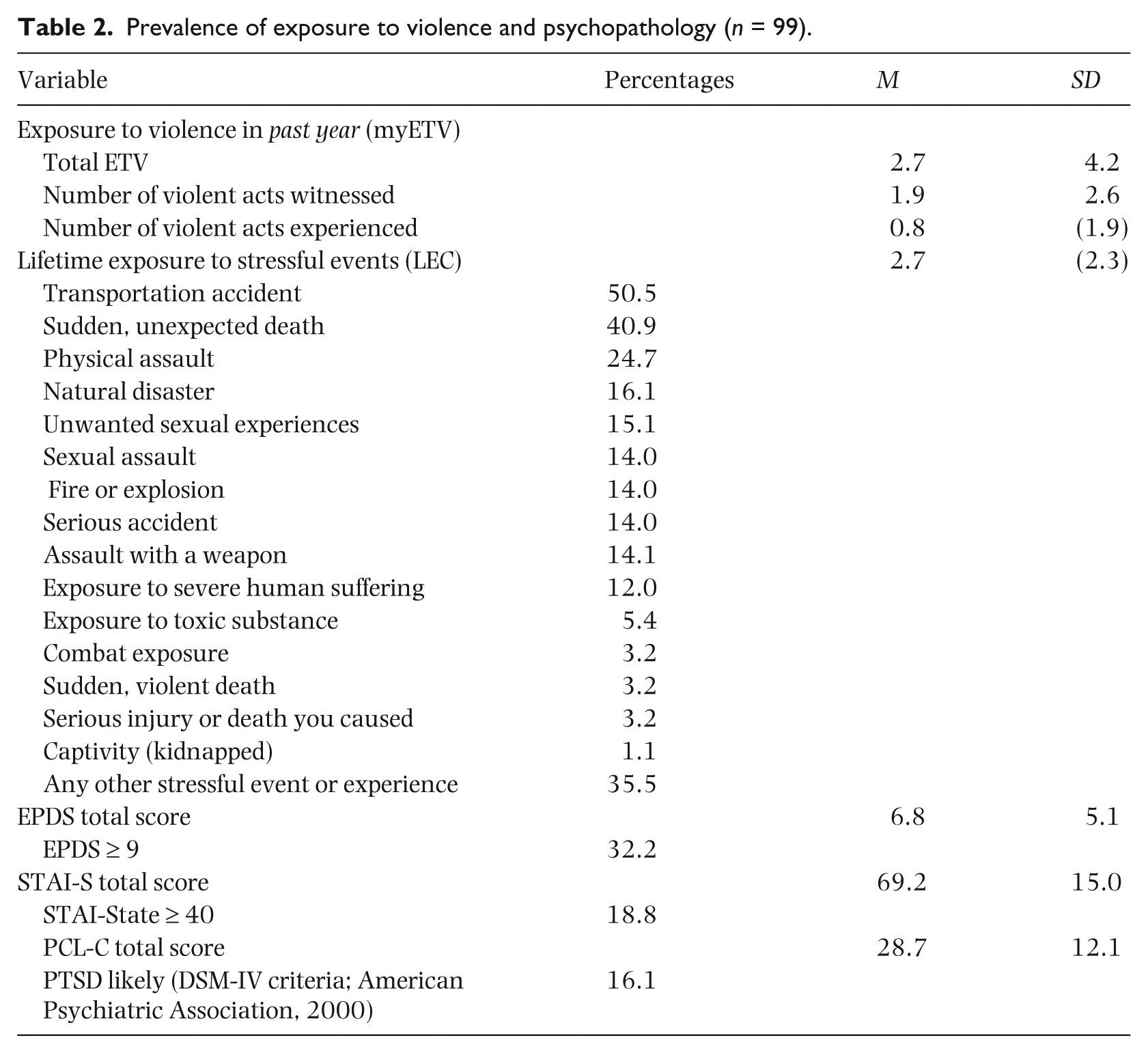
The first five measures listed below were included in the larger study and are presented to characterize and contextualize the sample. Participants completed self-report questionnaires tapping symptoms of psychopathology and exposure to community and interpersonal violence. Summary statistics of the quantitative measures are presented in Table 2.
Edinburgh postpartum depression scale (EPDS)
The EPDS (Cox, Holden, & Sagovsky, 1987) is a 10-item self-report questionnaire assessing depression during the previous 2-week period. Items are scored from 0 to 3 with higher scores indicating increased depressive symptomatology. The reliability coefficient for this study was α = .83.
State–trait anxiety inventory—State (STAI-S)
The state subscale of the STAI-S (Spielberger, 1983) is a 20-item self-report questionnaire measuring current anxiety. Items are scored from 1 to 4 with higher scores indicating increased levels of anxiety. The reliability coefficient for this study was α = .91.
Post-traumatic symptom disorder checklist—civilian (PCL-C)
The PCL-C (Weathers, Litz, Herman, Huska, & Keane, 1994) is a 17-item self-report questionnaire measuring symptoms of post-traumatic stress disorder (PTSD). Items are scored from 1 to 5, with higher scores indicative of higher levels of symptomatology. The reliability coefficient for this study was α = .92.
Life events checklist (LEC)
The LEC (Gray, Litz, Hsu, & Lombardo, 2004) is a self-report checklist that documents lifetime exposure to 17 potentially traumatic events. Events include interpersonal violence and loss, natural disasters, combat-related violence, and accidental incidents that are potentially traumatic.
My exposure to violence scale (MyETV)
The MyETV scale (Selner-O’Hagan, Kindlon, Buka, Raudenbush, & Earls, 1988) assessed whether participants had witnessed or experienced 18 different violent events over the last 12 months. The reliability coefficient for this study was α = .91.
Music interview
Interview questions were designed with the goal of understanding exposure to and engagement with music in the lives of parents of young children living in an urban environment. Participants were asked open-ended questions with follow-up probes about their exposure to music in their own childhoods, current lives, and their future plans to use music with their infants. Interviews were audio recorded and transcribed verbatim. A thematic analysis, drawing on principles of grounded theory (e.g., Glaser, 1978), was conducted which allowed for the participant stories and their lived experiences to be recorded. Grounded theory analysis utilizes an inductive investigatory approach to data analysis. Using a systematic approach to the identification of narrative themes across interviews, data are identified and analyzed in an iterative manner that facilitates theory development (Charmaz, 2006). The transcribed interview data were initially analyzed using open coding. Through a process of identifying and reviewing themes in the narratives, final codes were developed for data analysis and are reported here (Charmaz, 2006). Each transcript was double coded using NVivo software (QSR International Pty Ltd, 2012) by research assistants who were trained and supervised weekly by senior study staff and worked independently to code the data. Discrepancies in the assignment of codes were identified and resolved through consensus. There was an average of 8.5 discrepancies across interviews and the number of discrepancies per interview ranged from 0 to 24.
Characterization of the sample
As described in Table 1, the current sample is considered to be at relatively high risk due, in part, to high rates of unemployment, low rates of marriage, and personal income that is sufficiently low such that 49% of parents are living below the US federal poverty line. In addition, Table 2 presents the quantitative data, which are provided to characterize the sample in terms of rates of violence exposure and symptoms of psychopathology. The participants in this study have experienced relatively high rates of violence exposure and are suffering from moderate to high levels of symptoms of psychopathology (e.g., depression, anxiety, post-traumatic stress disorder [PTSD]). The qualitative findings are presented below and incorporate data from the quantitative measures in order to contextualize each participant’s narrative.
Demographics of participants (n = 99).

Prevalence of exposure to violence and psychopathology (n = 99).
Qualitative findings
Thematic categories are presented next, with representative quotations, and reflect the identification of common themes and underlying constructs across interviews. Data from the measures of violence exposure and psychopathology are used to describe participants whose quotes are presented and to contextualize their experiences. These themes highlight the relationship-salient and culturally embedded nature of music in the lives of these parents.
Relationship-salient connections to music
When describing their exposure to music as children, participants recalled their early relationships with family members and their memories of music within the context of daily family life. As they described their experiences, it became clear that exposure to music was filtered through these early relationships and that current music preferences were often tied to early exposure to music within particular relationships. In almost every case, these memories were positive; participants described feelings of connection that were comforting and pleasurable. Three sub-themes emerged within this meta-theme: (a) memories of music within particular family relationships; (b) music as related to important family events and routines; and (c) their plans to share music with their own infant as part of daily caretaking.
Memories of music within particular family relationships
When asked to reflect on their musical experiences in childhood most of the participants (n = 81) related the experience to at least one particular family member. More than two-thirds of the participants (n = 64) specifically referenced their mother, and one-third of the participants (n = 35) referenced their relationship with their father (or a father figure). Many of these memories brought back joyful feelings and memories of being cared for and comforted through music.
Many participants indicated that their mothers sang or played music for them. When speaking of their mothers, participants often described that music was ever-present in their lives growing up. For example, Destiny
1
was a 20-year-old, unmarried and unemployed, African American, first-time mother-to-be. Destiny’s household income fell below the federal poverty line and she reported that she had been exposed to two instances of violence over the course of the prior year. Destiny described growing up surrounded by music in her home and her community:
[My mom used to play] … like the nursery rhymes and stuff. My mom was a pre-school teacher so … [I would hear music] at home, [and] at church. Every time we went to church … Momma sang to me all the time. Christian nursery rhymes, “This Little Light of Mine,” “Row, Row, Row Your Boat,” “Ring Around the Rosy”…
Participants also recalled music within their relationships with their fathers. Often these memories were tied to particular songs, artists, or genres of music, and participants reported that the music itself held important meaning for them and that their enjoyment of music as adults was tied to their early exposure to music by their fathers. Kyle was a 32-year-old, unmarried, African American, first-time father who was employed full-time. He was living apart from the mother of his baby with some of his extended family members and reported that he had previously been arrested and placed on probation for a year for a crime that he chose not to disclose. Kyle reported that he had experienced two stressful life events but had not been exposed to any violent incidents over the course of the last year. Kyle extracted positive feelings and his personal love of music from an otherwise stressful and upsetting childhood memory of his parents, highlighting how music may be protective in the face of distress for some parents.
It was many, many, many days and nights where [my parents would] get drunk and high playing the damn music … [My dad used to play] a variety of music … rock, jazz, classical music. That’s one thing I can say about my pops though, like I’ve got my love of music from him.
Additionally, music helped many participants connect to their extended family, such as grandparents, aunts and uncles. Participants recalled, for example, their grandmothers singing in church and listening to music on the radio. Alyssa was a 20-year-old, African American, first-time mother-to-be who was unmarried and unemployed. She was living apart from the father of her baby in a home with her parents and sister. She reported experiencing four stressful life events and nine incidents of violence over the last year. She also reported clinically significant levels of depression, anxiety and PTSD. Like many other parents in the study, this quote from Alyssa conveyed the sense that music was ever present in her early life and relationships:
[Music was] … everywhere … It’s like I heard different kinds of music. My granddaddy played blues, my aunts played hip hop, my brother played rap. My sister always played R&B, so we [would] listen to a lot of music growing up. My mom … always had all the albums and stuff like that …
Music as related to family routines and events
Participants remembered music as associated with important family events and routines during childhood. They described that their parents would use music to cue daily routines (n = 44) such as initiating chore time (n = 22) and soothing them at bedtime (n = 16).
Shawn, for example, was a 28-year-old, African American father of one. He was unmarried, unemployed and living below the federal poverty line in a home with the mother of his baby and her four children. He reported lifetime exposure to three significant life stressors and was suffering from clinically elevated levels of depression. Shawn also reported that he had served a 5-year sentence in prison for a drug-related charge. In reflecting on his childhood, he described how he could assess his mother’s actions by listening to the music she was playing first thing in the morning:
When I was a kid music was used in all types of ways … like when I first woke up in the morning and I heard music, I knew [that] my mom [was] up … and I could pretty much tell you what she’s doing by the type [of music] she’s playing. Some music is like, “oh that”s the cleaning music,” … some music is the … you know, it might be “something on my mind music” … or [the] “just sitting” music …
Other participants remembered music as associated with completing household chores or a bedtime routine. Kiara, a 35-year-old, African American, married mother of one with no reported exposure to violence and no significant symptoms of psychopathology who was employed full-time, put it this way:
[We used to listen to music] at least once a day … we always heard something. On Saturdays, my mom would always play something while we were doing our chores, so that was something that always stuck with me was like that musical presence.
Sharing music with their own baby as a part of daily caretaking
All but two of the parents identified specific ways that they planned to use music with their babies (n = 97). Most parents described their plans to use music to connect with their infants—both within the establishment of family routines and as a daily caretaking strategy. Several parents mentioned their plans to share music with their children to facilitate family routines during the early childrearing years. John, for example, was a 28-year-old African American married father of two who was employed full time and did not endorse violence exposure or symptoms of psychopathology. He put it this way:
I haven’t really thought about it, but definitely during certain times, like during nap time, [I might] play a certain song or when we’re about to eat, you know, just so I kinda get him on a schedule so that he knows … even if it is a different part of the day, like if I can’t feed him at three o’clock, [if] it’s like seven, just the song will kind of put him in that mood maybe.
The vast majority of parents in this sample described their plans to use music as a caretaking technique with their infants. Shawn, for example, described his belief that music would be a useful tool in caring for his baby, even though he wasn’t sure exactly how he would implement it.
Music will play a part … music does play a part because sometimes you might have been done everything like and you [are] just sit[ting] and rockin’ the baby … you just doin’ everything and none of that’s workin’ and the music … like just come on and [the baby just becomes] quiet … just sittin’ there … So, music will play a factor, but, like I said, I couldn’t really put a finger on like when, where [and] how of importance it will be.
Emotion regulation through music
When reflecting on the ways in which music was a part of their lives, many of the participants described music as a powerful regulator of emotions. This included memories of their own parents using music to soothe them (n = 16), their current use of music to relax when they were feeling “stressed” (n = 34), to change their mood when they were sad or upset (n = 33), and their plans to use music to help soothe, calm, and care for their own baby after birth (n = 78). Thus, three generational themes were evident within this meta-theme: (a) memories of their own parents using music to soothe them when they were young; (b) engagement with music as an emotion regulator in their current lives; and (c) their plans to use music to soothe and calm their own infant after birth.
Memories of being soothed by their own parents using music
Many participants indicated that their parents sang or played music for them as a form of soothing to help them calm down when they were upset. Sarah was a 32-year-old, Caucasian, first-time mother-to-be. She was married and employed full time with a significant history of exposure to lifetime stress and community violence and clinically significant symptoms of anxiety. Sarah described her mother’s use of music to soothe her when she was a child:
[My mom used to sing] lullaby songs or like comforting songs [to me]. So, it’s like if I was havin’ a bad day, my mom would sing, … I don’t remember what songs, but I remember … an incident where I was upset when I was a kid, that my mom was like singing to me and trying to get me to calm down ‘cause I was really upset about something …
Jordan, a 26-year-old, African American father of one, was unmarried, unemployed, and living below the federal poverty line. Jordan reported clinically significant symptoms of depression and PTSD. Although he did not report exposure to violence, he did share that he had served one month in jail for aggravated assault. Jordan recalled that both his mother and his grandmother used music to help soothe him and put him to sleep.
My grandma and mom [played music for me] many times. I’m pretty sure they found out that’s what calmed me down, [so] they [would] take me and try to rock me to sleep.
Current engagement with music as an emotion regulator
Just as they could recall their own parents using music to soothe them, many parents reported that they currently used music as an emotion regulation strategy—to match their mood or calm themselves down, for instance, when they were feeling distressed. In describing her use of music as an emotion regulator, Sarah explicitly referenced her own mother’s use of music:
I think music is … and I would say that’s something that my mom taught me is … it’s kind of a coping skill. So, if I’m having a really angry day, I’ll listen to something either really relaxing or I’ll listen to … I would call it “angry music” like Eminem or something, but just to kind of like get it out. Or, if I’m unhappy, maybe I’ll listen to “happy music,” so I kind of use music as a way to … work through my feelings, whatever they are …
Steve, a 24-year-old, Caucasian, first-time father-to-be, was married and employed full time and endorsed only one lifetime stressor and no mental health problems, described his use of music to help himself regulate his emotions:
Music is a good outlet; you know … it helps calm you, it helps you get through things if you’re having a tough time. Music and certain kinds of songs can help you. So, I can say that all my life I used music as some sort of outlet or resource …
Plans to use music to soothe and calm their own infant after birth
Many parents described their plans to use music to soothe and calm their infant when he or she became upset. Often, expectant parents indicated that they planned to sing lullabies and nursery songs to their infants. Several mentioned they would try to sing songs they remembered from childhood. Others didn’t have particular songs in mind but commented that they would sing familiar songs that they liked or that they would make up songs. Many parents believed that music would help their infant regulate their emotions and relax. John put it this way:
Yeah, [I’ll use music] to soothe her if she’s crying or something. [It will] make her feel warm and comfortable, just [to] hear a sweet sound. So yeah, but maybe I’ll use some baby music too, like the ocean music or birds chirping, but … it’ll probably be like some nice soul … sweet music.
Similarly, Maria, a 19-year-old, Latina, first-time mother-to-be, who was living under the federal poverty line and endorsed exposure to five lifetime stressors and clinically significant symptoms of PTSD, had this to say:
I think music will calm him down … Like, say he’s having a tantrum or I gave him everything so he’s crying for absolutely no reason … I’m just gonna put some music on and eventually he’ll tune in with it and just stop crying.
While the majority of parents described playing music for their babies on the radio or an audio player (n = 45) or on their phone or mp3 device (n = 29), for example, some parents described an active approach to using music with their babies—either by rocking or dancing to the music with them (n = 11) or by singing to them (n = 76). Mario, a 28-year-old, Caucasian, father of two, who was unemployed and living below the federal poverty line, put it this way:
[I’ll use music] to soothe her when she’s crying and upset … to rock her and play the music … you know, [to] hold her and rock her back and forth and let her hear the song to calm her down.
Family, community, and cultural context of music
In reflecting on their own upbringing, many participants described being surrounded by music in their homes (n = 74), in the car (n = 48), at church (n = 33), and at school (n = 24). Three sub-themes were evident in this meta-theme: (a) music passed down as a tradition within their extended families; (b) music as expressed and experienced within their community; and (c) the cultural significance of music in their lives.
Music passed down as a family tradition
Some parents described the intergenerational transmission of music that they planned to initiate by using music with their infant in the same ways in which music was used with them. Dante was a 29-year-old, African American, father of one who was unmarried, employed full-time but living below the poverty line in a household apart from the mother of his baby. He endorsed five incidents of significant lifetime stressors, two incidents of violence exposure over the last year and had served 1 year in prison for carrying a concealed weapon. He had this to say:
[I will use music with him in] … the same ways it was a part of my life … just [as] a way to show family unity—cuz the music [is] always playing at the barbeque … or [as] a way to calm down when you’re feeling sad [by listening] to a song and bring[ing] yourself up … There’s many different ways music can be a part of your life and I just hope it’s a big part of his life as it was [in] mine.
Eboni was a 41-year-old, African American, unmarried and unemployed mother of four who was living below the federal poverty line. Eboni reported one incident of lifetime exposure to a significant stressor and one exposure to an act of violence over the last year. She also reported that she had been arrested and served 2 years of probation for fighting. In reflecting on the intergenerational use of one particular song, Eboni had this to say:
I’m sure I will sing all kinds of little baby songs. [There is] a song that we have in our family that everybody kind of sings to the baby—my Aunt made [it] up. It’s a little nursery song, and we all sing it to our babies … and my mom and my aunt sang it to their babies, so it’s kind of like a song that is passed down.
Music as expressed and experienced within their community
There was a sense in these narratives that participants felt as though they were surrounded by music within their community environments. Music seemed to connect them to friends and family. It reminded them of meaningful times, people, and experiences in their lives. Events that involved groups of people gathering together were prominent in these narratives. David was a 29-year-old, African American, married father of two. He was employed full-time and reported minimal lifetime exposure to significant stressors and no mental health problems. He had this to say:
[Music is] like the background music to your life. Like it [doesn’t] matter what I’m feeling, I got a song for it. Whatever I’m going through in my life, I got a song for it. And you know whether it’s good or bad as far as like the music I listen to … I just think it’s a connection in some kind of way kinda like how smells and food and stuff … that can connect you to your memories and bring you back to that point. Like right now if I heard Bobby Brown playing I would just instantly think of my Dad and the Friday night gatherings that he would have.
Music as expressed and experienced within their culture
Many of these parents described music as connected in very important ways to their cultural background and often their religious beliefs and practices were central. Most of the families in this sample reported their religion as Christian-based, and the connection to music within the church environment was a prominent theme. Tyler, for instance, was a 44-year-old, African American father of six who was unemployed and living below the federal poverty line. Tyler reported eight significant lifetime stressors and two incidents of exposure to violence over the past year. He put it this way:
So I heard the music in the church on both sides, I couldn’t avoid the church thing. My mother and father met at the church, got married when they were young so, I guess church would be the foundation of the music in my family, on both sides.
Discussion
This study explored participants’ musical engagement within a sample of expectant mothers and fathers in Detroit, Michigan, USA. These parents are at elevated risk for harsh and insensitive parenting due to their exposure to interpersonal and community violence and poverty. An inherent strength of the parents in the current sample is that both parents were involved in the pregnancy. Additionally, there was a sense that music was universal and pervasive throughout the lives and communities of these families.
Music and relationships
The manner in which parents care for their children is determined to a large extent by their own experiences of being cared for when they were children (e.g., Schofield, Conger, & Neppl, 2014). The narratives in the current study revealed that parents recalled memories of music in their own childhoods and that these memories were linked to their central caregivers. Many parents described music as ever present in their lives when they were children. Further, their planned use of music was closely tied to their early relationships and not solely to particular musical genres per se. Even in the case of Kyle, where music was intertwined with his memory of his father’s alcohol and drug use, there was a bittersweet connection facilitated by Kyle’s present love of music.
Participants’ responses highlighted their musical relationships with their mothers more frequently than their fathers. This is in line with numerous parenting studies that have consistently found that mothers engage in more direct childcare activities than fathers—especially during infancy and early childhood (e.g., Dayton, Walsh, Oh, & Volling, 2015). Importantly, however, both mothers and fathers expressed their intentions to use music in caring for their infant. In the USA there is an increasing social expectation that fathers will be more engaged in direct childcare activities with their infants and young children (McGill, 2014). Fathers often parent differently than mothers, however—preferring active and playful activities (Carson, Burks, & Parke, 1993). Thus, interventions that help fathers to successfully employ musical play and connection in caring for their children may represent an especially effective intervention technique.
Music and emotion regulation
Investigations of the benefits of music demonstrate reductions in stress-induced physiological arousal in adults (Zimmerman et al., 1988), and support of physiological regulation in newborn infants (Olischar et al., 2011). In the current study, participants valued the ability of music to help them cope with sorrow, depression and anger. Consistent with prior research (Addessi, 2009; Ilari, 2005), the parents in the current study planned to use music in response to their infants’ moods and to accompany daily parenting routines such as meal time and bedtime. They recognized how using music to calm their babies when crying or upset could be a successful strategy. The capacity to imagine the soothing effects of music for the expected infant is a parental strength that may also help parents remain emotionally regulated themselves and to support their infant’s regulation. To this point, Melloch & Trevarthen (2009) proposed that,
Music and dance, with their progressions from regularity and predictability to novelty and surprise and back again, can provide a safe, supportive environment in the “present moment” (Stern, 2004) for those for whom interactions with others are fraught with complexities and difficulties. (p. 6)
Because of its soothing properties for both parents and infants, the use of music by these at-risk parents to calm and care for their young children can be considered a strength that is grounded in their culture and community. This may be especially important for the parents in Detroit who are experiencing increased levels of emotional and contextual stress. Indeed, existing research suggests that symptoms of psychosocial distress in parents may influence the natural rhythm and interactive attunement of the parent–infant relationship (Hart, Field, del Valle, & Pelaez-Nogueras, 1998). Importantly, participants in the current study described very personal connections to music that were unique to each parent and paralleled their plans to interact musically with their babies. Thus, supporting the personal ways parents draw on music may bolster the developing parent–infant relationship. Early interventions with vulnerable families that seek to understand and promote parental use of their own musical preferences and connections (versus prescribing a particular genre of song or teaching common nursery songs) are likely to be especially effective (Barrett, 2005).
Families, culture and music
In families, the use of music reflects the values and culture of the community as well as the histories of each of the parents and elders in that family. Noting the intergenerational nature of this process, Levinowitz (1999, p. 18) asserted that, “From generation to generation, parents have generally been the first ones to give musical guidance to their children.” Consistent with this idea, in the current study the social embeddedness of music was evident in the parents’ narratives: parents described the intergenerational transmission of musical family traditions in addition to the integration of music within their communities and culture. Many reported hearing music in the car, at church, and at school, and they described how this musical context connected them to particular family members and norms. Additionally, the participants connected music with everyday activities and family routines. Many parents expressed how they planned to continue this practice and use music to soothe their babies at bedtime. For many participants, listening to music connected them to their parents and they indicated that they believed listening to music together as a family would help them, in turn, create a bond with their children. These shared experiences represent the range of socio-cultural and physical contexts for modeling and emulating musical parent–infant interactions.
Limitations and future directions
The current study sought to understand the use of music in the lives of a sample of families who were exposed to interpersonal and contextual risk using an inductive investigatory approach. An important limitation of this work is that we do not know whether or to what degree the parents followed through on these intentions. More research is needed to understand if these parents are able to implement their plans in light of the stressors they will experience in their community. Future studies that use longitudinal methodology are indicated to explore these associations.
Summary and implications
Music as expressed within the parent–infant relationship can be an agent for communication, emotional expression, and bonding for parents and infants, and can influence the physical, emotional, social, and cognitive development of infants (Sulkin & Brodsky, 2015). Our results highlight the intergenerational transmission of music and the ways in which music is transmitted via central early relationships. These results point to the importance of developing interventions to aid at-risk parents in utilizing music to mitigate the effects of interpersonal and contextual stress and to support positive relationships with their infants.
There are many examples of the use of music to improve parent–infant interactions (e.g., see Edwards, 2011). However, many of these are specific to mother–infant dyads and adaptations to father–infant dyads are needed. Music education of this type must draw upon the strengths of the various musical communities and sociocultural contexts in which these parents reside (Barrett, 2005). Given the importance of early parent–infant interactions to infant development, and the positive physiological effects of music on both parents and infants, interventions are needed that help new and expectant parents reflect on meanings of music from their own childhoods in order to creatively consider how they might musically relate to their infants. Such interventions that are culturally attuned to personal and contextual meaning, and are strength focused, have the capacity to be long lasting in their positive effects both in times of parenting struggle and success.
Footnotes
Funding
The author(s) received no financial support for the research, authorship, and/or publication of this article.