



Abstract
This research investigated whether music performance anxiety (MPA) can be theoretically understood as a unidimensional construct, and whether the factorial structure is robust across different populations of musicians with different levels of expertise. K-MPAI scores were obtained from 455 Peruvian tertiary music students (mean age = 21.19 years, SD = 3.13, range = 18–40 years) and 368 Australian professional orchestral musicians (mean age = 42.07 years, SD = 10.21, range = 18–68 years). A high order exploratory factor analysis with the Schmid-Leiman solution was performed on the K-MPAI items. Unweighted Least Squares extraction method and optimal implementation of parallel analysis revealed one high order factor and two first order factors for both samples. High Cronbach’s and ordinal alpha levels for items belonging to each first order and high order factor in both samples were also obtained. Structural similarities between the two samples and an invariance analysis signified a comparable structure and conceptual interpretation of K-MPAI scores in both populations. The factorial structure obtained supported a unidimensional interpretation of the construct of MPA. First order level interpretations are also possible and have been demonstrated to be clinically useful.
Keywords
Kenny (2011; Kenny, Arthey, & Abbass, 2014; Kenny & Holmes, 2015) has argued that music performance anxiety (MPA) can no longer be conceptualized as a unidimensional anxiety construct occurring on a continuum of severity from career stress at the low end to stage fright at the high end (Brodsky, 1996). The focus of this unidimensional conceptualization of MPA is on the symptom complex called the General Activation Syndrome, or the fight–flight–fright response, in which the somatic manifestations of anxiety occur in response to an impending musical performance as if it were a physical threat that posed a real and present danger to the musician.
Clinical work with severely performance-anxious musicians alerted the second author (Kenny) to the severity of the underlying psychopathology, which is more severe in the most anxious musicians. This pathology has been conceptualized as an attachment disorder (Kenny, 2011; Kenny et al., 2014; Kenny, Arthey, & Abbass, 2016; Kenny & Holmes, 2015). Such individuals presenting to mental health facilities are likely to be given diagnoses of an anxiety disorder – in particular, social anxiety disorder, other anxiety disorder, panic or panic disorder, and/or depression. Kenny (2011) concluded that while some musicians experienced reality-based focal anxiety that centered on the proximal somatic and cognitive anxiety symptoms typical of most performers when undertaking competitive or demanding public performances, others, while also frequently manifesting the same symptom constellation as those with focal anxiety, also experienced deeper, long-standing psychological distress that pervaded their lives, and which found excruciating expression in the performance context. Hence, Kenny proposed that MPA is better understood as a typology comprising three subtypes of MPA to account for qualitative differences in clinical presentation as well as variations in severity. The three subtypes proposed were: (a) MPA as a focal anxiety, where there is no generalized social anxiety, depression or panic; (b) MPA that co-occurs with other social anxieties; and (c) MPA that co-occurs with panic and depression. There are different levels of severity within each subtype. The theoretical model underpinning this typology is that MPA represents an intersection between an individual’s developmental history, which may be more or less disturbed – mildly, or not at all, in the case of focal anxiety and more severely in the third subtype – and the specific psychosocial conditions of musicianship – talent, achievement of technical mastery, preparedness, performance demands, exposure, competitiveness, and so on. Accordingly, MPA will have some of the general characteristics of other psychological disorders, in particular, the anxiety disorders, which are shared with nonmusicians, and some that are specific to MPA.
To understand these clinical presentations, Kenny applied Barlow’s triple vulnerability model for the development of anxiety disorders to further understand music performance anxiety. Barlow (2000) proposed an emotion-based model of anxiety development that owes much to Lazarus (1991) and Lazarus and Folkman (1987) whose relevance to understanding performance anxiety has been discussed in detail elsewhere (see Kenny, 2009, 2011). Barlow’s model proposes an integrated set of triple vulnerabilities that can account for the development of an anxiety or mood disorder. These are
a generalized biological (heritable) vulnerability;
a generalized psychological vulnerability;
specific life experiences that establish specific psychological vulnerabilities.
The generalized biological vulnerability infers a genetic contribution to the development of particular temperaments that have been labeled at various times “neuroticism,” “negative affect,” or “behavioural inhibition.” The generalized psychological vulnerability is based in early experiences, in particular negative relational experiences that result in a sense that life is unpredictable and uncontrollable and that one does not have the necessary coping resources to manage such experiences. Uncontrollability is strongly associated with negative affect and, subsequently, anxiety and depression (Allen, McHugh, & Barlow, 2008). The first two processes (a biological vulnerability and a generalized psychological vulnerability based on early experiences) may be sufficient conditions for the development of anxious apprehension, and genetic predisposition and sensitizing early life experiences may be sufficient to produce a generalized anxiety or mood (depression) disorder.
Barlow (1988, 2000, 2002) argued that panic attacks, which he called “false alarms,” arise in response to stressful life events (such as music performance) in people who experience high levels of general anxiety. Those at risk of panic attacks have also experienced specific psychological vulnerabilities whereby anxiety comes to be associated with certain internal (somatic sensations or intrusive thoughts) or environmental (social evaluation) stimuli that have become associated with heightened threat or danger. Social evaluation may be accompanied by heightened somatic sensations (false alarms or fear responses in the absence of a real threat or danger) that become associated with a perceived increase in threat or danger, in the case of social evaluation, the fear of others’ disapproval or rejection. Those perceiving most threat are likely to experience the greatest anxiety, and those who are most anxious are more likely to perceive the social evaluative context as more threatening. If individuals have both high negative affect and high anxiety sensitivity, this renders them more at risk of serious anxiety responses such as high music performance anxiety (Kenny, 2011; Kenny & Holmes, 2015; Kenny, Arthey, & Abbass, 2016). High anxiety sensitivity constitutes the first component (i.e., biological vulnerability) and negative affect the second component (i.e., psychological vulnerability) of the three factor model. Performance breakdown or adverse evaluations of performance are examples of the third component in the model.
Notwithstanding the commonalities between social anxiety and panic disorders with severe MPA presentations, the conceptual autonomy of MPA from other anxiety disorders has also been specified (Chang-Arana, 2015b; Kenny, 2009, 2011). For example, those with MPA are more likely than those with social phobia to (a) have higher expectations of themselves (Abbott & Rapee, 2004); (b) have greater fear of their own evaluation of their performance, as opposed to fear of the scrutiny of others in social phobia (Stoeber & Eismann, 2007), although the latter is also present in music performance anxiety; (c) have a higher degree of post-event rumination (Abbott & Rapee, 2004); and (d) a continued commitment to the feared performance situation, as opposed to avoidance of, or escape from the feared situation in social phobia (Powell, 2004); further, (e) the feared task in MPA is cognitively and physically challenging, unlike in social phobia in which the feared tasks are already in the behavioral repertoire (Kenny, 2011).
In response to the clinical findings and the conceptual specificity of MPA, Kenny (2009) developed a music performance anxiety inventory (K-MPAI) that aimed to assess the underlying psychopathology as well as the symptoms of MPA. It was administered to 379 professional orchestral musicians in Australia and to 159 tertiary music students in New Zealand. Principal axis factoring with varimax rotation of the K-MPAI revealed, for the tertiary level music students, 12 underlying factors, which could be subsumed under the following meta-factors:
Early relationship context: [(7) Generational transmission of anxiety; (4) Parental empathy];
Psychological vulnerability: [(1) Depression/Hopelessness (9); Controllability; (11) Trust (12); Pervasive performance anxiety]; and
Proximal performance concerns: [(3) Proximal somatic anxiety; (2) Worry/dread (negative cognitions); (6) Pre- and post-performance rumination; (8) Self/other scrutiny; (10) Opportunity cost; (5) Memory reliability].
Over the last ten years, Peru has experienced an increase in its capacity to offer higher level musical education at two new music faculties in two universities. The formation of two new youth symphony orchestras and one nonprofit organization inspired by the Venezuelan El Sistema (which targets high-risk and low-income children) have created more opportunities for young musicians. Consequently, the risk for non-adaptive anxiety-coping-behaviors are more likely to occur (Chang-Arana, 2015a, 2015b) particularly when there is fierce competition for places in these universities and orchestras.
In Peru, the empirical study of MPA is in its infancy. One of the hindrances to empirical research has been the absence of psychometrically robust psychological instruments to reliably assess MPA. Consequently, Chang-Arana (2015a, 2015b) adapted the K-MPAI for Spanish-speaking populations and estimated its psychometric properties in a sample of 455 Peruvian tertiary music students. Evidence for validity was based on intended test purpose, test content, internal structure and the relationship with other variables (American Educational Research Association, American Psychological Association & National Council on Measurement in Education, 2014).
One of the key findings in Chang-Arana (2015b) was a high order factorial structure for the K-MPAI named “negative affectivity in relation to music performance anxiety” which underlay two first order factors: “music performance anxiety” and “depression,” which corresponded to Kenny’s identification of a somatic symptoms cluster associated with MPA and an underlying psychological vulnerability. These categories were adopted in line with the tripartite model of anxiety and depression (Anderson & Hope, 2008; Brown, Chorpita, & Barlow, 1998; Clark & Watson, 1991). This structural model stated that generalized negative affectivity underlies both anxiety and depression and can account for the high correlation and the difficulty in finding discriminant differences between them. Thus, for the Peruvian sample it is possible to interpret MPA using the K-MPAI as a unidimensional construct comprised of two first order factors that independently measure music performance anxiety and depression.
In this article, we examined, first, whether MPA can be understood theoretically as a unidimensional construct and, if so, the nature and content of that construct; and, second, whether the factor structure is robust across culturally different populations of musicians, and musicians at different levels of expertise.
Methods
Participants
Two samples were used in this study. The first comprised 457 tertiary music students from three Peruvian music institutions; the second comprised 379 professional orchestral musicians from Australia who were each members of one of the eight premier state orchestras in Australia. Two participants from the Peruvian sample (0.44%) and 11 from the Australian sample (2.90%) had a high percentage of missing responses on the questionnaires (around 50%). Since they represented less than 5% for each sample, these cases were deleted from the analysis (Graham, 2009; Schafer & Graham, 2002). Missing data in both samples was replaced with regression imputation (Little & Rubin, 1987).
Sample 1
Eligible participants were undergraduate music students who were majoring in performance and were at least 18 years old. Students studying composition, music education, musicology, and music production were excluded. The final sample (n = 455 participants) was distributed among three music institutions – two private (69.01%) and one public (30.99%). The private institutions presented both contemporary and classical music curricula; the public institution was exclusively classical in focus. Mean age was 21.19 years (SD = 3.13; range = 18–40 years). There were more male (n = 337, 74.1%) than female participants (n = 113, 24.8%); five participants did not specify their sex (1.1%).
Sample 2
Australia has eight full-time professional symphonic and pit orchestras located in each of the capital cities of Australia. Their musicians represent the country’s most elite orchestral musician population. All members of these eight orchestras were invited to participate, of whom 379 agreed, representing a response rate of 72%. The final sample comprised 180 males (48.9%) and 188 females (51.1%). Their mean age was 42.07 years (SD = 10.21, range = 18–68 years). A comparison of the age, sex and instrument group of participants and nonparticipants was undertaken in order to ascertain the possible presence of systematic bias in the sample. Independent t-tests indicated that there were no differences on these dimensions.
Procedure
Sample 1
Authorizations from the music faculties were obtained to enter the classrooms to administer the test protocol. Data collection took place during either the first or last 30 minutes of each class which all music students attended. Prior to distributing the questionnaires, a consent form was presented to the students, read aloud, and signed. Questionnaires were completed successively in the following order: State-Trait Anxiety Inventory (STAI, Spielberger & Díaz-Guerrero, 1970), and Beck Anxiety Inventory (Thornberry, 2011). Participants were reminded about the anonymity of their answers. Some data collection sessions required research assistants who were trained to follow a standard data collection protocol. Data were analyzed with FACTOR version 10 (Lorenzo-Seva & Ferrando, 2006).
Sample 2
Ethical approval for the Australian study was granted by The University of Sydney Human Research Ethics Committee. Each participant received a package of questionnaires to be completed and returned in the pre-paid envelope provided or dropped into a confidential mailbox at each orchestra’s home venue. This was a large cross-sectional study (see, for example, Ackermann, Driscoll, & Kenny, 2012; Ackermann, Kenny, O’Brien, & Driscoll, 2014; Kenny & Ackermann, 2015; Kenny, Driscoll, & Ackermann, 2014, 2016) but only the results of the K-MPAI are of interest in this article.
High order exploratory factor analysis (HOEFA) was performed in both samples using FACTOR version 10 (Lorenzo-Seva & Ferrando, 2006). Following these analyses an invariance analysis was performed using R (version 3.2.5) and packages “semTools” (semTools Contributors, 2016) and “lavaan” (Rosseel, 2012).
Measures
Revised K-MPAI (Kenny, 2009)
This 40-item inventory was developed to assess the emotion-based theory of anxiety proposed by Barlow (2000) as it applies to anxiety in the context of music performance (see Kenny, 2011). This is a revised expanded version of the original 26-item inventory (Kenny, Davis, & Oates, 2004). Questions are answered on a seven-point Likert scale (0 = Strongly disagree to 6 = Strongly agree). Higher scores indicate greater anxiety and psychological distress. Items from this scale demonstrated excellent internal reliability (Cronbach’s alpha = .94; Kenny, 2009) and a robust factor structure with two music populations—professional orchestral musicians and tertiary music students.
Spanish version of the K-MPAI
A Spanish adaptation of the K-MPAI was developed for use with sample 1 by Chang-Arana (2015a, 2015b). All adaptations used blind back-translations until the precise meaning of each item was captured. Content, construct and discriminative validity, and clinical utility of the Spanish and Portuguese adaptations of the K-MPAI (both the 26-item-version and the 40-item-version) have been demonstrated in studies of Brazilian (Barbar, Crippa, & Osório, 2014a, 2014b, 2014c; Barbar, Souza, & Osório, 2015; Rocha, Dias-Neto, & Gattaz, 2011), Spanish (Zarza, Hernandez, López, & Gil, 2016), and Peruvian (Chang-Arana, 2015a, 2015b) musicians. Construct validity and clinical utility for the K-MPAI has also been reported using a German adaptation of the K-MPAI with German musicians (Peschke & von Georg, 2015), and with the English version of K-MPAI with Indian rock musicians undergoing yogic meditation treatment for severe MPA (Meitei & Kumari, 2014).
Results
Validity evidence for the Spanish K-MPAI (Chang-Arana, 2015a, 2015b)
Validity evidence based on test content
Adequate evidence for face and content validity based on test content was reported for the Peruvian sample by subject matter experts who rated item congruence. Of the 40 items, 39 reached a significant consensus (p < .05, consensus range = .88 – 1.00). The exception was item 27 (consensus level = .68): “As a child, I often felt sad.”
Validity evidence based on internal structure
Validity evidence based on the internal structure of the inventory was obtained by both first order and high order exploratory factor analysis.
First order exploratory factor analysis
A principal axis factor analysis with orthogonal-varimax rotation was performed on the 40 items of the K-MPAI. An appropriate Kaiser–Meyer–Olkin (KMO) measure of sampling adequacy and a statistically significant Bartlett’s test of sphericity were obtained, KMO = .91, χ2(496) = 5281.36, p < .001. Four factors were extracted and retained according to the parallel analysis. Factors were named “proximal performance concerns” (20 items, Cronbach’s alpha = .91), “psychological vulnerabilities” (seven items, Cronbach’s alpha = .80), “confidence in memory” (two items, Conbrach’s alpha = .82), and “early parental relationship context” (three items, Cronbach’s alpha = .71).
High order exploratory factor analysis
The factorial structure obtained was only slightly different from the one proposed by Kenny (2011). In order to explore a higher order structure that could articulate the obtained factors, a first HOEFA with Schmid–Leiman solution (SLS, Schmid & Leiman, 1957) was performed.
The HOEFA with Minimum Rank Factor Analysis (MRFA) as the extraction method was performed on the K-MPAI 40 items using an oblique rotation of promin type since the estimation of a higher/second order factor (G) implies a theoretical dependence between the first order factors. A polychoric correlation matrix was factorized because items were ordinal variables and were completed using a polychoric (i.e., Likert) scale (Burga, 2006). An orthogonal correction was performed using SLS which allowed identification of factorial loading contributions from every item with its first and second order factor, KMO = .91, χ²(780) = 6390.8, p < .001. A minimum average partial (MAP) method suggested retaining three first order factors. Items with factorial loadings equal to or higher than .30 were retained since HOEFA lowers factorial loadings (Wolff & Preising, 2005).
The HOEFA was repeated multiple times given that every item deletion resulted in an adjustment to factorial loadings. The procedure was repeated until a stable structure was achieved, i.e., the high order factor did not contain values lower than .30. At this point, both KMO and Bartlett’s sphericity tests presented adequate values, KMO = .93, χ²(435) = 4948.9, p < .001. MAP suggested retaining two first order factors which explained 58.65% of common shared variance. Based on the tripartite model of anxiety and depression (Anderson & Hope, 2008; Brown et al., 1998; Clark & Watson, 1991), these two first order factors were named “music performance anxiety” and “depression”; the G (higher order) factor was named “negative affectivity in relation to music performance.” Items that did not reach a minimum factorial loading of .30 on G and, hence, were eliminated, were:
- Item 2: I find it easy to trust others (G = .190).
- Item 8: I find it difficult to depend on others (G = .129).
- Item 9: My parents were mostly responsive to my needs (G = .181).
- Item 22: Prior to or during a performance, I experience increased heart rate like pounding in my chest (G = .261).
- Item 23: My parents almost always listened to me (G = .203).
- Item 25: After a performance, I worry whether I played well enough (G = .229).
- Item 33: My parents encouraged me to try new things (G = .141).
- Item 35: When performing without music, my memory is reliable (G = .220).
- Item 37: I am confident playing from memory (G = .261).
- Item 40: I remain committed to performing even though it causes me great anxiety (G = .001).
Scores derived from items belonging either to first or second order factors presented adequate reliability levels according to Nunnally and Bernstein (1995). Cronbach’s alpha, ordinal alpha, and standard error of measurement (SEM; calculation based on ordinal alpha levels) are presented in Table 1.
Cronbach’s alpha, ordinal alpha and SEM for high order factor scores and first order scores.

Note: Item 14 scored both in F1 and F2.
Validity evidence based on relationships with other variables
K-MPAI scores were correlated with both subscales of STAI and BAI. At p < .001 there were statistically significant relationships between K-MPAI scores and the other questionnaires. The correlation between K-MPAI and STAI-Trait scores, r = .70, was higher than the correlation between STAI-State and BAI at r = .53. Moderate effect sizes were obtained between K-MPAI and STAI-State scores and large effects were registered for K-MPAI and STAI-Trait scores and K-MPAI and BAI scores (Ellis, 2010). Statistical power > .80 (Cohen, 1992) was found for all correlations.
Validity evidence based on internal structure for Peruvian and Australian samples
An Unweighted Least Squares (ULS) extraction method with an optimal implementation of parallel analysis (Timmerman & Lorenzo-Seva, 2011) for determining the number of factors was performed on both the Peruvian and Australian samples.
HOEFA for Australian professional orchestral musicians’ sample
A HOEFA was performed on the K-MPAI 40 items using an oblique rotation of promin type and a SLS varimax correction. Sample size was 368. The correlation matrix was factorized using a polychoric correlation. Both KMO and Bartlett’s test of sphericity were adequate to perform a factor analysis, KMO = .93, χ²(780) = 7497, p < .001. Optimal implementation of parallel analysis suggested retaining two first order factors which explained 43.98% of shared variance. The first order factors’ correlation levels with G were: F1 = .72, and F2 = .91. Items with factorial loadings on G that were equal to or higher than .30 were retained. Accordingly, five items were eliminated:
- Item 9: My parents were mostly responsive to my needs (G = .236).
- Item 23: My parents almost always listened to me (G = .219).
- Item 33: My parents encouraged me to try new things (G = .129).
- Item 35: When performing without music, my memory is reliable (G = .286).
- Item 37: I am confident playing from memory (G = .292).
After two additional factor extractions, a stable structure was achieved; the high order factor did not present values lower than .30. KMO level and Bartlett’s test of sphericity were still adequate to perform a factor analysis, KMO = .95, χ²(595) = 6379.9, p < .001. The ULS-PA advised that two first order factors be retained. Together these explained 47.89% of shared variance. The first order factor correlation levels with G were: F1 = .80, and F2 = .93. Items with factorial loadings on G equal to or higher than .30 were retained. Table 2 presents the final solution for the Australian sample.
High order exploratory factor analysis with SLS for the K-MPAI items based on Australian professional musicians.
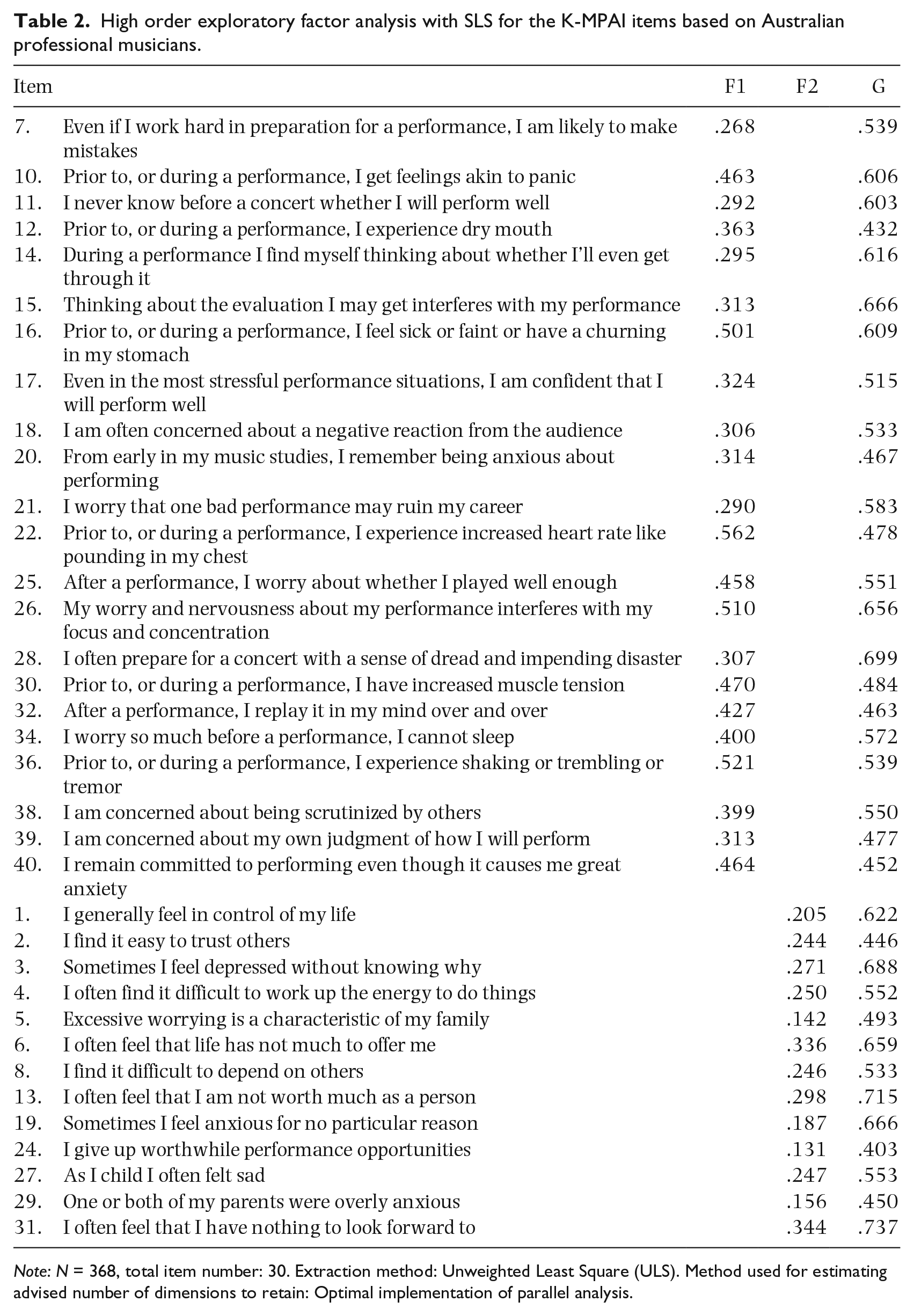
Note: N = 368, total item number: 30. Extraction method: Unweighted Least Square (ULS). Method used for estimating advised number of dimensions to retain: Optimal implementation of parallel analysis.
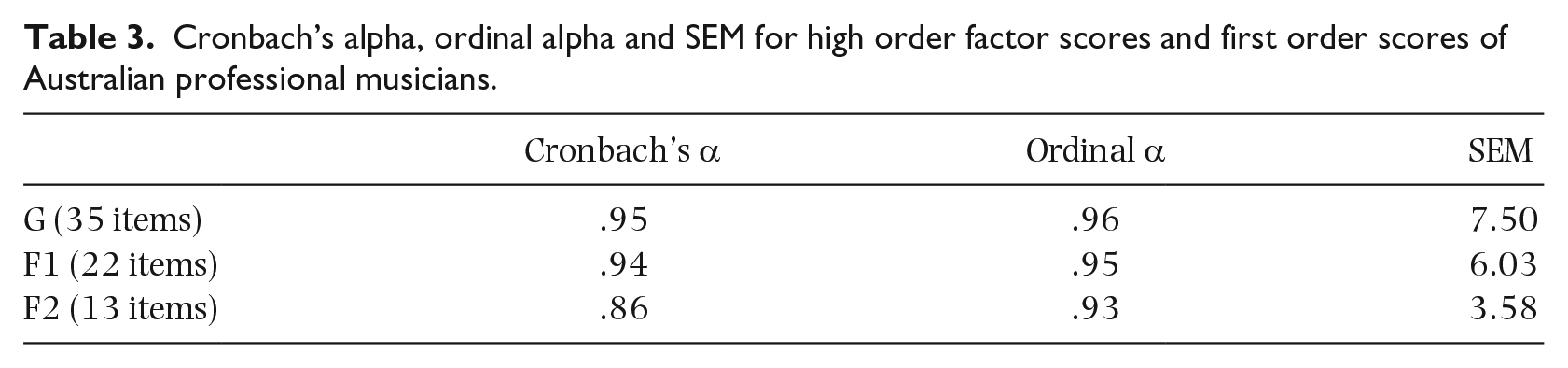
Scores derived from items belonging to either first or second order factors presented adequate reliability levels according to Nunnally and Bernstein (1995). Cronbach’s alpha, ordinal alpha, and SEM (calculation based on ordinal alpha levels) are depicted in Table 3.
Cronbach’s alpha, ordinal alpha and SEM for high order factor scores and first order scores of Australian professional musicians.
HOEFA for Peruvian tertiary music students’ sample
A HOEFA was performed on the K-MPAI 40 items using an oblique rotation of promin type and a SLS varimax correction. Sample size was 455. The correlation matrix was factorized using a polychoric correlation. Both KMO and Bartlett’s test of sphericity were adequate in order to perform a factor analysis, KMO = .91, χ²(780) = 6390.8, p < .001. Optimal implementation of parallel analysis suggested retaining three first order factors which explained 39.47% of shared variance. First order factors’ correlation levels with G were: F1 = .67, F2 = .91, and F3 = .57. Items with factorial loadings to G equal or higher than .30 were retained. Thus ten items were eliminated:
- Item 2: I find it easy to trust others (G = .187).
- Item 8: I find it difficult to depend on others (G = .131).
-Item 9: My parents were mostly responsive to my needs (G = .173).
- Item 22: Prior to, or during a performance, I experience increased heart rate like pounding in my chest (G = .270).
- Item 23: My parents almost always listened to me (G = .189).
- Item 25: After a performance, I worry whether I played well enough (G = .235).
- Item 33: My parents encouraged me to try new things (G = .142).
- Item 35: When performing without music, my memory is reliable (G = .245).
- Item 37: I am confident playing from memory (G = .282).
- Item 40: I remain committed to performing even though it causes me great anxiety (G = .001).
After one more factor extraction, a stable structure was achieved, that is, the high order factor did not present values lower than .30. KMO level and Bartlett’s test of sphericity were still adequate to perform a factor analysis, KMO = .93, χ²(435) = 4948.9, p < .001. The optimal implementation of parallel analysis advised retention of two first order factors which explained 41.17% of shared variance. Correlations of first order factors with G were: F1 = .76, and F2 = .92. Items with factorial loadings to G equal or higher than .30 were retained (Table 4).
High order exploratory factor analysis with SLS for the K-MPAI items based on Peruvian professional music students.
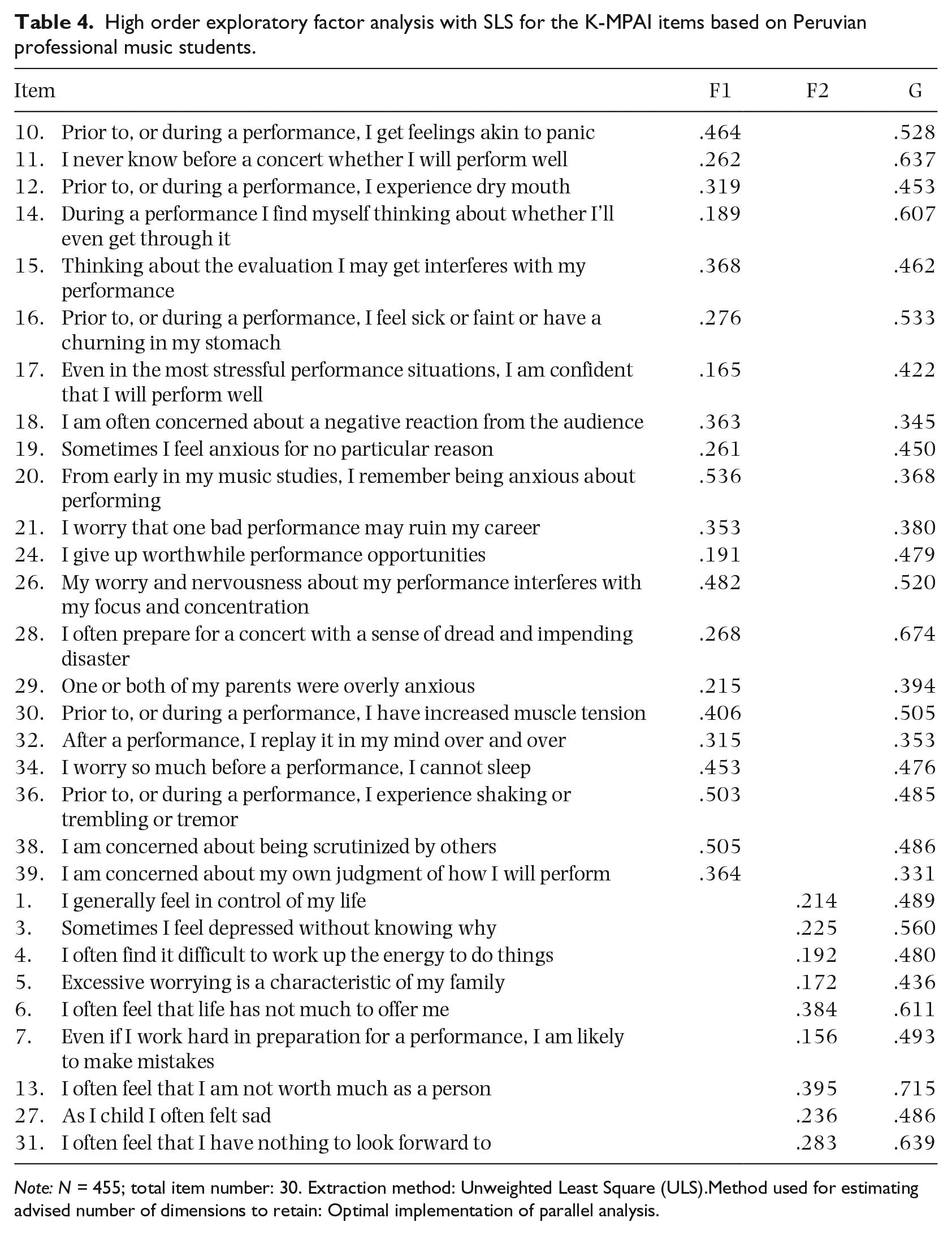
Note: N = 455; total item number: 30. Extraction method: Unweighted Least Square (ULS).Method used for estimating advised number of dimensions to retain: Optimal implementation of parallel analysis.
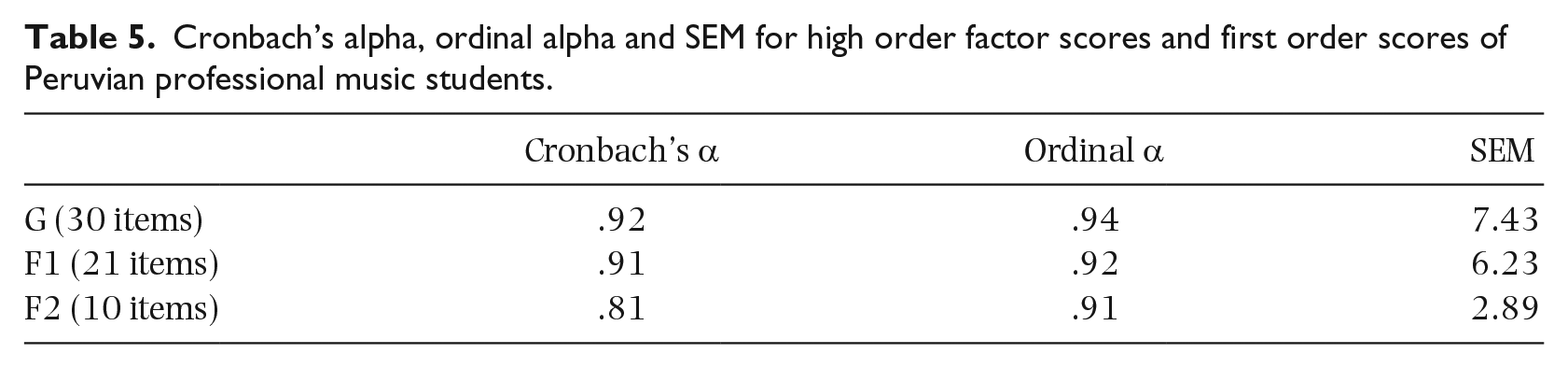
Just as with the Australian sample, Peruvian scores derived from items belonging either to first or second order factors presented adequate reliability levels according to Nunnally and Bernstein (1995). Cronbach’s alpha, ordinal alpha and SEM (calculation based on ordinal alpha levels) are presented in Table 5.
Cronbach’s alpha, ordinal alpha and SEM for high order factor scores and first order scores of Peruvian professional music students.
In both factorial structures there were shared items that were eliminated:
- Item 9: My parents were mostly responsive to my needs.
- Item 23: My parents almost always listened to me.
- Item 33: My parents encouraged me to try new things.
- Item 35: When performing without music, my memory is reliable.
- Item 37: I am confident playing from memory.
Invariance analysis
In order to further assess validity based on internal structure and determine whether it was possible to compare the Peruvian and Australian populations, a measure of invariance was computed. Given that in confirmatory models it is not possible to fit an SLS, the Peruvian model was fitted into a bi-factor model variation. The invariance of the bifactorial model was tested with the Peruvian sample. The fit of the model was good (Hu & Bentler, 1999), χ²(375) = 731.92, p < .001, CFI = .989, TLI = .987, RMSEA = .034, SRMR = .045.
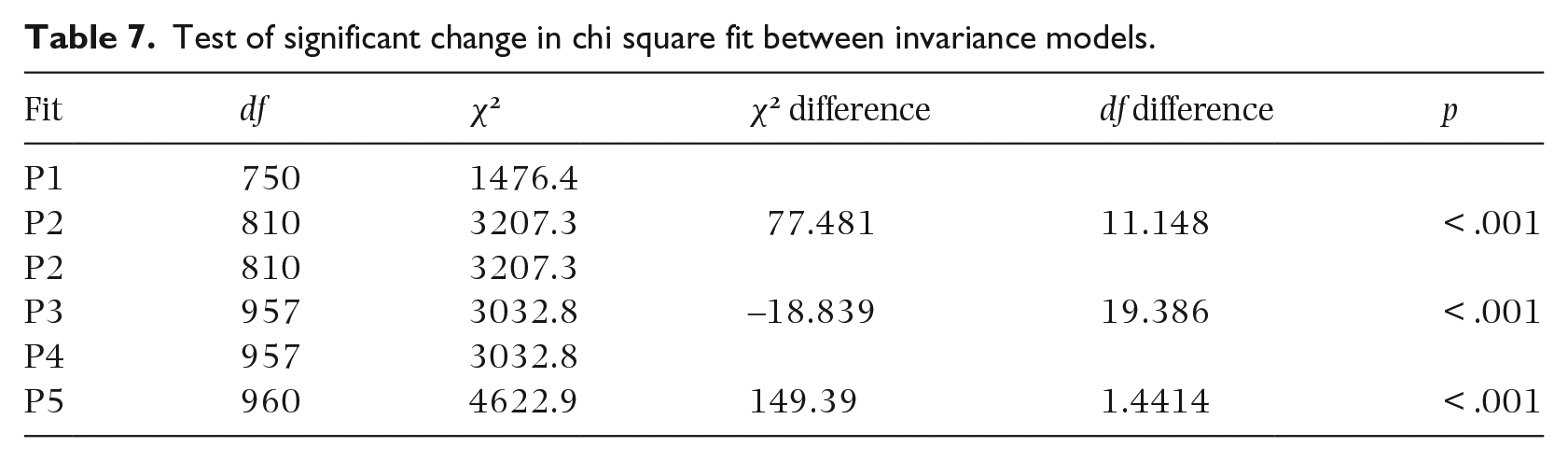
Next, different types of invariance models were fitted to the data. Only the first model was accepted (see Table 6).
Fit index of different types of invariance models.

The likelihood ratio test comparing nested models shows that when there are more equal parameters between groups, the model fit is worsened. When comparing model 1 with 2, it worsens. Comparison of models 2 and 3 did not show a change in fit. Models 3 and 4 showed that they were indistinguishable. Finally, comparison of models 4 and 5 showed that the fit worsened (see Table 7).
Test of significant change in chi square fit between invariance models.
Discussion
The HOEFA procedure revealed a nearly identical high order factorial structure in both samples. This provides strong evidence that the back-translation process of the K-MPAI into Spanish was accurate.
For the Peruvian sample the factorial structure obtained in this research was almost identical to the one reported in Chang-Arana (2015a, 2015b), except for item 14, which in the former was grouped under F1 and in the latter belonged to both F1 and F2. Both structures also suggested eliminating the same ten items even though the extraction method for Chang-Arana (2015a, 2015b) was MRFA and for this research was ULS. Additionally, either using MAP test or the optimal implementation of parallel analysis, data indicated that two first order factors be retained, just as the HOEFA with the Australian sample suggested. Taken together, we can conclude that from a HOEFA point of view the K-MPAI factorial structure for the Australian and Peruvian samples is robust.
Elimination of items 35, “When performing without music, my memory is reliable,” and 37, “I am confident playing from memory,” from both samples suggests that the memory-related items were not relevant to this factorial model. One plausible explanation for this lies in the emotion-oriented content of the K-MPAI. Even though memorization of music is an important skill required of professional musicians, it seems that this skill is more related to self-efficacy or technical mastery than the emotional dimension of personality and/or MPA. Similarly, items 9, “My parents were mostly responsive to my needs,” 23, “My parents almost always listened to me,” and 33 “My parents encouraged me to try new things” were excluded from both samples. It is possible that by the time musicians reach the age of 18, their internal working models of early relationships are well established and, having attained the capacity for self-awareness and self-reflection, are more likely to be focused on self-evaluation rather than evaluation of their internalized parental objects, which have, by this stage of development, become integrated into their self-concept (Goodman, 2005).
Factorial structures in both samples pointed towards a high order structure which can be interpreted as unidimensional. Based on the tripartite model of anxiety and depression (Anderson & Hope, 2008; Brown et al., 1998; Clark & Watson, 1991), this high order factor was named “negative affectivity in relation to music performance anxiety” and the two first order factors have been named “music performance anxiety” and “depression” for both samples. Given the clear content of each first order factor and their items’ high level of reliability it is possible to use the inventory in a bi-dimensional way, which has proven useful in the clinical setting.
In a validated German translation of the K-MPAI, and with 130 German musicians comprising professionals, students and amateurs, Peschke and von Georg (2015) reported a similar factorial structure to that found in this study. A three factor solution was obtained as follows: Factor 1: MPA-related symptoms experienced before, during, and after performance; Factor 2: General depression and psychological vulnerability; Factor 3: Early relationship context, including generational transmission of anxiety and parental empathy. Although the factorial method was not specified, the factor structure of the K-MPAI appears robust to different factorial extraction methods. The extracted factors in this study mapped onto performance competencies in the expected direction, with negative correlations on all three factors with a scale measuring conviction of performance competence, and positively with a factor measuring a deficit orientation to performance.
Results reported in this research resonate with two previous studies conducted with the 26-item-version of the K-MPAI (Kenny et al., 2004). For instance, Barbar et al. (2014a) reported an adequate back-translation process and high reliability values in a sample of 230 amateur and professional Brazilian musicians (Cronbach’s α = .82). More recently, Zarza et al. (2016) also conducted a back-translation for a Spanish sample. They performed a combination of exploratory factor analysis (EFA) and confirmatory factor analysis (CFA) on a sample of tertiary Spanish music students using equivalent sampling and data collection procedures to Chang-Arana (2015a, 2015b). They reported three main factors named “Helplessness” (Cronbach’s alpha = .79), “Specific Cognitions” (Cronbach’s alpha = .87), and “Early Relationship Context” (Cronbach’s alpha = .57), thereby providing further support for Kenny’s adaptation of Barlow’s anxiety model (2000) for a Spanish musician sample. Nevertheless, Zarza et al. (2016) chose principal components analysis (PCA) as a “factor” extraction method and the criterion of eigenvalues greater than 1 (K1) to retain seven factors in the EFA. This combination has been shown to lead to “potentially serious negative consequences” (Preacher & MacCullum, 2003, p. 13). On the one hand, PCA’s purpose is to reduce data until components that can account for as much variance as possible are identified. The purpose of EFA is not to explain as much variance as possible, but to assist the researcher’s interpretation of “sources of common variation underlying observed data” (Preacher & MacCullum, 2003, p. 21). Therefore, it is incorrect to use PCA when what is intended is factor extraction. On the other hand, the K1 criterion has been proven to underestimate the number of factors to be retained among other flaws, which can be avoided by more robust methods such as parallel analysis (Preacher & MacCullum, 2003). Despite these statistical reservations, the structure reported in Zarza et al. (2016) supported Barlow’s tripartite model (2000) and aligns with the conclusions in the present study. Since different data reduction techniques demonstrated similar theoretical implications, our results provide further support for the consistency of Barlow’s tripartite model of anxiety and depression (Barlow, 2000) and its adaptation to MPA by Kenny (2011).
Rocha et al. (2011) back-translated the revised 40-item K-MPAI (Kenny, 2009) in a Brazilian sample of 218 amateur and professional musicians. High correlations between the K-MPAI and STAI were reported (r = .64) as well as high internal consistency (Cronbach’s alpha = .96) and test–retest reliability measures. These results are consistent with Chang-Arana (2015a, 2015b) and Kenny (2011). Further confirmatory factor analyses and psychometric research using the revised K-MPAI (Kenny, 2009) is warranted. Additional cross-cultural comparisons of the revised K-MPAI could confirm the encouraging results reported in this and previous research that the inventory is applicable to musicians from different cultural contexts and stage of musical development.
The invariance analysis added empirical support to the structure and conceptual interpretation of the high order structure of the Peruvian and Australian samples; that is, the structure and theoretical interpretation is valid for both populations. Nevertheless, since only the first model fit was accepted, it is not possible to directly compare both populations. This result could be explained by the fact that two different kinds of populations were surveyed: music students and professional musicians. Therefore, further research could test our procedure in equivalent groups of musicians. Hence, there is not yet sufficient evidence for assuming that the interpretations and decisions derived from the scores of the K-MPAI are cross-culturally valid.
In sum, the results of this research suggest a strong high-order factorial structure and consistent theoretical interpretation across both Australian and Peruvian populations. The demonstration of a unidimensional higher order factor in this study provides further strong evidence for Kenny’s theory of the etiology of music performance anxiety and further support for the tripartite typology of MPA that she proposed (Kenny, 2011), comprising focal MPA, MPA with social anxiety, and MPA with panic and depression. Future research should include (a) further psychometric analysis of the K-MPAI, focusing on testing the high order factorial analysis in other contexts; (b) further cross-validations of the K-MPAI to support its application cross-culturally; and (c) experimental attempts to further validate Kenny’s clinical typology, as determination of MPA type has significant implications for treatment.
Footnotes
Funding
The author(s) disclosed receipt of the following financial support for the research, authorship, and/or publication of this article: The data collected for the Australian sample was funded by a grant to the second author (Kenny) with colleagues Dr Bronwen Ackermann and A/Professor Tim Driscoll from the Australia Research Council (ARC) (Project ID: LP0989486) and The Australia Council for the Arts (ACA). The researchers also received in-kind support from the eight major symphony and pit orchestras of Australia.