



Abstract
On the one hand, the majority of research on the functions of music listening focuses on individual differences; on the other hand, a growing amount of research investigates situational influences. However, the question of how much of our daily engagement with music is attributable to individual characteristics and how much it depends on the situation is still under-researched. To answer this question and to reveal the most important predictors of the two domains, participants (n = 587) of an online study reported on questions regarding the situation, the music, and the functions of music listening for three self-selected situations. Additionally, multiple person-related variables were measured. Results revealed that the influence of individual and situational variables on the functions of music listening varied across functions. The influence of situational variables on the functions of music listening outweighed the influence of individual characteristics. On the situational level, main activity while listening to music showed the greatest impact, while on the individual level, intensity of music preference was most influential. Our findings suggest that research on music in everyday life should incorporate both – individual and situational – variables determining the complex behavior of people interacting with music in a certain situation.
Keywords
The functions of listening to music are manifold, and speculation about the effects of music dates back to antiquity (Barker, 1989). Music has become virtually omnipresent in the Western world, in particular due to the development of portable music players, loudspeakers, and the distribution of smartphones with integrated music playback systems. As a result, music listening now represents one of the most common leisure activities (Reinhardt, 2015). The constant availability of music has significantly changed the ways people listen to music (Hargreaves & North, 1999). Before the invention of recording and broadcasting techniques around 1900, people could listen to music only when it was performed live; they therefore either had to attend events where music was played (for instance during concerts devoted directly to music listening, in taverns, at social or religious gatherings, etc.) or had to perform it themselves. In contrast, people today listen to music in all kinds of circumstances and locations: in transit, while engaged in sports or exercise, while doing housework, and so forth (North, Hargreaves, & Hargreaves, 2004). Having the possibility to listen to music in such diverse situations enables people to actively and individually engage with music by choosing music that fulfills specific functions in certain situations (see, e.g., DeNora, 2000; Heye & Lamont, 2010). Research has identified a vast number of functions that music listening can fulfill (for an overview, see Schäfer, Sedlmeier, Städtler, & Huron, 2013). Interestingly, the majority of research on the functions of music listening has focused on the associations between individual differences and the ways in which people interact with music. Few studies have investigated the potential influence of the concrete situation (i.e., time-varying influences) on music listening behavior. In addition, studies have either focused on individual differences or on situational influences, but in reality people interact with the situation in which they reside. Therefore, the influences of both aspects – person-related and situational variables – need to be studied to explain real-life music listening. There is still not enough empirical evidence to formulate a theory that would explain the complex interactions that take place when people listen to music in everyday life (Sloboda & Juslin, 2010; von Georgi, Grant, von Georgi, & Gebhardt, 2006). The present study therefore attempts to provide relevant new evidence for such a theory by investigating the relative impact of individual differences and situational influences on the functions of music listening. The findings are expected to deliver empirical evidence that might guide future theory development and help explain who listens to what kind of music, in which situation, and why.
Individual differences and the functions of music listening
The functionality of music listening refers to the intentional use of music to accomplish specific goals in specific situations, such as eliciting personal memories, getting energized, or making time go by more quickly. Research that focuses on individual differences associated with the functions of music listening has mainly investigated the relationships between music listening and factors such as age, gender, personality traits, health, well-being, and musical taste. In addition, typology research has tried to cluster people according to the ways in which they engage with music – based on the assumption that listeners consistently try to achieve the same goals by listening to music – whereas cross-cultural studies have focused on cultural differences related to the functions of music listening. In the following, we discuss findings of empirical studies based on these approaches in more detail.
Research on gender differences has consistently shown that women tend to use music for affective functions (e.g., expressing feelings and emotions), coping, and enhancement (Boer et al., 2012; Chamorro-Premuzic, Swami, & Cermakova, 2012; Kuntsche, Le Mevel, & Berson, 2016; North, 2010), while men tend to use music for cognitive or intellectual reasons (Chamorro-Premuzic et al., 2012). Some studies have found evidence for additional differences. Boer et al. (2012) showed that females also tend to use music for dancing and to express cultural identity, and Kuntsche et al. (2016) found that girls listen to music more frequently for social motives than boys. According to North (2010), women are more likely than men to report listening to their favorite music style for enjoyment, to relieve boredom, to relieve tension, and to reduce loneliness. In contrast, men tend to use their favorite music to be creative and use their imagination, to create a mental image for themselves, and to please friends (North, 2010).
The findings are rather diverse when it comes to the effects of age on the functions of music listening. Lonsdale and North (2011) showed that participants beyond adolescence and early adulthood are less likely to use music to regulate their emotions, participants over 30 are less likely to reminisce about the past through music, and participants over 50 less frequently report using music for social functions. Chamorro-Premuzic et al. (2012) and North (2010) found negative associations between age and diverse functions of music listening and the amount of music consumption. This is in line with several findings that show that the subjective importance of music increases until the mid-20s and then decreases again (for an overview, see Dollase, 1997). In contrast, Laukka (2007) found an increase of subjective importance of music with age in participants of higher age. He also showed that the elderly (aged 65–75 years) use music to experience emotions and to relax.
A number of studies found associations between personality traits and functions of listening to music. Openness to experience was found to be associated with cognitive and intellectually-stimulating functions of music listening, and neuroticism with affect-regulating functions (i.e., regulating moods and emotions; Chamorro-Premuzic & Furnham, 2007; Chamorro-Premuzic, Gomà-i-Freixanet, Furnham, & Muro, 2009; Chamorro-Premuzic et al., 2012; Chamorro-Premuzic, Swami, Furnham, & Maakip, 2009; Vella & Mills, 2017; von Georgi & Hock, 2015). Moreover, Chamorro-Premuzic and Furnham (2007) showed that intelligent and intellectually-engaged people are likely to listen to music for cognitive stimulation, and that introverted people tend to use music for affect regulation.
Research investigating the relationships between the functions of music listening and musical tastes or musical preferences has consistently shown strong associations between the strength of music preference and diverse functions of music listening (Schäfer, 2016; Schäfer & Sedlmeier, 2009; Schäfer & Sedlmeier, 2010). The communicative functions of music listening (e.g., expressing identity/values) were shown to have the strongest associations with the intensity of a participant’s preference for their favorite music (Schäfer & Sedlmeier, 2009; Schäfer & Sedlmeier, 2010). These findings are in line with those of Chamorro-Premuzic et al. (2012), who demonstrated positive associations between the functions of music listening and music consumption, such as buying music or attending concerts. In addition, Schäfer and Sedlmeier (2009) found varying correlations between liking a music style and several functions of music listening, showing that fans of different music styles like their music due to certain functions of music listening (e.g., fans of rock music and of rap music reported liking their music because it expresses their identity). These findings are in line with those of von Georgi et al. (2006) and Getz, Chamorro-Premuzic, Roy, and Devroop (2012) who also found correlations between specific functions of music listening and liking certain music styles.
A number of studies found inconsistent associations between cultural factors and the functions of music listening. Some functions were found to have stronger cultural associations (e.g., sociocultural functions such as expressing cultural identity) than others (e.g., social bonding, dancing; Boer et al., 2012; Boer & Fischer, 2012). In contrast to these findings, several studies did not find any major differences when comparing different cultures; for example, there is no difference between English and American adolescents (Tarrant, North, & Hargreaves, 2000), Germans and Indians (Schäfer, Tipandjan, & Sedlmeier, 2012), and Pakistanis and the English (Rana & North, 2007). It is interesting to see that the relationships between neuroticism and the use of affect-regulating functions of music, and the relationships between openness to experience and the tendency to use cognitively stimulating functions of music listening seem to be stable across different cultures (Chamorro-Premuzic, Gomà-i-Freixanet, et al., 2009; Chamorro-Premuzic, Swami, et al., 2009). In sum, these findings provide support for the assumption that some cross-cultural universalities and certain cultural specificities exist in the functions of music listening.
Mental health and well-being were also found to affect the functional use of music. A number of studies have demonstrated that people with poor mental health (e.g., people suffering from depression or negative affectivity) or well-being (e.g., life satisfaction) tend to listen to music for its coping or affect-regulating functions (Getz et al., 2012; Kuntsche et al., 2016; Laukka, 2007; North, 2010; Randall & Rickard, 2016; Randall, Rickard, & Vella-Brodrick, 2014; Vella & Mills, 2017; von Georgi et al., 2006).
We are not aware of any studies that specifically investigated the associations between musical training and the functions of music listening, although Lehmann (1993) did find differences between the functions of music listening for musicians and for non-musicians. We therefore infer that musical training influences the ways people engage with music.
The field of typology research has tried to cluster listeners into groups according to the ways they listen to or engage with music (see, e.g., Adorno, 1975; Behne, 1986; ter Bogt, Mulder Juul, Raaijmakers, Quinten, & Gabhainn, 2011). Approaches within this research field either construct the listener groups theoretically (e.g., Adorno, 1975) or empirically (e.g., Behne, 1986; ter Bogt et al., 2011). All these approaches have followed the basic assumption that a person is a certain kind of listener, meaning that people always listen to music in the same way or use music listening for the same functions.
In sum, people differ in the ways in which they engage with music, and these differences can to a certain extent be attributed to several of the listener’s individual characteristics.
Situational influences on the functions of music listening
Music listening always takes place in a triangulation between the listener, the situation, and the music. Although no music researcher is likely to disagree with this statement, the amount of literature investigating the situational (i.e., time-varying) influences on the functions of music listening is still quite small, and the ways in which people interact with music in specific situations still require further examination. Nevertheless, the few studies that have investigated such situational influences have already revealed a significant set of findings, which will be discussed in the following.
One question that immediately comes to the fore when we think about music listening in a specific situation is about where this listening is taking place. Studies that tackle this question have consistently found that nowadays, music listening takes place predominantly at home, while driving, or while using public transport (Greasley & Lamont, 2011; Krause, North, & Hewitt, 2014b; North et al., 2004). With regard to the influence of location on the functions of music listening, North et al. (2004) showed that the frequency of specific functions of music listening varies across different locations, and certain functions were predominately reported while being in a particular locality (“creating the right atmosphere”, for instance, was most often reported when being in a night club or pub). In line with these findings, Krause et al. (2014b) found that the intensity of the consequences of listening to music varies across listening locations (e.g., music in the gym was experienced as more motivating than music in a restaurant).
Research has furthermore shown that another important situational characteristic is the core activity that is performed while listening to music. Research consistently found that music listening mostly occurs during personal maintenance (e.g., housework, cooking), active leisure activities (e.g., exercise, socializing), and travel (e.g., driving, walking), while music listening that is not accompanied by any other activity is relatively uncommon (Greasley & Lamont, 2011; Juslin, Liljeström, Västfjäll, Barradas, & Silva, 2008; North et al., 2004; Sloboda, O’Neill, & Ivaldi, 2001). Greasley and Lamont (2011) highlighted the great individual variability of activities people engage in while listening to music. Whereas some participants reported never listening to music while working, others reported that they could not work without music. With reference to the question of how the activity performed while listening is related to the functions of music listening, Heye and Lamont (2010) found that people who frequently listen to music while on the move mainly listen for the functions of enjoyment, passing time, and enhancing emotional states. Kamalzadeh, Baur, and Möller (2012) showed that several music listening variables (such as changing moods) are affected by the activity that accompanies the music listening. Even though these studies did not specifically investigate the functions of music listening, their findings support the notion that activities performed while listening to music are specifically associated with certain functions of music listening.
Moreover, the presence of other people plays a crucial role in the characterization of a listening situation. Various studies have shown that people mostly listen to music either alone or with friends (Greasley & Lamont, 2011; Juslin et al., 2008; North et al., 2004; Rana & North, 2007; Tarrant et al., 2000). However, Greasley and Lamont (2011) pointed out that the amount of solitary music listening varies considerably between individuals. Two studies that specifically delved into the influence that social contexts exert on functions of music listening revealed significant effects of the presence of others on the observed frequency of a broad set of functions (such as “helping to concentrate”, “helping to pass time”, “bringing back certain memories”; North et al., 2004; Rana & North, 2007). Additionally, Tarrant et al. (2000) showed that people who mainly listen to music while they are alone are also more likely to use music for the fulfillment of emotional needs. The findings with regard to the emotional effects of music when listening together with others have been inconsistent. While Liljestrom, Juslin, and Västfjäll (2012) found more intense emotional responses to music when people listened together with a close friend or partner, Egermann et al. (2011) observed more intense responses when people listened to music alone. To sum up, there is evidence that the presence of others has an effect on the functions of music listening, but the specific relationships between social context and these functions still require further exploration.
The level of choice that one has also constitutes a fundamental influence on the functions of music listening. The concept of level of choice can refer either to the fundamental fact that people have the possibility to choose the music they listen to, or to the different ways people select the specific music they are listening to (selecting a certain piece, enabling shuffle mode, etc.). Heye and Lamont (2010) demonstrated that mobile listeners who mainly use the shuffle mode predominantly use music to help them pass the time. In contrast, specific choosers tend to use music for enjoyment or to create or accentuate emotions. Greasley and Lamont (2011) found higher levels of choice to be associated with certain functions of music listening (i.e., enjoyment, relaxation, help to concentrate/think). Krause, North, and Hewitt (2014a) showed that for people who do not have any control over what they listen to, music is unlikely to fulfill purposive (e.g., “helped me concentrate”) or actively engaged functions (e.g., “helped me pass the time”). In addition, Krause, North, and Hewitt (2015) found that recorded broadcasted music is associated with feeling lethargic, while personally-chosen music promotes contentment. These findings support the notion that a higher level of choice is associated with a higher level of beneficial functions of music listening.
Yet another variable that has been shown to affect the functions of music listening is the music’s mode of presentation. This variable on the one hand differentiates between music presented live or played back, and on the other hand distinguishes between the devices used to play music (e.g., CD player, smartphone). Research consistently showed that whereas listening to recorded music is the dominant mode of how people listen to music today, listening to live music has become a rather uncommon event (Greasley & Lamont, 2011; Krause et al., 2015). Moreover, Krause et al. (2015) revealed that the mode of presentation can affect the perceived consequences of music listening in a variety of ways. They demonstrated that devices that rely on controlled listener input (MP3 players, smartphones and the like) are associated with purposive and actively engaged consequences of listening to music (such as helping to concentrate or learning about the music), while validation-seeking consequences (e.g., making oneself look good) were associated with live music performed in public. This suggests that functions of music listening might also be dependent on the mode of presentation. It is also important to note here that the mode of presentation is strongly related to the listener’s level of choice. Listening to the radio has a lower level of choice compared to listening using an MP3 player (Krause et al., 2014a).
When investigating the situational variability of the functions of music listening, one must also consider the momentary mood of a listener. The most common functions of music listening related to initial mood are those concerned with affect regulation. There are several coexisting, partially opposing approaches to the affect-regulating functions of music listening. The most prominent among these are Katz and Foulkes’s (1962) “uses and gratification” approach, Berlyne’s (1971) arousal theory, Zillmann’s (1988) mood management theory, and North and Hargreaves’s (2000) arousal state-goal approach. Affect regulation is only one of the many functions of music listening. Since this paper has a broad focus on the entirety of music listening functions, we will here report just a small selection of the findings. Konečni – following Berlyne’s arousal-based approach – conducted several studies demonstrating that people select music to moderate their arousal to an optimal level (for an overview, see Konečni, 1982). These findings were elaborated upon by North and Hargreaves (2000), who demonstrated that people select music to reach certain arousal state goals (e.g., choosing arousing music to get energized during exercise). The momentary mood the listener experiences when choosing what music they want to listen to can therefore be said to influence the affect-regulating functions of music listening.
Another factor that bears on the functions of music listening is the time of day when music listening occurs. Several studies on the influence of time of day on music listening behavior found significant associations. North et al. (2004) showed that music is more likely to be used to help pass the time during the workday (8:00 a.m. – 4:59 p.m.) than during the evening (5:00 – 11:00 p.m.). Rana and North (2007) found that their participants were more likely to use music to help them concentrate or think during the workday than during the evening. Furthermore, Krause et al. (2014b) revealed several interaction effects of the time of day on the perceived consequences of listening to music. Specifically, they demonstrated that actively engaged listening (e.g., “learning about the music”, “bringing back memories”) is experienced differently depending on the time of day when music is heard in public places or on weekends. One must therefore also consider the time of day when investigating the situational variance of the functions of music listening.
Most of the above studies focused on the effects of a single variable on the functions of music listening. To briefly reiterate, the main variables are: gender, age, personality traits, musical taste, strength of music preference, cultural differences, mental health, psychological well-being, musical training, listening location, main activity while listening to music, presence of others, level of choice, mode of presentation, momentary mood, and time of day. However, the relative impact of variables in the context of other relevant variables has not been sufficiently examined. This is particularly important considering that real-life situations involve all of the aforementioned factors as simultaneous influences on the subjective goals and functions of listening to music.
Aim of the present study
The aim of our study was to investigate the relative impact of individual (i.e., constant) and situational (i.e., time-variant) influences on a broad range of functions of music listening. We were also interested in identifying the most important variables that predict the functions of music listening in the context of other relevant variables. Therefore, we aimed at integrating a broad set of potentially relevant variables that influence music listening functions as identified by previous research into a comprehensive model.
To address these topics, we conducted an online study asking participants to sequentially describe three self-chosen listening situations. This approach was inspired by North and Hargreaves (1996), who asked their participants to imagine a specific situation that was selected by the experimenters. As we were interested in situations that actually occur in the daily lives of our participants, we decided to give them the freedom to choose the situations themselves. For each listening situation, participants answered several questions related to the situation and the functions of music listening in that situation. We also measured multiple variables pertaining to participant characteristics (e.g., personality, musical taste). All variables were entered into a hierarchical linear regression model to estimate their impact on functions of music listening. We expected to replicate established findings on both the situational and the person-related variables. We furthermore expected to reveal novel associations that had not been found by any previous study.
As prior studies have not investigated the relative impact of the two levels of influences (personal and situational) on functions of music listening, we were particularly interested in answering the following questions:
- Are different functions of music listening similarly influenced by individual and by situational factors, or are there considerable variations? If the level of influence varies, to what extent does it vary between the diverse functions?
- Which are the key variables predicting the functions of music listening on the person and situation levels?
Methods
Sample
The study was advertised via mailing lists from German universities, posters displayed at the Goethe University Frankfurt, and on Facebook. As an incentive, respondents could enter a lottery to win a 15 Euro voucher for Amazon (chance of winning was 1 in 10).
In total, 945 people started the study. One hundred and seventy-six participants stopped during the description of the first situation, 133 while describing the second situation, and 9 while reporting the third situation. Forty respondents did not understand the instructions correctly and wrote down multiple situations in the first text field. All these participants (n = 358; 38% of those who started the study) were excluded from the analyses, which is an average exclusion and dropout rate when compared to other online studies (e.g., Egermann & McAdams, 2013; Egermann, Nagel, Altenmüller, & Kopiez, 2009). The remaining n = 587 participants (58% female) included in the study had a mean age of 25.4 years (SD = 7.0).
Design and measures
The questionnaire consisted of three sections: questions about the situation, questions about functions of music listening in the specific situation, and questions about personal information. Table 1 shows all situational variables that the study included.
Situational characteristics measured in the online study.
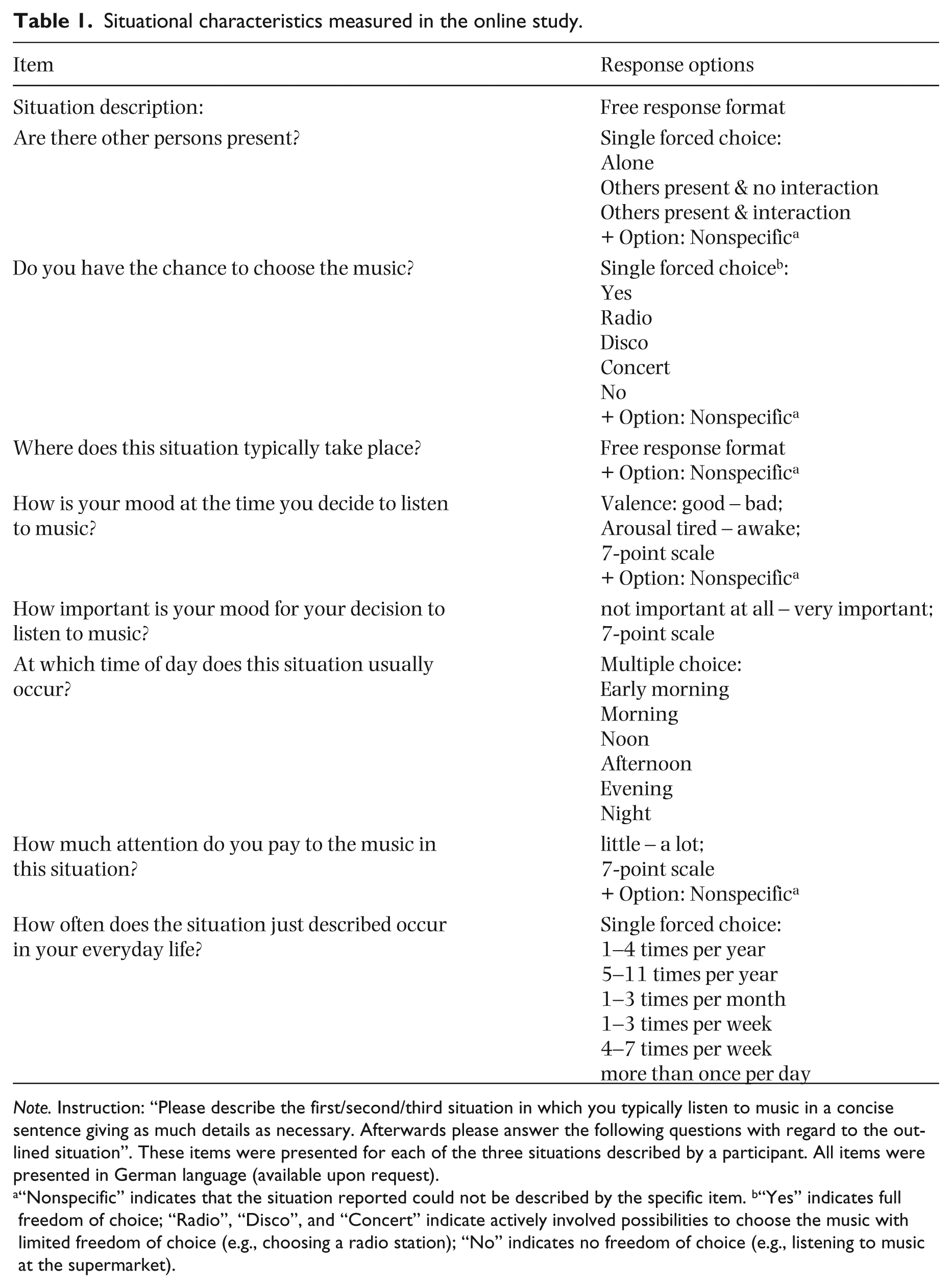
Note. Instruction: “Please describe the first/second/third situation in which you typically listen to music in a concise sentence giving as much details as necessary. Afterwards please answer the following questions with regard to the outlined situation”. These items were presented for each of the three situations described by a participant. All items were presented in German language (available upon request).
“Nonspecific” indicates that the situation reported could not be described by the specific item. b“Yes” indicates full freedom of choice; “Radio”, “Disco”, and “Concert” indicate actively involved possibilities to choose the music with limited freedom of choice (e.g., choosing a radio station); “No” indicates no freedom of choice (e.g., listening to music at the supermarket).
Our objective was to capture a wide range of potential functions of music listening. Part of this enterprise was a reanalysis of data collected by Schäfer et al. (2013), who performed a literature review and compiled a large and comprehensive list of possible functions of music listening. They asked 834 participants to rate to what degree music listening fulfills these functions in any possible situation where music might be heard. A principal component analysis revealed three distinct dimensions of the functions of music listening. To obtain the most diverse set of different functions and to disclose hierarchically-underlying sub-factors, we performed separate principal component analyses for each of the three main dimensions using the data provided by Schäfer et al. (2013). The analysis yielded 24 properly-interpretable sub-factors and we selected one item per sub-factor. We furthermore omitted two sub-factors on the basis of low prevalence of the respective items (namely, spirituality and express political attitude). This resulted in 22 items that we phrased in such a way that they could vary across situations (see Table 2; for details see Steffens, Greb, & Schlotz, 2016). Participants answered the items (“I listen to music because …”) on a 7-point rating scale for each situation (1 = Not at all to 7 = Completely). As previous research showed that each listening experience involves several functions (e.g., Greasley & Lamont, 2011), we decided to measure all 22 functions for each situation.
Twenty-two functions of music listening.

Note. All items were presented for each of the three situations described by a participant. Items were measured using a 7-point scale (1 = Not at all and 7 = Completely). All items were presented in German language (available upon request).
In addition, we collected the following person-related information: gender; age; Big Five personality traits using the BFI-10 (Rammstedt, Kemper, Klein, Beierlein, & Kovaleva, 2013); intensity of music preference measured by a 6-item inventory (Schäfer & Sedlmeier, 2009); musical training using the third scale of the Gold-MSI, consisting of 7 items (Schaal, Bauer, & Müllensiefen, 2014); and musical taste using an inventory currently under construction at the Max Planck Institute for Empirical Aesthetics. This unpublished musical taste inventory assesses an individual’s liking for a broad variety of musical styles (19 in total) using liking ratings on a 7-point scale (1 = Don’t like at all to 7 = Like very much). Participants could also indicate not being familiar with a certain style of music. No liking ratings were measured for these styles. Details on the styles that were assessed and on the factorial structure of the inventory are provided in the Results section below.
Procedure
Data were collected online (browser-based) through Unipark/EFS Survey software (Questback GmbH). Participants were redirected to the online survey after clicking a participation link in an email or scanning a QR Code on a poster. On the landing page, they were informed about the general procedure and the focus of the study, the voluntary nature of their participation, the possibility to terminate the survey at any time, and the opportunity to take part in a lottery to win a voucher. They were then asked to sequentially describe three self-selected situations in which they typically listen to music. First, the participants were asked to describe the situation they chose in a concise sentence, in as much detail as they considered necessary. Then, the participants answered questions regarding this situation and functions of music listening in that specific situation (Tables 1 and 2). This procedure was repeated for each of the three situations. After describing the three listening situations, participants reported on person-level variables. Finally, they could provide their email address to take part in the lottery for Amazon vouchers.
Data analysis
A principal component analysis was computed to reduce the number of independent variables related to musical taste. Varimax rotation was applied in order to obtain distinct and uncorrelated factors and to get results comparable to those of Rentfrow, Goldberg, and Levitin (2011), who also applied this kind of factor rotation in their analysis. As the musical taste questionnaire included the possibility to choose “I don’t know” for a music style, we used imputation to replace missing data. More specifically, we replaced the missing data points with the mean value of the ratings of the respective music style.
Another aim of the pre-analysis was to reduce the number of dependent variables and to reveal underlying broader constructs of functions of music listening. All 22 items that measured functions of music listening were therefore entered into a complex exploratory factor analysis for ordered categorical factor indicators (seven categories) with robust weighted least square estimation (WLSMV), and a robust sandwich estimator to account for the cluster-structure of observations within individuals, and Geomin rotation using Mplus v7.3 (Muthén & Muthén, 1998–2012).
Descriptions of the individual music listening situations were given in free response format. After a comprehensive review of all descriptions, 11 activity categories were defined. A research assistant not involved in the development of activity categories then classified each description into one of these categories. Finally, these classifications were double checked by two researchers based on a randomly chosen small subsample. Table 3 presents the category labels, descriptions, and relative frequencies.
Explanation and descriptive statistics of the 11 activity categories.

Note. Each situation described in free response format (N = 1,761) was classified into one activity category.
Free responses on listening location were classified by a research assistant to one of seven location categories (at home, workplace, transportation vehicle, music event location, public space, sports facility, others). Due to high correlations between activity and location categories, we excluded listening location from the analysis to avoid multicollinearity. We decided to include activity in the analysis as this variable captured more detailed information compared to listening location.
Measurements of the situation and the functions of music listening were taken three times per person, resulting in data with a two-level structure: measures (situations) nested within individuals. Multilevel linear regression models were therefore formulated to estimate the impact of personal and situational variables on the factor scores of functions of music listening. This data analysis approach allows for the inclusion of time-varying (i.e., situation-specific) predictors and the analysis of unbalanced designs, while simultaneously accounting for non-independence of observations within subjects. An intercept-only model was initially calculated to differentiate between variance components at the two levels. Categorical variables were included as dummy variables (coded as 0, 1). All situational variables were transformed by centering them around the within-person mean. This calculation produced within-subject (W-S) predictors that varied within, but not between individuals. In addition, all mean values of the situational variables were added to the model to evaluate between-subject (B-S) effects of these variables. Thus, the W-S situational predictors in this model represent “pure” situational influences (e.g., situation-specific individual state of high arousal as a deviation from this individual’s mean arousal states in all situations sampled for this person) and the B-S situational variables account for individual differences in situational variables (e.g., individual differences in mean arousal levels). As one of our aims was to identify the most important variables predicting functions of music listening, one model was formulated for each dependent variable containing all three sets of predictors (W-S situational predictors, B-S situational predictors, and B-S person-level predictors). This was done using the lmer function from the lme4 package (Bates, Mächler, Bolker, & Walker, 2015) and the step function of the lmerTest package (Kuznetsova, Brockhoff, & Christensen, 2015), which performs automatic backward elimination of all effects in linear mixed-effect regression models within the development environment R-Studio (RStudio Team, 2015) of the software R 3.0.2 (R Core Team, 2015). The step function first performs backward elimination of the random part followed by backward elimination of the fixed part. P-values for the random effects were based on likelihood ratio tests, while p-values for fixed effects were based on F-tests using Satterthwaite’s approximation. We used an alpha-level of p < .01 for random effects and p < .05 for fixed effects. This procedure was repeated until only significant predictors were left. As this procedure might result in a random effect being included in the model without its respective fixed effect, we manually included fixed effects regardless of their significance to specify significant random effects for which no fixed effect was included automatically.
As suggested by Nakagawa, Schielzeth, and O’Hara (2013), marginal and conditional R² values were computed as indices of explained variance. This was done using the r.squaredGLMM function of the MuMIn package (Barton, 2016). Whereas marginal R² (R²m) indicates the proportion of variance explained by the fixed factor(s) alone, conditional R² (R²c) indicates the proportion of variance explained by both fixed and random factors. As the effect sizes for the two B-S predictor sets (situation-related and person-related) could contain shared variance, and their sum was therefore likely to overestimate the amount of variance explained by B-S predictors, we also calculated R²m for the two B-S predictor sets together.
To assess the importance of single predictor variables we calculated two indices, IF and IR, indicating consistency across functions and summative strength of associations. The first index, IF, was a weighted index of variable consistency across musical functions (see Equation 1). IF is a count indicator of how often a variable was included as a significant predictor in the five models, weighted by the number of items a variable was represented by (e.g., activity was represented by 10 items [i.e., dummy variables], attention was represented by one item [i.e., one continuous variable]) to achieve identical ranges for different predictor variables.

Where IFi is the weighted frequency index for variable i, mi is the number of items which represented variable i, and Sik the sum of significant associations of item k of variable i across all five models. For example, the sum of significant associations of all dummy coded activities (i.e., items) in all five models was divided by 10, as the variable activity was represented by 10 items. In contrast, for the variable attention (represented by one item), the sum was divided by one. Therefore, IF scores range between 0 and 5 and provide a summary indicator of the consistency of each variable across musical functions. Low scores indicate specific associations between predictor and musical function factor scores, whereas high scores indicate consistent significant associations for a predictor across multiple musical function factor scores.
The second index, IR, was based on explained variance of the predictors’ fixed effects. We formulated a model containing only the significant predictors (i.e., items) representing a variable, calculated R²m, and summed up this variable-specific R²m values across all five models. Therefore, IR scores theoretically could range between 0 and 5 (as the maximum amount of variance explained in a model is 1), and provide a summary indicator of the strength of association for each predictor variable across musical function factor scores. Low scores indicate weak associations (small amounts of variance explained), whereas high scores indicate strong associations between a variable and musical function factor scores across all functions. In accordance with the expectation that no single variable explains the complete variance in any model, IR empirically varied between 0 and 0.43.
Results
Musical taste
A principal component analysis of musical taste suggested extraction of six factors with Eigenvalues greater than 1, and together accounted for 64.1% of variance in participants’ ratings. We labeled the six factors with those two music styles that showed the highest loadings on each respective factor (see Table 4): Blues & Jazz, Techno & EDM, Other Cultures & Latin, Volksmusik & Schlager, Pop, and Rock & Metal. Factor scores representing musical taste were used as independent variables for all further analyses.
Varimax-rotated loadings for 19 music styles on six factors.
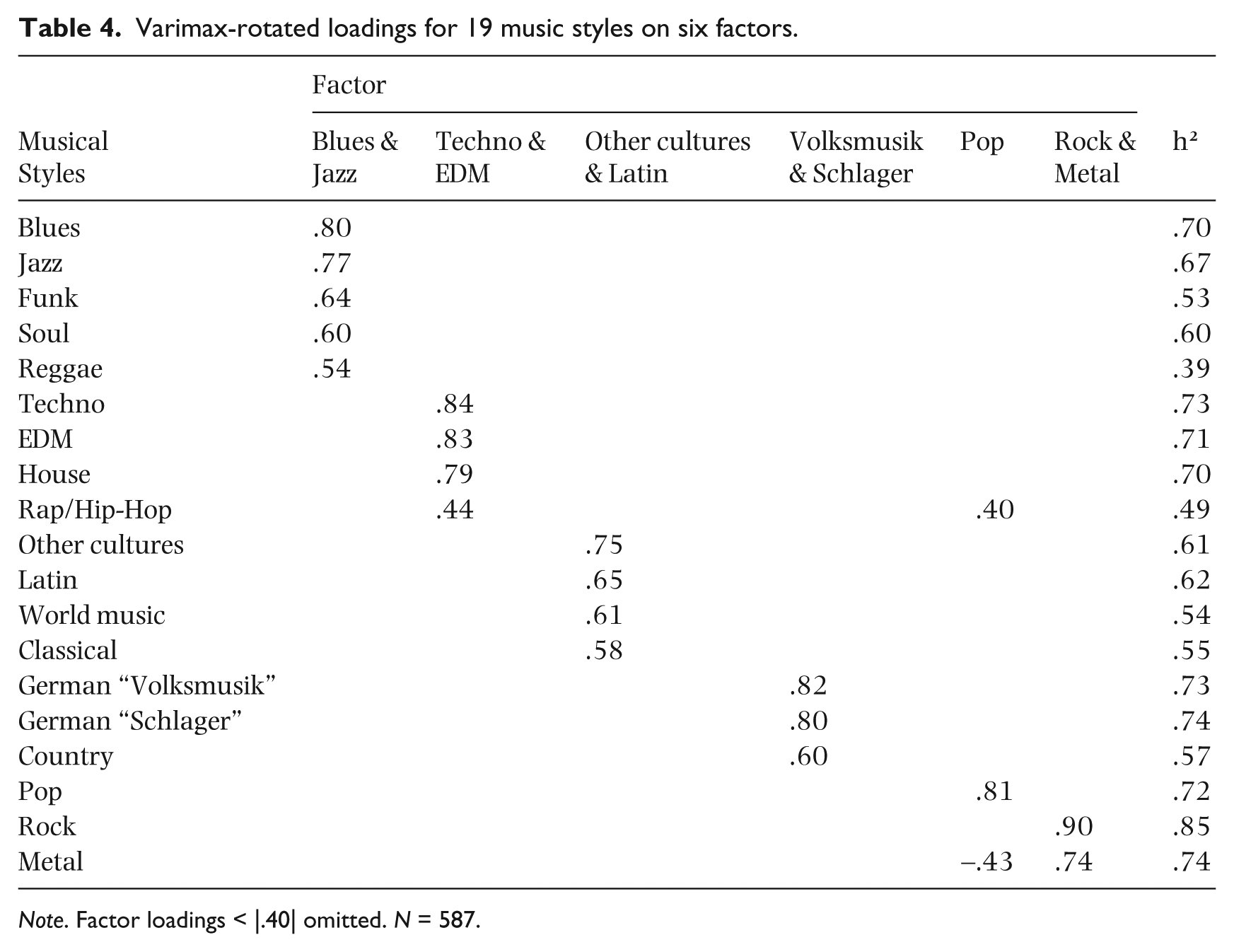
Note. Factor loadings < |.40| omitted. N = 587.
Dimensions of the functions of music listening
The factor analysis performed on the items that assessed functions of music listening resulted in a five-factor solution (Eigenvalues: 6.65; 2.76; 2.04; 1.49; 1.06) with acceptable model fit (χ² = 1034.8; df = 131; p < .001; root mean square error of approximation [RMSEA] = .063; 90% CI [.059, .066]; comparative fit index [CFI] = .94; Tucker-Lewis index [TLI] = .90), a satisfactory simple structure after Geomin rotation, and small to modest factor intercorrelations (see Table 5). The factors were labeled: Intellectual Stimulation, Mind Wandering & Emotional Involvement, Motor Synchronization & Enhanced Well-Being, Updating One’s Musical Knowledge, and Killing Time & Overcoming Loneliness (see Table 5).
Geomin-rotated loadings for the functions of music listening on five factors. Factor score correlations are shown at the bottom of the table.
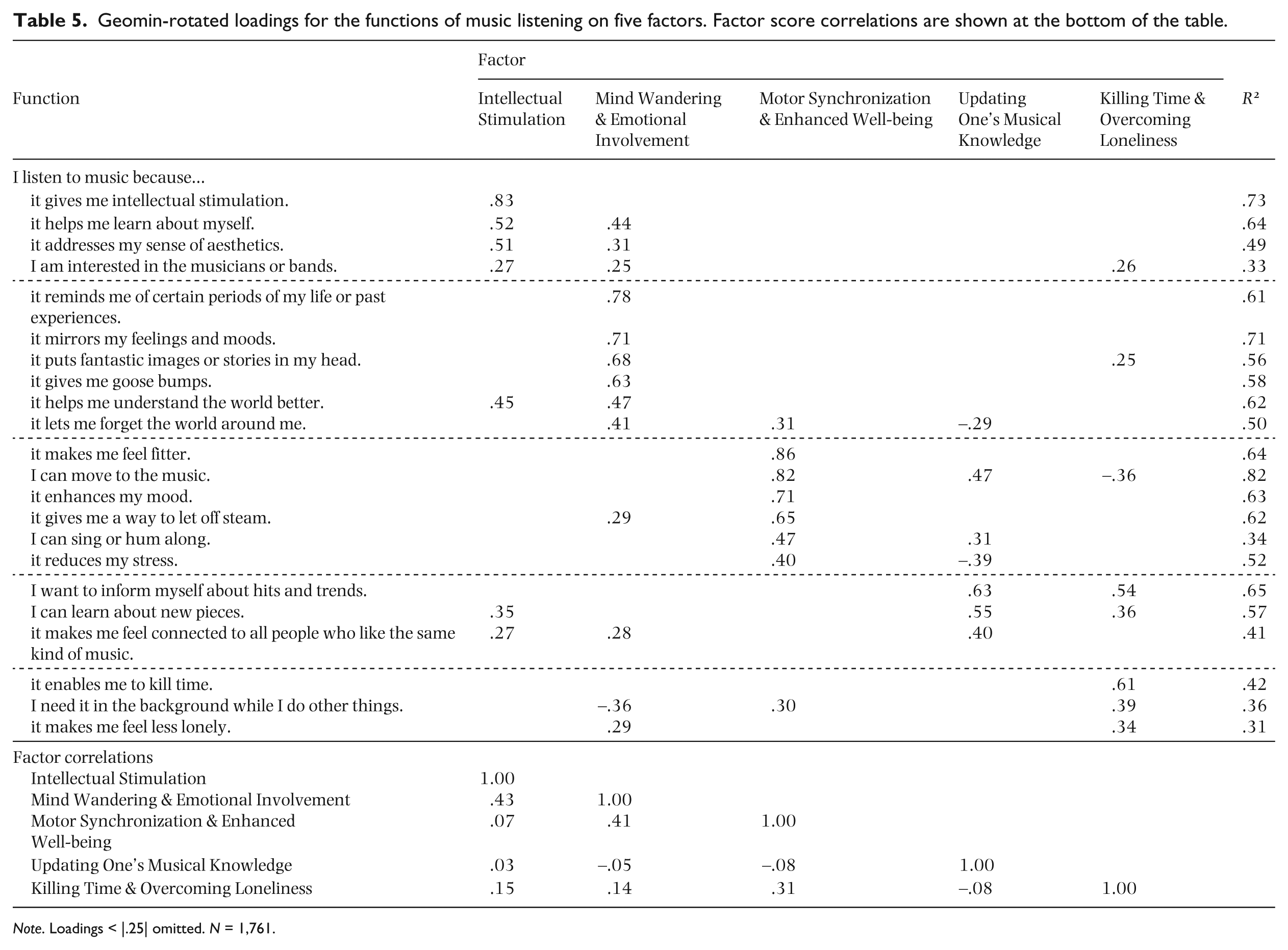
Note. Loadings < |.25| omitted. N = 1,761.
Intellectual Stimulation mainly comprises functions in the cognitive domain, ranging from intellectual stimulation and learning about oneself to addressing the individual’s sense of aesthetics. The cross-loadings of the two items “learning about oneself” and “addressing one’s sense of aesthetics” on the Mind Wandering & Emotional Involvement factor suggest that these two functions also have an affective component mainly represented by the second factor. The Mind Wandering & Emotional Involvement factor represents functions that are imaginative and have an affective aspect. The diverse functions that show the highest factor loadings on this factor might indicate that the use of music for mind wandering might be associated with higher emotional involvement. The cross-loading of the item “helps me understand the world better” might reflect a cognitive-affective facet of this item, and the cross-loading of the item “forget the world around me” indicates that this function might also be addressed by moving to music. Motor Synchronization & Enhanced Well-Being comprises functions that have an active motoric component (presumably associated with increased arousal) as well as several positive effects like “reducing stress” or “letting off steam”. The combination of items loading on this factor suggests that the use of music to enhance well-being might be associated with motoric activity. The cross-loading of the item “to let off steam” might indicate that this function might also be achieved while using music for mind wandering. The functions that have the highest factor loadings on Updating One’s Musical Knowledge cover satisfying one’s curiosity but also include a social aspect of feeling connected to other people. Finally, the Killing Time & Overcoming Loneliness factor represents passive functions including coping with feelings of loneliness. All further analyses of functions of listening to music were based on factor scores.
Representativeness of situations
In order to evaluate representativeness of the situations described by participants, we asked for frequency of situation occurrence in daily life. In our sample, 92% of the situations were reported to occur at least one to three times a month, and 73% at least one to three times a week. This indicates that participants reported frequent day-to-day situations rather than rare and untypical music listening events. Although very rare situations were probably not covered reliably, the high daily life frequency of the situations that were reported suggests representativeness for common music listening situations participants typically experience in their daily life.
Variance components of functions of music listening
In the next step, intra-class correlation coefficients (ICC) were calculated using intercept-only models predicting the five factors representing functions of music listening. On average, 36% of the variance of the functions of music listening was due to between-person differences, while 64% of the variance was attributable to within-person differences between situations (see Table 6). The proportion of variance accounted for by between- and within-person differences varied across factors. For example, between-person differences accounted for 47% of the variance in Intellectual Stimulation but accounted for only 21% of the variance in the factor Updating One’s Musical Knowledge. For all five factors, the variance attributable to within-person differences between situations was higher than the variance due to between-person differences.
Intraclass correlation coefficients and explained variance for the five final models predicting functions of music listening.
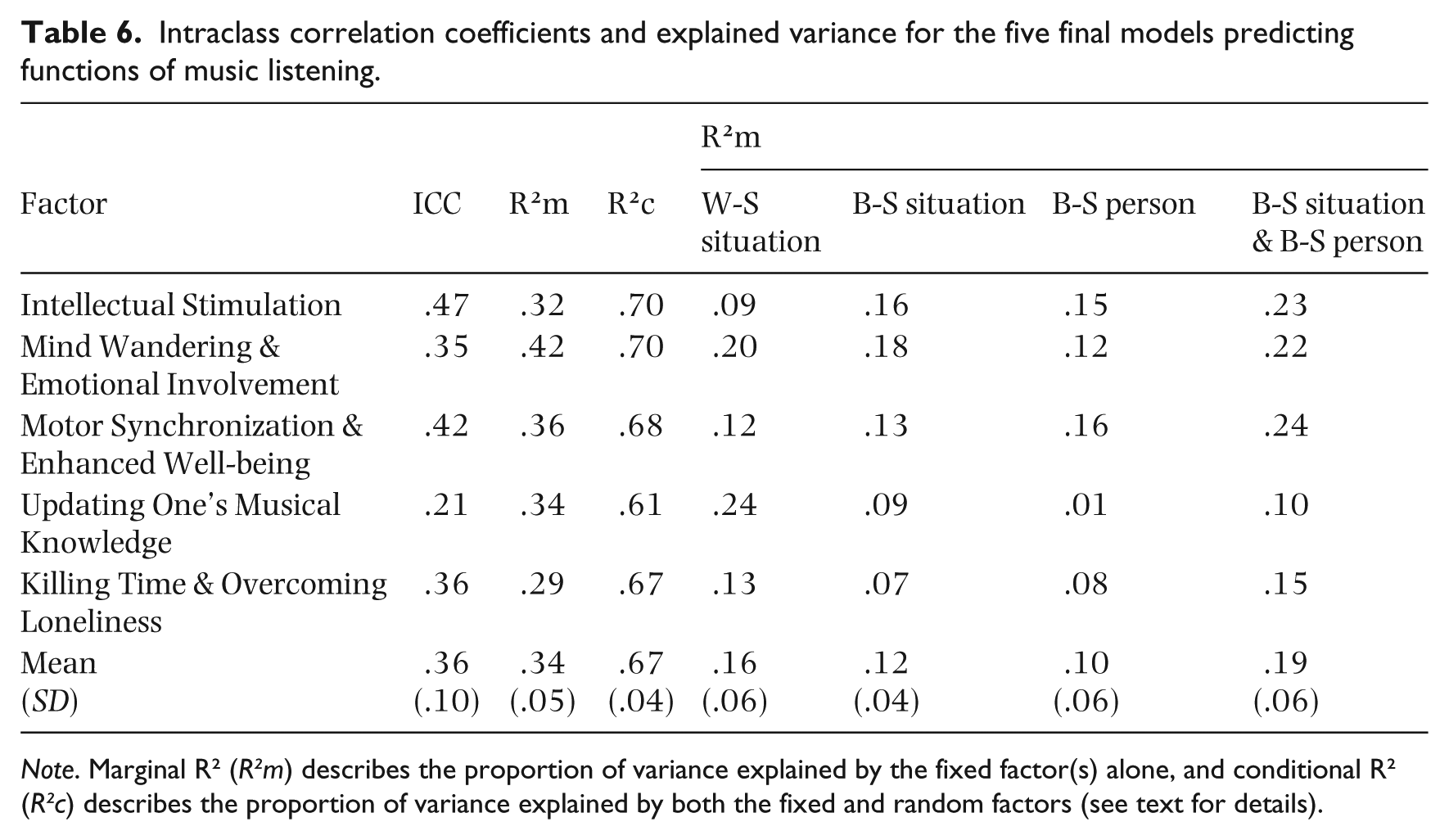
Note. Marginal R² (R²m) describes the proportion of variance explained by the fixed factor(s) alone, and conditional R² (R²c) describes the proportion of variance explained by both the fixed and random factors (see text for details).
Predicting the functions of music listening
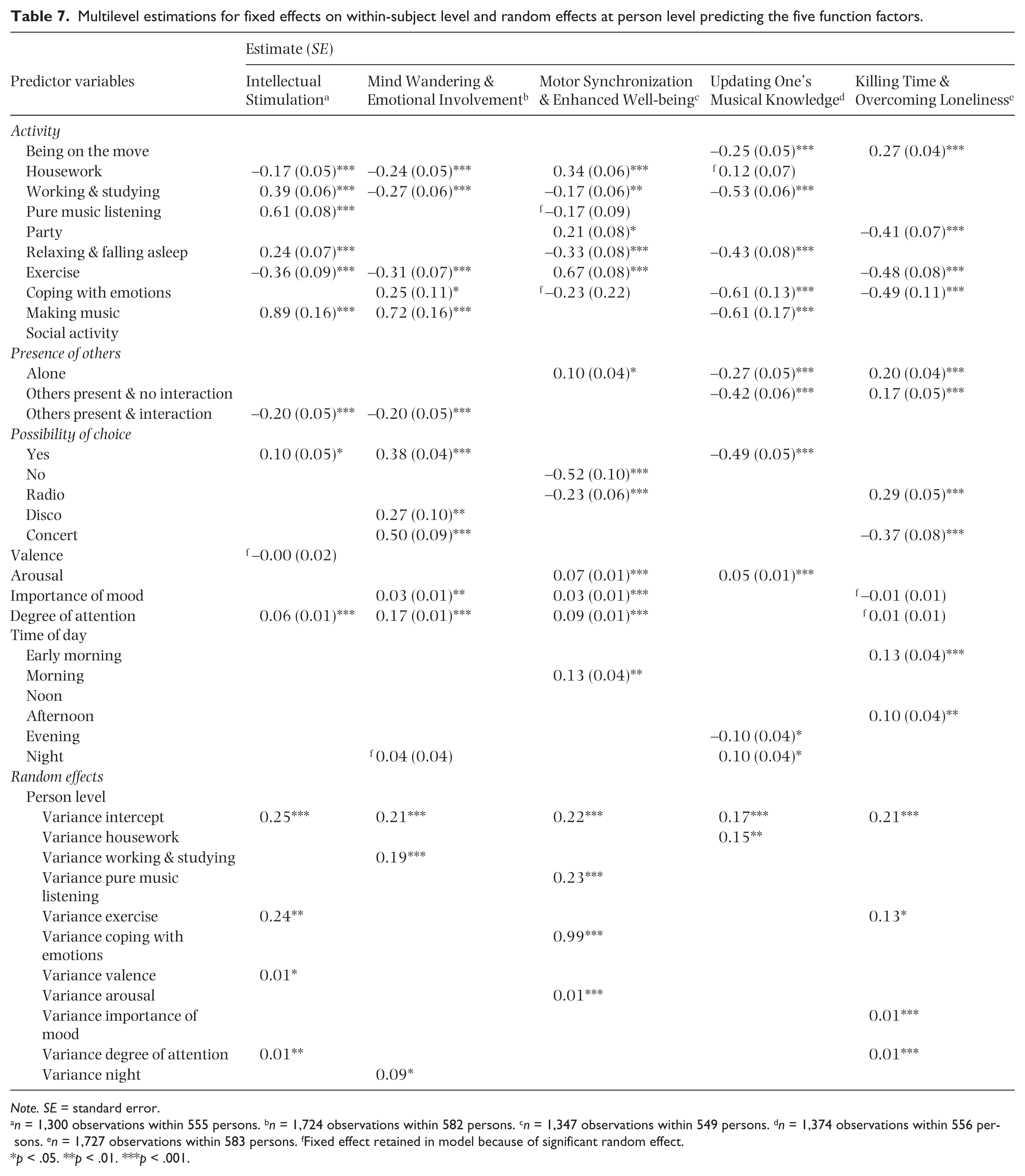
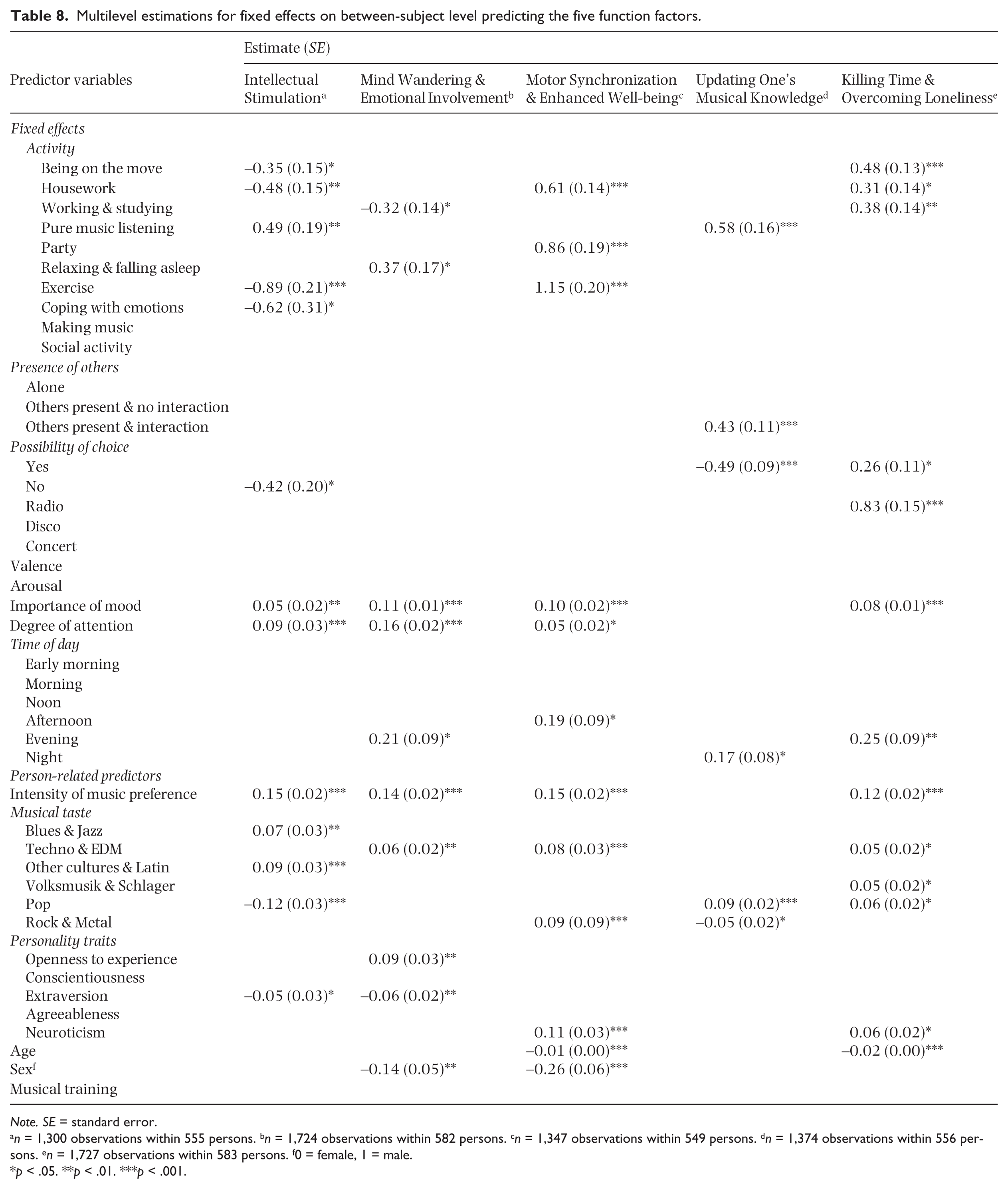
Tables 7 and 8 show the results of mixed-effects regression model fitting using the step function to reveal the most important individual and situational predictors of the functions of music listening in the context of the complete set of predictors for the five function factors. Table 7 includes estimations of W-S effects and random effects, and Table 8 contains all the B-S effects. Each function factor was modeled separately, resulting in five final models. These five models provide a detailed analysis of the associations between individual and situational variables and the functions of music listening as they occur in daily life. Due to the relatively high complexity of the models, we will report one of the models (Intellectual Stimulation) in more detail below and will describe the other four more concisely.
Multilevel estimations for fixed effects on within-subject level and random effects at person level predicting the five function factors.
Note. SE = standard error.
n = 1,300 observations within 555 persons. bn = 1,724 observations within 582 persons. cn = 1,347 observations within 549 persons. dn = 1,374 observations within 556 persons. en = 1,727 observations within 583 persons. fFixed effect retained in model because of significant random effect.
p < .05. **p < .01. ***p < .001.
Multilevel estimations for fixed effects on between-subject level predicting the five function factors.
Note. SE = standard error.
n = 1,300 observations within 555 persons. bn = 1,724 observations within 582 persons. cn = 1,347 observations within 549 persons. dn = 1,374 observations within 556 persons. en = 1,727 observations within 583 persons. f0 = female, 1 = male.
p < .05. **p < .01. ***p < .001.
Intellectual stimulation
Activity was the most important predictor on the W-S situational level. If the major reported activity was pure music listening, making music, working and studying, or relaxing and falling asleep, there was a higher chance that a person would report using music for intellectual stimulation in that situation. If, however, the primary activity performed while listening to music was exercise or housework, participants were unlikely to report using music for intellectual stimulation. Furthermore, a significant random effect was found for “exercise”, which means that the association between exercising and getting intellectually stimulated by music significantly varies between individuals. More specifically, the association was more negative for 10% of the participants than the fixed effect suggests, while for 10% of the participants the association was less negative (and it was actually positive for several participants). Moreover, the presence of other people was found to be significantly associated with listening to music for intellectual stimulation. When a person reported listening to music while interacting with others, it was less likely for the music to be reported to fulfill intellectually stimulating functions. Having the possibility to choose the music was significantly associated with high scores on Intellectual Stimulation. Finally, the more attention a person reported to pay to the music while listening to it, the more intellectual stimulation was reported. This association varied between individuals (slope varying from -0.59 to 0.19) as indicated by the significant random effect of the attention item.
In addition, several B-S situational predictors were found to have significant effects on intellectual stimulation caused by music. Participants who on average (over the situations reported) reported to listen to music as a main activity more frequently than others tended to use music as a resource for intellectual stimulation. In contrast, individuals who reported that they were typically more frequently than others to be doing housework or exercising while listening to music, or listening to music while being on the move or coping with emotions, showed lower mean values regarding the intellectually-stimulating function of music. Furthermore, people who reported a higher importance of mood in their decision to listen to music and people who generally pay more attention to music than others had higher average scores on intellectual stimulation by music. Participants who reported that they relatively often experienced situations in which they could not choose the music themselves also had lower factor scores on Intellectual Stimulation.
Finally, on the B-S personal level, a higher intensity of music preference was associated with high scores on Intellectual Stimulation, and participants scoring high on extraversion showed lower factor scores for Intellectual Stimulation. Lastly, participants with high liking ratings for the musical taste factors Blues & Jazz and Other cultures & Latin tended to use music for intellectual stimulation whereas participants with high liking ratings for the Pop factor on average tended to use the intellectual stimulating functions of music listening less.
Mind wandering and emotional involvement
On the W-S situational level, 11 variables significantly predicted the outcome variable. Positive associations were found for the reported activities “coping with emotions” and “making music”, all actively involved possibilities to choose the music (Yes, Disco, Concert), the degree of attention payed to the music, and the importance of mood for the decision to listen to music. Negative associations were found for doing housework, exercising, working, and studying while listening to music. Participants who reported that, in a given situation, other people were present and that they interacted with them, reported lower levels of mind wandering or emotional involvement. The model furthermore included two significant random slopes for “working and studying” and “night”, which showed that the associations of these predictors with scores on Mind Wandering & Emotional Involvement varied significantly across participants.
On the B-S situational level, five variables were found to contribute significantly to the prediction of the outcome. Participants who frequently reported to relax and fall asleep while listening to music, or to listen to music in the evening, tended to exploit the mind wandering and emotional qualities of music. This also applied to participants who on average reported paying higher levels of attention to music, or for whom mood had a higher importance in the decision to listen to music. In contrast, people who frequently reported listening to music while working or studying showed lower mean scores on the Mind Wandering & Emotional Involvement factor.
As for the B-S personal level, intensity of music preference was positively associated with the Mind Wandering & Emotional Involvement factor. Extraversion was negatively associated, whereas openness and liking ratings for the musical taste factor Techno & EDM were positively associated, with scores on this function factor. Lastly, it was found that women reported to make more use of the mind wandering and emotional involvement functions of music listening than men.
Motor synchronization and enhanced well-being
Twelve predictors were significant on the W-S level; five of these were activities. Listening to music while doing housework, exercising, or partying were positively associated with Motor Synchronization & Enhanced Well-being, whereas negative associations with this factor were found for “working and studying” and for “relaxing and falling asleep”. Furthermore, positive associations were shown for the presence of others, time of day, arousal, degree of attention, and importance of mood. Not having the possibility to choose the music or listening to the radio were also associated with lower levels of using music for motor synchronization or for enhancing one’s well-being.
On the B-S situational level, the model included six significant predictors: three activities (housework, exercise, and party), time of day (afternoon), the average level of attention that participants reported paying to music, and the average importance of mood for their decision to listen to music. All six predictors were positively associated with scores on this factor.
On the B-S personal level, intensity of music preference, neuroticism, and the musical taste factors Techno & EDM and Rock & Metal showed positive associations with factor scores. Lastly, an age effect was included that showed that older participants on average had lower levels of listening to music for motor synchronization or enhancing one’s well-being. In addition, men reported lower levels than women.
Updating one’s musical knowledge
On the W-S level, all statistically significant activities were negatively associated with the reported use of music to update one’s musical knowledge. More specifically, lower levels were reported for using music to inform oneself about new music if the major activity reported was making music, working and studying, coping with emotions, relaxing and trying to fall asleep, or being on the move while listening to music. When a participant reported listening to music alone or while not interacting with other people, it was unlikely that music in the same situation was reported to fulfill updating functions. Having the possibility to choose the music and listening to music in the evening were also negatively associated with scores on this factor. In contrast, a higher level of reported arousal at the moment when participants decided to listen to music, as well as listening at night were positively associated with the factor score of Updating One’s Musical Knowledge.
On the B-S situational level, the only statistically significant activity was pure music listening, meaning that participants who reported to purely listen to music frequently showed a tendency to use music to update their musical knowledge and to feel connected to others who like the same music. In addition, positive associations were found for frequently listening to music while interacting with others, and for listening to music at night. Participants who frequently reported listening to self-chosen music had lower factor scores for Updating One’s Musical Knowledge.
On the B-S personal level, liking Pop music showed a positive association, while liking Rock & Metal music was negatively associated with factor scores on Updating One’s Musical Knowledge.
Killing time and overcoming loneliness
Ten significant predictors were included in the model on the W-S level. Four of these were negatively (activities: exercise, coping with emotions, party, and possibility of choice: concert), and six were positively associated (activity: being on the move, presence of others: alone, others present & no interaction, possibility of choice: radio, time of day: morning and afternoon) with scores on the factor Killing Time & Overcoming Loneliness.
On the B-S situational level, seven effects showed to be significant, all positively associated with the outcome variable. Participants who frequently reported listening to music while being on the move, doing housework, or working and studying on average showed higher factor scores for Killing Time & Overcoming Loneliness. The same was found for participants who frequently reported having the possibility to choose the music, listening to radio, listen to music in the evening, or listen to music because of their mood.
As for the B-S personal level, intensity of music preference, neuroticism, liking for the musical taste factors Techno & EDM, Volksmusik & Schlager, and Pop showed significant positive associations with scores on Killing Time & Overcoming Loneliness. Age showed a negative association, meaning that older participants reported less use of the time killing and overcoming loneliness functions of music listening.
Overall importance of the predictors
As the five models that were presented above provided a very detailed and rather complex insight into specific associations of person and situation variables with different functions of music listening, we also analyzed the overall importance of single variables with regard to the prediction of the functions of music listening using two indices. Figures 1a to 1c show results of the consistency and strength-of-association indices (IF, IR) for all predictor variables. Overall, the indices showed similar results. Activity, choice, and degree of attention were found to be the most important W-S situational predictors. The B-S situational predictors of degree of attention, importance of mood, and activity had the greatest impact, and intensity of music preference and musical taste were the most important B-S person-related predictors.
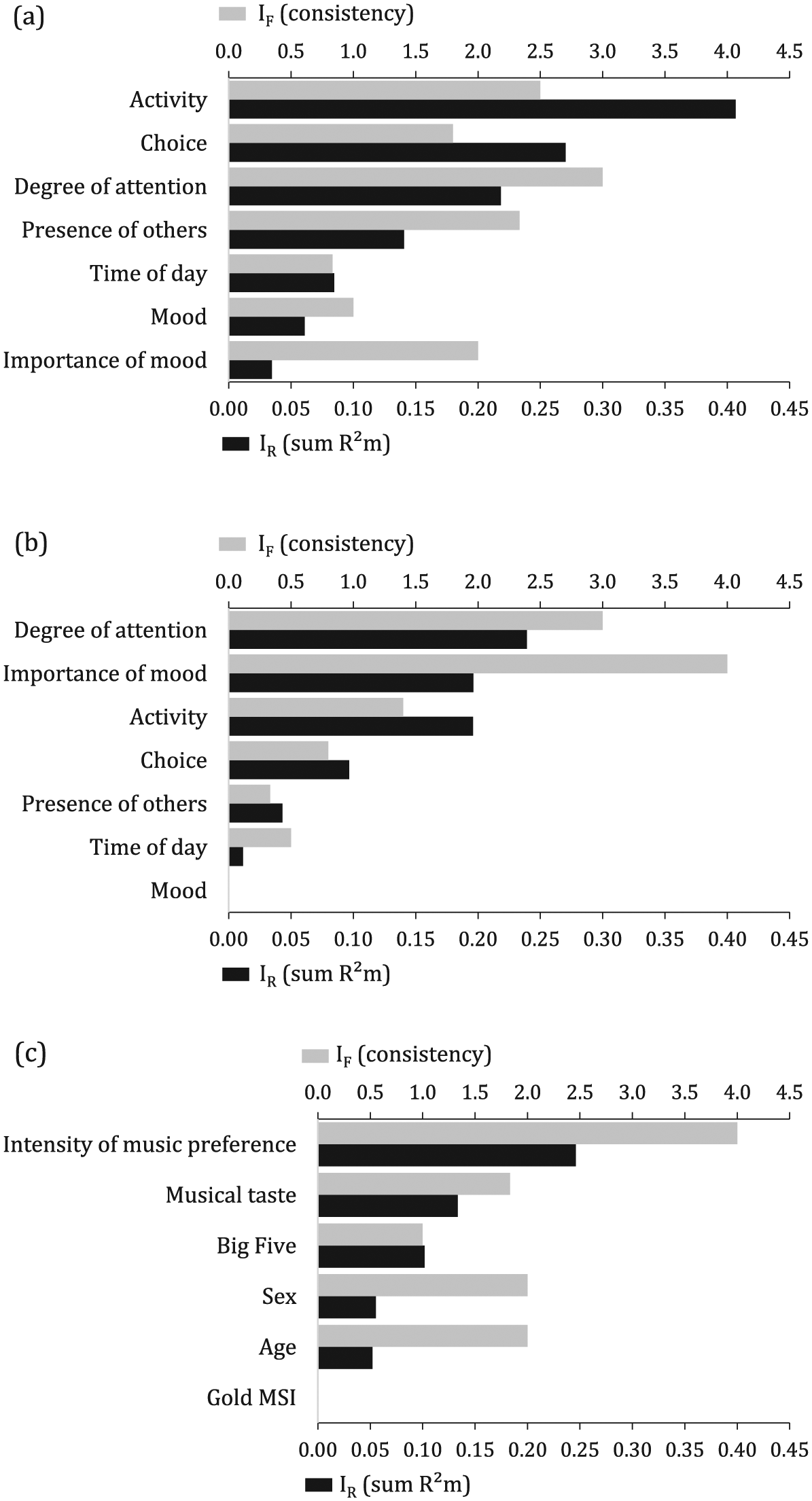
Consistency and strength of association indices for a) W-S situational, b) B-S situational, and c) B-S person-related predictors.
Variance explained
The amount of variance explained by the predictors in a specific model was assessed by calculating marginal and conditional R². Results are shown in Table 6. The five models explained between 29% and 42% of variance (34% on average) in the function factor scores. Similar to the ICCs, the amount of variance explained by situational and individual predictors also varied between models. Situational predictors explained between 9% and 24% of the variance of the factor scores. For example, situational variables varying within subjects explained 24% of variance in the factor Updating One’s Musical Knowledge, while the B-S person-related predictors explained a much smaller amount of variance (1%) in that factor. For the factor Intellectual Stimulation, which showed a stronger association with individual differences, situational aspects explained 9% of factor score variance, whereas B-S person-related predictors explained 15% variance. On average, B-S situational predictors explained a larger amount of variance than B-S person-related predictors.
Discussion
We indicated that most research into the functions of music listening either focused on individual differences or on situational influences. Since all relevant variables appear simultaneously in real-life situations, our first aim was to investigate the relative impact of individual and situational influences on the functions of music listening. We used the findings of previous research to select the most relevant individual and situational factors, and integrated these into a comprehensive model in order to estimate their associations with functions of music listening in the context of all other variables. Our results revealed that functions of music listening varied considerably across situations. Moreover, our results showed that the relative contribution of situational and individual influences varied across the different functions of music listening. This suggests that some functions are affected more by individual differences, while others are more affected by situational influences. On average, the effects of situational characteristics were greater than the effects of individual characteristics (see Table 6).
Our second objective was to identify the most important variables that influence the functions of music listening. With regard to this aim, we found that each of the five functions we identified was associated with a specific set of predictor variables. Taken as a whole, a person’s activity while listening to music was found to be the most influential situational variable explaining how people use music in a certain situation. Activity was followed by the possibility to choose the music and the degree of attention that was paid to music in that situation. Interestingly, for each factor of the functions of music listening, at least one activity was found to have a significant random effect, suggesting some variability in the effect of activity on functions of music listening between individuals. It can be expected that this between-person variability could be larger in studies that sample more situations than we did here. On the B-S level, the situational variables “degree of attention” and “importance of mood” were found to be the most important predictors. The fact that all effects of those two variables across the five models are positive indicates that people who generally pay more attention to music or who consider their mood very important in listening to music seem to get more out of music (i.e., they successfully use the functions of music listening). As for the B-S person-related variables, intensity of music preference and musical taste were found to be the most important predictors. These results are partly consistent with prior research that simultaneously investigated situational and person-related influences on music listening behavior (Krause & North, 2017). Krause and North (2017) also found that the current activity and the listener’s general importance of music were very important in predicting music listening variables.
In our study, situational influences had a greater impact on the functions of music listening than individual differences. This contradicts findings by Lehmann (1993), who concluded that the listener always tries to listen to music in the same way (i.e., to fulfill the same functions of music listening in every single instance of music listening). Furthermore, our findings support the notion that people actively engage with music to fulfill specific functions in certain situations. These findings are thus in line with studies that tried to highlight the importance of situational aspects in research into the functions of music listening (Krause et al., 2014b; North et al., 2004). The significance of situational influences has several implications for research that restricts measurements of the functions of music listening on the level of the individual (e.g., clustering people in different listening typologies). Our results suggest that such differences between individuals do exist, but they explain much less variability than situational characteristics. Therefore, the result of clustering people by their functional use of music should be interpreted with caution, as listeners seem to strongly adapt their use of music to the situation they are in at a specific time. Future research of both sides (i.e., research investigating situational or person-related influences on music listening behavior) will strongly benefit from intertwining both research approaches (for an overview and detailed suggestions, see Fleeson & Noftle, 2008).
The specific results of the five different models bear several implications for future research investigating specific functions or effects of music listening. For example, intellectual stimulation often occurs when people are alone and listening to music attentively, whereas other functions occur while other people are around and the listener is performing a certain activity while listening to music. Experimental research almost entirely focuses on the very specific situation of people attentively listening to music alone. This condition exclusively implements a very specific set of functions of music listening, and results are not generalizable beyond this specific situation. Hence, the diversity of situational characteristics should be thoroughly considered when planning and conducting research on the functions or effects of music listening (e.g., emotional or motoric functions of music listening).
Our finding that some of the effects of different activities while listening to music on music listening functions showed individual variation (random effects) is in line with findings by Greasley and Lamont (2011), who similarly observed a large variation of the association between listening to music while working and the functions of music listening. Such individual differences in associations suggest that cross-level interaction effects might explain why some people are intellectually stimulated when listening to music while exercising and some are not. Therefore, future research should include investigations of cross-level interaction effects to explore potentially important person–environment interactions.
Even though all effects of our W-S and B-S situational variables point in the same direction, several predictors showed significance on attentively one of either level. As these differential effects can only be discovered if between- and within-person variance is clearly separated, we here claim that within-subject centering of level-one predictors is crucial to research differentiating individual from situational effects. Neglecting this distinction might lead to biased effects and blurring of research findings.
Furthermore, in our study the B-S situational predictors (i.e., the mean values of the situational variables we measured in this survey) on average explained a larger amount of variance than the “classical” B-S person-related predictors such as Big Five personality dimensions or musical taste. This suggests that a large portion of the individual differences in functions of music listening might be explained by situation-related individual differences (e.g., the mean frequency of activities a person performs while listening to music) rather than by individual characteristics like personality traits or musical taste. Thus, these measures should be considered when investigating individual differences of the functions of music listening.
Importance of mood for the decision to listen to music showed to be a significant predictor of almost all functions of music listening on the B-S level, whereas specific mood states were not – neither valence nor arousal. In addition, specific mood states were only included in two models on the W-S level. We see three possible explanations for the absence of expected situational mood effects. First, our approach of retrospective assessments of three situations was not capable of reliably measuring specific mood states. Second, not a specific state of mood but some other person- or situation-related variable unrelated to mood might determine whether or not mood is important for functions of music listening. Third, the relatively broad dimensions of valence and arousal might be too non-specific and therefore not relevant for many of the functions of music listening investigated here. Measuring more specific emotional or mood states in future studies might help to find effects that were overlooked in the present study (for an interesting discussion, see Harmon-Jones, Bastian, & Harmon-Jones, 2016).
In addition to the many novel findings demonstrated here, we successfully replicated several findings of previous studies on both situational and individual levels, and as we controlled for a very broad set of influencing variables, we can assume that these effects are highly reliable. We will discuss a selection of effects in the following paragraphs.
The gender effect that we found for the factor Mind Wandering & Emotional Involvement is consistent with previous findings that show that female participants tend to use affective functions of music listening more than male respondents (Kuntsche et al., 2016).
We found a number of positive associations between the strength of music preference and functions of music listening on the between-subjects level. These findings provide further evidence for the notion that the more someone likes music in general, the more he/she uses almost all functions of music listening. However, this could also indicate a process in the opposite direction: The more someone uses almost all functions of music listening, the more he/she likes music in general (e.g., Schäfer & Sedlmeier, 2009).
Furthermore, we found an association between high neuroticism scores and the Motor Synchronization & Enhanced Well-being factor, which supports previous findings showing that people scoring high on neuroticism tend to use affect-regulating functions of music listening (Vella & Mills, 2017). It is important to mention that this association cannot be seen as a clear replication, as the Motor Synchronization & Enhanced Well-being factor is not about affect regulation only. In contrast, we did not observe an effect of openness to experience on the intellectual stimulation of music, which was in fact consistently shown by past research (e.g., Chamorro-Premuzic, Swami, et al., 2009).
Consistent with prior research investigating the role of choice on how people interact with music (e.g., Krause et al., 2014a; Krause et al., 2015), we also found the possibility to choose the music to be a very important factor influencing the functions of music listening. In detail, having the possibility to choose the music was positively associated with the factors Intellectual Stimulation and Mind Wandering & Emotional Involvement. These factors largely correspond with the “purposive listening” and “actively engaged listening” factors found by Krause et al. (2014a) and Krause et al. (2015), who also demonstrated positive associations between choice and these two factors. The pattern regarding the possibility of choice clearly shows that some functions of music listening require people to autonomously choose the music, whereas other functions do not. In general, our findings further emphasize the importance of having the possibility to choose music (i.e., choice and control) to the way people interact with music.
As was mentioned earlier, our present approach – integrating individual and situational variables into a comprehensive model to meet the complexity of real-life situations – calls for cross-level interactions (W-S × B-S). These interactions could be capable of explaining why several associations between situational influences and the functions of music listening varied across participants (i.e., revealed random effects). We decided against incorporating interaction effects here as our data includes three data points per participant only. However, our results revealed potentially valuable details for future research addressing cross-level interactions.
Furthermore, our survey relies on recollection of self-selected situations of our participants, that is, on memory representations. This method is vulnerable to bias due to memory effects as well as social desirability, and its ecological validity is limited. Due to the time limitations associated with an online survey, we limited our measurements to three situations per participant. Although we asked the participants to describe typical listening situations, we do not know whether or not these three reported situations are representative for each participant’s overall listening situations. Hence, our findings should be replicated using methods with higher ecological validity and better representativeness of situations such as experience sampling or related methods (Hektner, Schmidt, & Csikszentmihalyi, 2007; Shiffman, Stone, & Hufford, 2008; Trull & Ebner-Priemer, 2013), which have recently been successfully applied to music-related research (e.g. Randall & Rickard, 2013). Such methods – collecting data in a participant’s daily life – are virtually not affected by memory effects and allow the researcher to easily collect a multitude of data points per participant (Mehl & Conner, 2012).
The fact that we mainly recruited participants for our sample at German universities, and that it thus predominately comprises German students, prevents us from extending our findings and conclusions to other cultures. Future research should replicate this study in other cultures in order to investigate potential differences in the pattern of significant predictors of the functions of music listening.
It is also important to mention that some situations are inherently associated with certain forms of behavior or even with certain behavioral norms, which are often socially determined (Becker, 1963). These associations strongly depend on a person’s individual interpretation of a situation (Goffman, 1974; Thomas, 1928). In the case of music, this for instance means that attendees of a classical concert (in a concert hall) collectively behave in the same way, that is, they sit still while attentively listening to the music (Burland & Pitts, 2014). On the one hand this means that some situations are closely associated with specific functions of music listening (e.g., listening to music in a music club socially suggests dancing), whereas other situations allow a greater degree of freedom with regard to the functions of music listening (e.g., listening to music at home alone). Furthermore, functions of music listening in reality are not only a causal result of situational and individual influences. People also actively change situations to enable certain functions of music listening. Due to this circularity, it becomes increasingly difficult to clearly differentiate between certain situations and functions of music listening and their causal relationships.
Moreover, providing a clear definition of what constitutes a situation is notoriously difficult. Recent psychological research differentiates between environmental cues (i.e., measurable situational objectives such as temperature, presence of others), psychological situations (i.e., the individual phenomenal experience of the situation, consisting of several situation characteristics), and situation classes (i.e., groups of situations which tend to share similar patterns, or constellations of characteristics; Rauthmann, Sherman, & Funder, 2015). Situational characteristics were found to be most important in predicting human behavior (Sherman, Rauthmann, Brown, Serfass, & Jones, 2015). Music psychology, however, almost exclusively focuses on situational cues (e.g., location, time of day). Future music psychological research should incorporate these findings and explore which special characteristics accompany a music listening situation.
Finally, the present paper did not address the question of which music with specific musical characteristics people are listening to in order to fulfill the various functions of music listening. To better understand the complex interactions that occur when a person listens to music in a specific situation, future research should investigate how music listening behavior (i.e., listening to pieces of music with specific musical characteristics) can be predicted by individual, situational, and functional variables.
This study is one of the first that integrates situational and individual variables in a comprehensive model – explaining why people listen to music in their daily lives. We identified the most important variables that affect engagement of people with music in daily life, and found that the functions of music listening vary considerably across situations and individuals. Our findings suggest that, overall, functions of listening to music seem to depend more on situational than on individual characteristics.
Footnotes
Acknowledgements
We would like to thank Thomas Schäfer for providing us with the data for reanalysis. We also thank Melanie Wald-Fuhrmann, Richard von Georgi, Jesse David Dinneen, and the two anonymous reviewers for their critical reading of earlier versions of the manuscript. Finally, we are thankful to Claudia Lehr, Ingeborg Lorenz, and Mia Kuch whose support has been of value for the realization of the study.
Ethics Statement
All experimental procedures were ethically approved by the Ethics Council of the Max Planck Society, and were undertaken with informed consent of each participant.
Funding
The author(s) received no financial support for the research, authorship, and/or publication of this article.